Prof. Sonali
Mhatre
DATA STRUCTURES AND
ANALYSIS
TREE
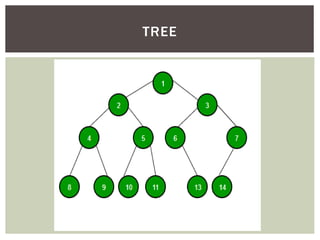
TREE
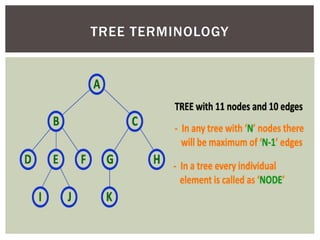
TREE TERMINOLOGY
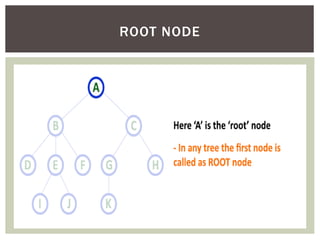
ROOT NODE
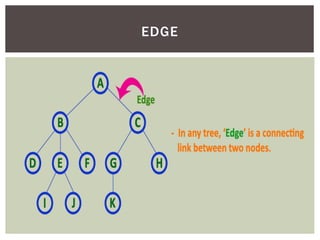
EDGE
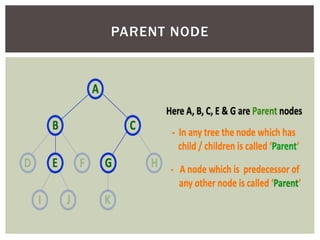
PARENT NODE
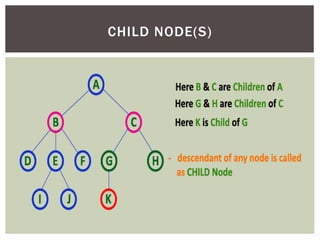
CHILD NODE(S)
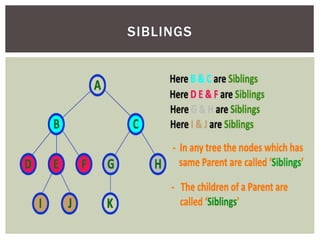
SIBLINGS
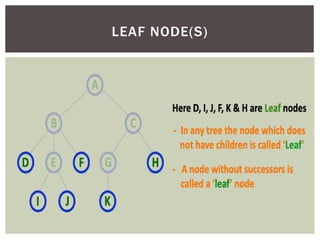
LEAF NODE(S)
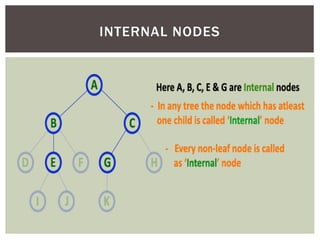
INTERNAL NODES
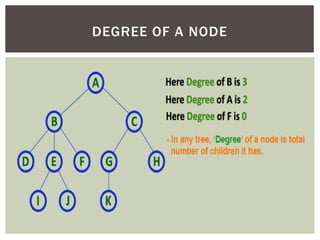
DEGREE OF A NODE
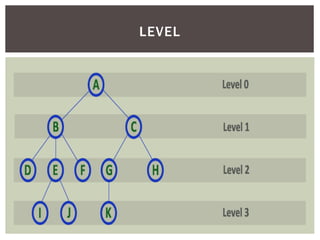
LEVEL
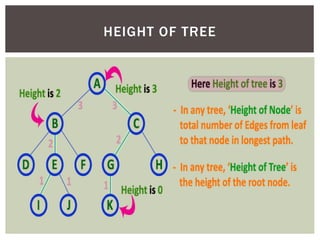
HEIGHT OF TREE
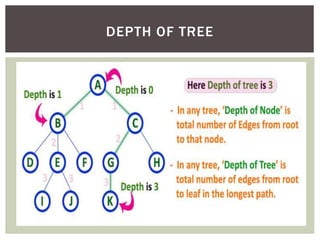
DEPTH OF TREE
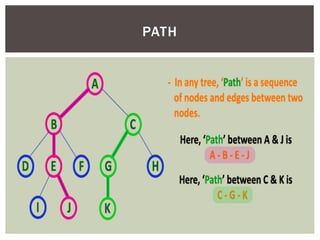
PATH
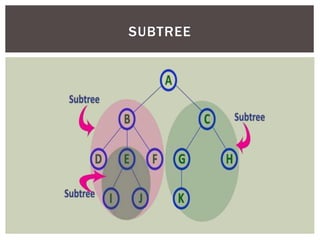
SUBTREE
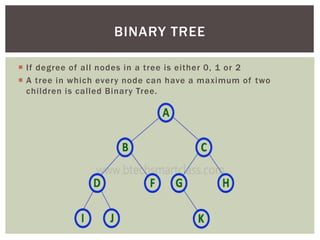
 If degree of all nodes in a tree is either 0, 1 or 2
 A tree in which every node can have a maximum of two
children is called Binary Tree.
BINARY TREE
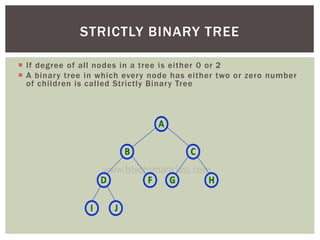
 If degree of all nodes in a tree is either 0 or 2
 A binary tree in which every node has either two or zero number
of children is called Strictly Binary Tree
STRICTLY BINARY TREE
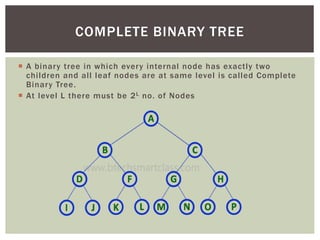
 A binary tree in which every internal node has exactly two
children and all leaf nodes are at same level is called Complete
Binary Tree.
 At level L there must be 2L no. of Nodes
COMPLETE BINARY TREE
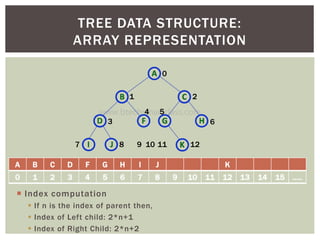
 Array representation
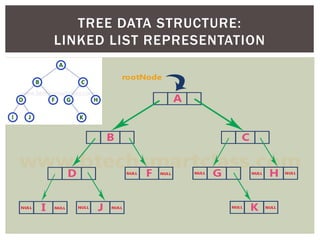
 Linked list representation
BINARY TREE DATA STRUCTURE
TREE DATA STRUCTURE:
ARRAY REPRESENTATION
0
1 2
3
4 5
6
7 8 9 10 11 12
A B C D F G H I J K
0 1 2 3 4 5 6 7 8 9 10 11 12 13 14 15 …..
 Index computation
 If n is the index of parent then,
 Index of Left child: 2*n+1
 Index of Right Child: 2*n+2
TREE DATA STRUCTURE:
LINKED LIST REPRESENTATION
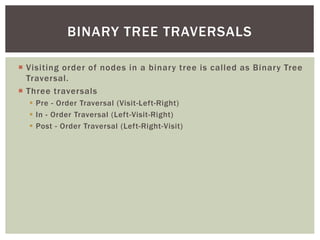
 Visiting order of nodes in a binary tree is called as Binary Tree
Traversal.
 Three traversals
 Pre - Order Traversal (Visit-Left-Right)
 In - Order Traversal (Left-Visit-Right)
 Post - Order Traversal (Left-Right-Visit)
BINARY TREE TRAVERSALS
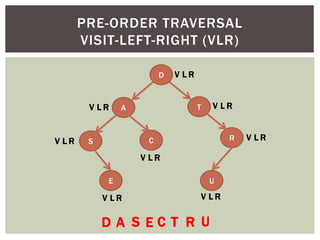
PRE-ORDER TRAVERSAL
VISIT-LEFT-RIGHT (VLR)
D
A T
S C
U
R
E
V L R
D
V L R
A
V L R
S
V L R
E
V L R
V L R
V L R
V L R
C T R U
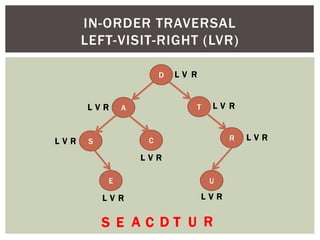
IN-ORDER TRAVERSAL
LEFT-VISIT-RIGHT (LVR)
D
A T
S C
U
R
E
L V R
S
L V R
E
L V R
A
L V R
C
L V R
L V R
L V R
L V R
D T U R
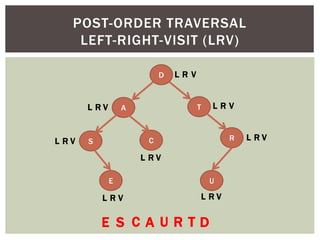
POST-ORDER TRAVERSAL
LEFT-RIGHT-VISIT (LRV)
D
A T
S C
U
R
E
L R V
E
L R V
S
L R V
C
L R V
A
L R V
L R V
L R V
L R V
U R T D
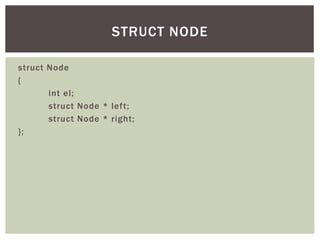
struct Node
{
int el;
struct Node * left;
struct Node * right;
};
STRUCT NODE
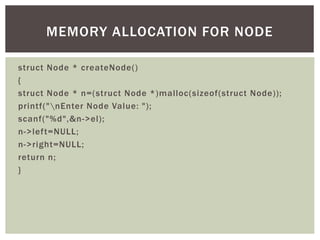
struct Node * createNode()
{
struct Node * n=(struct Node *)malloc(sizeof(struct Node));
printf("nEnter Node Value: ");
scanf("%d",&n->el);
n->left=NULL;
n->right=NULL;
return n;
}
MEMORY ALLOCATION FOR NODE
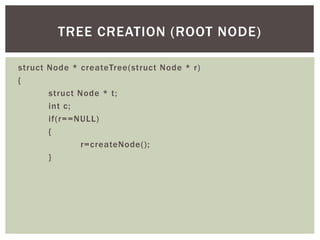
struct Node * createTree(struct Node * r)
{
struct Node * t;
int c;
if(r==NULL)
{
r=createNode();
}
TREE CREATION (ROOT NODE)
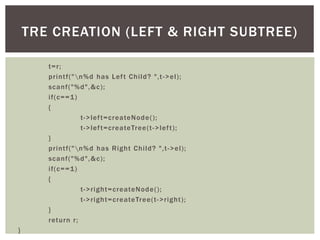
t=r;
printf("n%d has Left Child? ",t->el);
scanf("%d",&c);
if(c==1)
{
t->left=createNode();
t->left=createTree(t->left);
}
printf("n%d has Right Child? ",t->el);
scanf("%d",&c);
if(c==1)
{
t->right=createNode();
t->right=createTree(t->right);
}
return r;
}
TRE CREATION (LEFT & RIGHT SUBTREE)
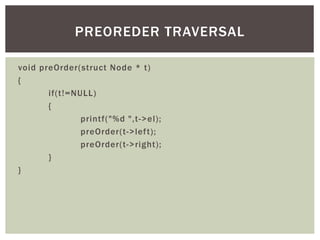
void preOrder(struct Node * t)
{
if(t!=NULL)
{
printf("%d ",t->el);
preOrder(t->left);
preOrder(t->right);
}
}
PREOREDER TRAVERSAL
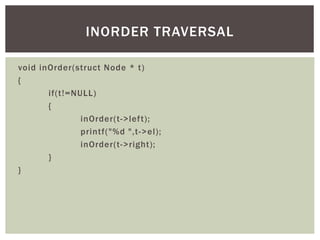
void inOrder(struct Node * t)
{
if(t!=NULL)
{
inOrder(t->left);
printf("%d ",t->el);
inOrder(t->right);
}
}
INORDER TRAVERSAL
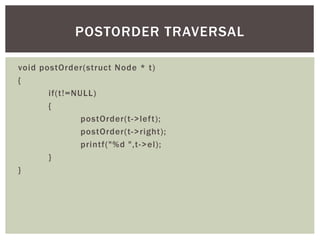
void postOrder(struct Node * t)
{
if(t!=NULL)
{
postOrder(t->left);
postOrder(t->right);
printf("%d ",t->el);
}
}
POSTORDER TRAVERSAL
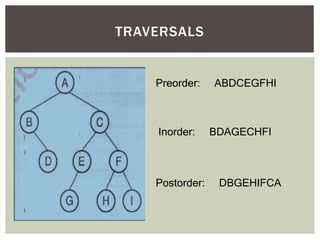
TRAVERSALS
Preorder: ABDCEGFHI
Inorder: BDAGECHFI
Postorder: DBGEHIFCA
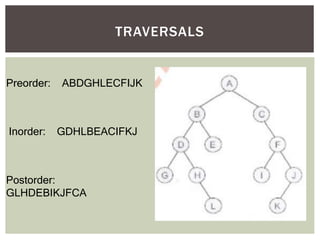
TRAVERSALS
Preorder: ABDGHLECFIJK
Inorder: GDHLBEACIFKJ
Postorder:
GLHDEBIKJFCA
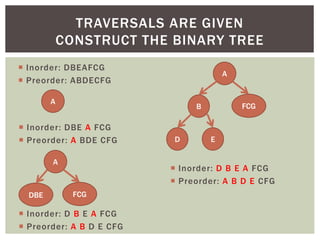
 Inorder: DBEAFCG
 Preorder: ABDECFG
TRAVERSALS ARE GIVEN
CONSTRUCT THE BINARY TREE
A
 Inorder: DBE A FCG
 Preorder: A BDE CFG
A
DBE
 Inorder: D B E A FCG
 Preorder: A B D E CFG
FCG
A
B FCG
D E
 Inorder: D B E A FCG
 Preorder: A B D E CFG
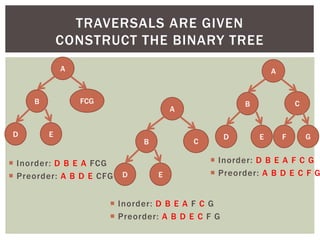
TRAVERSALS ARE GIVEN
CONSTRUCT THE BINARY TREE
A
B FCG
D E
 Inorder: D B E A FCG
 Preorder: A B D E CFG
A
B C
D E
 Inorder: D B E A F C G
 Preorder: A B D E C F G
A
B C
D E F G
 Inorder: D B E A F C G
 Preorder: A B D E C F G
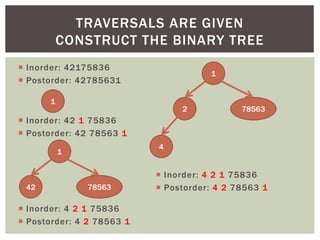
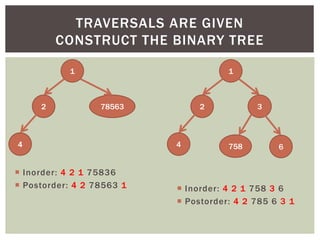
 Inorder: 42175836
 Postorder: 42785631
TRAVERSALS ARE GIVEN
CONSTRUCT THE BINARY TREE
1
 Inorder: 42 1 75836
 Postorder: 42 78563 1
1
42 78563
 Inorder: 4 2 1 75836
 Postorder: 4 2 78563 1
1
2 78563
4
 Inorder: 4 2 1 75836
 Postorder: 4 2 78563 1
TRAVERSALS ARE GIVEN
CONSTRUCT THE BINARY TREE
1
2 78563
4
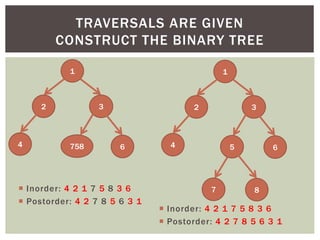
 Inorder: 4 2 1 75836
 Postorder: 4 2 78563 1
1
2 3
4
 Inorder: 4 2 1 758 3 6
 Postorder: 4 2 785 6 3 1
758 6
1
2 3
4
 Inorder: 4 2 1 7 5 8 3 6
 Postorder: 4 2 7 8 5 6 3 1
758 6
TRAVERSALS ARE GIVEN
CONSTRUCT THE BINARY TREE
1
2 3
4 5 6
7 8
 Inorder: 4 2 1 7 5 8 3 6
 Postorder: 4 2 7 8 5 6 3 1
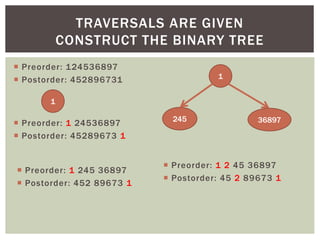
 Preorder: 124536897
 Postorder: 452896731
TRAVERSALS ARE GIVEN
CONSTRUCT THE BINARY TREE
1
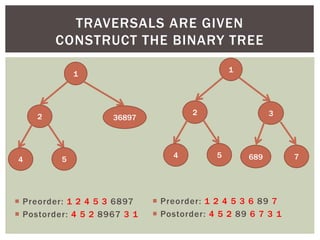
 Preorder: 1 24536897
 Postorder: 45289673 1
 Preorder: 1 245 36897
 Postorder: 452 89673 1
1
245 36897
 Preorder: 1 2 45 36897
 Postorder: 45 2 89673 1
TRAVERSALS ARE GIVEN
CONSTRUCT THE BINARY TREE
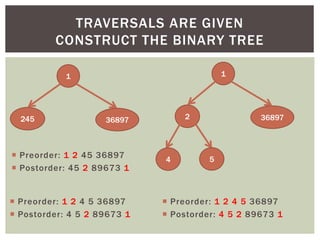
1
245 36897
 Preorder: 1 2 45 36897
 Postorder: 45 2 89673 1
 Preorder: 1 2 4 5 36897
 Postorder: 4 5 2 89673 1
1
2 36897
4 5
 Preorder: 1 2 4 5 36897
 Postorder: 4 5 2 89673 1
1
2 36897
4 5
 Preorder: 1 2 4 5 3 6897
 Postorder: 4 5 2 8967 3 1
TRAVERSALS ARE GIVEN
CONSTRUCT THE BINARY TREE
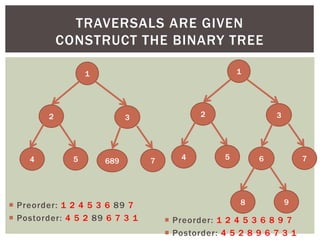
1
2 3
4 5
 Preorder: 1 2 4 5 3 6 89 7
 Postorder: 4 5 2 89 6 7 3 1
689 7
TRAVERSALS ARE GIVEN
CONSTRUCT THE BINARY TREE
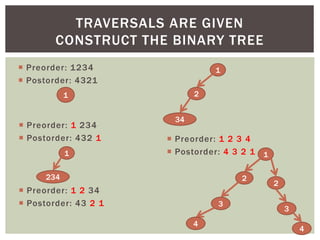
1
2 3
4 5
 Preorder: 1 2 4 5 3 6 89 7
 Postorder: 4 5 2 89 6 7 3 1
689 7
1
2 3
4 5 6 7
8 9
 Preorder: 1 2 4 5 3 6 8 9 7
 Postorder: 4 5 2 8 9 6 7 3 1
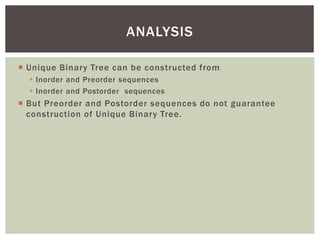
 Preorder: 1234
 Postorder: 4321
TRAVERSALS ARE GIVEN
CONSTRUCT THE BINARY TREE
1
 Preorder: 1 2 34
 Postorder: 43 2 1
1
234
 Preorder: 1 234
 Postorder: 432 1
1
2
34
 Preorder: 1 2 3 4
 Postorder: 4 3 2 1 1
2
3
4
2
3
4
 Unique Binary Tree can be constructed from
 Inorder and Preorder sequences
 Inorder and Postorder sequences
 But Preorder and Postorder sequences do not guarantee
construction of Unique Binary Tree.
ANALYSIS
 Recursive traversals make implicit use of Stack
 Non-Recursive traversals make explicit use of Stack
NON RECURSIVE TRAVERSAL
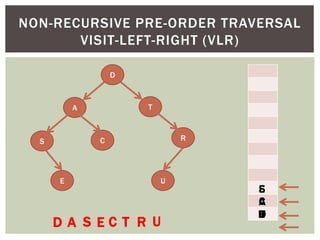
NON-RECURSIVE PRE-ORDER TRAVERSAL
VISIT-LEFT-RIGHT (VLR)
D
A T
S C
U
R
E
D A S E C T R U
D
T
A
C
S
E
R
U
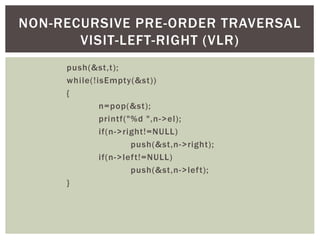
push(&st,t);
while(!isEmpty(&st))
{
n=pop(&st);
printf("%d ",n->el);
if(n->right!=NULL)
push(&st,n->right);
if(n->left!=NULL)
push(&st,n->left);
}
NON-RECURSIVE PRE-ORDER TRAVERSAL
VISIT-LEFT-RIGHT (VLR)
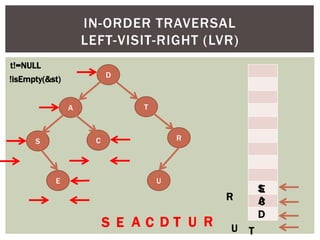
IN-ORDER TRAVERSAL
LEFT-VISIT-RIGHT (LVR)
D
A T
S C
U
R
E
S E A C D T U R
D
T
A
C
S
E
R
U
t!=NULL
!isEmpty(&st)
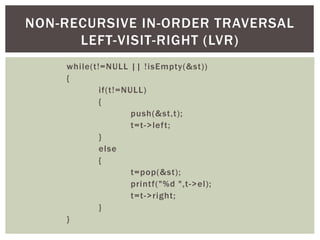
while(t!=NULL || !isEmpty(&st))
{
if(t!=NULL)
{
push(&st,t);
t=t->left;
}
else
{
t=pop(&st);
printf("%d ",t->el);
t=t->right;
}
}
NON-RECURSIVE IN-ORDER TRAVERSAL
LEFT-VISIT-RIGHT (LVR)
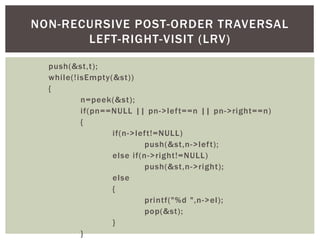
push(&st,t);
while(!isEmpty(&st))
{
n=peek(&st);
if(pn==NULL || pn->left==n || pn->right==n)
{
if(n->left!=NULL)
push(&st,n->left);
else if(n->right!=NULL)
push(&st,n->right);
else
{
printf("%d ",n->el);
pop(&st);
}
}
NON-RECURSIVE POST-ORDER TRAVERSAL
LEFT-RIGHT-VISIT (LRV)
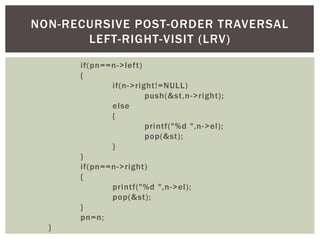
if(pn==n->left)
{
if(n->right!=NULL)
push(&st,n->right);
else
{
printf("%d ",n->el);
pop(&st);
}
}
if(pn==n->right)
{
printf("%d ",n->el);
pop(&st);
}
pn=n;
}
NON-RECURSIVE POST-ORDER TRAVERSAL
LEFT-RIGHT-VISIT (LRV)
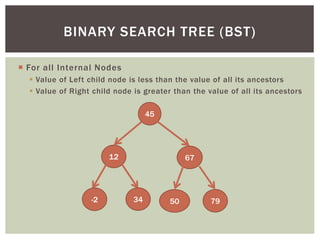
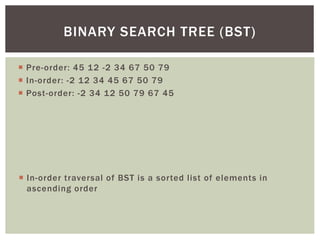
 For all Internal Nodes
 Value of Left child node is less than the value of all its ancestors
 Value of Right child node is greater than the value of all its ancestors
BINARY SEARCH TREE (BST)
45
12 67
-2 34 50 79
 In-order traversal of BST is a sorted list of elements in
ascending order
BINARY SEARCH TREE (BST)
 Pre-order: 45 12 -2 34 67 50 79
 In-order: -2 12 34 45 67 50 79
 Post-order: -2 34 12 50 79 67 45
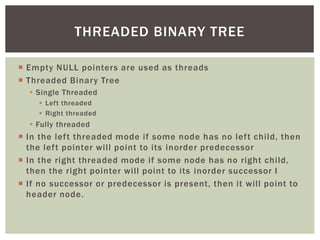
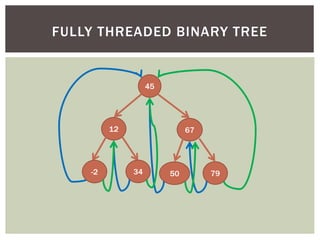
 Empty NULL pointers are used as threads
 Threaded Binary Tree
 Single Threaded
 Left threaded
 Right threaded
 Fully threaded
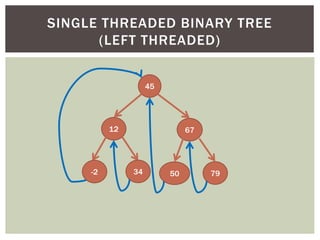
 In the left threaded mode if some node has no left child, then
the left pointer will point to its inorder predecessor
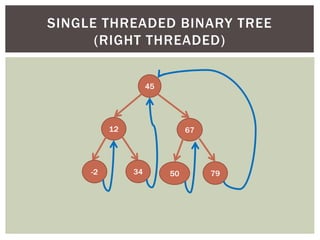
 In the right threaded mode if some node has no right child,
then the right pointer will point to its inorder successor I
 If no successor or predecessor is present, then it will point to
header node.
THREADED BINARY TREE
45
12 67
-2 34 50 79
SINGLE THREADED BINARY TREE
(LEFT THREADED)
45
12 67
-2 34 50 79
SINGLE THREADED BINARY TREE
(RIGHT THREADED)
45
12 67
-2 34 50 79
FULLY THREADED BINARY TREE
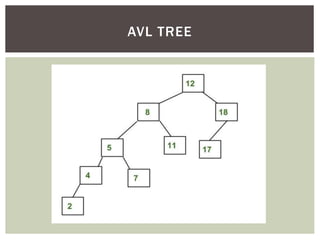
 Adelson, Velski & Landis
 AVL trees are height balancing binary search tree.
 The difference between heights of left and right subtrees
cannot be more than one for all nodes.
AVL TREE
AVL TREE
 Binary search tree: Traversal, searching, insertion and
deletion in binary search tree. Threaded Binary Tree: Finding
in-order successor and predecessor of a node in threaded
tree. Insertion and deletion in threaded binary tree. AVL Tree:
Searching and traversing in AVL trees. Tree Rotations: Right
Rotation, Left Rotation. Insertion and Deletion in an AVL Tree.
 B-tree: Searching, Insertion, Deletion from leaf node and non-
leaf node.
 B+ Tree, Digital Search Tree, Game Tree & Decision Tree

Trees.pptx