
DEPARTMENT OF ARTIFICIAL INTELLIGENCE AND DATA SCIENCE
Academic Year: 2021-2022(Even Semester)
Regulation 2021
Subject code & Title: AD3251 - Data Structures Design
Semester/Year : II/ I
Notes
14-06-2022
Prepared by: Dr.M.Kaliappan, Professor/AD
Dr.S.Vimal, Associate Professor/AD
----------------------------------------------------------------------------------------------------------------
2. Searching and Hashing
1. What is linear searching? What is the time complexity?
• A linear search scans one item at a time, without jumping to any item .
• The worst case complexity is O(n), sometimes known an O(n) search
• Time taken to search elements keep increasing as the number of elements are
increased
2. What is Binary search?
Binary Search is a searching algorithm for finding an element's position in a sorted
array by repeatedly dividing the search interval in half.
Implementation
 Iterative Method
 Recursive Method
3. What are the Applications of Binary search ?
 In libraries of Java, .Net, C++ STL
 While debugging, the binary search is used to pinpoint the place where the error
happens.
4. Why Hashing is needed?
• After storing a large amount of data. Linear search and binary search perform
lookups/search with time complexity of O(n) and O(log n) respectively.
• As the size of the dataset increases, these complexities also become significantly high
which is not acceptable.
• We need a technique that does not depend on the size of data. Hashing allows lookups
to occur in constant time i.e. O(1).
5 What is Hash Table ?
• Hash table is a data structure which stores data in an associative manner. In a
hash table, data is stored in an array format, where each data value has its own unique
index/hash key value.
6. What is hash function ?
A hash function is used for mapping each element of a dataset to indexes in the hash
table range [0,N −1], where N is the capacity of the bucket array for a hash table
7. What is Hashing?
Hashing is a technique of mapping a large set of arbitrary data to tabular indexes
using a hash function. It is a method for representing dictionaries for large datasets.
8. What is Hash code?
• Hash Code returns an integer value, generated by a hashing algorithm. This
integer need not be in the range [0,N −1], and may even be negative.
• The set of hash codes assigned to keys should avoid collisions as much as possible
9. What are the Types of hashcode?
 Bit Representation hash code : 32bit hash code
 Polynomial hash code
 Cyclic-Shift Hash Codes
10. What is Cyclic-Shift Hash Codes?
Polynomial hash code replaces multiplication by a with a cyclic shift of a partial sum
by a certain number of bits.
11. Write an algorithm for Cyclic-Shift Hash Codes
def hash code(s):
mask = (1 << 32) − 1 # limit to 32-bit integers
h = 0
for character in s:
h = (h << 5 & mask) | (h >> 27) # 5-bit cyclic shift of running sum
h += ord(character) # add in value of next character
return h
12. What is the use of compression function?
• A compression function is one that minimizes the number of collisions for a given set
of distinct hash codes.
• The Division Method
– A simple compression function is the division method, which maps an integer
i to i mod N,
• The MAD Method
– It helps eliminate repeated patterns in a set of integer keys, is the Multiply-
Add-and-Divide (or “MAD”) method.
– This method maps an integer i to [(ai+b) mod p] mod N
13. What is the Collision Resolution?
1. Linear Probing
2. Chaining
13. How will you avoid Collision using Linear Probing?
• One way to resolve collision is to find another open slot whenever there is a collision
and store the item in that open slot. The search for open slot starts from the slot where
the collision happened. It moves sequentially through the slots until an empty slot is
encountered. The movement is in a circular fashion. Hence, covering the entire hash
table. This kind of sequential search is called Linear Probing.
14 How will you avoid Collision using Chaining?
This allows multiple items exist in the same slot/index. This can create a chain/collection
of items in a single slot. When the collision happens, the item is stored in the same slot
using chaining mechanism.
15. What is load factor ?
– if there are n entries and b is the size of the array there would be n/b entries on each
index. This value n/b is called the load factor that represents the load that is there on
our map.
– Default Load factor=0.75
– This Load Factor needs to be kept low, so that number of entries at one index is less
and so is the complexity almost constant, i.e., O(1)
16. What are the applications are hashing?
 Password Verification
 Game Boards
 Graphics
 Message Digest
 Compiler Operation
 Rabin-Karp Algorithm
 Linking File name and path together
----------------------------------------------------------------------------------------------------------------
PART B
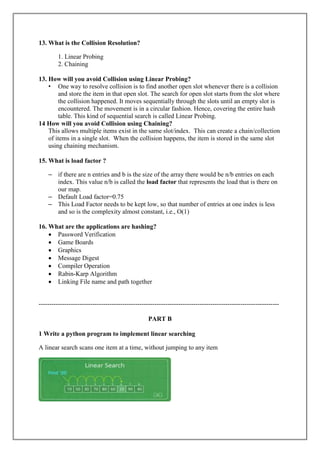
1 Write a python program to implement linear searching
A linear search scans one item at a time, without jumping to any item
def (
search , , ):
arr n x
i
for in (
range , n):
0
(arr[i] == x):
if
i
return
return -1
arr = [ , , , , ]
2 3 4 10 40
x = 10
n = (arr)
len
# Function call
result = search(arr, n, x)
(result ==
if ):
-1
(
print )
"Element is not present in array"
:
else
(
print , result)
"Element is present at index"
Time Complexity : O(n)
Auxiliary Space: O(1)
----------------------------------------------------------------------------------------------------------------
2. Write an optimized python program to implement linear search?
A linear search scans one item at a time, without jumping to any item
def (
search , ):
arr search_Element
left = 0
length = (arr)
len
position = -1
right = length - 1
left
for in (
range , right, ):
0 1 # Run loop from 0 to right
(arr[left] == search_Element):
if # If search_element is found with left variable
position = left
(
print , position +
"Element found in Array at " ,
1 , left +
" Position with " ,
1 )
" Attempt"
break
(arr[right] == search_Element):
if # If search_element is found with right variable
position = right
(
print , position +
"Element found in Array at " ,
1 , length -
" Position with "
right, )
" Attempt"
break
left += 1
right -= 1
(position ==
if ):
-1 # If element not found
(
print , left, )
"Not found in Array with " " Attempt"
arr = [ , , , , ]
1 2 3 4 5
search_element = 5
search(arr, search_element) # Function call
Time Complexity : O(n)
Auxiliary Space: O(1)
----------------------------------------------------------------------------------------------------------------
3. Implementation of Binary Search in python using Iterative method
Binary Search is a searching algorithm for finding an element's position in a sorted
array by repeatedly dividing the search interval in half
def (
binarySearch , , , ):
array x low high # Repeat until the pointers low and high meet each ot
her
low <= high:
while
mid = (low + high)//2
array[mid] == x:
if
mid
return
array[mid] < x:
elif
low = mid + 1
:
else
high = mid - 1
return -1
array = [ , , , , , , ]
3 4 5 6 7 8 9
x = 4
result = binarySearch(array, x, ,
0 (array)
len )
-1
result !=
if :
-1
(
print +
"Element is present at index " (result))
str
:
else
(
print )
"Not found"
Time Complexities
• Best case complexity: O(1)
• Average case complexity: O(log n)
• Worst case complexity: O(log n)
• Space Complexity
The space complexity of the binary search is O(1).
----------------------------------------------------------------------------------------------------------------
4. Implementation of Binary Search in python using recursive method
Binary Search is a searching algorithm for finding an element's position in a sorted
array by repeatedly dividing the search interval in half
# Binary Search in python : Recursive method
def (
binarySearch , , , ):
array x low high
high >= low:
if
mid = (low + high)//2
array[mid] == x:
if # If found at mid, then return it
mid
return
array[mid] > x:
elif # Search the left half
binarySearch(array, x, low, mid
return )
-1
:
else
binarySearch(array, x, mid +
return , high)
1 # Search the right half
:
else
return -1
array = [ , , , , , , ]
3 4 5 6 7 8 9
x = 4
result = binarySearch(array, x, ,
0 (array)
len )
-1
result !=
if :
-1
(
print +
"Element is present at index " (result))
str
:
else
(
print )
"Not found"
Time Complexities
• Best case complexity: O(1)
• Average case complexity: O(log n)
• Worst case complexity: O(log n)
• Space Complexity
The space complexity of the binary search is O(1).
----------------------------------------------------------------------------------------------------------------
5. Implementation of Hash table using python.
Hash table is a data structure which stores data in an associative manner. In a hash table,
data is stored in an array format, where each data value has its own unique index/hash key
value
hash_table = [ ] *
None 10 # Implementation of Hashtable using python
print (hash_table)
def (
hashing_func ):
key
key %
return (hash_table)
len
# print the calculated hash key
print (hashing_func( ))
10 # Output: 0
print (hashing_func( ))
20 # Output: 0
print (hashing_func( ))
25 # Output: 5
def (
insert , , ):
hash_table key value
hash_key = hashing_func(key)
hash_table[hash_key] = value
insert(hash_table, ,
10 )
'Nepal'
print (hash_table)
insert(hash_table, ,
25 )
'USA'
print (hash_table)
Output
['Nepal', None, None, None, None, None, None, None, None, None]
['Nepal', None, None, None, None, 'USA', None, None, None, None]
----------------------------------------------------------------------------------------------------------------
6. How will you avoid Collision using Chaining?
This allows multiple items exist in the same slot/index. This can create a chain/collection of
items in a single slot. When the collision happens, the item is stored in the same slot using
chaining mechanism.
Fig: The compression function is h(k)=k mod 13
HashTable = [[] _
for in (
range )]
10 # Creating Hashtable as a nested list
display_hash (HashTable)
def (
Hashing ):
keyvalue # Hashing Function to return key for every value.
hash_key=keyvalue % (HashTable)
len
hash_key
return
def (
insert , , ):
Hashtable keyvalue value # Insert Function to add # values to the hash table
hash_key = Hashing(keyvalue)
Hashtable[hash_key].append(value)
def (
display_hash ):
hashTable # Function to display hashtable
i
for in ( (hashTable)):
range len
(i, end =
print )
" "
j
for hashTable[i]:
in
(
print , end = )
"-->" " "
(j, end =
print )
" "
()
print
insert(HashTable, ,
10 )
'Allahabad'
insert(HashTable, ,
25 )
'Mumbai'
insert(HashTable, ,
20 )
'Mathura'
insert(HashTable, ,
9 )
'Delhi'
insert(HashTable, ,
21 )
'Punjab'
insert(HashTable, ,
21 )
'Noida'
display_hash (HashTable)
outout
0 --> Allahabad --> Mathura
1 --> Punjab --> Noida
2
3
4
5 --> Mumbai
6
7
8
9 --> Delhi
----------------------------------------------------------------------------------------------------------------
7. How will you avoid Collision using Chaining?
This allows multiple items exist in the same slot/index. This can create a chain/collection
of items in a single slot. When the collision happens, the item is stored in the same slot
using chaining mechanism.
hashTable:
class
def (
_init_ ):
self
.table = [
self ]*
None 10 # initialize hash Table
.elementCount =0
self
def (
hashFunction , ):
self key # Find Hash code
key %
return .size
self
def (
insert , ):
self key, element # inserts element into the hash table
position = .hashFunction(key)
self
if .table[position] ==
self :
None #checking if eth position is empty
.table[position] = element
self
.elementCount +=
self 1
# collision occured hence we do linear probing
:
else
while .table[position] !=
self :
None
position += 1
.table[position] = element
self
.elementCount +=
self 1
# method that searches for an element in the table returns position of element if found else ret
urns False
def (
search , ):
self key
position = .hashFunction(key)
self
(
if .table[position] == element):
self
(
print )
"element found "
position
return
:
else
(
print )
"element found "
# method to display the hash table
def (
display ):
self
(
print )
"n"
i
for in (
range .size):
self
(
print +i + +
"Hash Value: " "tt" .table[i])
self
--------------------------------------------------------------------------------------------------------------
8. Write a python program to implement the quadratic probing.
Quadratic probing is an open addressing scheme in computer programming for
resolving hash collisions in hash tables. Quadratic probing operates by taking the original
hash index and adding successive values of an arbitrary quadratic polynomial until an open
slot is found.
def (
hashing , , , ):
table tsize arr N # Iterating through the array
i
for in (N):
range # Computing the hash value
hv = arr[i] % tsize
(table[hv] ==
if ):
-1 # Insert in the table if there is no collision
table[hv] = arr[i]
:
else
j
for in (tsize):
range # If there is a collision iterating through all possible quadratic values
t = (hv + j * j) % tsize # Computing the new hash value
(table[t] ==
if ):
-1
table[t] = arr[i] # Break the loop after inserting the value in the table
break
----------------------------------------------------------------------------------------------------------------
9. Write a program to implement rehashing.
Rehashing means hashing again. Basically, when the load factor increases to more
than its pre-defined value (default value of load factor is 0.75), the complexity increases.
def (
__setitem__ , , ):
self k v
j = ._hash_function(k)
self
._bucket_setitem(j, k, v)
self # subroutine maintains self._n
if ._n >
self (
len ._table) //
self :
2 # keep load factor <= 0.5
._resize(
self *
2 (
len ._table) -
self )
1 # number 2^x - 1 is often prime
def (
__delitem__ , ):
self k
j = ._hash_function(k)
self
._bucket_delitem(j, k)
self # may raise KeyError
._n -=
self 1
def (
_resize , ):
self c
"""Resize bucket array to capacity c and rehash all items."""
old = (
list .items())
self # use iteration to record existing items
._table = c * [
self ]
None # then reset table to desired capacity
._n =
self 0 # n recomputed during subsequent adds
(k,v)
for old:
in
[k] = v
self # reinsert old key-value pair
def (
_bucket_setitem , , , ):
self j k v
found, s = ._find_slot(j, k)
self
if found:
not
._table[s] = ._Item(k,v)
self self # insert new item
._n +=
self 1 # size has increased
:
else
._table[s]._value = v
self # overwrite existing
----------------------------------------------------------------------------------------------------------------
10. Discuss about efficiency of hash table.
• If our hash function is good, then we expect the entries to be uniformly distributed in
the N cells of the bucket array. Thus, to store n entries, the expected number of keys
in a bucket would be n/N, which is O(1) if n is O(N). n/N is a load factor. The default
load factor is 0.75
• The costs associated with a periodic rehashing, to resize a table after occasional
insertions or deletions can be accounted for separately
References:
1. Michael T. Goodrich, Roberto Tamassia, and Michael H. Goldwasser, “Data Structures and
Algorithms in Python” (An Indian Adaptation), Wiley, 2021
2. https://www.geeksforgeeks.org/python-oops-concepts/
3. https://www.programiz.com/dsa/circular-queue
4. https://www.techiedelight.com/iterative-merge-sort-algorithm-bottom-up/
5. https://blog.chapagain.com.np/hash-table-implementation-in-python-data-structures-
algorithms/
6. https://www.codingninjas.com/codestudio/library/load-factor-and-rehashing
7. https://onecompiler.com/python/3wq9gxuuy
8. Madhavan Mukund, Chennai Mathematical Institute, NPTEL MOOC on
Programming Data Structure and Algorithms in Python
9. http://www.cse.unsw.edu.au/~cs2011/05s1/tut/solutions/tut08sol.html

AD3251-Data Structures Design-Notes-Searching-Hashing.pdf

  • 1.
    DEPARTMENT OF ARTIFICIALINTELLIGENCE AND DATA SCIENCE Academic Year: 2021-2022(Even Semester) Regulation 2021 Subject code & Title: AD3251 - Data Structures Design Semester/Year : II/ I Notes 14-06-2022 Prepared by: Dr.M.Kaliappan, Professor/AD Dr.S.Vimal, Associate Professor/AD ---------------------------------------------------------------------------------------------------------------- 2. Searching and Hashing 1. What is linear searching? What is the time complexity? • A linear search scans one item at a time, without jumping to any item . • The worst case complexity is O(n), sometimes known an O(n) search • Time taken to search elements keep increasing as the number of elements are increased 2. What is Binary search? Binary Search is a searching algorithm for finding an element's position in a sorted array by repeatedly dividing the search interval in half. Implementation  Iterative Method  Recursive Method 3. What are the Applications of Binary search ?  In libraries of Java, .Net, C++ STL  While debugging, the binary search is used to pinpoint the place where the error happens. 4. Why Hashing is needed? • After storing a large amount of data. Linear search and binary search perform lookups/search with time complexity of O(n) and O(log n) respectively. • As the size of the dataset increases, these complexities also become significantly high which is not acceptable. • We need a technique that does not depend on the size of data. Hashing allows lookups to occur in constant time i.e. O(1).
  • 2.
    5 What isHash Table ? • Hash table is a data structure which stores data in an associative manner. In a hash table, data is stored in an array format, where each data value has its own unique index/hash key value. 6. What is hash function ? A hash function is used for mapping each element of a dataset to indexes in the hash table range [0,N −1], where N is the capacity of the bucket array for a hash table 7. What is Hashing? Hashing is a technique of mapping a large set of arbitrary data to tabular indexes using a hash function. It is a method for representing dictionaries for large datasets. 8. What is Hash code? • Hash Code returns an integer value, generated by a hashing algorithm. This integer need not be in the range [0,N −1], and may even be negative. • The set of hash codes assigned to keys should avoid collisions as much as possible 9. What are the Types of hashcode?  Bit Representation hash code : 32bit hash code  Polynomial hash code  Cyclic-Shift Hash Codes 10. What is Cyclic-Shift Hash Codes? Polynomial hash code replaces multiplication by a with a cyclic shift of a partial sum by a certain number of bits. 11. Write an algorithm for Cyclic-Shift Hash Codes def hash code(s): mask = (1 << 32) − 1 # limit to 32-bit integers h = 0 for character in s: h = (h << 5 & mask) | (h >> 27) # 5-bit cyclic shift of running sum h += ord(character) # add in value of next character return h 12. What is the use of compression function? • A compression function is one that minimizes the number of collisions for a given set of distinct hash codes. • The Division Method – A simple compression function is the division method, which maps an integer i to i mod N, • The MAD Method – It helps eliminate repeated patterns in a set of integer keys, is the Multiply- Add-and-Divide (or “MAD”) method. – This method maps an integer i to [(ai+b) mod p] mod N
  • 3.
    13. What isthe Collision Resolution? 1. Linear Probing 2. Chaining 13. How will you avoid Collision using Linear Probing? • One way to resolve collision is to find another open slot whenever there is a collision and store the item in that open slot. The search for open slot starts from the slot where the collision happened. It moves sequentially through the slots until an empty slot is encountered. The movement is in a circular fashion. Hence, covering the entire hash table. This kind of sequential search is called Linear Probing. 14 How will you avoid Collision using Chaining? This allows multiple items exist in the same slot/index. This can create a chain/collection of items in a single slot. When the collision happens, the item is stored in the same slot using chaining mechanism. 15. What is load factor ? – if there are n entries and b is the size of the array there would be n/b entries on each index. This value n/b is called the load factor that represents the load that is there on our map. – Default Load factor=0.75 – This Load Factor needs to be kept low, so that number of entries at one index is less and so is the complexity almost constant, i.e., O(1) 16. What are the applications are hashing?  Password Verification  Game Boards  Graphics  Message Digest  Compiler Operation  Rabin-Karp Algorithm  Linking File name and path together ---------------------------------------------------------------------------------------------------------------- PART B 1 Write a python program to implement linear searching A linear search scans one item at a time, without jumping to any item
  • 4.
    def ( search ,, ): arr n x i for in ( range , n): 0 (arr[i] == x): if i return return -1 arr = [ , , , , ] 2 3 4 10 40 x = 10 n = (arr) len # Function call result = search(arr, n, x) (result == if ): -1 ( print ) "Element is not present in array" : else ( print , result) "Element is present at index" Time Complexity : O(n) Auxiliary Space: O(1) ---------------------------------------------------------------------------------------------------------------- 2. Write an optimized python program to implement linear search? A linear search scans one item at a time, without jumping to any item def ( search , ): arr search_Element left = 0 length = (arr) len position = -1 right = length - 1 left for in ( range , right, ): 0 1 # Run loop from 0 to right (arr[left] == search_Element): if # If search_element is found with left variable position = left ( print , position + "Element found in Array at " , 1 , left + " Position with " , 1 ) " Attempt" break (arr[right] == search_Element): if # If search_element is found with right variable position = right ( print , position + "Element found in Array at " , 1 , length - " Position with " right, ) " Attempt"
  • 5.
    break left += 1 right-= 1 (position == if ): -1 # If element not found ( print , left, ) "Not found in Array with " " Attempt" arr = [ , , , , ] 1 2 3 4 5 search_element = 5 search(arr, search_element) # Function call Time Complexity : O(n) Auxiliary Space: O(1) ---------------------------------------------------------------------------------------------------------------- 3. Implementation of Binary Search in python using Iterative method Binary Search is a searching algorithm for finding an element's position in a sorted array by repeatedly dividing the search interval in half def ( binarySearch , , , ): array x low high # Repeat until the pointers low and high meet each ot her low <= high: while mid = (low + high)//2 array[mid] == x: if mid return array[mid] < x: elif low = mid + 1 : else high = mid - 1 return -1 array = [ , , , , , , ] 3 4 5 6 7 8 9 x = 4 result = binarySearch(array, x, , 0 (array) len ) -1 result != if : -1 ( print + "Element is present at index " (result)) str : else ( print ) "Not found" Time Complexities • Best case complexity: O(1) • Average case complexity: O(log n) • Worst case complexity: O(log n) • Space Complexity The space complexity of the binary search is O(1).
  • 6.
    ---------------------------------------------------------------------------------------------------------------- 4. Implementation ofBinary Search in python using recursive method Binary Search is a searching algorithm for finding an element's position in a sorted array by repeatedly dividing the search interval in half # Binary Search in python : Recursive method def ( binarySearch , , , ): array x low high high >= low: if mid = (low + high)//2 array[mid] == x: if # If found at mid, then return it mid return array[mid] > x: elif # Search the left half binarySearch(array, x, low, mid return ) -1 : else binarySearch(array, x, mid + return , high) 1 # Search the right half : else return -1 array = [ , , , , , , ] 3 4 5 6 7 8 9 x = 4 result = binarySearch(array, x, , 0 (array) len ) -1 result != if : -1 ( print + "Element is present at index " (result)) str : else ( print ) "Not found" Time Complexities • Best case complexity: O(1) • Average case complexity: O(log n) • Worst case complexity: O(log n) • Space Complexity The space complexity of the binary search is O(1). ----------------------------------------------------------------------------------------------------------------
  • 7.
    5. Implementation ofHash table using python. Hash table is a data structure which stores data in an associative manner. In a hash table, data is stored in an array format, where each data value has its own unique index/hash key value hash_table = [ ] * None 10 # Implementation of Hashtable using python print (hash_table) def ( hashing_func ): key key % return (hash_table) len # print the calculated hash key print (hashing_func( )) 10 # Output: 0 print (hashing_func( )) 20 # Output: 0 print (hashing_func( )) 25 # Output: 5 def ( insert , , ): hash_table key value hash_key = hashing_func(key) hash_table[hash_key] = value insert(hash_table, , 10 ) 'Nepal' print (hash_table) insert(hash_table, , 25 ) 'USA' print (hash_table) Output ['Nepal', None, None, None, None, None, None, None, None, None] ['Nepal', None, None, None, None, 'USA', None, None, None, None] ---------------------------------------------------------------------------------------------------------------- 6. How will you avoid Collision using Chaining? This allows multiple items exist in the same slot/index. This can create a chain/collection of items in a single slot. When the collision happens, the item is stored in the same slot using chaining mechanism. Fig: The compression function is h(k)=k mod 13
  • 8.
    HashTable = [[]_ for in ( range )] 10 # Creating Hashtable as a nested list display_hash (HashTable) def ( Hashing ): keyvalue # Hashing Function to return key for every value. hash_key=keyvalue % (HashTable) len hash_key return def ( insert , , ): Hashtable keyvalue value # Insert Function to add # values to the hash table hash_key = Hashing(keyvalue) Hashtable[hash_key].append(value) def ( display_hash ): hashTable # Function to display hashtable i for in ( (hashTable)): range len (i, end = print ) " " j for hashTable[i]: in ( print , end = ) "-->" " " (j, end = print ) " " () print insert(HashTable, , 10 ) 'Allahabad' insert(HashTable, , 25 ) 'Mumbai' insert(HashTable, , 20 ) 'Mathura' insert(HashTable, , 9 ) 'Delhi' insert(HashTable, , 21 ) 'Punjab' insert(HashTable, , 21 ) 'Noida' display_hash (HashTable) outout 0 --> Allahabad --> Mathura 1 --> Punjab --> Noida 2 3 4 5 --> Mumbai 6 7 8 9 --> Delhi ----------------------------------------------------------------------------------------------------------------
  • 9.
    7. How willyou avoid Collision using Chaining? This allows multiple items exist in the same slot/index. This can create a chain/collection of items in a single slot. When the collision happens, the item is stored in the same slot using chaining mechanism. hashTable: class def ( _init_ ): self .table = [ self ]* None 10 # initialize hash Table .elementCount =0 self def ( hashFunction , ): self key # Find Hash code key % return .size self def ( insert , ): self key, element # inserts element into the hash table position = .hashFunction(key) self if .table[position] == self : None #checking if eth position is empty .table[position] = element self .elementCount += self 1 # collision occured hence we do linear probing : else while .table[position] != self : None position += 1 .table[position] = element self .elementCount += self 1 # method that searches for an element in the table returns position of element if found else ret urns False def ( search , ): self key position = .hashFunction(key) self ( if .table[position] == element): self ( print ) "element found " position return : else ( print ) "element found " # method to display the hash table def ( display ): self ( print ) "n" i for in ( range .size): self ( print +i + + "Hash Value: " "tt" .table[i]) self --------------------------------------------------------------------------------------------------------------
  • 10.
    8. Write apython program to implement the quadratic probing. Quadratic probing is an open addressing scheme in computer programming for resolving hash collisions in hash tables. Quadratic probing operates by taking the original hash index and adding successive values of an arbitrary quadratic polynomial until an open slot is found. def ( hashing , , , ): table tsize arr N # Iterating through the array i for in (N): range # Computing the hash value hv = arr[i] % tsize (table[hv] == if ): -1 # Insert in the table if there is no collision table[hv] = arr[i] : else j for in (tsize): range # If there is a collision iterating through all possible quadratic values t = (hv + j * j) % tsize # Computing the new hash value (table[t] == if ): -1 table[t] = arr[i] # Break the loop after inserting the value in the table break ---------------------------------------------------------------------------------------------------------------- 9. Write a program to implement rehashing. Rehashing means hashing again. Basically, when the load factor increases to more than its pre-defined value (default value of load factor is 0.75), the complexity increases. def ( __setitem__ , , ): self k v j = ._hash_function(k) self ._bucket_setitem(j, k, v) self # subroutine maintains self._n if ._n > self ( len ._table) // self : 2 # keep load factor <= 0.5 ._resize( self * 2 ( len ._table) - self ) 1 # number 2^x - 1 is often prime def ( __delitem__ , ): self k j = ._hash_function(k) self ._bucket_delitem(j, k) self # may raise KeyError ._n -= self 1 def ( _resize , ): self c """Resize bucket array to capacity c and rehash all items.""" old = ( list .items()) self # use iteration to record existing items ._table = c * [ self ] None # then reset table to desired capacity ._n = self 0 # n recomputed during subsequent adds (k,v) for old: in [k] = v self # reinsert old key-value pair def ( _bucket_setitem , , , ): self j k v found, s = ._find_slot(j, k) self if found: not
  • 11.
    ._table[s] = ._Item(k,v) selfself # insert new item ._n += self 1 # size has increased : else ._table[s]._value = v self # overwrite existing ---------------------------------------------------------------------------------------------------------------- 10. Discuss about efficiency of hash table. • If our hash function is good, then we expect the entries to be uniformly distributed in the N cells of the bucket array. Thus, to store n entries, the expected number of keys in a bucket would be n/N, which is O(1) if n is O(N). n/N is a load factor. The default load factor is 0.75 • The costs associated with a periodic rehashing, to resize a table after occasional insertions or deletions can be accounted for separately References: 1. Michael T. Goodrich, Roberto Tamassia, and Michael H. Goldwasser, “Data Structures and Algorithms in Python” (An Indian Adaptation), Wiley, 2021 2. https://www.geeksforgeeks.org/python-oops-concepts/ 3. https://www.programiz.com/dsa/circular-queue 4. https://www.techiedelight.com/iterative-merge-sort-algorithm-bottom-up/ 5. https://blog.chapagain.com.np/hash-table-implementation-in-python-data-structures- algorithms/ 6. https://www.codingninjas.com/codestudio/library/load-factor-and-rehashing 7. https://onecompiler.com/python/3wq9gxuuy 8. Madhavan Mukund, Chennai Mathematical Institute, NPTEL MOOC on Programming Data Structure and Algorithms in Python 9. http://www.cse.unsw.edu.au/~cs2011/05s1/tut/solutions/tut08sol.html