1 
TDB1023/TCB1063 
Recursion
2 
Famous Quotations 
• To err is human, to forgive divine. 
• Alexander Pope, An Essay on Criticism, 
English poet and satirist (1688 - 1744) 
• To iterate is human, to recurse, divine. 
• L. Peter Deutsch, computer scientist, or .... 
• Robert Heller, computer scientist, or .... 
• unknown ....
3 
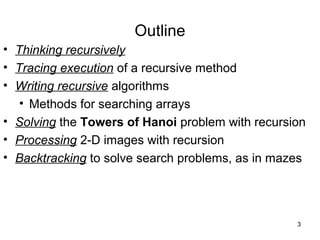
Outline 
• Thinking recursively 
• Tracing execution of a recursive method 
• Writing recursive algorithms 
• Methods for searching arrays 
• Solving the Towers of Hanoi problem with recursion 
• Processing 2-D images with recursion 
• Backtracking to solve search problems, as in mazes
4 
Recursive Thinking 
• Recursion is: 
• A problem-solving approach, that can ... 
• Generate simple solutions to ... 
• Certain kinds of problems that ... 
• Would be difficult to solve in other ways 
• Recursion splits a problem: 
• Into one or more simpler versions of itself
5 
Recursive Thinking: An Example 
Strategy for processing nested dolls: 
1. if there is only one doll 
2. do what it needed for it 
else 
1. do what is needed for the outer doll 
2. Process the inner nest in the same way
6 
Recursive Thinking: Another Example 
Strategy for searching a sorted array: 
1. if the array is empty 
2. return -1 as the search result (not present) 
3. else if the middle element == target 
4. return subscript of the middle element 
5. else if target < middle element 
6. recursively search elements before middle 
7. else 
8. recursively search elements after the middle
Recursive Thinking: The General Approach 
1. if problem is “small enough” 
2. solve it directly 
3. else 
4. break into one or more smaller subproblems 
5. solve each subproblem recursively 
6. combine results into solution to whole problem 
7
8 
Requirements for Recursive Solution 
• At least one “small” case that you can solve directly 
• A way of breaking a larger problem down into: 
• One or more smaller subproblems 
• Each of the same kind as the original 
• A way of combining subproblem results into an 
overall solution to the larger problem
9 
General Recursive Design Strategy 
• Identify the base case(s) (for direct solution) 
• Devise a problem splitting strategy 
• Subproblems must be smaller 
• Subproblems must work towards a base case 
• Devise a solution combining strategy
10 
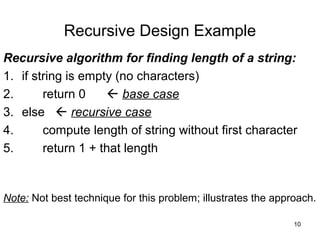
Recursive Design Example 
Recursive algorithm for finding length of a string: 
1. if string is empty (no characters) 
2. return 0  base case 
3. else  recursive case 
4. compute length of string without first character 
5. return 1 + that length 
Note: Not best technique for this problem; illustrates the approach.
11 
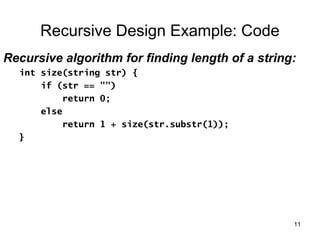
Recursive Design Example: Code 
Recursive algorithm for finding length of a string: 
int size(string str) { 
if (str == "") 
return 0; 
else 
return 1 + size(str.substr(1)); 
}
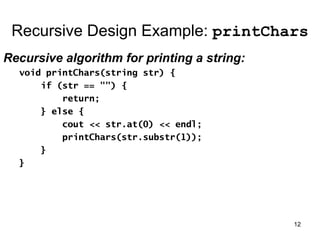
Recursive Design Example: printChars 
Recursive algorithm for printing a string: 
12 
void printChars(string str) { 
if (str == "") { 
return; 
} else { 
cout << str.at(0) << endl; 
printChars(str.substr(1)); 
} 
}
13 
Recursive Design Example: 
printCharsReverse 
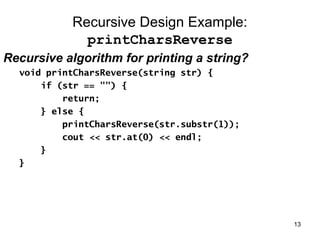
Recursive algorithm for printing a string? 
void printCharsReverse(string str) { 
if (str == "") { 
return; 
} else { 
printCharsReverse(str.substr(1)); 
cout << str.at(0) << endl; 
} 
}
Recursive Design Example: mystery 
14 
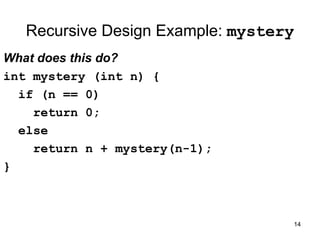
What does this do? 
int mystery (int n) { 
if (n == 0) 
return 0; 
else 
return n + mystery(n-1); 
}
Proving a Recursive Method Correct 
Recall Proof by Induction: 
1. Prove the theorem for the base case(s): n=0 
2. Show that: 
15 
• If the theorem is assumed true for n, 
• Then it must be true for n+1 
Result: Theorem true for all n ≥ 0.
Proving a Recursive Method Correct (2) 
Recursive proof is similar to induction: 
1. Show base case recognized and solved correctly 
2. Show that 
• If all smaller problems are solved correctly, 
• Then original problem is also solved correctly 
1. Show that each recursive case makes progress 
16 
towards the base case  terminates properly
17 
Tracing a Recursive Method 
length(“ace”) 
return 1 + length(“ce”) 
return 1 + length(“e”) 
return 1 + length(“”) 
0 
3 
2 
1 
Overall 
result
18 
Tracing a Recursive Method (2)
Recursive Definitions of Mathematical Formulas 
• Mathematicians often use recursive definitions 
• These lead very naturally to recursive algorithms 
• Examples include: 
• Factorial 
• Powers 
• Greatest common divisor 
19
20 
Recursive Definitions: Factorial 
• 0! = 1 
• n! = n x (n-1)! 
• If a recursive function never reaches its base case, a 
stack overflow error occurs
21 
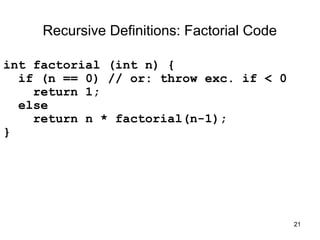
int factorial (int n) { 
if (n == 0) // or: throw exc. if < 0 
return 1; 
else 
return n * factorial(n-1); 
} 
Recursive Definitions: Factorial Code
22 
Recursive Definitions: Power 
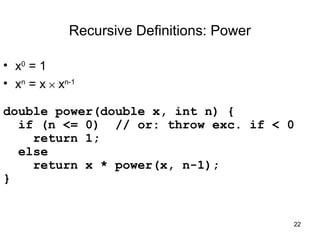
• x0 = 1 
• xn = x ´ xn-1 
double power(double x, int n) { 
if (n <= 0) // or: throw exc. if < 0 
return 1; 
else 
return x * power(x, n-1); 
}
Recursive Definitions: Greatest Common Divisor 
Definition of gcd(m, n), for integers m > n > 0: 
• gcd(m, n) = n, if n divides m evenly 
• gcd(m, n) = gcd(n, m % n), otherwise 
int gcd (int m, int n) { 
23 
if (m < n) 
return gcd(n, m); 
else if (m % n == 0) // could check n>0 
return n; 
else 
return gcd(n, m % n); 
}
24 
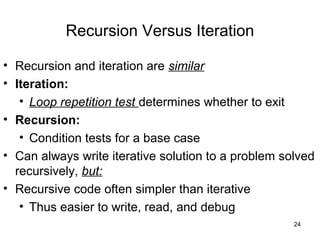
Recursion Versus Iteration 
• Recursion and iteration are similar 
• Iteration: 
• Loop repetition test determines whether to exit 
• Recursion: 
• Condition tests for a base case 
• Can always write iterative solution to a problem solved 
recursively, but: 
• Recursive code often simpler than iterative 
• Thus easier to write, read, and debug
25 
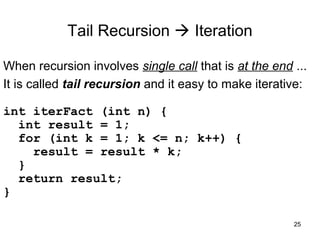
Tail Recursion  Iteration 
When recursion involves single call that is at the end ... 
It is called tail recursion and it easy to make iterative: 
int iterFact (int n) { 
int result = 1; 
for (int k = 1; k <= n; k++) { 
result = result * k; 
} 
return result; 
}
26 
Efficiency of Recursion 
• Recursive method often slower than iterative; why? 
• Overhead for loop repetition smaller than 
• Overhead for call and return 
• If easier to develop algorithm using recursion, 
• Then code it as a recursive method: 
• Software engineering benefit probably outweighs ... 
• Reduction in efficiency 
• Don’t “optimize” prematurely!
27 
Recursive Definitions: Fibonacci Series 
Definition of fibi, for integer i > 0: 
• fib1 = 1 
• fib2 = 1 
• fibn = fibn-1 + fibn-2, for n > 2
28 
Fibonacci Series Code 
int fib (int n) { 
if (n <= 2) 
return 1; 
else 
return fib(n-1) + fib(n-2); 
} 
This is straightforward, but an inefficient recursion ...
Efficiency of Recursion: Inefficient Fibonacci 
29 
# calls apparently 
O(2n) – big!
30 
Efficient Fibonacci 
• Strategy: keep track of: 
• Current Fibonacci number 
• Previous Fibonacci number 
• # left to compute
31 
Efficient Fibonacci: Code 
int fibonacci_start (int n) { 
return fibo(1, 0, n); 
} 
int fibo ( 
int curr, int prev, int n) { 
if (n <= 1) 
return curr; 
else 
return fibo(curr+prev, curr, n-1); 
}
32 
Efficient Fibonacci: A Trace 
Performance is O(n)
33 
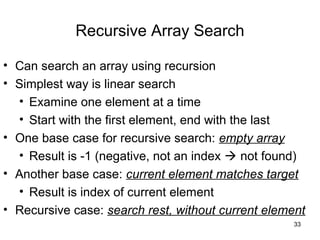
Recursive Array Search 
• Can search an array using recursion 
• Simplest way is linear search 
• Examine one element at a time 
• Start with the first element, end with the last 
• One base case for recursive search: empty array 
• Result is -1 (negative, not an index  not found) 
• Another base case: current element matches target 
• Result is index of current element 
• Recursive case: search rest, without current element
Recursive Array Search: Linear Algorithm 
1. if the array is empty 
2. return -1 
3. else if first element matches target 
4. return index of first element 
5. else 
6. return result of searching rest of the array, 
34 
excluding the first element
35 
Linear Array Search Code 
template<typename Item_Type> 
int linear_search ( 
const std::vector<Item_Type>& items, 
const Item_Type& target) { 
return linear_search(items, target, 0); 
} 
template<typename Item_Type> 
int linear_search ( 
const std::vector<Item_Type>& items, 
const Item_Type& target, size_t pos_first) { 
if (pos_first == items.size()) return -1; 
else if (target == items[pos_first]) 
return pos_first; 
else 
return linear_search(items, target, pos_first+1); 
}
Array Search: Getting Better Performance 
• Item not found: O(n) 
• Item found: n/2 on average, still O(n) 
• How can we perhaps do better than this? 
• What if the array is sorted? 
• Can compare with middle item 
• Get two subproblems of size £ n/2 
• What performance would this have? 
• Divide by 2 at each recursion  O(log n) 
• Much better! 
36
37 
Binary Search Algorithm 
• Works only on sorted arrays! 
• Base cases: 
• Empty (sub)array 
• Current element matches the target 
• Check middle element with the target 
• Consider only the array half where target can still lie
38 
Binary Search Algorithm Steps 
1. if array is empty 
2. return -1 as result 
3. else if middle element matches 
4. return index of middle element as result 
5. else if target < middle element 
6. return result of searching lower portion of array 
7. else 
8. return result of searching upper portion of array
39 
Binary Search Example
40 
Binary Search Code 
template <typename Item_Type> 
int binary_search(const std::vector<Item_Type>& items, 
int first, int last, const Item_Type& target) { 
if (first > last) 
return -1; // Base case for unsuccessful search. 
else { 
int middle = (first + last) / 2; // Next probe index. 
if (target < items[middle]) 
return binary_search(items, first, middle - 1, target); 
else if (items[middle] < target) 
return binary_search(items, middle + 1, last, target); 
else 
return middle; // Base case for successful search. 
} 
}
41 
Binary Search Code (2) 
template <typename Item_Type> 
int binary_search(const std::vector<Item_Type>items, const 
Item_Type& target) { 
return binary_search(items, 0, items.size() - 1, target); 
} 
• C++ Standard library function binary_search defined 
in <algorithms> does this.
42 
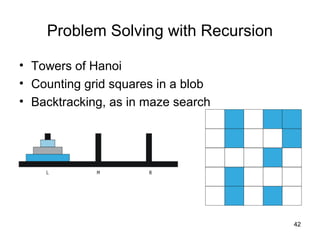
Problem Solving with Recursion 
• Towers of Hanoi 
• Counting grid squares in a blob 
• Backtracking, as in maze search
43 
Towers of Hanoi: Description 
Goal: Move entire tower to another peg 
Rules: 
1. You can move only the top disk from a peg. 
2. You can only put a smaller on a larger disk (or 
on an empty peg)
44 
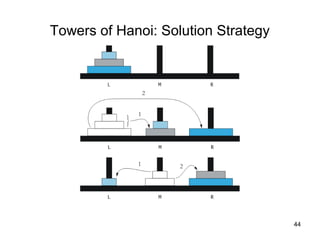
Towers of Hanoi: Solution Strategy
45 
Towers of Hanoi: Solution Strategy (2)
46 
Towers of Hanoi: Program Specification 
Problem Inputs 
Number of disks (an integer) 
Letter of starting peg: L (left), M (middle), or R (right) 
Letter of destination peg (L, M, or R), but different from starting peg. 
Letter of temporary peg (L, M, or R), but different from starting peg and destination peg. 
Problem Outputs 
A list of moves
Towers of Hanoi: Program Specification (2) 
47 
Function Behavior 
void show_moves(int n, char 
start_peg, char dest_peg, chat 
temp_peg) 
Builds a string containing all moves for a 
game with n disks on start_peg that will 
be moved to dest_peg, using temp_peg 
for temporary storage of disks being moved.
48 
Towers of Hanoi: Recursion Structure 
move(n, src, dst, tmp) = 
if n == 1: move disk 1 from src to dst 
otherwise: 
move(n-1, src, tmp, dst) 
move disk n from src to dst 
move(n-1, tmp, dst, src)
49 
Towers of Hanoi: Code 
void show_moves(int n, char start_peg, 
char dest_peg, char temp_peg) 
{ 
if (n == 1) 
{ 
cout << "Move disk 1 from peg " << start_peg 
<< " to peg " << dest_peg << "n"; 
} 
else 
{ // Recursive step 
show_moves(n - 1, start_peg, temp_peg, dest_peg); 
cout << "Move disk " << n << " from peg " << start_peg 
<< " to peg " << dest_peg << "n"; 
show_moves(n - 1, temp_peg, dest_peg, start_peg); 
} 
}
50 
Towers of Hanoi: Performance Analysis 
How big will the output be for a tower of size n? 
We’ll just count lines; call this L(n). 
• For n = 1, one line: L(1) = 1 
• For n > 1, one line plus twice L for next smaller size: 
L(n+1) = 2 x L(n) + 1 
Solving this gives L(n) = 2n – 1 = O(2n) 
So, don’t try this for very large n.
51 
Counting Cells in a Blob 
• Desire: Process an image presented as a two-dimensional 
array of color values 
• Information in the image may come from 
• X-Ray 
• MRI 
• Satellite imagery 
• Etc. 
• Goal: Determine size of any area considered 
abnormal because of its color values
52 
Counting Cells in a Blob (2) 
• A blob is a collection of contiguous cells that are 
abnormal 
• By contiguous we mean cells that are adjacent, 
horizontally, vertically, or diagonally
53 
Counting Cells in a Blob: Example
Counting Cells in a Blob: Recursive Algorithm 
Algorithm count_cells(x, y): 
• if (x, y) outside grid 
• return 0 
• else if color at (x, y) normal 
• return 0 
• else 
• Set color at (x, y) to “Temporary” (normal) 
• return 1 + sum of count_cells on neighbors 
54
55 
Count Cells Code 
int count_cells(color grid[ROW_SIZE][COL_SIZE], int r, int c) { 
if (r < 0 || r >= ROW_SIZE || c < 0 || c >= COL_SIZE) 
{ 
return 0; 
} 
else if (grid[r][c] != ABNORMAL) 
{ 
return 0; 
} 
else 
{ 
grid[r][c] = TEMPORARY; 
return 1 
+ count_cells(grid, r - 1, c - 1) + count_cells(grid, r - 1, c) 
+ count_cells(grid, r - 1, c + 1) + count_cells(grid, r, c + 1) 
+ count_cells(grid, r + 1, c + 1) + count_cells(grid, r + 1, c) 
+ count_cells(grid, r + 1, c - 1) + count_cells(grid, r, c - 1); 
} 
}
56 
Backtracking 
• Backtracking: systematic trial and error search for 
solution to a problem 
• Example: Finding a path through a maze 
• In walking through a maze, probably walk a path as far 
as you can go 
• Eventually, reach destination or dead end 
• If dead end, must retrace your steps 
• Loops: stop when reach place you’ve been before 
• Backtracking systematically tries alternative paths and 
eliminates them if they don’t work
57 
Backtracking (2) 
• If you never try exact same path more than once, and 
• You try all possibilities, 
• You will eventually find a solution path if one exists 
• Problems solved by backtracking: a set of choices 
• Recursion implements backtracking straightforwardly 
• Activation frame remembers choice made at that 
decision point 
• A chess playing program likely involves backtracking
58 
Maze Solving Algorithm: findPath(x, y) 
1. if (x,y) outside grid, return false 
2. if (x,y) barrier or visited, return false 
3. if (x,y) is maze exit, color PATH and return true 
4. else: 
5. set (x,y) color to PATH (“optimistically”) 
6. for each neighbor of (x,y) 
7. if findPath(neighbor), return true 
8. set (x,y) color to TEMPORARY (“visited”) 
9. return false
59 
Maze Solving Code 
bool findMazePath(color grid[ROW_SIZE][COL_SIZE], int r, int c) 
{ 
if (r < 0 || c < 0 || r >= ROW_SIZE || c >= COL_SIZE) 
return false; // Cell is out of bounds. 
else if (grid[r][c] != BACKGROUND) 
return false; // Cell is on barrier or dead end. 
else if (r == ROW_SIZE - 1 && c == COL_SIZE - 1) 
{ 
grid[r][c] = PATH; // Cell is on path 
return true; // and is maze exit. 
} 
else 
. . . 
}
60 
Maze Solving Code (2) 
{ // Recursive case. 
// Attempt to find a path from each neighbor. 
// Tentatively mark cell as on path. 
grid[r][c] = PATH; 
if (findMazePath(grid, r - 1, c) 
|| findMazePath(grid, r + 1, c) 
|| findMazePath(grid, r, c - 1) 
|| findMazePath(grid, r, c + 1 ) ) 
{ 
return true; 
} 
else 
{ 
grid[r][c] = TEMPORARY; // Dead end. 
return false; 
} 
}

Recursion

  • 1.
  • 2.
    2 Famous Quotations • To err is human, to forgive divine. • Alexander Pope, An Essay on Criticism, English poet and satirist (1688 - 1744) • To iterate is human, to recurse, divine. • L. Peter Deutsch, computer scientist, or .... • Robert Heller, computer scientist, or .... • unknown ....
  • 3.
    3 Outline •Thinking recursively • Tracing execution of a recursive method • Writing recursive algorithms • Methods for searching arrays • Solving the Towers of Hanoi problem with recursion • Processing 2-D images with recursion • Backtracking to solve search problems, as in mazes
  • 4.
    4 Recursive Thinking • Recursion is: • A problem-solving approach, that can ... • Generate simple solutions to ... • Certain kinds of problems that ... • Would be difficult to solve in other ways • Recursion splits a problem: • Into one or more simpler versions of itself
  • 5.
    5 Recursive Thinking:An Example Strategy for processing nested dolls: 1. if there is only one doll 2. do what it needed for it else 1. do what is needed for the outer doll 2. Process the inner nest in the same way
  • 6.
    6 Recursive Thinking:Another Example Strategy for searching a sorted array: 1. if the array is empty 2. return -1 as the search result (not present) 3. else if the middle element == target 4. return subscript of the middle element 5. else if target < middle element 6. recursively search elements before middle 7. else 8. recursively search elements after the middle
  • 7.
    Recursive Thinking: TheGeneral Approach 1. if problem is “small enough” 2. solve it directly 3. else 4. break into one or more smaller subproblems 5. solve each subproblem recursively 6. combine results into solution to whole problem 7
  • 8.
    8 Requirements forRecursive Solution • At least one “small” case that you can solve directly • A way of breaking a larger problem down into: • One or more smaller subproblems • Each of the same kind as the original • A way of combining subproblem results into an overall solution to the larger problem
  • 9.
    9 General RecursiveDesign Strategy • Identify the base case(s) (for direct solution) • Devise a problem splitting strategy • Subproblems must be smaller • Subproblems must work towards a base case • Devise a solution combining strategy
  • 10.
    10 Recursive DesignExample Recursive algorithm for finding length of a string: 1. if string is empty (no characters) 2. return 0  base case 3. else  recursive case 4. compute length of string without first character 5. return 1 + that length Note: Not best technique for this problem; illustrates the approach.
  • 11.
    11 Recursive DesignExample: Code Recursive algorithm for finding length of a string: int size(string str) { if (str == "") return 0; else return 1 + size(str.substr(1)); }
  • 12.
    Recursive Design Example:printChars Recursive algorithm for printing a string: 12 void printChars(string str) { if (str == "") { return; } else { cout << str.at(0) << endl; printChars(str.substr(1)); } }
  • 13.
    13 Recursive DesignExample: printCharsReverse Recursive algorithm for printing a string? void printCharsReverse(string str) { if (str == "") { return; } else { printCharsReverse(str.substr(1)); cout << str.at(0) << endl; } }
  • 14.
    Recursive Design Example:mystery 14 What does this do? int mystery (int n) { if (n == 0) return 0; else return n + mystery(n-1); }
  • 15.
    Proving a RecursiveMethod Correct Recall Proof by Induction: 1. Prove the theorem for the base case(s): n=0 2. Show that: 15 • If the theorem is assumed true for n, • Then it must be true for n+1 Result: Theorem true for all n ≥ 0.
  • 16.
    Proving a RecursiveMethod Correct (2) Recursive proof is similar to induction: 1. Show base case recognized and solved correctly 2. Show that • If all smaller problems are solved correctly, • Then original problem is also solved correctly 1. Show that each recursive case makes progress 16 towards the base case  terminates properly
  • 17.
    17 Tracing aRecursive Method length(“ace”) return 1 + length(“ce”) return 1 + length(“e”) return 1 + length(“”) 0 3 2 1 Overall result
  • 18.
    18 Tracing aRecursive Method (2)
  • 19.
    Recursive Definitions ofMathematical Formulas • Mathematicians often use recursive definitions • These lead very naturally to recursive algorithms • Examples include: • Factorial • Powers • Greatest common divisor 19
  • 20.
    20 Recursive Definitions:Factorial • 0! = 1 • n! = n x (n-1)! • If a recursive function never reaches its base case, a stack overflow error occurs
  • 21.
    21 int factorial(int n) { if (n == 0) // or: throw exc. if < 0 return 1; else return n * factorial(n-1); } Recursive Definitions: Factorial Code
  • 22.
    22 Recursive Definitions:Power • x0 = 1 • xn = x ´ xn-1 double power(double x, int n) { if (n <= 0) // or: throw exc. if < 0 return 1; else return x * power(x, n-1); }
  • 23.
    Recursive Definitions: GreatestCommon Divisor Definition of gcd(m, n), for integers m > n > 0: • gcd(m, n) = n, if n divides m evenly • gcd(m, n) = gcd(n, m % n), otherwise int gcd (int m, int n) { 23 if (m < n) return gcd(n, m); else if (m % n == 0) // could check n>0 return n; else return gcd(n, m % n); }
  • 24.
    24 Recursion VersusIteration • Recursion and iteration are similar • Iteration: • Loop repetition test determines whether to exit • Recursion: • Condition tests for a base case • Can always write iterative solution to a problem solved recursively, but: • Recursive code often simpler than iterative • Thus easier to write, read, and debug
  • 25.
    25 Tail Recursion Iteration When recursion involves single call that is at the end ... It is called tail recursion and it easy to make iterative: int iterFact (int n) { int result = 1; for (int k = 1; k <= n; k++) { result = result * k; } return result; }
  • 26.
    26 Efficiency ofRecursion • Recursive method often slower than iterative; why? • Overhead for loop repetition smaller than • Overhead for call and return • If easier to develop algorithm using recursion, • Then code it as a recursive method: • Software engineering benefit probably outweighs ... • Reduction in efficiency • Don’t “optimize” prematurely!
  • 27.
    27 Recursive Definitions:Fibonacci Series Definition of fibi, for integer i > 0: • fib1 = 1 • fib2 = 1 • fibn = fibn-1 + fibn-2, for n > 2
  • 28.
    28 Fibonacci SeriesCode int fib (int n) { if (n <= 2) return 1; else return fib(n-1) + fib(n-2); } This is straightforward, but an inefficient recursion ...
  • 29.
    Efficiency of Recursion:Inefficient Fibonacci 29 # calls apparently O(2n) – big!
  • 30.
    30 Efficient Fibonacci • Strategy: keep track of: • Current Fibonacci number • Previous Fibonacci number • # left to compute
  • 31.
    31 Efficient Fibonacci:Code int fibonacci_start (int n) { return fibo(1, 0, n); } int fibo ( int curr, int prev, int n) { if (n <= 1) return curr; else return fibo(curr+prev, curr, n-1); }
  • 32.
    32 Efficient Fibonacci:A Trace Performance is O(n)
  • 33.
    33 Recursive ArraySearch • Can search an array using recursion • Simplest way is linear search • Examine one element at a time • Start with the first element, end with the last • One base case for recursive search: empty array • Result is -1 (negative, not an index  not found) • Another base case: current element matches target • Result is index of current element • Recursive case: search rest, without current element
  • 34.
    Recursive Array Search:Linear Algorithm 1. if the array is empty 2. return -1 3. else if first element matches target 4. return index of first element 5. else 6. return result of searching rest of the array, 34 excluding the first element
  • 35.
    35 Linear ArraySearch Code template<typename Item_Type> int linear_search ( const std::vector<Item_Type>& items, const Item_Type& target) { return linear_search(items, target, 0); } template<typename Item_Type> int linear_search ( const std::vector<Item_Type>& items, const Item_Type& target, size_t pos_first) { if (pos_first == items.size()) return -1; else if (target == items[pos_first]) return pos_first; else return linear_search(items, target, pos_first+1); }
  • 36.
    Array Search: GettingBetter Performance • Item not found: O(n) • Item found: n/2 on average, still O(n) • How can we perhaps do better than this? • What if the array is sorted? • Can compare with middle item • Get two subproblems of size £ n/2 • What performance would this have? • Divide by 2 at each recursion  O(log n) • Much better! 36
  • 37.
    37 Binary SearchAlgorithm • Works only on sorted arrays! • Base cases: • Empty (sub)array • Current element matches the target • Check middle element with the target • Consider only the array half where target can still lie
  • 38.
    38 Binary SearchAlgorithm Steps 1. if array is empty 2. return -1 as result 3. else if middle element matches 4. return index of middle element as result 5. else if target < middle element 6. return result of searching lower portion of array 7. else 8. return result of searching upper portion of array
  • 39.
  • 40.
    40 Binary SearchCode template <typename Item_Type> int binary_search(const std::vector<Item_Type>& items, int first, int last, const Item_Type& target) { if (first > last) return -1; // Base case for unsuccessful search. else { int middle = (first + last) / 2; // Next probe index. if (target < items[middle]) return binary_search(items, first, middle - 1, target); else if (items[middle] < target) return binary_search(items, middle + 1, last, target); else return middle; // Base case for successful search. } }
  • 41.
    41 Binary SearchCode (2) template <typename Item_Type> int binary_search(const std::vector<Item_Type>items, const Item_Type& target) { return binary_search(items, 0, items.size() - 1, target); } • C++ Standard library function binary_search defined in <algorithms> does this.
  • 42.
    42 Problem Solvingwith Recursion • Towers of Hanoi • Counting grid squares in a blob • Backtracking, as in maze search
  • 43.
    43 Towers ofHanoi: Description Goal: Move entire tower to another peg Rules: 1. You can move only the top disk from a peg. 2. You can only put a smaller on a larger disk (or on an empty peg)
  • 44.
    44 Towers ofHanoi: Solution Strategy
  • 45.
    45 Towers ofHanoi: Solution Strategy (2)
  • 46.
    46 Towers ofHanoi: Program Specification Problem Inputs Number of disks (an integer) Letter of starting peg: L (left), M (middle), or R (right) Letter of destination peg (L, M, or R), but different from starting peg. Letter of temporary peg (L, M, or R), but different from starting peg and destination peg. Problem Outputs A list of moves
  • 47.
    Towers of Hanoi:Program Specification (2) 47 Function Behavior void show_moves(int n, char start_peg, char dest_peg, chat temp_peg) Builds a string containing all moves for a game with n disks on start_peg that will be moved to dest_peg, using temp_peg for temporary storage of disks being moved.
  • 48.
    48 Towers ofHanoi: Recursion Structure move(n, src, dst, tmp) = if n == 1: move disk 1 from src to dst otherwise: move(n-1, src, tmp, dst) move disk n from src to dst move(n-1, tmp, dst, src)
  • 49.
    49 Towers ofHanoi: Code void show_moves(int n, char start_peg, char dest_peg, char temp_peg) { if (n == 1) { cout << "Move disk 1 from peg " << start_peg << " to peg " << dest_peg << "n"; } else { // Recursive step show_moves(n - 1, start_peg, temp_peg, dest_peg); cout << "Move disk " << n << " from peg " << start_peg << " to peg " << dest_peg << "n"; show_moves(n - 1, temp_peg, dest_peg, start_peg); } }
  • 50.
    50 Towers ofHanoi: Performance Analysis How big will the output be for a tower of size n? We’ll just count lines; call this L(n). • For n = 1, one line: L(1) = 1 • For n > 1, one line plus twice L for next smaller size: L(n+1) = 2 x L(n) + 1 Solving this gives L(n) = 2n – 1 = O(2n) So, don’t try this for very large n.
  • 51.
    51 Counting Cellsin a Blob • Desire: Process an image presented as a two-dimensional array of color values • Information in the image may come from • X-Ray • MRI • Satellite imagery • Etc. • Goal: Determine size of any area considered abnormal because of its color values
  • 52.
    52 Counting Cellsin a Blob (2) • A blob is a collection of contiguous cells that are abnormal • By contiguous we mean cells that are adjacent, horizontally, vertically, or diagonally
  • 53.
    53 Counting Cellsin a Blob: Example
  • 54.
    Counting Cells ina Blob: Recursive Algorithm Algorithm count_cells(x, y): • if (x, y) outside grid • return 0 • else if color at (x, y) normal • return 0 • else • Set color at (x, y) to “Temporary” (normal) • return 1 + sum of count_cells on neighbors 54
  • 55.
    55 Count CellsCode int count_cells(color grid[ROW_SIZE][COL_SIZE], int r, int c) { if (r < 0 || r >= ROW_SIZE || c < 0 || c >= COL_SIZE) { return 0; } else if (grid[r][c] != ABNORMAL) { return 0; } else { grid[r][c] = TEMPORARY; return 1 + count_cells(grid, r - 1, c - 1) + count_cells(grid, r - 1, c) + count_cells(grid, r - 1, c + 1) + count_cells(grid, r, c + 1) + count_cells(grid, r + 1, c + 1) + count_cells(grid, r + 1, c) + count_cells(grid, r + 1, c - 1) + count_cells(grid, r, c - 1); } }
  • 56.
    56 Backtracking •Backtracking: systematic trial and error search for solution to a problem • Example: Finding a path through a maze • In walking through a maze, probably walk a path as far as you can go • Eventually, reach destination or dead end • If dead end, must retrace your steps • Loops: stop when reach place you’ve been before • Backtracking systematically tries alternative paths and eliminates them if they don’t work
  • 57.
    57 Backtracking (2) • If you never try exact same path more than once, and • You try all possibilities, • You will eventually find a solution path if one exists • Problems solved by backtracking: a set of choices • Recursion implements backtracking straightforwardly • Activation frame remembers choice made at that decision point • A chess playing program likely involves backtracking
  • 58.
    58 Maze SolvingAlgorithm: findPath(x, y) 1. if (x,y) outside grid, return false 2. if (x,y) barrier or visited, return false 3. if (x,y) is maze exit, color PATH and return true 4. else: 5. set (x,y) color to PATH (“optimistically”) 6. for each neighbor of (x,y) 7. if findPath(neighbor), return true 8. set (x,y) color to TEMPORARY (“visited”) 9. return false
  • 59.
    59 Maze SolvingCode bool findMazePath(color grid[ROW_SIZE][COL_SIZE], int r, int c) { if (r < 0 || c < 0 || r >= ROW_SIZE || c >= COL_SIZE) return false; // Cell is out of bounds. else if (grid[r][c] != BACKGROUND) return false; // Cell is on barrier or dead end. else if (r == ROW_SIZE - 1 && c == COL_SIZE - 1) { grid[r][c] = PATH; // Cell is on path return true; // and is maze exit. } else . . . }
  • 60.
    60 Maze SolvingCode (2) { // Recursive case. // Attempt to find a path from each neighbor. // Tentatively mark cell as on path. grid[r][c] = PATH; if (findMazePath(grid, r - 1, c) || findMazePath(grid, r + 1, c) || findMazePath(grid, r, c - 1) || findMazePath(grid, r, c + 1 ) ) { return true; } else { grid[r][c] = TEMPORARY; // Dead end. return false; } }