Progressive medical image coding using
binary wavelet transforms


Tirupathiraju Kanumuri, M. L. Dewal &
R. S. Anand


Signal, Image and Video Processing

ISSN 1863-1703

SIViP
DOI 10.1007/s11760-012-0325-1


                                     1 23
Your article is protected by copyright and all
rights are held exclusively by Springer-Verlag
London Limited. This e-offprint is for personal
use only and shall not be self-archived in
electronic repositories. If you wish to self-
archive your work, please use the accepted
author’s version for posting to your own
website or your institution’s repository. You
may further deposit the accepted author’s
version on a funder’s repository at a funder’s
request, provided it is not made publicly
available until 12 months after publication.


1 23
Author's personal copy
SIViP
DOI 10.1007/s11760-012-0325-1

 ORIGINAL PAPER


Progressive medical image coding using binary wavelet transforms
Tirupathiraju Kanumuri · M. L. Dewal · R. S. Anand


Received: 25 September 2011 / Revised: 21 April 2012 / Accepted: 23 April 2012
© Springer-Verlag London Limited 2012


Abstract In this paper, a new algorithm for progressive                 transmission. In telemedicine, the medical images are trans-
medical image coding is presented. An 8-bit gray scale                  mitted over long distances through Internet. This is mainly
image is divided into eight binary bit-planes, and then, binary         used in remote places such as villages, ships and air planes
wavelet transform is performed on each bit-plane to extract             where the specialized doctor is not available for diagnosis.
the three-level multi-resolution binary wavelet transformed             As the communication channel in such places is very narrow,
images. Starting from the most significant bit-plane, each bit-         embedded image coding method that can provide progressive
plane is encoded using quadtree-based partitioning scheme to            reconstruction is preferred so that the doctor can stop decod-
exploit the energy concentration in the high-frequency sub-             ing based on the individual requirements at the decoding
bands. Experiments are conducted on ultrasound, MRI and                 end. In this paper, a new method is proposed for progressive
CT images to prove the effectiveness of the proposed algo-              coding of medical images. The previously available progres-
rithm. The results show a significant improvement in terms              sive image coding methods can be classified into three cat-
of bit-rate for the required peak signal-to-noise ratio and cor-        egories: spatial domain methods [1–6], pyramidal structure
relation coefficient as compared to the existing state-of-art            methods [7–10] and transform domain methods [11–27]. Out
progressive image coding methods.                                       of the available techniques, transform domain techniques are
                                                                        more efficient due to their compression efficiency and hence
Keywords Binary wavelet transforms (BWT) · Progressive                  employed in JPEG and JPEG 2000 image coding standards
image coding · Medical image compression                                [11,16].
                                                                            A progressive coding method based on prioritized coding
                                                                        of DCT coefficients is proposed in [11]. DCT suffers from
1 Introduction                                                          blocking artifacts for low bit-rates, and to avoid this, many
                                                                        wavelets-based embedded image coding methods are pro-
With the advent development of digital imaging and image                posed. Shapiro [12] introduced lossy to lossless progressive
processing technology, all the hospitals are moving toward              embedded image coding method, embedded zerotree wave-
digitization of medical images for processing, storage and              let coding (EZW). Further, Zandi et al. extended the EZW
transmission purposes. This requires huge amount of stor-               with the reversible wavelets (CREW) [13]. Said and Pearl-
age space for data storage and higher band width for image              man introduced an algorithm known as set partitioning in
                                                                        hierarchical trees (SPIHT) [14] which utilizes the concept
                                                                        of parent–child relationship across wavelet subbands. Fur-
T. Kanumuri (B) · M. L. Dewal · R. S. Anand
                                                                        ther, Pearlman and Asad have extended the SPIHT, set par-
Department of Electrical Engineering, Indian Institute of Technology,
Roorkee, Roorkee, 247667 Uttarakhand, India                             titioning embedded block coder (SPECK) [15] that exploits
e-mail: ktrajuiitr@gmail.com                                            the parent–child relationship as well as clustering of energy
M. L. Dewal                                                             in the frequency domain. Taubman proposed a block-based
e-mail: mohanfee@iitr.ernet.in                                          coding method, embedded block coding with optimized trun-
R. S. Anand                                                             cation of the embedded bit-streams (EBCOT) [16], and it is
e-mail: anandfee@iitr.ernet.in                                          included in JPEG 2000. Pan and Siu introduced progressive


                                                                                                                           123
Author's personal copy
                                                                                                                             SIViP


partitioning binary wavelet tree coder (PPBWC) [17] using       ¯
                                                                a|s=k defines a vector with elements formed from a circular
binary wavelet transforms (BWT). They have combined the                             ¯
                                                                shifted sequence of a by k. and
features of zigzag scanning in EZW [12] and partitioning
                                                                a = {a0 , a1 , . . . , a S−1 }T
                                                                ¯
priority coding of progressive DCT [11] to encode the BWT.                                                                       (3)
   A concise review of the available related literature, tar-   ¯
                                                                d = {d0 , d1 , . . . , d S−1 }T
geted for development of our algorithm, is presented. Binary
                                                                where S is the number of scales, ai and di are the approximate
wavelet transform (BWT) is first proposed for binary image
                                                                (lowpass) and detail (highpass) coefficients, respectively.
compression [17–22]. Later, it has been extended to gray
                                                                   The BWT is then defined [23] as:
scale image by separating the gray scale image into series of
binary bit-planes, and then, the BWT is performed on each       y = Wx                                                           (4)
bit-plane [23]. Law and Sui proposed the in-place implemen-
tation for BWT [17] using lifting scheme that is similar to     Law and Sui proposed the in-place implementation for BWT
the lifting scheme in the real wavelet transform. BWT has       [17]. The 32 length-8 binary filters are classified into four
several advantages over the bi-orthogonal wavelets [25] and     groups depending on the number of ‘1’s in the binary fil-
integer wavelets [26], such as only basic Boolean operations    ters. Examples of the binary filters in each group are given
are involved, no quantization during transformation, no need    in Table 1. In the proposed method, filters of group 1 are
to transmit the sign bit and the transformed image have the     used because the entropy of the transformed image is less
same number of gray levels as the original image.               compared to other filters and hence more suitable for image
   In BWT, the energy clusters in the transformed subbands      compression.
correspond to the spatial locations associated with edges in       In order to have an in-place implementation structure, the
the original image. So, the energy is mainly concentrated       odd number and even number samples of the original signal
in high-frequency subbands and the parent–child relation-       are split into two sequences. These two sequences are then
ship is very weak [17]. So, the state-of-art progressive cod-   updated according to the filter coefficients from the low pass
ing methods SPIHT and SPECK are not efficient for binary         and high pass filters. The low pass and the high pass outputs
image coding. In this paper, a new coding method is pro-        are then interleaved together to get the transformed output.
posed, which uses the energy concentration property of BWT      The scheme is depicted in Fig. 1. If length of the input signal
in high-frequency subband.                                      is odd, the last sample is separated out and BWT is applied
   The paper is organized as follows: a concise review and      for remaining signal and the last sample is added at the end
implementation of 1-D and 2-D BWT is discussed in Sect. 2.      of low pass output. For example, if the input signal is of
The Sect. 3 presents the proposed method for encoding 2-D       15 bits length, the low pass filter will have 8 samples and
BWT coefficients. The decoding process is given in Sect. 4.      high pass filter will have 7 samples. To go for the next level
The experimental results in support of the proposed algo-       decomposition, BWT is applied to the lowpass output.
rithm are discussed in Sect. 5. Finally, the proposed work is
concluded in Sect. 6.                                           2.2 2-D binary wavelet transform (2-D BWT)

                                                                A separable 2-D BWT [28] can be computed efficiently in
                                                                binary space by applying the associated one-level 1-D fil-
2 Binary wavelet transform                                      ter bank to each row of the input binary image and to each
                                                                column of the resultant low pass and high pass output coef-
2.1 1-D binary wavelet transform (1-D BWT)                      ficients as shown in Fig. 2. This can be extended to gray
                                                                scale image by separating it into binary bit-planes, and then
The BWT is implemented on binary images in the similar          performing the BWT to each individual bit-plane of image
manner to the lifting scheme for real wavelet transforms on     as shown in Fig. 2. To go for second-level decomposition,
gray scale images [17].                                         the 2-D BWT is applied to the LL subband.
   Let x be an 1 × N signal, the transformed BWT coeffi-
cients matrix W can be constructed as follows
                                                                Table 1 Length-8 binary wavelet filters
W = [AD]    T
                                                          (1)   Group             Lowpass filter              Highpass filter

                                                                1                 {1, 0, 0, 0, 0, 0, 0, 0}   {1, 1, 0, 0, 0, 0, 0, 0}
where
                                                                2                 {1, 1, 1, 0, 0, 0, 0, 0}   {1, 1, 0, 0, 0, 0, 0, 0}
A = (a|s=0 , a|s=2 , . . . , a|s=N −2 )
     ¯       ¯               ¯            T                     3                 {1, 1, 1, 1, 0, 0, 0, 1}   {1, 1, 0, 0, 0, 0, 0, 0}
                                                          (2)   4                 {1, 1, 1, 1, 1, 1, 1, 0}   {1, 1, 0, 0, 0, 0, 0, 0}
     ¯       ¯               ¯
D = (d|s=0 , d|s=2 , . . . , d|s=N −2 )T


123
Author's personal copy
SIViP


3 The proposed encoder                                                subbands by considering them as parents and then go for
                                                                      the high-frequency subbands. SPECK [15] uses block-based
In real and integer wavelet transforms, the energy is concen-         coding by checking low-frequency subbands first, and then,
trated in low-frequency subbands and a parent–child relation-         it checks the high-frequency subbands. The energy clusters
ship exists. So, SPIHT [14] starts from the low-frequency             in the binary transform subbands correspond to the spatial
                                                                      locations associated with edges in the original image. So, the
                                                                      energy is mainly concentrated in high-frequency subbands.
                                                                      In the proposed method, higher priority is given for encoding
                                                                      high-frequency subbands than the low-frequency subbands.
                                                                      In PPBWC [17], each pixel is checked for significance in
                                                                      every loop until it becomes significant. In case of ultrasound
                                                                      images, most of the pixels have very low values, and thus, it
                                                                      necessitates transmitting more bits for checking the signifi-
                                                                      cance alone. Thus, it is not efficient. In the proposed method,
                                                                      block-based coding is used, which requires only 4 bits to
                                                                      be transmitted if the entire bit-plane is zero. In the proposed
                                                                      method, more emphasis is given for checking high-frequency
                                                                      subbands to exploit energy concentration.
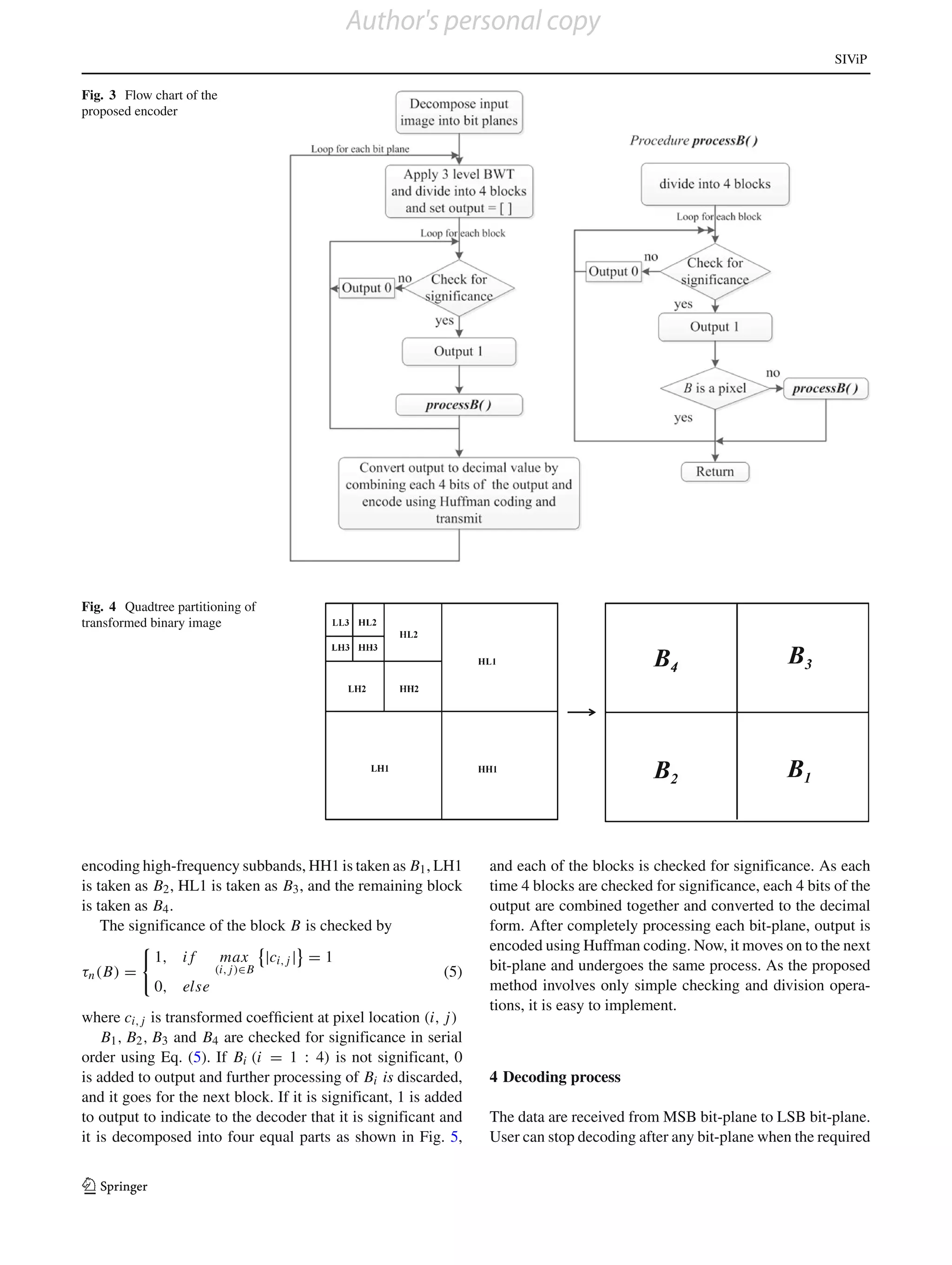
                                                                          The flow chart of the proposed method is given in Fig 3.
                                                                      The input gray scale image is first decomposed into binary
                                                                      bit-planes, and then, three-level 2-D BWT is calculated for
                                                                      each bit-plane starting from the most significant bit-plane
                                                                      (MSB) to the least significant bit-plane (LSB). Initially, the
                                                                      binary wavelet transformed image of each bit-plane is divided
Fig. 1 In-place implementation of 1-D BWT for one level               into 4 blocks as shown in Fig. 4. To give higher priority for


Fig. 2 One-level 2-D BWT implementation for one bit-plane of gray scale image


                                                                                                                          123
Author's personal copy
                                                                                                                           SIViP

Fig. 3 Flow chart of the
proposed encoder


Fig. 4 Quadtree partitioning of
transformed binary image


encoding high-frequency subbands, HH1 is taken as B1 , LH1         and each of the blocks is checked for significance. As each
is taken as B2 , HL1 is taken as B3 , and the remaining block      time 4 blocks are checked for significance, each 4 bits of the
is taken as B4 .                                                   output are combined together and converted to the decimal
    The significance of the block B is checked by                  form. After completely processing each bit-plane, output is
                                                                   encoded using Huffman coding. Now, it moves on to the next
            1, i f         max    |ci, j | = 1
τn (B) =               (i, j)∈B                             (5)    bit-plane and undergoes the same process. As the proposed
            0, else                                                method involves only simple checking and division opera-
                                                                   tions, it is easy to implement.
where ci, j is transformed coefficient at pixel location (i, j)
    B1 , B2 , B3 and B4 are checked for significance in serial
order using Eq. (5). If Bi (i = 1 : 4) is not significant, 0
is added to output and further processing of Bi is discarded,      4 Decoding process
and it goes for the next block. If it is significant, 1 is added
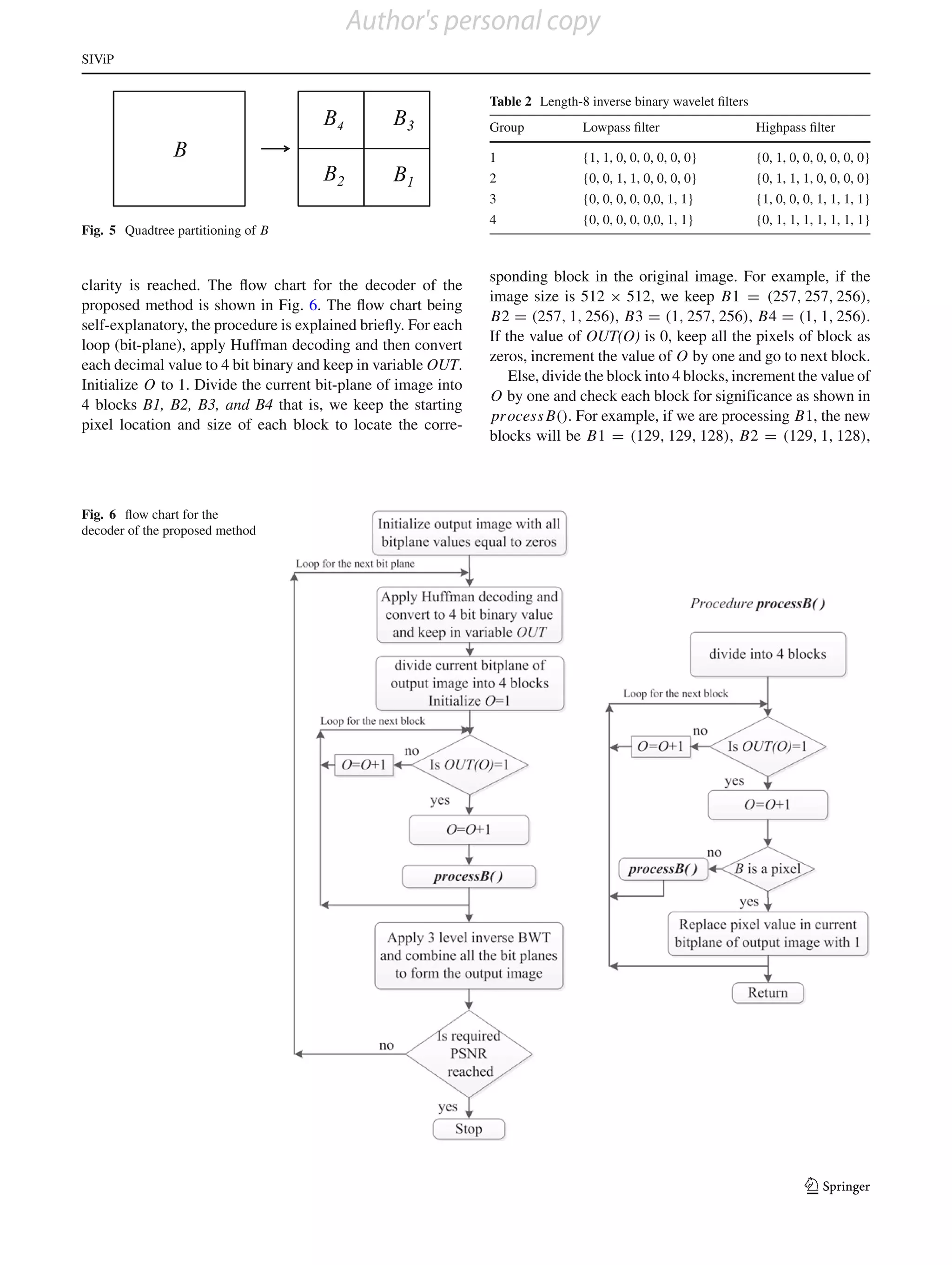
to output to indicate to the decoder that it is significant and    The data are received from MSB bit-plane to LSB bit-plane.
it is decomposed into four equal parts as shown in Fig. 5,         User can stop decoding after any bit-plane when the required


123
Author's personal copy
SIViP


                                                                Table 2 Length-8 inverse binary wavelet filters
                                                                Group           Lowpass filter                    Highpass filter

                                                                1               {1, 1, 0, 0, 0, 0, 0, 0}         {0, 1, 0, 0, 0, 0, 0, 0}
                                                                2               {0, 0, 1, 1, 0, 0, 0, 0}         {0, 1, 1, 1, 0, 0, 0, 0}
                                                                3               {0, 0, 0, 0, 0,0, 1, 1}          {1, 0, 0, 0, 1, 1, 1, 1}
                                                                4               {0, 0, 0, 0, 0,0, 1, 1}          {0, 1, 1, 1, 1, 1, 1, 1}
Fig. 5 Quadtree partitioning of B


                                                                sponding block in the original image. For example, if the
clarity is reached. The flow chart for the decoder of the
                                                                image size is 512 × 512, we keep B1 = (257, 257, 256),
proposed method is shown in Fig. 6. The flow chart being
                                                                B2 = (257, 1, 256), B3 = (1, 257, 256), B4 = (1, 1, 256).
self-explanatory, the procedure is explained briefly. For each
                                                                If the value of OUT(O) is 0, keep all the pixels of block as
loop (bit-plane), apply Huffman decoding and then convert
                                                                zeros, increment the value of O by one and go to next block.
each decimal value to 4 bit binary and keep in variable OUT.
                                                                    Else, divide the block into 4 blocks, increment the value of
Initialize O to 1. Divide the current bit-plane of image into
                                                                O by one and check each block for significance as shown in
4 blocks B1, B2, B3, and B4 that is, we keep the starting
                                                                pr ocess B(). For example, if we are processing B1, the new
pixel location and size of each block to locate the corre-
                                                                blocks will be B1 = (129, 129, 128), B2 = (129, 1, 128),


Fig. 6 flow chart for the
decoder of the proposed method


                                                                                                                           123
Author's personal copy
                                                      SIViP

Fig. 7 The output of EBCOT
method after each loop for
ultrasound image


Fig. 8 The output of SPIHT
method after each loop for
ultrasound image


123
Author's personal copy
SIViP

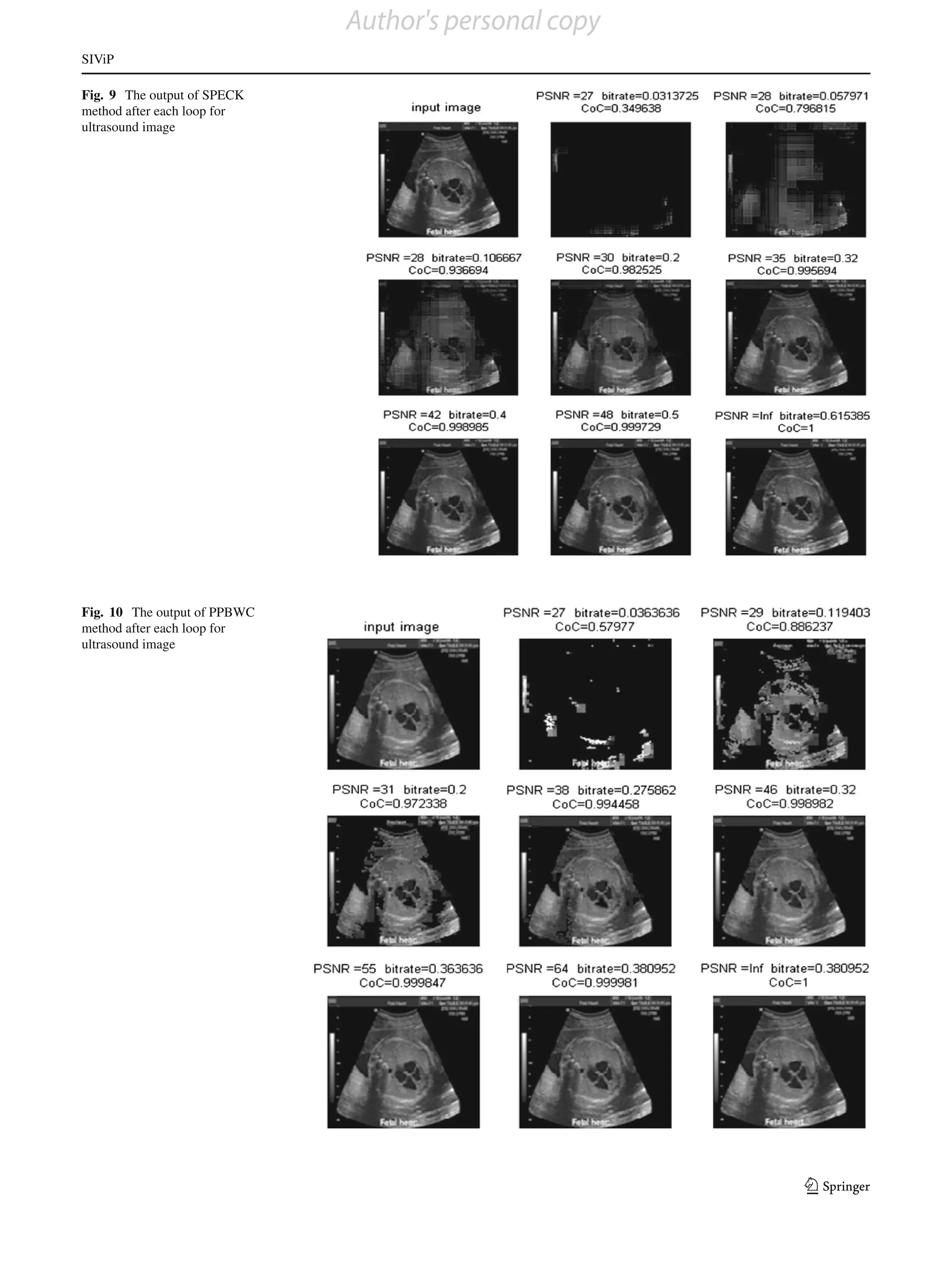
Fig. 9 The output of SPECK
method after each loop for
ultrasound image


Fig. 10 The output of PPBWC
method after each loop for
ultrasound image


                                                       123
Author's personal copy
                                                                                                                                   SIViP

Fig. 11 The output of the
proposed method after each loop
for ultrasound image


Table 3 Comparative results of PSNR versus bit-rate for ultrasound image
Result after loop   EBCOT                    SPIHT                  SPECK                      PPBWC                  PROPOSED
                    PSNR (dB)     Bit-rate   PSNR (dB)   Bit-rate   PSNR (dB)       Bit-rate   PSNR (dB)   Bit-rate   PSNR (dB)   Bit-rate

1                   27            0.0465     27          0.0313     27              0.0313     27          0.03636    27          0.0313
2                   28            0.0720     28          0.0571     28              0.057      29          0.1194     28          0.0792
3                   28.5          0.125      28.5        0.1212     28.5            0.1066     31          0.2        32          0.1212
4                   30            0.21       30          0.2        30              0.2        38          0.2758     38          0.1632
5                   35            0.32       35          0.3076     35              0.32       46          0.32       45          0.2051
6                   42            0.42       42          0.4210     42              0.4        55          0.3636     54          0.25
7                   48            0.53       48          0.533      48              0.5        64          0.3809     Inf         0.2962
8                   Inf           0.666      Inf         0.6153     Inf             0.6153     Inf         0.3892


B3 = (1, 129, 128), B4 = (1, 1, 128). While processing a                   5 Experimental results and discussions
block if it is reached to single pixel and value of OUT(O)
is 1, then replace that pixel value in the current bit-plane of            The performance of the proposed method is evaluated using
the image with 1. After completing the decoding of the entire              the bit-rate for the given peak signal-to-noise ratio (PSNR)
bit-plane, apply three-level inverse BWT and combine all the               and the correlation coefficient (CoC) [27]. A set of ten MRI,
bit-planes to form gray scale image. Examples of the inverse               ten CT images and five ultrasound images are taken for our
binary filters in each group are given in Table 2. Now check                experiment. The proposed method is compared with the state-
whether the required clarity is reached. If it has not reached,            of-art progressive image coders. SPIHT [14], SPECK [15]
go for the next loop.                                                      and EBCOT [16] are implemented using (2, 2) integer wave-


123
Author's personal copy
SIViP


Fig. 12 Plot for PSNR versus bit-rate for ultrasound image                    Fig. 13 Plot for bit-rate versus CoC for ultrasound image


let transforms, and the PPBWC [17] is implemented using                       decoding after any loop depending on the clarity required for
BWT. We got almost similar results for all the images of each                 making the diagnosis. For lossless reconstruction, the bit-rate
set, and hence, the results for one image from each group are                 required for the proposed method is only 0.2962 where as it
presented in this section.                                                    is 0.3892 for PPBWC and is above 0.6 for the other methods.
   For ultrasound images, most of the pixels’ gray levels are                 From the results and above observations, it is cleared that the
near to zero. Hence, most of the bit-planes consist of only                   proposed method outperforms all the methods on ultrasound
zeros, and they need not be encoded. In the proposed method,                  images.
only four bits are transmitted if all the pixels in the bit-plane                 For MRI images, most of the pixels’ gray levels have
are zero. But, in PPBWC and SPIHT, more bits are to be                        medium values. Hence, the proposed method needs more
transmitted. Thus, the proposed method requires lesser bit-                   bits initially giving inferior results for low bit-rate trans-
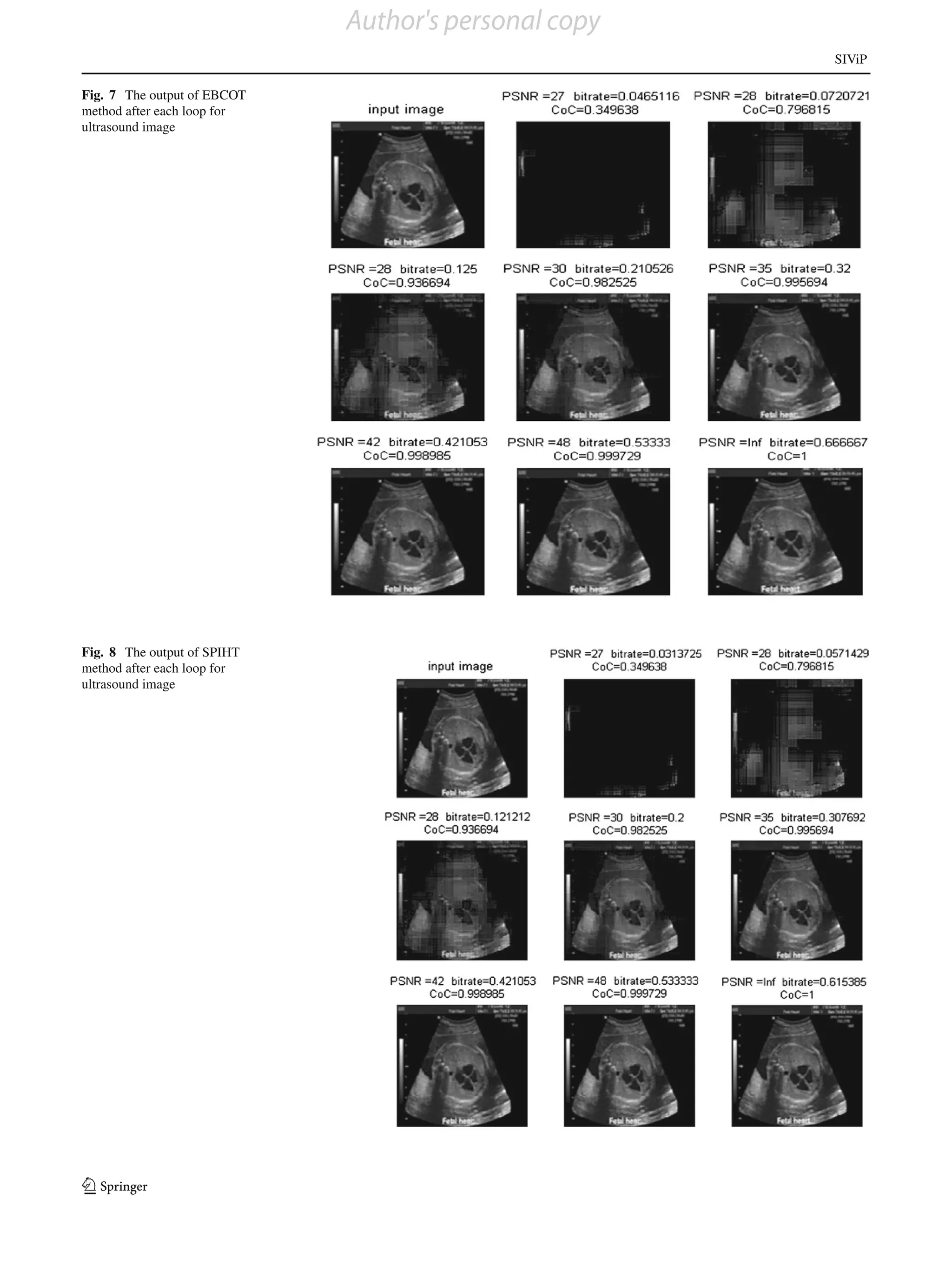
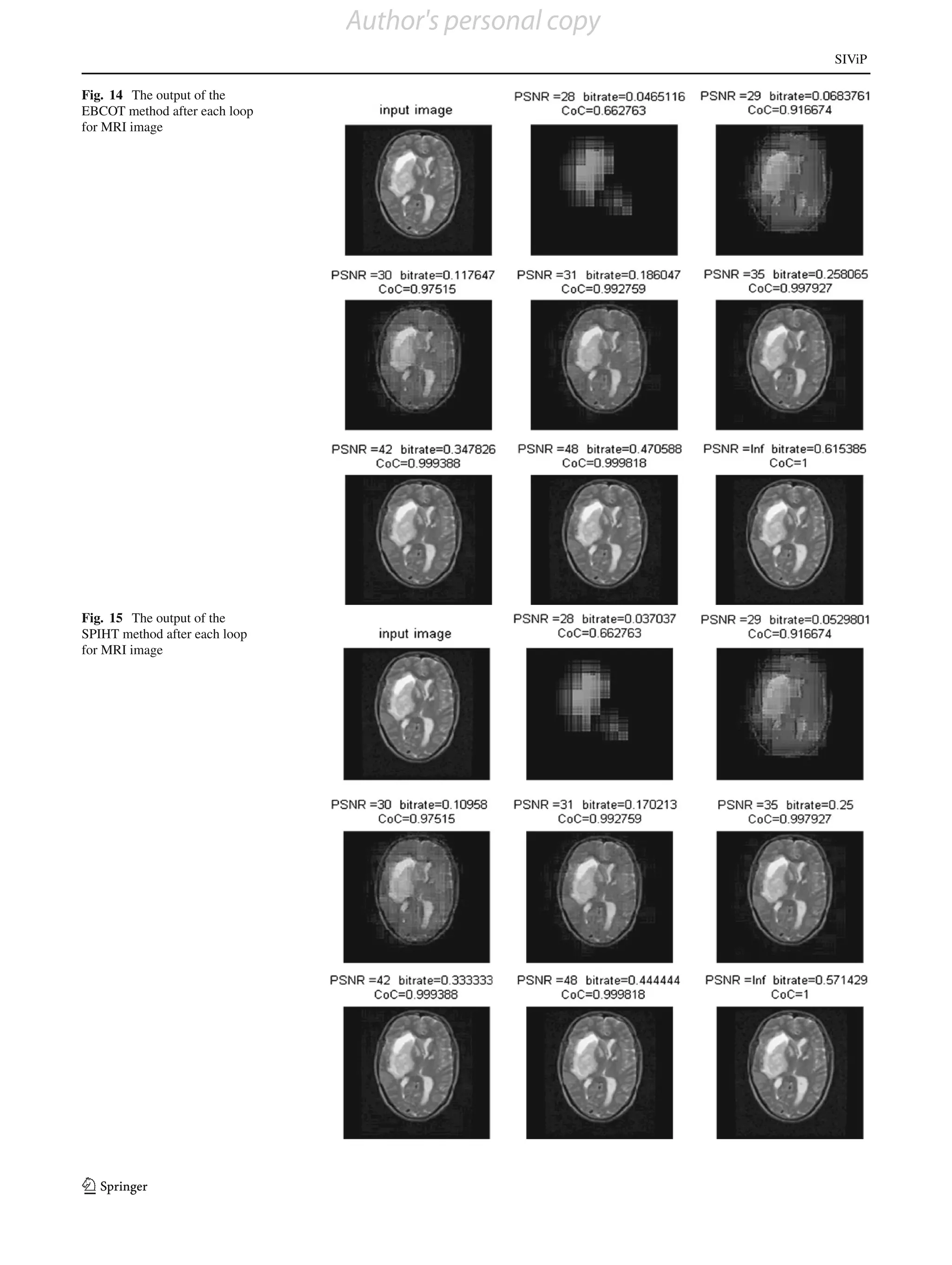
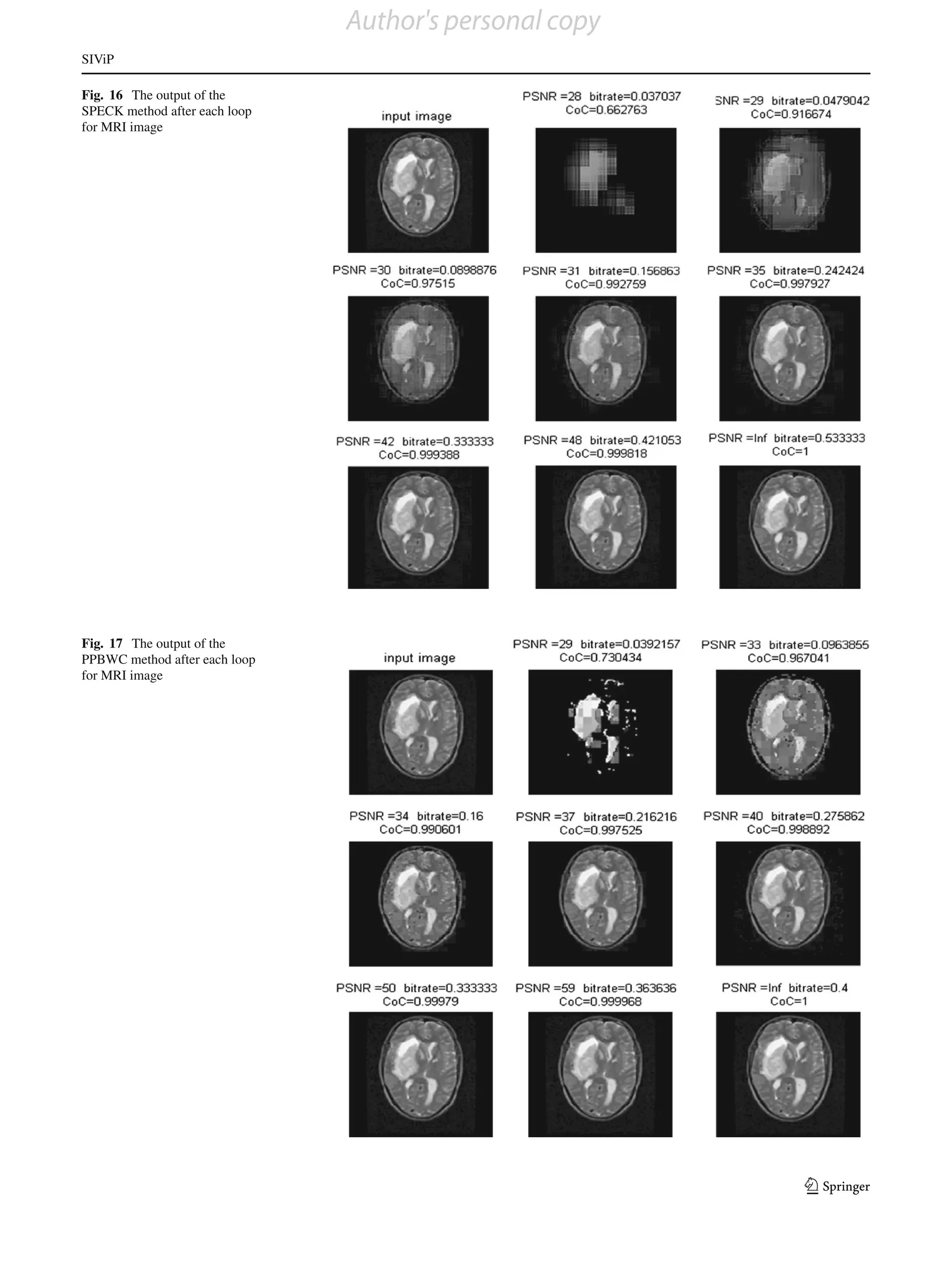
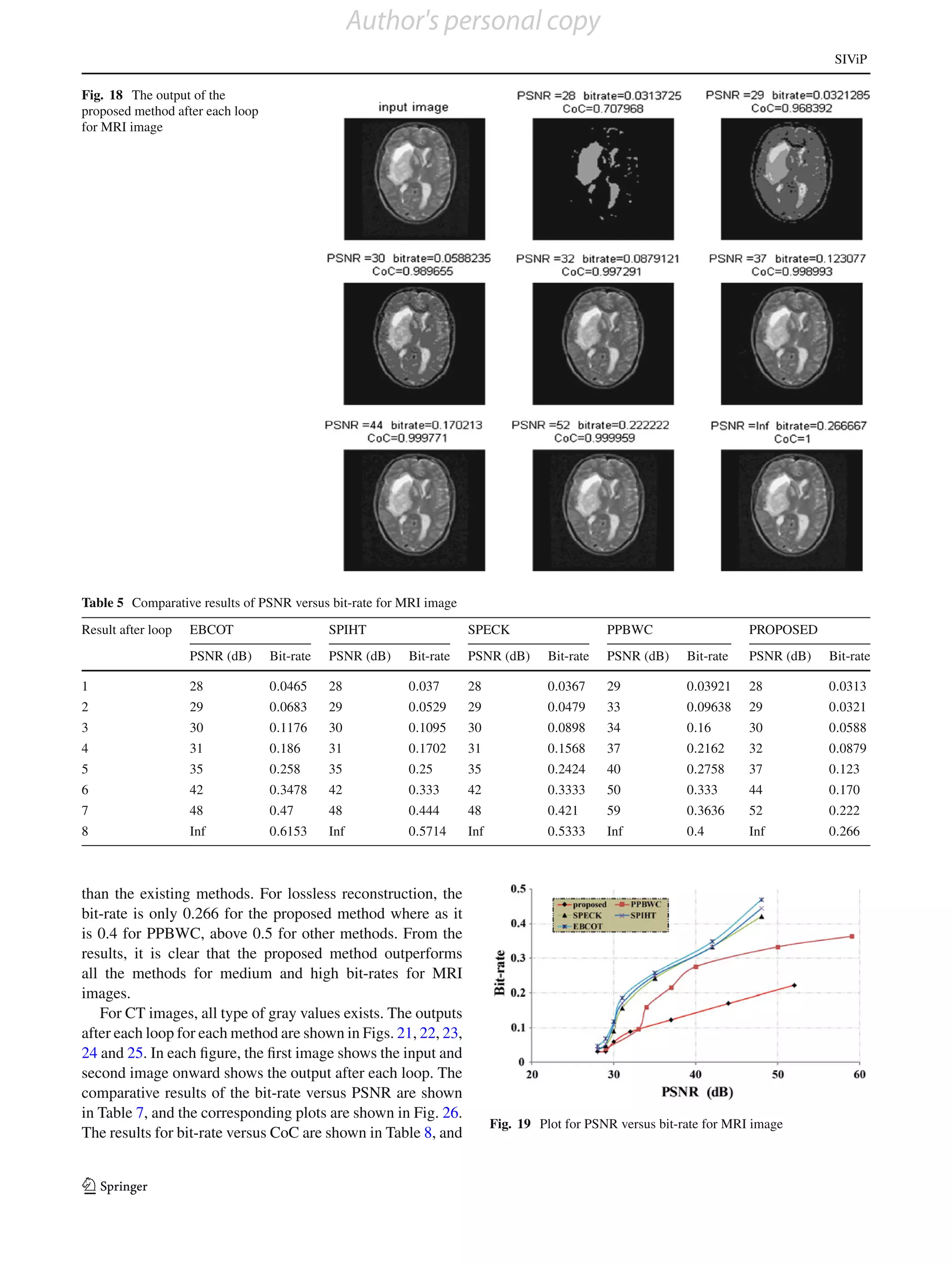
rate for the required PSNR and CoC. The outputs after each                    mission. But, for medium and high bit-rates, the proposed
loop for each method are shown in Figs. 7, 8, 9, 10 and 11.                   method gives better results than existing methods. The out-
In each figure, the first image shows the input and second                      puts after each loop for each method are shown in Figs. 14,
image onward shows the output after each loop. The com-                       15, 16, 17 and 18. In each figure, the first image shows the
parative results of the bit-rate versus PSNR after each loop                  input and second image onward shows the output after each
for one image are shown in Table 3, and the corresponding                     loop. The comparative results of the bit-rate versus PSNR
plots are shown in Fig. 12. The results for bit-rate versus CoC               are shown in Table 5, and the corresponding plots are shown
after each loop are shown in Table 4, and the corresponding                   in Fig. 19. The results for bit-rate versus CoC are shown in
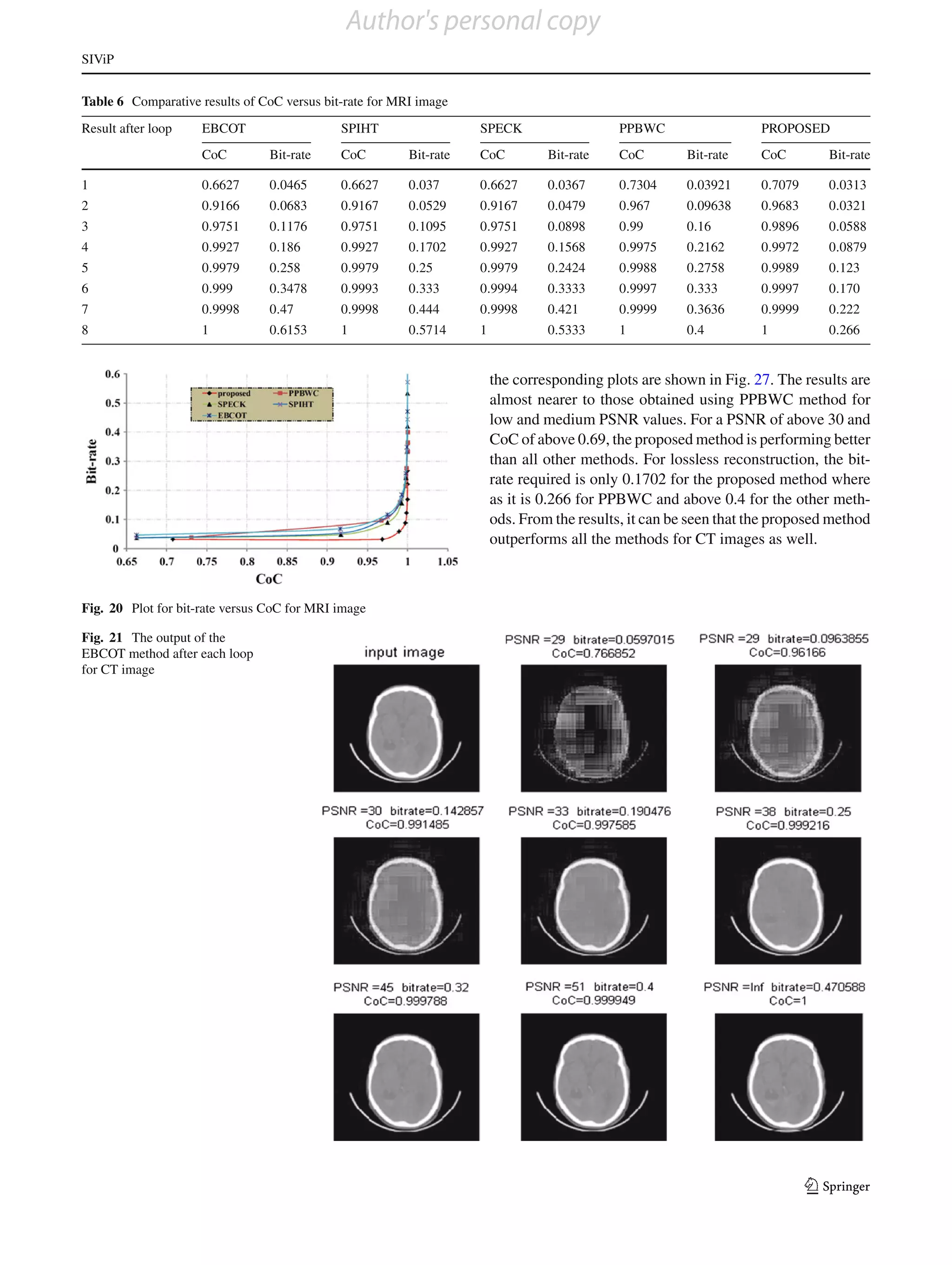
plots are shown in Fig. 13. From the plot, it can be seen that                Table 6, and the corresponding plots are shown in Fig. 20.
up to 2nd loop, the proposed method is giving comparable                      From the plots, it can be seen that for a PSNR of 33 and
results and from the 3rd loop onwards, requires very less                     CoC of 0.96, the PPBWC is giving better results than the
bit-rate when compared with bit-rates obtainable from other                   proposed method and for PSNR of above 33 and CoC of
methods for the required PSNR and CoC. The user can stop                      above 0.96, the proposed method is giving better results


Table 4 Comparative results of CoC versus bit-rate for ultrasound image
Result after loop    EBCOT                    SPIHT                       SPECK                      PPBWC                     PROPOSED
                     CoC         Bit-rate     CoC            Bit-rate     CoC           Bit-rate     CoC         Bit-rate      CoC         Bit-rate

1                    0.3496      0.0465       0.3496         0.3137       0.349         0.0313       0.5797      0.03636       0.5723      0.3137
2                    0.7968      0.0720       0.7968         0.0571       0.7968        0.057        0.8862      0.1194        0.9711      0.0792
3                    0.9366      0.125        0.9366         0.1212       0.9366        0.1066       0.9723      0.2           0.9931      0.1212
4                    0.9820      0.21         0.9825         0.2          0.9825        0.2          0.9944      0.2758        0.9985      0.1632
5                    0.9956      0.32         0.99           0.3076       0.9956        0.32         0.998       0.32          0.999       0.2051
6                    0.998       0.42         0.9989         0.4210       0.9989        0.4          0.9998      0.3636        0.9999      0.25
7                    0.999       0.53         0.999          0.533        0.999         0.5          0.9999      0.3809        1           0.2962
8                    1           0.666        1              0.6153       1             0.6153       1           0.3892


                                                                                                                                          123
Author's personal copy
                                                        SIViP

Fig. 14 The output of the
EBCOT method after each loop
for MRI image


Fig. 15 The output of the
SPIHT method after each loop
for MRI image


123
Author's personal copy
SIViP

Fig. 16 The output of the
SPECK method after each loop
for MRI image


Fig. 17 The output of the
PPBWC method after each loop
for MRI image


                                                        123
Author's personal copy
                                                                                                                                    SIViP

Fig. 18 The output of the
proposed method after each loop
for MRI image


Table 5 Comparative results of PSNR versus bit-rate for MRI image
Result after loop   EBCOT                    SPIHT                  SPECK                      PPBWC                   PROPOSED
                    PSNR (dB)     Bit-rate   PSNR (dB)   Bit-rate   PSNR (dB)       Bit-rate   PSNR (dB)    Bit-rate   PSNR (dB)   Bit-rate

1                   28            0.0465     28          0.037      28              0.0367     29           0.03921    28          0.0313
2                   29            0.0683     29          0.0529     29              0.0479     33           0.09638    29          0.0321
3                   30            0.1176     30          0.1095     30              0.0898     34           0.16       30          0.0588
4                   31            0.186      31          0.1702     31              0.1568     37           0.2162     32          0.0879
5                   35            0.258      35          0.25       35              0.2424     40           0.2758     37          0.123
6                   42            0.3478     42          0.333      42              0.3333     50           0.333      44          0.170
7                   48            0.47       48          0.444      48              0.421      59           0.3636     52          0.222
8                   Inf           0.6153     Inf         0.5714     Inf             0.5333     Inf          0.4        Inf         0.266


than the existing methods. For lossless reconstruction, the
bit-rate is only 0.266 for the proposed method where as it
is 0.4 for PPBWC, above 0.5 for other methods. From the
results, it is clear that the proposed method outperforms
all the methods for medium and high bit-rates for MRI
images.
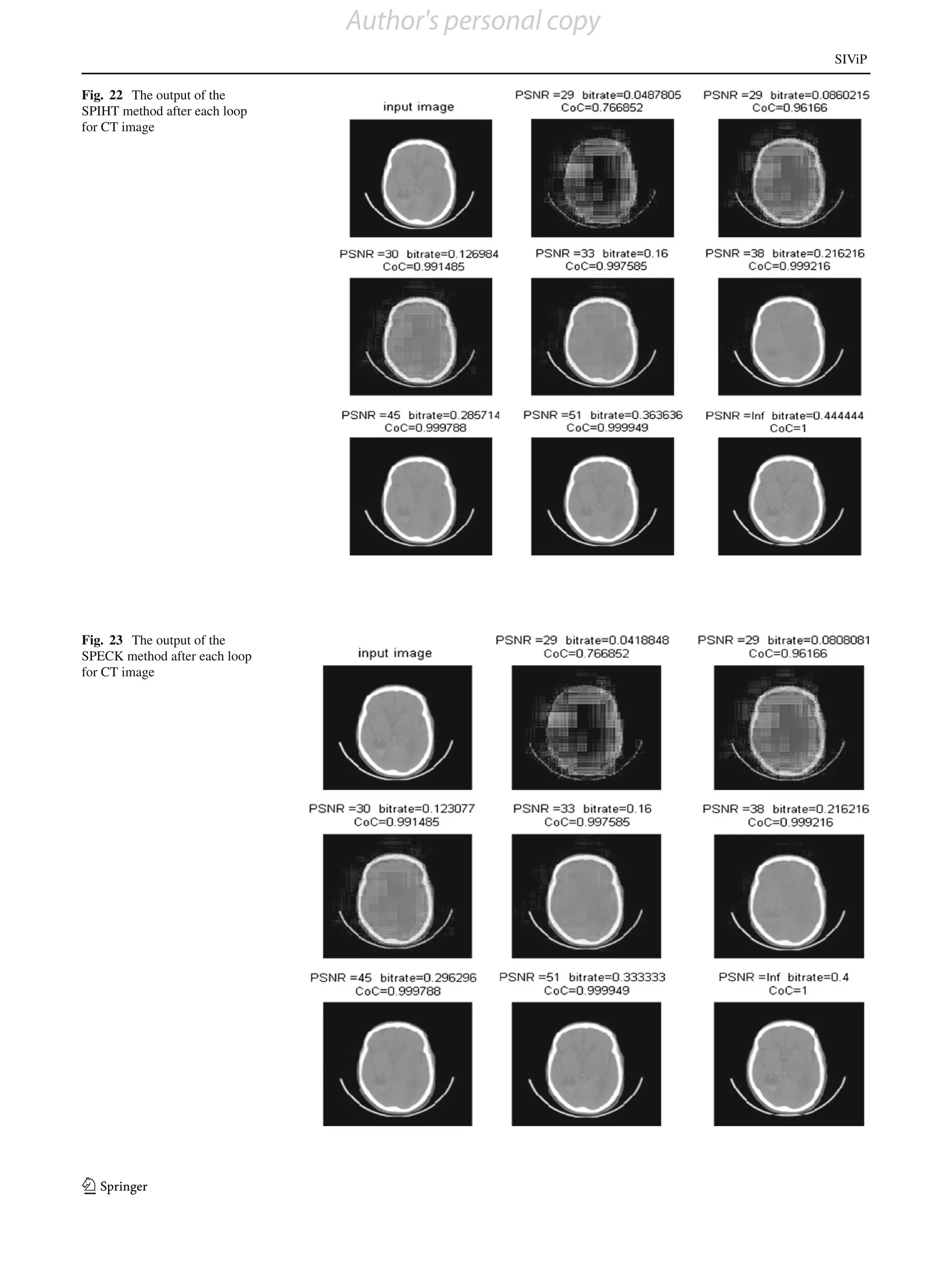
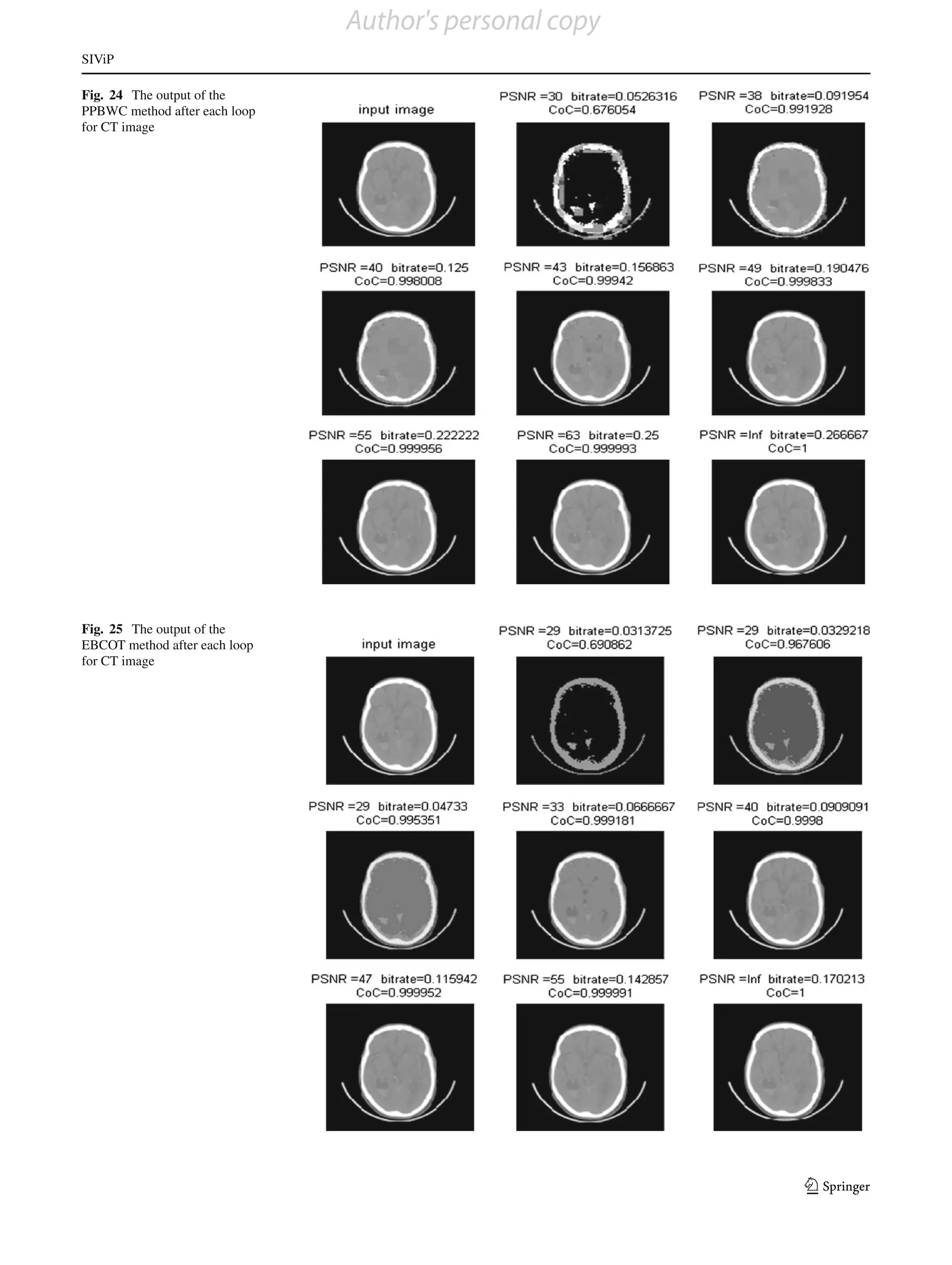
   For CT images, all type of gray values exists. The outputs
after each loop for each method are shown in Figs. 21, 22, 23,
24 and 25. In each figure, the first image shows the input and
second image onward shows the output after each loop. The
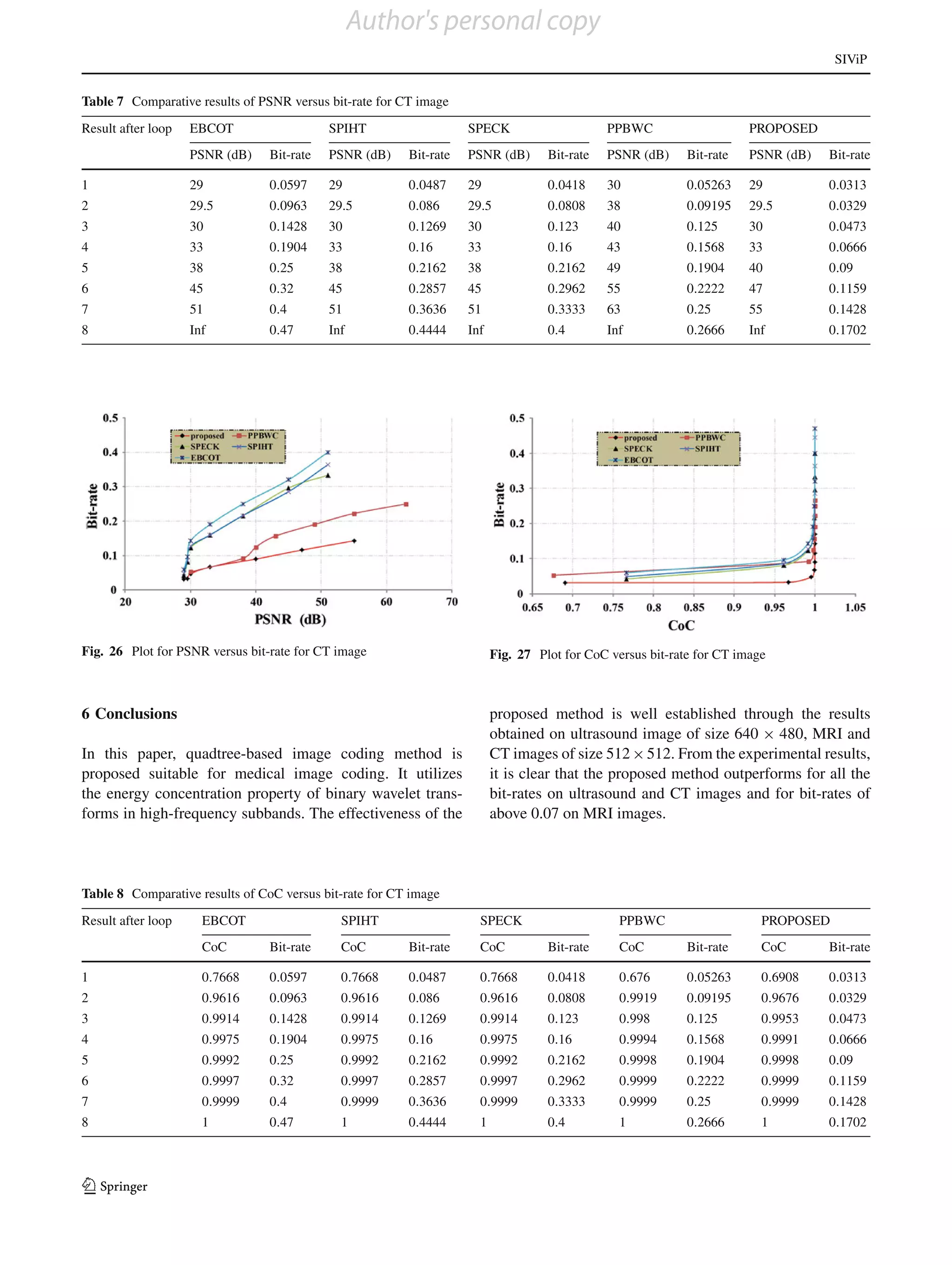
comparative results of the bit-rate versus PSNR are shown
in Table 7, and the corresponding plots are shown in Fig. 26.
                                                                          Fig. 19 Plot for PSNR versus bit-rate for MRI image
The results for bit-rate versus CoC are shown in Table 8, and


123
Author's personal copy
SIViP


Table 6 Comparative results of CoC versus bit-rate for MRI image
Result after loop    EBCOT                   SPIHT                  SPECK                    PPBWC                  PROPOSED
                     CoC         Bit-rate    CoC         Bit-rate   CoC          Bit-rate    CoC        Bit-rate    CoC        Bit-rate

1                    0.6627      0.0465      0.6627      0.037      0.6627       0.0367      0.7304     0.03921     0.7079     0.0313
2                    0.9166      0.0683      0.9167      0.0529     0.9167       0.0479      0.967      0.09638     0.9683     0.0321
3                    0.9751      0.1176      0.9751      0.1095     0.9751       0.0898      0.99       0.16        0.9896     0.0588
4                    0.9927      0.186       0.9927      0.1702     0.9927       0.1568      0.9975     0.2162      0.9972     0.0879
5                    0.9979      0.258       0.9979      0.25       0.9979       0.2424      0.9988     0.2758      0.9989     0.123
6                    0.999       0.3478      0.9993      0.333      0.9994       0.3333      0.9997     0.333       0.9997     0.170
7                    0.9998      0.47        0.9998      0.444      0.9998       0.421       0.9999     0.3636      0.9999     0.222
8                    1           0.6153      1           0.5714     1            0.5333      1          0.4         1          0.266


                                                                        the corresponding plots are shown in Fig. 27. The results are
                                                                        almost nearer to those obtained using PPBWC method for
                                                                        low and medium PSNR values. For a PSNR of above 30 and
                                                                        CoC of above 0.69, the proposed method is performing better
                                                                        than all other methods. For lossless reconstruction, the bit-
                                                                        rate required is only 0.1702 for the proposed method where
                                                                        as it is 0.266 for PPBWC and above 0.4 for the other meth-
                                                                        ods. From the results, it can be seen that the proposed method
                                                                        outperforms all the methods for CT images as well.


Fig. 20 Plot for bit-rate versus CoC for MRI image

Fig. 21 The output of the
EBCOT method after each loop
for CT image


                                                                                                                             123
Author's personal copy
                                                        SIViP

Fig. 22 The output of the
SPIHT method after each loop
for CT image


Fig. 23 The output of the
SPECK method after each loop
for CT image


123
Author's personal copy
SIViP

Fig. 24 The output of the
PPBWC method after each loop
for CT image


Fig. 25 The output of the
EBCOT method after each loop
for CT image


                                                        123
Author's personal copy
                                                                                                                                     SIViP


Table 7 Comparative results of PSNR versus bit-rate for CT image
Result after loop   EBCOT                   SPIHT                   SPECK                      PPBWC                    PROPOSED
                    PSNR (dB)    Bit-rate   PSNR (dB)    Bit-rate   PSNR (dB)       Bit-rate   PSNR (dB)     Bit-rate   PSNR (dB)   Bit-rate

1                   29           0.0597     29           0.0487     29              0.0418     30            0.05263    29          0.0313
2                   29.5         0.0963     29.5         0.086      29.5            0.0808     38            0.09195    29.5        0.0329
3                   30           0.1428     30           0.1269     30              0.123      40            0.125      30          0.0473
4                   33           0.1904     33           0.16       33              0.16       43            0.1568     33          0.0666
5                   38           0.25       38           0.2162     38              0.2162     49            0.1904     40          0.09
6                   45           0.32       45           0.2857     45              0.2962     55            0.2222     47          0.1159
7                   51           0.4        51           0.3636     51              0.3333     63            0.25       55          0.1428
8                   Inf          0.47       Inf          0.4444     Inf             0.4        Inf           0.2666     Inf         0.1702


Fig. 26 Plot for PSNR versus bit-rate for CT image                        Fig. 27 Plot for CoC versus bit-rate for CT image


6 Conclusions                                                             proposed method is well established through the results
                                                                          obtained on ultrasound image of size 640 × 480, MRI and
In this paper, quadtree-based image coding method is                      CT images of size 512 × 512. From the experimental results,
proposed suitable for medical image coding. It utilizes                   it is clear that the proposed method outperforms for all the
the energy concentration property of binary wavelet trans-                bit-rates on ultrasound and CT images and for bit-rates of
forms in high-frequency subbands. The effectiveness of the                above 0.07 on MRI images.


Table 8 Comparative results of CoC versus bit-rate for CT image
Result after loop     EBCOT                   SPIHT                   SPECK                      PPBWC                    PROPOSED
                      CoC        Bit-rate     CoC        Bit-rate     CoC           Bit-rate     CoC         Bit-rate     CoC       Bit-rate

1                     0.7668     0.0597       0.7668     0.0487       0.7668        0.0418       0.676       0.05263      0.6908    0.0313
2                     0.9616     0.0963       0.9616     0.086        0.9616        0.0808       0.9919      0.09195      0.9676    0.0329
3                     0.9914     0.1428       0.9914     0.1269       0.9914        0.123        0.998       0.125        0.9953    0.0473
4                     0.9975     0.1904       0.9975     0.16         0.9975        0.16         0.9994      0.1568       0.9991    0.0666
5                     0.9992     0.25         0.9992     0.2162       0.9992        0.2162       0.9998      0.1904       0.9998    0.09
6                     0.9997     0.32         0.9997     0.2857       0.9997        0.2962       0.9999      0.2222       0.9999    0.1159
7                     0.9999     0.4          0.9999     0.3636       0.9999        0.3333       0.9999      0.25         0.9999    0.1428
8                     1          0.47         1          0.4444       1             0.4          1           0.2666       1         0.1702


123
Author's personal copy
SIViP


References                                                               15. Pearlman, W.A., Islam, A., Nagaraj, N., Said, A.: Efficient
                                                                             low-complexity image coding with a set-partitioning embed-
 1. Chang, C.C., Shine, F.C., Chen, T.S.: A new scheme of progressive        ded block coder. Proc. IEEE Trans. Circuits Syst. Video Tech-
    image transmission based on bit-plane method. In: Proceedings of         nol. 14(11), 1219–1235 (2004)
    Fifth Asian Pacific Conference on Communications and Fourth           16. Taubman, D.: High performance scalable image compression with
    Optoelectronics and Communications Conference, Beijing, China,           EBCOT. Proc. IEEE Trans. Image Process. 9(7), 1159–1170 (2000)
    pp. 892–895 (1999)                                                   17. Pan, H., Siu, W.C., Law, N.F.: Lossless image compression employ-
 2. Jiang, J.H., Chang, C.C., Chen, T.S.: Selective progressive image        ing binary wavelet transforms. Proc. IET Image Process. 1(4), 353–
    transmission using diagonal sampling technique. In: Proceedings          362 (2007)
    of International Symposium on Digital Media Information Base,        18. Swanson, M.D., Tewfik, A.H.: A binary wavelet decomposition
    Nara, Japan, pp. 56–67 (1997)                                            of binary images. Proc. IEEE Trans. Image Process. 5, 1637–
 3. Chang, C.C., Ja, J., Chen, T.S.: A fast reconstruction method for        1650 (1996)
    transmitting images progressively. Proc. IEEE. Trans. Consumer       19. Kamstra, L.: The design of linear binary wavelet transforms and
    Electron. 44(4), 1225–1233 (1998)                                        their application to binary image compression. In: Proceedings
 4. Chung, K.L., Tseng, S.Y.: New progressive image transmission             of IEEE International Conference Image Processing, ICIP’03, pp.
    based on quadtree and shading approach with resolution control.          241–244 (2003)
    Proc. J. Pattern Recognit. 22, 1545–1555                             20. Kamstra, L.: Nonlinear binary wavelet transforms and their appli-
 5. Hung, K.L., Chang, C.C.: New irregular sampling coding method            cation to binary image compression. In: Proceedings of 2003 IEEE
    for transmitting images progressively. Proc. IEEE Vis. Image Sig-        International Conference Image Processing, pp. 593–596 (2002)
    nal Process. 105(1), 44–50 (2003)                                    21. Gerek, Ö.N., Çetin, A.E., Tewfik, A.H.: Subband coding of binary
 6. Yu-Chen, H., Ji-Han, J.: Low complexity progressive image trans-         textual images for document retrieval. In: Proceedings of IEEE
    mission scheme based on quadtree tree segmentation. Proc. J. Real        International Conference Image Processing, ICIP ’96, pp. 899–902
    Time Imaging 11, 59–70 (2005)                                            (1996)
 7. Wang, L., Goldberg, M.: Progressive image transmission using vec-    22. Pan, H., Jin, L.Z., Yuan, X.H., Xia, X.Y., Xia, L.Z.: Context
    tor quantization on images in pyramid form. Proc. IEEE Trans.            based embedded image compression using binary wavelet trans-
    Commun. 37(12), 1341–1348 (1989)                                         form. Proc. J. Image Vis. Comput. 28, 991–1002 (2010)
 8. Goldberg, M., Wang, L.: Comparative performance of pyramid data      23. Law, N.F., Siu, W.C.: A filter design strategy for binary field wave-
    structures for progressive image transmission. Proc. IEEE Trans.         let transform using the perpendicular constraint. Proc. J. Signal
    Commun. 39(4), 540–548 (1991)                                            Process. 87(11), 2850–2858 (2007)
 9. Aiazzi, B., Alparone, L., Baronti, S.: A reduced Laplacian pyramid   24. Sweldens, W.: The lifting scheme: a construction of second gener-
    for lossless and progressive image transmission. Proc. IEEE Trans.       ation wavelets. Proc. SIAM J. Math. Anal. 29(2), 511–546 (1997)
    Commun. 44(1), 18–22 (1996)                                          25. Adams, M.D., Kossentini, F.: Reversible integer-to-integer wave-
10. Qiu, G.: A progressively predictive image pyramid for efficient           let transform for image compression: performance evaluation and
    lossless coding. Proc. IEEE Trans. Image Process. 8(1), 109–             analysis. Proc. IEEE Trans. Image Process. 8(6), 1010–1024 (2000)
    115 (1999)                                                           26. Antonini, M., Barlaud, M., Mathieu, P., Daubechies, I.: Image
11. Huang, Y., Driezen, H.M., Galatsanos, N.P.: Prioritized DCT for          coding using wavelet transforms. Proc. IEEE Trans. Image Pro-
    compression and progressive transmission of images. Proc. IEEE           cess. 1, 205–220 (1992)
    Trans. Image Process. 1(4), 477–487 (1992)                           27. Kanumuri, T., Dewal, M.L., Anand, R.S.: Lossy to lossless medical
12. Shapiro, J.M.: Embedded image coding using zerotrees of wave-            image coding using joint bit scanning method. Proc. Comput. Eng.
    let coefficients. Proc. IEEE Trans. Image Process. 41(12), 3445–          Intell. Syst. 2(4), 101–109 (2011)
    3462 (1993)                                                          28. Murala, S, Maheshwari, R.P., Balasubramanian, R.: Directional
13. Zandi, A., Allen, J.D., Schwartz, E.L., Boliek, M.: CREW: com-           binary wavelet patterns for biomedical image indexing and
    pression with reversible embedded wavelets. In: Proceedings of           retrieval. Proc. J. Med. Syst. doi:10.1007/s10916-011-9764-4
    IEEE Data Computer Conference, pp. 212–221 (1995)
14. Said, A., Pearlman, W.A.: A new fast and efficient image codec
    based on set partitioning in hierarchical trees. Proc. IEEE Trans.
    Circuits Syst. Video Technol. 6(3), 243–250 (1996)


                                                                                                                                    123

Springer base paper

  • 1.
    Progressive medical imagecoding using binary wavelet transforms Tirupathiraju Kanumuri, M. L. Dewal & R. S. Anand Signal, Image and Video Processing ISSN 1863-1703 SIViP DOI 10.1007/s11760-012-0325-1 1 23
  • 2.
    Your article isprotected by copyright and all rights are held exclusively by Springer-Verlag London Limited. This e-offprint is for personal use only and shall not be self-archived in electronic repositories. If you wish to self- archive your work, please use the accepted author’s version for posting to your own website or your institution’s repository. You may further deposit the accepted author’s version on a funder’s repository at a funder’s request, provided it is not made publicly available until 12 months after publication. 1 23
  • 3.
    Author's personal copy SIViP DOI10.1007/s11760-012-0325-1 ORIGINAL PAPER Progressive medical image coding using binary wavelet transforms Tirupathiraju Kanumuri · M. L. Dewal · R. S. Anand Received: 25 September 2011 / Revised: 21 April 2012 / Accepted: 23 April 2012 © Springer-Verlag London Limited 2012 Abstract In this paper, a new algorithm for progressive transmission. In telemedicine, the medical images are trans- medical image coding is presented. An 8-bit gray scale mitted over long distances through Internet. This is mainly image is divided into eight binary bit-planes, and then, binary used in remote places such as villages, ships and air planes wavelet transform is performed on each bit-plane to extract where the specialized doctor is not available for diagnosis. the three-level multi-resolution binary wavelet transformed As the communication channel in such places is very narrow, images. Starting from the most significant bit-plane, each bit- embedded image coding method that can provide progressive plane is encoded using quadtree-based partitioning scheme to reconstruction is preferred so that the doctor can stop decod- exploit the energy concentration in the high-frequency sub- ing based on the individual requirements at the decoding bands. Experiments are conducted on ultrasound, MRI and end. In this paper, a new method is proposed for progressive CT images to prove the effectiveness of the proposed algo- coding of medical images. The previously available progres- rithm. The results show a significant improvement in terms sive image coding methods can be classified into three cat- of bit-rate for the required peak signal-to-noise ratio and cor- egories: spatial domain methods [1–6], pyramidal structure relation coefficient as compared to the existing state-of-art methods [7–10] and transform domain methods [11–27]. Out progressive image coding methods. of the available techniques, transform domain techniques are more efficient due to their compression efficiency and hence Keywords Binary wavelet transforms (BWT) · Progressive employed in JPEG and JPEG 2000 image coding standards image coding · Medical image compression [11,16]. A progressive coding method based on prioritized coding of DCT coefficients is proposed in [11]. DCT suffers from 1 Introduction blocking artifacts for low bit-rates, and to avoid this, many wavelets-based embedded image coding methods are pro- With the advent development of digital imaging and image posed. Shapiro [12] introduced lossy to lossless progressive processing technology, all the hospitals are moving toward embedded image coding method, embedded zerotree wave- digitization of medical images for processing, storage and let coding (EZW). Further, Zandi et al. extended the EZW transmission purposes. This requires huge amount of stor- with the reversible wavelets (CREW) [13]. Said and Pearl- age space for data storage and higher band width for image man introduced an algorithm known as set partitioning in hierarchical trees (SPIHT) [14] which utilizes the concept of parent–child relationship across wavelet subbands. Fur- T. Kanumuri (B) · M. L. Dewal · R. S. Anand ther, Pearlman and Asad have extended the SPIHT, set par- Department of Electrical Engineering, Indian Institute of Technology, Roorkee, Roorkee, 247667 Uttarakhand, India titioning embedded block coder (SPECK) [15] that exploits e-mail: ktrajuiitr@gmail.com the parent–child relationship as well as clustering of energy M. L. Dewal in the frequency domain. Taubman proposed a block-based e-mail: mohanfee@iitr.ernet.in coding method, embedded block coding with optimized trun- R. S. Anand cation of the embedded bit-streams (EBCOT) [16], and it is e-mail: anandfee@iitr.ernet.in included in JPEG 2000. Pan and Siu introduced progressive 123
  • 4.
    Author's personal copy SIViP partitioning binary wavelet tree coder (PPBWC) [17] using ¯ a|s=k defines a vector with elements formed from a circular binary wavelet transforms (BWT). They have combined the ¯ shifted sequence of a by k. and features of zigzag scanning in EZW [12] and partitioning a = {a0 , a1 , . . . , a S−1 }T ¯ priority coding of progressive DCT [11] to encode the BWT. (3) A concise review of the available related literature, tar- ¯ d = {d0 , d1 , . . . , d S−1 }T geted for development of our algorithm, is presented. Binary where S is the number of scales, ai and di are the approximate wavelet transform (BWT) is first proposed for binary image (lowpass) and detail (highpass) coefficients, respectively. compression [17–22]. Later, it has been extended to gray The BWT is then defined [23] as: scale image by separating the gray scale image into series of binary bit-planes, and then, the BWT is performed on each y = Wx (4) bit-plane [23]. Law and Sui proposed the in-place implemen- tation for BWT [17] using lifting scheme that is similar to Law and Sui proposed the in-place implementation for BWT the lifting scheme in the real wavelet transform. BWT has [17]. The 32 length-8 binary filters are classified into four several advantages over the bi-orthogonal wavelets [25] and groups depending on the number of ‘1’s in the binary fil- integer wavelets [26], such as only basic Boolean operations ters. Examples of the binary filters in each group are given are involved, no quantization during transformation, no need in Table 1. In the proposed method, filters of group 1 are to transmit the sign bit and the transformed image have the used because the entropy of the transformed image is less same number of gray levels as the original image. compared to other filters and hence more suitable for image In BWT, the energy clusters in the transformed subbands compression. correspond to the spatial locations associated with edges in In order to have an in-place implementation structure, the the original image. So, the energy is mainly concentrated odd number and even number samples of the original signal in high-frequency subbands and the parent–child relation- are split into two sequences. These two sequences are then ship is very weak [17]. So, the state-of-art progressive cod- updated according to the filter coefficients from the low pass ing methods SPIHT and SPECK are not efficient for binary and high pass filters. The low pass and the high pass outputs image coding. In this paper, a new coding method is pro- are then interleaved together to get the transformed output. posed, which uses the energy concentration property of BWT The scheme is depicted in Fig. 1. If length of the input signal in high-frequency subband. is odd, the last sample is separated out and BWT is applied The paper is organized as follows: a concise review and for remaining signal and the last sample is added at the end implementation of 1-D and 2-D BWT is discussed in Sect. 2. of low pass output. For example, if the input signal is of The Sect. 3 presents the proposed method for encoding 2-D 15 bits length, the low pass filter will have 8 samples and BWT coefficients. The decoding process is given in Sect. 4. high pass filter will have 7 samples. To go for the next level The experimental results in support of the proposed algo- decomposition, BWT is applied to the lowpass output. rithm are discussed in Sect. 5. Finally, the proposed work is concluded in Sect. 6. 2.2 2-D binary wavelet transform (2-D BWT) A separable 2-D BWT [28] can be computed efficiently in binary space by applying the associated one-level 1-D fil- 2 Binary wavelet transform ter bank to each row of the input binary image and to each column of the resultant low pass and high pass output coef- 2.1 1-D binary wavelet transform (1-D BWT) ficients as shown in Fig. 2. This can be extended to gray scale image by separating it into binary bit-planes, and then The BWT is implemented on binary images in the similar performing the BWT to each individual bit-plane of image manner to the lifting scheme for real wavelet transforms on as shown in Fig. 2. To go for second-level decomposition, gray scale images [17]. the 2-D BWT is applied to the LL subband. Let x be an 1 × N signal, the transformed BWT coeffi- cients matrix W can be constructed as follows Table 1 Length-8 binary wavelet filters W = [AD] T (1) Group Lowpass filter Highpass filter 1 {1, 0, 0, 0, 0, 0, 0, 0} {1, 1, 0, 0, 0, 0, 0, 0} where 2 {1, 1, 1, 0, 0, 0, 0, 0} {1, 1, 0, 0, 0, 0, 0, 0} A = (a|s=0 , a|s=2 , . . . , a|s=N −2 ) ¯ ¯ ¯ T 3 {1, 1, 1, 1, 0, 0, 0, 1} {1, 1, 0, 0, 0, 0, 0, 0} (2) 4 {1, 1, 1, 1, 1, 1, 1, 0} {1, 1, 0, 0, 0, 0, 0, 0} ¯ ¯ ¯ D = (d|s=0 , d|s=2 , . . . , d|s=N −2 )T 123
  • 5.
    Author's personal copy SIViP 3The proposed encoder subbands by considering them as parents and then go for the high-frequency subbands. SPECK [15] uses block-based In real and integer wavelet transforms, the energy is concen- coding by checking low-frequency subbands first, and then, trated in low-frequency subbands and a parent–child relation- it checks the high-frequency subbands. The energy clusters ship exists. So, SPIHT [14] starts from the low-frequency in the binary transform subbands correspond to the spatial locations associated with edges in the original image. So, the energy is mainly concentrated in high-frequency subbands. In the proposed method, higher priority is given for encoding high-frequency subbands than the low-frequency subbands. In PPBWC [17], each pixel is checked for significance in every loop until it becomes significant. In case of ultrasound images, most of the pixels have very low values, and thus, it necessitates transmitting more bits for checking the signifi- cance alone. Thus, it is not efficient. In the proposed method, block-based coding is used, which requires only 4 bits to be transmitted if the entire bit-plane is zero. In the proposed method, more emphasis is given for checking high-frequency subbands to exploit energy concentration. The flow chart of the proposed method is given in Fig 3. The input gray scale image is first decomposed into binary bit-planes, and then, three-level 2-D BWT is calculated for each bit-plane starting from the most significant bit-plane (MSB) to the least significant bit-plane (LSB). Initially, the binary wavelet transformed image of each bit-plane is divided Fig. 1 In-place implementation of 1-D BWT for one level into 4 blocks as shown in Fig. 4. To give higher priority for Fig. 2 One-level 2-D BWT implementation for one bit-plane of gray scale image 123
  • 6.
    Author's personal copy SIViP Fig. 3 Flow chart of the proposed encoder Fig. 4 Quadtree partitioning of transformed binary image encoding high-frequency subbands, HH1 is taken as B1 , LH1 and each of the blocks is checked for significance. As each is taken as B2 , HL1 is taken as B3 , and the remaining block time 4 blocks are checked for significance, each 4 bits of the is taken as B4 . output are combined together and converted to the decimal The significance of the block B is checked by form. After completely processing each bit-plane, output is encoded using Huffman coding. Now, it moves on to the next 1, i f max |ci, j | = 1 τn (B) = (i, j)∈B (5) bit-plane and undergoes the same process. As the proposed 0, else method involves only simple checking and division opera- tions, it is easy to implement. where ci, j is transformed coefficient at pixel location (i, j) B1 , B2 , B3 and B4 are checked for significance in serial order using Eq. (5). If Bi (i = 1 : 4) is not significant, 0 is added to output and further processing of Bi is discarded, 4 Decoding process and it goes for the next block. If it is significant, 1 is added to output to indicate to the decoder that it is significant and The data are received from MSB bit-plane to LSB bit-plane. it is decomposed into four equal parts as shown in Fig. 5, User can stop decoding after any bit-plane when the required 123
  • 7.
    Author's personal copy SIViP Table 2 Length-8 inverse binary wavelet filters Group Lowpass filter Highpass filter 1 {1, 1, 0, 0, 0, 0, 0, 0} {0, 1, 0, 0, 0, 0, 0, 0} 2 {0, 0, 1, 1, 0, 0, 0, 0} {0, 1, 1, 1, 0, 0, 0, 0} 3 {0, 0, 0, 0, 0,0, 1, 1} {1, 0, 0, 0, 1, 1, 1, 1} 4 {0, 0, 0, 0, 0,0, 1, 1} {0, 1, 1, 1, 1, 1, 1, 1} Fig. 5 Quadtree partitioning of B sponding block in the original image. For example, if the clarity is reached. The flow chart for the decoder of the image size is 512 × 512, we keep B1 = (257, 257, 256), proposed method is shown in Fig. 6. The flow chart being B2 = (257, 1, 256), B3 = (1, 257, 256), B4 = (1, 1, 256). self-explanatory, the procedure is explained briefly. For each If the value of OUT(O) is 0, keep all the pixels of block as loop (bit-plane), apply Huffman decoding and then convert zeros, increment the value of O by one and go to next block. each decimal value to 4 bit binary and keep in variable OUT. Else, divide the block into 4 blocks, increment the value of Initialize O to 1. Divide the current bit-plane of image into O by one and check each block for significance as shown in 4 blocks B1, B2, B3, and B4 that is, we keep the starting pr ocess B(). For example, if we are processing B1, the new pixel location and size of each block to locate the corre- blocks will be B1 = (129, 129, 128), B2 = (129, 1, 128), Fig. 6 flow chart for the decoder of the proposed method 123
  • 8.
    Author's personal copy SIViP Fig. 7 The output of EBCOT method after each loop for ultrasound image Fig. 8 The output of SPIHT method after each loop for ultrasound image 123
  • 9.
    Author's personal copy SIViP Fig.9 The output of SPECK method after each loop for ultrasound image Fig. 10 The output of PPBWC method after each loop for ultrasound image 123
  • 10.
    Author's personal copy SIViP Fig. 11 The output of the proposed method after each loop for ultrasound image Table 3 Comparative results of PSNR versus bit-rate for ultrasound image Result after loop EBCOT SPIHT SPECK PPBWC PROPOSED PSNR (dB) Bit-rate PSNR (dB) Bit-rate PSNR (dB) Bit-rate PSNR (dB) Bit-rate PSNR (dB) Bit-rate 1 27 0.0465 27 0.0313 27 0.0313 27 0.03636 27 0.0313 2 28 0.0720 28 0.0571 28 0.057 29 0.1194 28 0.0792 3 28.5 0.125 28.5 0.1212 28.5 0.1066 31 0.2 32 0.1212 4 30 0.21 30 0.2 30 0.2 38 0.2758 38 0.1632 5 35 0.32 35 0.3076 35 0.32 46 0.32 45 0.2051 6 42 0.42 42 0.4210 42 0.4 55 0.3636 54 0.25 7 48 0.53 48 0.533 48 0.5 64 0.3809 Inf 0.2962 8 Inf 0.666 Inf 0.6153 Inf 0.6153 Inf 0.3892 B3 = (1, 129, 128), B4 = (1, 1, 128). While processing a 5 Experimental results and discussions block if it is reached to single pixel and value of OUT(O) is 1, then replace that pixel value in the current bit-plane of The performance of the proposed method is evaluated using the image with 1. After completing the decoding of the entire the bit-rate for the given peak signal-to-noise ratio (PSNR) bit-plane, apply three-level inverse BWT and combine all the and the correlation coefficient (CoC) [27]. A set of ten MRI, bit-planes to form gray scale image. Examples of the inverse ten CT images and five ultrasound images are taken for our binary filters in each group are given in Table 2. Now check experiment. The proposed method is compared with the state- whether the required clarity is reached. If it has not reached, of-art progressive image coders. SPIHT [14], SPECK [15] go for the next loop. and EBCOT [16] are implemented using (2, 2) integer wave- 123
  • 11.
    Author's personal copy SIViP Fig.12 Plot for PSNR versus bit-rate for ultrasound image Fig. 13 Plot for bit-rate versus CoC for ultrasound image let transforms, and the PPBWC [17] is implemented using decoding after any loop depending on the clarity required for BWT. We got almost similar results for all the images of each making the diagnosis. For lossless reconstruction, the bit-rate set, and hence, the results for one image from each group are required for the proposed method is only 0.2962 where as it presented in this section. is 0.3892 for PPBWC and is above 0.6 for the other methods. For ultrasound images, most of the pixels’ gray levels are From the results and above observations, it is cleared that the near to zero. Hence, most of the bit-planes consist of only proposed method outperforms all the methods on ultrasound zeros, and they need not be encoded. In the proposed method, images. only four bits are transmitted if all the pixels in the bit-plane For MRI images, most of the pixels’ gray levels have are zero. But, in PPBWC and SPIHT, more bits are to be medium values. Hence, the proposed method needs more transmitted. Thus, the proposed method requires lesser bit- bits initially giving inferior results for low bit-rate trans- rate for the required PSNR and CoC. The outputs after each mission. But, for medium and high bit-rates, the proposed loop for each method are shown in Figs. 7, 8, 9, 10 and 11. method gives better results than existing methods. The out- In each figure, the first image shows the input and second puts after each loop for each method are shown in Figs. 14, image onward shows the output after each loop. The com- 15, 16, 17 and 18. In each figure, the first image shows the parative results of the bit-rate versus PSNR after each loop input and second image onward shows the output after each for one image are shown in Table 3, and the corresponding loop. The comparative results of the bit-rate versus PSNR plots are shown in Fig. 12. The results for bit-rate versus CoC are shown in Table 5, and the corresponding plots are shown after each loop are shown in Table 4, and the corresponding in Fig. 19. The results for bit-rate versus CoC are shown in plots are shown in Fig. 13. From the plot, it can be seen that Table 6, and the corresponding plots are shown in Fig. 20. up to 2nd loop, the proposed method is giving comparable From the plots, it can be seen that for a PSNR of 33 and results and from the 3rd loop onwards, requires very less CoC of 0.96, the PPBWC is giving better results than the bit-rate when compared with bit-rates obtainable from other proposed method and for PSNR of above 33 and CoC of methods for the required PSNR and CoC. The user can stop above 0.96, the proposed method is giving better results Table 4 Comparative results of CoC versus bit-rate for ultrasound image Result after loop EBCOT SPIHT SPECK PPBWC PROPOSED CoC Bit-rate CoC Bit-rate CoC Bit-rate CoC Bit-rate CoC Bit-rate 1 0.3496 0.0465 0.3496 0.3137 0.349 0.0313 0.5797 0.03636 0.5723 0.3137 2 0.7968 0.0720 0.7968 0.0571 0.7968 0.057 0.8862 0.1194 0.9711 0.0792 3 0.9366 0.125 0.9366 0.1212 0.9366 0.1066 0.9723 0.2 0.9931 0.1212 4 0.9820 0.21 0.9825 0.2 0.9825 0.2 0.9944 0.2758 0.9985 0.1632 5 0.9956 0.32 0.99 0.3076 0.9956 0.32 0.998 0.32 0.999 0.2051 6 0.998 0.42 0.9989 0.4210 0.9989 0.4 0.9998 0.3636 0.9999 0.25 7 0.999 0.53 0.999 0.533 0.999 0.5 0.9999 0.3809 1 0.2962 8 1 0.666 1 0.6153 1 0.6153 1 0.3892 123
  • 12.
    Author's personal copy SIViP Fig. 14 The output of the EBCOT method after each loop for MRI image Fig. 15 The output of the SPIHT method after each loop for MRI image 123
  • 13.
    Author's personal copy SIViP Fig.16 The output of the SPECK method after each loop for MRI image Fig. 17 The output of the PPBWC method after each loop for MRI image 123
  • 14.
    Author's personal copy SIViP Fig. 18 The output of the proposed method after each loop for MRI image Table 5 Comparative results of PSNR versus bit-rate for MRI image Result after loop EBCOT SPIHT SPECK PPBWC PROPOSED PSNR (dB) Bit-rate PSNR (dB) Bit-rate PSNR (dB) Bit-rate PSNR (dB) Bit-rate PSNR (dB) Bit-rate 1 28 0.0465 28 0.037 28 0.0367 29 0.03921 28 0.0313 2 29 0.0683 29 0.0529 29 0.0479 33 0.09638 29 0.0321 3 30 0.1176 30 0.1095 30 0.0898 34 0.16 30 0.0588 4 31 0.186 31 0.1702 31 0.1568 37 0.2162 32 0.0879 5 35 0.258 35 0.25 35 0.2424 40 0.2758 37 0.123 6 42 0.3478 42 0.333 42 0.3333 50 0.333 44 0.170 7 48 0.47 48 0.444 48 0.421 59 0.3636 52 0.222 8 Inf 0.6153 Inf 0.5714 Inf 0.5333 Inf 0.4 Inf 0.266 than the existing methods. For lossless reconstruction, the bit-rate is only 0.266 for the proposed method where as it is 0.4 for PPBWC, above 0.5 for other methods. From the results, it is clear that the proposed method outperforms all the methods for medium and high bit-rates for MRI images. For CT images, all type of gray values exists. The outputs after each loop for each method are shown in Figs. 21, 22, 23, 24 and 25. In each figure, the first image shows the input and second image onward shows the output after each loop. The comparative results of the bit-rate versus PSNR are shown in Table 7, and the corresponding plots are shown in Fig. 26. Fig. 19 Plot for PSNR versus bit-rate for MRI image The results for bit-rate versus CoC are shown in Table 8, and 123
  • 15.
    Author's personal copy SIViP Table6 Comparative results of CoC versus bit-rate for MRI image Result after loop EBCOT SPIHT SPECK PPBWC PROPOSED CoC Bit-rate CoC Bit-rate CoC Bit-rate CoC Bit-rate CoC Bit-rate 1 0.6627 0.0465 0.6627 0.037 0.6627 0.0367 0.7304 0.03921 0.7079 0.0313 2 0.9166 0.0683 0.9167 0.0529 0.9167 0.0479 0.967 0.09638 0.9683 0.0321 3 0.9751 0.1176 0.9751 0.1095 0.9751 0.0898 0.99 0.16 0.9896 0.0588 4 0.9927 0.186 0.9927 0.1702 0.9927 0.1568 0.9975 0.2162 0.9972 0.0879 5 0.9979 0.258 0.9979 0.25 0.9979 0.2424 0.9988 0.2758 0.9989 0.123 6 0.999 0.3478 0.9993 0.333 0.9994 0.3333 0.9997 0.333 0.9997 0.170 7 0.9998 0.47 0.9998 0.444 0.9998 0.421 0.9999 0.3636 0.9999 0.222 8 1 0.6153 1 0.5714 1 0.5333 1 0.4 1 0.266 the corresponding plots are shown in Fig. 27. The results are almost nearer to those obtained using PPBWC method for low and medium PSNR values. For a PSNR of above 30 and CoC of above 0.69, the proposed method is performing better than all other methods. For lossless reconstruction, the bit- rate required is only 0.1702 for the proposed method where as it is 0.266 for PPBWC and above 0.4 for the other meth- ods. From the results, it can be seen that the proposed method outperforms all the methods for CT images as well. Fig. 20 Plot for bit-rate versus CoC for MRI image Fig. 21 The output of the EBCOT method after each loop for CT image 123
  • 16.
    Author's personal copy SIViP Fig. 22 The output of the SPIHT method after each loop for CT image Fig. 23 The output of the SPECK method after each loop for CT image 123
  • 17.
    Author's personal copy SIViP Fig.24 The output of the PPBWC method after each loop for CT image Fig. 25 The output of the EBCOT method after each loop for CT image 123
  • 18.
    Author's personal copy SIViP Table 7 Comparative results of PSNR versus bit-rate for CT image Result after loop EBCOT SPIHT SPECK PPBWC PROPOSED PSNR (dB) Bit-rate PSNR (dB) Bit-rate PSNR (dB) Bit-rate PSNR (dB) Bit-rate PSNR (dB) Bit-rate 1 29 0.0597 29 0.0487 29 0.0418 30 0.05263 29 0.0313 2 29.5 0.0963 29.5 0.086 29.5 0.0808 38 0.09195 29.5 0.0329 3 30 0.1428 30 0.1269 30 0.123 40 0.125 30 0.0473 4 33 0.1904 33 0.16 33 0.16 43 0.1568 33 0.0666 5 38 0.25 38 0.2162 38 0.2162 49 0.1904 40 0.09 6 45 0.32 45 0.2857 45 0.2962 55 0.2222 47 0.1159 7 51 0.4 51 0.3636 51 0.3333 63 0.25 55 0.1428 8 Inf 0.47 Inf 0.4444 Inf 0.4 Inf 0.2666 Inf 0.1702 Fig. 26 Plot for PSNR versus bit-rate for CT image Fig. 27 Plot for CoC versus bit-rate for CT image 6 Conclusions proposed method is well established through the results obtained on ultrasound image of size 640 × 480, MRI and In this paper, quadtree-based image coding method is CT images of size 512 × 512. From the experimental results, proposed suitable for medical image coding. It utilizes it is clear that the proposed method outperforms for all the the energy concentration property of binary wavelet trans- bit-rates on ultrasound and CT images and for bit-rates of forms in high-frequency subbands. The effectiveness of the above 0.07 on MRI images. Table 8 Comparative results of CoC versus bit-rate for CT image Result after loop EBCOT SPIHT SPECK PPBWC PROPOSED CoC Bit-rate CoC Bit-rate CoC Bit-rate CoC Bit-rate CoC Bit-rate 1 0.7668 0.0597 0.7668 0.0487 0.7668 0.0418 0.676 0.05263 0.6908 0.0313 2 0.9616 0.0963 0.9616 0.086 0.9616 0.0808 0.9919 0.09195 0.9676 0.0329 3 0.9914 0.1428 0.9914 0.1269 0.9914 0.123 0.998 0.125 0.9953 0.0473 4 0.9975 0.1904 0.9975 0.16 0.9975 0.16 0.9994 0.1568 0.9991 0.0666 5 0.9992 0.25 0.9992 0.2162 0.9992 0.2162 0.9998 0.1904 0.9998 0.09 6 0.9997 0.32 0.9997 0.2857 0.9997 0.2962 0.9999 0.2222 0.9999 0.1159 7 0.9999 0.4 0.9999 0.3636 0.9999 0.3333 0.9999 0.25 0.9999 0.1428 8 1 0.47 1 0.4444 1 0.4 1 0.2666 1 0.1702 123
  • 19.
    Author's personal copy SIViP References 15. Pearlman, W.A., Islam, A., Nagaraj, N., Said, A.: Efficient low-complexity image coding with a set-partitioning embed- 1. Chang, C.C., Shine, F.C., Chen, T.S.: A new scheme of progressive ded block coder. Proc. IEEE Trans. Circuits Syst. Video Tech- image transmission based on bit-plane method. In: Proceedings of nol. 14(11), 1219–1235 (2004) Fifth Asian Pacific Conference on Communications and Fourth 16. Taubman, D.: High performance scalable image compression with Optoelectronics and Communications Conference, Beijing, China, EBCOT. Proc. IEEE Trans. Image Process. 9(7), 1159–1170 (2000) pp. 892–895 (1999) 17. Pan, H., Siu, W.C., Law, N.F.: Lossless image compression employ- 2. Jiang, J.H., Chang, C.C., Chen, T.S.: Selective progressive image ing binary wavelet transforms. Proc. IET Image Process. 1(4), 353– transmission using diagonal sampling technique. In: Proceedings 362 (2007) of International Symposium on Digital Media Information Base, 18. Swanson, M.D., Tewfik, A.H.: A binary wavelet decomposition Nara, Japan, pp. 56–67 (1997) of binary images. Proc. IEEE Trans. Image Process. 5, 1637– 3. Chang, C.C., Ja, J., Chen, T.S.: A fast reconstruction method for 1650 (1996) transmitting images progressively. Proc. IEEE. Trans. Consumer 19. Kamstra, L.: The design of linear binary wavelet transforms and Electron. 44(4), 1225–1233 (1998) their application to binary image compression. In: Proceedings 4. Chung, K.L., Tseng, S.Y.: New progressive image transmission of IEEE International Conference Image Processing, ICIP’03, pp. based on quadtree and shading approach with resolution control. 241–244 (2003) Proc. J. Pattern Recognit. 22, 1545–1555 20. Kamstra, L.: Nonlinear binary wavelet transforms and their appli- 5. Hung, K.L., Chang, C.C.: New irregular sampling coding method cation to binary image compression. In: Proceedings of 2003 IEEE for transmitting images progressively. Proc. IEEE Vis. Image Sig- International Conference Image Processing, pp. 593–596 (2002) nal Process. 105(1), 44–50 (2003) 21. Gerek, Ö.N., Çetin, A.E., Tewfik, A.H.: Subband coding of binary 6. Yu-Chen, H., Ji-Han, J.: Low complexity progressive image trans- textual images for document retrieval. In: Proceedings of IEEE mission scheme based on quadtree tree segmentation. Proc. J. Real International Conference Image Processing, ICIP ’96, pp. 899–902 Time Imaging 11, 59–70 (2005) (1996) 7. Wang, L., Goldberg, M.: Progressive image transmission using vec- 22. Pan, H., Jin, L.Z., Yuan, X.H., Xia, X.Y., Xia, L.Z.: Context tor quantization on images in pyramid form. Proc. IEEE Trans. based embedded image compression using binary wavelet trans- Commun. 37(12), 1341–1348 (1989) form. Proc. J. Image Vis. Comput. 28, 991–1002 (2010) 8. Goldberg, M., Wang, L.: Comparative performance of pyramid data 23. Law, N.F., Siu, W.C.: A filter design strategy for binary field wave- structures for progressive image transmission. Proc. IEEE Trans. let transform using the perpendicular constraint. Proc. J. Signal Commun. 39(4), 540–548 (1991) Process. 87(11), 2850–2858 (2007) 9. Aiazzi, B., Alparone, L., Baronti, S.: A reduced Laplacian pyramid 24. Sweldens, W.: The lifting scheme: a construction of second gener- for lossless and progressive image transmission. Proc. IEEE Trans. ation wavelets. Proc. SIAM J. Math. Anal. 29(2), 511–546 (1997) Commun. 44(1), 18–22 (1996) 25. Adams, M.D., Kossentini, F.: Reversible integer-to-integer wave- 10. Qiu, G.: A progressively predictive image pyramid for efficient let transform for image compression: performance evaluation and lossless coding. Proc. IEEE Trans. Image Process. 8(1), 109– analysis. Proc. IEEE Trans. Image Process. 8(6), 1010–1024 (2000) 115 (1999) 26. Antonini, M., Barlaud, M., Mathieu, P., Daubechies, I.: Image 11. Huang, Y., Driezen, H.M., Galatsanos, N.P.: Prioritized DCT for coding using wavelet transforms. Proc. IEEE Trans. Image Pro- compression and progressive transmission of images. Proc. IEEE cess. 1, 205–220 (1992) Trans. Image Process. 1(4), 477–487 (1992) 27. Kanumuri, T., Dewal, M.L., Anand, R.S.: Lossy to lossless medical 12. Shapiro, J.M.: Embedded image coding using zerotrees of wave- image coding using joint bit scanning method. Proc. Comput. Eng. let coefficients. Proc. IEEE Trans. Image Process. 41(12), 3445– Intell. Syst. 2(4), 101–109 (2011) 3462 (1993) 28. Murala, S, Maheshwari, R.P., Balasubramanian, R.: Directional 13. Zandi, A., Allen, J.D., Schwartz, E.L., Boliek, M.: CREW: com- binary wavelet patterns for biomedical image indexing and pression with reversible embedded wavelets. In: Proceedings of retrieval. Proc. J. Med. Syst. doi:10.1007/s10916-011-9764-4 IEEE Data Computer Conference, pp. 212–221 (1995) 14. Said, A., Pearlman, W.A.: A new fast and efficient image codec based on set partitioning in hierarchical trees. Proc. IEEE Trans. Circuits Syst. Video Technol. 6(3), 243–250 (1996) 123