Family And Intimate
Relationships
Zerk Shaban
Ali Pirzada
Saad Mansoor
Sayyed Afraz Hassan
Shaleem John
BS(CS)
2014-2018
Overview
• Global View of The Family
• Sociology Perspectives
• Marriage and Family
• Divorce
• Diverse Lifestyles
Global View of the
Family Zerk Shaban
Family
What is a Family?
A family is a group of people living together as a unit. A group of
people sharing common ancestry.
• Types of Family
• Nuclear Family
Family in which Parents and unmarried children live together.
• Extended Family
A joint family living together including other relatives.
Continue…
• Monogamy
It is a form of family in which one man and one woman are married only to
each other.
• Polygamy
Some cultures allow to have several husbands or wives simultaneously.
 Research
Anthropologist George Murdock (1949,1957) sampled 565 societies and
found that in more than 80 percent, some type of polygamy was preferred
form.
• Polyandry
It is a form of family in which a woman may have more than one husband
at the same time.
Kinship Patterns: To whom are we Related?
• In every culture, children encounter relative to whom they are expected
to show an emotional attachment. The state of being related to others is
called kinship. Kinship is culturally learned, however, and is not totally
determined by biological or marital ties. For example, adoption creates
a kinship tie that is legally acknowledged and socially accepted.
• Kin groups include aunts, uncles, cousins, in-laws and so forth.
Polygany
It is a form of family in which a man can have more than one wife at a
time.
Sociological Perspectives Ali Pirzada
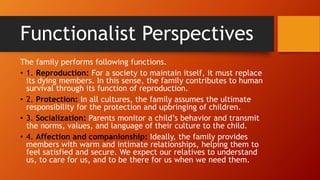
Functionalist Perspectives
The family performs following functions.
• 1. Reproduction: For a society to maintain itself, it must replace
its dying members. In this sense, the family contributes to human
survival through its function of reproduction.
• 2. Protection: In all cultures, the family assumes the ultimate
responsibility for the protection and upbringing of children.
• 3. Socialization: Parents monitor a child’s behavior and transmit
the norms, values, and language of their culture to the child.
• 4. Affection and companionship: Ideally, the family provides
members with warm and intimate relationships, helping them to
feel satisfied and secure. We expect our relatives to understand
us, to care for us, and to be there for us when we need them.
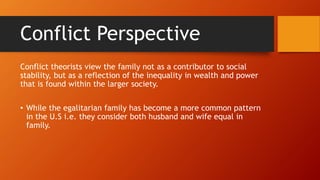
Conflict Perspective
Conflict theorists view the family not as a contributor to social
stability, but as a reflection of the inequality in wealth and power
that is found within the larger society.
• While the egalitarian family has become a more common pattern
in the U.S i.e. they consider both husband and wife equal in
family.
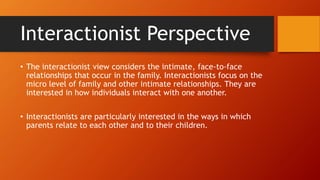
Interactionist Perspective
• The interactionist view considers the intimate, face-to-face
relationships that occur in the family. Interactionists focus on the
micro level of family and other intimate relationships. They are
interested in how individuals interact with one another.
• Interactionists are particularly interested in the ways in which
parents relate to each other and to their children.
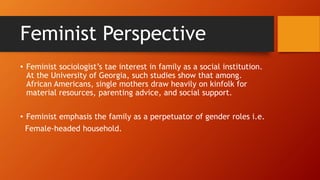
Feminist Perspective
• Feminist sociologist’s tae interest in family as a social institution.
At the University of Georgia, such studies show that among.
African Americans, single mothers draw heavily on kinfolk for
material resources, parenting advice, and social support.
• Feminist emphasis the family as a perpetuator of gender roles i.e.
Female-headed household.
Marriage and
Family Saad Mansoor
Marriage
What is Marriage?
Marriage is the approved social pattern whereby two or more
persons established a family.
• Courtship and mate selection
• In the past, most of the couples met their partners through
friends, or their neighborhood or work place.
Continue…
• Aspects of mate selection
• Many societies have explicit or unstated rules that define
potential mates as acceptable or unacceptable.
• Endogamy
• Exogamy
• Homogamy
The Love Relationship
• Nowadays the young generation of most of the societies has
changed; there general perspective of thinking. If we look in the
past marriages were arranged by the parents but now in most of
the societies, young generation selects there life partner by their
own. But in some of the cultures it is taken as immoral due to
their religious aspects.
Variations in family life and intimate
relationships
• Social class differences
• Racial and ethnic differences
• Parenthood and grandparenthood
• Adoption
• Dual-income families
• Single-parent families
• Step families
Divorce Sayyed Afraz Hassan
Divorce
What is Divorce?
Any formal separation of husband and wife according to established
custom.
• Explanation: Divorce is compared to an epidemic in any society it
infiltrates. Currently, it is spreading at an alarming rate.
Frequently, offspring are most affected. Various researches on the
relationship of divorce and its social effects in children are
compared and contrasted by this study.
Continue…
• Introduction: Divorce is extremely common in today. In
fact, one out of every two marriages ends in divorce.
Numerous children are raised in single-parent homes.
• Children of divorcees have carried with them divorce
related problems.
Problems for Children
What problems do Children face?
Children who have experienced high anxiety life events, such as
divorce, develop problems during adolescence. When problems such
as depression develop during adolescence, these problems persist
into adulthood.
Surveys
• In many countries, divorce began to increase in the late 1960s but
then leveled off; since the late 1980s, it has declined by 30
percent.
• Three researches were scrutinized namely: Parental Study 1993,
Institute's Parents and Children after Marriage Breakdown 1992
and Loyola University New Orleans 2006 studies.
Diverse Lifestyles Shaleem John
Cohabitation
What is Cohabitation?
Cohabitation is a practice in which male-female couples choose to
live together without marrying.
• The number of unmarried couples has been rising steadily; in 2010
it was 6.7 million.
• In Europe, cohabitation is so common that the general sentiment
seems to be “Love, yes; marriage, maybe.”
Remaining Single
• Men and women in some societies are likely to remain single
throughout their lives. There are many reasons why a person may
choose not to marry.
What is the Main Reason?
Marriage Without Children
• More and more couples today, however, choose not to have
children and regard themselves as child- free. They do not believe
that having children is necessary.
Why?
Economic considerations for having children has become quite
expensive. According to a government estimate made for 2012, the
average middle-class family would be able to spend $229,320 to
feed, clothe, and shelter a child from birth to age 18.
Lesbian and Gay Relationships
• As we know, when same-gender people are attracted to each
other then we use the term gay and lesbian for them.
• Gay and lesbian couples face discrimination on both a personal
and a legal level. Their inability to marry denies them many rights
that married couples take for granted.
• Though gay couples consider themselves families just like the
straight couples who live down the street, they are often treated
as if they are not.
Review
• Family
• Types of Family
• Sociological Perspectives
• Marriage
• Divorce
• Diverse Lifestyles
Time for Questions?

Family and intimate relationships

  • 1.
    Family And Intimate Relationships ZerkShaban Ali Pirzada Saad Mansoor Sayyed Afraz Hassan Shaleem John BS(CS) 2014-2018
  • 2.
    Overview • Global Viewof The Family • Sociology Perspectives • Marriage and Family • Divorce • Diverse Lifestyles
  • 3.
    Global View ofthe Family Zerk Shaban
  • 4.
    Family What is aFamily? A family is a group of people living together as a unit. A group of people sharing common ancestry. • Types of Family • Nuclear Family Family in which Parents and unmarried children live together. • Extended Family A joint family living together including other relatives.
  • 5.
    Continue… • Monogamy It isa form of family in which one man and one woman are married only to each other. • Polygamy Some cultures allow to have several husbands or wives simultaneously.  Research Anthropologist George Murdock (1949,1957) sampled 565 societies and found that in more than 80 percent, some type of polygamy was preferred form. • Polyandry It is a form of family in which a woman may have more than one husband at the same time.
  • 6.
    Kinship Patterns: Towhom are we Related? • In every culture, children encounter relative to whom they are expected to show an emotional attachment. The state of being related to others is called kinship. Kinship is culturally learned, however, and is not totally determined by biological or marital ties. For example, adoption creates a kinship tie that is legally acknowledged and socially accepted. • Kin groups include aunts, uncles, cousins, in-laws and so forth. Polygany It is a form of family in which a man can have more than one wife at a time.
  • 7.
  • 8.
    Functionalist Perspectives The familyperforms following functions. • 1. Reproduction: For a society to maintain itself, it must replace its dying members. In this sense, the family contributes to human survival through its function of reproduction. • 2. Protection: In all cultures, the family assumes the ultimate responsibility for the protection and upbringing of children. • 3. Socialization: Parents monitor a child’s behavior and transmit the norms, values, and language of their culture to the child. • 4. Affection and companionship: Ideally, the family provides members with warm and intimate relationships, helping them to feel satisfied and secure. We expect our relatives to understand us, to care for us, and to be there for us when we need them.
  • 9.
    Conflict Perspective Conflict theoristsview the family not as a contributor to social stability, but as a reflection of the inequality in wealth and power that is found within the larger society. • While the egalitarian family has become a more common pattern in the U.S i.e. they consider both husband and wife equal in family.
  • 10.
    Interactionist Perspective • Theinteractionist view considers the intimate, face-to-face relationships that occur in the family. Interactionists focus on the micro level of family and other intimate relationships. They are interested in how individuals interact with one another. • Interactionists are particularly interested in the ways in which parents relate to each other and to their children.
  • 11.
    Feminist Perspective • Feministsociologist’s tae interest in family as a social institution. At the University of Georgia, such studies show that among. African Americans, single mothers draw heavily on kinfolk for material resources, parenting advice, and social support. • Feminist emphasis the family as a perpetuator of gender roles i.e. Female-headed household.
  • 12.
  • 13.
    Marriage What is Marriage? Marriageis the approved social pattern whereby two or more persons established a family. • Courtship and mate selection • In the past, most of the couples met their partners through friends, or their neighborhood or work place.
  • 14.
    Continue… • Aspects ofmate selection • Many societies have explicit or unstated rules that define potential mates as acceptable or unacceptable. • Endogamy • Exogamy • Homogamy
  • 15.
    The Love Relationship •Nowadays the young generation of most of the societies has changed; there general perspective of thinking. If we look in the past marriages were arranged by the parents but now in most of the societies, young generation selects there life partner by their own. But in some of the cultures it is taken as immoral due to their religious aspects.
  • 16.
    Variations in familylife and intimate relationships • Social class differences • Racial and ethnic differences • Parenthood and grandparenthood • Adoption • Dual-income families • Single-parent families • Step families
  • 17.
  • 18.
    Divorce What is Divorce? Anyformal separation of husband and wife according to established custom. • Explanation: Divorce is compared to an epidemic in any society it infiltrates. Currently, it is spreading at an alarming rate. Frequently, offspring are most affected. Various researches on the relationship of divorce and its social effects in children are compared and contrasted by this study.
  • 19.
    Continue… • Introduction: Divorceis extremely common in today. In fact, one out of every two marriages ends in divorce. Numerous children are raised in single-parent homes. • Children of divorcees have carried with them divorce related problems.
  • 20.
    Problems for Children Whatproblems do Children face? Children who have experienced high anxiety life events, such as divorce, develop problems during adolescence. When problems such as depression develop during adolescence, these problems persist into adulthood.
  • 21.
    Surveys • In manycountries, divorce began to increase in the late 1960s but then leveled off; since the late 1980s, it has declined by 30 percent. • Three researches were scrutinized namely: Parental Study 1993, Institute's Parents and Children after Marriage Breakdown 1992 and Loyola University New Orleans 2006 studies.
  • 22.
  • 23.
    Cohabitation What is Cohabitation? Cohabitationis a practice in which male-female couples choose to live together without marrying. • The number of unmarried couples has been rising steadily; in 2010 it was 6.7 million. • In Europe, cohabitation is so common that the general sentiment seems to be “Love, yes; marriage, maybe.”
  • 24.
    Remaining Single • Menand women in some societies are likely to remain single throughout their lives. There are many reasons why a person may choose not to marry. What is the Main Reason?
  • 25.
    Marriage Without Children •More and more couples today, however, choose not to have children and regard themselves as child- free. They do not believe that having children is necessary. Why? Economic considerations for having children has become quite expensive. According to a government estimate made for 2012, the average middle-class family would be able to spend $229,320 to feed, clothe, and shelter a child from birth to age 18.
  • 26.
    Lesbian and GayRelationships • As we know, when same-gender people are attracted to each other then we use the term gay and lesbian for them. • Gay and lesbian couples face discrimination on both a personal and a legal level. Their inability to marry denies them many rights that married couples take for granted. • Though gay couples consider themselves families just like the straight couples who live down the street, they are often treated as if they are not.
  • 27.
    Review • Family • Typesof Family • Sociological Perspectives • Marriage • Divorce • Diverse Lifestyles
  • 28.