BUILD-UP/BUILD
DOWN
Array card for Inverse relationship between
Multiplication and Division
Designed for Grade 2
EDX1280 S3 2014
Student no: 0031010900
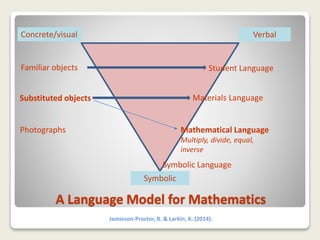
A Language Model for Mathematics
Jamieson-Proctor, R. & Larkin, K. (2014).
Student LanguageFamiliar objects
Materials LanguageSubstituted objects
Mathematical Language
Multiply, divide, equal,
inverse
Photographs
Symbolic Language
VerbalConcrete/visual
Symbolic
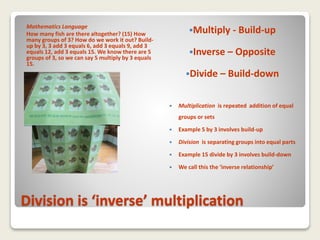
Division is ‘inverse’ multiplication
Mathematics Language
How many fish are there altogether? (15) How
many groups of 3? How do we work it out? Build-
up by 3, 3 add 3 equals 6, add 3 equals 9, add 3
equals 12, add 3 equals 15. We know there are 5
groups of 3, so we can say 5 multiply by 3 equals
15.
Multiply - Build-up
Inverse – Opposite
Divide – Build-down
 Multiplication is repeated addition of equal
groups or sets
 Example 5 by 3 involves build-up
 Division is separating groups into equal parts
 Example 15 divide by 3 involves build-down
 We call this the ‘inverse relationship’
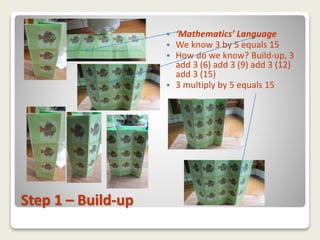
Step 1 – Build-up
 ‘Mathematics’ Language
 We know 3 by 5 equals 15
 How do we know? Build-up, 3
add 3 (6) add 3 (9) add 3 (12)
add 3 (15)
 3 multiply by 5 equals 15
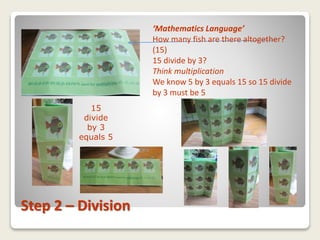
Step 2 – Division
15
divide
by 3
equals 5
‘Mathematics Language’
How many fish are there altogether?
(15)
15 divide by 3?
Think multiplication
We know 5 by 3 equals 15 so 15 divide
by 3 must be 5
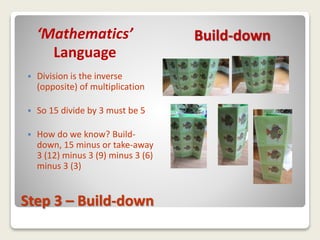
Step 3 – Build-down
‘Mathematics’
Language
Build-down
 Division is the inverse
(opposite) of multiplication
 So 15 divide by 3 must be 5
 How do we know? Build-
down, 15 minus or take-away
3 (12) minus 3 (9) minus 3 (6)
minus 3 (3)
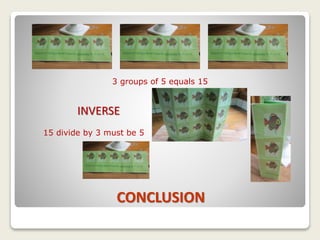
CONCLUSION
3 groups of 5 equals 15
INVERSE
15 divide by 3 must be 5

Build up array/build down 1

  • 1.
    BUILD-UP/BUILD DOWN Array card forInverse relationship between Multiplication and Division Designed for Grade 2 EDX1280 S3 2014 Student no: 0031010900
  • 2.
    A Language Modelfor Mathematics Jamieson-Proctor, R. & Larkin, K. (2014). Student LanguageFamiliar objects Materials LanguageSubstituted objects Mathematical Language Multiply, divide, equal, inverse Photographs Symbolic Language VerbalConcrete/visual Symbolic
  • 3.
    Division is ‘inverse’multiplication Mathematics Language How many fish are there altogether? (15) How many groups of 3? How do we work it out? Build- up by 3, 3 add 3 equals 6, add 3 equals 9, add 3 equals 12, add 3 equals 15. We know there are 5 groups of 3, so we can say 5 multiply by 3 equals 15. Multiply - Build-up Inverse – Opposite Divide – Build-down  Multiplication is repeated addition of equal groups or sets  Example 5 by 3 involves build-up  Division is separating groups into equal parts  Example 15 divide by 3 involves build-down  We call this the ‘inverse relationship’
  • 4.
    Step 1 –Build-up  ‘Mathematics’ Language  We know 3 by 5 equals 15  How do we know? Build-up, 3 add 3 (6) add 3 (9) add 3 (12) add 3 (15)  3 multiply by 5 equals 15
  • 5.
    Step 2 –Division 15 divide by 3 equals 5 ‘Mathematics Language’ How many fish are there altogether? (15) 15 divide by 3? Think multiplication We know 5 by 3 equals 15 so 15 divide by 3 must be 5
  • 6.
    Step 3 –Build-down ‘Mathematics’ Language Build-down  Division is the inverse (opposite) of multiplication  So 15 divide by 3 must be 5  How do we know? Build- down, 15 minus or take-away 3 (12) minus 3 (9) minus 3 (6) minus 3 (3)
  • 7.
    CONCLUSION 3 groups of5 equals 15 INVERSE 15 divide by 3 must be 5