FAME Analysis Technique
Sarfaraz Hussain
Roll no. 2054
Department of Bioinformatics and Biotechnology, GCUF
Responsible teacher: Dr Shahid
Contents
 Fame
 Objectives of Fame analysis
 Techniques
 Procedure
 Sherlock Software
FAME ?
 FAME is stand for Fatty Acid Methyl Ester.
FAME Production:
FAME is produced by transesterification. In the transesterification
process a glyceride reacts with an alcohol in the presence of a
catalyst, forming a mixture of fatty acids esters and an alcohol.
Objective of FAME Analysis
 This is widely used in characterizing
new species of bacteria, and is useful
for identifying pathogenic strains.
 Organisms have different ,Quality
and Quantity of Fatty Acid
FAME Analysis By Different Technique
There are different technique which are used for Fame analysis
1: FAME analysis by capillary GC
2: FAME analysis by gas chromatography
 Gas chromatography (GC) USED due to the volatility and thermal
stability of the FAME.
 Gas chromatography has become an important technique in fats
and oils analysis because accurate results can be obtained for
complex, as well as simple, sample matrices.
Chromatography (GC)
 The FAMEs are injected on a gas chromatography (GC)
system for separation, and are subsequently detected
by a flame ionization detector (FID). Analyte identity is
verified by an additional injection on a GC where the
analytes are separated and identified by a mass
spectrometric detector (MSD).
 Sherlock software is use to in this technique.
 Chromatograph shows fatty acid contents(Methyl esters)in the form
of peaks.
 Y-axis shows amount of fatty acids.
 X-axis shows time.
Results
FAME Analysis Technique
 Fatty acid methyl ester analysis by gas chromatography
(GC-FAME) is use to identify microbes in environmental
and clinical settings.
 It is specific to growth conditions, including the media and
temperature used.
 In addition to identification, FAME analysis is often
specific enough to allow for strain or sub-species level
comparisons.
 This is the specified method for determining total
fat content for nutritional labeling purposes.
After quantifying the total FAMEs present in the
derivatized sample, the amount of fat (as
triglycerides) in the sample is calculated, based
on initial sample weight.
FAME Analysis Technique
FAME Analysis Procedure
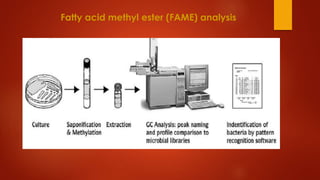
 The Sherlock System requires that bacteria to be grown
in culture.
 The fatty acids are extracted ,followed by derivatization
with dilute hydrochloric acid/methanol solution to give
the respective methyl esters (FAMEs).
 The FAMEs are then extracted from the aqueous phase by
the use of an organic solvent.
Sherlock software
 The Sherlock software automates all
analytical operations and uses a sophisticated
pattern recognition algorithm to match the
unknown FAME profile to the stored library
entries for identification.
 Sherlock Instant FAME (I-FAME)
 Sherlock Quality FAME (Q-FAME)
Sherlock FAME Analysis
Sherlock System Library
 The Sherlock System is capable of identifying a wide
range of microorganisms library was carefully
developed by collecting well characterized strains of
reference cultures from microbiologists specializing in
many areas, including: clinical, environmental, industrial,
drinking/waste water, and food.
 The current Sherlock System libraries have over 1,500
bacterial species, along with 200 species of yeast.
Fatty acid methyl ester (FAME) analysis
 describes the determination of total fat content based on the fatty
acid content.
 This is the specified method for determining total fat content for
nutritional labeling purpose.
 quantifying the total FAMEs present in the derivative sample, the
amount of fat (as triglycerides) in the sample is calculated
Applications
Fame analysis techniques

Fame analysis techniques

  • 2.
    FAME Analysis Technique SarfarazHussain Roll no. 2054 Department of Bioinformatics and Biotechnology, GCUF Responsible teacher: Dr Shahid
  • 3.
    Contents  Fame  Objectivesof Fame analysis  Techniques  Procedure  Sherlock Software
  • 4.
    FAME ?  FAMEis stand for Fatty Acid Methyl Ester. FAME Production: FAME is produced by transesterification. In the transesterification process a glyceride reacts with an alcohol in the presence of a catalyst, forming a mixture of fatty acids esters and an alcohol.
  • 5.
    Objective of FAMEAnalysis  This is widely used in characterizing new species of bacteria, and is useful for identifying pathogenic strains.  Organisms have different ,Quality and Quantity of Fatty Acid
  • 6.
    FAME Analysis ByDifferent Technique There are different technique which are used for Fame analysis 1: FAME analysis by capillary GC 2: FAME analysis by gas chromatography
  • 7.
     Gas chromatography(GC) USED due to the volatility and thermal stability of the FAME.  Gas chromatography has become an important technique in fats and oils analysis because accurate results can be obtained for complex, as well as simple, sample matrices. Chromatography (GC)
  • 8.
     The FAMEsare injected on a gas chromatography (GC) system for separation, and are subsequently detected by a flame ionization detector (FID). Analyte identity is verified by an additional injection on a GC where the analytes are separated and identified by a mass spectrometric detector (MSD).  Sherlock software is use to in this technique.
  • 9.
     Chromatograph showsfatty acid contents(Methyl esters)in the form of peaks.  Y-axis shows amount of fatty acids.  X-axis shows time. Results
  • 10.
    FAME Analysis Technique Fatty acid methyl ester analysis by gas chromatography (GC-FAME) is use to identify microbes in environmental and clinical settings.  It is specific to growth conditions, including the media and temperature used.  In addition to identification, FAME analysis is often specific enough to allow for strain or sub-species level comparisons.
  • 11.
     This isthe specified method for determining total fat content for nutritional labeling purposes. After quantifying the total FAMEs present in the derivatized sample, the amount of fat (as triglycerides) in the sample is calculated, based on initial sample weight. FAME Analysis Technique
  • 12.
    FAME Analysis Procedure The Sherlock System requires that bacteria to be grown in culture.  The fatty acids are extracted ,followed by derivatization with dilute hydrochloric acid/methanol solution to give the respective methyl esters (FAMEs).  The FAMEs are then extracted from the aqueous phase by the use of an organic solvent.
  • 13.
    Sherlock software  TheSherlock software automates all analytical operations and uses a sophisticated pattern recognition algorithm to match the unknown FAME profile to the stored library entries for identification.
  • 14.
     Sherlock InstantFAME (I-FAME)  Sherlock Quality FAME (Q-FAME) Sherlock FAME Analysis
  • 15.
    Sherlock System Library The Sherlock System is capable of identifying a wide range of microorganisms library was carefully developed by collecting well characterized strains of reference cultures from microbiologists specializing in many areas, including: clinical, environmental, industrial, drinking/waste water, and food.  The current Sherlock System libraries have over 1,500 bacterial species, along with 200 species of yeast.
  • 16.
    Fatty acid methylester (FAME) analysis
  • 17.
     describes thedetermination of total fat content based on the fatty acid content.  This is the specified method for determining total fat content for nutritional labeling purpose.  quantifying the total FAMEs present in the derivative sample, the amount of fat (as triglycerides) in the sample is calculated Applications