Falls Fractures and Frailty
Dr Damian Gormley
Consultant Geriatrician Southern
Trust
5th October 2017
Summary
• Epidemiology of falls
• Guidelines/Evidence
– Frailty
– Risk factors
– Interventions
• Falls, Fracture and Frailty Southern Trust
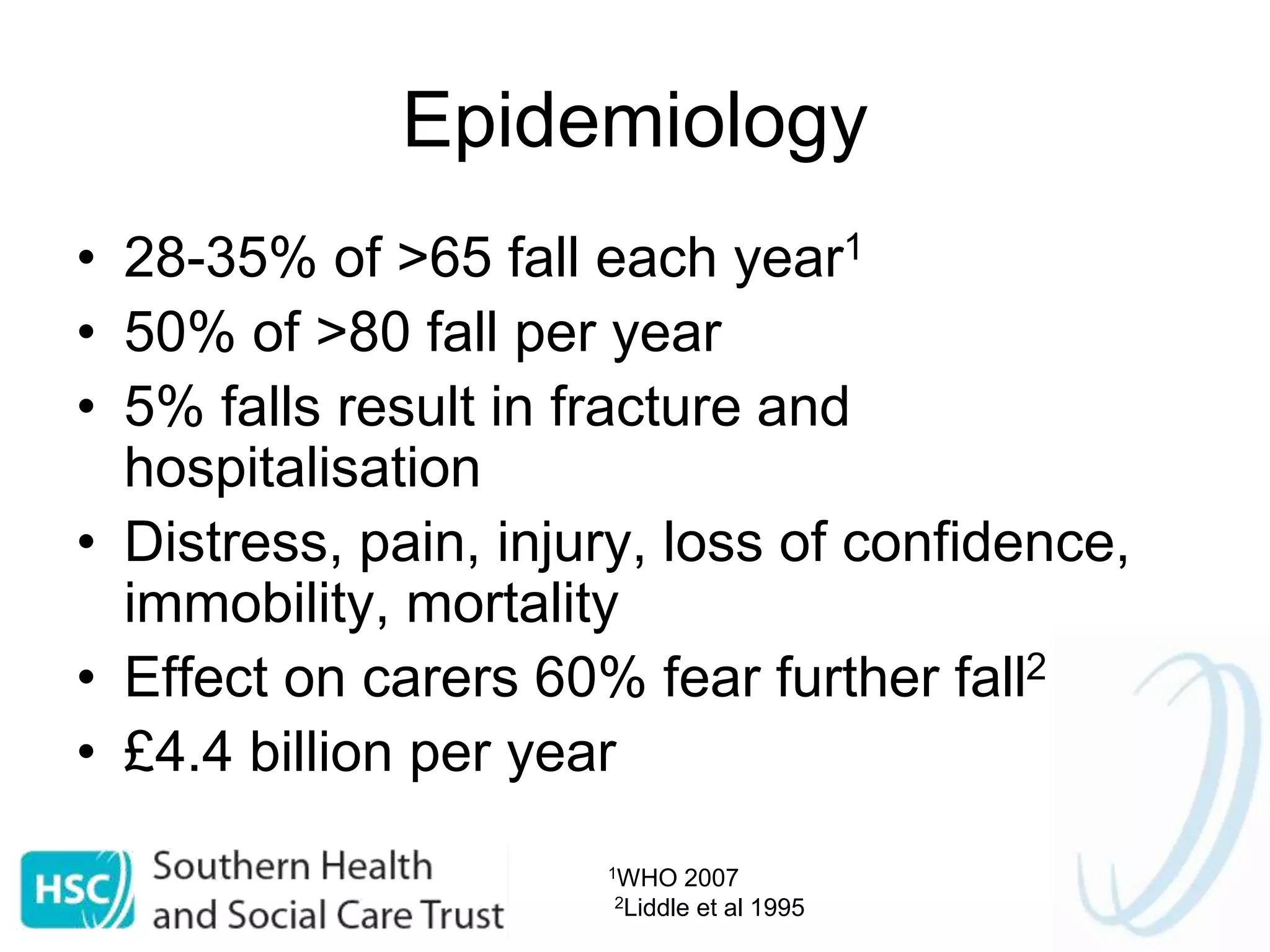
Epidemiology
• 28-35% of >65 fall each year1
• 50% of >80 fall per year
• 5% falls result in fracture and
hospitalisation
• Distress, pain, injury, loss of confidence,
immobility, mortality
• Effect on carers 60% fear further fall2
• £4.4 billion per year
1WHO 2007
2Liddle et al 1995
Craigavon and Banbridge
Craigavon Area Hospital
Emergency Department
Trauma and orthopaedic
inpatients
Fracture clinics
Lurgan Hospital
Falls clinic
Strength & Balance
classes (3)
Armagh and Dungannon
South Tyrone Hospital
Minor injuries Unit
DXA scanner
Falls Clinic
Mullinure Hospital
Falls clinic
Strength & Balance classes (4)
Newry and Mourne
Daisyhill Hospital
Emergency Department
Fracture clinics
Falls Clinic
Strength & Balance
classes (2 )
NISRA MYE 2014
SHSCT Population =
370000
Over 65 population =
52,556
Southern Trust NI
• Number of fallers/year=17,518
• 350 People attend ED/month
• Number of consultant falls clinics per
yr=126
• Number of new patients per year = 630
• Able to see 3.6% of fallers
• Oops!
Who should I see?
• Patients at risk of further falls
• Patients at risk of harm from falls
• Patients in whom I can alter their risk
• Patients who need a consultant to alter
their risk
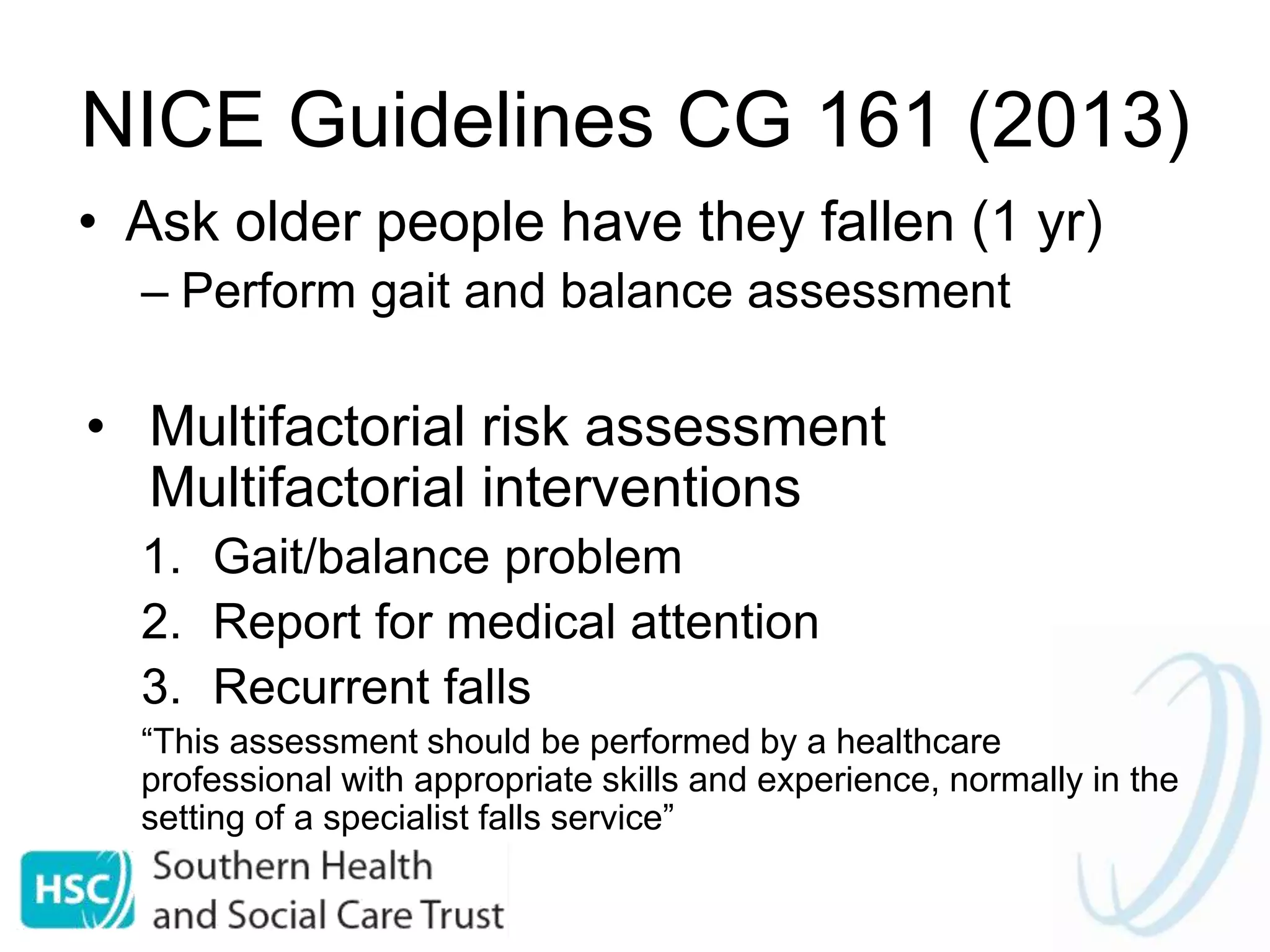
NICE Guidelines CG 161 (2013)
• Ask older people have they fallen (1 yr)
– Perform gait and balance assessment
• Multifactorial risk assessment
Multifactorial interventions
1. Gait/balance problem
2. Report for medical attention
3. Recurrent falls
“This assessment should be performed by a healthcare
professional with appropriate skills and experience, normally in the
setting of a specialist falls service”
Gait and Balance Screen
1. Timed up and Go test
2. Turn 180º
3. Performance-oriented assessment of
mobility problems (Tinetti scale)
4. Functional reach
5. Dynamic gait index
6. Berg balance scale
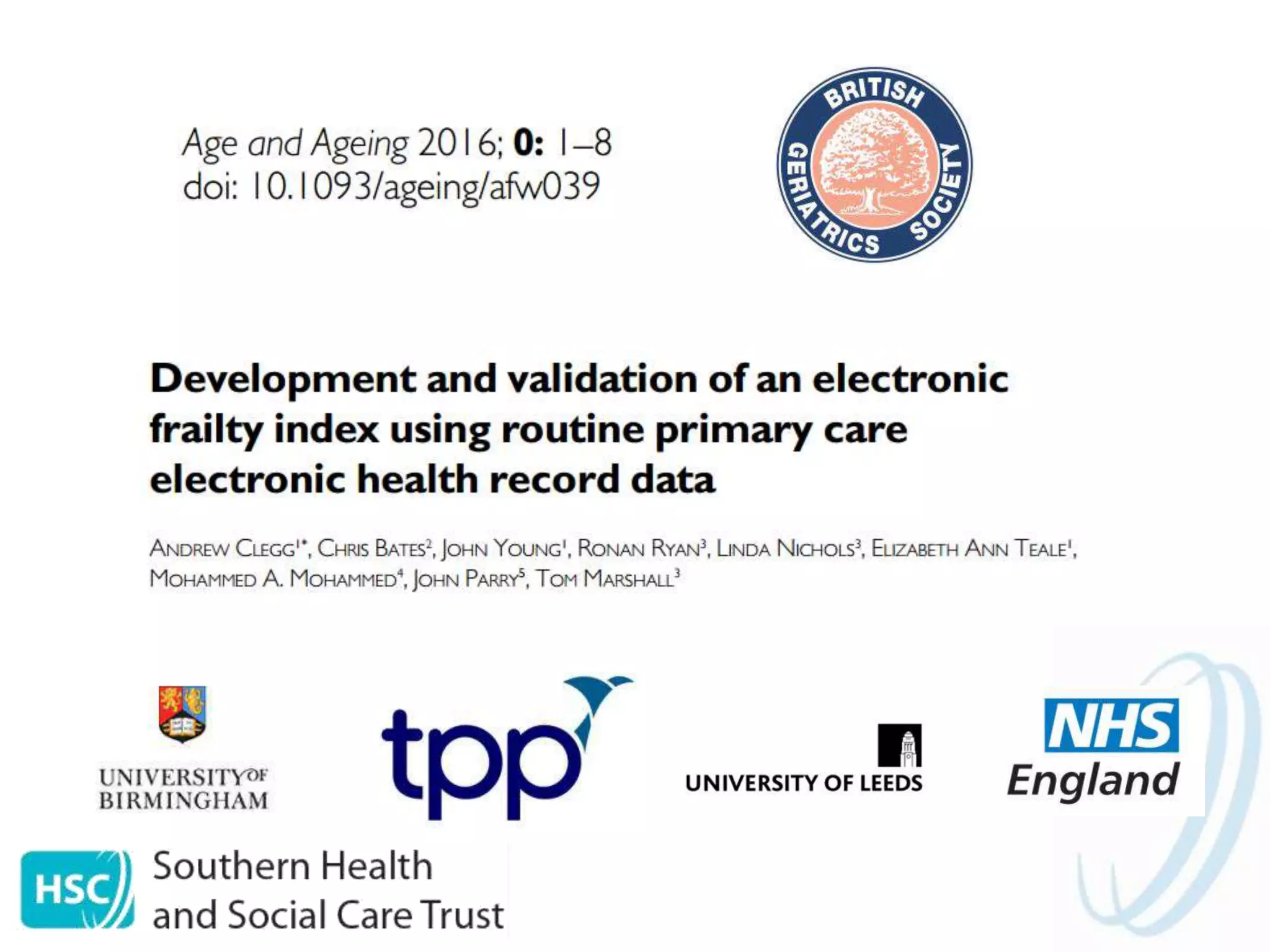
Frailty
• Related to the ageing process
• Multiple body systems gradually lose their
in-built reserves
• Adverse outcomes
• Dramatic changes in wellbeing after an
apparently minor event
BGS Fit for frailty June 2014
eFI Frailty Categories
• Fit (eFIscore 0 -0.12): People who have no or few long-term
conditions that are usually well controlled. This group would mainly
be independent in day to day living activities.
• Mild frailty (eFIscore 0.13 –0.24): People who are slowing up in
older age and may need help with personal activities of daily living
such as finances, shopping, transportation.
• Moderate Frailty (eFIscore 0.25 –0.36): People who have
difficulties with outdoor activities and may have mobility problems or
require help with activities such as washing and dressing.
• Severe Frailty (eFIscore > 0.36): People who are often dependent
for personal cares and have a range of long-term conditions/multi-
morbidity. Some of this group may be medically stable but others
can be unstable and at risk of dying within 6 -12 months
5. FOR THOSE WITH SEVERE
FRAILTY Undertake falls
assessment and medications review
• Annual review of medications.
• Annual direct review to establish if patient
has fallen in last year.
– No fall in last 12 months - No further action
– One or more falls in past 12 months - See
guidance and best practice
Risk factors
Previous falls Relative Risk
Muscle weakness* 4.4
History of Fall 3.0
Gait deficit* 2.9
Fear of falling* 2.8
Balance problems* 2.8
Use of assist device 2.6
Visual deficit* 2.5
Arthritis 2.4
Depression* 2.2
Cognitive impairment 1.8
Psychotropic Medications* 1.7
Age >80 1.7
Perell et al 2001
NICE 2013
Intervention Evidence
• Inconsistant
• Poorly designed trials
– Not blinded
– Multiple outcomes
– Heterogeneous populations
– Variable outcomes
• Risk of falling
• Time to first fall
• Rate of falling
Cochrane Review 2012
Interventions for preventing falls in
older people living in the community
• 159 Trials
• 79 193 participants
• Exercise only 59 trials
• Multifactorial 40 trials
Results
Rate of falling Risk of falling
Multicomponent group Exercise 0.71* (0.63-0.82) 0.85* (0.76-0.96)
Multicomponent Home exercise 0.68 *(0.58-0.80) 0.78* (0.64-0.96)
Tai Chi 0.72 (0.52-1.00) 0.71* (0.57-0.87)
Multifactorial 0.76 *(0.67-0.86) 0.93 (0.86-1.02)
Vitamin D 1.00 (0.90-1.11) 0.96 ( 0.89-1.03)
Home Safety 0.81* (0.68-0.97) 0.88* (0.80-0.96)
Visual intervention 1.57 *(1.19-2.06) 1.54* (1.24-1.91)
Prescribing intervention 0.61* (0.41-0.91)
Interventions for preventing falls in older
people in care facilities and hospitals 2012
• 43 trials
• 30 373 participants
Rate of falling Risk of falling
Exercise 1.03 (0.81-1.31) 1.07 (0.94-1.24)
Vitamin D 0.63* (0.46-0.86) 0.99 (0.90-1.08)
Multifactorial 0.78 (0.59-1.04) 0.89 (0.77-1.02)
Secondary falls prevention
exercise
Otago Home Exercise
Programme (OEP)
• – 1 yr; 3 x p/w; 6 home
visits and telephone
support
• – 6 mths; 3 x p/w (1 p/w
group, 2 p/w home)
exercise instructor
• – Effects on strength
and balance in a group
Falls Management
Exercise Programme
(FaME/PSI)
• – 9 mths; 3 x p/w (one
group, two home);
includes floorwork;
• – Increases habitual
physical activity as well
(Campbell 1997; Robertson 2001; Campbell 2005;
Liu_Ambrose 2008;
Kyrdalen 2014; Skelton 2005, 2008)
What works
• Greatest effects of exercise on fall rates
(38% reduction) from interventions
including:
– Highly challenging balance training
– 3 Times a week
– High dose (50+ hours)
– Progressive strength training
– Avoid brisk walking
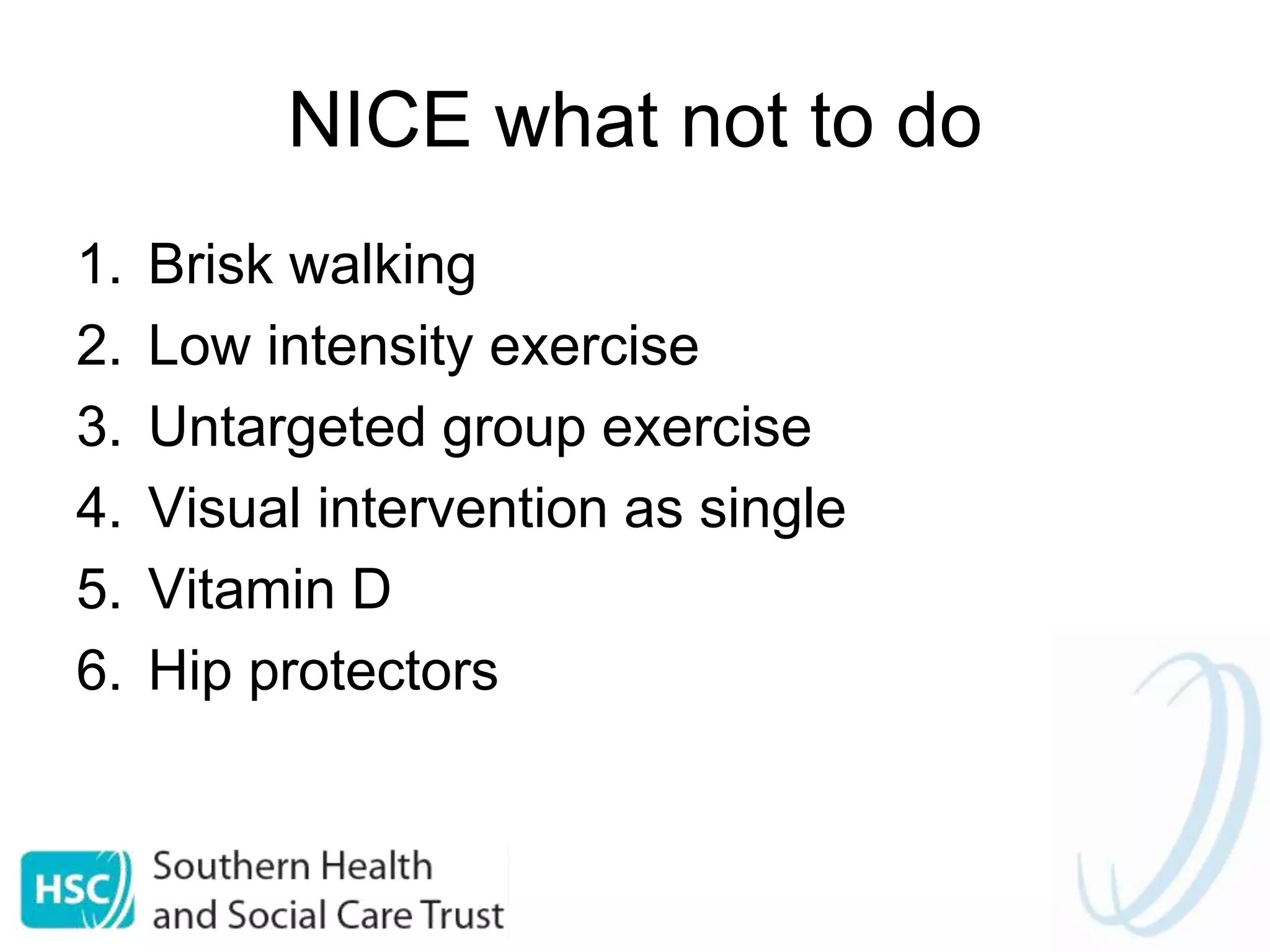
NICE what not to do
1. Brisk walking
2. Low intensity exercise
3. Untargeted group exercise
4. Visual intervention as single
5. Vitamin D
6. Hip protectors
Post Hospital Home Exercise
Program
• 340 older people
• 81.2 yrs. 70% fallen in past year
• 15-20 mins exercise /week (S+B-WEBB)
• 12 months
• 10 physio visits
• Falls 177 v 123 IR 1.43 (1.07-1.93)
• Fallers 98 v 70 RR 1.38 (1.11-1.73)
Sherrington et al 2014
Multifactorial intervention after a fall in older
people with cognitive impairment
• 274 patients with dementia
• >65 presented to ED after fall
• Fallers 74% v 80% RR0.92 (0.81-1.05)
• No difference
– Number of falls
– Time to first fall
– ED attendances or admissions
– Injuries
– Mortality
Shaw et al 2003 BMJ
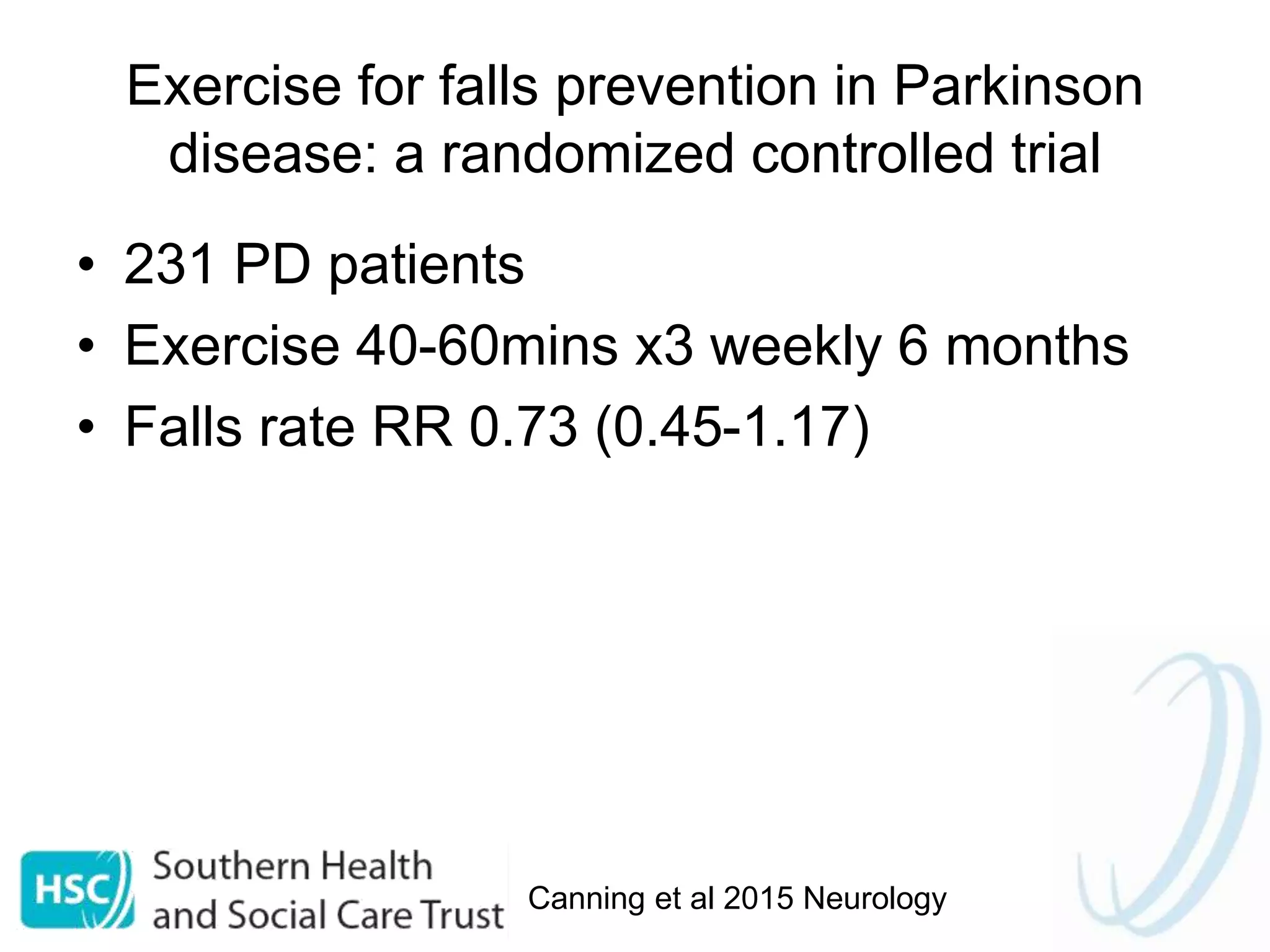
Exercise for falls prevention in Parkinson
disease: a randomized controlled trial
• 231 PD patients
• Exercise 40-60mins x3 weekly 6 months
• Falls rate RR 0.73 (0.45-1.17)
Canning et al 2015 Neurology
Falls Fracture Frailty Pathway
Southern Trust
Fracture Liaison Service
DXA Scan
Fracture risk
assessment and falls
screen
Falls screening
no further action
required
DXA not appropriate
or feasible
Falls Service
Community based
Strength & balance
Classes
Level 2
AHP Assessment
S&B classes
Level 3
Medical
Assessment
Frail Elderly
Falls & Fracture Pathway >65
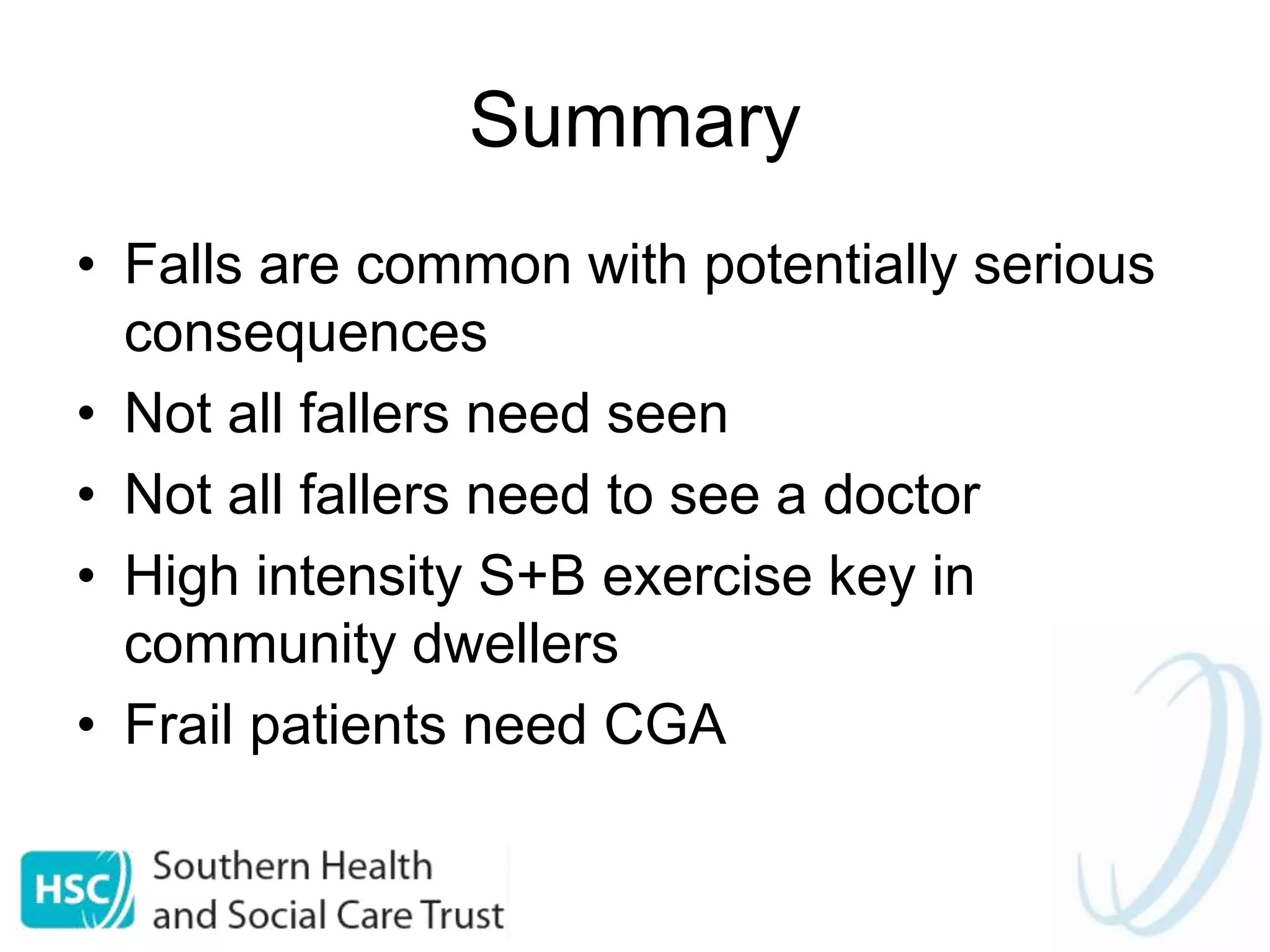
Summary
• Falls are common with potentially serious
consequences
• Not all fallers need seen
• Not all fallers need to see a doctor
• High intensity S+B exercise key in
community dwellers
• Frail patients need CGA

Falls Fractures and Frailty

  • 1.
    Falls Fractures andFrailty Dr Damian Gormley Consultant Geriatrician Southern Trust 5th October 2017
  • 2.
    Summary • Epidemiology offalls • Guidelines/Evidence – Frailty – Risk factors – Interventions • Falls, Fracture and Frailty Southern Trust
  • 3.
    Epidemiology • 28-35% of>65 fall each year1 • 50% of >80 fall per year • 5% falls result in fracture and hospitalisation • Distress, pain, injury, loss of confidence, immobility, mortality • Effect on carers 60% fear further fall2 • £4.4 billion per year 1WHO 2007 2Liddle et al 1995
  • 4.
    Craigavon and Banbridge CraigavonArea Hospital Emergency Department Trauma and orthopaedic inpatients Fracture clinics Lurgan Hospital Falls clinic Strength & Balance classes (3) Armagh and Dungannon South Tyrone Hospital Minor injuries Unit DXA scanner Falls Clinic Mullinure Hospital Falls clinic Strength & Balance classes (4) Newry and Mourne Daisyhill Hospital Emergency Department Fracture clinics Falls Clinic Strength & Balance classes (2 ) NISRA MYE 2014 SHSCT Population = 370000 Over 65 population = 52,556
  • 5.
    Southern Trust NI •Number of fallers/year=17,518 • 350 People attend ED/month • Number of consultant falls clinics per yr=126 • Number of new patients per year = 630 • Able to see 3.6% of fallers • Oops!
  • 6.
    Who should Isee? • Patients at risk of further falls • Patients at risk of harm from falls • Patients in whom I can alter their risk • Patients who need a consultant to alter their risk
  • 7.
    NICE Guidelines CG161 (2013) • Ask older people have they fallen (1 yr) – Perform gait and balance assessment • Multifactorial risk assessment Multifactorial interventions 1. Gait/balance problem 2. Report for medical attention 3. Recurrent falls “This assessment should be performed by a healthcare professional with appropriate skills and experience, normally in the setting of a specialist falls service”
  • 8.
    Gait and BalanceScreen 1. Timed up and Go test 2. Turn 180º 3. Performance-oriented assessment of mobility problems (Tinetti scale) 4. Functional reach 5. Dynamic gait index 6. Berg balance scale
  • 9.
    Frailty • Related tothe ageing process • Multiple body systems gradually lose their in-built reserves • Adverse outcomes • Dramatic changes in wellbeing after an apparently minor event BGS Fit for frailty June 2014
  • 12.
    eFI Frailty Categories •Fit (eFIscore 0 -0.12): People who have no or few long-term conditions that are usually well controlled. This group would mainly be independent in day to day living activities. • Mild frailty (eFIscore 0.13 –0.24): People who are slowing up in older age and may need help with personal activities of daily living such as finances, shopping, transportation. • Moderate Frailty (eFIscore 0.25 –0.36): People who have difficulties with outdoor activities and may have mobility problems or require help with activities such as washing and dressing. • Severe Frailty (eFIscore > 0.36): People who are often dependent for personal cares and have a range of long-term conditions/multi- morbidity. Some of this group may be medically stable but others can be unstable and at risk of dying within 6 -12 months
  • 14.
    5. FOR THOSEWITH SEVERE FRAILTY Undertake falls assessment and medications review • Annual review of medications. • Annual direct review to establish if patient has fallen in last year. – No fall in last 12 months - No further action – One or more falls in past 12 months - See guidance and best practice
  • 15.
    Risk factors Previous fallsRelative Risk Muscle weakness* 4.4 History of Fall 3.0 Gait deficit* 2.9 Fear of falling* 2.8 Balance problems* 2.8 Use of assist device 2.6 Visual deficit* 2.5 Arthritis 2.4 Depression* 2.2 Cognitive impairment 1.8 Psychotropic Medications* 1.7 Age >80 1.7 Perell et al 2001 NICE 2013
  • 16.
    Intervention Evidence • Inconsistant •Poorly designed trials – Not blinded – Multiple outcomes – Heterogeneous populations – Variable outcomes • Risk of falling • Time to first fall • Rate of falling
  • 17.
    Cochrane Review 2012 Interventionsfor preventing falls in older people living in the community • 159 Trials • 79 193 participants • Exercise only 59 trials • Multifactorial 40 trials
  • 18.
    Results Rate of fallingRisk of falling Multicomponent group Exercise 0.71* (0.63-0.82) 0.85* (0.76-0.96) Multicomponent Home exercise 0.68 *(0.58-0.80) 0.78* (0.64-0.96) Tai Chi 0.72 (0.52-1.00) 0.71* (0.57-0.87) Multifactorial 0.76 *(0.67-0.86) 0.93 (0.86-1.02) Vitamin D 1.00 (0.90-1.11) 0.96 ( 0.89-1.03) Home Safety 0.81* (0.68-0.97) 0.88* (0.80-0.96) Visual intervention 1.57 *(1.19-2.06) 1.54* (1.24-1.91) Prescribing intervention 0.61* (0.41-0.91)
  • 19.
    Interventions for preventingfalls in older people in care facilities and hospitals 2012 • 43 trials • 30 373 participants Rate of falling Risk of falling Exercise 1.03 (0.81-1.31) 1.07 (0.94-1.24) Vitamin D 0.63* (0.46-0.86) 0.99 (0.90-1.08) Multifactorial 0.78 (0.59-1.04) 0.89 (0.77-1.02)
  • 20.
    Secondary falls prevention exercise OtagoHome Exercise Programme (OEP) • – 1 yr; 3 x p/w; 6 home visits and telephone support • – 6 mths; 3 x p/w (1 p/w group, 2 p/w home) exercise instructor • – Effects on strength and balance in a group Falls Management Exercise Programme (FaME/PSI) • – 9 mths; 3 x p/w (one group, two home); includes floorwork; • – Increases habitual physical activity as well (Campbell 1997; Robertson 2001; Campbell 2005; Liu_Ambrose 2008; Kyrdalen 2014; Skelton 2005, 2008)
  • 21.
    What works • Greatesteffects of exercise on fall rates (38% reduction) from interventions including: – Highly challenging balance training – 3 Times a week – High dose (50+ hours) – Progressive strength training – Avoid brisk walking
  • 22.
    NICE what notto do 1. Brisk walking 2. Low intensity exercise 3. Untargeted group exercise 4. Visual intervention as single 5. Vitamin D 6. Hip protectors
  • 23.
    Post Hospital HomeExercise Program • 340 older people • 81.2 yrs. 70% fallen in past year • 15-20 mins exercise /week (S+B-WEBB) • 12 months • 10 physio visits • Falls 177 v 123 IR 1.43 (1.07-1.93) • Fallers 98 v 70 RR 1.38 (1.11-1.73) Sherrington et al 2014
  • 24.
    Multifactorial intervention aftera fall in older people with cognitive impairment • 274 patients with dementia • >65 presented to ED after fall • Fallers 74% v 80% RR0.92 (0.81-1.05) • No difference – Number of falls – Time to first fall – ED attendances or admissions – Injuries – Mortality Shaw et al 2003 BMJ
  • 25.
    Exercise for fallsprevention in Parkinson disease: a randomized controlled trial • 231 PD patients • Exercise 40-60mins x3 weekly 6 months • Falls rate RR 0.73 (0.45-1.17) Canning et al 2015 Neurology
  • 26.
    Falls Fracture FrailtyPathway Southern Trust
  • 27.
    Fracture Liaison Service DXAScan Fracture risk assessment and falls screen Falls screening no further action required DXA not appropriate or feasible Falls Service Community based Strength & balance Classes Level 2 AHP Assessment S&B classes Level 3 Medical Assessment Frail Elderly Falls & Fracture Pathway >65
  • 28.
    Summary • Falls arecommon with potentially serious consequences • Not all fallers need seen • Not all fallers need to see a doctor • High intensity S+B exercise key in community dwellers • Frail patients need CGA

Editor's Notes

  • #8 Older people reporting a fall or considered at risk of falling should be observed for balance and gait deficits and considered for their ability to benefit from interventions to improve strength and balance Older people who present for medical attention because of a fall, or report recurrent falls in the past year, or demonstrate abnormalities of gait and/or balance should be offered a multifactorial falls risk assessment. This assessment should be performed by a healthcare professional with appropriate skills and experience, normally in the setting of a specialist falls service. This assessment should be part of an individualised, multifactorial intervention
  • #16 People at increased fear of falling increase co-contraction of agonist and antagonist which decreases risk of falls during high velocity disruptions such as tripping
  • #20 – multi-factorial interventions, overall did not significantly reduce the rate of falls or risk of falling unless provided by a multidisciplinary team, then reduced rate of falls and risk of falling.
  • #24 WEBB= weight bearing exercise for better balance More frequent physio visits at the start Both groups received usual care and education booklet on falls Patients taken form geriatric rehabilitation and orthopaedic wards No 0ne reported fall whilst doing exercise Small improvement in mobiltiy
  • #25 In this study 79% lived in nursing home Interventions included optical correction, medical assessment, physiotherapy, occupational therapy, and foot care. No significant difference between the intervention and control groups in fall risk was found BGS/AGS For older persons with cognitive impairment, there is insufficient evidence for supporting any recommendations to reduce fall risk.
  • #26 Preplanned subgroup analysis revealed a significant interaction for disease severity (p < 0.001). In the lower disease severity subgroup, there were fewer falls in the exercise group compared with controls (IRR = 0.31, 95% CI 0.15-0.62, p < 0.001), while in the higher disease severity subgroup, there was a trend toward more falls in the exercise group (IRR = 1.61, 95% CI 0.86-3.03, p = 0.13). Postintervention, the exercise group scored significantly (p < 0.05) better than controls on the Short Physical Performance Battery, sit-to-stand, fear of falling, affect, and quality of life, after adjusting for baseline performance. CONCLUSIONS: An exercise program targeting balance, leg strength, and freezing of gait did not reduce falls but improved physical and psychological health. Falls were reduced in people with milder disease but not in those with more severe Parkinson disease