


Mountain States Engineering & Controls | 303-232-4100 | www.mnteng.com
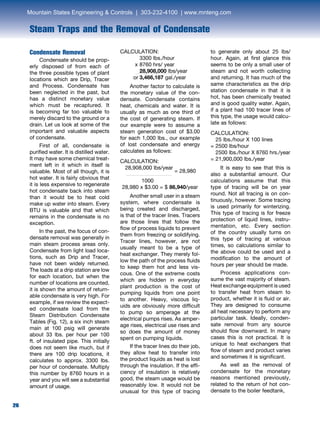
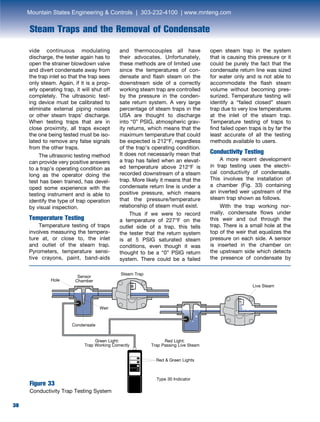
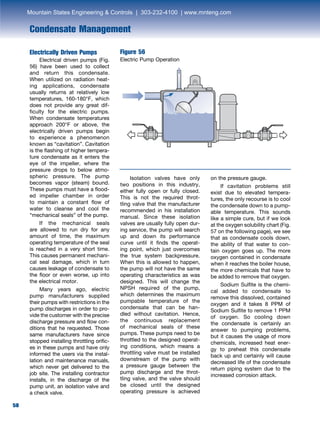
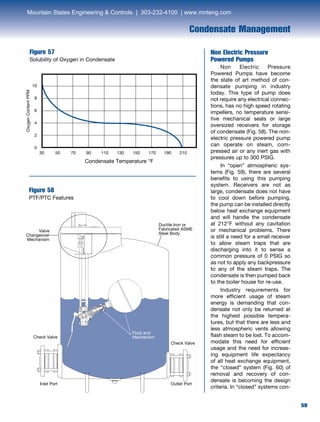
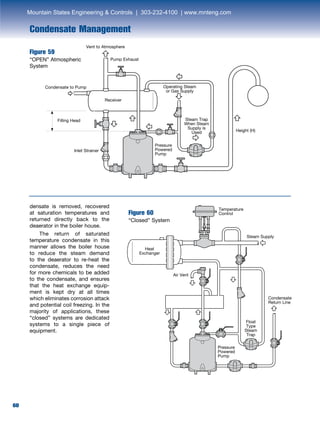
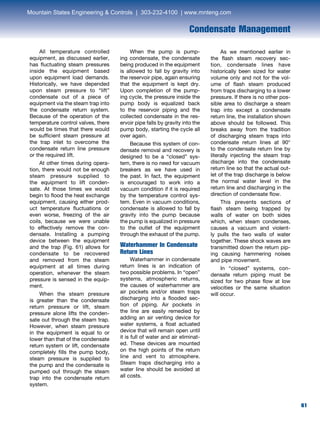
2
Published by
$19.95 per copy
Copyright © 2017
by Spirax Sarco, Inc.
All Rights Reserved
No part of this publication may be reproduced, stored in a
retrieval system or transmitted, in any form or by any means,
electronic, mechanical, photocopying, recording, or otherwise,
without the prior written permission of the publisher.
PREFACE
Recognizing the on-going need for education as it relates to the
fundamentals of steam including the most efficient use of its heat
content, Spirax Sarco has developed the Steam Utilization Course.
This handbook represents over 100 years of steam experience in the
proper selection, sizing and application of steam traps, pressure
and temperature controls, and condensate recovery systems
in major industrial plants throughout the world.
The Steam Utilization Course can be used in conjunction with
“Design of Fluid Systems—Hook Ups” for a complete and
concise knowledge of the use of steam for heat.
Spirax Sarco, Inc.
1150 Northpoint Blvd.
Blythewood, SC 26016
800-883-4411
www.spiraxsarco.com/global/us
2
Mountain States Engineering & Controls | 303-232-4100 | www.mnteng.com
33
Spirax Sarco
Spirax Sarco is the recognized industry standard
for knowledge and products and for over 100 years
has been committed to servicing the steam users
worldwide. The existing and potential applications for
steam, water and air are virtually unlimited. Beginning
with steam generation, through distribution and uti-
lization and ultimately returning condensate to the
boiler, Spirax Sarco has the solutions to optimize
steam system performance and increase productivity
to save valuable time and money.
In today’s economy, corporations are looking for reli-
able products and services to expedite processes and
alleviate workers of problems which may arise with
their steam systems. As support to industries around
the globe, Spirax Sarco offers decades of experience,
knowledge, and expert advice to steam users world-
wide on the proper control and conditioning of steam
systems.
Spirax Sarco draws upon its worldwide resources of
over 4000 people to bring complete and thorough
service to steam users. This service is built into our
products as a performance guarantee. From initial
consultation to effective solutions, our goal is to
manufacture safe, reliable products that improve
productivity. With a quick, responsive team of sales
engineers and a dedicated network of local authorized
distributors Spirax Sarco provides quality service and
support with fast, efficient delivery.
Reliable steam system components are at the heart
of Spirax Sarco’s commitment. Controls and regula-
tors for ideal temperature, pressure and flow control;
steam traps for efficient drainage of condensate for
maximum heat transfer; flowmeters for precise mea-
surement of liquids; liquid drain traps for automatic
and continuous drain trap operation to boost system
efficiency; rotary filters for increased productivity
through proper filtering of fluids; condensate recovery
pumps for effective condensate management to save
water and sewage costs; stainless steel specialty
products for maintaining quality and purity of steam;
and a full range of pipeline auxiliaries, all work together
to produce a productive steam system. Spirax Sarco’s
new line of engineered equipment reduces installation
costs with prefabricated assemblies and fabricated
modules for system integrity and turnkey advantages.
From large oil refineries and chemical plants to local
laundries, from horticulture to shipping, for hospitals,
universities, offices and hotels, in business and gov-
ernment, wherever steam, hot water and compressed
air is generated and handled effectively and efficiently,
Spirax Sarco is there with knowledge and experience.
For assistance with the installation or operation of any
Spirax Sarco product or application, call toll free:
1-800-883-4411
Mountain States Engineering & Controls | 303-232-4100 | www.mnteng.com
4
Contents
4
BASIC STEAM ENGINEERING PRINCIPLES	 6	
INTRODUCTION	 6	
WHAT IS STEAM	 6	
DEFINITIONS	 6	
THE FORMATION OF STEAM	 6		
Steam Saturation Table 	 8
STEAM GENERATION	 10	
BOILERS & BOILER EFFICIENCY	 10	
SELECTION OF WORKING PRESSURES	 11		
Steam Velocity	 12		
Air and Non-Condensable Gases	 13
STEAM SYSTEM BASICS	 14	
STEAM PIPING DESIGN CONSIDERATIONS	 15
STEAM AND CONDENSATE METERING	 17	
WHY MEASURE STEAM?	 18		
Plant Efficiency	 18		
Energy Efficiency	 18		
Process Control	 18		
Costing and Custody Transfer	 18
CONTROL AND REGULATION OF STEAM	 19	
PRESSURE REDUCING VALVES	 19		
Direct Acting Valves	 19		
Pilot Operated Valves	 20		
Selection and Application	 21	
TEMPERATURE CONTROL VALVES	 22		
Manual Controls	 22		
Self-Acting Controls	 22		
Pilot Operated Controls	 23		
Pneumatic Controls	 24		
Proportional Control Bands	 24
STEAM TRAPS AND THE REMOVAL OF CONDENSATE	 26	
CONDENSATE REMOVAL	 26		
Air Venting	 27		
Thermal Efficiency	 27		
Reliability	 27
Mountain States Engineering & Controls | 303-232-4100 | www.mnteng.com
5
	 STEAM TRAPS	 27
		 Mechanical Steam Traps	 28
		 Thermostatically or Temperature Controlled Traps	 30
		 Thermodynamic Steam Traps	 32
		 Variations on Steam Traps	 33
		 Swivel Connector Traps	 37
	 STEAM TRAP TESTING METHODS	 37
		Visual Testing	 37
		 Ultrasonic Trap Testing	 37
		Temperature Testing	 38
		Conductivity Testing	 38
		 Wireless Steam Trap Monitoring	 39
	 BY-PASSES AROUND STEAM TRAPS	 40
	 PREVENTIVE MAINTENANCE PROGRAMS	 40
		 Steam Trap Fault Finding	 40
		 Steam Trap Discharge Characteristics	 42
	 STEAM TRAP SELECTION	 42
		Waterlogging	 42
		 Lifting of Condensate	 43
	 REQUIREMENTS FOR STEAM TRAP/APPLICATIONS	43
		 Application Requirements	 43		
		 Steam Trap Selection Chart	 44
		 Steam Trap Sizing	 45
STEAM TRACING	46
	 CRITICAL TRACING	46
	 NON-CRITICAL TRACING	46
		 Attaching Tracer Lines	 47
	 JACKETED PIPE TRACERS	48
	 STEAM TRACING MANIFOLDS	49
	 CONDENSATE MANIFOLDS	49
CONDENSATE MANAGEMENT	51
	 FLASH STEAM RECOVERY	 52
	 CONDENSATE RECOVERY SYSTEMS	 56
		 Electrically Driven Pumps	 58
		 Non Electric Pressure Powered Pumps	 59
	 WATERHAMMER IN CONDENSATE RETURN LINES	 61
STEAM UTILIZATION COURSE REVIEW	63
Contents
5
Mountain States Engineering & Controls | 303-232-4100 | www.mnteng.com
6
Basic Steam Engineering Principals
6
Introduction
	 This Spirax Sarco Steam
Utilization Course is intended to
cover the basic fundamentals
and efficient usage of steam as a
cost effective conveyor of energy
(Fig. 2) to space heating or pro-
cess heating equipment. The use
of steam for power generation
is a specialized subject, already
well documented, and is outside
the scope of this course.
	 This course has been
designed and written for those
engaged in the design, opera-
tion, maintenance and or general
care of a steam system. A mod-
erate knowledge of physics is
assumed. The first part of this
course attempts to define the
basic terminology and principles
involved in steam generation and
system engineering.
What Is Steam
	 Like many other sub-
stances, water can exist in the
form of either a solid, liquid,
or gas. We will focus largely
on liquid and gas phases and
the changes that occur during
the transition between these two
phases. Steam is the vaporized
state of water which contains
heat energy intended for transfer
into a variety of processes from
air heating to vaporizing liquids
in the refining process.
	 Perhaps the first thing that
we should do is define some of
the basic terminology that will be
used in this course.
Definitions
BTU
	 The basic unit of measure-
ment for all types of heat energy
is the British Thermal Unit or BTU.
Specifically, it is the amount of
heat energy necessary to raise
one pound of water one degree
Fahrenheit.
Temperature
	 A degree of hot or cold mea-
sured on a definite scale. For all
practical purposes a measure-
ment from a known starting point
to a known ending point.
Heat
	Energy
Saturation
	 The point where a substance
can hold no more energy without
changing phase (physical state).
Enthalpy
	 The term given for the total
energy, measured in BTU’s, due
to both pressure and temperature
of a fluid or vapor, at any given
time or condition.
Gauge Pressure (PSIG)
	 Pressure shown on a stan-
dard gauge and indicated the
pressure above atmospheric
pressure.
Absolute Pressure (PSIA)	
	 The pressure from and above
perfect vacuum
Sensible Heat (hf)
	 The heat energy that raises
the water temperature from 32°F.
The maximum amount of sensible
heat the water can absorb is
determined by the pressure of the
liquid. (Fig 1 & 2)
Latent Heat (hfg)
	 The enthalpy of evaporation.
The heat input which produces
a change of water from liquid to
gas.
Total Heat
	 Is the sum of sensible heat
and latent heat (ht
=hf
+hhfg
). (Fig 1)
The Formation of Steam
	 Steam is created from the
boiling of water. As heat energy
(BTU’s) is added to water, the
temperature rises accordingly.
When water reaches its saturation
point, it begins to change from a
liquid to a gas. Let’s investigate
how this happens by placing a
thermometer in one pound of
water at a temperature of 32˚F,
which is the coldest temperature
water can exist at atmospheric
pressure before changing from
liquid to a solid.
	 Let’s put this water into a pan
on top of our stove and turn on
the burner. Heat energy from the
burner will be transferred through
the pan into the water, causing
the water’s temperature to rise.
	 We can actually monitor the
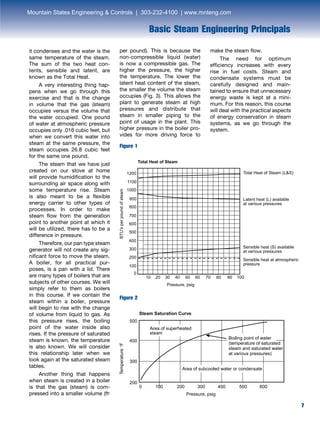
heat energy transfer (Fig.1) by
watching the thermometer level
rise - one BTU of heat energy
will raise one pound of water
by one degree Fahrenheit. As
each degree of temperature rise
is registered on the thermometer,
we can read that as the addition
of 1 BTU. Eventually, the water
temperature will rise to its boil-
ing point (saturation temperature)
at atmospheric pressure, which
is 212°F at sea level. Any addi-
tional heat energy that we add
at this point will cause the water
to begin changing state (phase)
from a liquid to a gas (steam).
	 At atmospheric pressure
and at sea level we have added
180 BTU’s, changing the water
temperature from 32°F to 212°F
(212-32=180). This enthalpy is
known as Sensible Heat (BTU
per pound). If we continue to add
heat energy to the water via the
burner, we will notice that the
thermometer will not change, but
the water will begin to evaporate
into steam. The heat energy that
is being added which causes the
water’s change of phase from
liquid to gas is known as Latent
Heat. This latent heat content
is the sole purpose of gener-
ating steam. Latent heat (BTU
per pound) has a very high heat
content that transfers to colder
products/processes very rapidly
without losing any temperature.
As steam gives up its latent heat,
Mountain States Engineering & Controls | 303-232-4100 | www.mnteng.com
7
Basic Steam Engineering Principals
7
it condenses and the water is the
same temperature of the steam.
The sum of the two heat con-
tents, sensible and latent, are
known as the Total Heat.
	 A very interesting thing hap-
pens when we go through this
exercise and that is the change
in volume that the gas (steam)
occupies versus the volume that
the water occupied. One pound
of water at atmospheric pressure
occupies only .016 cubic feet, but
when we convert this water into
steam at the same pressure, the
steam occupies 26.8 cubic feet
for the same one pound.
	 The steam that we have just
created on our stove at home
will provide humidification to the
surrounding air space along with
some temperature rise. Steam
is also meant to be a flexible
energy carrier to other types of
processes. In order to make
steam flow from the generation
point to another point at which it
will be utilized, there has to be a
difference in pressure.	
Therefore, our pan type steam
generator will not create any sig-
nificant force to move the steam.
A boiler, for all practical pur-
poses, is a pan with a lid. There
are many types of boilers that are
subjects of other courses. We will
simply refer to them as boilers
in this course. If we contain the
steam within a boiler, pressure
will begin to rise with the change
of volume from liquid to gas. As
this pressure rises, the boiling
point of the water inside also
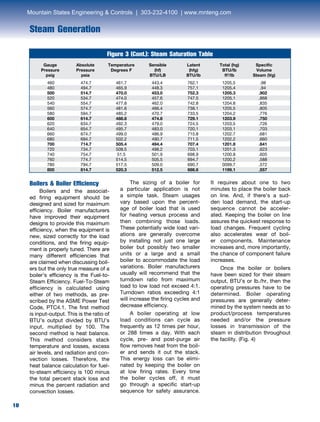
rises. If the pressure of saturated
steam is known, the temperature
is also known. We will consider
this relationship later when we
look again at the saturated steam
tables.
	 Another thing that happens
when steam is created in a boiler
is that the gas (steam) is com-
pressed into a smaller volume (ft3
per pound). This is because the
non-compressible liquid (water)
is now a compressible gas. The
higher the pressure, the higher
the temperature. The lower the
latent heat content of the steam,
the smaller the volume the steam
occupies (Fig. 3). This allows the
plant to generate steam at high
pressures and distribute that
steam in smaller piping to the
point of usage in the plant. This
higher pressure in the boiler pro-
vides for more driving force to
make the steam flow.
	 The need for optimum
efficiency increases with every
rise in fuel costs. Steam and
condensate systems must be
carefully designed and main-
tained to ensure that unnecessary
energy waste is kept at a mini-
mum. For this reason, this course
will deal with the practical aspects
of energy conservation in steam
systems, as we go through the
system.
Total Heat of Steam
Total Heat of Steam (L&S)1200
1100
1000
900
800
700
600
500
400
300
200
100
0
10 20 30 40 50 60 70 80 90 100
Latent heat (L) available
at various pressures
Sensible heat (S) available
at various pressures
Sensible heat at atmospheric
pressure
BTU’sperpoundofsteam
Pressure, psig
Steam Saturation Curve
Temperature°F
Pressure, psig
500
400
300
200
1000 200 300 400 500 600
Area of subcooled water or condensate
Area of superheated
steam
Boiling point of water
(temperature of saturated
steam and saturated water
at various pressures)
Total Heat of Steam
Total Heat of Steam (L&S)1200
1100
1000
900
800
700
600
500
400
300
200
100
0
10 20 30 40 50 60 70 80 90 100
Latent heat (L) available
at various pressures
Sensible heat (S) available
at various pressures
Sensible heat at atmospheric
pressure
BTU’sperpoundofsteam
Pressure, psig
Steam Saturation Curve
Temperature°F
Pressure, psig
500
400
300
200
1000 200 300 400 500 600
Area of subcooled water or condensate
Area of superheated
steam
Boiling point of water
(temperature of saturated
steam and saturated water
at various pressures)
Figure 1
Figure 2
Mountain States Engineering & Controls | 303-232-4100 | www.mnteng.com
8
Basic Steam Engineering Principals
8
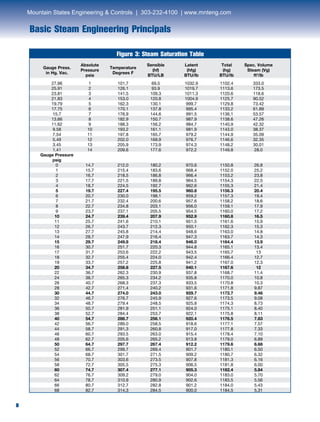
Figure 3: Steam Saturation Table
	
Gauge Press.
	Absolute	
Temperature
	 Sensible	 Latent	 Total	 Spec. Volume
	
in Hg. Vac.
	Pressure	
Degrees F
	 (hf)	 (hfg)	 (hg)	 Steam (Vg)
		 psia		 BTU/LB	 BTU/lb	 BTU/lb	ft3
/lb
	27.96	 1	 101.7	 69.5	 1032.9	 1102.4	 333.0
	25.91	 2	 126.1	 93.9	 1019.7	 1113.6	 173.5
	23.81	 3	 141.5	 109.3	 1011.3	 1120.6	 118.6
	21.83	 4	 153.0	 120.8	 1004.9	 1125.7	 90.52
	19.79	 5	 162.3	 130.1	 999.7	 1129.8	 73.42
	17.75	 6	 170.1	 137.8	 995.4	 1133.2	 61.89
	15.7	 7	 176.9	 144.6	 991.5	 1136.1	 53.57
	13.66	 8	 182.9	 150.7	 987.9	 1138.6	 47.26
	11.62	 9	 188.3	 156.2	 984.7	 1140.9	 42.32
	9.58	 10	 193.2	 161.1	 981.9	 1143.0	 38.37
	7.54	 11	 197.8	 165.7	 979.2	 1144.9	 35.09
	5.49	 12	 202.0	 169.9	 976.7	 1146.6	 32.35
	3.45	 13	 205.9	 173.9	 974.3	 1148.2	 30.01
	1.41	 14	 209.6	 177.6	 972.2	 1149.8	 28.0
	 Gauge Pressure						
	psig						
	0	 14.7	 212.0	 180.2	 970.6	 1150.8	 26.8
	1	 15.7	 215.4	 183.6	 968.4	 1152.0	 25.2
	2	 16.7	 218.5	 186.8	 966.4	 1153.2	 23.8
	3	 17.7	 221.5	 189.8	 964.5	 1154.3	 22.5
	4	 18.7	 224.5	 192.7	 962.6	 1155.3	 21.4
	5	 19.7	 227.4	 195.5	 960.8	 1156.3	 20.4
	6	 20.7	 230.0	 198.1	 959.2	 1157.3	 19.4
	7	 21.7	 232.4	 200.6	 957.6	 1158.2	 18.6
	8	 22.7	 234.8	 203.1	 956.0	 1159.1	 17.9
	9	 23.7	 237.1	 205.5	 954.5	 1160.0	 17.2
	10	 24.7	 239.4	 207.9	 952.9	 1160.8	 16.5
	11	 25.7	 241.6	 210.1	 951.5	 1161.6	 15.9
	12	 26.7	 243.7	 212.3	 950.1	 1162.3	 15.3
	13	 27.7	 245.8	 214.4	 948.6	 1163.0	 14.8
	14	 28.7	 247.9	 216.4	 947.3	 1163.7	 14.3
	15	 29.7	 249.8	 218.4	 946.0	 1164.4	 13.9
	16	 30.7	 251.7	 220.3	 944.8	 1165.1	 13.4
	17	 31.7	 253.6	 222.2	 943.5	 1165.7	 13
	18	 32.7	 255.4	 224.0	 942.4	 1166.4	 12.7
	19	 33.7	 257.2	 225.8	 941.2	 1167.0	 12.3
	20	 34.7	 258.8	 227.5	 940.1	 1167.6	 12
	22	 36.7	 262.3	 230.9	 937.8	 1168.7	 11.4
	24	 38.7	 265.3	 234.2	 935.8	 1170.0	 10.8
	26	 40.7	 268.3	 237.3	 933.5	 1170.8	 10.3
	28	 42.7	 271.4	 240.2	 931.6	 1171.8	 9.87
	30	 44.7	 274.0	 243.0	 929.7	 1172.7	 9.46
	32	 46.7	 276.7	 245.9	 927.6	 1173.5	 9.08
	34	 48.7	 279.4	 248.5	 925.8	 1174.3	 8.73
	36	 50.7	 281.9	 251.1	 924.0	 1175.1	 8.40
	38	 52.7	 284.4	 253.7	 922.1	 1175.8	 8.11
	40	 54.7	 286.7	 256.1	 920.4	 1176.5	 7.83
	42	 56.7	 289.0	 258.5	 918.6	 1177.1	 7.57
	44	 58.7	 291.3	 260.8	 917.0	 1177.8	 7.33
	46	 60.7	 293.5	 263.0	 915.4	 1178.4	 7.10
	48	 62.7	 205.6	 265.2	 913.8	 1179.0	 6.89
	50	 64.7	 297.7	 267.4	 912.2	 1179.6	 6.68
	52	 66.7	 299.7	 269.4	 901.7	 1180.1	 6.50
	54	 68.7	 301.7	 271.5	 909.2	 1180.7	 6.32
	56	 70.7	 303.6	 273.5	 907.8	 1181.3	 6.16
	58	 72.7	 305.5	 275.3	 906.5	 1181.8	 6.00
	60	 74.7	 307.4	 277.1	 905.3	 1182.4	 5.84
	62	 76.7	 309.2	 279.0	 904.0	 1183.0	 5.70
	64	 78.7	 310.9	 280.9	 902.6	 1183.5	 5.56
	66	 80.7	 312.7	 282.8	 901.2	 1184.0	 5.43
	68	 82.7	 314.3	 284.5	 900.0	 1184.5	 5.31
Mountain States Engineering & Controls | 303-232-4100 | www.mnteng.com
9
Basic Steam Engineering Principals
9
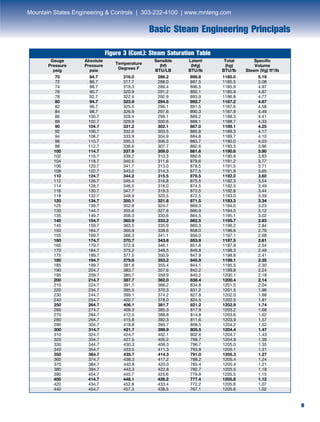
Figure 3 (Cont.): Steam Saturation Table
	 Gauge	Absolute	
Temperature
	 Sensible	 Latent	 Total 	 Specific 	
	Pressure	Pressure	
Degrees F
	(hf)	 (hfg)	 (hg)	 Volume
	 psig	 psia		 BTU/LB	 BTU/lb	 BTU/lb	 Steam (Vg) ft3
/lb
	 70	 84.7	 316.0	 286.2	898.8	1185.0	 5.19
	 72	 86.7	 317.7	 288.0	897.5	1185.5	 5.08
	 74	 88.7	 319.3	 289.4	896.5	1185.9	 4.97
	 76	 90.7	 320.9	 291.2	895.1	1185.9	 4.87
	 78	 92.7	 322.4	 292.9	893.9	1186.8	 4.77
	 80	 94.7	 323.9	 294.5	892.7	1187.2	 4.67
	 82	 96.7	 325.5	 296.1	891.5	1187.6	 4.58
	 84	 98.7	 326.9	 297.6	890.3	1187.9	 4.49
	 86	 100.7	 328.4	 299.1	889.2	1188.3	 4.41
	 88	 102.7	 329.9	 300.6	888.1	1188.7	 4.33
	 90	 104.7	 331.2	 302.1	887.0	1189.1	 4.25
	 92	 106.7	 332.6	 303.5	885.8	1189.3	 4.17
	 94	 108.7	 333.9	 304.9	884.8	1189.7	 4.10
	 96	 110.7	 335.3	 306.3	883.7	1190.0	 4.03
	 98	 112.7	 336.6	 307.7	882.6	1190.3	 3.96
	 100	 114.7	 337.9	 309.0	881.6	1190.6	 3.90
	 102	 116.7	 339.2	 310.3	880.6	1190.9	 3.83
	 104	 118.7	 340.5	 311.6	879.6	1191.2	 3.77
	 106	 120.7	 341.7	 313.0	878.5	1191.5	 3.71
	 108	 122.7	 343.0	 314.3	877.5	1191.8	 3.65
	 110	 124.7	 344.2	 315.5	876.5	1192.0	 3.60
	 112	 126.7	 345.4	 316.8	875.5	1192.3	 3.54
	 114	 128.7	 346.5	 318.0	874.5	1192.5	 3.49
	 116	 130.7	 347.7	 319.3	873.5	1192.8	 3.44
	 118	 132.7	 348.9	 320.5	872.5	1193.0	 3.39
	 120	 134.7	 350.1	 321.8	871.5	1193.3	 3.34
	 125	 139.7	 352.8	 324.7	869.3	1194.0	 3.23
	 130	 144.7	 355.6	 327.6	866.9	1194.5	 3.12
	 135	 149.7	 358.3	 330.6	864.5	1195.1	 3.02
	 140	 154.7	 360.9	 333.2	862.5	1195.7	 2.93
	 145	 159.7	 363.5	 335.9	860.3	1196.2	 2.84
	 150	 164.7	 365.9	 338.6	858.0	1196.6	 2.76
	 155	 169.7	 368.3	 341.1	856.0	1197.1	 2.68
	 160	 174.7	 370.7	 343.6	853.9	1197.5	 2.61
	 165	 179.7	 372.9	 346.1	851.8	1197.9	 2.54
	 170	 184.7	 375.2	 348.5	849.8	1198.3	 2.48
	 175	 189.7	 377.5	 350.9	847.9	1198.8	 2.41
	 180	 194.7	 379.6	 353.2	845.9	1199.1	 2.35
	 185	 199.7	 381.6	 355.4	844.1	1195.5	 2.30
	 190	 204.7	 383.7	 357.6	842.2	1199.8	 2.24
	 195	 209.7	 385.7	 359.9	840.2	1200.1	 2.18
	 200	 214.7	 387.7	 362.0	838.4	1200.4	 2.14
	 210	 224.7	 391.7	 366.2	834.8	1201.0	 2.04
	 220	 234.7	 395.5	 370.3	831.2	1201.5	 1.96
	 230	 244.7	 399.1	 374.2	827.8	1202.0	 1.88
	 240	 254.7	 402.7	 378.0	824.5	1202.5	 1.81
	 250	 264.7	 406.1	 381.7	821.2	1202.9	 1.74
	 260	 274.7	 409.3	 385.3	817.9	1203.2	 1.68
	 270	 284.7	 412.5	 388.8	814.8	1203.6	 1.62
	 280	 294.7	 415.8	 392.3	811.6	1203.9	 1.57
	 290	 304.7	 418.8	 395.7	808.5	1204.2	 1.52
	 300	 314.7	 421.7	 398.9	805.5	1204.4	 1.47
	 310	 324.7	 424.7	 402.1	802.6	1204.7	 1.43
	 320	 334.7	 427.5	 405.2	799.7	1204.9	 1.39
	 330	 344.7	 430.3	 408.3	796.7	1205.0	 1.35
	 340	 354.7	 433.0	 411.3	793.8	1205.1	 1.31
	 350	 364.7	 435.7	 414.3	791.0	1205.3	 1.27
	 360	 374.7	 438.3	 417.2	788.2	1205.4	 1.24
	 370	 384.7	 440.8	 420.0	785.4	1205.4	 1.21
	 380	 394.7	 443.3	 422.8	782.7	1205.5	 1.18
	 390	 404.7	 445.7	 425.6	779.9	1205.5	 1.15
	 400	 414.7	 448.1	 428.2	777.4	1205.6	 1.12
	 420	 434.7	 452.8	 433.4	772.2	1205.6	 1.07
	 440	 454.7	 457.3	 438.5	767.1	1205.6	 1.02
Mountain States Engineering & Controls | 303-232-4100 | www.mnteng.com
10
Boilers & Boiler Efficiency
Boilers and the associat-
ed firing equipment should be
designed and sized for maximum
efficiency. Boiler manufacturers
have improved their equipment
designs to provide this maximum
efficiency, when the equipment is
new, sized correctly for the load
conditions, and the firing equip-
ment is properly tuned. There are
many different efficiencies that
are claimed when discussing boil-
ers but the only true measure of a
boiler’s efficiency is the Fuel-to-
Steam Efficiency. Fuel-To-Steam
efficiency is calculated using
either of two methods, as pre-
scribed by the ASME Power Test
Code, PTC4.1. The first method
is input-output. This is the ratio of
BTU’s output divided by BTU’s
input, multiplied by 100. The
second method is heat balance.
This method considers stack
temperature and losses, excess
air levels, and radiation and con-
vection losses. Therefore, the
heat balance calculation for fuel-
to-steam efficiency is 100 minus
the total percent stack loss and
minus the percent radiation and
convection losses.
The sizing of a boiler for
a particular application is not
a simple task. Steam usages
vary based upon the percent-
age of boiler load that is used
for heating versus process and
then combining those loads.
These potentially wide load vari-
ations are generally overcome
by installing not just one large
boiler but possibly two smaller
units or a large and a small
boiler to accommodate the load
variations. Boiler manufacturers
usually will recommend that the
turndown ratio from maximum
load to low load not exceed 4:1.
Turndown ratios exceeding 4:1
will increase the firing cycles and
decrease efficiency.
A boiler operating at low
load conditions can cycle as
frequently as 12 times per hour,
or 288 times a day. With each
cycle, pre- and post-purge air
flow removes heat from the boil-
er and sends it out the stack.
This energy loss can be elimi-
nated by keeping the boiler on
at low firing rates. Every time
the boiler cycles off, it must
go through a specific start-up
sequence for safety assurance.
Steam Generation
10
It requires about one to two
minutes to place the boiler back
on line. And, if there’s a sud-
den load demand, the start-up
sequence cannot be acceler-
ated. Keeping the boiler on line
assures the quickest response to
load changes. Frequent cycling
also accelerates wear of boil-
er components. Maintenance
increases and, more importantly,
the chance of component failure
increases.
Once the boiler or boilers
have been sized for their steam
output, BTU’s or lb./hr, then the
operating pressures have to be
determined. Boiler operating
pressures are generally deter-
mined by the system needs as to
product/process temperatures
needed and/or the pressure
losses in transmission of the
steam in distribution throughout
the facility. (Fig. 4)
Figure 3 (Cont.): Steam Saturation Table	
Gauge	 Absolute	 Temperature	 Sensible	 Latent	 Total (hg)	 Specific 	
Pressure	 Pressure	 Degrees F	 (hf)	 (hfg)	 BTU/lb	 Volume	
psig	 psia		 BTU/LB	 BTU/lb	 ft3
/lb	 Steam (Vg)
	460	 474.7	 461.7	 443.4	 762.1	 1205.5	 .98
	480	 494.7	 465.9	 448.3	 757.1	 1205.4	 .94
	500	 514.7	 470.0	 453.0	 752.3	 1205.3	 .902
	520	 534.7	 474.0	 457.6	 747.5	 1205.1	 .868
	540	 554.7	 477.8	 462.0	 742.8	 1204.8	 .835
	560	 574.7	 481.6	 466.4	 738.1	 1205.5	 .805
	580	 594.7	 485.2	 470.7	 733.5	 1204.2	 .776
	600	 614.7	 488.8	 474.8	 729.1	 1203.9	 .750
	620	 634.7	 492.3	 479.0	 724.5	 1203.5	 .726
	640	 654.7	 495.7	 483.0	 720.1	 1203.1	 .703
	660	 674.7	 499.0	 486.9	 715.8	 1202.7	 .681
	680	 694.7	 502.2	 490.7	 711.5	 1202.2	 .660
	700	 714.7	 505.4	 494.4	 707.4	 1201.8	 .641
	720	 734.7	 508.5	 498.2	 703.1	 1201.3	 .623	
740	 754.7	 51.5	 501.9	 698.9	 1200.8	 .605
	760	 774.7	 514.5	 505.5	 694.7	 1200.2	 .588
	780	 794.7	 517.5	 509.0	 690.7	 0099.7	 .572
	800	 814.7	 520.3	 512.5	 686.6	 1199.1	 .557
Mountain States Engineering & Controls | 303-232-4100 | www.mnteng.com
11
Steam Generation
11
Selection of Working Pressure
	 The steam distribution sys-
tem is an important link between
the steam source and the steam
user. It must supply good quality
steam at the required rate and at
the right pressure. It must do this
with a minimum of heat loss, and
be economical in capital cost.
	 The pressure at which the
steam is to be distributed is
determined by the point of usage
in the plant needing the high-
est pressure. We must remember
however that as the steam passes
through the distribution pipework,
it will lose some of its pressure
due to resistance to flow, and the
fact that some of it will condense
due to loss of heat from the pip-
ing. Therefore, allowance should
be made for this pressure loss
when deciding upon the initial
distribution pressure.
	 Summarizing, we need to
consider when selecting our
working pressure:
• 	 Pressure required at point
	 of usage
• 	 Pressure drop along pipe
	 due to resistance of flow
	(friction)
• 	 Pipe heat losses
	 It is a recommended practice
to select a boiler operating pres-
sure greater than what is actually
required.
	 This is an acceptable practice
as long as it is understood that
selecting a boiler with a much
greater operating pressure than
is required, then operating it at
the lower pressure will cause a
loss in efficiency of the boiler.
This efficiency loss comes from
the increased radiation and con-
vection losses. Another area of
efficiency loss comes from the
lower quality (dryness) of the
steam produced due to increased
water level in the boiler and the
increased steam bubble size
because of the lower operating
pressures internally. It is always
recommended to operate the
boiler at or as close to the maxi-
mum operating pressure that the
vessel was designed for. The
boilers operating pressure (Fig.
4) has a definite impact on the
potential of priming and carry-
over which can cause serious
problems not only for the system
but for the boiler also.
	 Many of the boiler manu-
facturers today design their
equipment to provide 99.5% dry
saturated steam to be generated
and admitted into the distribu-
tion system. This means that less
than 1/2 of 1% of the volume exit-
ing the boiler will be water, not
steam. In practice, steam often
carries tiny droplets of water with
it and cannot be described as dry
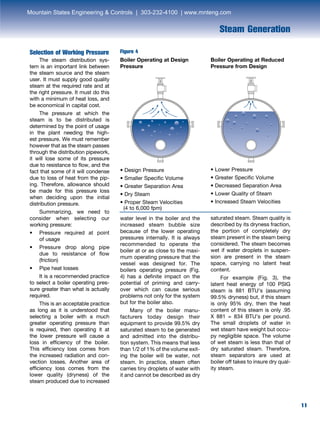
Boiler Operating at Design
Pressure
Boiler Operating at Reduced
Pressure from Design
• Design Pressure
• Smaller Specific Volume
• Greater Separation Area
• Dry Steam
• Proper Steam Velocities
(4 to 6,000 fpm)
• Lower Pressure
• Greater Specific Volume
• Decreased Separation Area
• Lower Quality of Steam
• Increased Steam Velocities
saturated steam. Steam quality is
described by its dryness fraction,
the portion of completely dry
steam present in the steam being
considered. The steam becomes
wet if water droplets in suspen-
sion are present in the steam
space, carrying no latent heat
content.
	 For example (Fig. 3), the
latent heat energy of 100 PSIG
steam is 881 BTU’s (assuming
99.5% dryness) but, if this steam
is only 95% dry, then the heat
content of this steam is only .95
X 881 = 834 BTU’s per pound.
The small droplets of water in
wet steam have weight but occu-
py negligible space. The volume
of wet steam is less than that of
dry saturated steam. Therefore,
steam separators are used at
boiler off takes to insure dry qual-
ity steam.
Figure 4
Mountain States Engineering & Controls | 303-232-4100 | www.mnteng.com
12
that can be insulated. A sin-
gle foot of 3” pipe with 100
PSI steam in it exposed to an
ambient temperature of 60°F will
radiate 778 BTU’s per hour of
operation. The latent heat energy
content of 100 PSI steam is 880
BTU’s per pound.
	 Nearly a pound of steam per
hour per foot of pipe is con-
densed just in distributing this
valuable energy supply to the
point of usage. Flanges, valves,
strainers and equipment will
waste much more energy than
Steam Generation
12
Steam Velocity
	 The velocity of the steam
flow out of the boiler, at designed
operating pressure, is estab-
lished by the outlet nozzle of the
boiler itself. Target velocities of
6,000 fpm or less have become
commonplace as design criteria.
These lower velocities provide for
reduced pressure losses, more
efficient condensate drainage,
reduced waterhammer potential
and piping erosion.
	 It is important that the steam
velocity, piping and nozzle sizing,
be considered when selecting
the boiler operating pressure
required.
	 Noise is not the only rea-
son velocities in a steam system
should be kept as low as prac-
tical. Steam is generated and
distributed throughout the system
and because of temperature dif-
ferences in the surroundings and
the insulation losses, the steam
gives up its heat and condenses.
Although it may not travel as fast
as the steam, the condensate
(water) is still going to erode the
bottom of the pipe. This erosion
is accelerated with the velocity of
the steam, therefore the lower the
steam velocity, the less erosion
will take place.
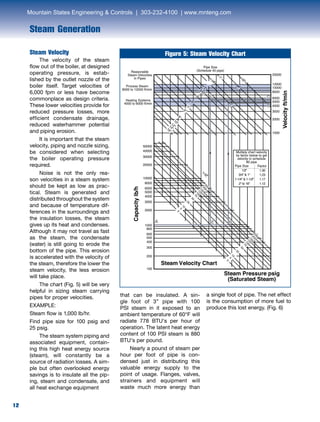
	 The chart (Fig. 5) will be very
helpful in sizing steam carrying
pipes for proper velocities.
EXAMPLE:
Steam flow is 1,000 lb/hr.
Find pipe size for 100 psig and
25 psig.
	 The steam system piping and
associated equipment, contain-
ing this high heat energy source
(steam), will constantly be a
source of radiation losses. A sim-
ple but often overlooked energy
savings is to insulate all the pip-
ing, steam and condensate, and
all heat exchange equipment
Multiply chart velocity
by factor below to get
velocity in schedule
80 pipe
Pipe Size Factor
1/2"
3/4" & 1"
1-1/4" & 1-1/2"
2" to 16"
1.30
1.23
1.17
1.12
20000
12000
10000
8000
6000
5000
4000
3000
2000
1000
50000
40000
30000
20000
10000
8000
6000
5000
4000
3000
2000
1000
800
600
100
200
300
400
500
Capacitylb/h
Reasonable
Steam Velocities
in Pipes
Process Steam
8000 to 12000 ft/min
Heating Systems
4000 to 6000 ft/min
Velocityft/min
Steam Pressure psig
(Saturated Steam)
Steam Velocity Chart
Pipe Size
(Schedule 40 pipe)
250
200
150
125
100
75
50
25
10
5
0
250
200
150
125
100
75
50
25
10
5
0
16"
14"
12"
10"
8"
6"
4"
3"
2"
1"1-1/4"
5"
3/4"
1/2"
EA
D
G
C
F
B
2-1/2"
1-1/2"
Figure 5: Steam Velocity Chart
a single foot of pipe. The net effect
is the consumption of more fuel to
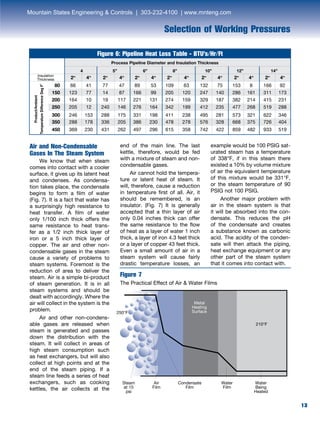
produce this lost energy. (Fig. 6)
Mountain States Engineering & Controls | 303-232-4100 | www.mnteng.com
13
Selection of Working Pressures
13
Air and Non-Condensable
Gases In The Steam System	
We know that when steam
comes into contact with a cooler
surface, it gives up its latent heat
and condenses. As condensa-
tion takes place, the condensate
begins to form a film of water
(Fig. 7). It is a fact that water has
a surprisingly high resistance to
heat transfer. A film of water
only 1/100 inch thick offers the
same resistance to heat trans-
fer as a 1/2 inch thick layer of
iron or a 5 inch thick layer of
copper. The air and other non-
condensable gases in the steam
cause a variety of problems to
steam systems. Foremost is the
reduction of area to deliver the
steam. Air is a simple bi-product
of steam generation. It is in all
steam systems and should be
dealt with accordingly. Where the
air will collect in the system is the
problem.
	 Air and other non-condens-
able gases are released when
steam is generated and passes
down the distribution with the
steam. It will collect in areas of
high steam consumption such
as heat exchangers, but will also
collect at high points and at the
end of the steam piping. If a
steam line feeds a series of heat
exchangers, such as cooking
kettles, the air collects at the
end of the main line. The last
kettle, therefore, would be fed
with a mixture of steam and non-
condensable gases.	
Air cannot hold the tempera-
ture or latent heat of steam. It
will, therefore, cause a reduction
in temperature first of all. Air, it
should be remembered, is an
insulator. (Fig. 7) It is generally
accepted that a thin layer of air
only 0.04 inches thick can offer
the same resistance to the flow
of heat as a layer of water 1 inch
thick, a layer of iron 4.3 feet thick
or a layer of copper 43 feet thick.
Even a small amount of air in a
steam system will cause fairly
drastic temperature losses, an
example would be 100 PSIG sat-
urated steam has a temperature
of 338°F, if in this steam there
existed a 10% by volume mixture
of air the equivalent temperature
of this mixture would be 331°F,
or the steam temperature of 90
PSIG not 100 PSIG.
	 Another major problem with
air in the steam system is that
it will be absorbed into the con-
densate. This reduces the pH
of the condensate and creates
a substance known as carbonic
acid. The acidity of the conden-
sate will then attack the piping,
heat exchange equipment or any
other part of the steam system
that it comes into contact with.
Figure 6: Pipeline Heat Loss Table - BTU’s/Hr/Ft
		2”	4”	2”	4”	2”	4”	2”	4”	2”	4”	2”	4”	2”	4”	
80	 66	 41	 77	 47	 89	 53	109	 63	 132	75	153	8	 166	92	
150	 123	 77	 14	 87	 166	 99	 205	 120	 247	 140	 286	161	 311	173	
200	 164	10	 19	 117	221	131	274	159	 329	187	382	214	415	231	
250	 205	12	 240	146	276	164	342	199	 412	235	477	268	519	288	
300	 246	153	288	175	331	198	411	238	 495	281	573	321	622	346	
350	 288	178	336	205	386	230	478	278	 576	328	668	375	726	404		
450	 369	230	431	262	497	296	615	358	 742	422	859	482	933	519	
Process Pipeline Diameter and Insulation Thickness		
4	 5”	 6”	 8”	 10”	 12”	 14”
Insulation
Thickness
Product/Ambient
TemperatureDifferenceDegF˚
Figure 7
The Practical Effect of Air & Water Films
250°F
210°F
Steam
at 15
psi
Air
Film
Condensate
Film
Water
Being
Heated
Water
Film
Metal
Heating
Surface
Mountain States Engineering & Controls | 303-232-4100 | www.mnteng.com
14
Steam System Basics
14
Steam System Basics
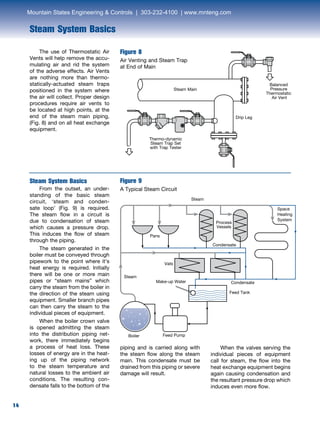
	 From the outset, an under-
standing of the basic steam
circuit, ‘steam and conden-
sate loop’ (Fig. 9) is required.
The steam flow in a circuit is
due to condensation of steam
which causes a pressure drop.
This induces the flow of steam
through the piping.
	 The steam generated in the
boiler must be conveyed through
pipework to the point where it’s
heat energy is required. Initially
there will be one or more main
pipes or “steam mains” which
carry the steam from the boiler in
the direction of the steam using
equipment. Smaller branch pipes
can then carry the steam to the
individual pieces of equipment.
	 When the boiler crown valve
is opened admitting the steam
into the distribution piping net-
work, there immediately begins
a process of heat loss. These
losses of energy are in the heat-
ing up of the piping network
to the steam temperature and
natural losses to the ambient air
conditions. The resulting con-
densate falls to the bottom of the
piping and is carried along with
the steam flow along the steam
main. This condensate must be
drained from this piping or severe
damage will result.
	 When the valves serving the
individual pieces of equipment
call for steam, the flow into the
heat exchange equipment begins
again causing condensation and
the resultant pressure drop which
induces even more flow.
Figure 9
A Typical Steam Circuit
Steam
Steam
Boiler Feed Pump
Feed Tank
Condensate
CondensateMake-up Water
Process
Vessels
Space
Heating
System
Pans
Vats
	 The use of Thermostatic Air
Vents will help remove the accu-
mulating air and rid the system
of the adverse effects. Air Vents
are nothing more than thermo-
statically-actuated steam traps
positioned in the system where
the air will collect. Proper design
procedures require air vents to
be located at high points, at the
end of the steam main piping,
(Fig. 8) and on all heat exchange
equipment.
Figure 8
Air Venting and Steam Trap
at End of Main
Steam Main
Balanced
Pressure
Thermostatic
Air Vent
Thermo-dynamic
Steam Trap Set
with Trap Tester
Drip Leg
Mountain States Engineering & Controls | 303-232-4100 | www.mnteng.com
15
Steam System Basics
15
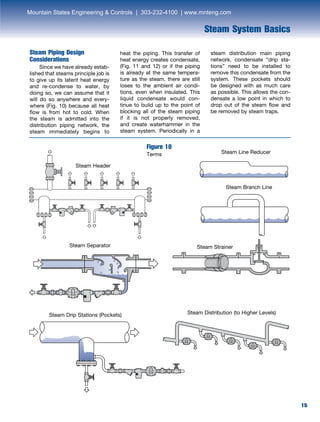
Steam Piping Design
Considerations	
Since we have already estab-
lished that steams principle job is
to give up its latent heat energy
and re-condense to water, by
doing so, we can assume that it
will do so anywhere and every-
where (Fig. 10) because all heat
flow is from hot to cold. When
the steam is admitted into the
distribution piping network, the
steam immediately begins to
heat the piping. This transfer of
heat energy creates condensate,
(Fig. 11 and 12) or if the piping
is already at the same tempera-
ture as the steam, there are still
loses to the ambient air condi-
tions, even when insulated. This
liquid condensate would con-
tinue to build up to the point of
blocking all of the steam piping
if it is not properly removed,
and create waterhammer in the
steam system. Periodically in a
steam distribution main piping
network, condensate “drip sta-
tions” need to be installed to
remove this condensate from the
system. These pockets should
be designed with as much care
as possible. This allows the con-
densate a low point in which to
drop out of the steam flow and
be removed by steam traps.
Figure 10
Terms
Steam Header
Steam Line Reducer
Steam Branch Line
Steam Separator
Steam Drip Stations (Pockets)
Steam Strainer
Steam Distribution (to Higher Levels)
Mountain States Engineering & Controls | 303-232-4100 | www.mnteng.com
16
Steam System Basics
16
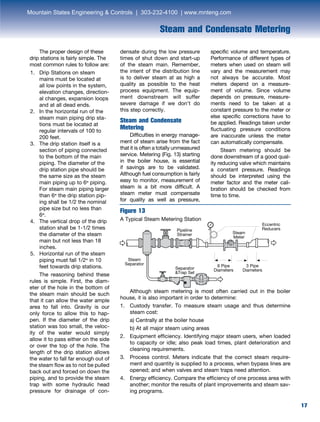
Ambient Temperature 70°F. Insulation 80% efficient.
Load due to radiation and convection for saturated steam.
Ambient Temperature 70°F. Based on Sch. 40 pipe to 250 psi
Sch. 80 above 250 except Sch. 120 5” and larger above 800 psi
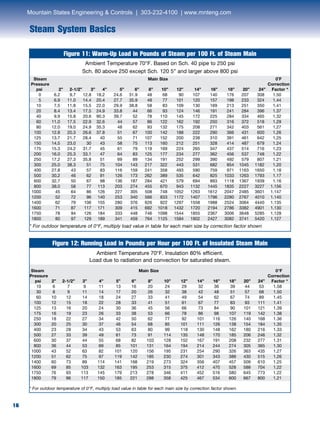
Figure 11: Warm-Up Load in Pounds of Steam per 100 Ft. of Steam Main
Figure 12: Running Load in Pounds per Hour per 100 Ft. of Insulated Steam Main
Steam	 Main Size					 0˚F
Pressure											 Correction
psi	 2”	 2-1/2”	 3”	 4”	 5”	 6”	 8”	 10”	 12”	 14”	 16”	 18”	 20”	 24”	 Factor *
	 0	 6.2	 9.7	 12.8	18.2	 24.6	 31.9	 48	 68	 90	 107	 140	 176	 207	 308	 1.50
	 5	 6.9	 11.0	 14.4	20.4	 27.7	 35.9	 48	 77	 101	 120	 157	 198	 233	 324	 1.44
	 10	 7.5	 11.8	 15.5	22.0	 29.9	 38.8	 58	 83	 109	 130	 169	 213	 251	 350	 1.41
	20	 8.4	13.4	17.5	24.9	33.8	44	66	93	124	146	191	241	284	396	1.37
	 40	 9.9	 15.8	 20.6	90.3	 39.7	 52	 78	 110	 145	 172	 225	 284	 334	 465	 1.32
	 60	 11.0	 17.5	 22.9	32.6	 44	 57	 86	 122	 162	 192	 250	 316	 372	 518	 1.29
	 80	 12.0	 19.0	 24.9	35.3	 48	 62	 93	 132	 175	 208	 271	 342	 403	 561	 1.27
	100	 12.8	 20.3	 26.6	 37.8	 51	 67	 100	 142	 188	 222	 290	 366	 431	 600	 1.26
	125	 13.7	 21.7	 28.4	 40	 55	 71	 107	 152	 200	 238	 310	 391	 461	 642	 1.25
	150	 14.5	 23.0	 30	 43	 58	 75	 113	 160	 212	 251	 328	 414	 487	 679	 1.24
	175	 15.3	 24.2	 31.7	 45	 61	 79	 119	 169	 224	 265	 347	 437	 514	 716	 1.23
	200	 16.0	 25.3	 33.1	 47	 64	 83	 125	 177	 234	 277	 362	 456	 537	 748	 1.22
	250	 17.2	 27.3	 35.8	 51	 69	 89	 134	 191	 252	 299	 390	 492	 579	 807	 1.21
	300	 25.0	38.3	 51	75	 104	143	217	322	 443	 531	 682	 854	1045	1182	1.20
	400	 27.8	 43	 57	83	 116	159	241	358	 493	 590	 759	 971	1163	1650	1.18
	500	 30.2	 46	 62	91	 126	173	262	389	 535	 642	 825	1033	1263	1793	1.17
	600	 32.7	 50	 67	98	 136	187	284	421	 579	 694	 893	1118	1367	1939	1.16
	800	 38.0	 58	 77	113	 203	274	455	670	 943	1132	1445	1835	2227	3227	1.156
	1000	 45	 64	 86	126	 227	305	508	748	1052	1263	1612	2047	2485	3601	1.147
	1200	 52	 72	 96	140	 253	340	566	833	1172	1407	1796	2280	2767	4010	1.140
	1400	 62	 79	106	155	 280	376	626	922	1297	1558	1988	2524	3064	4440	1.135
	1600	 71	 87	 117	 171	 309	 415	 692	 1018	 1432	 1720	 2194	 2786	 3382	 4901	 1.130
	1750	 78	 94	 126	 184	 333	 448	 746	 1098	 1544	 1855	 2367	 3006	 3648	 5285	 1.128
	1800	 80	 97	 129	 189	 341	 459	 764	 1125	 1584	 1902	 2427	 3082	 3741	 5420	 1.127
* For outdoor temperature of 0°F, multiply load value in table for each main size by correction factor shown		
Steam	 Main Size						 0°F
Pressure												 Correction
	 psi	 2”	 2-1/2”	 3”	 4”	 5”	 6”	 8”	 10”	 12”	 14”	 16”	 18”	 20”	 24” 	Factor *
	10	6	7	 9	11	13	16	20	24	29	32	36	39	44	53	1.58
	30	8	9	 11	14	17	20	26	32	38	42	48	51	57	68	1.50
	60	10	12	14	18	 24	27	33	 41	49	54	62	67	74	89	1.45
	100	12	15	18	22	 28	33	41	 51	61	67	77	83	93	111	1.41
	125	13	16	20	24	 30	36	45	 56	66	73	84	90	101	121	1.39
	175	16	19	23	26	33	38	53	66	78	86	98	107	119	142	1.38
	250	18	22	27	34	42	50	62	77	92	101	116	126	140	168	1.36
	300	20	25	30	37	46	54	68	85	101	111	126	138	154	184	1.35
	400	23	28	34	43	53	63	80	99	118	130	148	162	180	216	1.33
	500	 27	 33	 39	 49	 61	 73	 91	 114	 135	 148	 170	 185	 206	 246	 1.32
	600	 30	 37	 44	 55	 68	 82	 103	 128	 152	 167	 191	 208	 232	 277	 1.31
	800	 36	 44	 53	 69	 85	 101	 131	 164	 194	 214	 244	 274	 305	 365	 1.30
	1000	 43	 52	 63	 82	 101	 120	 156	 195	 231	 254	 290	 326	 363	 435	 1.27
	1200	 51	 62	 75	 97	 119	 142	 185	 230	 274	 301	 343	 386	 430	 515	 1.26
	1400	60	73	 89	114	141	168	219	273	324	356	407	457	509	610	1.25
	1600	 69	85	 103	132	163	195	253	315	375	412	470	528	588	704	1.22
	1750	 76	93	 113	145	179	213	278	346	411	452	516	580	645	773	1.22
	1800	 79	96	 117	150	185	221	288	358	425	467	534	600	667	800	1.21
* For outdoor temperature of 0°F, multiply load value in table for each main size by correction factor shown.		
Mountain States Engineering & Controls | 303-232-4100 | www.mnteng.com
17
Steam and Condensate Metering
17
The proper design of these
drip stations is fairly simple. The
most common rules to follow are:
1.	 Drip Stations on steam
mains must be located at
all low points in the system,
elevation changes, direction-
al changes, expansion loops
and at all dead ends.
2.	 In the horizontal run of the
steam main piping drip sta-
tions must be located at
regular intervals of 100 to
200 feet.
3.	 The drip station itself is a
section of piping connected
to the bottom of the main
piping. The diameter of the
drip station pipe should be
the same size as the steam
main piping up to 6” piping.
For steam main piping larger
than 6” the drip station pip-
ing shall be 1/2 the nominal
pipe size but no less than
6”.
4.	 The vertical drop of the drip
station shall be 1-1/2 times
the diameter of the steam
main but not less than 18
inches.
5.	 Horizontal run of the steam
piping must fall 1/2” in 10
feet towards drip stations.
	 The reasoning behind these
rules is simple. First, the diam-
eter of the hole in the bottom of
the steam main should be such
that it can allow the water ample
area to fall into. Gravity is our
only force to allow this to hap-
pen. If the diameter of the drip
station was too small, the veloc-
ity of the water would simply
allow it to pass either on the side
or over the top of the hole. The
length of the drip station allows
the water to fall far enough out of
the steam flow as to not be pulled
back out and forced on down the
piping, and to provide the steam
trap with some hydraulic head
pressure for drainage of con-
	 Although steam metering is most often carried out in the boiler
house, it is also important in order to determine:
1.	Custody transfer. To measure steam usage and thus determine
steam cost:
	 a) Centrally at the boiler house
	 b) At all major steam using areas
2.	Equipment efficiency. Identifying major steam users, when loaded
to capacity or idle; also peak load times, plant deterioration and
cleaning requirements.
3.	Process control. Meters indicate that the correct steam require-
ment and quantity is supplied to a process, when bypass lines are
opened; and when valves and steam traps need attention.
4.	Energy efficiency. Compare the efficiency of one process area with
another; monitor the results of plant improvements and steam sav-
ing programs.
Figure 13
A Typical Steam Metering Station
densate during the low pressure
times of shut down and start-up
of the steam main. Remember,
the intent of the distribution line
is to deliver steam at as high a
quality as possible to the heat
process equipment. The equip-
ment downstream will suffer
severe damage if we don’t do
this step correctly.
Steam and Condensate
Metering
Difficulties in energy manage-
ment of steam arise from the fact
that it is often a totally unmeasured
service. Metering (Fig. 13) starting
in the boiler house, is essential
if savings are to be validated.
Although fuel consumption is fairly
easy to monitor, measurement of
steam is a bit more difficult. A
steam meter must compensate
for quality as well as pressure,
specific volume and temperature.
Performance of different types of
meters when used on steam will
vary and the measurement may
not always be accurate. Most
meters depend on a measure-
ment of volume. Since volume
depends on pressure, measure-
ments need to be taken at a
constant pressure to the meter or
else specific corrections have to
be applied. Readings taken under
fluctuating pressure conditions
are inaccurate unless the meter
can automatically compensate.
Steam metering should be
done downstream of a good qual-
ity reducing valve which maintains
a constant pressure. Readings
should be interpreted using the
meter factor and the meter cali-
bration should be checked from
time to time.
Pipeline
Strainer
Steam
Separator
Steam
Meter
Separator
Trap Set
Eccentric
Reducers
6 Pipe
Diameters
3 Pipe
Diameters
Mountain States Engineering  Controls | 303-232-4100 | www.mnteng.com
18
Steam and Condensate Metering
18
Why Measure Steam?	
Steam is still the most widely
used heat carrying medium in the
world. It is used in the processes
that make many of the foodstuffs
we eat, the clothes we wear,
components of the cars we ride
in and the furniture we use. It
is used in hospitals for steriliza-
tion of instruments and surgical
packs, in the refining process
for crude oil based products, in
chemical production, and in the
laundry that cleans our clothes.
	 Despite this, it is commonly
regarded as an almost free ser-
vice - easily available. Very few
attempt to monitor its usage and
costs, as they would for other
raw materials in the process.
	 “But a steam meter won’t
save energy’’. This statement
is sometimes used as a reason
for not installing steam meters.
It cannot be argued against if
steam meters are evaluated in
the same way as other pieces
of energy saving equipment or
schemes.	
	 A statement such as the
one quoted earlier does little to
ease the frustration of the Energy
Manager or Factory Manager try-
ing to establish where steam is
being used, how much is being
used and whether it is being
used wisely and effectively.
	 All too often, when the need
for a steam meter is accepted,
only central monitoring i.e. in the
Boiler House or a major Plant
Room is carried out. Monitoring
at branch mains or at each plant
room, a section of the process
or major pieces of steam using
equipment, are not considered.
	 While central monitoring
will establish overall steam flow
figures (and thus, costs), ’depart-
mental’ monitoring will give data
which is much more useful.
Such steam meters will enable
checks to be kept on individual
plant performance. Costs can
be analyzed for each part of the
process and ‘pay-back’ records
can be established following the
implementation of energy saving
measures.
	 The steam meter is the
first basic tool in good steam
housekeeping - it provides the
knowledge of steam usage and
cost which is vital to an efficiently
operated plant or building. The
main reasons for using a steam
meter are, therefore:-
Plant Efficiency
	 A steam meter will indi-
cate process efficiency. For
example, whether idle machin-
ery is switched off; whether
plant is loaded to capacity and
whether working practices are
satisfactory. It will also show the
deterioration of plant overtime,
allowing optimal plant cleaning
or even replacement, to be cal-
culated. Further, it can establish
peak steam usage times or iden-
tify sections or items of plant
which are major steam users.
This may lead to a change in
production methods to even out
steam usage and ease the peak
load problems on boiler plant.
Energy Efficiency
	 Steam meters can be used
to monitor the results of energy
saving schemes and to compare
the efficiency of one piece of
plant with another.
Process Control
	 Steam meters can indicate
that the correct quantity of steam
is being supplied to a process
and that it is at the correct tem-
perature and pressure.
Costing and Custody Transfer
	 Steam meters can measure
steam usage and thus steam
cost.	
(a)	 Centrally	
(b) 	At major steam using
centers.
	 Steam can be costed as a
‘raw material’ at various stages
of the production process thus
allowing the true cost of individu-
al product lines to be calculated.
The Control and Regulation of
Steam	
The proper control and regu-
lation of steam either in regards
to steam pressure for equipment
or for the flow of this valuable
heat energy source to heat trans-
fer equipment is mandatory for
today’s industrial and HVAC
steam users for efficient usage of
this energy source. The control
of heat flow to product tempera-
tures in process equipment is
mandatory, otherwise production
wastage becomes intolerable,
which means lost profits.
	 The control of steam pres-
sures and the regulation of
steam flow to heat exchangers is
accomplished by several differ-
ent types of valves. This section
is intended to describe the differ-
ent types of valves used for these
operations and the differences
that will help the user in deciding
which type of valve is necessary
for his specific application. This
section will not go into complete
descriptions of these valves but
just an overview of their oper-
ational characteristics and the
benefits of that operation.
Mountain States Engineering  Controls | 303-232-4100 | www.mnteng.com
19
Pressure Reducing Valves
	 Most steam boilers are
designed to work at relatively
high pressures, generally above
the steam pressure required in
equipment, and should not be
operated at lower pressures.
Operation at lowered pressures
causes reduced efficiencies and
increased potential for boiler
carryover. For this reason, the
highest efficiency is maintained
by generating and distributing the
highest steam pressures that the
boiler is capable of producing. To
produce lower pressure steam at
the point of use, a building pres-
sure reducing valve should be
used. This system design allows
for much smaller distribution pip-
ing, reducing costs and reducing
heat losses from these pipes.
Also every piece of steam using
equipment has a maximum safe
working pressure which can-
not be exceeded in operation.
Another energy efficiency reason
for reducing steam pressures is
the “latent” heat content is great-
er in lower pressure steam. More
heat content per pound means
less pounds of steam to do the
work. These are not the only
reasons for reducing steam pres-
sure. Since the temperature of
saturated steam is determined by
its pressure, control of pressure
is a simple but effective method
of accurate temperature control.
This fact is used in applications
such as sterilizers and control of
surface temperatures on contact
dryers. Reducing steam pressure
will also cut down on the losses
of flash steam from vented con-
densate return receivers.
	 Most pressure reducing
valves currently available can be
divided into three groups and
their operation is as follows:
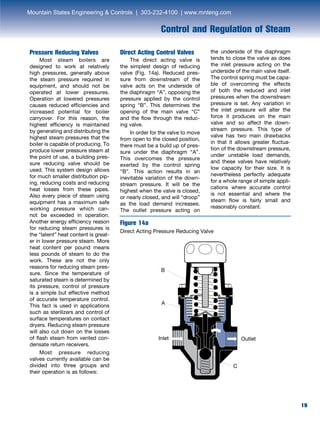
Direct Acting Control Valves
	 The direct acting valve is
the simplest design of reducing
valve (Fig. 14a). Reduced pres-
sure from downstream of the
valve acts on the underside of
the diaphragm “A”, opposing the
pressure applied by the control
spring “B”. This determines the
opening of the main valve “C”
and the flow through the reduc-
ing valve.
	 In order for the valve to move
from open to the closed position,
there must be a build up of pres-
sure under the diaphragm “A”.
This overcomes the pressure
exerted by the control spring
“B”. This action results in an
inevitable variation of the down-
stream pressure. It will be the
highest when the valve is closed,
or nearly closed, and will “droop”
as the load demand increases.
The outlet pressure acting on
the underside of the diaphragm
tends to close the valve as does
the inlet pressure acting on the
underside of the main valve itself.
The control spring must be capa-
ble of overcoming the effects
of both the reduced and inlet
pressures when the downstream
pressure is set. Any variation in
the inlet pressure will alter the
force it produces on the main
valve and so affect the down-
stream pressure. This type of
valve has two main drawbacks
in that it allows greater fluctua-
tion of the downstream pressure,
under unstable load demands,
and these valves have relatively
low capacity for their size. It is
nevertheless perfectly adequate
for a whole range of simple appli-
cations where accurate control
is not essential and where the
steam flow is fairly small and
reasonably constant.
Control and Regulation of Steam
19
Figure 14a
Direct Acting Pressure Reducing Valve
A
Inlet Outlet
B
C
Mountain States Engineering  Controls | 303-232-4100 | www.mnteng.com
20
fore, small. Although any rise in
upstream pressure will apply an
increased closing force on the
main valve, this is offset by the
force of the upstream pressure
acting on the main diaphragm.
The result is a valve which gives
close control of downstream
pressure regardless of variations
on the upstream sides (Fig. 16).
Pneumatically Operated
Valves
	 Pneumatically operated con-
trol valves with actuators and
positioners (Fig. 15) being piloted
Control and Regulation of Steam
20
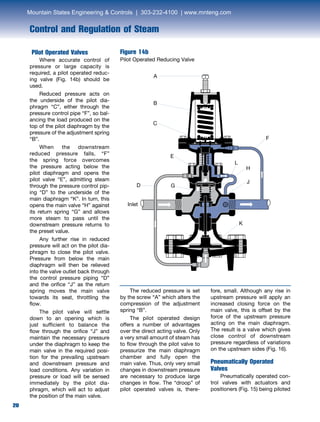
Pilot Operated Valves
	 Where accurate control of
pressure or large capacity is
required, a pilot operated reduc-
ing valve (Fig. 14b) should be
used.
	 Reduced pressure acts on
the underside of the pilot dia-
phragm “C”, either through the
pressure control pipe “F”, so bal-
ancing the load produced on the
top of the pilot diaphragm by the
pressure of the adjustment spring
“B”.
	 When the downstream
reduced pressure falls, “F”
the spring force overcomes
the pressure acting below the
pilot diaphragm and opens the
pilot valve “E”, admitting steam
through the pressure control pip-
ing “D” to the underside of the
main diaphragm “K”. In turn, this
opens the main valve “H” against
its return spring “G” and allows
more steam to pass until the
downstream pressure returns to
the preset value.
	 Any further rise in reduced
pressure will act on the pilot dia-
phragm to close the pilot valve.
Pressure from below the main
diaphragm will then be relieved
into the valve outlet back through
the control pressure piping “D”
and the orifice “J” as the return
spring moves the main valve
towards its seat, throttling the
flow.
	 The pilot valve will settle
down to an opening which is
just sufficient to balance the
flow through the orifice “J” and
maintain the necessary pressure
under the diaphragm to keep the
main valve in the required posi-
tion for the prevailing upstream
and downstream pressure and
load conditions. Any variation in
pressure or load will be sensed
immediately by the pilot dia-
phragm, which will act to adjust
the position of the main valve.
	 The reduced pressure is set
by the screw “A” which alters the
compression of the adjustment
spring “B”.
	 The pilot operated design
offers a number of advantages
over the direct acting valve. Only
a very small amount of steam has
to flow through the pilot valve to
pressurize the main diaphragm
chamber and fully open the
main valve. Thus, only very small
changes in downstream pressure
are necessary to produce large
changes in flow. The “droop” of
pilot operated valves is, there-
Figure 14b
Pilot Operated Reducing Valve
A
B
C
D
E
G
A F
H
J
K
Inlet
L
Mountain States Engineering  Controls | 303-232-4100 | www.mnteng.com
21
Selection  Application	
The first essential is to select
the best type of valve for a given
application and this follows
logically from the descriptions
already given. Small loads
where accurate control is not
vital should be met by using the
simple direct acting valves. In
all other cases, the pilot oper-
ated valves will be the best
choice, particularly if there are
periods of no demand when the
downstream pressure must not
be allowed to rise.
	 Oversizing, a common
industry practice, should be
avoided at all costs regardless of
Control and Regulation of Steam
21
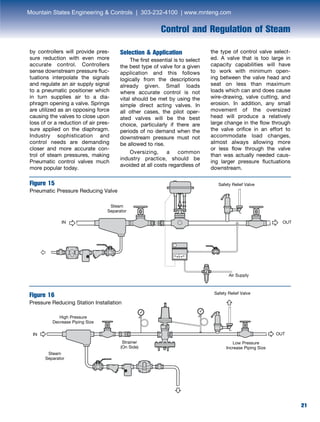
Figure 15
Pneumatic Pressure Reducing Valve
Figure 16
Pressure Reducing Station Installation
the type of control valve select-
ed. A valve that is too large in
capacity capabilities will have
to work with minimum open-
ing between the valve head and
seat on less than maximum
loads which can and does cause
wire-drawing, valve cutting, and
erosion. In addition, any small
movement of the oversized
head will produce a relatively
large change in the flow through
the valve orifice in an effort to
accommodate load changes,
almost always allowing more
or less flow through the valve
than was actually needed caus-
ing larger pressure fluctuations
downstream.
by controllers will provide pres-
sure reduction with even more
accurate control. Controllers
sense downstream pressure fluc-
tuations interpolate the signals
and regulate an air supply signal
to a pneumatic positioner which
in turn supplies air to a dia-
phragm opening a valve. Springs
are utilized as an opposing force
causing the valves to close upon
loss of or a reduction of air pres-
sure applied on the diaphragm.
Industry sophistication and
control needs are demanding
closer and more accurate con-
trol of steam pressures, making
Pneumatic control valves much
more popular today.
High Pressure
Decrease Piping Size
Steam
Separator
Steam
Separator
Strainer
(On Side)
Air Supply
Safety Relief Valve
Safety Relief Valve
Low Pressure
Increase Piping Size
IN
IN
OUT
OUT
Mountain States Engineering  Controls | 303-232-4100 | www.mnteng.com
22
Control and Regulation of Steam
22
	 A smaller, correctly sized
reducing valve will be less prone
to wear and will give more
accurate control. Where it is nec-
essary to make bigger reductions
in pressure or to cope with wide
fluctuations in loads, it is rec-
ommended to use two or more
valves in series or parallel to
improve controllability and life
expectancy of the valves.
	 Although reliability and accu-
racy depend on correct selection
and sizing, they also depend on
correct installation.
	 Since the majority of reduc-
ing valve problems are caused by
the presence of wet steam and/
or dirt, a steam separator and
strainer with a fine mesh screen
(100 mesh) are fitted before the
valve. The strainer is installed
with the “Y” portion of its body
just below horizontal in a hori-
zontal steam line to prevent the
body from filling up with conden-
sate during periods of shut down
and to ensure that the full area of
the screen is effective in prevent-
ing dirt from passing through.
As a part of a Preventative
Maintenance Program all strain-
ers should be installed with
blowdown valves for regular dirt
removal. All upstream and down-
stream piping and fittings should
be sized to handle the maximum
steam flows at a reasonable
velocity of not more than 6,000
feet per minute. Eccentric pipe
reducers, with the flat side on the
bottom, should be used to pre-
vent any build up of condensate
in the piping during shutdown. 	
If the downstream equipment
is not capable of withstanding
the full upstream steam pressure,
then a safety relief valve must be
fitted either on the downstream
piping or the specific piece of
equipment to be protected from
over pressurization in case of
a valve failure. This safety relief
valve must be sized to handle
the maximum steam flow of the
reducing valve at the desired set
relief pressure. ASME standards
state that those set relief pres-
sures are to be 5 PSI above the
equipment maximum operating
pressure for equipment operat-
ing up to 70 PSI, and not to
exceed 10% greater than maxi-
mum operating pressures for
equipment operating above 70
PSI but below 1000 PSI.
Temperature Control Valves
	 Most types of steam equip-
ment need to utilize some form
of temperature control system.
In process equipment, product
quality is often dependent upon
accurate temperature control,
while heating systems need to
be thermostatically controlled in
order to maintain optimum com-
fort conditions. From an energy
saving point of view, control-
ling the steam energy supply to
a process piece of equipment
to maintain the desired product
temperature, whether air or any
product, is mandatory. If process
systems are not controlled to the
desired temperatures then the
system will run “wild” either not
providing the required heat ener-
gy or over heating the product
to unacceptable levels. A very
important item to remember in the
use of temperature control valves
on systems is that in order to reg-
ulate the heat energy transferred
to the process the control valve
effectively regulates not only the
flow rate of energy in pounds
per hour, but, also accomplishes
temperature control by regulating
the saturated steam pressure/
temperature levels admitted
to the process heat exchange
equipment. Temperature control
can be accomplished by several
methods and valves:
Manual Control Valves	
Manual valves can be applied
to a piece of equipment to con-
trol the energy supplied to the
process as simply as they are
used to regulate the flow of other
fluids. The major drawback of
manual valves to control tem-
peratures is that these valves
will undoubtedly need frequent
adjustments and monitoring to
maintain just the correct temper-
atures under constantly changing
load conditions, which is the
case of most pieces of process
equipment.
Self Acting Control Valves 	
Self-Acting Control Valves
(Fig. 17) are operated by a sen-
sor system that senses the
product temperatures, causing
a heat sensitive fluid to expand
or contract based on the prod-
uct temperature transferring heat
energy to the sensors fluid. This
expansion and contraction of the
heat sensitive fluid is transmit-
ted up through a capillary tubing
arrangement and the respective
expansion and contraction of the
fluid applies or relieves pres-
sure to a valve head, causing
the valve head to move. This
movement allows the control
valve to throttle the steam flow
to the equipment. These control
systems are calibrated by the
amount of heat sensitive fluid to
control within a given tempera-
ture range and can be set to any
temperature between the upper
and lower limits by means of an
adjustment knob.
Mountain States Engineering  Controls | 303-232-4100 | www.mnteng.com
23
Control and Regulation of Steam
23
Figure 17
Self Acting Temperature Control
Figure 18
Pilot Operated Temperature Control Valve
Pilot Operated Control Valves
	 Pilot Operated Temperature
Control Valves (Fig. 18) oper-
ate on a similar design except
instead of operating the control
valve head movement direct-
ly, these units only control a
small pilot device which in turn
operates the main valve for throt-
tling of the steam flow. Since
on this device the heat sensi-
tive fluid only operates a very
small valve mechanism, which
in turn operates the main throt-
tling device, the sensing system
is much smaller in physical size.
These systems tend to control
the required temperatures much
closer to the desired levels and if
and when a load change require-
ment occurs, the pilot operated
valves are able to respond to
these changes much more rap-
idly.
	 The normal position before
starting up the system is with
the main throttling valve closed
and the pilot valve held open
by spring force. Entering steam
passes through the pilot valve
into the diaphragm chamber and
out through the control orifice.
Control pressure increases in
the diaphragm chamber, which
opens the main valve. As the
product being heated approach-
es the pre-selected desired
temperature, the heat sensitive
fluid in the sensor bulb expands
through the capillary tubing into
the bellows and throttles the pilot
valve. The control pressure main-
tained in the diaphragm chamber
positions the main valve to
deliver the required steam flow.
When heat is not required, the
main valve closes tight to provide
dead end shut off. The tem-
perature setting can be changed
by turning the calibrated adjust-
ment dial on the pilot. This type
of temperature control is known
as “modulating control”, since
the steam supply is gradu-
ally increased or decreased in
response to any variation in the
temperature of the medium being
heated. Remember that this
means that the steam pressure
in the heating equipment can and
will vary from relatively high pres-
sure/temperature when the valve
is wide open to practically noth-
ing, or even potentially in vacuum
conditions. NOTE: A vacuum can
form as the residual steam in the
coil or heat exchanger equipment
condenses because the closed
valve prevents any further steam
from entering. The most common
occurrence is coils and/or heat
exchanger equipment running in
vacuum, doing more work than
what they were designed for,
greater product flows through
the equipment causing the steam
to be condensed faster than it
can be admitted.
Adjustment Knob
Sensor
Add 1°C to
Sensor
Overload Bellows
Valve Housing
Thrust Pin
Capillary
Actuator to Valve
Connection
Valve Plug
Movement
Movement
caused by
Adding Temp
to Sensor
Temperature
Adjustment
Control Pressure
Temperature
Pilot
Inlet
Orifice
Bulb
Main Valve
Main Diaphragm
Mountain States Engineering  Controls | 303-232-4100 | www.mnteng.com
24
Control and Regulation of Steam
24
Pneumatic Control Valve
	 Pneumatic Control Valves
(Fig. 19) are also pilot operated
valves in that they receive their
control signals from an external
sensing system, converting this
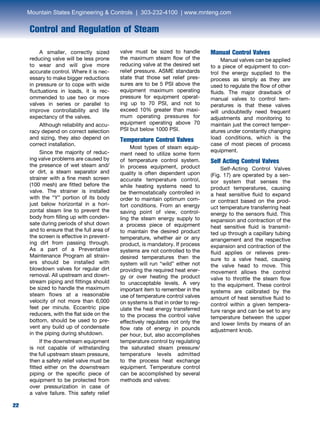
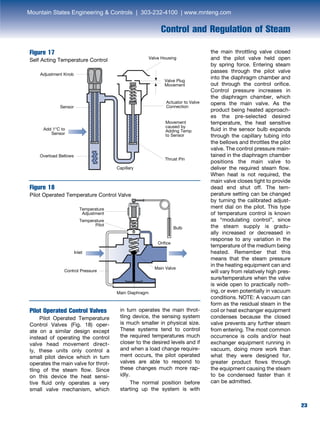
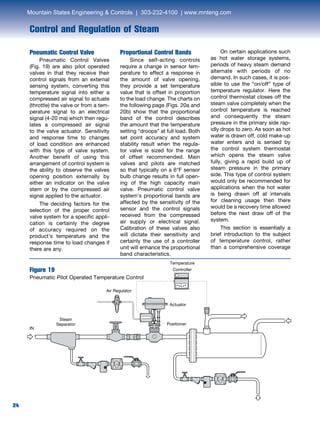
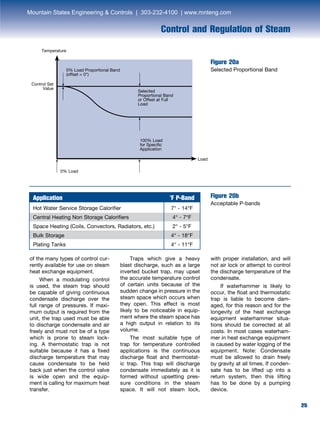
temperature signal into either a
compressed air signal to actuate
(throttle) the valve or from a tem-
perature signal to an electrical
signal (4-20 ma) which then regu-
lates a compressed air signal
to the valve actuator. Sensitivity
and response time to changes
of load condition are enhanced
with this type of valve system.
Another benefit of using this
arrangement of control system is
the ability to observe the valves
opening position externally by
either an indicator on the valve
stem or by the compressed air
signal applied to the actuator.
	 The deciding factors for the
selection of the proper control
valve system for a specific appli-
cation is certainly the degree
of accuracy required on the
product’s temperature and the
response time to load changes if
there are any.
Figure 19
Pneumatic Pilot Operated Temperature Control
Proportional Control Bands
	 Since self-acting controls
require a change in sensor tem-
perature to effect a response in
the amount of valve opening,
they provide a set temperature
value that is offset in proportion
to the load change. The charts on
the following page (Figs. 20a and
20b) show that the proportional
band of the control describes
the amount that the temperature
setting “droops” at full load. Both
set point accuracy and system
stability result when the regula-
tor valve is sized for the range
of offset recommended. Main
valves and pilots are matched
so that typically on a 6°F sensor
bulb change results in full open-
ing of the high capacity main
valve. Pneumatic control valve
system’s proportional bands are
affected by the sensitivity of the
sensor and the control signals
received from the compressed
air supply or electrical signal.
Calibration of these valves also
will dictate their sensitivity and
certainly the use of a controller
unit will enhance the proportional
band characteristics.
	 On certain applications such
as hot water storage systems,
periods of heavy steam demand
alternate with periods of no
demand. In such cases, it is pos-
sible to use the “on/off” type of
temperature regulator. Here the
control thermostat closes off the
steam valve completely when the
control temperature is reached
and consequently the steam
pressure in the primary side rap-
idly drops to zero. As soon as hot
water is drawn off, cold make-up
water enters and is sensed by
the control system thermostat
which opens the steam valve
fully, giving a rapid build up of
steam pressure in the primary
side. This type of control system
would only be recommended for
applications when the hot water
is being drawn off at intervals
for cleaning usage then there
would be a recovery time allowed
before the next draw off of the
system.
	 This section is essentially a
brief introduction to the subject
of temperature control, rather
than a comprehensive coverage
Steam
Separator Positioner
Actuator
Air Regulator
Temperature
Controller
IN
Mountain States Engineering  Controls | 303-232-4100 | www.mnteng.com
25
Control and Regulation of Steam
25
Figure 20a
Selected Proportional Band
of the many types of control cur-
rently available for use on steam
heat exchange equipment.
	 When a modulating control
is used, the steam trap should
be capable of giving continuous
condensate discharge over the
full range of pressures. If maxi-
mum output is required from the
unit, the trap used must be able
to discharge condensate and air
freely and must not be of a type
which is prone to steam lock-
ing. A thermostatic trap is not
suitable because it has a fixed
discharge temperature that may
cause condensate to be held
back just when the control valve
is wide open and the equip-
ment is calling for maximum heat
transfer.
	 Traps which give a heavy
blast discharge, such as a large
inverted bucket trap, may upset
the accurate temperature control
of certain units because of the
sudden change in pressure in the
steam space which occurs when
they open. This effect is most
likely to be noticeable in equip-
ment where the steam space has
a high output in relation to its
volume.
	 The most suitable type of
trap for temperature controlled
applications is the continuous
discharge float and thermostat-
ic trap. This trap will discharge
condensate immediately as it is
formed without upsetting pres-
sure conditions in the steam
space. It will not steam lock,
Figure 20b
Acceptable P-bands
with proper installation, and will
not air lock or attempt to control
the discharge temperature of the
condensate.
	 If waterhammer is likely to
occur, the float and thermostatic
trap is liable to become dam-
aged, for this reason and for the
longevity of the heat exchange
equipment waterhammer situa-
tions should be corrected at all
costs. In most cases waterham-
mer in heat exchange equipment
is caused by water logging of the
equipment. Note: Condensate
must be allowed to drain freely
by gravity at all times. If conden-
sate has to be lifted up into a
return system, then this lifting
has to be done by a pumping
device.
Control Set
Value
Temperature
0% Load Proportional Band
(offset = 0°)
Selected
Proportional Band
or Offset at Full
Load
100% Load
for Specific
Application
0% Load
Application	 °F P-Band
Hot Water Service Storage Calorifier	 7° - 14°F
Central Heating Non Storage Calorifiers	 4° - 7°F
Space Heating (Coils, Convectors, Radiators, etc.)	 2° - 5°F
Bulk Storage	 4° - 18°F
Plating Tanks	 4° - 11°F
Load
Mountain States Engineering  Controls | 303-232-4100 | www.mnteng.com
26
Steam Traps and the Removal of Condensate
26
Condensate Removal	
Condensate should be prop-
erly disposed of from each of
the three possible types of plant
locations which are Drip, Tracer
and Process. Condensate has
been neglected in the past, but
has a distinct monetary value
which must be recaptured. It
is becoming far too valuable to
merely discard to the ground or a
drain. Let us look at some of the
important and valuable aspects
of condensate.
	 First of all, condensate is
purified water. It is distilled water.
It may have some chemical treat-
ment left in it which in itself is
valuable. Most of all though, it is
hot water. It is fairly obvious that
it is less expensive to regenerate
hot condensate back into steam
than it would be to heat cold
make up water into steam. Every
BTU is valuable and that which
remains in the condensate is no
exception.	
In the past, the focus of con-
densate removal was generally in
main steam process areas only.
Condensate from light load loca-
tions, such as Drip and Tracer,
have not been widely returned.
The loads at a drip station are low
for each location, but when the
number of locations are counted,
it is shown the amount of return-
able condensate is very high. For
example, if we review the expect-
ed condensate load from the
Steam Distribution Condensate
Tables (Fig. 12), a six inch steam
main at 100 psig will generate
about 33 lbs. per hour per 100
ft. of insulated pipe. This initially
does not seem like much, but if
there are 100 drip locations, it
calculates to approx. 3300 lbs.
per hour of condensate. Multiply
this number by 8760 hours in a
year and you will see a substantial
amount of usage.
CALCULATION:		
3300 lbs./hour	
x 	8760 hrs/ year
		 28,908,000 lbs/year
or	3,466,187 gal./year	
Another factor to calculate is
the monetary value of the con-
densate. Condensate contains
heat, chemicals and water. It is
usually as much as one third of
the cost of generating steam. If
our example were to assume a
steam generation cost of $3.00
for each 1,000 lbs., our example
of lost condensate and energy
calculates as follows:
CALCULATION:
28,908,000 lbs/year
= 28,980		
1000	
28,980 x $3.00 = $ 86,940/year	
Another small user in a steam
system, where condensate is
being created and discharged,
is that of the tracer lines. Tracers
are those lines that follow the
flow of process liquids to prevent
them from freezing or solidifying.
Tracer lines, however, are not
usually meant to be a type of
heat exchanger. They merely fol-
low the path of the process fluids
to keep them hot and less vis-
cous. One of the extreme costs
which are hidden in everyday
plant production is the cost of
pumping liquids from one point
to another. Heavy, viscous liq-
uids are obviously more difficult
to pump so amperage at the
electrical pumps rises. As amper-
age rises, electrical use rises and
so does the amount of money
spent on pumping liquids. 	
If the tracer lines do their job,
they allow heat to transfer into
the product liquids as heat is lost
through the insulation. If the effi-
ciency of insulation is relatively
good, the steam usage would be
reasonably low. It would not be
unusual for this type of tracing
to generate only about 25 lbs/
hour. Again, at first glance this
seems to be only a small user of
steam and not worth collecting
and returning. It has much of the
same characteristics as the drip
station condensate in that it is
hot, has been chemically treated
and is good quality water. Again,
if a plant had 100 tracer lines of
this type, the usage would calcu-
late as follows:
CALCULATION:
25 lbs./hour X 100 lines
= 2500 lbs/hour
2500 lbs./hour X 8760 hrs./year
= 21,900,000 lbs./year
	 It is easy to see that this is
also a substantial amount. Our
calculations assume that this
type of tracing will be on year
round. Not all tracing is on con-
tinuously, however. Some tracing
is used primarily for winterizing.
This type of tracing is for freeze
protection of liquid lines, instru-
mentation, etc. Every section
of the country usually turns on
this type of tracing at various
times, so calculations similar to
the above could be used and a
modification to the amount of
hours per year should be made.
	 Process applications con-
sume the vast majority of steam.
Heat exchange equipment is used
to transfer heat from steam to
product, whether it is fluid or air.
They are designed to consume
all heat necessary to perform any
particular task. Ideally, conden-
sate removal from any source
should flow downward. In many
cases this is not practical. It is
unique to heat exchangers that
flow of steam and product varies
and sometimes it is significant.
	 As well as the removal of
condensate for the monetary
reasons mentioned previously,
related to the return of hot con-
densate to the boiler feedtank,
Mountain States Engineering  Controls | 303-232-4100 | www.mnteng.com
27
Steam Traps and the Removal of Condensate
27
there are other reasons equally
as important to why steam traps
should be utilized, these are:
Air Venting
	 At start up the trap must
be capable of discharging air.
Unless air is displaced, steam
cannot enter the steam space
and warming up becomes a
lengthy business. Standing loss-
es increase and plant efficiency
falls. Separate air vents may be
required on larger or more awk-
ward steam spaces, but in most
cases air in a system is dis-
charged through the steam traps.
Here thermostatic traps have a
clear advantage over other types
since they are fully open at start
up.
	 Float traps with inbuilt ther-
mostatic air vents are especially
useful, while many thermodynam-
ic traps are quite capable of
handling moderate amounts of
air. The small bleed hole in the
inverted bucket trap or the orifice
plate generally leads to poor air
venting capacity.
Thermal Efficiency
	 Once the requirements of air
and condensate removal have
been considered we can turn our
attention to thermal efficiency.
This is often simplified into a con-
sideration of how much heat is
profitably used in a given weight
of steam.
	 On this basis the thermostat-
ic trap may appear to be the best
choice. These traps hold back
condensate until it has cooled
to something below saturation
temperature. Provided that the
heat is given up in the plant itself,
to the space being heated or to
the process, then there is a real
saving in steam consumption.
Indeed, there is every induce-
ment to discharge condensate at
the lowest possible temperature.
	 On the other hand, if cool
condensate is then returned to
a feed tank which requires pre-
heating, the ‘efficient’ trap has
done little for the overall effi-
ciency of the steam system.
	 Care must also be taken
in evaluating any application
involving a cooling leg. Draining
through a bimetallic steam trap
may look attractive in terms of
lower temperature discharge and
reduced loss of flash steam. On
the other hand, if heat is being
lost to atmosphere through an
unlagged cooling leg, then the
net gain in thermal efficiency is
probably negligible.
	 Without a cooling leg con-
densate will be held back within
the plant and the main reservation
must be whether the plant itself
will accept this waterlogging. It
is permissible with non-critical
tracer lines or oversized coils,
but as already indicated, it can
be disastrous in the case of heat
exchangers.
Reliability
	 It has been said that ‘good
steamtrapping’,meanstheavoid-
ance of ‘trouble’. Undoubtedly,
reliability is a major consider-
ation. Reliability means the ability
to perform under the prevailing
conditions with the minimum of
attention.
	 Given thought, the prevailing
conditions can usually be pre-
dicted.
• Corrosion due to the condi-
tion of the condensate or of the
surrounding atmosphere may be
known, and can be countered
by using particular materials of
construction.
• Waterhammer, often due to a
lift after the trap, may be over-
looked at the design stage and
can mean unnecessary damage
to otherwise reliable steam traps.
• Dirt is another factor. A trap
selected to meet all the obvious
criteria may be less reliable in a
system where water treatment
compound carried over from the
boiler, or pipe dirt, is allowed to
interfere with trap operation.
	 The prime requirement how-
ever is the adequate removal of
air and condensate. This requires
a clear understanding of how
traps operate.
NOTE: WATERHAMMER
CONDITIONS IN A STEAM
SYSTEM DAMAGE MORE THAN
JUST STEAM TRAPS AND IS
A VERY SERIOUS CONDITION
WHICH SHOULD BE RESOLVED.
Steam Traps
	 First, a definition of a steam
trap may be in order to fully
understand the function of this
piece of equipment. A steam trap
is an automatic valve designed
to stop the flow of steam so that
heat energy can be transferred,
and the condensate and air can
be discharged as required. If we
break this definition down into
sections, it is first of all an “auto-
matic valve”. 	
	 This infers that there is some
form of automatic motion that
must take place. It is “designed
to stop the flow of steam so that
heat energy can be transferred”.
This portion of the description
is such that it would imply the
transmission of energy whether
by flowing down a distribution
pipe or giving up energy to a
product in a heat exchanger. The
definition also continues to say
“discharge condensate and air
as required”. This portion of the
definition implies that some types
may handle differing amounts of
either condensate or air, or even
a combination of the two.
	 In the beginning, steam traps
were manually operated valves.
Mountain States Engineering  Controls | 303-232-4100 | www.mnteng.com
28
Steam Traps and the Removal of Condensate
28
The major problem with this type
of condensate drainage system
is the variation to changing con-
densate flows. Condensate, you
will recall, is steam that has given
up its enthalpy and reformed into
water. The amount of conden-
sate being created varies in many
different ways. A fixed position
of a block valve or fixed hole in
a drilled plug cock valve can-
not adjust automatically to the
varying conditions of condensate
load.
	 This method of condensate
removal would warrant an opera-
tor be present much of the time
to correct the setting of the valve.
If condensate was allowed to
back up, less heat transfer would
take place, causing production to
fall off. If, on the other hand, the
condensing load was less, the
operator would have to close the
valve to the point that steam was
not continuously being released.
Because of the changing nature
of condensing loads, this would
be a full-time job.
	 True steam trap operation
will fall under one of the following
three categories:
1. 	 Mechanical or Density
2. 	Thermostatic or Temperature
Controlled
3. 	 Thermodynamic or Velocity
	 These categories of traps
have distinctive operating
characteristics and work most
efficiently when used for their
designed purpose. It would
stand to reason that steam
traps evolved with industry and
demand. There are really only
three applications for steam
traps: drip stations (located on
steam delivery lines), tracing
(steam lines designed to maintain
a product temperature or keep a
liquid system from freezing) and
process (steam used specifically
for heating products such as air,
process fluids, foods etc.). These
differing applications will be dis-
cussed later. Our purpose now is
to explore the operating charac-
teristics of traps and where they
fall within each category.
Mechanical Steam Traps
	 There are two basic designs
of steam traps in this cate-
gory. They are the “Float and
Thermostatic” and the “Inverted
Bucket” designs. The float and
thermostatic design evolved pri-
marily from a free floating ball
design.
	 The first float type trap con-
sisted of a free floating ball in
an expanded area of pipe. It
was a top in, bottom out type of
system that required water to fill
the expanded area and float the
ball upwards, exposing the outlet
piping and outlet orifice. As long
as condensate was flowing to
the trap, condensate would flow
from the trap at the same rate.
The floats were weighted slightly
to require water to always be
present in the trap and there-
by stop steam from leaking into
the condensate return line or to
atmosphere. It was soon noted,
however, that air would accu-
mulate in the expanded area of
pipe and form a bubble which
kept condensate from flowing
downward. A piece of pipe was
added to the inlet piping to the
trap and a manual valve attached
to be periodically “blown down”
to keep water flowing to the trap
and air removed. When the ther-
mostatic bellows steam trap was
invented, it soon took the place
of the manual valve and auto-
mated the procedure.
Float And Thermostatic Trap	
	 Modern Float and Thermo-
static traps (Fig. 21) still have
a ball type float, but it is now
attached to a lever. The lever is
attached to a valve head and
pivot point. When condensate
enters the trap, the float rises
with the liquid level and mechani-
cally pulls the valve off the seat
to allow condensate to be dis-
charged. A thermostatically
operated air vent is still present
but located inside the body on
most modern day designs of FT
traps.
	 Some manufacturers locate
the “air vent” externally, but the
purpose is the same. This part of
the trap is strictly there for auto-
mating the air venting procedure.
It is also noteworthy to note here
that this type of trap has one
basic application point, and that
is for process purposes. This
is due to the fact that this trap
type immediately removes air
and non-condensables as they
enter the trap and discharges
condensate in the same manner,
at saturation temperatures. There
may be some limited uses other
than process for this type of trap,
but primarily it is used in this type
of application.
	 The main advantages to this
type of trap is its superior air
removal capabilities either on
start up or during the process
procedure. It also has a con-
tinuous discharge characteristic
that follows exactly the forming
of condensate. In other words,
what comes in goes out at the
same rate. This type of steam
trap adjusts automatically to
either heavy or light loads of
condensing and is not adversely
affected by changes in pressure.
Condensate removal is also
done at steam temperature, so
heat exchange takes place at
constant temperatures, insuring
maximum efficiency use of the
energy supply.
Mountain States Engineering  Controls | 303-232-4100 | www.mnteng.com
29
Steam Traps and the Removal of Condensate
29
	 A disadvantage is general to
all mechanical type of traps and
that is the power of the float is
constant, so as steam pressure
goes up, the size of the per-
missible discharge orifice goes
down. In practice, mechanical
traps must have different sizes
of valves and seats for differ-
ent pressure ranges. This is to
ensure that the float and lever
combination has the ability to
generate enough energy to lift
the valve head off of the seat at
the design operating pressures. If
it cannot, the trap mechanism is
overcome by the steam pressure
and the trap fails closed.
Inverted Bucket Traps
	 The second mechanical-
ly operated steam trap is the
Inverted Bucket type of trap
(Fig. 22). In this trap, the operat-
ing force is provided by steam
entering and being contained
within an inverted bucket caus-
ing it to float in condensate that
surrounds the bucket itself. The
bucket is attached to a lever
and pivot point similar to that in
the F  T. The valve head and
seat, however, are located at the
top of the trap. It requires water
being present within the body
in order for the bucket to have
something in which to float. This
is called the “prime”.
	 When steam is first turned
on, air is allowed to flow to the
trap. This air is captured within
the bucket and flows out through
a hole in the top of the bucket
known as the “vent hole”. Air
passes upward through the hole,
through the prime, and collects at
the top of the trap. Since the sys-
tem is building pressure, the air
is at its most compressed state.
This puts a downward force on
the prime and pushes it back up
into the bucket. As this bucket
fills with water, it loses buoyancy
Figure 21
Float and Thermostatic Steam Trap
Figure 22
Inverted Bucket Trap
Thermostatic
Air Vent
Mountain States Engineering  Controls | 303-232-4100 | www.mnteng.com
30
Steam Traps and the Removal of Condensate
30
and sinks in the surrounding liq-
uid. In doing so, it pulls the
valve head off of the valve seat
and allows the collected air to
discharge. Flow from under the
bucket starts again. This allows
either more air or steam to begin
to enter the trap body. If it is more
air, the sequence is repeated.
	 If it is steam, however, the
sequence is different. Steam
passes through the bucket vent
hole to the top of the trap and is
condensed by heat losses from
the trap body, in particular the
cap or top. This loss is necessary
to keep steam and condensate
coming to the trap. As conden-
sate enters under the bucket,
it fills the space and again the
bucket loses buoyancy and sinks.
Discharge flow is first downward
from under the bucket, and then
upward to the discharge orifice.
	 The biggest advantage to
this type of trap is its ability to
withstand high pressures. It has
a reasonable degree of toler-
ance to waterhammer damage
but suffers from freeze damage.
In the case of freezing, however,
most of the damage is done to
the body of the trap rather than
to the mechanism or float.
		 The disadvantage to this
trap type is its limited ability
to discharge air and other non-
condensable gases. This is due
to the small vent hole and low
differential pressure driving the
air through it. It is suspect at
times to rapid pressure chang-
es in the system due to the
requirement of a “prime” being
maintained internally for proper
operation. The “prime” water seal
is at saturated steam pressure/
temperatures and if the steam
pressure drops rapidly due to
load changes of equipment, the
“prime” has a tendency to boil
off (flash). Without the required
“prime,” this type of trap fails
open.
	 This type of trap is most
appropriately suited for stable,
steady load and pressure condi-
tions such as one would find on
a steam distribution system.
Thermostatically or
Temperature Controlled Traps
	 The balanced pressure or
bellows type of steam trap was
first manufactured with a bellows
of copper design. This bellows
(Fig. 23) had a liquid fill which,
in the beginning, was distilled
water. Modern thermostatic type
traps still have a liquid fill but it
is made up of a distilled water
and alcohol mixture and they
are contained within an enclosed
capsule rather than a bellows.
Alcohol was added to the fill to
lower its boiling point.
	 The capsules work by
exploiting the difference in the
boiling point between the alco-
hol mixture and the surrounding
condensate. As the temperature
of the condensate gets closer
to steam temperature, the mix-
ture contained within the capsule
gets closer to its boiling point
at a set temperature below that
of steam (before steam reaches
the trap), the mixture evaporates.
This results in an increase in
internal pressure of the capsule,
which is greater than that within
the trap body so forcing the valve
down onto its seat, and prevent-
ing the trap from blowing steam.
As the steam condenses back to
condensate, and the temperature
drops accordingly, the alcohol
mixture recondenses so reliev-
ing the internal pressure of the
capsule and thus lifting the valve
back off its seat, allowing con-
densate to flow through the trap.
	 The mixture of distilled
water and alcohol in the bel-
lows is the key to the operating
temperatures of the balanced
pressure trap. Most manufactur-
ers provide thermostatic traps to
operate within 20 to 40 degrees
of saturated steam temperatures.
An important point to remem-
ber is that all thermostatically
operated steam traps will cause
condensate to back up in the
system. The amount of backup
in the system is dependent upon
the temperature that the trap is
designed to operate at, along
with the condensate loads com-
ing to the trap.
	 The advantage to this type
of trap is its ability to freely and
immediately discharge air and
Figure 23
Stainless Steel Bellows for Thermostatic Trap
Mountain States Engineering  Controls | 303-232-4100 | www.mnteng.com
31
Steam Traps and the Removal of Condensate
31
non-condensables as soon as
they enter the trap’s body, as
in the F  T. These traps have
the ability to operate up to 600
PSIG and provide constant and
consistent levels of subcooling
of the condensate in relation to
the saturated steam pressure/
temperature curve. The most
modern designs have overcome
the earlier models’ sensitivities
of waterhammer and superheat
damage by encapsulating the
filling in a much more robust
enclosure.
	 The disadvantages of ther-
mostatically operated traps is
that there is always a backup
of condensate in the system,
which could reduce heat trans-
fer in some applications. These
traps also will require a time
period to adjust to load changes
in the system. Balanced pressure
steam traps are used very com-
monly in air venting, distribution,
main drip drainage and in tracing
applications.
Figure 24
Bimetallic Trap
Bimetallic Thermostatic Traps
	 Bimetallic type traps have
shown a lot of variation since
their original design. The mod-
ern types of bimetal traps all
are common in that the valve
is located on the outlet side of
the trap and the bimetal strips,
or disks, are located inside the
body. This means that the action
of the trap is to pull the valve
head into the valve seat oppos-
ing the steam pressure of the
system, trying to drive the valve
head off of the valve seat.
The bimetal strips or disks (Fig.
24) are made of two dissimilar
metals, usually of 304 and 316
stainless steel. Because they are
dissimilar metals, one expands
more than the other at a given
temperature. It is said to have dif-
ferent coefficients of expansion.
A characteristic of this differing
expansion rate is that the element
has to bend or arch. This bending
motion can then be used to open
or close a valve accordingly.
	 This type of trap has a very
deep subcooling range. This
range may be as much as 100°F
below the saturation tempera-
tures, thus causing excessive
back up of condensate into the
system. Extreme caution must
be taken when applying a bimetal
thermostatic trap to equipment
so as not to cause equipment
damage from this backup of con-
densate.
	 The advantages to this type
of trap are its ability to with-
stand waterhammer and handle
fairly large condensate loads for
its small physical size. They do
discharge air and non-condens-
able gases well, but because of
their low temperature sensitiv-
ity (subcooling), they may fully
close before all of these gases
are removed. The trap drains
freely upon drop in temperature
or system shutdown, so freeze
damage should not be a fac-
tor. Its primary use is for drip
stations on superheated steam
mains, where superheated steam
and condensate cannot coex-
ist. Another application in which
these are used is for non-critical
tracing (freeze protection) where
energy efficiency is maximized.
	 A disadvantage to this type
of trap is the lag time required
when condensate loads change
to open the trap. Response to
changes are very slow. Another
disadvantage to this type of trap
is that they are highly susceptible
to dirt being caught between the
valve head and seat. Also, dirt
attaches to the bimetal strips or
disks and acts as and insulator,
changing the discharge charac-
teristics.
Valve Open
Mountain States Engineering  Controls | 303-232-4100 | www.mnteng.com
32
Steam Traps and the Removal of Condensate
32
Liquid Expansion
Thermostatic	
	 This type of trap is a varia-
tion to the standard thermostatic
steam trap. The variation comes
in the fill which is used and the
location of that fill. There is a
bellows but it is surrounded by a
light mineral oil (Fig. 25). Another
variation on this type of trap is
an adjustment nut which allows
adjustment of the stroke on the
valve. The operational character-
istics remain much the same as
for the bellows type trap.
	 On start-up, the bellows is
relaxed and the valve is wide
open. Air is allowed to pass freely
through and out of the trap. As
condensate begins to flow to the
trap, it surrounds the bellows
and flows out as well. As the
condensate temperature rises, it
transfers its heat energy into the
mineral oil filling which causes
the mineral oil to begin chang-
ing its volume (expanding). The
changing volume of the mineral
oil exerts a force on the end of
the bellows and forces a plunger
valve toward the seat. This trap
type has a substantial subcool-
ing range. This range is variable
and adjustable with the mineral
oil which makes up this type
of trap. It will back up conden-
sate and regulate its flow by its
temperature. Since the discharge
temperature of this type of trap is
adjustable, it is best used where
inexpensive temperature control
is needed. A primary applica-
tion for this type of trap is on hot
water or oil storage tanks where
the temperature of the stored
liquids needs to be kept below
steam temperature of 0 PSIG
(212°F).
	 The main advantage to this
type of steam trap is its ability
to adjust a discharge tempera-
ture to match that desired in
the storage tank. This effectively
reduces steam consumption on
applications where controlled
waterlogging can be tolerated.
This trap can and is used also
for freeze protection of float and
thermostatic steam traps.
	 The major disadvantages to
this trap are the amount of con-
densate back-up plus its inability
to respond rapidly to condensate
load changes and its sensitivity
to dirt.
Thermodynamic Steam Traps
	 This type of steam trap uses
velocity to open and close a
valve. The valve in this type of
trap is a free floating disk which
sits on two seating surface areas.
One area is an inlet orifice and
the other are multiple outlet ori-
fices located in an adjacent ring.
It is a fairly simple trap to under-
stand. On start-up, the disk is
forced upward and off the seat-
ing surface rings by the flow of
air and condensate. Condensate
and air are discharged from the
Figure 25
Liquid Expansion Thermostatic Trap
trap. Condensate force is direct-
ed to the center and under the
disk chamber and is exposed
to the outlet ring of orifices. It
recognizes a lower downstream
pressure within the chamber
and flashing of the condensate
occurs.
	 Flashing is nature’s way of
cooling condensate back to the
saturation temperature at which
it can exist as liquid at the lower
pressure. The excess heat ener-
gy in the condensate that cannot
exist as liquid at the lower pres-
sure and temperature generates
steam at the lower pressure and
expands. This expansion causes
an increase in the velocity of flow
between the bottom of the disk
and the seating surfaces, which
in turn causes a negative pres-
sure to be sensed on the bottom
of the disk beginning to pull it
down onto the seating surfaces.
Some of the flash steam that is
being created flows around the
sides of the disk to the top sur-
face of the disk. This flash steam
is trapped between the top of the
disk and the cap of the trap and
pressure develops in this space,
pushing the disk down onto the
seating surfaces.
	 When the pressure in the cap
chamber is great enough to over-
come the inlet pressure of the
condensate on the bottom of the
disk, the trap snaps closed. The
trap will remain closed until the
Mountain States Engineering  Controls | 303-232-4100 | www.mnteng.com
33
Steam Traps and the Removal of Condensate
33
pressure in the cap chamber has
dropped to below the inlet pres-
sure. Then the cycle will repeat
itself. The cap chamber pressure
drops due to natural heat losses
from the cap to the ambient con-
ditions, condensing this steam.
This type of trap operates on
a cyclical pattern, either open
or closed. Because the trap is
closed by flash steam created
from hot condensate, there is
a small amount of subcooling
of the condensate and back up
of condensate in the system.
The subcooling ranges between
2 to 10°F below saturated steam
pressure and temperature rela-
tionship.
	 The advantages of this type
of trap are they are not damaged
by waterhammer or freezing and
will work consistently through-
out their pressure range (up to
1750 PSIG). They can be utilized
on superheated steam systems
without any problems, and they
are easily tested, installed and
maintained. This is the only type
of steam trap that will give an
indication of wear before final
failure occurs. The cycling rate
increases with wear and gives
a distinct audible clicking sound
(rapid cycling).
Figure 26
Thermodynamic Steam Trap
Conclusion
	 The three categories of
steam traps discussed above are
the most commonly used and
widely known trap types. There
are obviously variations to almost
all of the traps described in this
section. Some of those varia-
tions can be seen in the following
descriptions and operating char-
acteristics.
Variations on Steam Traps
	 If we begin reviewing some
of the variations of steam traps
in the mechanical grouping, we
note first the float type trap (Fig.
27). This type of design operates
more like a liquid drain type trap
that has no real balance line. You
will see a small petcock valve
located on top of the trap. This
valve would be left open slightly
to allow air and other non-con-
densables to be discharged. It
probably worked fairly well for
its day, but in today’s world of
expensive steam, would not be
acceptable. Even a small steam
bypass or leak may cost hun-
dreds of dollars per year.
Figure 27
Float Trap
	 The disadvantages to this
trap are that it does not operate
well at extremely low pressures
(below 3.5 PSIG) or extremely
high percentages of back pres-
sure (around 80%). They are also
limited in their air handling capa-
bility.
	 This type trap is ideally suited
for steam main distribution drain-
age and tracing applications.
Air Vent
Mountain States Engineering  Controls | 303-232-4100 | www.mnteng.com
34
Steam Traps and the Removal of Condensate
34
	 In the Thermostatic category
of traps we see the most activity
in attempts to redesign some of
the elements themselves. In the
beginning, you may remember
that a balanced pressure bellows
type of trap was originally made
of copper. Bellows still exist today
but are now made of stainless
steel. This allows the manufactur-
ers to use a more robust material
and also allow them to use welds
on the edges of disks for more
strength (Fig. 30). The disks have
a hole in the center to allow a
hollow space to be created when
they are welded together. This
creates a bellows for fill just like
the extruded copper bellows. It is
said that these bellows are filled
under vacuum, but in reality they
are just compressed when filled
Figure 28
Free Float Trap
Figure 29
Open Top Bucket Trap
	 Another variation to the Float
and Thermostatic trap is a free
floating ball (Fig. 28) with the
addition of a bimetal disk located
at the top of the trap for air vent-
ing purposes. The outlet orifice is
located on the lower section of
the trap. The idea behind this type
of trap valve and seat is basically
the same as the ancient design
of the original float type trap.
The one big difference is that
the seat is extended slightly out-
ward from its position inside the
trap body. This extension would
cause dents to be created on the
ball float that would not allow it
to properly seat off when it was
required. Another special note of
attention should be paid to the
operating (closing and opening)
temperature of the bimetal disk
for air venting purposes. The disk
is a bimetal design that may close
prematurely and not allow for
proper air venting to take place.
It may not open again until the
subcooling range allows it to do
so and air bind the trap. A special
screwed stem is installed on the
trap top to allow an operator to
force the bimetal disk off the seat
and again allow some steam to
pass to prevent air binding of the
trap.
	 The upright bucket trap (Fig.
29) uses siphon and float oper-
ation. As you can see by the
design, the upright bucket allows
condensate to flow over the float
and fill from the top. This weighs
down the bucket to the point that
it sinks in the surrounding fluid.
As it sinks, the valve is pulled
out of the seat and line pressure
forces the condensate inside the
bucket to flow. It is fairly obvious
that this type of design would
have a lot of difficulty in ridding
itself of air. Air binding was a
main source of problem for this
trap.
Mountain States Engineering  Controls | 303-232-4100 | www.mnteng.com
35
Steam Traps and the Removal of Condensate
35
and sealed.
	 The problem with having a
liquid fill on the inside of a bellows
still exists. That problem being the
fill over expanding and rupturing
the bellows when a small amount
of superheat may be allowed to
reach the trap internals. There
have been two attempts to try
to correct for this. As mentioned
earlier, thermostatic type traps
usually (but not always) reach a
point where the inside pressure
balances to the outside pres-
sure of the bellows. This causes
them to basically average the
pressure temperature and con-
stantly dribble. One attempt to
solve the over expansion problem
and dribble discharge was to cre-
ate a single wafer type of capsule
where the center portion contain-
ing the valve was forced in during
the filling procedure of manu-
facturing. This created a bowing
type of appearance and caused
the capsule to operate more like
the bottom of an oil can. As
the fill vaporized it “popped” the
portion of the capsule outward
and forced the valve head on to
the seat. As the fill cooled and
contracted it popped again to
the original position and opened
Figure 30
Balanced Pressure Capsule
for Thermostatic Trap
the valve to allow discharge.
This popping action meant that
it would insure the trapping of
some condensate around the
capsule at all times and prevent
over expansion. Superheat has
no condensate, as you know, and
also has a tendency of vaporizing
any condensate in a system once
it is up to full temperature. This
still created over expansion, but
the trap now had a more distinct
on and off type of operation when
used on saturated steam lines.	
The problem with this type of
trap was the design and location
of the liquid fill that causes the
trap to operate. Later design of
the capsule put the liquid fill on
the outside of the moving part
of the wafer. The result of the fill
vaporizing and forcing the valve
to the seat in part then doubles
the thickness of the wafer at its
weakest point. It is also appar-
ent that the fill then be encased
in a thicker shell to prevent water
hammer damage to the element.
As you can see, the operation
of this type of design improve-
ment for the thermostatic trap is
much more resistant to damage
by either superheat or water ham-
mer.		
There have been many design
changes over the evolution of
the bimetal type of steam trap.
They started off by the strip of
metal expanding and pushing the
valve into the seat. The obvious
problem with that was aligning
the valve head to the seat. Then
it evolved to pull the valve into
the seat (Fig. 31). In either case
though, a single strip of very
heavy metal could only create
a linear tracking of the steam
curve. Close inspection of this
shows that the deepest subcool-
ing range occurred at about the
highest point in the steam curve.
This meant that there was a lot of
condensate backed up into the
lines. A point to remember is that
these traps can be adjusted by
adjustment nuts on the stem. This
controls the valve stem stroke
and discharge temperature.
	 The next step in evolution
was to “stack” strips that were
of different thickness to both add
power to draw on the valve stem
and also operate at differing levels
of the steam curve. This change,
as can be seen in the curve, cre-
ates the effect of bending the
straight line discharge of single
Figure 31
Simple Bimetallic Trap
Mountain States Engineering  Controls | 303-232-4100 | www.mnteng.com
36
Steam Traps and the Removal of Condensate
36
Figure 32
Impulse Trap
metal strips. It follows the steam
curve closer than just a single
heavy metal strip. This made the
trap more acceptable for use on
some saturated steam lines but
still kept a problem that exists
with the design. This problem is
how to draw a straight valve stem
up through an outlet orifice with
a arched draw. Typically, these
two designs bind the valve stem
within the orifice itself and can
cause it to hang up and continu-
ously leak.
	 As this trap was developed,
it needed to maintain: A) clos-
ing force, B) operation to steam
curve, and C) valve steam posi-
tion through trap orifice. As you
can see by this newer design, the
differing lengths of bimetal strips
would follow the steam curve
adding force as the temperature
and pressure rises. Also, the hole
through the center allowed the
manufacturer to create a straight
pull on the valve stem to draw
the valve directly through the
center of the orifice. The sec-
ond example of this type of new
design stacked disks of bimetals
opposing each other on the stem
which results in the same type of
action as the newer cross design.
It should be mentioned that the
job of the steam trap is to remove
condensate which these designs
will do, but should do so with
regard to subcooling temperature
of operation. All designs offer the
adjustability of the stem stroke,
but time is required to set them
properly. With all of the down siz-
ing of plants today, this probably
does not occur that often.
	 Thermodynamic traps are
either of the flat disk design dis-
cussed earlier or of the piston
design. The piston design (Fig.
32) as you can see, incorporates
a constant bleed hole through
the piston stem and seating disk.
This relieves the pressure above
and allows the disk to open to
discharge. This hole is very small
and easily plugged rendering it
ineffective. Other design differ-
ences in TD traps is location
and sizes of outlet orifices. Some
types use two different sized ori-
fices located on opposite sides
of the trap and in line with the
piping. This causes the disk to
operate in a tilting fashion rather
than straight up and down as with
the three symmetrically spaced
and same sized orifices. The tilt-
ing action causes the disk to
spin during the closing sequence
and cause wear on the outside
edge of the seating surface and
disk itself. Wear on this type
of trap should be kept as even
as possible to prolong the life
expectancy. Another variation to
disk traps is the inlet flow direc-
tions. Some traps are designed
to flow the condensate and steam
over the control chamber and
create a barrier to ambient condi-
tions. In order for the trap to work
if surrounded by steam or hot
condensate, a groove is cut into
the disk that crosses the seating
surface to bleed the steam from
the top of the disk when closed.
In this case, the trap uses steam
as the gas to force closure of the
trap and not flash to do the work.
	 With all of the types of traps
and variations to each, how does
one effectively choose a trap for
application to their specific plant
use? The chart, “Steam Trap
Selection Guide” (Fig. 36), found
on page 44, may help in the
selection process. You must first
determine the factors required
from your own plant size and age.
You must determine the needs
for condensate and air removal.
Mountain States Engineering  Controls | 303-232-4100 | www.mnteng.com
37
Swivel Connector Traps
	 The swivel connector steam
traps are designed to allow for
any piping configuration. The
swivel connector is a compact
in-line design that can be easily
installed into the pipeline. Once
installed, the swivel connector
remains in-line permanently.
	 The steam traps are assem-
bled to the swivel connector by
the two bolts as shown. The
steam trap can be oriented (or
swiveled) to the best operating
position, regardless of the piping,
before the bolts are completely
tightened.
	 Replacement or repair of the
steam trap is now as easy as
removing the bolts, then installing
a new or repaired trap by these
same two bolts. This concept
provides the ability to change
steam trap styles using the same
universal connector.
Steam Trap Testing Methods
	 There is virtually no point in
spending the time and money in
creating a highly efficient steam
system and then failing to main-
tain it at this same level. However,
all too often leaking joints and
valve stems are accepted as a
normal operating condition of
both steam and condensate sys-
tems.
	 Even a 1/8” diameter hole can
discharge as much as 65 lb/hr of
steam at 150 PSIG which repre-
sents a waste of approximately
30 tons of coal, 4,800 gallons of
fuel oil or 7,500 therms of natural
gas in a year (8400 hours).
	 Elimination of the visible leaks
already mentioned is obviously
reasonably straight forward. It is
the invisible steam leaks through
faulty steam traps that present
a far more taxing problem. We
know that the basic function of a
steam trap is to discharge con-
densate and non-condensable
gases in our systems and prevent
live steam from escaping. Steam
trap testing has brought about
four different methods of testing.
Let’s look at all four methods and
see what each will tell us about
the condition of the steam trap.
Visual Testing
	 The first point that has to be
understood when visually test-
ing a steam trap is that it will
be a very rare occasion where
the only matter coming out of a
steam trap will be water!! Almost
always, there will be varying mix-
tures of flash steam and water
and in some cases the visual
discharge will be all flash steam.
So the first thing to remember is
that we do not want to look for
water only, nor do we want to
attempt to decide if we are seeing
the appropriate amount of flash
steam and water mixture.
	 Visual testing of steam traps
works best on two types of
trap operation due to the trap’s
inherent discharge characteris-
tics. Those two traps are the
Inverted Bucket (Density) and
Thermodynamic (Kinetic Energy).
These two traps operate in a
cyclical manner being fully open,
discharging, or fully closed. The
open/closed operation is the key
to correct visual testing and what
the tester should be looking for
to indicate a properly operating
steam trap.
	 If there is installed in the pip-
ing ahead of the steam trap, a
Y type strainer with a blowdown
valve, opening the blowdown
valve and diverting all of the con-
densate away from the steam
trap allows only steam into the
trap.
	 Any steam trap type should
close positively when it senses
only steam. This additional step,
diverting the condensate away
from the trap’s inlet, allows the
tester to test any type of trap
operation and receive 100%
positive answers to the trap’s
condition.
Ultrasonic Trap Testing
	 Ultrasonic trap testing began
with a screwdriver and has pro-
gressed to electronic sensing
devices which amplify vibrations
of flow. Flow of water and steam
set up vibrations which are what
we are looking for with ultra-
sonic testing. This form of testing
works very well on traps that
have cyclical discharge charac-
teristics, like the kinetic energy
Thermodynamic and the density
operated Inverted Bucket. The
open/closed operation provides a
very positive answer to the trap’s
operation.
	 When testing other traps,
like Float  Thermostatic and
Thermostatic types which pro-
Steam Traps and the Removal of Condensate
Mountain States Engineering  Controls | 303-232-4100 | www.mnteng.com
38
Steam Traps and the Removal of Condensate
Figure 33
Conductivity Trap Testing System
Steam Trap
Live Steam
Red  Green Lights
Red Light:
Trap Passing Live Steam
Green Light:
Trap Working Correctly
Type 30 Indicator
Sensor
ChamberHole
Weir
Condensate
vide continuous modulating
discharge, the tester again has to
open the strainer blowdown valve
and divert condensate away from
the trap inlet so that the trap sees
only steam. Again, if it is a prop-
erly operating trap, it will shut off
completely. The ultrasonic test-
ing device must be calibrated to
eliminate external piping noises
or other steam traps’ discharge.
When testing traps that are in
close proximity, all traps except
the one being tested must be iso-
lated to remove any false signals
from the other traps.
	 The ultrasonic testing method
can provide very positive answers
to a trap’s operating condition as
long as the operator doing the
test has been trained, has devel-
oped some experience with the
testing instrument and is able to
identify the type of trap operation
by visual inspection.
Temperature Testing
	 Temperature testing of traps
involves measuring the tempera-
ture at, or close to, the inlet
and outlet of the steam trap.
Pyrometers, temperature sensi-
tive crayons, paint, band-aids
and thermocouples all have
their advocates. Unfortunately,
these methods are of limited use
since the temperatures of con-
densate and flash steam on the
downstream side of a correctly
working steam trap are controlled
by the pressure in the conden-
sate return system. A very large
percentage of steam traps in the
USA are thought to discharge
into “0” PSIG, atmospheric grav-
ity returns, which means that the
maximum temperature that could
be expected is 212°F, regardless
of the trap’s operating condition.
It does not necessarily mean that
a trap has failed when an elevat-
ed temperature above 212°F is
recorded downstream of a steam
trap. More likely it means that the
condensate return line is under a
positive pressure, which means
that the pressure/temperature
relationship of steam must exist.
	 Thus if we were to record
a temperature of 227°F on the
outlet side of a trap, this tells
the tester that the return system
is at 5 PSIG saturated steam
conditions, even though it was
thought to be a “0” PSIG return
system. There could be a failed
open steam trap in the system
that is causing this pressure or it
could be purely the fact that the
condensate return line was sized
for water only and is not able to
accommodate the flash steam
volume without becoming pres-
surized. Temperature testing will
identify a “failed closed” steam
trap due to very low temperatures
at the inlet of the steam trap.
Temperature testing of traps to
find failed open traps is by far the
least accurate of all the testing
methods available to users.
Conductivity Testing
	 A more recent development
in trap testing uses the electri-
cal conductivity of condensate.
This involves the installation of
a chamber (Fig. 33) containing
an inverted weir upstream of the
steam trap shown as follows.
	 With the trap working nor-
mally, condensate flows under
this weir and out through the
trap. There is a small hole at the
top of the weir that equalizes the
pressure on each side. A sensor
is inserted in the chamber on
the upstream side which detects
the presence of condensate by
Mountain States Engineering  Controls | 303-232-4100 | www.mnteng.com
39
Steam Traps and the Removal of Condensate
completing an electrical circuit
with the condensate. A portable
indicator is plugged into the sen-
sor and the indicator provides
the ability to read a completed
circuit on the sensor. If the trap
becomes defective and begins
blowing steam, equilibrium on
either side of the weir becomes
disturbed and the steam pressure
on the inlet side of the chamber
displaces the condensate below
the sensor. The sensor is no lon-
ger surrounded by the conductive
condensate and the electrical cir-
cuit is broken, providing a failed
signal on the indicator.
	 A major advantage to this
method is the very positive signal
which can be interpreted without
resorting to experience or person-
al judgment. It is possible to wire
a number of sensor chambers to
one remote testing point for ease
Building 1Building 2
Control room
LAN
Head Unit
Assembly
Steam Trap
Receiver Unit
Repeater Unit
Head Unit
Assembly acting
as a repeater
PC
of quickly testing larger numbers
of traps. The latest designs of
conductivity testing equipment
have added a temperature sen-
sor in the same chamber that will
provide the ability to determine a
failed closed trap.
WirelessSteamTrapMonitoring
The wireless steam trap moni-
tor has been designed for easy,
non-intrusive installation with ac-
curate wireless monitoring and
reporting to help improve your
steam system performance.
How Wireless Works
A head unit assembly mounted
on the pipe upstream of the trap
to be monitored ‘listens’ to the
sound signature of the trap in
operation. This sound signature
is categorized and transmitted
via 2.4 Ghz wireless network to a
Mountain States Engineering  Controls | 303-232-4100 | www.mnteng.com
40
Steam Traps and the Removal of Condensate
central PC. The PC determines the
trap condition and calculates any
steam loss.
Each head unit assembly is pow-
ered by a long life Lithium battery.
It can communicate directly to a
receiver that is connected to the
PC software via a LAN connection
or via another intelligent head or a
head unit acting as a repeater. The
PC software can be installed onto
the site internal network, or onto a
stand-alone local PC. The head,
repeater and receiver create a net-
work and can communicate with
each other, passing on the steam
trap data to the coordinating PC.
The illustrations below and oppo-
site show typical networks.
By-Passes Around Steam
Traps
	 The habitual use of by-pass
valves around steam traps can
result in significant waste and
loss of steam energy. Although
a by-pass can be a very use-
ful emergency device, it should
never be regarded as a normal
means of discharging conden-
sate or air. Some trapping points
still incorporate by-passes due
to the misguided belief that they
are essential to cope with start-up
conditions. The operator may also
be tempted to leave the by-passes
cracked open during normal run-
ning. A valve used in this way will
rapidly become wire-drawn and
incapable of giving a tight shut-off.
Once this has occurred, greater
steam losses are inevitable. Steam
traps are fully automatic devices
which should be properly sized so
that by-passes are unnecessary.
Preventive Maintenance
Programs
	 In order to ensure that pres-
sure reducing valves, temperature
controls, steam traps, etc. give
long life and trouble-free ser-
vice, it is essential to carry out
a program of planned preventive
maintenance. In general, this will
mean regular cleaning of strain-
er screens and replacement of
any internals which are begin-
ning to show signs of wear. It is
always advisable to hold a stock
of spares recommended by the
relevant manufacturer and a num-
ber of standby valves and traps
which are on hand for use in an
emergency.
	 Most steam system mainte-
nance will have to be carried out
during an annual shutdown, but
it is usually easier to spread the
work evenly over the course of an
entire year. Most items will only
need attention once every twelve
months, although strainer screens
may need more frequent cleaning,
especially in the case of newly
installed systems. In conclusion,
it may be useful to list some of
the causes of problems common-
ly experienced with the various
designs of steam traps which are
available.
Steam Trap Fault Finding
Thermodynamic Disc Trap
Symptom-Trap Blows Steam
The trap will probably give
a series of abrupt discharges
(machine gunning). Check for dirt,
including the strainer, and wipe the
disc and seat. If no improvement,
it is probable that the seating
face and disc have become worn.
The extent of this wear is evident
by the normal crosshatching of
machining. This can be dealt with
by:
1. 	Re-lapping the seating face
and disc in accordance with
the manufacturer’s instruc-
tions.
2. 	Installing a new disc if the trap
seat is in good condition.
3.	If both seating face and disc are
not repairable, then the com-
plete trap must be replaced.
If historical records show
that thermodynamic traps on
one particular application suf-
fer repeatedly from rapid wear,
suspect either an oversized trap,
undersized associated pipe work
or excessive back pressure.
Symptom-Trap will not pass
condensate
While the trap’s discharge
orifices may be plugged shut
with dirt, this symptom is most
likely due to air binding, particu-
larly if it occurs regularly during
start up. Look at the air venting
requirements of the steam using
equipment in general.
Balanced Pressure
Thermostatic Trap
Symptom-Trap blows steam
Isolate the trap and allow it
to cool before inspecting for dirt.
If the seat is wire-drawn, replace
all the internals including the
thermostatic element. The origi-
nal has probably been strained
by the continuous steam blow.
If the valve and seat seem to be
in good order, then check the
element. To check the element
remove the complete element
and holder assembly from the
trap. Place the complete assem-
bly in a pan of boiling water below
the water level in the pan with
the discharge end pointing up.
Leave the assembly submerged
in the boiling water for 5 minutes
then carefully lift the assembly
out of the water, as the element
is removed from the water there
should be a water accumulation
in the discharge of the element.
Set the element assembly on a
table, still with the discharge end
up and observe the water in the
discharge side of the element.
If the element is working cor-
rectly, the water will remain in
the discharge until the element
cools then the water will drain out
onto the table. If the element has
Mountain States Engineering  Controls | 303-232-4100 | www.mnteng.com
41
Steam Traps and the Removal of Condensate
failed, the water will leak out of
the immediately.
Symptom-Trap will not pass
condensate
The element may be over-
extended due to excessive
internal pressure making it impos-
sible for the valve to lift off its
seat. An over-expanded element
could be caused by super heat,
or perhaps by someone opening
the trap while the element was
still very hot, so that the liquid fill
boiled as the pressure in the body
was released.
Liquid Expansion Thermostatic
Trap
Symptom-Trap blows steam
Check for dirt or wear on
the valve and seat. If wear has
occurred, change the complete
set of internals. It must be remem-
bered that this type of trap is
adjustable in the temperature of
discharge, check to see if inadver-
tently the trap’s adjustment has
been turned out too far for it to
close. Try adjusting the trap to
a cooler setting. If it does not
appear to react to temperature,
a complete new set of internals
should be fitted.
Symptom-Trap will not pass
condensate
Check that the trap’s adjust-
ment has not been turned in too
far to a setting that’s too cold.
Bimetallic Thermostatic Trap
Symptom-Trap blows steam
Check as usual for dirt and
wear on the valve and seat. A
bimetallic trap has only limited
power to close by virtue of its
method of operation and the
valve may be held off its seat
by an accumulation of quite soft
deposits. This type of trap is usu-
ally supplied pre-set to a specific
amount of subcooling. Check to
see that the locking device on the
manual adjustment is still secure.
If this seems suspect, see if the
trap will respond to adjustment. If
cleaning has no effect, a complete
new set of internals should be
installed.
Symptom-Trap will not pass
condensate
Bimetallic traps have the valve
on the downstream side of the
valve orifice which means that they
tend to fail in the open position.
Failure to pass cold condensate
indicates either gross mis-adjust-
ment or complete blockage of the
valve orifice or built in strainer.
Float  Thermostatic Trap
Symptom-Trap blows steam
Check the trap for dirt foul-
ing either the main valve and seat
or the thermostatic air vent valve
and seat. If a steam lock release
is installed in the trap, check to
insure that it is not open caus-
ing a leak. Make sure that the
float and valve mechanism has not
been knocked out of line either by
rough handling or waterhammer,
preventing the valve from seating.
Check that the float ball has not
been damaged by waterhammer
and developed a leak which would
not allow the float ball to float or
bind in its operation. The air vent
assembly should be tested in the
same manner as the Balanced
Pressure Thermostatic trap ele-
ment. When replacing the main
float mechanism and valve assem-
bly, these should be replaced as a
complete set.
Symptom-Trap will not pass
condensate
Check that the maximum
operating pressure rating of the
trap mechanism has not been
exceeded. If this has happened,
the mechanism will not have the
power to open the valve against
the higher steam pressure. A leak-
ing or damaged float is almost
certainly the result of waterham-
mer damage and the problem
should be corrected.
Inverted Bucket Trap
Symptom-Trap blows steam
Check for loss of the water
seal “prime”. Isolate the trap, wait
for condensate to accumulate and
start up the trap again. If this
cures the trouble, try to discover
the cause of the loss of the water
seal “prime”. This could be due to
superheat, sudden pressure fluc-
tuations or the trap being installed
in such a way that the water seal
can drain out by gravity. Try fitting
a check valve before the trap to
prevent this loss.
If steam blow persists, check
for dirt or wear on the valve head
and seat or failed mechanism.
Replace the complete valve
mechanism and linkage as a com-
plete set.
Check the bucket to determine
if it is distorted from waterhammer.
Symptom-Trap will not pass
condensate
Checkthatthemaximumoper-
ating pressure of the mechanism
has not been exceeded causing
the trap to lock shut. While check-
ing the internals, insure that the
air vent hole in the bucket is not
obstructed, as this could cause
the trap to fail closed. Air venting
could also be a cause of a failed
closed trap, especially in systems
that start up and shut down fre-
quently. Look at the air venting
arrangements of the steam using
equipment in general.
Conclusion
It is important to know the
type of trap discharge (see
Fig. 34 on page 42) which should
be expected when making main-
tenance checks or trap testing.
The table on the following page
sets out the usual discharge
characteristics of the most com-
monly used traps.
Mountain States Engineering  Controls | 303-232-4100 | www.mnteng.com
42
Steam Traps and the Removal of Condensate
Figure 34
Steam Trap Discharge Characteristics
Steam Trap Selection
	 It can be claimed that the
majority of steam trap types
will “work” on any application
(provided that the operating con-
ditions fall within the pressure
range and condensate discharge
capacity of the trap) (Fig. 35).
However, we do not just want
steam traps to “work” moderate-
ly well. We must aim to achieve
maximum output and efficiency
from all steam using equipment.
This means selecting the best
trap to suit each particular appli-
cation (Fig. 36).
	 The following list contains a
number of important questions
which should be considered
when choosing a steam trap for
a particular application:
1.	Will condensate be dis-
charged immediately as it
forms?
2.	Is there condensate back
pressure or a return line high-
er than the steam heated
equipment?
3.	Are there waterhammer con-
ditions in the steam supply
line?
4.	Is there vibration or exces-
sive movement in the
equipment?
5.	Does the condensate contain
corrosive substances?
6.	Will the trap be in an exposed
position?
7.	 Is the steam supply super		
	heated?
8.	 Is air likely to be present in 		
	 any quantity?
9.	 Is steam locking a possibility?
10.	Is the installation made up 		
	 of several steam heated 		
	units?
Waterlogging
	 With most steam heated
equipment it is desirable, and
very frequently essential, to dis-
charge condensate as soon as
it forms in the steam space.
Although sensible heat in the
condensate is usable heat, a
much greater rate of heat transfer
will be obtained if only the steam
is in contact with the heat trans-
fer surface.
	 Steam traps of the mechani-
cal type should always be chosen
for applications which require
rapid condensate removal.
Thermostatic type traps cannot
release condensate until it has
cooled a set number of degrees
below steam temperature, result-
ing in waterlogging the steam
space. There are, however, a
number of occasions when such
waterlogging may be perfectly
acceptable and even desirable.
	 As an example, let us con-
sider the difference in trapping
requirements of a steam radia-
tor and a unit heater. While the
steam space of the radiator is
great compared with its heating
surface, the steam capacity of
the unit heater is small compared
with its heat output. The radia-
tor can make good use of the
sensible heat in the condensate
before it is discharged, but the
unit heater cannot. For this rea-
son, the radiator should be fitted
with a thermostatic trap that will
hold back condensate until its
temperature has dropped a pre-
determined number of degrees
below that of the steam.
	 On the other hand, the unit
heater must be fitted with a trap
that will discharge condensate
immediately as it forms. The
slightest waterlogging in this
case would reduce heat output
and cause the heater to blow cool
air. Condensate held back in the
unit heater will also promote cor-
rosion and unnecessarily reduce
the life of the heater tubes.
	 The extent to which water-
logging of a steam space can be
tolerated is clearly a significant
factor in steam trap selection.
The wrong choice of trap is at the
root of many instances of poor
plant performance.
TRAP TYPE					USUAL DISCHARGE PATTERN
Thermodynamic Disc				 Blast action. Cyclical Open/Closed
Balanced Pressure Thermostatic		 Blast action. Cyclical Open/Closed on Light loads
						Continuous Modulating on Heavier loads
Bimetallic Thermostatic				 Continuous dribble discharge
Liquid Expansion Thermostatic			 Continuous dribble discharge
Float and Thermostatic 				 Continuous discharge-varies with loads
Inverted Bucket					 Blast action. Cyclical Open/Closed on Light loads
						 Modulating on Heavier loads no definite closure
Mountain States Engineering  Controls | 303-232-4100 | www.mnteng.com
43
Steam Traps and the Removal of Condensate
Lifting Of Condensate
	 The rate at which a steam
trap can discharge condensate
depends on the size of the valve
orifice and the “differential pres-
sure”, the difference in pressure
between the inlet and the outlet
of the trap.
	 If a steam trap discharges
to atmosphere, the differential
pressure across the trap will be
the same as the upstream steam
pressure. The same will be true
if the trap discharges into a
return line at a lower level which
allows the condensate to gravi-
tate back to the boiler feed tank.
Unfortunately, such an arrange-
ment is often ruled out because
either the boiler feed tank is high-
er than the traps or the return
main has to run at high level
to clear obstructions. In these
cases, the condensate must be
lifted either directly by steam
pressure in the apparatus or by
a pump. In this section we are
particularly concerned with the
problems which may arise from
lifting condensate by the steam
pressure at the trap inlet.
	 For every 1 psi of steam
pressure at the trap, conden-
sate can be lifted to a height of
approximately 2.31 feet. In order
to lift condensate, the trap must
have positive steam pressure at
all times. There are disadvan-
tages to lifting condensate in
this manner. In the first place,
the necessary steam pressure
may not always be available at
the trap inlet. If, for example, the
normal operating pressure is 25
psi, it is theoretically possible
to lift the condensate 57.5 feet.
However, on a cold start up, the
steam pressure may for a time
drop to, or even below, zero.
Until this pressure builds up,
condensate cannot be removed
from the equipment and will col-
lect in the steam space. This will
result in a greatly extended heat
up period. The condensate will
also prevent any air from escap-
ing through the steam trap which
makes the problem even worse.
	 If the equipment is tempera-
ture controlled, the very action
of the control may reduce the
steam pressure below the point
at which it can successfully
lift condensate to an overhead
return line. Once again the
steam space will waterlog until
the control valve opens, result-
ing in poor temperature control
and the possibility of waterham-
mer as the steam rushes into
the waterlogged steam space.
Additionally, if the steam space is
a coil, considerable erosion and
corrosion may take place.
	 It must be remembered that
certain types of steam traps are
limited as to the amount of “back
pressure” against which they will
satisfactorily operate.
Figure 35
Requirements for Steam Trap/Applications
REQUIREMENTS FOR STEAM TRAP/APPLICATIONS
TYPES	 DISCHARGE	 DISCHARGE TEMPERATURE	 AIR HANDLING					
Balanced Pressure	 Continuous (Dribble)	 20 - 40°F Subcool			 Excellent
							
	Bi-metallic	 Continuous (Dribble)	 50 - 100°F Subcool			 Excellent 					
(but may close 							
too quickly due to 	
					subcooling)
Inverted Bucket	 Intermittent	 Saturated Steam Temperature	 Limited
Float and Thermostatic	 Continuous	 Saturated Steam Temperature	 Excellent
Disk (TD)	 Intermittent	 2 to 10°F Subcool			 Limited
APPLICATION REQUIREMENTS
APPLICATION	 DISCHARGE	 SUB-COOL	 AIR HANDLING
Drip	 Continuous or Intermittent	 Little	 Little
Tracer/Critical	 Continuous or Intermittent	 Little	 Little
Tracer/Non-Critical	 Continuous 	 Some	 None
Process	 Continuous	 None	 Much
Mountain States Engineering  Controls | 303-232-4100 | www.mnteng.com
44
Steam Traps and the Removal of Condensate
	 As the USA’s leading provider of steam system solutions, Spirax Sarco recognizes that no two steam trapping
systems are identical. Because of the wide array of steam trap applications with inherently different characteristics,
choosing the correct steam trap for optimum performance is difficult. Waterhammer, superheat, corrosive conden-
sate, or other damaging operating characteristics dramatically affect performance of a steam trap. With over 80
years of experience in steam technology, Spirax Sarco is committed to helping its customers design, operate and
maintain an efficient steam system. You have our word on it!
				 1st Choice					 2nd Choice
		Float 	 Thermo-	 Balanced		 Liquid	 Inverted	 Float 	 Thermo-	 Balanced		 Liquid	 Inverted
Application		Thermostatic	Dynamic®	
Pressure	 Bimetallic	Expansion	 Bucket	 Thermostatic	 Dynamic®	
Pressure	 Bimetallic	Expansion	 Bucket
Steam Mains	 to 30 psig	 3	 	 	 	 	 	 	 	 	 	 	 3
	 30-400 psig	 	 3	 	 	 	 	 	 	 	 	 	 3
	 to 600 psig	 	 3	 	 	 	 	 	 	 	 	 	 3
	 to 900 psig	 	 3	 	 	 	 	 	 	 	 	 	 3
	 to 2000 psig	 	 3	 	 	 	 	 	 	 	 	 	 3
	 with Superheat	 	 3	 	 	 	 	 	 	 	 3
Separators		3	 	 	 	 	 	 	 	 	 	 	 3
Steam Tracers	Critical	 	 3	 	 	 	 	 	 	 3
	Non-Critical		 	 3	 	 	 	 	 3
Heating Equipment
	 Shell  Tube Heat Exchangers	 3	 	 	 	 	 	 	 	 	 	 	 3*
	 Heating Coils	 3	 	 	 	 	 	 	 	 	 	 	 3*
	 Unit Heaters	 3	 	 	 	 	 	 	 	 	 	 	 3*
	 Plate  Frame Heat Exchangers	 3	 	 	 	 	 	 	 	 	 	 	 3*
	Radiators		 	 3
General Process Equipment
	 to 30 psig	 3	 	 	 	 	 	 	 	 	 	 	 3*
	 to 200 psig	 3	 	 	 	 	 	 	 	 	 	 	 3*
	 to 465 psig	 3	 	 	 	 	 	 	 	 	 	 	 3*
	 to 600 psig	 	 	 	 	 	 3
	 to 900 psig	 	 	 	 	 	 3
	 to 2000 psig	 	 	 	 	 	 3
Hospital Equipment
	Autoclaves	3	 	 	 	 	 	 	 	 3
	Sterilizers	3	 	 	 	 	 	 	 	 3
Fuel Oil Heating	
	 Bulk Storage Tanks	 	 	 3	 	 	 	 3
	 Line Heaters	 3
Tanks  Vats
	 Bulk Storage Tanks	 	 	 3	 	 	 	 3
	 Process Vats	 3	 	 	 	 	 	 	 3
Vulcanizers			 3	 	 	 	 	 3
Evaporators		3	 	 	 	 	 	 	 	 	 	 	 3
Reboilers		3	 	 	 	 	 	 	 	 	 	 	 3
Rotating Cylinders		3	 	 	 	 	 	 	 	 	 	 	 3
Freeze Protection			 	 	 	 3
Figure 36: Steam Trap Selection Guide
* With the addition of thermostatic air vent device
Mountain States Engineering  Controls | 303-232-4100 | www.mnteng.com
45
Steam Traps and the Removal of Condensate
Steam Trap Sizing	
	 The benefits of selecting the
best type of steam trap for a
given application (Fig. 35  36)
will be wasted if the trap is not
correctly sized. It is bad practice
to choose a 3/4” trap simply
because it has to go on a 3/4”
drain line. In order to size a
steam trap, we obviously need to
know the quantity of condensate
to be handled in a given time.
The makers of most standard
kinds of steam equipment usu-
ally supply reliable figures on
the condensation rates of their
equipment. If such information
is not available, it has to be
acquired either by calculation
or practical measurement of the
condensate produced. A test
procedure which will give rea-
sonably accurate results is set
out at the end of this section.
	 Reference has already been
made to “start-up” loads and
“running” loads in this course.
We know that steam will con-
dense most rapidly on start up
when the system is cold. It is
for this reason that it is common
practice to size traps using a
safety factor. The trap selected
should be able to handle twice
the normal running load, or as
much as 3 times the running load
following an automatic tempera-
ture control. An undersized trap
will cause waterlogging of the
steam space when it can be least
afforded.
Steam Pressure and Trap
Capacity	
	 We know that for a steam
trap to operate, there must be a
higher pressure at its inlet than
there is at its outlet. The actual
amount of condensate which the
trap can discharge is governed
by the following three factors:
1.	 The differential pressure
2.	The size of the trap discharge
orifice.
3.	The temperature of the con-
densate.
	 We must now examine these
factors in more detail.
1. Differential Pressure
	 The maximum amount of con-
densate the trap will discharge
will increase as the differential
pressure (the difference in pres-
sure between the inlet and outlet
of the trap) increases. In other
words, the capacity of a trap
discharging to atmosphere with
steam at 75 psi will be greater
than that of the same trap with
steam at 30 psi. The capacity
does not, however, increase in
proportion to the pressure.
	 It is not wise to assume that
the pressure at which steam is
supplied to a piece of equip-
ment will be the pressure on the
inlet to its steam trap. Pressure
losses often mean that the steam
pressure at the trap will be con-
siderably less than the steam
supply pressure. 	
	 If a steam trap is discharging
condensate to atmosphere, the
outlet pressure will be atmospher-
ic and, therefore, the differential
pressure will be the same as the
gauge pressure at the trap inlet.
However, if the trap discharges
into a main which is under pres-
sure, the differential pressure will
be reduced by an amount which
can be determined by subtract-
ing the outlet pressure from the
trap inlet pressure. The quantity
of condensate which the trap is
capable of passing in a given
time will be reduced accordingly.
2. Size of Discharge Orifice
	 The size of the discharge
orifice not only helps to deter-
mine the capacity of the trap but
also often fixes the maximum
pres-sure at which the trap will
operate. Reference to the steam
trap section reveals that the vast
majority of the traps described
have the valve on the pressure
side (the inlet side) of the valve
seat. The only notable exception
to this arrangement occurs in the
bimetallic type of traps where the
valve is on the outlet side of the
valve seat. In the case of traps
with the valve on the pressure
side of the valve seat, the valve,
when closed, will be held on
its seat by the steam pressure.
According to the type of trap in
question, the thermostatic ele-
ment, ball float or bucket must
have enough force to pull the
valve away from its seat against
this pressure.
	 In any given trap, the force is
a fixed amount. Force Required =
pressure x area.
	 The maximum pressure at
which the valve of the trap can
open is the pressure at which
this operating force is just greater
than the valve seat area multi-
plied by the pressure in the trap
body.
	 In the case of traps with the
valve at the outlet side of the
valve seat, the situation is dif-
ferent. In this type, the steam
pressure tends to open the valve,
so the maximum pressure at
which the trap can close is when
the operating force is just greater
than the steam pressure multi-
plied by the valve seat area.
3. The Temperature Of The
Condensate.
	 The capacity of a trap should
never be based on the amount
of cold water the trap will pass
at any given differential pres-
sure. Condensate in a steam
trap is usually at a temperature
above atmospheric boiling point.
When the condensate is pass-
ing through the valve seat of
the trap, its pressure is quickly
reduced and a certain amount
of flash steam is generated.
This flash steam tends to choke
Mountain States Engineering  Controls | 303-232-4100 | www.mnteng.com
46
Steam Tracing
the discharge orifice, reducing
its effective area. As the con-
densate temperature rises, the
amount of flash steam generated
will increase and the discharge
capacity of the trap will decrease.
The extent of which condensate
temperature affects the trap’s
discharge capacity is relative to
its temperature below saturation
temperature -- lower tempera-
tures, lower flashing rates.
Steam Tracing
	 There are two typical appli-
cations of tracing. They are
typically referred to as either
process fluid (critical) or freeze
protection (non-critical) tracing.
There are different requirements
for each as far as heat is con-
cerned, so we will separate their
requirements prior to discuss-
ing how to attach tracing to the
application.
	 Tracing is as its name implies,
a pipe or tube following either
process fluid lines or lines where
it is desirable to prevent freez-
ing during the winter months.
Steam tracing is the distribu-
tion of steam through small bore
tubing or pipes which basically
transfer heat to a larger pipe to
keep fluids from becoming vis-
cous, solidifying or freezing.
Process (Critical) Tracing
Typically, process fluids are
already at as high a temperature
as desired. They have passed
through heat exchange equip-
ment and absorbed as much
heat as necessary to keep the
viscosity to a level that they flow
smoothly through the piping.
Tracing is installed running along
the fluid lines mainly to keep the
product at the specific tempera-
ture it already has. It is, therefore,
a heat maintainer, and not a heat
exchanger. Because of this, the
consumption of the steam is usu-
ally very low. In fact, it is one of
the smallest steam consumers
in a given plant. The fact is how-
ever, that in some plants (such as
Hydrocarbon Processing facili-
ties), they account for as much
as 70% of the steam using loca-
tions. The fact that they consume
very little steam is then over-
shadowed by the sheer numbers
of lines.
Freeze Protection
(Non-Critical)
	 In areas of the country where
freezing conditions prevail during
winter months, many different
types of systems require protec-
tion from freeze-up. Obviously,
these lines are water lines or
perhaps metering equipment
that use water in sensor tubes
to detect flow of gases, etc.
Tracing lines keep the water from
freezing which will in turn pos-
sibly rupture piping, tubing or
equipment. Sometimes, liquids
that will not necessarily freeze
become very thick if not heated
and kept heated throughout their
processing. An example usually
used is “thick as molasses”.
	 There are many different
ways of attaching tracing and
there are many different types
or methods of using the tracing
concept. The following discusses
these.
	 Typically, tracing is copper
tubing attached to a pipe filled
with some type of liquid (Fig. 37).
	 The method of attaching
also varies from plant to plant
and spec to spec. The lines
themselves can be banded or
strapped, (when temperature dif-
ferences between the steam and
product fluid are low and steel
pipe is used), attached using
Heat Conducting Paste (Fig.
38) and Channels and straight
wiring them in place. The place-
ment of the tracer tubing is more
important in most cases than the
method used for attachment. In
whichever method of attaching is
selected, it is most important to
avoid crimping the tubing.
Figure 37
Tracer Line Attachments
18” Max.
Process Fluid
Tracer Tubing
Process Fluid
Tracer Tubing
Stainless Wire (Wrapped)
Insulation
Process Fluid
Steam Tracer
Mountain States Engineering  Controls | 303-232-4100 | www.mnteng.com
47
Steam Tracing
Figure 38
Tracer Using Heat Transfer Paste
Figure 39
Welded Steam Tracer Pipe
	 Another popular method of
tracing is the use of jacketed
pipe (Fig. 40). This method of
tracing is used particularly when
there is need to keep a fluid (such
as Sulfur) from solidifying in the
pipes. We will look at each of the
methods mentioned above and
discuss some do’s and don’ts.
Attaching Tracers
	 The easiest method of trac-
ing is by attaching copper tubing
to the pipe. It is used mostly
because of the abundance of
copper tubing and the cost which
is relatively low. The tubing is
attached in the lower quadrant
of the pipe being traced (Fig.
41). Another important consider-
ation in tracing is to oppose the
two flows, fluids in the process
piping and steam in the tracer
tubes. This may not always be
practiced, however, but there
are some solid reasons why one
would want to consider this.
Think about what the tracer job is
- maintain heat already absorbed
by the process fluid. As it trans-
fers from point “A” to point “B”
in the plant, heat will naturally be
lost through the insulation. The
job of the tracer then is to allow
transfer of the heat of the steam
into the flowing fluids as it is lost
to the atmosphere.
	 The tracer line then should
also be installed running in a
straight line as far toward the
bottom of the piping as is possi-
ble (Fig. 42). The tracer is housed
inside the insulation wrapping
on the pipe, and we gain much
benefit from attaching it in this
manner. Heat, which you may
recall, rises naturally and sur-
rounds the piping allowing for
as much natural conduction of
BTU’s as possible. This heat bar-
rier also reduces the heat losses
from the process fluids.
	 On some occasions, the
amount of heat available and
temperature of the steam is such
that spacers are used to prevent
burning the liquids on the inside
of the process lines. This could
cause coking (burning) of the
lines and also restrict flow of the
process. When spacers are used,
it is important that the insulation
be sized to allow for the extra
space required. It may also be
advisable to label the outside
of the insulation with informa-
tion such as “traced” and maybe
even the number of tracer lines
attached along with the pres-
sures being used. This may help
in future maintenance of the sys-
tem itself. It may also help in
using the numbers of tracers as
they are needed.
	 There may be times when the
number of tracer lines being used
can be reduced. For example,
a process pipe during the win-
ter months may require multiple
tracer lines to insure that the
fluids remain at the proper tem-
perature. However, during the
summer months, the numbers
of tracer lines may be reduced
because of less heat loss through
the insulation. Some plants list
the steam manifold header num-
ber where the on/off valves may
be found to help with reducing
the amount of steam being con-
sumed unnecessarily.
Insulation
Process Fluid
Heat Transfer Paste
Tracer Tube
Insulation
Process Fluid
Heat Transfer Paste
Tracer Tube
Mountain States Engineering  Controls | 303-232-4100 | www.mnteng.com
48
Steam Tracing
Figure 40
Single Section of Jacketed Pipe
Figure 41
Pipe Support
Figure 42
Horizontal Tracing
Jacketed Pipe
	 Jacketed pipe (Fig. 43 on the
following page) may be an alter-
native method of tracing used
when the process fluids require
a high temperature to stay flow-
ing with the least amount of
resistance. These liquid lines are
usually fluids that set up at very
high temperatures such as sul-
fur. They are very specialized
tracer lines as the steam jacket
completely encircles the process
fluid line. This pipe within a pipe
requires special attention and
will require specialized traps
to ensure the proper drainage.
Jacketed pipe obviously trans-
fers a lot of heat in comparison
to steam tracer lines made of
copper or stainless steel. This
type of tracer line usually is used
when the temperature of the pro-
cess fluid is about the same
temperature as the steam being
used. The lines are usually flange
fitted and the passing of steam
from one line to the next requires
steam flow to ensure the pas-
sage of steam on down the lines.
The chart (Fig. 44 on the follow-
ing page) will help in sizing the
steam connection line size for
the size of jacketed pipe being
used. Each jacketed line has a
connection at the bottom on the
downstream line that is used
to drain each section individu-
ally. This is important because
this particular type of special-
ized tracer is truly acting like
a heat exchanger. The steam
consumption of this type of trac-
ing may be much higher than the
smaller tubing type tracers used
in plants.
Steam In Steam Out
Condensate Out
Process
Flow In
Multiple tracer lines attached to lower half of
process fluid lines. Insulation not shown
Process Pipe
Tracers
Pipe
Support
Tracing lines that must pass over flanges should pass in the
horizontal. If it is required to place a connection fitting along
side of flanges, they should also be placed horizontally.
Mountain States Engineering  Controls | 303-232-4100 | www.mnteng.com
49
Steam Tracing
Figure 43
Jacketed Tracing System
Steam Manifolds	
	 Steam manifolds are most
helpful in running the steam to
the system. Manifolds are eas-
ily maintained and located as
opposed to individually valving
areas of a plant. A centralized
location for manifolds (Fig. 45a)
ensure operators of turning on
and off the correct valves for
tracing. Manifolds should be fit-
ted with a tag that identifies what
lines are traced and how many
lines are going to that particular
process line. Other consider-
ations for manifolding steam lines
is the ability to control automatic
valves on and off. If the tracing
on a particular manifold is used
for freeze protection, ambient
sensors on control valves will
automatically turn the steam on
when needed. This ensures that
the steam is turned on and off
properly. The important word
here is “off”. It is not unusual to
see steam lines turned on dur-
ing a particular time of year. The
conditions may change at any
given time and the steam may
not be required. If the steam is
always on, then it is always used
even in small quantities. This is
wasteful and should be avoided.
As this course has mentioned,
it is important to conserve this
precious and costly commod-
ity called steam. Even though
tracing systems individually use
small amounts of steam, remem-
ber the sheer numbers of lines
that may be involved.
Condensate Manifolds
	 Condensate manifolds (Fig.
45b) are also very useful in any
typical plant that uses tracing.
The condensate manifold itself
locates traps and tracers in a
small given area. The condensate
from the tracer lines is usually
very high quality condensate and
should be collected and returned
to the boiler. There is normally no
cross contamination of product
fluids to tracer lines. Condensate
manifolds also make it very easy
to find and monitor the trac-
ing traps being used. Each trap
station on a manifold should be
Stop
Valve
25P Valve
Steam Air Vent
TD 42
Process Pipe
Jacket
NOTE: Each section of jacketed pipe should
be trapped. Steam jumper lines should con-
tinue over the top of the flanges.
Condensate to grade
Figure 44
Steam Connection Line Sizing for Jacketed Pipe
STEAM CONNECTION LINE SIZING FOR JACKETED PIPE
	
	 Product Line	 Jacket Diameter	 Steam Connection
	2-1/2”	4”	1/2”
	3”	6”	3/4”
	4”	6”	3/4”
	6”	8”	3/4”
	8”	10”	1”
	10”	12”	1”
Mountain States Engineering  Controls | 303-232-4100 | www.mnteng.com
50
Steam Out
SteamOut
Air
Vent
Steam
Trap
Steam
Trap
Horizontal Manifold
VerticalManifold
Steam Tracing
Figure 45a
Steam Manifolds
Figure 45b
Condensate Manifolds
tagged with a number that iden-
tifies the trap, size, pressure,
etc. so that a maintenance pro-
gram can help determine the
correctness of either the traps
being selected or size of trap
being used. These manifolds
can be either horizontally or
vertically designed depend-
ing on the space available and
the specification of any given
plant.	
	 The following charts (Fig.
46) and illustrations (Fig. 47)
may be helpful in sizing, select-
ing and specifying tracers and
their types.
Figure 46
NUMBER OF 1/2” TRACERS USED WITH DIFFERENT SIZES OF PRODUCT LINES
	 Type A	 Type B	 Type C
	
	 General Frost 	 Where solidification	 Where solidification
	 protection or 	 may occur at temps	 may occur at temps
	 where solidification	 between 	 between
	 may occur at 	 75-150°F	 150-300°F
	 temps below 75°F 		
	 Product Line Size	 Number of 1/2” Tracers	 Number of 1/2” Tracers	 Number of 1/2” Tracers
	1”	 1	 1	 1
	1-1/2”	 1	 1	 2
	2”	 1	 1	 2
	3”	 1	 1	 3
	4”	 1	 2	 3
	6”	 2	 2	 3
	8”	 2	 2	 3
	10-12”	 2	 3	 6
	14-16”	 2	 3	 8
	18-20”	 2	 3	 10
RECOMMENDED HEADER SIZE FOR CONDENSATE LINES
	 Header Size	 Number of 1/2” Tracers
	 1”	 Up to 5
	 1-1/2”	 6 to 10
	 2”	 11 to 25
Mountain States Engineering  Controls | 303-232-4100 | www.mnteng.com
51
Condensate Management
Figure 47
Switch Back Tracing Line
Condensate Management
	 When steam condenses,
energy is transferred to the cool-
er material to be heated. This
accounts for only around 75%
of the energy supplied in the
boiler to produce the steam. The
remainder, about 25%, is still
held by the condensed water.
	 As well as having heat con-
tent, the condensate is distilled
water: ideal for use as boiler feed
water. An efficient installation will
collect every drop of condensate
it economically can, and either
return it to the deaerator or boiler
feed tank, or use it in the pro-
cess.
	 Condensate is discharged
through steam traps from a high-
er to a lower pressure. As a result
of this drop in pressure, some
of the condensate will then re-
evaporate, and is referred to as
flash steam. The proportion that
will flash off differs according to
the level of pressure reduction
between the ‘steam’ and ‘con-
densate’ sides of the system, but
a figure of 10-15% by mass is
typical (Fig. 48).
	 About half of the energy
mentioned above (i.e. 12.5% of
the total energy supplied) could
be lost through flash steam (Fig.
49).
	 Flash Steam Recovery is,
therefore, an essential part of
achieving an energy efficient
system.
	 This section will bring
together Condensate Recovery,
Condensate Removal and Flash
Steam Recovery under the head-
ing of Condensate Management.
The objective is to examine the
technical aspects for the benefit
of the expert and then to use
this as a basis to provide simple
guide lines for the occasional
user.
	 Condensate line sizing plays
an important role in success-
fully controlling and collecting
condensate. Sizing condensate
Figure 48
Approximate amount of flash
steam in Condensate
Figure 49
Approximate amount of energy in
Condensate
Flash
Steam
15%
Water
85%
Water
50%
Flash
Steam
50%
Steam Trap
Note:
Condensate
pipe is
always
sloped in a
downward
direction.
In some
cases, using
switch back
tracing adds
more surface
contact area.
End View
Tracing Valves
Separate Steam Traps
for each section of tracer
Steam In
Steam In
lines requires much planning to
control velocities of liquids and
gases. It should be remembered
that condensate lines are, in fact,
bi-phase systems that require
proper planning. Review the
Condensate Line Sizing Chart for
assistance in this area (Fig. 50).
	 You will note that it is rec-
ommended to increase the line
size on the discharge of all
steam traps. This is intended
Mountain States Engineering  Controls | 303-232-4100 | www.mnteng.com
52
Condensate Management
6000
3000
4000
2000
1000
600
100
66
50
33
50,000
30,000
20,000
10,000
8000
20
30
40
50
60
80
100
200
300
500
800
1000
2000
3000
5000
FlashSteamFlowrate(lb/h)
Velocity
(ft/sec)
Velocity
(ft/min)
Pressure
in
condensate
line
or
flash
tank
(psig)
Pipe Size (schedule 40)
A
D
E
C
Recommended
Service
Condensate Return
Line Sizing
Vent Pipe Sizing
Flash Tank
Diameter Sizing
10
17
2830
24
26
20
18
16
14
12
10
8 6 5 4 3
2-1/2
2
1-1/2
1-1/4
1 3/4
1/2
B
100
80
60
40
30
20
10
5
0
100
80
60
40
30
20
10
5
0
100
80
60
40
30
20
10
5
0
Multiply chart velocity
by factor below
to get velocity
in schedule 80 pipe
Pipe Size
1/2
3/4  1
1-1/4  1-1/2
2  3
4 to 24
26 to 30
Factor
1.30
1.23
1.15
1.12
1.1
1.0
10
Figure 50: Condensate Line Sizing Chart
to allow for the flashing that
will be expected when steam
traps discharge condensate into
lower pressure systems. A chart
is provided to assist in quickly
estimating the amount of flash
that can be produced. The vol-
umetric change of condensate
flashing into steam may cause
substantial increasing velocities
that may damage existing con-
densate recovery systems.
Flash Steam Recovery
	 When hot condensate under
pressure is released to a lower
pressure, its temperature must
very quickly drop to the boiling
point for the lower pressure as
shown in the steam tables. The
surplus heat is utilized by the
condensate as latent heat caus-
ing some of it to re-evaporate
into steam.
	 The quantity of “flash steam”
available from each pound of
condensate can be calculated
using this formula:
Mountain States Engineering  Controls | 303-232-4100 | www.mnteng.com
53
Condensate Management
Percentage Quantity of Flash
Steam
	 = 	 Sensible Heat at
		 the Higher Pressure
	 - 	 Sensible Heat at
		 the Lower Pressure
	 ÷ 	 Latent Heat of
		 the Lower Pressure
Figure 51: Percent Flash
	Steam
	Pressure	 Atmosphere				Flash Tank Pressure (psig)	
	(psig)	 0	 2	 5	10	15	20	30	40	60	80	100
	 5	 1.7	 1.0	0	
	 10	 2.9	 2.2	1.4	 0
	 15	 4.0	 3.2	2.4	1.1	 0
	 20	 4.9	 4.2	3.4	2.1	1.1	 0
	 30	 6.5	 5.8	5.0	3.8	2.6	1.7	 0
	 40	 7.8	 7.1	6.4	5.1	4.0	3.1	1.3	 0
	 60	 10.0	 9.3	8.6	7.3	6.3	5.4	3.6	2.2	 0
	 80	 11.7	 11.1	10.3	9.0	8.1	7.1	5.5	4.0	1.9	 0
	100	 13.3	 12.6	11.8	10.6	9.7	8.8	7.0	5.7	3.5	1.7	 0
	125	 14.8	 14.2	13.4	12.2	11.3	10.3	8.6	7.4	5.2	3.4	1.8
	160	 16.8	 16.2	15.4	14.1	13.2	12.4	10.6	9.5	7.4	5.6	4.0
	 200	 18.6	 18.0	17.3	16.1	15.2	14.3	12.8	11.5	 9.3	 7.5	 5.9
	 250	 20.6	 20.0	19.3	18.1	17.2	16.3	14.7	13.6	11.2	 9.8	 8.2
	 300	 22.7	 21.8	21.1	19.9	19.0	18.2	16.7	15.4	13.4	11.8	10.1
	 350	 24.0	 23.3	22.6	21.6	20.5	19.8	18.3	17.2	15.1	13.5	11.9
	 400	 25.3	 24.7	24.0	22.9	22.0	21.1	19.7	18.5	16.5	15.0	13.4
Percent flash for various initial steam pressures and flash tank pressures.
	 To simplify this procedure
we can use the chart (Fig. 51) to
read off the percentage of flash
steam produced by this pressure
drop. An example would be if we
had 100 PSIG saturated steam/
condensate being discharged
from a steam trap to an atmo-
spheric, gravity flow condensate
return system (0 PSIG), the flash
percentage of the condensate
would be 13.3% of the volume
discharged.
	 Conversely, if we had 15
PSIG saturated steam dis-
charging to the same (0 PSIG)
atmospheric gravity flow return
system, the percentage of flash
steam would be only 4% by
volume. These examples clearly
show that the amount of flash
released depends upon the dif-
ference between the pressures
upstream and downstream of
the trap and the corresponding
temperatures of those pressures
in saturated steam. The higher
the initial pressure and the lower
the flash recovery pressure,
the greater the quantity of flash
steam produced.
	 It must be noted here that
the chart is based upon saturat-
ed steam pressure/temperature
conditions at the trap inlet, and
that the condensate is discharged
as rapidly as it appears at the
trap. Steam traps that subcool
the condensate, such as bal-
anced pressure thermostatic and
bimetallic traps, hold condensate
back in the system allowing it to
give up sensible heat energy and
causing it to cool below the satu-
rated steam temperature for that
pressure. Under those circum-
stances, we must calculate from
the formula above the percent-
age of flash steam produced, but
the amount of subcooling (the
condensate temperature) must
be known before calculating.
	 Before discussing the ways
of recovering flash steam and
why we want to recover it, there
are two important practical points
which should be noted:
	 First, one pound of steam has
a specific volume of 26.8 cubic
feet at atmospheric pressure. It
also contains 970 BTU’s of latent
heat energy. This means that if
a trap discharges 100 pounds
per hour of condensate from 100
PSIG to atmosphere, the weight
of flash steam released will be
13.3 pounds per hour, having a
specific volume of 356.4 cubic
feet. It will also have 12,901
BTU’s of latent heat energy. This
will appear to be a very large
quantity of steam and may well
lead to the erroneous conclusion
that the trap is passing live steam
(failed open).
	 Another factor to be consid-
ered is that we have just released
13.3 pounds of water to the atmo-
sphere that should have gone
back to the boiler house for recy-
cling as boiler feed water. Since
we just wasted it, we now have
to supply 13.3 pounds of fresh
city water that has been softened,
chemically treated and preheated
to the feedwater system’s tem-
perature before putting this new
water back into the boiler.
	 Secondly, the actual forma-
tion of flash steam takes place
within and downstream of the
steam trap orifice where pres-
sure drop occurs. From this point
onward, the condensate return
system must be capable of car-
rying this flash steam, as well
as condensate. Unfortunately,
during the past 80 years, con-
densate return lines have been
sized using water volume only
and did not include the flash
steam volume that is present.
Mountain States Engineering  Controls | 303-232-4100 | www.mnteng.com
54
Condensate Management
	 The size of the vessel has
to be designed to allow for a
reduced velocity so that the
separation of the flash steam
and condensate can be accom-
plished adequately, so as not to
have carry-over of condensate
out into the flash steam recovery
system. This target velocity is
ten feet per second per ASHRAE
standards to ensure proper sep-
aration. The condensate drops
to the bottom of the flash tank
where it is removed by a float
and thermostatic steam trap.
	 A number of basic require-
ments and considerations have
to be met before flash steam
recovery is a viable and eco-
nomical proposition:
1. 	 It is first essential to have a
sufficient supply of conden-
sate, from loads at sufficiently
higher pressures, to ensure
that enough flash steam will
be released to make recov-
ery economically effective.
The steam traps, and the
equipment from which they
are draining condensate,
must be able to function
satisfactorily while accept-
ing the new back pressure
applied to them by the flash
recovery system.
	 In particular, care is needed
when attempting flash steam
recovery from condensate, which
is leaving temperature controlled
equipment. At less than full
loads, the steam space pressure
will be lowered by the action of
the temperature control valve.
If the steam space pressure
approaches or even falls below
the flash steam vessel pressure,
condensate drainage from this
equipment becomes impractical
by a steam trap alone, and the
equipment becomes “stalled”
and water logging will most defi-
nitely occur. We will look at this
problem in much further detail
in our next section “Condensate
Recovery”.
2. 	The second requirement is
a suitable use for low pres-
sure flash steam. Ideally, low
pressure load(s) requires at
all times a supply of steam
Figure 52
Operation of a flash
steam vessel
Pressure
Gauge
Connection
Condensate Outlet
Flash Steam Outlet
Condensate and
Flash Steam Inlet
	 The specific volume of water
at 0 PSIG is .016 cubic feet per
pound, compared to 26.8 cubic
feet per pound for flash steam
at the same pressure. Sizing of
condensate return lines from
trap discharges based totally
on water is a gross error and
causes lines to be drastically
undersized for the flash steam.
This causes condensate lines to
become pressurized, not atmo-
spheric, which in turn causes
a backpressure to be applied
to the trap’s discharge which
can cause equipment failure and
flooding.
	 This undersizing explains why
the majority of 0 PSI atmospheric
condensate return systems in the
United States do not operate
at 0 PSIG. To take this thought
one step further for those people
who perform temperature tests
on steam traps to determine if
the trap has failed, the instant
we cause a positive pressure
to develop in the condensate
return system by flash steam, the
condensate return line now must
follow the pressure/temperature
relationship of saturated steam.
So, trap testing by temperature
identifies only that we have a
return system at a certain tem-
perature above 212°F (0 PSIG)
and we can then determine by
that temperature the system
pressure at which it is operat-
ing. Elevated condensate return
temperatures do not necessarily
mean a trap has failed.
If the flash steam is to be recov-
ered and utilized, it obviously has
to be separated from the con-
densate. This is best achieved
by passing the mixture of flash
steam and condensate through
what is known as a “flash tank”
or “flash vessel” (Fig. 52). A typi-
cal arrangement is shown.
Mountain States Engineering  Controls | 303-232-4100 | www.mnteng.com
55
Condensate Management
which either equals or
exceeds the available flash
steam supply. The deficit can
then be made up through a
pressure reducing valve set.
If the supply of flash steam
exceeds the demand for it,
the surplus may have to be
vented to waste through a
backpressure relief valve.
	 Thus it is possible to utilize
the flash steam from process
condensate on a space heating
installation, but the savings will
only be achieved during the heat-
ing season. When heating is not
required, the recovery system
becomes ineffective.
	 Wherever possible, the bet-
ter arrangement is to use flash
steam from process condensate
to supply process loads, and
that from heating condensate to
supply heating loads. Supply and
demand are then more likely to
remain “in step”.
	 When all else fails, in many
facilities there is always a need
for hot water, especially in the
boiler house. This can be sup-
plied via a heat exchanger and
the use of flash steam.
3. 	It is also preferable to select
an application for the flash
steam which is reasonably
close in proximity to the high
pressure condensate source.
Piping for low pressure steam
is inevitably of larger diam-
eter. This makes it somewhat
costly to install. Furthermore,
the heat loss from large
diameter pipes reduces the
benefits obtained from flash
steam recovery and in the
worst cases could outweigh
them.
	 Flash steam recovery is sim-
plest when being recovered from
a single piece of equipment that
condenses a large amount of
steam, such as a large steam
to water converter or a large
air handling coil bank, but we
cannot forget that flash steam
recovery systems by design will
apply a backpressure to the
equipment that is being drained
or to the flash steam source.
Another very common area from
which flash steam is recovered
is boiler blowdown. Dissolved
solids that create the need for
boiler blowdown drop out and
will produce usable flash steam
and condensate.
	 Boiler blowdown flash steam
recovery (Fig. 53) is a very effi-
cient method for recovery. It not
only is a continuous supply of
valuable heat energy to be uti-
lized, but it is in close proximity to
an area of definite need as in the
boiler feed or deaerator system
that demands a constant source
of low pressure heat energy for
preheating the boiler make up
water supply. This simple instal-
lation is shown below.
Figure 53
Boiler Blowdown Heat
Recovery System
Pilot Operated Back
Pressure Valve
Safety Valve
Boiler
Blowdown
Source
Steam Trap Set
Steam Trap SetFlash Vessel
Cold Water
Hot Water
Mountain States Engineering  Controls | 303-232-4100 | www.mnteng.com
56
Control Valve
Pressure
Reducing
Valve
Steam
Air
Flow
Condensate
Flash Steam
Steam Trap
Flash Vessel
Condensate Management
	 Another area that works very
well in the utilization of flash
steam recovery is large multi-
section air heating coils (Fig. 54).
Many times flash steam can be
supplied to a coil added to the
system to maximize use of the
flash steam supplied by the pri-
mary coils in the system. An
example is shown in the follow-
ing sketch. This example clearly
fulfills the basic requirements of
having a flash steam recovery
system which is in step with
demand.
	 Only when air coils are called
upon to supply heat does the
flash steam recovery system
become available, and it can then
be condensed in the first air coil
which is essentially a pre-heater.
This simple arrangement ensures
that higher pressure traps are not
subjected to any backpressure
Figure 54
Control of Flash
Steam Pressure
on start up of the system.
	 Another method of flash
steam recovery is through a vent
condenser on a receiver (Fig. 55
on following page). Flash steam
is allowed to flow up through
the condenser (heat exchanger),
that has a supply of fluid flowing
through it, to capture the heat
energy contained in the flash
steam. This type of system is an
“atmospheric” pressure system,
which allows condensate from
the flash steam to flow by gravity
back into the original condensate
receiver. This provides the user
with recovery of heat energy and
the complete recovery of all con-
densate from that system, and
enables the user to accomplish
this without presenting all of the
equipment in that system with
any backpressure.
Condensate Recovery
Systems
	 The importance of effec-
tive condensate removal from
steam spaces has been stressed
throughout this course. If maxi-
mum steam system efficiency
is to be achieved, the best type
of steam trap must be fitted in
the most suitable position for the
application in question. Having
considered how to best utilize
any flash steam which may be
available, we must now decide
what to do with the condensate
which remains.
	 There are a number of rea-
sons why condensate should
not be allowed to discharge to
drain. The most important con-
sideration is the valuable heat
which it contains even after flash
steam has been recovered. It is
possible to use condensate as
Mountain States Engineering  Controls | 303-232-4100 | www.mnteng.com
57
Condensate Management
hot process water but the best
arrangement is to return it to
the boiler house, where it can
be re-used as boiler feed water
without further treatment, saving
preheating fuel, raw water and
the chemicals needed for boiler
feed treatment. These savings
will be even greater in cases
where effluent charges have to
be paid for the discharge of valu-
able hot condensate down the
drain.
	 Condensate recovery sav-
ings can add up to 25 to 30%
of the plant’s steam generating
costs. One justifiable reason for
not returning condensate is the
risk of contamination. Perforated
coils in process vessels and
heat exchangers do exist and
the cross contamination of con-
densate and process fluids is
always a danger. If there is any
possibility that the condensate
is contaminated, it must not be
returned to the boiler. These
problems have been lessened
by the application of sensing
systems monitoring the quality
of condensate in different hold-
ing areas of a plant to determine
condensate quality and providing
a means to re-route the conden-
sate if contaminated.
	 Vented “open” return sys-
tems have been utilized for
90 plus years where the con-
densate is allowed to flow by
gravity to a central collection
receiver and then the use of
electrically driven pumps
return it to the boiler house
when these receivers are full.
Figure 55
Flash Steam Condenser or Heater
Cold Water Supply
Steam or Gas Inlet
Heat Exchanger
Condensate
Return System
Mountain States Engineering  Controls | 303-232-4100 | www.mnteng.com
58
Condensate Management
Electrically Driven Pumps
	 Electrical driven pumps (Fig.
56) have been used to collect
and return this condensate.
When utilized on radiation heat-
ing applications, condensate
usually returns at relatively low
temperatures, 160-180°F, which
does not provide any great dif-
ficulty for the electric pumps.
When condensate temperatures
approach 200°F or above, the
electrically driven pumps begin
to experience a phenomenon
known as “cavitation”. Cavitation
is the flashing of higher tempera-
ture condensate as it enters the
eye of the impeller, where the
pressure drops to below atmo-
spheric pressure. The pump
becomes vapor (steam) bound.
These pumps must have a flood-
ed impeller chamber in order
to maintain a constant flow of
water to cleanse and cool the
“mechanical seals” of the pump.
	 If the mechanical seals
are allowed to run dry for any
amount of time, the maximum
operating temperature of the seal
is reached in a very short time.
This causes permanent mechani-
cal seal damage, which in turn
causes leakage of condensate to
the floor or even worse, up into
the electrical motor.
	 Many years ago, electric
pump manufacturers supplied
their pumps with restrictions in the
pump discharges in order to pro-
vide the customer with the precise
discharge pressure and flow con-
ditions that he requested. Those
same manufacturers have since
stopped installing throttling orific-
es in these pumps and have only
informed the users via the instal-
lation and maintenance manuals,
which never get delivered to the
job site. The installing contractor
installs, in the discharge of the
pump unit, an isolation valve and
a check valve.
	 Isolation valves have only
two positions in this industry,
either fully open or fully closed.
This is not the required throt-
tling valve that the manufacturer
recommended in his installation
manual. Since these isolation
valves are usually fully open dur-
ing service, the pump will search
up and down its performance
curve until it finds the operat-
ing point, which just overcomes
the true system backpressure.
When this is allowed to happen,
the pump will not have the same
operating characteristics as was
designed. This will change the
NPSH required of the pump,
which determines the maximum
pumpable temperature of the
condensate that can be han-
dled without cavitation. Hence,
the continuous replacement
of mechanical seals of these
pumps. These pumps need to be
throttled to the designed operat-
ing conditions, which means a
throttling valve must be installed
downstream of the pump with
a pressure gauge between the
pump discharge and the throt-
tling valve, and the valve should
be closed until the designed
operating pressure is achieved
on the pressure gauge.
	 If cavitation problems still
exist due to elevated tempera-
tures, the only recourse is to cool
the condensate down to a pump-
able temperature. This sounds
like a simple cure, but if we look
at the oxygen solubility chart (Fig.
57 on the following page), we see
that as condensate cools down,
the ability of that water to con-
tain oxygen goes up. The more
oxygen contained in condensate
when it reaches the boiler house,
the more chemicals that have to
be added to remove that oxygen.
	 Sodium Sulfite is the chemi-
cal added to condensate to
remove this dissolved, contained
oxygen and it takes 8 PPM of
Sodium Sulfite to remove 1 PPM
of oxygen. So cooling down
the condensate is certainly an
answer to pumping problems,
but it causes the usage of more
chemicals, increased heat ener-
gy to preheat this condensate
back up and certainly will cause
decreased life of the condensate
return piping system due to the
increased corrosion attack.
Figure 56
Electric Pump Operation
Mountain States Engineering  Controls | 303-232-4100 | www.mnteng.com
59
Condensate Management
Figure 57
Solubility of Oxygen in Condensate
Non Electric Pressure
Powered Pumps
	 Non Electric Pressure
Powered Pumps have become
the state of art method of con-
densate pumping in industry
today. This type of pump does
not require any electrical connec-
tions, has no high speed rotating
impellers, no temperature sensi-
tive mechanical seals or large
oversized receivers for storage
of condensate (Fig. 58). The non-
electric pressure powered pump
can operate on steam, com-
pressed air or any inert gas with
pressures up to 300 PSIG.
	 In “open” atmospheric sys-
tems (Fig. 59), there are several
benefits to using this pumping
system. Receivers are not as
large, condensate does not have
to cool down before pumping,
the pump can be installed directly
below heat exchange equipment
and will handle the condensate
at 212°F without any cavitation
or mechanical problems. There
is still a need for a small receiver
to allow steam traps that are
discharging into it to sense a
common pressure of 0 PSIG so
as not to apply any backpressure
to any of the steam traps. The
condensate is then pumped back
to the boiler house for re-use.
	 Industry requirements for
more efficient usage of steam
energy is demanding that con-
densate not only be returned at
the highest possible tempera-
tures, but that there are less and
less atmospheric vents allowing
flash steam to be lost. To accom-
modate this need for efficient
usage and the need for increas-
ing equipment life expectancy
of all heat exchange equipment,
the “closed” system (Fig. 60) of
removal and recovery of con-
densate is becoming the design
criteria. In “closed” systems con-
Figure 58
PTF/PTC Features
30	 50	 70	 90	 110	130	150	170	190	210
Condensate Temperature °F
10
8
6
4
2
0
OxygenContentPPM
Valve
Changeover
Mechanism
Check Valve
Check Valve
Inlet Port Outlet Port
Float and
Mechanism
Ductile Iron or
Fabricated ASME
Steel Body
Mountain States Engineering  Controls | 303-232-4100 | www.mnteng.com
60
Condensate Management
densate is removed, recovered
at saturation temperatures and
returned directly back to the
deaerator in the boiler house.
	 The return of saturated
temperature condensate in this
manner allows the boiler house
to reduce the steam demand
to the deaerator to re-heat the
condensate, reduces the need
for more chemicals to be added
to the condensate, and ensures
that the heat exchange equip-
ment is kept dry at all times
which eliminates corrosion attack
and potential coil freezing. In the
majority of applications, these
“closed” systems are dedicated
systems to a single piece of
equipment.
Figure 59
“OPEN” Atmospheric
System
Pump Exhaust
Vent to Atmosphere
Receiver
Pressure
Powered
Pump
Inlet Strainer
Filling Head
Condensate to Pump Operating Steam
or Gas Supply
Steam Trap
When Steam
Supply is
Used Height (H)
Figure 60
“Closed” System
Heat
Exchanger
Air Vent
Temperature
Control
Steam Supply
Condensate
Return Line
Pressure
Powered
Pump
Float
Type
Steam
Trap
Mountain States Engineering  Controls | 303-232-4100 | www.mnteng.com
61
Condensate Management
	 All temperature controlled
equipment, as discussed earlier,
has fluctuating steam pressures
inside the equipment based
upon equipment load demands.
Historically, we have depended
upon steam pressure to “lift”
condensate out of a piece of
equipment via the steam trap into
the condensate return system.
Because of the operation of the
temperature control valves, there
would be times that there would
be sufficient steam pressure at
the trap inlet to overcome the
condensate return line pressure
or the required lift.
	 At other times during opera-
tion, there would not be enough
steam pressure supplied to
the equipment to lift conden-
sate. At those times we would
begin to flood the heat exchange
equipment, causing either prod-
uct temperature fluctuations or
even worse, freezing of the air
coils, because we were unable
to effectively remove the con-
densate. Installing a pumping
device between the equipment
and the trap (Fig. 61) allows for
condensate to be recovered
and removed from the steam
equipment at all times during
operation, whenever the steam
pressure is sensed in the equip-
ment.
	 When the steam pressure
is greater than the condensate
return pressure or lift, steam
pressure alone lifts the conden-
sate out through the steam trap.
However, when steam pressure
in the equipment is equal to or
lower than that of the condensate
return system or lift, condensate
completely fills the pump body,
steam pressure is supplied to
the pump and the condensate is
pumped out through the steam
trap into the condensate return
system.
	 When the pump is pump-
ing condensate, the condensate
being produced in the equipment
is allowed to fall by gravity into
the reservoir pipe, again ensuring
that the equipment is kept dry.
Upon completion of the pump-
ing cycle, the pressure inside the
pump body is equalized back
to the reservoir piping and the
collected condensate in the res-
ervoir pipe falls by gravity into the
pump body, starting the cycle all
over again.
	 Because this system of con-
densate removal and recovery is
designed to be a “closed” sys-
tem, there is no need for vacuum
breakers as we have used in
the past. In fact, the equipment
is encouraged to work into a
vacuum condition if it is required
by the temperature control sys-
tem. Even in vacuum conditions,
condensate is allowed to fall by
gravity into the pump because
the pump is equalized in pressure
to the outlet of the equipment
through the exhaust of the pump.
Waterhammer In Condensate
Return Lines
Waterhammer in condensate
return lines is an indication of
two possible problems. In “open”
systems, atmospheric returns,
the causes of waterhammer are
air pockets and/or steam traps
discharging into a flooded sec-
tion of piping. Air pockets in
the line are easily remedied by
adding an air venting device for
water systems, a float actuated
device that will remain open until
it is full of water and air eliminat-
ed. These devices are mounted
on the high points of the return
line and vent to atmosphere.
Steam traps discharging into a
water line should be avoided at
all costs.
	 As we mentioned earlier in
the flash steam recovery sec-
tion, condensate lines have
historically been sized for water
volume only and not for the vol-
ume of flash steam produced
from traps discharging to a lower
pressure. If there is no other pos-
sible area to discharge a steam
trap into except a condensate
return line, the installation shown
above should be followed. This
breaks away from the tradition
of discharging steam traps into
condensate return lines at 90°
to the condensate return line by
literally injecting the steam trap
discharge into the condensate
return line so that the actual out-
let of the trap discharge is below
the normal water level in the
return line and discharging in the
direction of condensate flow.
	 This prevents sections of
flash steam being trapped by
walls of water on both sides
which, when steam condenses,
causes a vacuum and violent-
ly pulls the two walls of water
together. These shock waves are
transmitted down the return pip-
ing causing hammering noises
and pipe movement.
	 In “closed” systems, con-
densate return piping must be
sized for two phase flow at low
velocities or the same situation
will occur.
Mountain States Engineering  Controls | 303-232-4100 | www.mnteng.com
62
Condensate Management
Sparge Pipe
Enlarge Condensate return, if necessary, to accommodate Sparge Pipe
Sparge Pipe to made of
Stainless Steel
Figure 62
Discharging Into Condensate Return Line
Figure 61
Closed System
Float  Thermostatic
Steam Trap
Motive
Steam
Supply
Pressure
Powered
Pump
Moisture
Separator
Thermo-
Dynamic
Steam Trap
Reservoir
Condensate
Return
Temperature
Control Sensor
Temperature
Control Valve
Controller
Strainer
Steam Trap Station
Mountain States Engineering  Controls | 303-232-4100 | www.mnteng.com
63
Steam Utilization Course Review
1.	 Steam is created by _____________________ _______________________­__.
2.	 A typical target velocity for steam is ___________________________________.
3.	 Why is steam velocity important?	
	 1. _________________________________________________________	_____	
	 2. ______________________________________________________________
	 3. ______________________________________________________________
4.	 Five common rules in designing steam main drip stations are:
	 1. ______________________________________________________________
	 2. ______________________________________________________________
	 3. ______________________________________________________________
	 4. ______________________________________________________________
	 5. ______________________________________________________________
5.	 A normal byproduct of steam generation is the release of __________________.
6.	 How much condensate is created in a steam main of 8” diameter at 125 psig for
	 every 100 feet?____________________________________________________
7.	 What 3 categories do steam traps fall under?
	 1. ______________________________________________________________
	 2. ______________________________________________________________
	 3. ______________________________________________________________
8.	 List the types of steam traps for each category.
	 1. ______________________________________________________________
	 2. ______________________________________________________________
	 3. ______________________________________________________________
	 4. ______________________________________________________________
	 5. ______________________________________________________________
	 6. ______________________________________________________________
9.	 List the 4 methods used for testing steam traps.
	 1. ______________________________________________________________
	2. ______________________________________________________________			
	 3. ______________________________________________________________
	 4. ______________________________________________________________
10.	 When lifting condensate, how much pressure is exerted for every 2.3 feet of lift?
	________________________________________________________________
Mountain States Engineering  Controls | 303-232-4100 | www.mnteng.com
64
Steam Utilization Course Review
11.	 Properly sized steam traps are sized to ____________________________ and not to
	 ________________________________ ___________________________________.
12.	 How many tracer lines are recommended for an 8” product pipe to keep
	 temperatures at or above 150*F?
	_____________________________________________________________________
13.	 Into what three groups can pressure reducing valves be divided?
	 1. ___________________________________________________________________
	 2. ___________________________________________________________________
	 3. ___________________________________________________________________
14.	 What 3 factors attribute to proper reliability and accuracy of control valves?
	 1. ___________________________________________________________________
	 2. ___________________________________________________________________
	 3. ___________________________________________________________________
15.	 The term used when condensate is discharged to a lower pressure and partially
	 vaporizes is __________________________________________________________.
16.	 Calculate the percent of flash steam created when 100 psig condensate is
	 discharged to atmosphere (Sh H.P. - sh L.P.) / Lh L.P.
17.	 List 3 important reasons to recover condensate.
	 1. ___________________________________________________________________
	 2. ___________________________________________________________________
	 3. ___________________________________________________________________
18.	 List 3 considerations that must be met before flash steam recovery is viable and
	economical.
	 1. ___________________________________________________________________
	 2. ___________________________________________________________________
	 3. ___________________________________________________________________
19.	 Condensate lines should be sized for handling what two factors?
	 1. ___________________________________________________________________
	 2. ___________________________________________________________________
20.	 Shock waves created in condensate return lines are known as
_____________________________________________________________________
Mountain States Engineering  Controls | 303-232-4100 | www.mnteng.com
65
Group Companies and Sales Offices
Argentina
Spirax Sarco S.A.
Ruta Panamericana Km. 24,900
1611 Don Torcuato
Buenos Aires, Argentina
Australia
Spirax Sarco Pty. Limited
P.O. Box 6308
Delivery Centre
Blacktown
N.S.W. 2148, Australia
Austria
Spirax Sarco Ges.m.b.H.
Eisgrubengasse 2/PF 41
A-2334 Vosendorf-Sud.
Austria
Belgium
Spirax Sarco N. V.
Industriepark Zwijnaarde 5
9052 Gent - Zwijnaarde
Belgium
Brazil
Spirax Sarco Ind. E Com Ltda
Av. Mancel Lages do Chao
CEP 06705-050
Cotia S.P.
Brazil
Canada
Spirax Sarco Canada Limited
383 Applewood Crescent
Concord
Ontario L4K 4J3, Canada
China
Spirax Sarco Engineering (China). Ltd.
No. 107 Gui Qing Road
Caohejing Hi Tech Park
Shanghai, China, Postcode 200233
Colombia
Spirax Sarco Internacional Ltda
Apartado Aereo 32484
Cali (Valle)
Colombia, South America
Czech Republic
Spirax Sarco Spol. s. r. o.
V korytech (areal nakladoveho nadrazi CD)
100 00 Praha 10 Strasnice
Czech Republic
Denmark
Spirax Sarco Limited
Birkedommervej - 31
2400-Copenhagen N.V., Denmark
East Africa
Spirax Sarco Ltd
(Above Gilami’s) Waryaki Way
3rd Floor ABC Place
Westlands, Nairobi
Kenya, East Africa
Finland
Spirax Oy
Sorvaajankatu 9
00810 Helsinki, Finland
France
Spirax Sarco S.A.
B P 61
F 78193 Trappes
Cedex, France
Germany
Spirax Sarco GmbH
Postfach 10 20 42
D-78420 Konstanz, Germany
Hygromatik Lufttechnischer 		
Apparatebau GmbH
Lise-Meitner-StraBe 3
D-24558 Henstedt-Ulzburg
Germany
Great Britain
Spirax Sarco Limited
Head Office
Charlton House, Cheltenham
Gloucestershire, GL53 8ER
Great Britain
Hong Kong
See Singapore
Hungary
Spirax Sarco Ltd.
H-1141 Budapest
Ors Vezer utja42
Hungary
India
Spirax Marshall Limited
P.B. No. 29
Bombay Poona Road
Kasarwadi
Pune 411 034, India
Indonesia
See Singapore
Italy
Spirax-Jucker S.r.l.
Via Per Cinisello 18
20054 Nova Milanese
Milano, Italy
Japan
Spirax Sarco (Japan) Limited
2-37 Hamada
Mihamaku Chiba 261-0025
Japan
Korea
Spirax Sarco Korea Limited
3rd-5th Floor, Jungwoo Building
1552-8 Seocho-dong
Seocho-ku
Seoul 137-070, Korea
Malaysia
Spirax Sarco Sdn Bhd
25, Jalan PJS 11/1
Bandar Sunway
46150 Petaling Jaya
Selangor Darul Ehsan
West Malaysia
Mexico
Spirax Sarco Mexicana S.A. de CV
Apartado Postal 196
Santa Caterina, NL
66350 - Mexico
New Zealand
Spirax Sarco Limited
P.O. Box 76-160
Manukau City
Auckland, New Zealand
Nigeria
Spirax Sarco Sales Representative
Cakasa Company Ltd.
96 Palm Ave.
P.O. Box 871
Mushin Lagos Nigeria
Norway
Spirax Sarco Limited (Norge)
P.O. Box 47
1483 Skytta, Norway
Pakistan
Spirax Sarco Sales Representative
2-C Gulistan-E-Zafar P.R.E.C.H.S.
Near SMCHS Block B
Postal Code 74400
Karachi, Pakistan
Poland
Spirax Sarco Sp. z o.o.
Fosa 25
02-768 Warszawa, Poland
Portugal
Spirax Sarco-Equipamentos
Industrias Lda.
Rua Da Quinta Do Pinheiro, 8
Portela de Carnaxide
2795 Carnaxide, Portugal
Russia
Spirax Sarco Ltd.
(Room 1401)
4 Vozrozhdenija Str.
198097 St. Petersburg, Russia
Singapore
Spirax Sarco Pvt. Limited
464 Tagore Industrial Avenue
Upper Thomson Road
Singapore 787833
South Africa
Spirax Sarco (Pty) Ltd.
P.O. Box 925
Kempton Park 1620
Transvaal, South Africa
Spain
Spirax Sarco S.A.
Sant Josep, 130
Poligon El Pla
08980 Sant Feliu de Llobregat
Spain
Sweden
Spirax Sarco AB
Västberga Allé 60
S-126 30 Hagersten, Sweden
Switzerland
Spirax Sarco A. G.
Gustav-Maurer-Str.9
8702 Zollikon, Switzerland
Taiwan
Spirax Longbridge Limited
6th Floor
No. 8, Lane 94, Tsao Ti Wei
Shen Keng Hsiang
Taipei County
Taiwan, Republic of China
Thailand
Spirax Sarco Limited
9th Floor, Benjaporn Building
222 Krungtep-kreetha Road
Bangkapi
Bangkok 10240, Thailand
U.S.A.
Spirax Sarco, Inc.
Northpoint Park
1150 Northpoint Blvd.
Blythewood, SC 29016
Watson-Marlow Bredel Inc.
220 Balladvale Street
Wilmington, MA 01887
Venezuela
Spirax Sarco S.A.
Apartado 81088
Caracas 1080A, Venezuela
Mountain States Engineering  Controls | 303-232-4100 | www.mnteng.com
66
Spirax Sarco, Inc
1150 Northpoint Blvd
Blythewood, SC 29016
Phone: (800) 883-4411
www.spiraxsarco.com/global/us
Mountain States Engineering  Controls | 303-232-4100 | www.mnteng.com

Design of Fluid Systems - Steam Utilization

  • 1.
    Mountain States Engineering& Controls | 303-232-4100 | www.mnteng.com
  • 2.
    2 Published by $19.95 percopy Copyright © 2017 by Spirax Sarco, Inc. All Rights Reserved No part of this publication may be reproduced, stored in a retrieval system or transmitted, in any form or by any means, electronic, mechanical, photocopying, recording, or otherwise, without the prior written permission of the publisher. PREFACE Recognizing the on-going need for education as it relates to the fundamentals of steam including the most efficient use of its heat content, Spirax Sarco has developed the Steam Utilization Course. This handbook represents over 100 years of steam experience in the proper selection, sizing and application of steam traps, pressure and temperature controls, and condensate recovery systems in major industrial plants throughout the world. The Steam Utilization Course can be used in conjunction with “Design of Fluid Systems—Hook Ups” for a complete and concise knowledge of the use of steam for heat. Spirax Sarco, Inc. 1150 Northpoint Blvd. Blythewood, SC 26016 800-883-4411 www.spiraxsarco.com/global/us 2 Mountain States Engineering & Controls | 303-232-4100 | www.mnteng.com
  • 3.
    33 Spirax Sarco Spirax Sarcois the recognized industry standard for knowledge and products and for over 100 years has been committed to servicing the steam users worldwide. The existing and potential applications for steam, water and air are virtually unlimited. Beginning with steam generation, through distribution and uti- lization and ultimately returning condensate to the boiler, Spirax Sarco has the solutions to optimize steam system performance and increase productivity to save valuable time and money. In today’s economy, corporations are looking for reli- able products and services to expedite processes and alleviate workers of problems which may arise with their steam systems. As support to industries around the globe, Spirax Sarco offers decades of experience, knowledge, and expert advice to steam users world- wide on the proper control and conditioning of steam systems. Spirax Sarco draws upon its worldwide resources of over 4000 people to bring complete and thorough service to steam users. This service is built into our products as a performance guarantee. From initial consultation to effective solutions, our goal is to manufacture safe, reliable products that improve productivity. With a quick, responsive team of sales engineers and a dedicated network of local authorized distributors Spirax Sarco provides quality service and support with fast, efficient delivery. Reliable steam system components are at the heart of Spirax Sarco’s commitment. Controls and regula- tors for ideal temperature, pressure and flow control; steam traps for efficient drainage of condensate for maximum heat transfer; flowmeters for precise mea- surement of liquids; liquid drain traps for automatic and continuous drain trap operation to boost system efficiency; rotary filters for increased productivity through proper filtering of fluids; condensate recovery pumps for effective condensate management to save water and sewage costs; stainless steel specialty products for maintaining quality and purity of steam; and a full range of pipeline auxiliaries, all work together to produce a productive steam system. Spirax Sarco’s new line of engineered equipment reduces installation costs with prefabricated assemblies and fabricated modules for system integrity and turnkey advantages. From large oil refineries and chemical plants to local laundries, from horticulture to shipping, for hospitals, universities, offices and hotels, in business and gov- ernment, wherever steam, hot water and compressed air is generated and handled effectively and efficiently, Spirax Sarco is there with knowledge and experience. For assistance with the installation or operation of any Spirax Sarco product or application, call toll free: 1-800-883-4411 Mountain States Engineering & Controls | 303-232-4100 | www.mnteng.com
  • 4.
    4 Contents 4 BASIC STEAM ENGINEERINGPRINCIPLES 6 INTRODUCTION 6 WHAT IS STEAM 6 DEFINITIONS 6 THE FORMATION OF STEAM 6 Steam Saturation Table 8 STEAM GENERATION 10 BOILERS & BOILER EFFICIENCY 10 SELECTION OF WORKING PRESSURES 11 Steam Velocity 12 Air and Non-Condensable Gases 13 STEAM SYSTEM BASICS 14 STEAM PIPING DESIGN CONSIDERATIONS 15 STEAM AND CONDENSATE METERING 17 WHY MEASURE STEAM? 18 Plant Efficiency 18 Energy Efficiency 18 Process Control 18 Costing and Custody Transfer 18 CONTROL AND REGULATION OF STEAM 19 PRESSURE REDUCING VALVES 19 Direct Acting Valves 19 Pilot Operated Valves 20 Selection and Application 21 TEMPERATURE CONTROL VALVES 22 Manual Controls 22 Self-Acting Controls 22 Pilot Operated Controls 23 Pneumatic Controls 24 Proportional Control Bands 24 STEAM TRAPS AND THE REMOVAL OF CONDENSATE 26 CONDENSATE REMOVAL 26 Air Venting 27 Thermal Efficiency 27 Reliability 27 Mountain States Engineering & Controls | 303-232-4100 | www.mnteng.com
  • 5.
    5 STEAM TRAPS 27 Mechanical Steam Traps 28 Thermostatically or Temperature Controlled Traps 30 Thermodynamic Steam Traps 32 Variations on Steam Traps 33 Swivel Connector Traps 37 STEAM TRAP TESTING METHODS 37 Visual Testing 37 Ultrasonic Trap Testing 37 Temperature Testing 38 Conductivity Testing 38 Wireless Steam Trap Monitoring 39 BY-PASSES AROUND STEAM TRAPS 40 PREVENTIVE MAINTENANCE PROGRAMS 40 Steam Trap Fault Finding 40 Steam Trap Discharge Characteristics 42 STEAM TRAP SELECTION 42 Waterlogging 42 Lifting of Condensate 43 REQUIREMENTS FOR STEAM TRAP/APPLICATIONS 43 Application Requirements 43 Steam Trap Selection Chart 44 Steam Trap Sizing 45 STEAM TRACING 46 CRITICAL TRACING 46 NON-CRITICAL TRACING 46 Attaching Tracer Lines 47 JACKETED PIPE TRACERS 48 STEAM TRACING MANIFOLDS 49 CONDENSATE MANIFOLDS 49 CONDENSATE MANAGEMENT 51 FLASH STEAM RECOVERY 52 CONDENSATE RECOVERY SYSTEMS 56 Electrically Driven Pumps 58 Non Electric Pressure Powered Pumps 59 WATERHAMMER IN CONDENSATE RETURN LINES 61 STEAM UTILIZATION COURSE REVIEW 63 Contents 5 Mountain States Engineering & Controls | 303-232-4100 | www.mnteng.com
  • 6.
    6 Basic Steam EngineeringPrincipals 6 Introduction This Spirax Sarco Steam Utilization Course is intended to cover the basic fundamentals and efficient usage of steam as a cost effective conveyor of energy (Fig. 2) to space heating or pro- cess heating equipment. The use of steam for power generation is a specialized subject, already well documented, and is outside the scope of this course. This course has been designed and written for those engaged in the design, opera- tion, maintenance and or general care of a steam system. A mod- erate knowledge of physics is assumed. The first part of this course attempts to define the basic terminology and principles involved in steam generation and system engineering. What Is Steam Like many other sub- stances, water can exist in the form of either a solid, liquid, or gas. We will focus largely on liquid and gas phases and the changes that occur during the transition between these two phases. Steam is the vaporized state of water which contains heat energy intended for transfer into a variety of processes from air heating to vaporizing liquids in the refining process. Perhaps the first thing that we should do is define some of the basic terminology that will be used in this course. Definitions BTU The basic unit of measure- ment for all types of heat energy is the British Thermal Unit or BTU. Specifically, it is the amount of heat energy necessary to raise one pound of water one degree Fahrenheit. Temperature A degree of hot or cold mea- sured on a definite scale. For all practical purposes a measure- ment from a known starting point to a known ending point. Heat Energy Saturation The point where a substance can hold no more energy without changing phase (physical state). Enthalpy The term given for the total energy, measured in BTU’s, due to both pressure and temperature of a fluid or vapor, at any given time or condition. Gauge Pressure (PSIG) Pressure shown on a stan- dard gauge and indicated the pressure above atmospheric pressure. Absolute Pressure (PSIA) The pressure from and above perfect vacuum Sensible Heat (hf) The heat energy that raises the water temperature from 32°F. The maximum amount of sensible heat the water can absorb is determined by the pressure of the liquid. (Fig 1 & 2) Latent Heat (hfg) The enthalpy of evaporation. The heat input which produces a change of water from liquid to gas. Total Heat Is the sum of sensible heat and latent heat (ht =hf +hhfg ). (Fig 1) The Formation of Steam Steam is created from the boiling of water. As heat energy (BTU’s) is added to water, the temperature rises accordingly. When water reaches its saturation point, it begins to change from a liquid to a gas. Let’s investigate how this happens by placing a thermometer in one pound of water at a temperature of 32˚F, which is the coldest temperature water can exist at atmospheric pressure before changing from liquid to a solid. Let’s put this water into a pan on top of our stove and turn on the burner. Heat energy from the burner will be transferred through the pan into the water, causing the water’s temperature to rise. We can actually monitor the heat energy transfer (Fig.1) by watching the thermometer level rise - one BTU of heat energy will raise one pound of water by one degree Fahrenheit. As each degree of temperature rise is registered on the thermometer, we can read that as the addition of 1 BTU. Eventually, the water temperature will rise to its boil- ing point (saturation temperature) at atmospheric pressure, which is 212°F at sea level. Any addi- tional heat energy that we add at this point will cause the water to begin changing state (phase) from a liquid to a gas (steam). At atmospheric pressure and at sea level we have added 180 BTU’s, changing the water temperature from 32°F to 212°F (212-32=180). This enthalpy is known as Sensible Heat (BTU per pound). If we continue to add heat energy to the water via the burner, we will notice that the thermometer will not change, but the water will begin to evaporate into steam. The heat energy that is being added which causes the water’s change of phase from liquid to gas is known as Latent Heat. This latent heat content is the sole purpose of gener- ating steam. Latent heat (BTU per pound) has a very high heat content that transfers to colder products/processes very rapidly without losing any temperature. As steam gives up its latent heat, Mountain States Engineering & Controls | 303-232-4100 | www.mnteng.com
  • 7.
    7 Basic Steam EngineeringPrincipals 7 it condenses and the water is the same temperature of the steam. The sum of the two heat con- tents, sensible and latent, are known as the Total Heat. A very interesting thing hap- pens when we go through this exercise and that is the change in volume that the gas (steam) occupies versus the volume that the water occupied. One pound of water at atmospheric pressure occupies only .016 cubic feet, but when we convert this water into steam at the same pressure, the steam occupies 26.8 cubic feet for the same one pound. The steam that we have just created on our stove at home will provide humidification to the surrounding air space along with some temperature rise. Steam is also meant to be a flexible energy carrier to other types of processes. In order to make steam flow from the generation point to another point at which it will be utilized, there has to be a difference in pressure. Therefore, our pan type steam generator will not create any sig- nificant force to move the steam. A boiler, for all practical pur- poses, is a pan with a lid. There are many types of boilers that are subjects of other courses. We will simply refer to them as boilers in this course. If we contain the steam within a boiler, pressure will begin to rise with the change of volume from liquid to gas. As this pressure rises, the boiling point of the water inside also rises. If the pressure of saturated steam is known, the temperature is also known. We will consider this relationship later when we look again at the saturated steam tables. Another thing that happens when steam is created in a boiler is that the gas (steam) is com- pressed into a smaller volume (ft3 per pound). This is because the non-compressible liquid (water) is now a compressible gas. The higher the pressure, the higher the temperature. The lower the latent heat content of the steam, the smaller the volume the steam occupies (Fig. 3). This allows the plant to generate steam at high pressures and distribute that steam in smaller piping to the point of usage in the plant. This higher pressure in the boiler pro- vides for more driving force to make the steam flow. The need for optimum efficiency increases with every rise in fuel costs. Steam and condensate systems must be carefully designed and main- tained to ensure that unnecessary energy waste is kept at a mini- mum. For this reason, this course will deal with the practical aspects of energy conservation in steam systems, as we go through the system. Total Heat of Steam Total Heat of Steam (L&S)1200 1100 1000 900 800 700 600 500 400 300 200 100 0 10 20 30 40 50 60 70 80 90 100 Latent heat (L) available at various pressures Sensible heat (S) available at various pressures Sensible heat at atmospheric pressure BTU’sperpoundofsteam Pressure, psig Steam Saturation Curve Temperature°F Pressure, psig 500 400 300 200 1000 200 300 400 500 600 Area of subcooled water or condensate Area of superheated steam Boiling point of water (temperature of saturated steam and saturated water at various pressures) Total Heat of Steam Total Heat of Steam (L&S)1200 1100 1000 900 800 700 600 500 400 300 200 100 0 10 20 30 40 50 60 70 80 90 100 Latent heat (L) available at various pressures Sensible heat (S) available at various pressures Sensible heat at atmospheric pressure BTU’sperpoundofsteam Pressure, psig Steam Saturation Curve Temperature°F Pressure, psig 500 400 300 200 1000 200 300 400 500 600 Area of subcooled water or condensate Area of superheated steam Boiling point of water (temperature of saturated steam and saturated water at various pressures) Figure 1 Figure 2 Mountain States Engineering & Controls | 303-232-4100 | www.mnteng.com
  • 8.
    8 Basic Steam EngineeringPrincipals 8 Figure 3: Steam Saturation Table Gauge Press. Absolute Temperature Sensible Latent Total Spec. Volume in Hg. Vac. Pressure Degrees F (hf) (hfg) (hg) Steam (Vg) psia BTU/LB BTU/lb BTU/lb ft3 /lb 27.96 1 101.7 69.5 1032.9 1102.4 333.0 25.91 2 126.1 93.9 1019.7 1113.6 173.5 23.81 3 141.5 109.3 1011.3 1120.6 118.6 21.83 4 153.0 120.8 1004.9 1125.7 90.52 19.79 5 162.3 130.1 999.7 1129.8 73.42 17.75 6 170.1 137.8 995.4 1133.2 61.89 15.7 7 176.9 144.6 991.5 1136.1 53.57 13.66 8 182.9 150.7 987.9 1138.6 47.26 11.62 9 188.3 156.2 984.7 1140.9 42.32 9.58 10 193.2 161.1 981.9 1143.0 38.37 7.54 11 197.8 165.7 979.2 1144.9 35.09 5.49 12 202.0 169.9 976.7 1146.6 32.35 3.45 13 205.9 173.9 974.3 1148.2 30.01 1.41 14 209.6 177.6 972.2 1149.8 28.0 Gauge Pressure psig 0 14.7 212.0 180.2 970.6 1150.8 26.8 1 15.7 215.4 183.6 968.4 1152.0 25.2 2 16.7 218.5 186.8 966.4 1153.2 23.8 3 17.7 221.5 189.8 964.5 1154.3 22.5 4 18.7 224.5 192.7 962.6 1155.3 21.4 5 19.7 227.4 195.5 960.8 1156.3 20.4 6 20.7 230.0 198.1 959.2 1157.3 19.4 7 21.7 232.4 200.6 957.6 1158.2 18.6 8 22.7 234.8 203.1 956.0 1159.1 17.9 9 23.7 237.1 205.5 954.5 1160.0 17.2 10 24.7 239.4 207.9 952.9 1160.8 16.5 11 25.7 241.6 210.1 951.5 1161.6 15.9 12 26.7 243.7 212.3 950.1 1162.3 15.3 13 27.7 245.8 214.4 948.6 1163.0 14.8 14 28.7 247.9 216.4 947.3 1163.7 14.3 15 29.7 249.8 218.4 946.0 1164.4 13.9 16 30.7 251.7 220.3 944.8 1165.1 13.4 17 31.7 253.6 222.2 943.5 1165.7 13 18 32.7 255.4 224.0 942.4 1166.4 12.7 19 33.7 257.2 225.8 941.2 1167.0 12.3 20 34.7 258.8 227.5 940.1 1167.6 12 22 36.7 262.3 230.9 937.8 1168.7 11.4 24 38.7 265.3 234.2 935.8 1170.0 10.8 26 40.7 268.3 237.3 933.5 1170.8 10.3 28 42.7 271.4 240.2 931.6 1171.8 9.87 30 44.7 274.0 243.0 929.7 1172.7 9.46 32 46.7 276.7 245.9 927.6 1173.5 9.08 34 48.7 279.4 248.5 925.8 1174.3 8.73 36 50.7 281.9 251.1 924.0 1175.1 8.40 38 52.7 284.4 253.7 922.1 1175.8 8.11 40 54.7 286.7 256.1 920.4 1176.5 7.83 42 56.7 289.0 258.5 918.6 1177.1 7.57 44 58.7 291.3 260.8 917.0 1177.8 7.33 46 60.7 293.5 263.0 915.4 1178.4 7.10 48 62.7 205.6 265.2 913.8 1179.0 6.89 50 64.7 297.7 267.4 912.2 1179.6 6.68 52 66.7 299.7 269.4 901.7 1180.1 6.50 54 68.7 301.7 271.5 909.2 1180.7 6.32 56 70.7 303.6 273.5 907.8 1181.3 6.16 58 72.7 305.5 275.3 906.5 1181.8 6.00 60 74.7 307.4 277.1 905.3 1182.4 5.84 62 76.7 309.2 279.0 904.0 1183.0 5.70 64 78.7 310.9 280.9 902.6 1183.5 5.56 66 80.7 312.7 282.8 901.2 1184.0 5.43 68 82.7 314.3 284.5 900.0 1184.5 5.31 Mountain States Engineering & Controls | 303-232-4100 | www.mnteng.com
  • 9.
    9 Basic Steam EngineeringPrincipals 9 Figure 3 (Cont.): Steam Saturation Table Gauge Absolute Temperature Sensible Latent Total Specific Pressure Pressure Degrees F (hf) (hfg) (hg) Volume psig psia BTU/LB BTU/lb BTU/lb Steam (Vg) ft3 /lb 70 84.7 316.0 286.2 898.8 1185.0 5.19 72 86.7 317.7 288.0 897.5 1185.5 5.08 74 88.7 319.3 289.4 896.5 1185.9 4.97 76 90.7 320.9 291.2 895.1 1185.9 4.87 78 92.7 322.4 292.9 893.9 1186.8 4.77 80 94.7 323.9 294.5 892.7 1187.2 4.67 82 96.7 325.5 296.1 891.5 1187.6 4.58 84 98.7 326.9 297.6 890.3 1187.9 4.49 86 100.7 328.4 299.1 889.2 1188.3 4.41 88 102.7 329.9 300.6 888.1 1188.7 4.33 90 104.7 331.2 302.1 887.0 1189.1 4.25 92 106.7 332.6 303.5 885.8 1189.3 4.17 94 108.7 333.9 304.9 884.8 1189.7 4.10 96 110.7 335.3 306.3 883.7 1190.0 4.03 98 112.7 336.6 307.7 882.6 1190.3 3.96 100 114.7 337.9 309.0 881.6 1190.6 3.90 102 116.7 339.2 310.3 880.6 1190.9 3.83 104 118.7 340.5 311.6 879.6 1191.2 3.77 106 120.7 341.7 313.0 878.5 1191.5 3.71 108 122.7 343.0 314.3 877.5 1191.8 3.65 110 124.7 344.2 315.5 876.5 1192.0 3.60 112 126.7 345.4 316.8 875.5 1192.3 3.54 114 128.7 346.5 318.0 874.5 1192.5 3.49 116 130.7 347.7 319.3 873.5 1192.8 3.44 118 132.7 348.9 320.5 872.5 1193.0 3.39 120 134.7 350.1 321.8 871.5 1193.3 3.34 125 139.7 352.8 324.7 869.3 1194.0 3.23 130 144.7 355.6 327.6 866.9 1194.5 3.12 135 149.7 358.3 330.6 864.5 1195.1 3.02 140 154.7 360.9 333.2 862.5 1195.7 2.93 145 159.7 363.5 335.9 860.3 1196.2 2.84 150 164.7 365.9 338.6 858.0 1196.6 2.76 155 169.7 368.3 341.1 856.0 1197.1 2.68 160 174.7 370.7 343.6 853.9 1197.5 2.61 165 179.7 372.9 346.1 851.8 1197.9 2.54 170 184.7 375.2 348.5 849.8 1198.3 2.48 175 189.7 377.5 350.9 847.9 1198.8 2.41 180 194.7 379.6 353.2 845.9 1199.1 2.35 185 199.7 381.6 355.4 844.1 1195.5 2.30 190 204.7 383.7 357.6 842.2 1199.8 2.24 195 209.7 385.7 359.9 840.2 1200.1 2.18 200 214.7 387.7 362.0 838.4 1200.4 2.14 210 224.7 391.7 366.2 834.8 1201.0 2.04 220 234.7 395.5 370.3 831.2 1201.5 1.96 230 244.7 399.1 374.2 827.8 1202.0 1.88 240 254.7 402.7 378.0 824.5 1202.5 1.81 250 264.7 406.1 381.7 821.2 1202.9 1.74 260 274.7 409.3 385.3 817.9 1203.2 1.68 270 284.7 412.5 388.8 814.8 1203.6 1.62 280 294.7 415.8 392.3 811.6 1203.9 1.57 290 304.7 418.8 395.7 808.5 1204.2 1.52 300 314.7 421.7 398.9 805.5 1204.4 1.47 310 324.7 424.7 402.1 802.6 1204.7 1.43 320 334.7 427.5 405.2 799.7 1204.9 1.39 330 344.7 430.3 408.3 796.7 1205.0 1.35 340 354.7 433.0 411.3 793.8 1205.1 1.31 350 364.7 435.7 414.3 791.0 1205.3 1.27 360 374.7 438.3 417.2 788.2 1205.4 1.24 370 384.7 440.8 420.0 785.4 1205.4 1.21 380 394.7 443.3 422.8 782.7 1205.5 1.18 390 404.7 445.7 425.6 779.9 1205.5 1.15 400 414.7 448.1 428.2 777.4 1205.6 1.12 420 434.7 452.8 433.4 772.2 1205.6 1.07 440 454.7 457.3 438.5 767.1 1205.6 1.02 Mountain States Engineering & Controls | 303-232-4100 | www.mnteng.com
  • 10.
    10 Boilers & BoilerEfficiency Boilers and the associat- ed firing equipment should be designed and sized for maximum efficiency. Boiler manufacturers have improved their equipment designs to provide this maximum efficiency, when the equipment is new, sized correctly for the load conditions, and the firing equip- ment is properly tuned. There are many different efficiencies that are claimed when discussing boil- ers but the only true measure of a boiler’s efficiency is the Fuel-to- Steam Efficiency. Fuel-To-Steam efficiency is calculated using either of two methods, as pre- scribed by the ASME Power Test Code, PTC4.1. The first method is input-output. This is the ratio of BTU’s output divided by BTU’s input, multiplied by 100. The second method is heat balance. This method considers stack temperature and losses, excess air levels, and radiation and con- vection losses. Therefore, the heat balance calculation for fuel- to-steam efficiency is 100 minus the total percent stack loss and minus the percent radiation and convection losses. The sizing of a boiler for a particular application is not a simple task. Steam usages vary based upon the percent- age of boiler load that is used for heating versus process and then combining those loads. These potentially wide load vari- ations are generally overcome by installing not just one large boiler but possibly two smaller units or a large and a small boiler to accommodate the load variations. Boiler manufacturers usually will recommend that the turndown ratio from maximum load to low load not exceed 4:1. Turndown ratios exceeding 4:1 will increase the firing cycles and decrease efficiency. A boiler operating at low load conditions can cycle as frequently as 12 times per hour, or 288 times a day. With each cycle, pre- and post-purge air flow removes heat from the boil- er and sends it out the stack. This energy loss can be elimi- nated by keeping the boiler on at low firing rates. Every time the boiler cycles off, it must go through a specific start-up sequence for safety assurance. Steam Generation 10 It requires about one to two minutes to place the boiler back on line. And, if there’s a sud- den load demand, the start-up sequence cannot be acceler- ated. Keeping the boiler on line assures the quickest response to load changes. Frequent cycling also accelerates wear of boil- er components. Maintenance increases and, more importantly, the chance of component failure increases. Once the boiler or boilers have been sized for their steam output, BTU’s or lb./hr, then the operating pressures have to be determined. Boiler operating pressures are generally deter- mined by the system needs as to product/process temperatures needed and/or the pressure losses in transmission of the steam in distribution throughout the facility. (Fig. 4) Figure 3 (Cont.): Steam Saturation Table Gauge Absolute Temperature Sensible Latent Total (hg) Specific Pressure Pressure Degrees F (hf) (hfg) BTU/lb Volume psig psia BTU/LB BTU/lb ft3 /lb Steam (Vg) 460 474.7 461.7 443.4 762.1 1205.5 .98 480 494.7 465.9 448.3 757.1 1205.4 .94 500 514.7 470.0 453.0 752.3 1205.3 .902 520 534.7 474.0 457.6 747.5 1205.1 .868 540 554.7 477.8 462.0 742.8 1204.8 .835 560 574.7 481.6 466.4 738.1 1205.5 .805 580 594.7 485.2 470.7 733.5 1204.2 .776 600 614.7 488.8 474.8 729.1 1203.9 .750 620 634.7 492.3 479.0 724.5 1203.5 .726 640 654.7 495.7 483.0 720.1 1203.1 .703 660 674.7 499.0 486.9 715.8 1202.7 .681 680 694.7 502.2 490.7 711.5 1202.2 .660 700 714.7 505.4 494.4 707.4 1201.8 .641 720 734.7 508.5 498.2 703.1 1201.3 .623 740 754.7 51.5 501.9 698.9 1200.8 .605 760 774.7 514.5 505.5 694.7 1200.2 .588 780 794.7 517.5 509.0 690.7 0099.7 .572 800 814.7 520.3 512.5 686.6 1199.1 .557 Mountain States Engineering & Controls | 303-232-4100 | www.mnteng.com
  • 11.
    11 Steam Generation 11 Selection ofWorking Pressure The steam distribution sys- tem is an important link between the steam source and the steam user. It must supply good quality steam at the required rate and at the right pressure. It must do this with a minimum of heat loss, and be economical in capital cost. The pressure at which the steam is to be distributed is determined by the point of usage in the plant needing the high- est pressure. We must remember however that as the steam passes through the distribution pipework, it will lose some of its pressure due to resistance to flow, and the fact that some of it will condense due to loss of heat from the pip- ing. Therefore, allowance should be made for this pressure loss when deciding upon the initial distribution pressure. Summarizing, we need to consider when selecting our working pressure: • Pressure required at point of usage • Pressure drop along pipe due to resistance of flow (friction) • Pipe heat losses It is a recommended practice to select a boiler operating pres- sure greater than what is actually required. This is an acceptable practice as long as it is understood that selecting a boiler with a much greater operating pressure than is required, then operating it at the lower pressure will cause a loss in efficiency of the boiler. This efficiency loss comes from the increased radiation and con- vection losses. Another area of efficiency loss comes from the lower quality (dryness) of the steam produced due to increased water level in the boiler and the increased steam bubble size because of the lower operating pressures internally. It is always recommended to operate the boiler at or as close to the maxi- mum operating pressure that the vessel was designed for. The boilers operating pressure (Fig. 4) has a definite impact on the potential of priming and carry- over which can cause serious problems not only for the system but for the boiler also. Many of the boiler manu- facturers today design their equipment to provide 99.5% dry saturated steam to be generated and admitted into the distribu- tion system. This means that less than 1/2 of 1% of the volume exit- ing the boiler will be water, not steam. In practice, steam often carries tiny droplets of water with it and cannot be described as dry Boiler Operating at Design Pressure Boiler Operating at Reduced Pressure from Design • Design Pressure • Smaller Specific Volume • Greater Separation Area • Dry Steam • Proper Steam Velocities (4 to 6,000 fpm) • Lower Pressure • Greater Specific Volume • Decreased Separation Area • Lower Quality of Steam • Increased Steam Velocities saturated steam. Steam quality is described by its dryness fraction, the portion of completely dry steam present in the steam being considered. The steam becomes wet if water droplets in suspen- sion are present in the steam space, carrying no latent heat content. For example (Fig. 3), the latent heat energy of 100 PSIG steam is 881 BTU’s (assuming 99.5% dryness) but, if this steam is only 95% dry, then the heat content of this steam is only .95 X 881 = 834 BTU’s per pound. The small droplets of water in wet steam have weight but occu- py negligible space. The volume of wet steam is less than that of dry saturated steam. Therefore, steam separators are used at boiler off takes to insure dry qual- ity steam. Figure 4 Mountain States Engineering & Controls | 303-232-4100 | www.mnteng.com
  • 12.
    12 that can beinsulated. A sin- gle foot of 3” pipe with 100 PSI steam in it exposed to an ambient temperature of 60°F will radiate 778 BTU’s per hour of operation. The latent heat energy content of 100 PSI steam is 880 BTU’s per pound. Nearly a pound of steam per hour per foot of pipe is con- densed just in distributing this valuable energy supply to the point of usage. Flanges, valves, strainers and equipment will waste much more energy than Steam Generation 12 Steam Velocity The velocity of the steam flow out of the boiler, at designed operating pressure, is estab- lished by the outlet nozzle of the boiler itself. Target velocities of 6,000 fpm or less have become commonplace as design criteria. These lower velocities provide for reduced pressure losses, more efficient condensate drainage, reduced waterhammer potential and piping erosion. It is important that the steam velocity, piping and nozzle sizing, be considered when selecting the boiler operating pressure required. Noise is not the only rea- son velocities in a steam system should be kept as low as prac- tical. Steam is generated and distributed throughout the system and because of temperature dif- ferences in the surroundings and the insulation losses, the steam gives up its heat and condenses. Although it may not travel as fast as the steam, the condensate (water) is still going to erode the bottom of the pipe. This erosion is accelerated with the velocity of the steam, therefore the lower the steam velocity, the less erosion will take place. The chart (Fig. 5) will be very helpful in sizing steam carrying pipes for proper velocities. EXAMPLE: Steam flow is 1,000 lb/hr. Find pipe size for 100 psig and 25 psig. The steam system piping and associated equipment, contain- ing this high heat energy source (steam), will constantly be a source of radiation losses. A sim- ple but often overlooked energy savings is to insulate all the pip- ing, steam and condensate, and all heat exchange equipment Multiply chart velocity by factor below to get velocity in schedule 80 pipe Pipe Size Factor 1/2" 3/4" & 1" 1-1/4" & 1-1/2" 2" to 16" 1.30 1.23 1.17 1.12 20000 12000 10000 8000 6000 5000 4000 3000 2000 1000 50000 40000 30000 20000 10000 8000 6000 5000 4000 3000 2000 1000 800 600 100 200 300 400 500 Capacitylb/h Reasonable Steam Velocities in Pipes Process Steam 8000 to 12000 ft/min Heating Systems 4000 to 6000 ft/min Velocityft/min Steam Pressure psig (Saturated Steam) Steam Velocity Chart Pipe Size (Schedule 40 pipe) 250 200 150 125 100 75 50 25 10 5 0 250 200 150 125 100 75 50 25 10 5 0 16" 14" 12" 10" 8" 6" 4" 3" 2" 1"1-1/4" 5" 3/4" 1/2" EA D G C F B 2-1/2" 1-1/2" Figure 5: Steam Velocity Chart a single foot of pipe. The net effect is the consumption of more fuel to produce this lost energy. (Fig. 6) Mountain States Engineering & Controls | 303-232-4100 | www.mnteng.com
  • 13.
    13 Selection of WorkingPressures 13 Air and Non-Condensable Gases In The Steam System We know that when steam comes into contact with a cooler surface, it gives up its latent heat and condenses. As condensa- tion takes place, the condensate begins to form a film of water (Fig. 7). It is a fact that water has a surprisingly high resistance to heat transfer. A film of water only 1/100 inch thick offers the same resistance to heat trans- fer as a 1/2 inch thick layer of iron or a 5 inch thick layer of copper. The air and other non- condensable gases in the steam cause a variety of problems to steam systems. Foremost is the reduction of area to deliver the steam. Air is a simple bi-product of steam generation. It is in all steam systems and should be dealt with accordingly. Where the air will collect in the system is the problem. Air and other non-condens- able gases are released when steam is generated and passes down the distribution with the steam. It will collect in areas of high steam consumption such as heat exchangers, but will also collect at high points and at the end of the steam piping. If a steam line feeds a series of heat exchangers, such as cooking kettles, the air collects at the end of the main line. The last kettle, therefore, would be fed with a mixture of steam and non- condensable gases. Air cannot hold the tempera- ture or latent heat of steam. It will, therefore, cause a reduction in temperature first of all. Air, it should be remembered, is an insulator. (Fig. 7) It is generally accepted that a thin layer of air only 0.04 inches thick can offer the same resistance to the flow of heat as a layer of water 1 inch thick, a layer of iron 4.3 feet thick or a layer of copper 43 feet thick. Even a small amount of air in a steam system will cause fairly drastic temperature losses, an example would be 100 PSIG sat- urated steam has a temperature of 338°F, if in this steam there existed a 10% by volume mixture of air the equivalent temperature of this mixture would be 331°F, or the steam temperature of 90 PSIG not 100 PSIG. Another major problem with air in the steam system is that it will be absorbed into the con- densate. This reduces the pH of the condensate and creates a substance known as carbonic acid. The acidity of the conden- sate will then attack the piping, heat exchange equipment or any other part of the steam system that it comes into contact with. Figure 6: Pipeline Heat Loss Table - BTU’s/Hr/Ft 2” 4” 2” 4” 2” 4” 2” 4” 2” 4” 2” 4” 2” 4” 80 66 41 77 47 89 53 109 63 132 75 153 8 166 92 150 123 77 14 87 166 99 205 120 247 140 286 161 311 173 200 164 10 19 117 221 131 274 159 329 187 382 214 415 231 250 205 12 240 146 276 164 342 199 412 235 477 268 519 288 300 246 153 288 175 331 198 411 238 495 281 573 321 622 346 350 288 178 336 205 386 230 478 278 576 328 668 375 726 404 450 369 230 431 262 497 296 615 358 742 422 859 482 933 519 Process Pipeline Diameter and Insulation Thickness 4 5” 6” 8” 10” 12” 14” Insulation Thickness Product/Ambient TemperatureDifferenceDegF˚ Figure 7 The Practical Effect of Air & Water Films 250°F 210°F Steam at 15 psi Air Film Condensate Film Water Being Heated Water Film Metal Heating Surface Mountain States Engineering & Controls | 303-232-4100 | www.mnteng.com
  • 14.
    14 Steam System Basics 14 SteamSystem Basics From the outset, an under- standing of the basic steam circuit, ‘steam and conden- sate loop’ (Fig. 9) is required. The steam flow in a circuit is due to condensation of steam which causes a pressure drop. This induces the flow of steam through the piping. The steam generated in the boiler must be conveyed through pipework to the point where it’s heat energy is required. Initially there will be one or more main pipes or “steam mains” which carry the steam from the boiler in the direction of the steam using equipment. Smaller branch pipes can then carry the steam to the individual pieces of equipment. When the boiler crown valve is opened admitting the steam into the distribution piping net- work, there immediately begins a process of heat loss. These losses of energy are in the heat- ing up of the piping network to the steam temperature and natural losses to the ambient air conditions. The resulting con- densate falls to the bottom of the piping and is carried along with the steam flow along the steam main. This condensate must be drained from this piping or severe damage will result. When the valves serving the individual pieces of equipment call for steam, the flow into the heat exchange equipment begins again causing condensation and the resultant pressure drop which induces even more flow. Figure 9 A Typical Steam Circuit Steam Steam Boiler Feed Pump Feed Tank Condensate CondensateMake-up Water Process Vessels Space Heating System Pans Vats The use of Thermostatic Air Vents will help remove the accu- mulating air and rid the system of the adverse effects. Air Vents are nothing more than thermo- statically-actuated steam traps positioned in the system where the air will collect. Proper design procedures require air vents to be located at high points, at the end of the steam main piping, (Fig. 8) and on all heat exchange equipment. Figure 8 Air Venting and Steam Trap at End of Main Steam Main Balanced Pressure Thermostatic Air Vent Thermo-dynamic Steam Trap Set with Trap Tester Drip Leg Mountain States Engineering & Controls | 303-232-4100 | www.mnteng.com
  • 15.
    15 Steam System Basics 15 SteamPiping Design Considerations Since we have already estab- lished that steams principle job is to give up its latent heat energy and re-condense to water, by doing so, we can assume that it will do so anywhere and every- where (Fig. 10) because all heat flow is from hot to cold. When the steam is admitted into the distribution piping network, the steam immediately begins to heat the piping. This transfer of heat energy creates condensate, (Fig. 11 and 12) or if the piping is already at the same tempera- ture as the steam, there are still loses to the ambient air condi- tions, even when insulated. This liquid condensate would con- tinue to build up to the point of blocking all of the steam piping if it is not properly removed, and create waterhammer in the steam system. Periodically in a steam distribution main piping network, condensate “drip sta- tions” need to be installed to remove this condensate from the system. These pockets should be designed with as much care as possible. This allows the con- densate a low point in which to drop out of the steam flow and be removed by steam traps. Figure 10 Terms Steam Header Steam Line Reducer Steam Branch Line Steam Separator Steam Drip Stations (Pockets) Steam Strainer Steam Distribution (to Higher Levels) Mountain States Engineering & Controls | 303-232-4100 | www.mnteng.com
  • 16.
    16 Steam System Basics 16 AmbientTemperature 70°F. Insulation 80% efficient. Load due to radiation and convection for saturated steam. Ambient Temperature 70°F. Based on Sch. 40 pipe to 250 psi Sch. 80 above 250 except Sch. 120 5” and larger above 800 psi Figure 11: Warm-Up Load in Pounds of Steam per 100 Ft. of Steam Main Figure 12: Running Load in Pounds per Hour per 100 Ft. of Insulated Steam Main Steam Main Size 0˚F Pressure Correction psi 2” 2-1/2” 3” 4” 5” 6” 8” 10” 12” 14” 16” 18” 20” 24” Factor * 0 6.2 9.7 12.8 18.2 24.6 31.9 48 68 90 107 140 176 207 308 1.50 5 6.9 11.0 14.4 20.4 27.7 35.9 48 77 101 120 157 198 233 324 1.44 10 7.5 11.8 15.5 22.0 29.9 38.8 58 83 109 130 169 213 251 350 1.41 20 8.4 13.4 17.5 24.9 33.8 44 66 93 124 146 191 241 284 396 1.37 40 9.9 15.8 20.6 90.3 39.7 52 78 110 145 172 225 284 334 465 1.32 60 11.0 17.5 22.9 32.6 44 57 86 122 162 192 250 316 372 518 1.29 80 12.0 19.0 24.9 35.3 48 62 93 132 175 208 271 342 403 561 1.27 100 12.8 20.3 26.6 37.8 51 67 100 142 188 222 290 366 431 600 1.26 125 13.7 21.7 28.4 40 55 71 107 152 200 238 310 391 461 642 1.25 150 14.5 23.0 30 43 58 75 113 160 212 251 328 414 487 679 1.24 175 15.3 24.2 31.7 45 61 79 119 169 224 265 347 437 514 716 1.23 200 16.0 25.3 33.1 47 64 83 125 177 234 277 362 456 537 748 1.22 250 17.2 27.3 35.8 51 69 89 134 191 252 299 390 492 579 807 1.21 300 25.0 38.3 51 75 104 143 217 322 443 531 682 854 1045 1182 1.20 400 27.8 43 57 83 116 159 241 358 493 590 759 971 1163 1650 1.18 500 30.2 46 62 91 126 173 262 389 535 642 825 1033 1263 1793 1.17 600 32.7 50 67 98 136 187 284 421 579 694 893 1118 1367 1939 1.16 800 38.0 58 77 113 203 274 455 670 943 1132 1445 1835 2227 3227 1.156 1000 45 64 86 126 227 305 508 748 1052 1263 1612 2047 2485 3601 1.147 1200 52 72 96 140 253 340 566 833 1172 1407 1796 2280 2767 4010 1.140 1400 62 79 106 155 280 376 626 922 1297 1558 1988 2524 3064 4440 1.135 1600 71 87 117 171 309 415 692 1018 1432 1720 2194 2786 3382 4901 1.130 1750 78 94 126 184 333 448 746 1098 1544 1855 2367 3006 3648 5285 1.128 1800 80 97 129 189 341 459 764 1125 1584 1902 2427 3082 3741 5420 1.127 * For outdoor temperature of 0°F, multiply load value in table for each main size by correction factor shown Steam Main Size 0°F Pressure Correction psi 2” 2-1/2” 3” 4” 5” 6” 8” 10” 12” 14” 16” 18” 20” 24” Factor * 10 6 7 9 11 13 16 20 24 29 32 36 39 44 53 1.58 30 8 9 11 14 17 20 26 32 38 42 48 51 57 68 1.50 60 10 12 14 18 24 27 33 41 49 54 62 67 74 89 1.45 100 12 15 18 22 28 33 41 51 61 67 77 83 93 111 1.41 125 13 16 20 24 30 36 45 56 66 73 84 90 101 121 1.39 175 16 19 23 26 33 38 53 66 78 86 98 107 119 142 1.38 250 18 22 27 34 42 50 62 77 92 101 116 126 140 168 1.36 300 20 25 30 37 46 54 68 85 101 111 126 138 154 184 1.35 400 23 28 34 43 53 63 80 99 118 130 148 162 180 216 1.33 500 27 33 39 49 61 73 91 114 135 148 170 185 206 246 1.32 600 30 37 44 55 68 82 103 128 152 167 191 208 232 277 1.31 800 36 44 53 69 85 101 131 164 194 214 244 274 305 365 1.30 1000 43 52 63 82 101 120 156 195 231 254 290 326 363 435 1.27 1200 51 62 75 97 119 142 185 230 274 301 343 386 430 515 1.26 1400 60 73 89 114 141 168 219 273 324 356 407 457 509 610 1.25 1600 69 85 103 132 163 195 253 315 375 412 470 528 588 704 1.22 1750 76 93 113 145 179 213 278 346 411 452 516 580 645 773 1.22 1800 79 96 117 150 185 221 288 358 425 467 534 600 667 800 1.21 * For outdoor temperature of 0°F, multiply load value in table for each main size by correction factor shown. Mountain States Engineering & Controls | 303-232-4100 | www.mnteng.com
  • 17.
    17 Steam and CondensateMetering 17 The proper design of these drip stations is fairly simple. The most common rules to follow are: 1. Drip Stations on steam mains must be located at all low points in the system, elevation changes, direction- al changes, expansion loops and at all dead ends. 2. In the horizontal run of the steam main piping drip sta- tions must be located at regular intervals of 100 to 200 feet. 3. The drip station itself is a section of piping connected to the bottom of the main piping. The diameter of the drip station pipe should be the same size as the steam main piping up to 6” piping. For steam main piping larger than 6” the drip station pip- ing shall be 1/2 the nominal pipe size but no less than 6”. 4. The vertical drop of the drip station shall be 1-1/2 times the diameter of the steam main but not less than 18 inches. 5. Horizontal run of the steam piping must fall 1/2” in 10 feet towards drip stations. The reasoning behind these rules is simple. First, the diam- eter of the hole in the bottom of the steam main should be such that it can allow the water ample area to fall into. Gravity is our only force to allow this to hap- pen. If the diameter of the drip station was too small, the veloc- ity of the water would simply allow it to pass either on the side or over the top of the hole. The length of the drip station allows the water to fall far enough out of the steam flow as to not be pulled back out and forced on down the piping, and to provide the steam trap with some hydraulic head pressure for drainage of con- Although steam metering is most often carried out in the boiler house, it is also important in order to determine: 1. Custody transfer. To measure steam usage and thus determine steam cost: a) Centrally at the boiler house b) At all major steam using areas 2. Equipment efficiency. Identifying major steam users, when loaded to capacity or idle; also peak load times, plant deterioration and cleaning requirements. 3. Process control. Meters indicate that the correct steam require- ment and quantity is supplied to a process, when bypass lines are opened; and when valves and steam traps need attention. 4. Energy efficiency. Compare the efficiency of one process area with another; monitor the results of plant improvements and steam sav- ing programs. Figure 13 A Typical Steam Metering Station densate during the low pressure times of shut down and start-up of the steam main. Remember, the intent of the distribution line is to deliver steam at as high a quality as possible to the heat process equipment. The equip- ment downstream will suffer severe damage if we don’t do this step correctly. Steam and Condensate Metering Difficulties in energy manage- ment of steam arise from the fact that it is often a totally unmeasured service. Metering (Fig. 13) starting in the boiler house, is essential if savings are to be validated. Although fuel consumption is fairly easy to monitor, measurement of steam is a bit more difficult. A steam meter must compensate for quality as well as pressure, specific volume and temperature. Performance of different types of meters when used on steam will vary and the measurement may not always be accurate. Most meters depend on a measure- ment of volume. Since volume depends on pressure, measure- ments need to be taken at a constant pressure to the meter or else specific corrections have to be applied. Readings taken under fluctuating pressure conditions are inaccurate unless the meter can automatically compensate. Steam metering should be done downstream of a good qual- ity reducing valve which maintains a constant pressure. Readings should be interpreted using the meter factor and the meter cali- bration should be checked from time to time. Pipeline Strainer Steam Separator Steam Meter Separator Trap Set Eccentric Reducers 6 Pipe Diameters 3 Pipe Diameters Mountain States Engineering Controls | 303-232-4100 | www.mnteng.com
  • 18.
    18 Steam and CondensateMetering 18 Why Measure Steam? Steam is still the most widely used heat carrying medium in the world. It is used in the processes that make many of the foodstuffs we eat, the clothes we wear, components of the cars we ride in and the furniture we use. It is used in hospitals for steriliza- tion of instruments and surgical packs, in the refining process for crude oil based products, in chemical production, and in the laundry that cleans our clothes. Despite this, it is commonly regarded as an almost free ser- vice - easily available. Very few attempt to monitor its usage and costs, as they would for other raw materials in the process. “But a steam meter won’t save energy’’. This statement is sometimes used as a reason for not installing steam meters. It cannot be argued against if steam meters are evaluated in the same way as other pieces of energy saving equipment or schemes. A statement such as the one quoted earlier does little to ease the frustration of the Energy Manager or Factory Manager try- ing to establish where steam is being used, how much is being used and whether it is being used wisely and effectively. All too often, when the need for a steam meter is accepted, only central monitoring i.e. in the Boiler House or a major Plant Room is carried out. Monitoring at branch mains or at each plant room, a section of the process or major pieces of steam using equipment, are not considered. While central monitoring will establish overall steam flow figures (and thus, costs), ’depart- mental’ monitoring will give data which is much more useful. Such steam meters will enable checks to be kept on individual plant performance. Costs can be analyzed for each part of the process and ‘pay-back’ records can be established following the implementation of energy saving measures. The steam meter is the first basic tool in good steam housekeeping - it provides the knowledge of steam usage and cost which is vital to an efficiently operated plant or building. The main reasons for using a steam meter are, therefore:- Plant Efficiency A steam meter will indi- cate process efficiency. For example, whether idle machin- ery is switched off; whether plant is loaded to capacity and whether working practices are satisfactory. It will also show the deterioration of plant overtime, allowing optimal plant cleaning or even replacement, to be cal- culated. Further, it can establish peak steam usage times or iden- tify sections or items of plant which are major steam users. This may lead to a change in production methods to even out steam usage and ease the peak load problems on boiler plant. Energy Efficiency Steam meters can be used to monitor the results of energy saving schemes and to compare the efficiency of one piece of plant with another. Process Control Steam meters can indicate that the correct quantity of steam is being supplied to a process and that it is at the correct tem- perature and pressure. Costing and Custody Transfer Steam meters can measure steam usage and thus steam cost. (a) Centrally (b) At major steam using centers. Steam can be costed as a ‘raw material’ at various stages of the production process thus allowing the true cost of individu- al product lines to be calculated. The Control and Regulation of Steam The proper control and regu- lation of steam either in regards to steam pressure for equipment or for the flow of this valuable heat energy source to heat trans- fer equipment is mandatory for today’s industrial and HVAC steam users for efficient usage of this energy source. The control of heat flow to product tempera- tures in process equipment is mandatory, otherwise production wastage becomes intolerable, which means lost profits. The control of steam pres- sures and the regulation of steam flow to heat exchangers is accomplished by several differ- ent types of valves. This section is intended to describe the differ- ent types of valves used for these operations and the differences that will help the user in deciding which type of valve is necessary for his specific application. This section will not go into complete descriptions of these valves but just an overview of their oper- ational characteristics and the benefits of that operation. Mountain States Engineering Controls | 303-232-4100 | www.mnteng.com
  • 19.
    19 Pressure Reducing Valves Most steam boilers are designed to work at relatively high pressures, generally above the steam pressure required in equipment, and should not be operated at lower pressures. Operation at lowered pressures causes reduced efficiencies and increased potential for boiler carryover. For this reason, the highest efficiency is maintained by generating and distributing the highest steam pressures that the boiler is capable of producing. To produce lower pressure steam at the point of use, a building pres- sure reducing valve should be used. This system design allows for much smaller distribution pip- ing, reducing costs and reducing heat losses from these pipes. Also every piece of steam using equipment has a maximum safe working pressure which can- not be exceeded in operation. Another energy efficiency reason for reducing steam pressures is the “latent” heat content is great- er in lower pressure steam. More heat content per pound means less pounds of steam to do the work. These are not the only reasons for reducing steam pres- sure. Since the temperature of saturated steam is determined by its pressure, control of pressure is a simple but effective method of accurate temperature control. This fact is used in applications such as sterilizers and control of surface temperatures on contact dryers. Reducing steam pressure will also cut down on the losses of flash steam from vented con- densate return receivers. Most pressure reducing valves currently available can be divided into three groups and their operation is as follows: Direct Acting Control Valves The direct acting valve is the simplest design of reducing valve (Fig. 14a). Reduced pres- sure from downstream of the valve acts on the underside of the diaphragm “A”, opposing the pressure applied by the control spring “B”. This determines the opening of the main valve “C” and the flow through the reduc- ing valve. In order for the valve to move from open to the closed position, there must be a build up of pres- sure under the diaphragm “A”. This overcomes the pressure exerted by the control spring “B”. This action results in an inevitable variation of the down- stream pressure. It will be the highest when the valve is closed, or nearly closed, and will “droop” as the load demand increases. The outlet pressure acting on the underside of the diaphragm tends to close the valve as does the inlet pressure acting on the underside of the main valve itself. The control spring must be capa- ble of overcoming the effects of both the reduced and inlet pressures when the downstream pressure is set. Any variation in the inlet pressure will alter the force it produces on the main valve and so affect the down- stream pressure. This type of valve has two main drawbacks in that it allows greater fluctua- tion of the downstream pressure, under unstable load demands, and these valves have relatively low capacity for their size. It is nevertheless perfectly adequate for a whole range of simple appli- cations where accurate control is not essential and where the steam flow is fairly small and reasonably constant. Control and Regulation of Steam 19 Figure 14a Direct Acting Pressure Reducing Valve A Inlet Outlet B C Mountain States Engineering Controls | 303-232-4100 | www.mnteng.com
  • 20.
    20 fore, small. Althoughany rise in upstream pressure will apply an increased closing force on the main valve, this is offset by the force of the upstream pressure acting on the main diaphragm. The result is a valve which gives close control of downstream pressure regardless of variations on the upstream sides (Fig. 16). Pneumatically Operated Valves Pneumatically operated con- trol valves with actuators and positioners (Fig. 15) being piloted Control and Regulation of Steam 20 Pilot Operated Valves Where accurate control of pressure or large capacity is required, a pilot operated reduc- ing valve (Fig. 14b) should be used. Reduced pressure acts on the underside of the pilot dia- phragm “C”, either through the pressure control pipe “F”, so bal- ancing the load produced on the top of the pilot diaphragm by the pressure of the adjustment spring “B”. When the downstream reduced pressure falls, “F” the spring force overcomes the pressure acting below the pilot diaphragm and opens the pilot valve “E”, admitting steam through the pressure control pip- ing “D” to the underside of the main diaphragm “K”. In turn, this opens the main valve “H” against its return spring “G” and allows more steam to pass until the downstream pressure returns to the preset value. Any further rise in reduced pressure will act on the pilot dia- phragm to close the pilot valve. Pressure from below the main diaphragm will then be relieved into the valve outlet back through the control pressure piping “D” and the orifice “J” as the return spring moves the main valve towards its seat, throttling the flow. The pilot valve will settle down to an opening which is just sufficient to balance the flow through the orifice “J” and maintain the necessary pressure under the diaphragm to keep the main valve in the required posi- tion for the prevailing upstream and downstream pressure and load conditions. Any variation in pressure or load will be sensed immediately by the pilot dia- phragm, which will act to adjust the position of the main valve. The reduced pressure is set by the screw “A” which alters the compression of the adjustment spring “B”. The pilot operated design offers a number of advantages over the direct acting valve. Only a very small amount of steam has to flow through the pilot valve to pressurize the main diaphragm chamber and fully open the main valve. Thus, only very small changes in downstream pressure are necessary to produce large changes in flow. The “droop” of pilot operated valves is, there- Figure 14b Pilot Operated Reducing Valve A B C D E G A F H J K Inlet L Mountain States Engineering Controls | 303-232-4100 | www.mnteng.com
  • 21.
    21 Selection Application Thefirst essential is to select the best type of valve for a given application and this follows logically from the descriptions already given. Small loads where accurate control is not vital should be met by using the simple direct acting valves. In all other cases, the pilot oper- ated valves will be the best choice, particularly if there are periods of no demand when the downstream pressure must not be allowed to rise. Oversizing, a common industry practice, should be avoided at all costs regardless of Control and Regulation of Steam 21 Figure 15 Pneumatic Pressure Reducing Valve Figure 16 Pressure Reducing Station Installation the type of control valve select- ed. A valve that is too large in capacity capabilities will have to work with minimum open- ing between the valve head and seat on less than maximum loads which can and does cause wire-drawing, valve cutting, and erosion. In addition, any small movement of the oversized head will produce a relatively large change in the flow through the valve orifice in an effort to accommodate load changes, almost always allowing more or less flow through the valve than was actually needed caus- ing larger pressure fluctuations downstream. by controllers will provide pres- sure reduction with even more accurate control. Controllers sense downstream pressure fluc- tuations interpolate the signals and regulate an air supply signal to a pneumatic positioner which in turn supplies air to a dia- phragm opening a valve. Springs are utilized as an opposing force causing the valves to close upon loss of or a reduction of air pres- sure applied on the diaphragm. Industry sophistication and control needs are demanding closer and more accurate con- trol of steam pressures, making Pneumatic control valves much more popular today. High Pressure Decrease Piping Size Steam Separator Steam Separator Strainer (On Side) Air Supply Safety Relief Valve Safety Relief Valve Low Pressure Increase Piping Size IN IN OUT OUT Mountain States Engineering Controls | 303-232-4100 | www.mnteng.com
  • 22.
    22 Control and Regulationof Steam 22 A smaller, correctly sized reducing valve will be less prone to wear and will give more accurate control. Where it is nec- essary to make bigger reductions in pressure or to cope with wide fluctuations in loads, it is rec- ommended to use two or more valves in series or parallel to improve controllability and life expectancy of the valves. Although reliability and accu- racy depend on correct selection and sizing, they also depend on correct installation. Since the majority of reduc- ing valve problems are caused by the presence of wet steam and/ or dirt, a steam separator and strainer with a fine mesh screen (100 mesh) are fitted before the valve. The strainer is installed with the “Y” portion of its body just below horizontal in a hori- zontal steam line to prevent the body from filling up with conden- sate during periods of shut down and to ensure that the full area of the screen is effective in prevent- ing dirt from passing through. As a part of a Preventative Maintenance Program all strain- ers should be installed with blowdown valves for regular dirt removal. All upstream and down- stream piping and fittings should be sized to handle the maximum steam flows at a reasonable velocity of not more than 6,000 feet per minute. Eccentric pipe reducers, with the flat side on the bottom, should be used to pre- vent any build up of condensate in the piping during shutdown. If the downstream equipment is not capable of withstanding the full upstream steam pressure, then a safety relief valve must be fitted either on the downstream piping or the specific piece of equipment to be protected from over pressurization in case of a valve failure. This safety relief valve must be sized to handle the maximum steam flow of the reducing valve at the desired set relief pressure. ASME standards state that those set relief pres- sures are to be 5 PSI above the equipment maximum operating pressure for equipment operat- ing up to 70 PSI, and not to exceed 10% greater than maxi- mum operating pressures for equipment operating above 70 PSI but below 1000 PSI. Temperature Control Valves Most types of steam equip- ment need to utilize some form of temperature control system. In process equipment, product quality is often dependent upon accurate temperature control, while heating systems need to be thermostatically controlled in order to maintain optimum com- fort conditions. From an energy saving point of view, control- ling the steam energy supply to a process piece of equipment to maintain the desired product temperature, whether air or any product, is mandatory. If process systems are not controlled to the desired temperatures then the system will run “wild” either not providing the required heat ener- gy or over heating the product to unacceptable levels. A very important item to remember in the use of temperature control valves on systems is that in order to reg- ulate the heat energy transferred to the process the control valve effectively regulates not only the flow rate of energy in pounds per hour, but, also accomplishes temperature control by regulating the saturated steam pressure/ temperature levels admitted to the process heat exchange equipment. Temperature control can be accomplished by several methods and valves: Manual Control Valves Manual valves can be applied to a piece of equipment to con- trol the energy supplied to the process as simply as they are used to regulate the flow of other fluids. The major drawback of manual valves to control tem- peratures is that these valves will undoubtedly need frequent adjustments and monitoring to maintain just the correct temper- atures under constantly changing load conditions, which is the case of most pieces of process equipment. Self Acting Control Valves Self-Acting Control Valves (Fig. 17) are operated by a sen- sor system that senses the product temperatures, causing a heat sensitive fluid to expand or contract based on the prod- uct temperature transferring heat energy to the sensors fluid. This expansion and contraction of the heat sensitive fluid is transmit- ted up through a capillary tubing arrangement and the respective expansion and contraction of the fluid applies or relieves pres- sure to a valve head, causing the valve head to move. This movement allows the control valve to throttle the steam flow to the equipment. These control systems are calibrated by the amount of heat sensitive fluid to control within a given tempera- ture range and can be set to any temperature between the upper and lower limits by means of an adjustment knob. Mountain States Engineering Controls | 303-232-4100 | www.mnteng.com
  • 23.
    23 Control and Regulationof Steam 23 Figure 17 Self Acting Temperature Control Figure 18 Pilot Operated Temperature Control Valve Pilot Operated Control Valves Pilot Operated Temperature Control Valves (Fig. 18) oper- ate on a similar design except instead of operating the control valve head movement direct- ly, these units only control a small pilot device which in turn operates the main valve for throt- tling of the steam flow. Since on this device the heat sensi- tive fluid only operates a very small valve mechanism, which in turn operates the main throt- tling device, the sensing system is much smaller in physical size. These systems tend to control the required temperatures much closer to the desired levels and if and when a load change require- ment occurs, the pilot operated valves are able to respond to these changes much more rap- idly. The normal position before starting up the system is with the main throttling valve closed and the pilot valve held open by spring force. Entering steam passes through the pilot valve into the diaphragm chamber and out through the control orifice. Control pressure increases in the diaphragm chamber, which opens the main valve. As the product being heated approach- es the pre-selected desired temperature, the heat sensitive fluid in the sensor bulb expands through the capillary tubing into the bellows and throttles the pilot valve. The control pressure main- tained in the diaphragm chamber positions the main valve to deliver the required steam flow. When heat is not required, the main valve closes tight to provide dead end shut off. The tem- perature setting can be changed by turning the calibrated adjust- ment dial on the pilot. This type of temperature control is known as “modulating control”, since the steam supply is gradu- ally increased or decreased in response to any variation in the temperature of the medium being heated. Remember that this means that the steam pressure in the heating equipment can and will vary from relatively high pres- sure/temperature when the valve is wide open to practically noth- ing, or even potentially in vacuum conditions. NOTE: A vacuum can form as the residual steam in the coil or heat exchanger equipment condenses because the closed valve prevents any further steam from entering. The most common occurrence is coils and/or heat exchanger equipment running in vacuum, doing more work than what they were designed for, greater product flows through the equipment causing the steam to be condensed faster than it can be admitted. Adjustment Knob Sensor Add 1°C to Sensor Overload Bellows Valve Housing Thrust Pin Capillary Actuator to Valve Connection Valve Plug Movement Movement caused by Adding Temp to Sensor Temperature Adjustment Control Pressure Temperature Pilot Inlet Orifice Bulb Main Valve Main Diaphragm Mountain States Engineering Controls | 303-232-4100 | www.mnteng.com
  • 24.
    24 Control and Regulationof Steam 24 Pneumatic Control Valve Pneumatic Control Valves (Fig. 19) are also pilot operated valves in that they receive their control signals from an external sensing system, converting this temperature signal into either a compressed air signal to actuate (throttle) the valve or from a tem- perature signal to an electrical signal (4-20 ma) which then regu- lates a compressed air signal to the valve actuator. Sensitivity and response time to changes of load condition are enhanced with this type of valve system. Another benefit of using this arrangement of control system is the ability to observe the valves opening position externally by either an indicator on the valve stem or by the compressed air signal applied to the actuator. The deciding factors for the selection of the proper control valve system for a specific appli- cation is certainly the degree of accuracy required on the product’s temperature and the response time to load changes if there are any. Figure 19 Pneumatic Pilot Operated Temperature Control Proportional Control Bands Since self-acting controls require a change in sensor tem- perature to effect a response in the amount of valve opening, they provide a set temperature value that is offset in proportion to the load change. The charts on the following page (Figs. 20a and 20b) show that the proportional band of the control describes the amount that the temperature setting “droops” at full load. Both set point accuracy and system stability result when the regula- tor valve is sized for the range of offset recommended. Main valves and pilots are matched so that typically on a 6°F sensor bulb change results in full open- ing of the high capacity main valve. Pneumatic control valve system’s proportional bands are affected by the sensitivity of the sensor and the control signals received from the compressed air supply or electrical signal. Calibration of these valves also will dictate their sensitivity and certainly the use of a controller unit will enhance the proportional band characteristics. On certain applications such as hot water storage systems, periods of heavy steam demand alternate with periods of no demand. In such cases, it is pos- sible to use the “on/off” type of temperature regulator. Here the control thermostat closes off the steam valve completely when the control temperature is reached and consequently the steam pressure in the primary side rap- idly drops to zero. As soon as hot water is drawn off, cold make-up water enters and is sensed by the control system thermostat which opens the steam valve fully, giving a rapid build up of steam pressure in the primary side. This type of control system would only be recommended for applications when the hot water is being drawn off at intervals for cleaning usage then there would be a recovery time allowed before the next draw off of the system. This section is essentially a brief introduction to the subject of temperature control, rather than a comprehensive coverage Steam Separator Positioner Actuator Air Regulator Temperature Controller IN Mountain States Engineering Controls | 303-232-4100 | www.mnteng.com
  • 25.
    25 Control and Regulationof Steam 25 Figure 20a Selected Proportional Band of the many types of control cur- rently available for use on steam heat exchange equipment. When a modulating control is used, the steam trap should be capable of giving continuous condensate discharge over the full range of pressures. If maxi- mum output is required from the unit, the trap used must be able to discharge condensate and air freely and must not be of a type which is prone to steam lock- ing. A thermostatic trap is not suitable because it has a fixed discharge temperature that may cause condensate to be held back just when the control valve is wide open and the equip- ment is calling for maximum heat transfer. Traps which give a heavy blast discharge, such as a large inverted bucket trap, may upset the accurate temperature control of certain units because of the sudden change in pressure in the steam space which occurs when they open. This effect is most likely to be noticeable in equip- ment where the steam space has a high output in relation to its volume. The most suitable type of trap for temperature controlled applications is the continuous discharge float and thermostat- ic trap. This trap will discharge condensate immediately as it is formed without upsetting pres- sure conditions in the steam space. It will not steam lock, Figure 20b Acceptable P-bands with proper installation, and will not air lock or attempt to control the discharge temperature of the condensate. If waterhammer is likely to occur, the float and thermostatic trap is liable to become dam- aged, for this reason and for the longevity of the heat exchange equipment waterhammer situa- tions should be corrected at all costs. In most cases waterham- mer in heat exchange equipment is caused by water logging of the equipment. Note: Condensate must be allowed to drain freely by gravity at all times. If conden- sate has to be lifted up into a return system, then this lifting has to be done by a pumping device. Control Set Value Temperature 0% Load Proportional Band (offset = 0°) Selected Proportional Band or Offset at Full Load 100% Load for Specific Application 0% Load Application °F P-Band Hot Water Service Storage Calorifier 7° - 14°F Central Heating Non Storage Calorifiers 4° - 7°F Space Heating (Coils, Convectors, Radiators, etc.) 2° - 5°F Bulk Storage 4° - 18°F Plating Tanks 4° - 11°F Load Mountain States Engineering Controls | 303-232-4100 | www.mnteng.com
  • 26.
    26 Steam Traps andthe Removal of Condensate 26 Condensate Removal Condensate should be prop- erly disposed of from each of the three possible types of plant locations which are Drip, Tracer and Process. Condensate has been neglected in the past, but has a distinct monetary value which must be recaptured. It is becoming far too valuable to merely discard to the ground or a drain. Let us look at some of the important and valuable aspects of condensate. First of all, condensate is purified water. It is distilled water. It may have some chemical treat- ment left in it which in itself is valuable. Most of all though, it is hot water. It is fairly obvious that it is less expensive to regenerate hot condensate back into steam than it would be to heat cold make up water into steam. Every BTU is valuable and that which remains in the condensate is no exception. In the past, the focus of con- densate removal was generally in main steam process areas only. Condensate from light load loca- tions, such as Drip and Tracer, have not been widely returned. The loads at a drip station are low for each location, but when the number of locations are counted, it is shown the amount of return- able condensate is very high. For example, if we review the expect- ed condensate load from the Steam Distribution Condensate Tables (Fig. 12), a six inch steam main at 100 psig will generate about 33 lbs. per hour per 100 ft. of insulated pipe. This initially does not seem like much, but if there are 100 drip locations, it calculates to approx. 3300 lbs. per hour of condensate. Multiply this number by 8760 hours in a year and you will see a substantial amount of usage. CALCULATION: 3300 lbs./hour x 8760 hrs/ year 28,908,000 lbs/year or 3,466,187 gal./year Another factor to calculate is the monetary value of the con- densate. Condensate contains heat, chemicals and water. It is usually as much as one third of the cost of generating steam. If our example were to assume a steam generation cost of $3.00 for each 1,000 lbs., our example of lost condensate and energy calculates as follows: CALCULATION: 28,908,000 lbs/year = 28,980 1000 28,980 x $3.00 = $ 86,940/year Another small user in a steam system, where condensate is being created and discharged, is that of the tracer lines. Tracers are those lines that follow the flow of process liquids to prevent them from freezing or solidifying. Tracer lines, however, are not usually meant to be a type of heat exchanger. They merely fol- low the path of the process fluids to keep them hot and less vis- cous. One of the extreme costs which are hidden in everyday plant production is the cost of pumping liquids from one point to another. Heavy, viscous liq- uids are obviously more difficult to pump so amperage at the electrical pumps rises. As amper- age rises, electrical use rises and so does the amount of money spent on pumping liquids. If the tracer lines do their job, they allow heat to transfer into the product liquids as heat is lost through the insulation. If the effi- ciency of insulation is relatively good, the steam usage would be reasonably low. It would not be unusual for this type of tracing to generate only about 25 lbs/ hour. Again, at first glance this seems to be only a small user of steam and not worth collecting and returning. It has much of the same characteristics as the drip station condensate in that it is hot, has been chemically treated and is good quality water. Again, if a plant had 100 tracer lines of this type, the usage would calcu- late as follows: CALCULATION: 25 lbs./hour X 100 lines = 2500 lbs/hour 2500 lbs./hour X 8760 hrs./year = 21,900,000 lbs./year It is easy to see that this is also a substantial amount. Our calculations assume that this type of tracing will be on year round. Not all tracing is on con- tinuously, however. Some tracing is used primarily for winterizing. This type of tracing is for freeze protection of liquid lines, instru- mentation, etc. Every section of the country usually turns on this type of tracing at various times, so calculations similar to the above could be used and a modification to the amount of hours per year should be made. Process applications con- sume the vast majority of steam. Heat exchange equipment is used to transfer heat from steam to product, whether it is fluid or air. They are designed to consume all heat necessary to perform any particular task. Ideally, conden- sate removal from any source should flow downward. In many cases this is not practical. It is unique to heat exchangers that flow of steam and product varies and sometimes it is significant. As well as the removal of condensate for the monetary reasons mentioned previously, related to the return of hot con- densate to the boiler feedtank, Mountain States Engineering Controls | 303-232-4100 | www.mnteng.com
  • 27.
    27 Steam Traps andthe Removal of Condensate 27 there are other reasons equally as important to why steam traps should be utilized, these are: Air Venting At start up the trap must be capable of discharging air. Unless air is displaced, steam cannot enter the steam space and warming up becomes a lengthy business. Standing loss- es increase and plant efficiency falls. Separate air vents may be required on larger or more awk- ward steam spaces, but in most cases air in a system is dis- charged through the steam traps. Here thermostatic traps have a clear advantage over other types since they are fully open at start up. Float traps with inbuilt ther- mostatic air vents are especially useful, while many thermodynam- ic traps are quite capable of handling moderate amounts of air. The small bleed hole in the inverted bucket trap or the orifice plate generally leads to poor air venting capacity. Thermal Efficiency Once the requirements of air and condensate removal have been considered we can turn our attention to thermal efficiency. This is often simplified into a con- sideration of how much heat is profitably used in a given weight of steam. On this basis the thermostat- ic trap may appear to be the best choice. These traps hold back condensate until it has cooled to something below saturation temperature. Provided that the heat is given up in the plant itself, to the space being heated or to the process, then there is a real saving in steam consumption. Indeed, there is every induce- ment to discharge condensate at the lowest possible temperature. On the other hand, if cool condensate is then returned to a feed tank which requires pre- heating, the ‘efficient’ trap has done little for the overall effi- ciency of the steam system. Care must also be taken in evaluating any application involving a cooling leg. Draining through a bimetallic steam trap may look attractive in terms of lower temperature discharge and reduced loss of flash steam. On the other hand, if heat is being lost to atmosphere through an unlagged cooling leg, then the net gain in thermal efficiency is probably negligible. Without a cooling leg con- densate will be held back within the plant and the main reservation must be whether the plant itself will accept this waterlogging. It is permissible with non-critical tracer lines or oversized coils, but as already indicated, it can be disastrous in the case of heat exchangers. Reliability It has been said that ‘good steamtrapping’,meanstheavoid- ance of ‘trouble’. Undoubtedly, reliability is a major consider- ation. Reliability means the ability to perform under the prevailing conditions with the minimum of attention. Given thought, the prevailing conditions can usually be pre- dicted. • Corrosion due to the condi- tion of the condensate or of the surrounding atmosphere may be known, and can be countered by using particular materials of construction. • Waterhammer, often due to a lift after the trap, may be over- looked at the design stage and can mean unnecessary damage to otherwise reliable steam traps. • Dirt is another factor. A trap selected to meet all the obvious criteria may be less reliable in a system where water treatment compound carried over from the boiler, or pipe dirt, is allowed to interfere with trap operation. The prime requirement how- ever is the adequate removal of air and condensate. This requires a clear understanding of how traps operate. NOTE: WATERHAMMER CONDITIONS IN A STEAM SYSTEM DAMAGE MORE THAN JUST STEAM TRAPS AND IS A VERY SERIOUS CONDITION WHICH SHOULD BE RESOLVED. Steam Traps First, a definition of a steam trap may be in order to fully understand the function of this piece of equipment. A steam trap is an automatic valve designed to stop the flow of steam so that heat energy can be transferred, and the condensate and air can be discharged as required. If we break this definition down into sections, it is first of all an “auto- matic valve”. This infers that there is some form of automatic motion that must take place. It is “designed to stop the flow of steam so that heat energy can be transferred”. This portion of the description is such that it would imply the transmission of energy whether by flowing down a distribution pipe or giving up energy to a product in a heat exchanger. The definition also continues to say “discharge condensate and air as required”. This portion of the definition implies that some types may handle differing amounts of either condensate or air, or even a combination of the two. In the beginning, steam traps were manually operated valves. Mountain States Engineering Controls | 303-232-4100 | www.mnteng.com
  • 28.
    28 Steam Traps andthe Removal of Condensate 28 The major problem with this type of condensate drainage system is the variation to changing con- densate flows. Condensate, you will recall, is steam that has given up its enthalpy and reformed into water. The amount of conden- sate being created varies in many different ways. A fixed position of a block valve or fixed hole in a drilled plug cock valve can- not adjust automatically to the varying conditions of condensate load. This method of condensate removal would warrant an opera- tor be present much of the time to correct the setting of the valve. If condensate was allowed to back up, less heat transfer would take place, causing production to fall off. If, on the other hand, the condensing load was less, the operator would have to close the valve to the point that steam was not continuously being released. Because of the changing nature of condensing loads, this would be a full-time job. True steam trap operation will fall under one of the following three categories: 1. Mechanical or Density 2. Thermostatic or Temperature Controlled 3. Thermodynamic or Velocity These categories of traps have distinctive operating characteristics and work most efficiently when used for their designed purpose. It would stand to reason that steam traps evolved with industry and demand. There are really only three applications for steam traps: drip stations (located on steam delivery lines), tracing (steam lines designed to maintain a product temperature or keep a liquid system from freezing) and process (steam used specifically for heating products such as air, process fluids, foods etc.). These differing applications will be dis- cussed later. Our purpose now is to explore the operating charac- teristics of traps and where they fall within each category. Mechanical Steam Traps There are two basic designs of steam traps in this cate- gory. They are the “Float and Thermostatic” and the “Inverted Bucket” designs. The float and thermostatic design evolved pri- marily from a free floating ball design. The first float type trap con- sisted of a free floating ball in an expanded area of pipe. It was a top in, bottom out type of system that required water to fill the expanded area and float the ball upwards, exposing the outlet piping and outlet orifice. As long as condensate was flowing to the trap, condensate would flow from the trap at the same rate. The floats were weighted slightly to require water to always be present in the trap and there- by stop steam from leaking into the condensate return line or to atmosphere. It was soon noted, however, that air would accu- mulate in the expanded area of pipe and form a bubble which kept condensate from flowing downward. A piece of pipe was added to the inlet piping to the trap and a manual valve attached to be periodically “blown down” to keep water flowing to the trap and air removed. When the ther- mostatic bellows steam trap was invented, it soon took the place of the manual valve and auto- mated the procedure. Float And Thermostatic Trap Modern Float and Thermo- static traps (Fig. 21) still have a ball type float, but it is now attached to a lever. The lever is attached to a valve head and pivot point. When condensate enters the trap, the float rises with the liquid level and mechani- cally pulls the valve off the seat to allow condensate to be dis- charged. A thermostatically operated air vent is still present but located inside the body on most modern day designs of FT traps. Some manufacturers locate the “air vent” externally, but the purpose is the same. This part of the trap is strictly there for auto- mating the air venting procedure. It is also noteworthy to note here that this type of trap has one basic application point, and that is for process purposes. This is due to the fact that this trap type immediately removes air and non-condensables as they enter the trap and discharges condensate in the same manner, at saturation temperatures. There may be some limited uses other than process for this type of trap, but primarily it is used in this type of application. The main advantages to this type of trap is its superior air removal capabilities either on start up or during the process procedure. It also has a con- tinuous discharge characteristic that follows exactly the forming of condensate. In other words, what comes in goes out at the same rate. This type of steam trap adjusts automatically to either heavy or light loads of condensing and is not adversely affected by changes in pressure. Condensate removal is also done at steam temperature, so heat exchange takes place at constant temperatures, insuring maximum efficiency use of the energy supply. Mountain States Engineering Controls | 303-232-4100 | www.mnteng.com
  • 29.
    29 Steam Traps andthe Removal of Condensate 29 A disadvantage is general to all mechanical type of traps and that is the power of the float is constant, so as steam pressure goes up, the size of the per- missible discharge orifice goes down. In practice, mechanical traps must have different sizes of valves and seats for differ- ent pressure ranges. This is to ensure that the float and lever combination has the ability to generate enough energy to lift the valve head off of the seat at the design operating pressures. If it cannot, the trap mechanism is overcome by the steam pressure and the trap fails closed. Inverted Bucket Traps The second mechanical- ly operated steam trap is the Inverted Bucket type of trap (Fig. 22). In this trap, the operat- ing force is provided by steam entering and being contained within an inverted bucket caus- ing it to float in condensate that surrounds the bucket itself. The bucket is attached to a lever and pivot point similar to that in the F T. The valve head and seat, however, are located at the top of the trap. It requires water being present within the body in order for the bucket to have something in which to float. This is called the “prime”. When steam is first turned on, air is allowed to flow to the trap. This air is captured within the bucket and flows out through a hole in the top of the bucket known as the “vent hole”. Air passes upward through the hole, through the prime, and collects at the top of the trap. Since the sys- tem is building pressure, the air is at its most compressed state. This puts a downward force on the prime and pushes it back up into the bucket. As this bucket fills with water, it loses buoyancy Figure 21 Float and Thermostatic Steam Trap Figure 22 Inverted Bucket Trap Thermostatic Air Vent Mountain States Engineering Controls | 303-232-4100 | www.mnteng.com
  • 30.
    30 Steam Traps andthe Removal of Condensate 30 and sinks in the surrounding liq- uid. In doing so, it pulls the valve head off of the valve seat and allows the collected air to discharge. Flow from under the bucket starts again. This allows either more air or steam to begin to enter the trap body. If it is more air, the sequence is repeated. If it is steam, however, the sequence is different. Steam passes through the bucket vent hole to the top of the trap and is condensed by heat losses from the trap body, in particular the cap or top. This loss is necessary to keep steam and condensate coming to the trap. As conden- sate enters under the bucket, it fills the space and again the bucket loses buoyancy and sinks. Discharge flow is first downward from under the bucket, and then upward to the discharge orifice. The biggest advantage to this type of trap is its ability to withstand high pressures. It has a reasonable degree of toler- ance to waterhammer damage but suffers from freeze damage. In the case of freezing, however, most of the damage is done to the body of the trap rather than to the mechanism or float. The disadvantage to this trap type is its limited ability to discharge air and other non- condensable gases. This is due to the small vent hole and low differential pressure driving the air through it. It is suspect at times to rapid pressure chang- es in the system due to the requirement of a “prime” being maintained internally for proper operation. The “prime” water seal is at saturated steam pressure/ temperatures and if the steam pressure drops rapidly due to load changes of equipment, the “prime” has a tendency to boil off (flash). Without the required “prime,” this type of trap fails open. This type of trap is most appropriately suited for stable, steady load and pressure condi- tions such as one would find on a steam distribution system. Thermostatically or Temperature Controlled Traps The balanced pressure or bellows type of steam trap was first manufactured with a bellows of copper design. This bellows (Fig. 23) had a liquid fill which, in the beginning, was distilled water. Modern thermostatic type traps still have a liquid fill but it is made up of a distilled water and alcohol mixture and they are contained within an enclosed capsule rather than a bellows. Alcohol was added to the fill to lower its boiling point. The capsules work by exploiting the difference in the boiling point between the alco- hol mixture and the surrounding condensate. As the temperature of the condensate gets closer to steam temperature, the mix- ture contained within the capsule gets closer to its boiling point at a set temperature below that of steam (before steam reaches the trap), the mixture evaporates. This results in an increase in internal pressure of the capsule, which is greater than that within the trap body so forcing the valve down onto its seat, and prevent- ing the trap from blowing steam. As the steam condenses back to condensate, and the temperature drops accordingly, the alcohol mixture recondenses so reliev- ing the internal pressure of the capsule and thus lifting the valve back off its seat, allowing con- densate to flow through the trap. The mixture of distilled water and alcohol in the bel- lows is the key to the operating temperatures of the balanced pressure trap. Most manufactur- ers provide thermostatic traps to operate within 20 to 40 degrees of saturated steam temperatures. An important point to remem- ber is that all thermostatically operated steam traps will cause condensate to back up in the system. The amount of backup in the system is dependent upon the temperature that the trap is designed to operate at, along with the condensate loads com- ing to the trap. The advantage to this type of trap is its ability to freely and immediately discharge air and Figure 23 Stainless Steel Bellows for Thermostatic Trap Mountain States Engineering Controls | 303-232-4100 | www.mnteng.com
  • 31.
    31 Steam Traps andthe Removal of Condensate 31 non-condensables as soon as they enter the trap’s body, as in the F T. These traps have the ability to operate up to 600 PSIG and provide constant and consistent levels of subcooling of the condensate in relation to the saturated steam pressure/ temperature curve. The most modern designs have overcome the earlier models’ sensitivities of waterhammer and superheat damage by encapsulating the filling in a much more robust enclosure. The disadvantages of ther- mostatically operated traps is that there is always a backup of condensate in the system, which could reduce heat trans- fer in some applications. These traps also will require a time period to adjust to load changes in the system. Balanced pressure steam traps are used very com- monly in air venting, distribution, main drip drainage and in tracing applications. Figure 24 Bimetallic Trap Bimetallic Thermostatic Traps Bimetallic type traps have shown a lot of variation since their original design. The mod- ern types of bimetal traps all are common in that the valve is located on the outlet side of the trap and the bimetal strips, or disks, are located inside the body. This means that the action of the trap is to pull the valve head into the valve seat oppos- ing the steam pressure of the system, trying to drive the valve head off of the valve seat. The bimetal strips or disks (Fig. 24) are made of two dissimilar metals, usually of 304 and 316 stainless steel. Because they are dissimilar metals, one expands more than the other at a given temperature. It is said to have dif- ferent coefficients of expansion. A characteristic of this differing expansion rate is that the element has to bend or arch. This bending motion can then be used to open or close a valve accordingly. This type of trap has a very deep subcooling range. This range may be as much as 100°F below the saturation tempera- tures, thus causing excessive back up of condensate into the system. Extreme caution must be taken when applying a bimetal thermostatic trap to equipment so as not to cause equipment damage from this backup of con- densate. The advantages to this type of trap are its ability to with- stand waterhammer and handle fairly large condensate loads for its small physical size. They do discharge air and non-condens- able gases well, but because of their low temperature sensitiv- ity (subcooling), they may fully close before all of these gases are removed. The trap drains freely upon drop in temperature or system shutdown, so freeze damage should not be a fac- tor. Its primary use is for drip stations on superheated steam mains, where superheated steam and condensate cannot coex- ist. Another application in which these are used is for non-critical tracing (freeze protection) where energy efficiency is maximized. A disadvantage to this type of trap is the lag time required when condensate loads change to open the trap. Response to changes are very slow. Another disadvantage to this type of trap is that they are highly susceptible to dirt being caught between the valve head and seat. Also, dirt attaches to the bimetal strips or disks and acts as and insulator, changing the discharge charac- teristics. Valve Open Mountain States Engineering Controls | 303-232-4100 | www.mnteng.com
  • 32.
    32 Steam Traps andthe Removal of Condensate 32 Liquid Expansion Thermostatic This type of trap is a varia- tion to the standard thermostatic steam trap. The variation comes in the fill which is used and the location of that fill. There is a bellows but it is surrounded by a light mineral oil (Fig. 25). Another variation on this type of trap is an adjustment nut which allows adjustment of the stroke on the valve. The operational character- istics remain much the same as for the bellows type trap. On start-up, the bellows is relaxed and the valve is wide open. Air is allowed to pass freely through and out of the trap. As condensate begins to flow to the trap, it surrounds the bellows and flows out as well. As the condensate temperature rises, it transfers its heat energy into the mineral oil filling which causes the mineral oil to begin chang- ing its volume (expanding). The changing volume of the mineral oil exerts a force on the end of the bellows and forces a plunger valve toward the seat. This trap type has a substantial subcool- ing range. This range is variable and adjustable with the mineral oil which makes up this type of trap. It will back up conden- sate and regulate its flow by its temperature. Since the discharge temperature of this type of trap is adjustable, it is best used where inexpensive temperature control is needed. A primary applica- tion for this type of trap is on hot water or oil storage tanks where the temperature of the stored liquids needs to be kept below steam temperature of 0 PSIG (212°F). The main advantage to this type of steam trap is its ability to adjust a discharge tempera- ture to match that desired in the storage tank. This effectively reduces steam consumption on applications where controlled waterlogging can be tolerated. This trap can and is used also for freeze protection of float and thermostatic steam traps. The major disadvantages to this trap are the amount of con- densate back-up plus its inability to respond rapidly to condensate load changes and its sensitivity to dirt. Thermodynamic Steam Traps This type of steam trap uses velocity to open and close a valve. The valve in this type of trap is a free floating disk which sits on two seating surface areas. One area is an inlet orifice and the other are multiple outlet ori- fices located in an adjacent ring. It is a fairly simple trap to under- stand. On start-up, the disk is forced upward and off the seat- ing surface rings by the flow of air and condensate. Condensate and air are discharged from the Figure 25 Liquid Expansion Thermostatic Trap trap. Condensate force is direct- ed to the center and under the disk chamber and is exposed to the outlet ring of orifices. It recognizes a lower downstream pressure within the chamber and flashing of the condensate occurs. Flashing is nature’s way of cooling condensate back to the saturation temperature at which it can exist as liquid at the lower pressure. The excess heat ener- gy in the condensate that cannot exist as liquid at the lower pres- sure and temperature generates steam at the lower pressure and expands. This expansion causes an increase in the velocity of flow between the bottom of the disk and the seating surfaces, which in turn causes a negative pres- sure to be sensed on the bottom of the disk beginning to pull it down onto the seating surfaces. Some of the flash steam that is being created flows around the sides of the disk to the top sur- face of the disk. This flash steam is trapped between the top of the disk and the cap of the trap and pressure develops in this space, pushing the disk down onto the seating surfaces. When the pressure in the cap chamber is great enough to over- come the inlet pressure of the condensate on the bottom of the disk, the trap snaps closed. The trap will remain closed until the Mountain States Engineering Controls | 303-232-4100 | www.mnteng.com
  • 33.
    33 Steam Traps andthe Removal of Condensate 33 pressure in the cap chamber has dropped to below the inlet pres- sure. Then the cycle will repeat itself. The cap chamber pressure drops due to natural heat losses from the cap to the ambient con- ditions, condensing this steam. This type of trap operates on a cyclical pattern, either open or closed. Because the trap is closed by flash steam created from hot condensate, there is a small amount of subcooling of the condensate and back up of condensate in the system. The subcooling ranges between 2 to 10°F below saturated steam pressure and temperature rela- tionship. The advantages of this type of trap are they are not damaged by waterhammer or freezing and will work consistently through- out their pressure range (up to 1750 PSIG). They can be utilized on superheated steam systems without any problems, and they are easily tested, installed and maintained. This is the only type of steam trap that will give an indication of wear before final failure occurs. The cycling rate increases with wear and gives a distinct audible clicking sound (rapid cycling). Figure 26 Thermodynamic Steam Trap Conclusion The three categories of steam traps discussed above are the most commonly used and widely known trap types. There are obviously variations to almost all of the traps described in this section. Some of those varia- tions can be seen in the following descriptions and operating char- acteristics. Variations on Steam Traps If we begin reviewing some of the variations of steam traps in the mechanical grouping, we note first the float type trap (Fig. 27). This type of design operates more like a liquid drain type trap that has no real balance line. You will see a small petcock valve located on top of the trap. This valve would be left open slightly to allow air and other non-con- densables to be discharged. It probably worked fairly well for its day, but in today’s world of expensive steam, would not be acceptable. Even a small steam bypass or leak may cost hun- dreds of dollars per year. Figure 27 Float Trap The disadvantages to this trap are that it does not operate well at extremely low pressures (below 3.5 PSIG) or extremely high percentages of back pres- sure (around 80%). They are also limited in their air handling capa- bility. This type trap is ideally suited for steam main distribution drain- age and tracing applications. Air Vent Mountain States Engineering Controls | 303-232-4100 | www.mnteng.com
  • 34.
    34 Steam Traps andthe Removal of Condensate 34 In the Thermostatic category of traps we see the most activity in attempts to redesign some of the elements themselves. In the beginning, you may remember that a balanced pressure bellows type of trap was originally made of copper. Bellows still exist today but are now made of stainless steel. This allows the manufactur- ers to use a more robust material and also allow them to use welds on the edges of disks for more strength (Fig. 30). The disks have a hole in the center to allow a hollow space to be created when they are welded together. This creates a bellows for fill just like the extruded copper bellows. It is said that these bellows are filled under vacuum, but in reality they are just compressed when filled Figure 28 Free Float Trap Figure 29 Open Top Bucket Trap Another variation to the Float and Thermostatic trap is a free floating ball (Fig. 28) with the addition of a bimetal disk located at the top of the trap for air vent- ing purposes. The outlet orifice is located on the lower section of the trap. The idea behind this type of trap valve and seat is basically the same as the ancient design of the original float type trap. The one big difference is that the seat is extended slightly out- ward from its position inside the trap body. This extension would cause dents to be created on the ball float that would not allow it to properly seat off when it was required. Another special note of attention should be paid to the operating (closing and opening) temperature of the bimetal disk for air venting purposes. The disk is a bimetal design that may close prematurely and not allow for proper air venting to take place. It may not open again until the subcooling range allows it to do so and air bind the trap. A special screwed stem is installed on the trap top to allow an operator to force the bimetal disk off the seat and again allow some steam to pass to prevent air binding of the trap. The upright bucket trap (Fig. 29) uses siphon and float oper- ation. As you can see by the design, the upright bucket allows condensate to flow over the float and fill from the top. This weighs down the bucket to the point that it sinks in the surrounding fluid. As it sinks, the valve is pulled out of the seat and line pressure forces the condensate inside the bucket to flow. It is fairly obvious that this type of design would have a lot of difficulty in ridding itself of air. Air binding was a main source of problem for this trap. Mountain States Engineering Controls | 303-232-4100 | www.mnteng.com
  • 35.
    35 Steam Traps andthe Removal of Condensate 35 and sealed. The problem with having a liquid fill on the inside of a bellows still exists. That problem being the fill over expanding and rupturing the bellows when a small amount of superheat may be allowed to reach the trap internals. There have been two attempts to try to correct for this. As mentioned earlier, thermostatic type traps usually (but not always) reach a point where the inside pressure balances to the outside pres- sure of the bellows. This causes them to basically average the pressure temperature and con- stantly dribble. One attempt to solve the over expansion problem and dribble discharge was to cre- ate a single wafer type of capsule where the center portion contain- ing the valve was forced in during the filling procedure of manu- facturing. This created a bowing type of appearance and caused the capsule to operate more like the bottom of an oil can. As the fill vaporized it “popped” the portion of the capsule outward and forced the valve head on to the seat. As the fill cooled and contracted it popped again to the original position and opened Figure 30 Balanced Pressure Capsule for Thermostatic Trap the valve to allow discharge. This popping action meant that it would insure the trapping of some condensate around the capsule at all times and prevent over expansion. Superheat has no condensate, as you know, and also has a tendency of vaporizing any condensate in a system once it is up to full temperature. This still created over expansion, but the trap now had a more distinct on and off type of operation when used on saturated steam lines. The problem with this type of trap was the design and location of the liquid fill that causes the trap to operate. Later design of the capsule put the liquid fill on the outside of the moving part of the wafer. The result of the fill vaporizing and forcing the valve to the seat in part then doubles the thickness of the wafer at its weakest point. It is also appar- ent that the fill then be encased in a thicker shell to prevent water hammer damage to the element. As you can see, the operation of this type of design improve- ment for the thermostatic trap is much more resistant to damage by either superheat or water ham- mer. There have been many design changes over the evolution of the bimetal type of steam trap. They started off by the strip of metal expanding and pushing the valve into the seat. The obvious problem with that was aligning the valve head to the seat. Then it evolved to pull the valve into the seat (Fig. 31). In either case though, a single strip of very heavy metal could only create a linear tracking of the steam curve. Close inspection of this shows that the deepest subcool- ing range occurred at about the highest point in the steam curve. This meant that there was a lot of condensate backed up into the lines. A point to remember is that these traps can be adjusted by adjustment nuts on the stem. This controls the valve stem stroke and discharge temperature. The next step in evolution was to “stack” strips that were of different thickness to both add power to draw on the valve stem and also operate at differing levels of the steam curve. This change, as can be seen in the curve, cre- ates the effect of bending the straight line discharge of single Figure 31 Simple Bimetallic Trap Mountain States Engineering Controls | 303-232-4100 | www.mnteng.com
  • 36.
    36 Steam Traps andthe Removal of Condensate 36 Figure 32 Impulse Trap metal strips. It follows the steam curve closer than just a single heavy metal strip. This made the trap more acceptable for use on some saturated steam lines but still kept a problem that exists with the design. This problem is how to draw a straight valve stem up through an outlet orifice with a arched draw. Typically, these two designs bind the valve stem within the orifice itself and can cause it to hang up and continu- ously leak. As this trap was developed, it needed to maintain: A) clos- ing force, B) operation to steam curve, and C) valve steam posi- tion through trap orifice. As you can see by this newer design, the differing lengths of bimetal strips would follow the steam curve adding force as the temperature and pressure rises. Also, the hole through the center allowed the manufacturer to create a straight pull on the valve stem to draw the valve directly through the center of the orifice. The sec- ond example of this type of new design stacked disks of bimetals opposing each other on the stem which results in the same type of action as the newer cross design. It should be mentioned that the job of the steam trap is to remove condensate which these designs will do, but should do so with regard to subcooling temperature of operation. All designs offer the adjustability of the stem stroke, but time is required to set them properly. With all of the down siz- ing of plants today, this probably does not occur that often. Thermodynamic traps are either of the flat disk design dis- cussed earlier or of the piston design. The piston design (Fig. 32) as you can see, incorporates a constant bleed hole through the piston stem and seating disk. This relieves the pressure above and allows the disk to open to discharge. This hole is very small and easily plugged rendering it ineffective. Other design differ- ences in TD traps is location and sizes of outlet orifices. Some types use two different sized ori- fices located on opposite sides of the trap and in line with the piping. This causes the disk to operate in a tilting fashion rather than straight up and down as with the three symmetrically spaced and same sized orifices. The tilt- ing action causes the disk to spin during the closing sequence and cause wear on the outside edge of the seating surface and disk itself. Wear on this type of trap should be kept as even as possible to prolong the life expectancy. Another variation to disk traps is the inlet flow direc- tions. Some traps are designed to flow the condensate and steam over the control chamber and create a barrier to ambient condi- tions. In order for the trap to work if surrounded by steam or hot condensate, a groove is cut into the disk that crosses the seating surface to bleed the steam from the top of the disk when closed. In this case, the trap uses steam as the gas to force closure of the trap and not flash to do the work. With all of the types of traps and variations to each, how does one effectively choose a trap for application to their specific plant use? The chart, “Steam Trap Selection Guide” (Fig. 36), found on page 44, may help in the selection process. You must first determine the factors required from your own plant size and age. You must determine the needs for condensate and air removal. Mountain States Engineering Controls | 303-232-4100 | www.mnteng.com
  • 37.
    37 Swivel Connector Traps SwivelConnector Traps The swivel connector steam traps are designed to allow for any piping configuration. The swivel connector is a compact in-line design that can be easily installed into the pipeline. Once installed, the swivel connector remains in-line permanently. The steam traps are assem- bled to the swivel connector by the two bolts as shown. The steam trap can be oriented (or swiveled) to the best operating position, regardless of the piping, before the bolts are completely tightened. Replacement or repair of the steam trap is now as easy as removing the bolts, then installing a new or repaired trap by these same two bolts. This concept provides the ability to change steam trap styles using the same universal connector. Steam Trap Testing Methods There is virtually no point in spending the time and money in creating a highly efficient steam system and then failing to main- tain it at this same level. However, all too often leaking joints and valve stems are accepted as a normal operating condition of both steam and condensate sys- tems. Even a 1/8” diameter hole can discharge as much as 65 lb/hr of steam at 150 PSIG which repre- sents a waste of approximately 30 tons of coal, 4,800 gallons of fuel oil or 7,500 therms of natural gas in a year (8400 hours). Elimination of the visible leaks already mentioned is obviously reasonably straight forward. It is the invisible steam leaks through faulty steam traps that present a far more taxing problem. We know that the basic function of a steam trap is to discharge con- densate and non-condensable gases in our systems and prevent live steam from escaping. Steam trap testing has brought about four different methods of testing. Let’s look at all four methods and see what each will tell us about the condition of the steam trap. Visual Testing The first point that has to be understood when visually test- ing a steam trap is that it will be a very rare occasion where the only matter coming out of a steam trap will be water!! Almost always, there will be varying mix- tures of flash steam and water and in some cases the visual discharge will be all flash steam. So the first thing to remember is that we do not want to look for water only, nor do we want to attempt to decide if we are seeing the appropriate amount of flash steam and water mixture. Visual testing of steam traps works best on two types of trap operation due to the trap’s inherent discharge characteris- tics. Those two traps are the Inverted Bucket (Density) and Thermodynamic (Kinetic Energy). These two traps operate in a cyclical manner being fully open, discharging, or fully closed. The open/closed operation is the key to correct visual testing and what the tester should be looking for to indicate a properly operating steam trap. If there is installed in the pip- ing ahead of the steam trap, a Y type strainer with a blowdown valve, opening the blowdown valve and diverting all of the con- densate away from the steam trap allows only steam into the trap. Any steam trap type should close positively when it senses only steam. This additional step, diverting the condensate away from the trap’s inlet, allows the tester to test any type of trap operation and receive 100% positive answers to the trap’s condition. Ultrasonic Trap Testing Ultrasonic trap testing began with a screwdriver and has pro- gressed to electronic sensing devices which amplify vibrations of flow. Flow of water and steam set up vibrations which are what we are looking for with ultra- sonic testing. This form of testing works very well on traps that have cyclical discharge charac- teristics, like the kinetic energy Thermodynamic and the density operated Inverted Bucket. The open/closed operation provides a very positive answer to the trap’s operation. When testing other traps, like Float Thermostatic and Thermostatic types which pro- Steam Traps and the Removal of Condensate Mountain States Engineering Controls | 303-232-4100 | www.mnteng.com
  • 38.
    38 Steam Traps andthe Removal of Condensate Figure 33 Conductivity Trap Testing System Steam Trap Live Steam Red Green Lights Red Light: Trap Passing Live Steam Green Light: Trap Working Correctly Type 30 Indicator Sensor ChamberHole Weir Condensate vide continuous modulating discharge, the tester again has to open the strainer blowdown valve and divert condensate away from the trap inlet so that the trap sees only steam. Again, if it is a prop- erly operating trap, it will shut off completely. The ultrasonic test- ing device must be calibrated to eliminate external piping noises or other steam traps’ discharge. When testing traps that are in close proximity, all traps except the one being tested must be iso- lated to remove any false signals from the other traps. The ultrasonic testing method can provide very positive answers to a trap’s operating condition as long as the operator doing the test has been trained, has devel- oped some experience with the testing instrument and is able to identify the type of trap operation by visual inspection. Temperature Testing Temperature testing of traps involves measuring the tempera- ture at, or close to, the inlet and outlet of the steam trap. Pyrometers, temperature sensi- tive crayons, paint, band-aids and thermocouples all have their advocates. Unfortunately, these methods are of limited use since the temperatures of con- densate and flash steam on the downstream side of a correctly working steam trap are controlled by the pressure in the conden- sate return system. A very large percentage of steam traps in the USA are thought to discharge into “0” PSIG, atmospheric grav- ity returns, which means that the maximum temperature that could be expected is 212°F, regardless of the trap’s operating condition. It does not necessarily mean that a trap has failed when an elevat- ed temperature above 212°F is recorded downstream of a steam trap. More likely it means that the condensate return line is under a positive pressure, which means that the pressure/temperature relationship of steam must exist. Thus if we were to record a temperature of 227°F on the outlet side of a trap, this tells the tester that the return system is at 5 PSIG saturated steam conditions, even though it was thought to be a “0” PSIG return system. There could be a failed open steam trap in the system that is causing this pressure or it could be purely the fact that the condensate return line was sized for water only and is not able to accommodate the flash steam volume without becoming pres- surized. Temperature testing will identify a “failed closed” steam trap due to very low temperatures at the inlet of the steam trap. Temperature testing of traps to find failed open traps is by far the least accurate of all the testing methods available to users. Conductivity Testing A more recent development in trap testing uses the electri- cal conductivity of condensate. This involves the installation of a chamber (Fig. 33) containing an inverted weir upstream of the steam trap shown as follows. With the trap working nor- mally, condensate flows under this weir and out through the trap. There is a small hole at the top of the weir that equalizes the pressure on each side. A sensor is inserted in the chamber on the upstream side which detects the presence of condensate by Mountain States Engineering Controls | 303-232-4100 | www.mnteng.com
  • 39.
    39 Steam Traps andthe Removal of Condensate completing an electrical circuit with the condensate. A portable indicator is plugged into the sen- sor and the indicator provides the ability to read a completed circuit on the sensor. If the trap becomes defective and begins blowing steam, equilibrium on either side of the weir becomes disturbed and the steam pressure on the inlet side of the chamber displaces the condensate below the sensor. The sensor is no lon- ger surrounded by the conductive condensate and the electrical cir- cuit is broken, providing a failed signal on the indicator. A major advantage to this method is the very positive signal which can be interpreted without resorting to experience or person- al judgment. It is possible to wire a number of sensor chambers to one remote testing point for ease Building 1Building 2 Control room LAN Head Unit Assembly Steam Trap Receiver Unit Repeater Unit Head Unit Assembly acting as a repeater PC of quickly testing larger numbers of traps. The latest designs of conductivity testing equipment have added a temperature sen- sor in the same chamber that will provide the ability to determine a failed closed trap. WirelessSteamTrapMonitoring The wireless steam trap moni- tor has been designed for easy, non-intrusive installation with ac- curate wireless monitoring and reporting to help improve your steam system performance. How Wireless Works A head unit assembly mounted on the pipe upstream of the trap to be monitored ‘listens’ to the sound signature of the trap in operation. This sound signature is categorized and transmitted via 2.4 Ghz wireless network to a Mountain States Engineering Controls | 303-232-4100 | www.mnteng.com
  • 40.
    40 Steam Traps andthe Removal of Condensate central PC. The PC determines the trap condition and calculates any steam loss. Each head unit assembly is pow- ered by a long life Lithium battery. It can communicate directly to a receiver that is connected to the PC software via a LAN connection or via another intelligent head or a head unit acting as a repeater. The PC software can be installed onto the site internal network, or onto a stand-alone local PC. The head, repeater and receiver create a net- work and can communicate with each other, passing on the steam trap data to the coordinating PC. The illustrations below and oppo- site show typical networks. By-Passes Around Steam Traps The habitual use of by-pass valves around steam traps can result in significant waste and loss of steam energy. Although a by-pass can be a very use- ful emergency device, it should never be regarded as a normal means of discharging conden- sate or air. Some trapping points still incorporate by-passes due to the misguided belief that they are essential to cope with start-up conditions. The operator may also be tempted to leave the by-passes cracked open during normal run- ning. A valve used in this way will rapidly become wire-drawn and incapable of giving a tight shut-off. Once this has occurred, greater steam losses are inevitable. Steam traps are fully automatic devices which should be properly sized so that by-passes are unnecessary. Preventive Maintenance Programs In order to ensure that pres- sure reducing valves, temperature controls, steam traps, etc. give long life and trouble-free ser- vice, it is essential to carry out a program of planned preventive maintenance. In general, this will mean regular cleaning of strain- er screens and replacement of any internals which are begin- ning to show signs of wear. It is always advisable to hold a stock of spares recommended by the relevant manufacturer and a num- ber of standby valves and traps which are on hand for use in an emergency. Most steam system mainte- nance will have to be carried out during an annual shutdown, but it is usually easier to spread the work evenly over the course of an entire year. Most items will only need attention once every twelve months, although strainer screens may need more frequent cleaning, especially in the case of newly installed systems. In conclusion, it may be useful to list some of the causes of problems common- ly experienced with the various designs of steam traps which are available. Steam Trap Fault Finding Thermodynamic Disc Trap Symptom-Trap Blows Steam The trap will probably give a series of abrupt discharges (machine gunning). Check for dirt, including the strainer, and wipe the disc and seat. If no improvement, it is probable that the seating face and disc have become worn. The extent of this wear is evident by the normal crosshatching of machining. This can be dealt with by: 1. Re-lapping the seating face and disc in accordance with the manufacturer’s instruc- tions. 2. Installing a new disc if the trap seat is in good condition. 3. If both seating face and disc are not repairable, then the com- plete trap must be replaced. If historical records show that thermodynamic traps on one particular application suf- fer repeatedly from rapid wear, suspect either an oversized trap, undersized associated pipe work or excessive back pressure. Symptom-Trap will not pass condensate While the trap’s discharge orifices may be plugged shut with dirt, this symptom is most likely due to air binding, particu- larly if it occurs regularly during start up. Look at the air venting requirements of the steam using equipment in general. Balanced Pressure Thermostatic Trap Symptom-Trap blows steam Isolate the trap and allow it to cool before inspecting for dirt. If the seat is wire-drawn, replace all the internals including the thermostatic element. The origi- nal has probably been strained by the continuous steam blow. If the valve and seat seem to be in good order, then check the element. To check the element remove the complete element and holder assembly from the trap. Place the complete assem- bly in a pan of boiling water below the water level in the pan with the discharge end pointing up. Leave the assembly submerged in the boiling water for 5 minutes then carefully lift the assembly out of the water, as the element is removed from the water there should be a water accumulation in the discharge of the element. Set the element assembly on a table, still with the discharge end up and observe the water in the discharge side of the element. If the element is working cor- rectly, the water will remain in the discharge until the element cools then the water will drain out onto the table. If the element has Mountain States Engineering Controls | 303-232-4100 | www.mnteng.com
  • 41.
    41 Steam Traps andthe Removal of Condensate failed, the water will leak out of the immediately. Symptom-Trap will not pass condensate The element may be over- extended due to excessive internal pressure making it impos- sible for the valve to lift off its seat. An over-expanded element could be caused by super heat, or perhaps by someone opening the trap while the element was still very hot, so that the liquid fill boiled as the pressure in the body was released. Liquid Expansion Thermostatic Trap Symptom-Trap blows steam Check for dirt or wear on the valve and seat. If wear has occurred, change the complete set of internals. It must be remem- bered that this type of trap is adjustable in the temperature of discharge, check to see if inadver- tently the trap’s adjustment has been turned out too far for it to close. Try adjusting the trap to a cooler setting. If it does not appear to react to temperature, a complete new set of internals should be fitted. Symptom-Trap will not pass condensate Check that the trap’s adjust- ment has not been turned in too far to a setting that’s too cold. Bimetallic Thermostatic Trap Symptom-Trap blows steam Check as usual for dirt and wear on the valve and seat. A bimetallic trap has only limited power to close by virtue of its method of operation and the valve may be held off its seat by an accumulation of quite soft deposits. This type of trap is usu- ally supplied pre-set to a specific amount of subcooling. Check to see that the locking device on the manual adjustment is still secure. If this seems suspect, see if the trap will respond to adjustment. If cleaning has no effect, a complete new set of internals should be installed. Symptom-Trap will not pass condensate Bimetallic traps have the valve on the downstream side of the valve orifice which means that they tend to fail in the open position. Failure to pass cold condensate indicates either gross mis-adjust- ment or complete blockage of the valve orifice or built in strainer. Float Thermostatic Trap Symptom-Trap blows steam Check the trap for dirt foul- ing either the main valve and seat or the thermostatic air vent valve and seat. If a steam lock release is installed in the trap, check to insure that it is not open caus- ing a leak. Make sure that the float and valve mechanism has not been knocked out of line either by rough handling or waterhammer, preventing the valve from seating. Check that the float ball has not been damaged by waterhammer and developed a leak which would not allow the float ball to float or bind in its operation. The air vent assembly should be tested in the same manner as the Balanced Pressure Thermostatic trap ele- ment. When replacing the main float mechanism and valve assem- bly, these should be replaced as a complete set. Symptom-Trap will not pass condensate Check that the maximum operating pressure rating of the trap mechanism has not been exceeded. If this has happened, the mechanism will not have the power to open the valve against the higher steam pressure. A leak- ing or damaged float is almost certainly the result of waterham- mer damage and the problem should be corrected. Inverted Bucket Trap Symptom-Trap blows steam Check for loss of the water seal “prime”. Isolate the trap, wait for condensate to accumulate and start up the trap again. If this cures the trouble, try to discover the cause of the loss of the water seal “prime”. This could be due to superheat, sudden pressure fluc- tuations or the trap being installed in such a way that the water seal can drain out by gravity. Try fitting a check valve before the trap to prevent this loss. If steam blow persists, check for dirt or wear on the valve head and seat or failed mechanism. Replace the complete valve mechanism and linkage as a com- plete set. Check the bucket to determine if it is distorted from waterhammer. Symptom-Trap will not pass condensate Checkthatthemaximumoper- ating pressure of the mechanism has not been exceeded causing the trap to lock shut. While check- ing the internals, insure that the air vent hole in the bucket is not obstructed, as this could cause the trap to fail closed. Air venting could also be a cause of a failed closed trap, especially in systems that start up and shut down fre- quently. Look at the air venting arrangements of the steam using equipment in general. Conclusion It is important to know the type of trap discharge (see Fig. 34 on page 42) which should be expected when making main- tenance checks or trap testing. The table on the following page sets out the usual discharge characteristics of the most com- monly used traps. Mountain States Engineering Controls | 303-232-4100 | www.mnteng.com
  • 42.
    42 Steam Traps andthe Removal of Condensate Figure 34 Steam Trap Discharge Characteristics Steam Trap Selection It can be claimed that the majority of steam trap types will “work” on any application (provided that the operating con- ditions fall within the pressure range and condensate discharge capacity of the trap) (Fig. 35). However, we do not just want steam traps to “work” moderate- ly well. We must aim to achieve maximum output and efficiency from all steam using equipment. This means selecting the best trap to suit each particular appli- cation (Fig. 36). The following list contains a number of important questions which should be considered when choosing a steam trap for a particular application: 1. Will condensate be dis- charged immediately as it forms? 2. Is there condensate back pressure or a return line high- er than the steam heated equipment? 3. Are there waterhammer con- ditions in the steam supply line? 4. Is there vibration or exces- sive movement in the equipment? 5. Does the condensate contain corrosive substances? 6. Will the trap be in an exposed position? 7. Is the steam supply super heated? 8. Is air likely to be present in any quantity? 9. Is steam locking a possibility? 10. Is the installation made up of several steam heated units? Waterlogging With most steam heated equipment it is desirable, and very frequently essential, to dis- charge condensate as soon as it forms in the steam space. Although sensible heat in the condensate is usable heat, a much greater rate of heat transfer will be obtained if only the steam is in contact with the heat trans- fer surface. Steam traps of the mechani- cal type should always be chosen for applications which require rapid condensate removal. Thermostatic type traps cannot release condensate until it has cooled a set number of degrees below steam temperature, result- ing in waterlogging the steam space. There are, however, a number of occasions when such waterlogging may be perfectly acceptable and even desirable. As an example, let us con- sider the difference in trapping requirements of a steam radia- tor and a unit heater. While the steam space of the radiator is great compared with its heating surface, the steam capacity of the unit heater is small compared with its heat output. The radia- tor can make good use of the sensible heat in the condensate before it is discharged, but the unit heater cannot. For this rea- son, the radiator should be fitted with a thermostatic trap that will hold back condensate until its temperature has dropped a pre- determined number of degrees below that of the steam. On the other hand, the unit heater must be fitted with a trap that will discharge condensate immediately as it forms. The slightest waterlogging in this case would reduce heat output and cause the heater to blow cool air. Condensate held back in the unit heater will also promote cor- rosion and unnecessarily reduce the life of the heater tubes. The extent to which water- logging of a steam space can be tolerated is clearly a significant factor in steam trap selection. The wrong choice of trap is at the root of many instances of poor plant performance. TRAP TYPE USUAL DISCHARGE PATTERN Thermodynamic Disc Blast action. Cyclical Open/Closed Balanced Pressure Thermostatic Blast action. Cyclical Open/Closed on Light loads Continuous Modulating on Heavier loads Bimetallic Thermostatic Continuous dribble discharge Liquid Expansion Thermostatic Continuous dribble discharge Float and Thermostatic Continuous discharge-varies with loads Inverted Bucket Blast action. Cyclical Open/Closed on Light loads Modulating on Heavier loads no definite closure Mountain States Engineering Controls | 303-232-4100 | www.mnteng.com
  • 43.
    43 Steam Traps andthe Removal of Condensate Lifting Of Condensate The rate at which a steam trap can discharge condensate depends on the size of the valve orifice and the “differential pres- sure”, the difference in pressure between the inlet and the outlet of the trap. If a steam trap discharges to atmosphere, the differential pressure across the trap will be the same as the upstream steam pressure. The same will be true if the trap discharges into a return line at a lower level which allows the condensate to gravi- tate back to the boiler feed tank. Unfortunately, such an arrange- ment is often ruled out because either the boiler feed tank is high- er than the traps or the return main has to run at high level to clear obstructions. In these cases, the condensate must be lifted either directly by steam pressure in the apparatus or by a pump. In this section we are particularly concerned with the problems which may arise from lifting condensate by the steam pressure at the trap inlet. For every 1 psi of steam pressure at the trap, conden- sate can be lifted to a height of approximately 2.31 feet. In order to lift condensate, the trap must have positive steam pressure at all times. There are disadvan- tages to lifting condensate in this manner. In the first place, the necessary steam pressure may not always be available at the trap inlet. If, for example, the normal operating pressure is 25 psi, it is theoretically possible to lift the condensate 57.5 feet. However, on a cold start up, the steam pressure may for a time drop to, or even below, zero. Until this pressure builds up, condensate cannot be removed from the equipment and will col- lect in the steam space. This will result in a greatly extended heat up period. The condensate will also prevent any air from escap- ing through the steam trap which makes the problem even worse. If the equipment is tempera- ture controlled, the very action of the control may reduce the steam pressure below the point at which it can successfully lift condensate to an overhead return line. Once again the steam space will waterlog until the control valve opens, result- ing in poor temperature control and the possibility of waterham- mer as the steam rushes into the waterlogged steam space. Additionally, if the steam space is a coil, considerable erosion and corrosion may take place. It must be remembered that certain types of steam traps are limited as to the amount of “back pressure” against which they will satisfactorily operate. Figure 35 Requirements for Steam Trap/Applications REQUIREMENTS FOR STEAM TRAP/APPLICATIONS TYPES DISCHARGE DISCHARGE TEMPERATURE AIR HANDLING Balanced Pressure Continuous (Dribble) 20 - 40°F Subcool Excellent Bi-metallic Continuous (Dribble) 50 - 100°F Subcool Excellent (but may close too quickly due to subcooling) Inverted Bucket Intermittent Saturated Steam Temperature Limited Float and Thermostatic Continuous Saturated Steam Temperature Excellent Disk (TD) Intermittent 2 to 10°F Subcool Limited APPLICATION REQUIREMENTS APPLICATION DISCHARGE SUB-COOL AIR HANDLING Drip Continuous or Intermittent Little Little Tracer/Critical Continuous or Intermittent Little Little Tracer/Non-Critical Continuous Some None Process Continuous None Much Mountain States Engineering Controls | 303-232-4100 | www.mnteng.com
  • 44.
    44 Steam Traps andthe Removal of Condensate As the USA’s leading provider of steam system solutions, Spirax Sarco recognizes that no two steam trapping systems are identical. Because of the wide array of steam trap applications with inherently different characteristics, choosing the correct steam trap for optimum performance is difficult. Waterhammer, superheat, corrosive conden- sate, or other damaging operating characteristics dramatically affect performance of a steam trap. With over 80 years of experience in steam technology, Spirax Sarco is committed to helping its customers design, operate and maintain an efficient steam system. You have our word on it! 1st Choice 2nd Choice Float Thermo- Balanced Liquid Inverted Float Thermo- Balanced Liquid Inverted Application Thermostatic Dynamic® Pressure Bimetallic Expansion Bucket Thermostatic Dynamic® Pressure Bimetallic Expansion Bucket Steam Mains to 30 psig 3 3 30-400 psig 3 3 to 600 psig 3 3 to 900 psig 3 3 to 2000 psig 3 3 with Superheat 3 3 Separators 3 3 Steam Tracers Critical 3 3 Non-Critical 3 3 Heating Equipment Shell Tube Heat Exchangers 3 3* Heating Coils 3 3* Unit Heaters 3 3* Plate Frame Heat Exchangers 3 3* Radiators 3 General Process Equipment to 30 psig 3 3* to 200 psig 3 3* to 465 psig 3 3* to 600 psig 3 to 900 psig 3 to 2000 psig 3 Hospital Equipment Autoclaves 3 3 Sterilizers 3 3 Fuel Oil Heating Bulk Storage Tanks 3 3 Line Heaters 3 Tanks Vats Bulk Storage Tanks 3 3 Process Vats 3 3 Vulcanizers 3 3 Evaporators 3 3 Reboilers 3 3 Rotating Cylinders 3 3 Freeze Protection 3 Figure 36: Steam Trap Selection Guide * With the addition of thermostatic air vent device Mountain States Engineering Controls | 303-232-4100 | www.mnteng.com
  • 45.
    45 Steam Traps andthe Removal of Condensate Steam Trap Sizing The benefits of selecting the best type of steam trap for a given application (Fig. 35 36) will be wasted if the trap is not correctly sized. It is bad practice to choose a 3/4” trap simply because it has to go on a 3/4” drain line. In order to size a steam trap, we obviously need to know the quantity of condensate to be handled in a given time. The makers of most standard kinds of steam equipment usu- ally supply reliable figures on the condensation rates of their equipment. If such information is not available, it has to be acquired either by calculation or practical measurement of the condensate produced. A test procedure which will give rea- sonably accurate results is set out at the end of this section. Reference has already been made to “start-up” loads and “running” loads in this course. We know that steam will con- dense most rapidly on start up when the system is cold. It is for this reason that it is common practice to size traps using a safety factor. The trap selected should be able to handle twice the normal running load, or as much as 3 times the running load following an automatic tempera- ture control. An undersized trap will cause waterlogging of the steam space when it can be least afforded. Steam Pressure and Trap Capacity We know that for a steam trap to operate, there must be a higher pressure at its inlet than there is at its outlet. The actual amount of condensate which the trap can discharge is governed by the following three factors: 1. The differential pressure 2. The size of the trap discharge orifice. 3. The temperature of the con- densate. We must now examine these factors in more detail. 1. Differential Pressure The maximum amount of con- densate the trap will discharge will increase as the differential pressure (the difference in pres- sure between the inlet and outlet of the trap) increases. In other words, the capacity of a trap discharging to atmosphere with steam at 75 psi will be greater than that of the same trap with steam at 30 psi. The capacity does not, however, increase in proportion to the pressure. It is not wise to assume that the pressure at which steam is supplied to a piece of equip- ment will be the pressure on the inlet to its steam trap. Pressure losses often mean that the steam pressure at the trap will be con- siderably less than the steam supply pressure. If a steam trap is discharging condensate to atmosphere, the outlet pressure will be atmospher- ic and, therefore, the differential pressure will be the same as the gauge pressure at the trap inlet. However, if the trap discharges into a main which is under pres- sure, the differential pressure will be reduced by an amount which can be determined by subtract- ing the outlet pressure from the trap inlet pressure. The quantity of condensate which the trap is capable of passing in a given time will be reduced accordingly. 2. Size of Discharge Orifice The size of the discharge orifice not only helps to deter- mine the capacity of the trap but also often fixes the maximum pres-sure at which the trap will operate. Reference to the steam trap section reveals that the vast majority of the traps described have the valve on the pressure side (the inlet side) of the valve seat. The only notable exception to this arrangement occurs in the bimetallic type of traps where the valve is on the outlet side of the valve seat. In the case of traps with the valve on the pressure side of the valve seat, the valve, when closed, will be held on its seat by the steam pressure. According to the type of trap in question, the thermostatic ele- ment, ball float or bucket must have enough force to pull the valve away from its seat against this pressure. In any given trap, the force is a fixed amount. Force Required = pressure x area. The maximum pressure at which the valve of the trap can open is the pressure at which this operating force is just greater than the valve seat area multi- plied by the pressure in the trap body. In the case of traps with the valve at the outlet side of the valve seat, the situation is dif- ferent. In this type, the steam pressure tends to open the valve, so the maximum pressure at which the trap can close is when the operating force is just greater than the steam pressure multi- plied by the valve seat area. 3. The Temperature Of The Condensate. The capacity of a trap should never be based on the amount of cold water the trap will pass at any given differential pres- sure. Condensate in a steam trap is usually at a temperature above atmospheric boiling point. When the condensate is pass- ing through the valve seat of the trap, its pressure is quickly reduced and a certain amount of flash steam is generated. This flash steam tends to choke Mountain States Engineering Controls | 303-232-4100 | www.mnteng.com
  • 46.
    46 Steam Tracing the dischargeorifice, reducing its effective area. As the con- densate temperature rises, the amount of flash steam generated will increase and the discharge capacity of the trap will decrease. The extent of which condensate temperature affects the trap’s discharge capacity is relative to its temperature below saturation temperature -- lower tempera- tures, lower flashing rates. Steam Tracing There are two typical appli- cations of tracing. They are typically referred to as either process fluid (critical) or freeze protection (non-critical) tracing. There are different requirements for each as far as heat is con- cerned, so we will separate their requirements prior to discuss- ing how to attach tracing to the application. Tracing is as its name implies, a pipe or tube following either process fluid lines or lines where it is desirable to prevent freez- ing during the winter months. Steam tracing is the distribu- tion of steam through small bore tubing or pipes which basically transfer heat to a larger pipe to keep fluids from becoming vis- cous, solidifying or freezing. Process (Critical) Tracing Typically, process fluids are already at as high a temperature as desired. They have passed through heat exchange equip- ment and absorbed as much heat as necessary to keep the viscosity to a level that they flow smoothly through the piping. Tracing is installed running along the fluid lines mainly to keep the product at the specific tempera- ture it already has. It is, therefore, a heat maintainer, and not a heat exchanger. Because of this, the consumption of the steam is usu- ally very low. In fact, it is one of the smallest steam consumers in a given plant. The fact is how- ever, that in some plants (such as Hydrocarbon Processing facili- ties), they account for as much as 70% of the steam using loca- tions. The fact that they consume very little steam is then over- shadowed by the sheer numbers of lines. Freeze Protection (Non-Critical) In areas of the country where freezing conditions prevail during winter months, many different types of systems require protec- tion from freeze-up. Obviously, these lines are water lines or perhaps metering equipment that use water in sensor tubes to detect flow of gases, etc. Tracing lines keep the water from freezing which will in turn pos- sibly rupture piping, tubing or equipment. Sometimes, liquids that will not necessarily freeze become very thick if not heated and kept heated throughout their processing. An example usually used is “thick as molasses”. There are many different ways of attaching tracing and there are many different types or methods of using the tracing concept. The following discusses these. Typically, tracing is copper tubing attached to a pipe filled with some type of liquid (Fig. 37). The method of attaching also varies from plant to plant and spec to spec. The lines themselves can be banded or strapped, (when temperature dif- ferences between the steam and product fluid are low and steel pipe is used), attached using Heat Conducting Paste (Fig. 38) and Channels and straight wiring them in place. The place- ment of the tracer tubing is more important in most cases than the method used for attachment. In whichever method of attaching is selected, it is most important to avoid crimping the tubing. Figure 37 Tracer Line Attachments 18” Max. Process Fluid Tracer Tubing Process Fluid Tracer Tubing Stainless Wire (Wrapped) Insulation Process Fluid Steam Tracer Mountain States Engineering Controls | 303-232-4100 | www.mnteng.com
  • 47.
    47 Steam Tracing Figure 38 TracerUsing Heat Transfer Paste Figure 39 Welded Steam Tracer Pipe Another popular method of tracing is the use of jacketed pipe (Fig. 40). This method of tracing is used particularly when there is need to keep a fluid (such as Sulfur) from solidifying in the pipes. We will look at each of the methods mentioned above and discuss some do’s and don’ts. Attaching Tracers The easiest method of trac- ing is by attaching copper tubing to the pipe. It is used mostly because of the abundance of copper tubing and the cost which is relatively low. The tubing is attached in the lower quadrant of the pipe being traced (Fig. 41). Another important consider- ation in tracing is to oppose the two flows, fluids in the process piping and steam in the tracer tubes. This may not always be practiced, however, but there are some solid reasons why one would want to consider this. Think about what the tracer job is - maintain heat already absorbed by the process fluid. As it trans- fers from point “A” to point “B” in the plant, heat will naturally be lost through the insulation. The job of the tracer then is to allow transfer of the heat of the steam into the flowing fluids as it is lost to the atmosphere. The tracer line then should also be installed running in a straight line as far toward the bottom of the piping as is possi- ble (Fig. 42). The tracer is housed inside the insulation wrapping on the pipe, and we gain much benefit from attaching it in this manner. Heat, which you may recall, rises naturally and sur- rounds the piping allowing for as much natural conduction of BTU’s as possible. This heat bar- rier also reduces the heat losses from the process fluids. On some occasions, the amount of heat available and temperature of the steam is such that spacers are used to prevent burning the liquids on the inside of the process lines. This could cause coking (burning) of the lines and also restrict flow of the process. When spacers are used, it is important that the insulation be sized to allow for the extra space required. It may also be advisable to label the outside of the insulation with informa- tion such as “traced” and maybe even the number of tracer lines attached along with the pres- sures being used. This may help in future maintenance of the sys- tem itself. It may also help in using the numbers of tracers as they are needed. There may be times when the number of tracer lines being used can be reduced. For example, a process pipe during the win- ter months may require multiple tracer lines to insure that the fluids remain at the proper tem- perature. However, during the summer months, the numbers of tracer lines may be reduced because of less heat loss through the insulation. Some plants list the steam manifold header num- ber where the on/off valves may be found to help with reducing the amount of steam being con- sumed unnecessarily. Insulation Process Fluid Heat Transfer Paste Tracer Tube Insulation Process Fluid Heat Transfer Paste Tracer Tube Mountain States Engineering Controls | 303-232-4100 | www.mnteng.com
  • 48.
    48 Steam Tracing Figure 40 SingleSection of Jacketed Pipe Figure 41 Pipe Support Figure 42 Horizontal Tracing Jacketed Pipe Jacketed pipe (Fig. 43 on the following page) may be an alter- native method of tracing used when the process fluids require a high temperature to stay flow- ing with the least amount of resistance. These liquid lines are usually fluids that set up at very high temperatures such as sul- fur. They are very specialized tracer lines as the steam jacket completely encircles the process fluid line. This pipe within a pipe requires special attention and will require specialized traps to ensure the proper drainage. Jacketed pipe obviously trans- fers a lot of heat in comparison to steam tracer lines made of copper or stainless steel. This type of tracer line usually is used when the temperature of the pro- cess fluid is about the same temperature as the steam being used. The lines are usually flange fitted and the passing of steam from one line to the next requires steam flow to ensure the pas- sage of steam on down the lines. The chart (Fig. 44 on the follow- ing page) will help in sizing the steam connection line size for the size of jacketed pipe being used. Each jacketed line has a connection at the bottom on the downstream line that is used to drain each section individu- ally. This is important because this particular type of special- ized tracer is truly acting like a heat exchanger. The steam consumption of this type of trac- ing may be much higher than the smaller tubing type tracers used in plants. Steam In Steam Out Condensate Out Process Flow In Multiple tracer lines attached to lower half of process fluid lines. Insulation not shown Process Pipe Tracers Pipe Support Tracing lines that must pass over flanges should pass in the horizontal. If it is required to place a connection fitting along side of flanges, they should also be placed horizontally. Mountain States Engineering Controls | 303-232-4100 | www.mnteng.com
  • 49.
    49 Steam Tracing Figure 43 JacketedTracing System Steam Manifolds Steam manifolds are most helpful in running the steam to the system. Manifolds are eas- ily maintained and located as opposed to individually valving areas of a plant. A centralized location for manifolds (Fig. 45a) ensure operators of turning on and off the correct valves for tracing. Manifolds should be fit- ted with a tag that identifies what lines are traced and how many lines are going to that particular process line. Other consider- ations for manifolding steam lines is the ability to control automatic valves on and off. If the tracing on a particular manifold is used for freeze protection, ambient sensors on control valves will automatically turn the steam on when needed. This ensures that the steam is turned on and off properly. The important word here is “off”. It is not unusual to see steam lines turned on dur- ing a particular time of year. The conditions may change at any given time and the steam may not be required. If the steam is always on, then it is always used even in small quantities. This is wasteful and should be avoided. As this course has mentioned, it is important to conserve this precious and costly commod- ity called steam. Even though tracing systems individually use small amounts of steam, remem- ber the sheer numbers of lines that may be involved. Condensate Manifolds Condensate manifolds (Fig. 45b) are also very useful in any typical plant that uses tracing. The condensate manifold itself locates traps and tracers in a small given area. The condensate from the tracer lines is usually very high quality condensate and should be collected and returned to the boiler. There is normally no cross contamination of product fluids to tracer lines. Condensate manifolds also make it very easy to find and monitor the trac- ing traps being used. Each trap station on a manifold should be Stop Valve 25P Valve Steam Air Vent TD 42 Process Pipe Jacket NOTE: Each section of jacketed pipe should be trapped. Steam jumper lines should con- tinue over the top of the flanges. Condensate to grade Figure 44 Steam Connection Line Sizing for Jacketed Pipe STEAM CONNECTION LINE SIZING FOR JACKETED PIPE Product Line Jacket Diameter Steam Connection 2-1/2” 4” 1/2” 3” 6” 3/4” 4” 6” 3/4” 6” 8” 3/4” 8” 10” 1” 10” 12” 1” Mountain States Engineering Controls | 303-232-4100 | www.mnteng.com
  • 50.
    50 Steam Out SteamOut Air Vent Steam Trap Steam Trap Horizontal Manifold VerticalManifold SteamTracing Figure 45a Steam Manifolds Figure 45b Condensate Manifolds tagged with a number that iden- tifies the trap, size, pressure, etc. so that a maintenance pro- gram can help determine the correctness of either the traps being selected or size of trap being used. These manifolds can be either horizontally or vertically designed depend- ing on the space available and the specification of any given plant. The following charts (Fig. 46) and illustrations (Fig. 47) may be helpful in sizing, select- ing and specifying tracers and their types. Figure 46 NUMBER OF 1/2” TRACERS USED WITH DIFFERENT SIZES OF PRODUCT LINES Type A Type B Type C General Frost Where solidification Where solidification protection or may occur at temps may occur at temps where solidification between between may occur at 75-150°F 150-300°F temps below 75°F Product Line Size Number of 1/2” Tracers Number of 1/2” Tracers Number of 1/2” Tracers 1” 1 1 1 1-1/2” 1 1 2 2” 1 1 2 3” 1 1 3 4” 1 2 3 6” 2 2 3 8” 2 2 3 10-12” 2 3 6 14-16” 2 3 8 18-20” 2 3 10 RECOMMENDED HEADER SIZE FOR CONDENSATE LINES Header Size Number of 1/2” Tracers 1” Up to 5 1-1/2” 6 to 10 2” 11 to 25 Mountain States Engineering Controls | 303-232-4100 | www.mnteng.com
  • 51.
    51 Condensate Management Figure 47 SwitchBack Tracing Line Condensate Management When steam condenses, energy is transferred to the cool- er material to be heated. This accounts for only around 75% of the energy supplied in the boiler to produce the steam. The remainder, about 25%, is still held by the condensed water. As well as having heat con- tent, the condensate is distilled water: ideal for use as boiler feed water. An efficient installation will collect every drop of condensate it economically can, and either return it to the deaerator or boiler feed tank, or use it in the pro- cess. Condensate is discharged through steam traps from a high- er to a lower pressure. As a result of this drop in pressure, some of the condensate will then re- evaporate, and is referred to as flash steam. The proportion that will flash off differs according to the level of pressure reduction between the ‘steam’ and ‘con- densate’ sides of the system, but a figure of 10-15% by mass is typical (Fig. 48). About half of the energy mentioned above (i.e. 12.5% of the total energy supplied) could be lost through flash steam (Fig. 49). Flash Steam Recovery is, therefore, an essential part of achieving an energy efficient system. This section will bring together Condensate Recovery, Condensate Removal and Flash Steam Recovery under the head- ing of Condensate Management. The objective is to examine the technical aspects for the benefit of the expert and then to use this as a basis to provide simple guide lines for the occasional user. Condensate line sizing plays an important role in success- fully controlling and collecting condensate. Sizing condensate Figure 48 Approximate amount of flash steam in Condensate Figure 49 Approximate amount of energy in Condensate Flash Steam 15% Water 85% Water 50% Flash Steam 50% Steam Trap Note: Condensate pipe is always sloped in a downward direction. In some cases, using switch back tracing adds more surface contact area. End View Tracing Valves Separate Steam Traps for each section of tracer Steam In Steam In lines requires much planning to control velocities of liquids and gases. It should be remembered that condensate lines are, in fact, bi-phase systems that require proper planning. Review the Condensate Line Sizing Chart for assistance in this area (Fig. 50). You will note that it is rec- ommended to increase the line size on the discharge of all steam traps. This is intended Mountain States Engineering Controls | 303-232-4100 | www.mnteng.com
  • 52.
    52 Condensate Management 6000 3000 4000 2000 1000 600 100 66 50 33 50,000 30,000 20,000 10,000 8000 20 30 40 50 60 80 100 200 300 500 800 1000 2000 3000 5000 FlashSteamFlowrate(lb/h) Velocity (ft/sec) Velocity (ft/min) Pressure in condensate line or flash tank (psig) Pipe Size(schedule 40) A D E C Recommended Service Condensate Return Line Sizing Vent Pipe Sizing Flash Tank Diameter Sizing 10 17 2830 24 26 20 18 16 14 12 10 8 6 5 4 3 2-1/2 2 1-1/2 1-1/4 1 3/4 1/2 B 100 80 60 40 30 20 10 5 0 100 80 60 40 30 20 10 5 0 100 80 60 40 30 20 10 5 0 Multiply chart velocity by factor below to get velocity in schedule 80 pipe Pipe Size 1/2 3/4 1 1-1/4 1-1/2 2 3 4 to 24 26 to 30 Factor 1.30 1.23 1.15 1.12 1.1 1.0 10 Figure 50: Condensate Line Sizing Chart to allow for the flashing that will be expected when steam traps discharge condensate into lower pressure systems. A chart is provided to assist in quickly estimating the amount of flash that can be produced. The vol- umetric change of condensate flashing into steam may cause substantial increasing velocities that may damage existing con- densate recovery systems. Flash Steam Recovery When hot condensate under pressure is released to a lower pressure, its temperature must very quickly drop to the boiling point for the lower pressure as shown in the steam tables. The surplus heat is utilized by the condensate as latent heat caus- ing some of it to re-evaporate into steam. The quantity of “flash steam” available from each pound of condensate can be calculated using this formula: Mountain States Engineering Controls | 303-232-4100 | www.mnteng.com
  • 53.
    53 Condensate Management Percentage Quantityof Flash Steam = Sensible Heat at the Higher Pressure - Sensible Heat at the Lower Pressure ÷ Latent Heat of the Lower Pressure Figure 51: Percent Flash Steam Pressure Atmosphere Flash Tank Pressure (psig) (psig) 0 2 5 10 15 20 30 40 60 80 100 5 1.7 1.0 0 10 2.9 2.2 1.4 0 15 4.0 3.2 2.4 1.1 0 20 4.9 4.2 3.4 2.1 1.1 0 30 6.5 5.8 5.0 3.8 2.6 1.7 0 40 7.8 7.1 6.4 5.1 4.0 3.1 1.3 0 60 10.0 9.3 8.6 7.3 6.3 5.4 3.6 2.2 0 80 11.7 11.1 10.3 9.0 8.1 7.1 5.5 4.0 1.9 0 100 13.3 12.6 11.8 10.6 9.7 8.8 7.0 5.7 3.5 1.7 0 125 14.8 14.2 13.4 12.2 11.3 10.3 8.6 7.4 5.2 3.4 1.8 160 16.8 16.2 15.4 14.1 13.2 12.4 10.6 9.5 7.4 5.6 4.0 200 18.6 18.0 17.3 16.1 15.2 14.3 12.8 11.5 9.3 7.5 5.9 250 20.6 20.0 19.3 18.1 17.2 16.3 14.7 13.6 11.2 9.8 8.2 300 22.7 21.8 21.1 19.9 19.0 18.2 16.7 15.4 13.4 11.8 10.1 350 24.0 23.3 22.6 21.6 20.5 19.8 18.3 17.2 15.1 13.5 11.9 400 25.3 24.7 24.0 22.9 22.0 21.1 19.7 18.5 16.5 15.0 13.4 Percent flash for various initial steam pressures and flash tank pressures. To simplify this procedure we can use the chart (Fig. 51) to read off the percentage of flash steam produced by this pressure drop. An example would be if we had 100 PSIG saturated steam/ condensate being discharged from a steam trap to an atmo- spheric, gravity flow condensate return system (0 PSIG), the flash percentage of the condensate would be 13.3% of the volume discharged. Conversely, if we had 15 PSIG saturated steam dis- charging to the same (0 PSIG) atmospheric gravity flow return system, the percentage of flash steam would be only 4% by volume. These examples clearly show that the amount of flash released depends upon the dif- ference between the pressures upstream and downstream of the trap and the corresponding temperatures of those pressures in saturated steam. The higher the initial pressure and the lower the flash recovery pressure, the greater the quantity of flash steam produced. It must be noted here that the chart is based upon saturat- ed steam pressure/temperature conditions at the trap inlet, and that the condensate is discharged as rapidly as it appears at the trap. Steam traps that subcool the condensate, such as bal- anced pressure thermostatic and bimetallic traps, hold condensate back in the system allowing it to give up sensible heat energy and causing it to cool below the satu- rated steam temperature for that pressure. Under those circum- stances, we must calculate from the formula above the percent- age of flash steam produced, but the amount of subcooling (the condensate temperature) must be known before calculating. Before discussing the ways of recovering flash steam and why we want to recover it, there are two important practical points which should be noted: First, one pound of steam has a specific volume of 26.8 cubic feet at atmospheric pressure. It also contains 970 BTU’s of latent heat energy. This means that if a trap discharges 100 pounds per hour of condensate from 100 PSIG to atmosphere, the weight of flash steam released will be 13.3 pounds per hour, having a specific volume of 356.4 cubic feet. It will also have 12,901 BTU’s of latent heat energy. This will appear to be a very large quantity of steam and may well lead to the erroneous conclusion that the trap is passing live steam (failed open). Another factor to be consid- ered is that we have just released 13.3 pounds of water to the atmo- sphere that should have gone back to the boiler house for recy- cling as boiler feed water. Since we just wasted it, we now have to supply 13.3 pounds of fresh city water that has been softened, chemically treated and preheated to the feedwater system’s tem- perature before putting this new water back into the boiler. Secondly, the actual forma- tion of flash steam takes place within and downstream of the steam trap orifice where pres- sure drop occurs. From this point onward, the condensate return system must be capable of car- rying this flash steam, as well as condensate. Unfortunately, during the past 80 years, con- densate return lines have been sized using water volume only and did not include the flash steam volume that is present. Mountain States Engineering Controls | 303-232-4100 | www.mnteng.com
  • 54.
    54 Condensate Management Thesize of the vessel has to be designed to allow for a reduced velocity so that the separation of the flash steam and condensate can be accom- plished adequately, so as not to have carry-over of condensate out into the flash steam recovery system. This target velocity is ten feet per second per ASHRAE standards to ensure proper sep- aration. The condensate drops to the bottom of the flash tank where it is removed by a float and thermostatic steam trap. A number of basic require- ments and considerations have to be met before flash steam recovery is a viable and eco- nomical proposition: 1. It is first essential to have a sufficient supply of conden- sate, from loads at sufficiently higher pressures, to ensure that enough flash steam will be released to make recov- ery economically effective. The steam traps, and the equipment from which they are draining condensate, must be able to function satisfactorily while accept- ing the new back pressure applied to them by the flash recovery system. In particular, care is needed when attempting flash steam recovery from condensate, which is leaving temperature controlled equipment. At less than full loads, the steam space pressure will be lowered by the action of the temperature control valve. If the steam space pressure approaches or even falls below the flash steam vessel pressure, condensate drainage from this equipment becomes impractical by a steam trap alone, and the equipment becomes “stalled” and water logging will most defi- nitely occur. We will look at this problem in much further detail in our next section “Condensate Recovery”. 2. The second requirement is a suitable use for low pres- sure flash steam. Ideally, low pressure load(s) requires at all times a supply of steam Figure 52 Operation of a flash steam vessel Pressure Gauge Connection Condensate Outlet Flash Steam Outlet Condensate and Flash Steam Inlet The specific volume of water at 0 PSIG is .016 cubic feet per pound, compared to 26.8 cubic feet per pound for flash steam at the same pressure. Sizing of condensate return lines from trap discharges based totally on water is a gross error and causes lines to be drastically undersized for the flash steam. This causes condensate lines to become pressurized, not atmo- spheric, which in turn causes a backpressure to be applied to the trap’s discharge which can cause equipment failure and flooding. This undersizing explains why the majority of 0 PSI atmospheric condensate return systems in the United States do not operate at 0 PSIG. To take this thought one step further for those people who perform temperature tests on steam traps to determine if the trap has failed, the instant we cause a positive pressure to develop in the condensate return system by flash steam, the condensate return line now must follow the pressure/temperature relationship of saturated steam. So, trap testing by temperature identifies only that we have a return system at a certain tem- perature above 212°F (0 PSIG) and we can then determine by that temperature the system pressure at which it is operat- ing. Elevated condensate return temperatures do not necessarily mean a trap has failed. If the flash steam is to be recov- ered and utilized, it obviously has to be separated from the con- densate. This is best achieved by passing the mixture of flash steam and condensate through what is known as a “flash tank” or “flash vessel” (Fig. 52). A typi- cal arrangement is shown. Mountain States Engineering Controls | 303-232-4100 | www.mnteng.com
  • 55.
    55 Condensate Management which eitherequals or exceeds the available flash steam supply. The deficit can then be made up through a pressure reducing valve set. If the supply of flash steam exceeds the demand for it, the surplus may have to be vented to waste through a backpressure relief valve. Thus it is possible to utilize the flash steam from process condensate on a space heating installation, but the savings will only be achieved during the heat- ing season. When heating is not required, the recovery system becomes ineffective. Wherever possible, the bet- ter arrangement is to use flash steam from process condensate to supply process loads, and that from heating condensate to supply heating loads. Supply and demand are then more likely to remain “in step”. When all else fails, in many facilities there is always a need for hot water, especially in the boiler house. This can be sup- plied via a heat exchanger and the use of flash steam. 3. It is also preferable to select an application for the flash steam which is reasonably close in proximity to the high pressure condensate source. Piping for low pressure steam is inevitably of larger diam- eter. This makes it somewhat costly to install. Furthermore, the heat loss from large diameter pipes reduces the benefits obtained from flash steam recovery and in the worst cases could outweigh them. Flash steam recovery is sim- plest when being recovered from a single piece of equipment that condenses a large amount of steam, such as a large steam to water converter or a large air handling coil bank, but we cannot forget that flash steam recovery systems by design will apply a backpressure to the equipment that is being drained or to the flash steam source. Another very common area from which flash steam is recovered is boiler blowdown. Dissolved solids that create the need for boiler blowdown drop out and will produce usable flash steam and condensate. Boiler blowdown flash steam recovery (Fig. 53) is a very effi- cient method for recovery. It not only is a continuous supply of valuable heat energy to be uti- lized, but it is in close proximity to an area of definite need as in the boiler feed or deaerator system that demands a constant source of low pressure heat energy for preheating the boiler make up water supply. This simple instal- lation is shown below. Figure 53 Boiler Blowdown Heat Recovery System Pilot Operated Back Pressure Valve Safety Valve Boiler Blowdown Source Steam Trap Set Steam Trap SetFlash Vessel Cold Water Hot Water Mountain States Engineering Controls | 303-232-4100 | www.mnteng.com
  • 56.
    56 Control Valve Pressure Reducing Valve Steam Air Flow Condensate Flash Steam SteamTrap Flash Vessel Condensate Management Another area that works very well in the utilization of flash steam recovery is large multi- section air heating coils (Fig. 54). Many times flash steam can be supplied to a coil added to the system to maximize use of the flash steam supplied by the pri- mary coils in the system. An example is shown in the follow- ing sketch. This example clearly fulfills the basic requirements of having a flash steam recovery system which is in step with demand. Only when air coils are called upon to supply heat does the flash steam recovery system become available, and it can then be condensed in the first air coil which is essentially a pre-heater. This simple arrangement ensures that higher pressure traps are not subjected to any backpressure Figure 54 Control of Flash Steam Pressure on start up of the system. Another method of flash steam recovery is through a vent condenser on a receiver (Fig. 55 on following page). Flash steam is allowed to flow up through the condenser (heat exchanger), that has a supply of fluid flowing through it, to capture the heat energy contained in the flash steam. This type of system is an “atmospheric” pressure system, which allows condensate from the flash steam to flow by gravity back into the original condensate receiver. This provides the user with recovery of heat energy and the complete recovery of all con- densate from that system, and enables the user to accomplish this without presenting all of the equipment in that system with any backpressure. Condensate Recovery Systems The importance of effec- tive condensate removal from steam spaces has been stressed throughout this course. If maxi- mum steam system efficiency is to be achieved, the best type of steam trap must be fitted in the most suitable position for the application in question. Having considered how to best utilize any flash steam which may be available, we must now decide what to do with the condensate which remains. There are a number of rea- sons why condensate should not be allowed to discharge to drain. The most important con- sideration is the valuable heat which it contains even after flash steam has been recovered. It is possible to use condensate as Mountain States Engineering Controls | 303-232-4100 | www.mnteng.com
  • 57.
    57 Condensate Management hot processwater but the best arrangement is to return it to the boiler house, where it can be re-used as boiler feed water without further treatment, saving preheating fuel, raw water and the chemicals needed for boiler feed treatment. These savings will be even greater in cases where effluent charges have to be paid for the discharge of valu- able hot condensate down the drain. Condensate recovery sav- ings can add up to 25 to 30% of the plant’s steam generating costs. One justifiable reason for not returning condensate is the risk of contamination. Perforated coils in process vessels and heat exchangers do exist and the cross contamination of con- densate and process fluids is always a danger. If there is any possibility that the condensate is contaminated, it must not be returned to the boiler. These problems have been lessened by the application of sensing systems monitoring the quality of condensate in different hold- ing areas of a plant to determine condensate quality and providing a means to re-route the conden- sate if contaminated. Vented “open” return sys- tems have been utilized for 90 plus years where the con- densate is allowed to flow by gravity to a central collection receiver and then the use of electrically driven pumps return it to the boiler house when these receivers are full. Figure 55 Flash Steam Condenser or Heater Cold Water Supply Steam or Gas Inlet Heat Exchanger Condensate Return System Mountain States Engineering Controls | 303-232-4100 | www.mnteng.com
  • 58.
    58 Condensate Management Electrically DrivenPumps Electrical driven pumps (Fig. 56) have been used to collect and return this condensate. When utilized on radiation heat- ing applications, condensate usually returns at relatively low temperatures, 160-180°F, which does not provide any great dif- ficulty for the electric pumps. When condensate temperatures approach 200°F or above, the electrically driven pumps begin to experience a phenomenon known as “cavitation”. Cavitation is the flashing of higher tempera- ture condensate as it enters the eye of the impeller, where the pressure drops to below atmo- spheric pressure. The pump becomes vapor (steam) bound. These pumps must have a flood- ed impeller chamber in order to maintain a constant flow of water to cleanse and cool the “mechanical seals” of the pump. If the mechanical seals are allowed to run dry for any amount of time, the maximum operating temperature of the seal is reached in a very short time. This causes permanent mechani- cal seal damage, which in turn causes leakage of condensate to the floor or even worse, up into the electrical motor. Many years ago, electric pump manufacturers supplied their pumps with restrictions in the pump discharges in order to pro- vide the customer with the precise discharge pressure and flow con- ditions that he requested. Those same manufacturers have since stopped installing throttling orific- es in these pumps and have only informed the users via the instal- lation and maintenance manuals, which never get delivered to the job site. The installing contractor installs, in the discharge of the pump unit, an isolation valve and a check valve. Isolation valves have only two positions in this industry, either fully open or fully closed. This is not the required throt- tling valve that the manufacturer recommended in his installation manual. Since these isolation valves are usually fully open dur- ing service, the pump will search up and down its performance curve until it finds the operat- ing point, which just overcomes the true system backpressure. When this is allowed to happen, the pump will not have the same operating characteristics as was designed. This will change the NPSH required of the pump, which determines the maximum pumpable temperature of the condensate that can be han- dled without cavitation. Hence, the continuous replacement of mechanical seals of these pumps. These pumps need to be throttled to the designed operat- ing conditions, which means a throttling valve must be installed downstream of the pump with a pressure gauge between the pump discharge and the throt- tling valve, and the valve should be closed until the designed operating pressure is achieved on the pressure gauge. If cavitation problems still exist due to elevated tempera- tures, the only recourse is to cool the condensate down to a pump- able temperature. This sounds like a simple cure, but if we look at the oxygen solubility chart (Fig. 57 on the following page), we see that as condensate cools down, the ability of that water to con- tain oxygen goes up. The more oxygen contained in condensate when it reaches the boiler house, the more chemicals that have to be added to remove that oxygen. Sodium Sulfite is the chemi- cal added to condensate to remove this dissolved, contained oxygen and it takes 8 PPM of Sodium Sulfite to remove 1 PPM of oxygen. So cooling down the condensate is certainly an answer to pumping problems, but it causes the usage of more chemicals, increased heat ener- gy to preheat this condensate back up and certainly will cause decreased life of the condensate return piping system due to the increased corrosion attack. Figure 56 Electric Pump Operation Mountain States Engineering Controls | 303-232-4100 | www.mnteng.com
  • 59.
    59 Condensate Management Figure 57 Solubilityof Oxygen in Condensate Non Electric Pressure Powered Pumps Non Electric Pressure Powered Pumps have become the state of art method of con- densate pumping in industry today. This type of pump does not require any electrical connec- tions, has no high speed rotating impellers, no temperature sensi- tive mechanical seals or large oversized receivers for storage of condensate (Fig. 58). The non- electric pressure powered pump can operate on steam, com- pressed air or any inert gas with pressures up to 300 PSIG. In “open” atmospheric sys- tems (Fig. 59), there are several benefits to using this pumping system. Receivers are not as large, condensate does not have to cool down before pumping, the pump can be installed directly below heat exchange equipment and will handle the condensate at 212°F without any cavitation or mechanical problems. There is still a need for a small receiver to allow steam traps that are discharging into it to sense a common pressure of 0 PSIG so as not to apply any backpressure to any of the steam traps. The condensate is then pumped back to the boiler house for re-use. Industry requirements for more efficient usage of steam energy is demanding that con- densate not only be returned at the highest possible tempera- tures, but that there are less and less atmospheric vents allowing flash steam to be lost. To accom- modate this need for efficient usage and the need for increas- ing equipment life expectancy of all heat exchange equipment, the “closed” system (Fig. 60) of removal and recovery of con- densate is becoming the design criteria. In “closed” systems con- Figure 58 PTF/PTC Features 30 50 70 90 110 130 150 170 190 210 Condensate Temperature °F 10 8 6 4 2 0 OxygenContentPPM Valve Changeover Mechanism Check Valve Check Valve Inlet Port Outlet Port Float and Mechanism Ductile Iron or Fabricated ASME Steel Body Mountain States Engineering Controls | 303-232-4100 | www.mnteng.com
  • 60.
    60 Condensate Management densate isremoved, recovered at saturation temperatures and returned directly back to the deaerator in the boiler house. The return of saturated temperature condensate in this manner allows the boiler house to reduce the steam demand to the deaerator to re-heat the condensate, reduces the need for more chemicals to be added to the condensate, and ensures that the heat exchange equip- ment is kept dry at all times which eliminates corrosion attack and potential coil freezing. In the majority of applications, these “closed” systems are dedicated systems to a single piece of equipment. Figure 59 “OPEN” Atmospheric System Pump Exhaust Vent to Atmosphere Receiver Pressure Powered Pump Inlet Strainer Filling Head Condensate to Pump Operating Steam or Gas Supply Steam Trap When Steam Supply is Used Height (H) Figure 60 “Closed” System Heat Exchanger Air Vent Temperature Control Steam Supply Condensate Return Line Pressure Powered Pump Float Type Steam Trap Mountain States Engineering Controls | 303-232-4100 | www.mnteng.com
  • 61.
    61 Condensate Management Alltemperature controlled equipment, as discussed earlier, has fluctuating steam pressures inside the equipment based upon equipment load demands. Historically, we have depended upon steam pressure to “lift” condensate out of a piece of equipment via the steam trap into the condensate return system. Because of the operation of the temperature control valves, there would be times that there would be sufficient steam pressure at the trap inlet to overcome the condensate return line pressure or the required lift. At other times during opera- tion, there would not be enough steam pressure supplied to the equipment to lift conden- sate. At those times we would begin to flood the heat exchange equipment, causing either prod- uct temperature fluctuations or even worse, freezing of the air coils, because we were unable to effectively remove the con- densate. Installing a pumping device between the equipment and the trap (Fig. 61) allows for condensate to be recovered and removed from the steam equipment at all times during operation, whenever the steam pressure is sensed in the equip- ment. When the steam pressure is greater than the condensate return pressure or lift, steam pressure alone lifts the conden- sate out through the steam trap. However, when steam pressure in the equipment is equal to or lower than that of the condensate return system or lift, condensate completely fills the pump body, steam pressure is supplied to the pump and the condensate is pumped out through the steam trap into the condensate return system. When the pump is pump- ing condensate, the condensate being produced in the equipment is allowed to fall by gravity into the reservoir pipe, again ensuring that the equipment is kept dry. Upon completion of the pump- ing cycle, the pressure inside the pump body is equalized back to the reservoir piping and the collected condensate in the res- ervoir pipe falls by gravity into the pump body, starting the cycle all over again. Because this system of con- densate removal and recovery is designed to be a “closed” sys- tem, there is no need for vacuum breakers as we have used in the past. In fact, the equipment is encouraged to work into a vacuum condition if it is required by the temperature control sys- tem. Even in vacuum conditions, condensate is allowed to fall by gravity into the pump because the pump is equalized in pressure to the outlet of the equipment through the exhaust of the pump. Waterhammer In Condensate Return Lines Waterhammer in condensate return lines is an indication of two possible problems. In “open” systems, atmospheric returns, the causes of waterhammer are air pockets and/or steam traps discharging into a flooded sec- tion of piping. Air pockets in the line are easily remedied by adding an air venting device for water systems, a float actuated device that will remain open until it is full of water and air eliminat- ed. These devices are mounted on the high points of the return line and vent to atmosphere. Steam traps discharging into a water line should be avoided at all costs. As we mentioned earlier in the flash steam recovery sec- tion, condensate lines have historically been sized for water volume only and not for the vol- ume of flash steam produced from traps discharging to a lower pressure. If there is no other pos- sible area to discharge a steam trap into except a condensate return line, the installation shown above should be followed. This breaks away from the tradition of discharging steam traps into condensate return lines at 90° to the condensate return line by literally injecting the steam trap discharge into the condensate return line so that the actual out- let of the trap discharge is below the normal water level in the return line and discharging in the direction of condensate flow. This prevents sections of flash steam being trapped by walls of water on both sides which, when steam condenses, causes a vacuum and violent- ly pulls the two walls of water together. These shock waves are transmitted down the return pip- ing causing hammering noises and pipe movement. In “closed” systems, con- densate return piping must be sized for two phase flow at low velocities or the same situation will occur. Mountain States Engineering Controls | 303-232-4100 | www.mnteng.com
  • 62.
    62 Condensate Management Sparge Pipe EnlargeCondensate return, if necessary, to accommodate Sparge Pipe Sparge Pipe to made of Stainless Steel Figure 62 Discharging Into Condensate Return Line Figure 61 Closed System Float Thermostatic Steam Trap Motive Steam Supply Pressure Powered Pump Moisture Separator Thermo- Dynamic Steam Trap Reservoir Condensate Return Temperature Control Sensor Temperature Control Valve Controller Strainer Steam Trap Station Mountain States Engineering Controls | 303-232-4100 | www.mnteng.com
  • 63.
    63 Steam Utilization CourseReview 1. Steam is created by _____________________ _______________________­__. 2. A typical target velocity for steam is ___________________________________. 3. Why is steam velocity important? 1. _________________________________________________________ _____ 2. ______________________________________________________________ 3. ______________________________________________________________ 4. Five common rules in designing steam main drip stations are: 1. ______________________________________________________________ 2. ______________________________________________________________ 3. ______________________________________________________________ 4. ______________________________________________________________ 5. ______________________________________________________________ 5. A normal byproduct of steam generation is the release of __________________. 6. How much condensate is created in a steam main of 8” diameter at 125 psig for every 100 feet?____________________________________________________ 7. What 3 categories do steam traps fall under? 1. ______________________________________________________________ 2. ______________________________________________________________ 3. ______________________________________________________________ 8. List the types of steam traps for each category. 1. ______________________________________________________________ 2. ______________________________________________________________ 3. ______________________________________________________________ 4. ______________________________________________________________ 5. ______________________________________________________________ 6. ______________________________________________________________ 9. List the 4 methods used for testing steam traps. 1. ______________________________________________________________ 2. ______________________________________________________________ 3. ______________________________________________________________ 4. ______________________________________________________________ 10. When lifting condensate, how much pressure is exerted for every 2.3 feet of lift? ________________________________________________________________ Mountain States Engineering Controls | 303-232-4100 | www.mnteng.com
  • 64.
    64 Steam Utilization CourseReview 11. Properly sized steam traps are sized to ____________________________ and not to ________________________________ ___________________________________. 12. How many tracer lines are recommended for an 8” product pipe to keep temperatures at or above 150*F? _____________________________________________________________________ 13. Into what three groups can pressure reducing valves be divided? 1. ___________________________________________________________________ 2. ___________________________________________________________________ 3. ___________________________________________________________________ 14. What 3 factors attribute to proper reliability and accuracy of control valves? 1. ___________________________________________________________________ 2. ___________________________________________________________________ 3. ___________________________________________________________________ 15. The term used when condensate is discharged to a lower pressure and partially vaporizes is __________________________________________________________. 16. Calculate the percent of flash steam created when 100 psig condensate is discharged to atmosphere (Sh H.P. - sh L.P.) / Lh L.P. 17. List 3 important reasons to recover condensate. 1. ___________________________________________________________________ 2. ___________________________________________________________________ 3. ___________________________________________________________________ 18. List 3 considerations that must be met before flash steam recovery is viable and economical. 1. ___________________________________________________________________ 2. ___________________________________________________________________ 3. ___________________________________________________________________ 19. Condensate lines should be sized for handling what two factors? 1. ___________________________________________________________________ 2. ___________________________________________________________________ 20. Shock waves created in condensate return lines are known as _____________________________________________________________________ Mountain States Engineering Controls | 303-232-4100 | www.mnteng.com
  • 65.
    65 Group Companies andSales Offices Argentina Spirax Sarco S.A. Ruta Panamericana Km. 24,900 1611 Don Torcuato Buenos Aires, Argentina Australia Spirax Sarco Pty. Limited P.O. Box 6308 Delivery Centre Blacktown N.S.W. 2148, Australia Austria Spirax Sarco Ges.m.b.H. Eisgrubengasse 2/PF 41 A-2334 Vosendorf-Sud. Austria Belgium Spirax Sarco N. V. Industriepark Zwijnaarde 5 9052 Gent - Zwijnaarde Belgium Brazil Spirax Sarco Ind. E Com Ltda Av. Mancel Lages do Chao CEP 06705-050 Cotia S.P. Brazil Canada Spirax Sarco Canada Limited 383 Applewood Crescent Concord Ontario L4K 4J3, Canada China Spirax Sarco Engineering (China). Ltd. No. 107 Gui Qing Road Caohejing Hi Tech Park Shanghai, China, Postcode 200233 Colombia Spirax Sarco Internacional Ltda Apartado Aereo 32484 Cali (Valle) Colombia, South America Czech Republic Spirax Sarco Spol. s. r. o. V korytech (areal nakladoveho nadrazi CD) 100 00 Praha 10 Strasnice Czech Republic Denmark Spirax Sarco Limited Birkedommervej - 31 2400-Copenhagen N.V., Denmark East Africa Spirax Sarco Ltd (Above Gilami’s) Waryaki Way 3rd Floor ABC Place Westlands, Nairobi Kenya, East Africa Finland Spirax Oy Sorvaajankatu 9 00810 Helsinki, Finland France Spirax Sarco S.A. B P 61 F 78193 Trappes Cedex, France Germany Spirax Sarco GmbH Postfach 10 20 42 D-78420 Konstanz, Germany Hygromatik Lufttechnischer Apparatebau GmbH Lise-Meitner-StraBe 3 D-24558 Henstedt-Ulzburg Germany Great Britain Spirax Sarco Limited Head Office Charlton House, Cheltenham Gloucestershire, GL53 8ER Great Britain Hong Kong See Singapore Hungary Spirax Sarco Ltd. H-1141 Budapest Ors Vezer utja42 Hungary India Spirax Marshall Limited P.B. No. 29 Bombay Poona Road Kasarwadi Pune 411 034, India Indonesia See Singapore Italy Spirax-Jucker S.r.l. Via Per Cinisello 18 20054 Nova Milanese Milano, Italy Japan Spirax Sarco (Japan) Limited 2-37 Hamada Mihamaku Chiba 261-0025 Japan Korea Spirax Sarco Korea Limited 3rd-5th Floor, Jungwoo Building 1552-8 Seocho-dong Seocho-ku Seoul 137-070, Korea Malaysia Spirax Sarco Sdn Bhd 25, Jalan PJS 11/1 Bandar Sunway 46150 Petaling Jaya Selangor Darul Ehsan West Malaysia Mexico Spirax Sarco Mexicana S.A. de CV Apartado Postal 196 Santa Caterina, NL 66350 - Mexico New Zealand Spirax Sarco Limited P.O. Box 76-160 Manukau City Auckland, New Zealand Nigeria Spirax Sarco Sales Representative Cakasa Company Ltd. 96 Palm Ave. P.O. Box 871 Mushin Lagos Nigeria Norway Spirax Sarco Limited (Norge) P.O. Box 47 1483 Skytta, Norway Pakistan Spirax Sarco Sales Representative 2-C Gulistan-E-Zafar P.R.E.C.H.S. Near SMCHS Block B Postal Code 74400 Karachi, Pakistan Poland Spirax Sarco Sp. z o.o. Fosa 25 02-768 Warszawa, Poland Portugal Spirax Sarco-Equipamentos Industrias Lda. Rua Da Quinta Do Pinheiro, 8 Portela de Carnaxide 2795 Carnaxide, Portugal Russia Spirax Sarco Ltd. (Room 1401) 4 Vozrozhdenija Str. 198097 St. Petersburg, Russia Singapore Spirax Sarco Pvt. Limited 464 Tagore Industrial Avenue Upper Thomson Road Singapore 787833 South Africa Spirax Sarco (Pty) Ltd. P.O. Box 925 Kempton Park 1620 Transvaal, South Africa Spain Spirax Sarco S.A. Sant Josep, 130 Poligon El Pla 08980 Sant Feliu de Llobregat Spain Sweden Spirax Sarco AB Västberga Allé 60 S-126 30 Hagersten, Sweden Switzerland Spirax Sarco A. G. Gustav-Maurer-Str.9 8702 Zollikon, Switzerland Taiwan Spirax Longbridge Limited 6th Floor No. 8, Lane 94, Tsao Ti Wei Shen Keng Hsiang Taipei County Taiwan, Republic of China Thailand Spirax Sarco Limited 9th Floor, Benjaporn Building 222 Krungtep-kreetha Road Bangkapi Bangkok 10240, Thailand U.S.A. Spirax Sarco, Inc. Northpoint Park 1150 Northpoint Blvd. Blythewood, SC 29016 Watson-Marlow Bredel Inc. 220 Balladvale Street Wilmington, MA 01887 Venezuela Spirax Sarco S.A. Apartado 81088 Caracas 1080A, Venezuela Mountain States Engineering Controls | 303-232-4100 | www.mnteng.com
  • 66.
    66 Spirax Sarco, Inc 1150Northpoint Blvd Blythewood, SC 29016 Phone: (800) 883-4411 www.spiraxsarco.com/global/us Mountain States Engineering Controls | 303-232-4100 | www.mnteng.com