1
BOILER OPERATION AND
MAINTENANCE
2
STEAM BOILERS: WHAT IS IT? HOW DOES IT WORK
A Steam boiler is a steam producing heating system. It can be referred to as a heat
exchanger, producing steam for outside usage. A steam boiler burns fuel to heat
water.
TYPES
Steam boilers are defined by their;
- Construction portability; tube type, fuel type, and the pressure they produce.
First generation boilers were dangerous because of few control mechanisms:
the size, fuel and dimensions of a boiler varies with the type of job it is designed
to perform and the industry in which is deployed.
- Fuels; the types of fuel include electricity, wood, natural gas, coal, and fossil
fuels. The difference between the fuels is their cost, eco – friendliness and
efficiency.
3
SIMPLE CLASSIFICATION
TYPES DESCRIPTION COST/LIMITATION
Hot water boiler Made of stainless steel, cast
iron aluminum. Used for
heating purpose
Prone to scaling, requiring
maintenance at intervals
Electric boiler It uses electric element. To
generate heat Eco – friendly,
fast, cleaner system.
Ease of maintenance
Gas boiler Powered by natural gas or
propane, the fuel is piped
directly into the boiler. Gas
steam boilers are used for
industrial purposes and low
pressure applications.
Not easily fouled
Oil boilers Oil boilers operate on the same
principles as gas boilers, oil is
ignited in the combustion
chamber. More expensive than
gas steam boilers.
High level of fouling,
requiring scavenging;
implying high cost.
4
FIRE TUBE/Water tube boilers, with economizer
SHELL BOILERS – enclosed in shell made of steel also known as flue boilers
can have more than one pass. They produce steam efficiently and economically.
METHODS USED TO HEAT A BOILER
- A Steam boiler absorbs heat that is released from combustion, the heat is
transferred either by Radiation, Convection or Conduction. the
proportion of heat transferred is dependent upon the type of steam, fuel
and transfer surface
5
BASIC ELEMENTS COMMON TO STEAM BOILERS
A. BURNER – To inject fuel and air into the combustion area. Damper are
used to regulate the amount of air entering the burner, an
impeller or swirled ensures even circulation around the burner.
Pipes referred to as spuds inject the fuel into the boiler and are
ignited by an igniter.
B. COMBUSTION CHAMBER
-The combustion chamber has tubes containing water and Steam
that pass through the open box with the burner and controls. The
heat produced in the combustion chamber is absorbed on the
surface of the boiler at the top of the combustion chamber.
6
C. HEAT EXCHANGERS
- A long coiled pipe that is immersed in the fluid to be heated. Gas
or a heated liquid passes through the pipe and heats the water
around it. They are made of a variety of materials with stainless
steel being the best, as it does not corrode.
D. EXPANSION TANK OR VESSEL
- Expansion tank helps to maintain the pressure in a boiler by
providing a place for water to expand, absorb the pressure and
thus regulate it. The tank has a diaphragm that is divided into two
sections, one portion accepts water from the boiler and the other
side being controlled by the air valve to alleviate pressure. The air
valve pushes against the water in the other section until normal
pressure is attained.
7
E. STEAM TEMPERATURE CONTROL
- This prevents thermal stresses.
This is achieved by:
a. By using an attemperator or desuperheater.
b. By flue gas bypass.
c. By adjusting the tilting angle at which the burners fire the furnace.
The simplest method is to monitor the steam as it exits the boiler
and change the position of the spray water value.
F. SAFETY RELIEF VALVE
- It ensures that the buildup of pressure in a steam boiler will be
relieved, to avoid a catastrophic disaster. The valve lifts when the
pressure reaches a critical level and closes when the pressure
returns to normal.
8
G. LOW WATER CUTOFF
- This turns off the burner or shuts off fuel to a steam boiler when the
water level drops below a set point. A dry fired boiler can explode,
rupture or suffer significant failure. It is another safety feature of the
boiler.
9
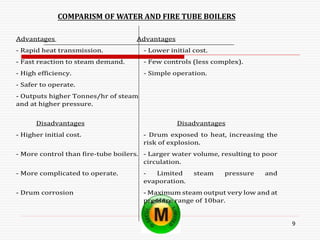
COMPARISM OF WATER AND FIRE TUBE BOILERS
Advantages Advantages
- Rapid heat transmission. - Lower initial cost.
- Fast reaction to steam demand. - Few controls (less complex).
- High efficiency. - Simple operation.
- Safer to operate.
- Outputs higher Tonnes/hr of steam
and at higher pressure.
Disadvantages Disadvantages
- Higher initial cost. - Drum exposed to heat, increasing the
risk of explosion.
- More control than fire-tube boilers. - Larger water volume, resulting to poor
circulation.
- More complicated to operate. - Limited steam pressure and
evaporation.
- Drum corrosion - Maximum steam output very low and at
pressure range of 10bar.
10
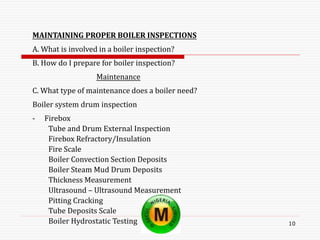
MAINTAINING PROPER BOILER INSPECTIONS
A. What is involved in a boiler inspection?
B. How do I prepare for boiler inspection?
Maintenance
C. What type of maintenance does a boiler need?
Boiler system drum inspection
- Firebox
Tube and Drum External Inspection
Firebox Refractory/Insulation
Fire Scale
Boiler Convection Section Deposits
Boiler Steam Mud Drum Deposits
Thickness Measurement
Ultrasound – Ultrasound Measurement
Pitting Cracking
Tube Deposits Scale
Boiler Hydrostatic Testing
11
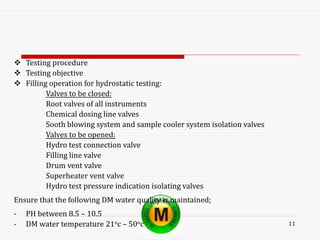
 Testing procedure
 Testing objective
 Filling operation for hydrostatic testing:
Valves to be closed:
Root valves of all instruments
Chemical dosing line valves
Sooth blowing system and sample cooler system isolation valves
Valves to be opened:
Hydro test connection valve
Filling line valve
Drum vent valve
Superheater vent valve
Hydro test pressure indication isolating valves
Ensure that the following DM water quality is maintained;
- PH between 8.5 – 10.5
- DM water temperature 21oc – 50oc
12
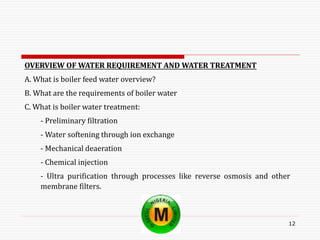
OVERVIEW OF WATER REQUIREMENT AND WATER TREATMENT
A. What is boiler feed water overview?
B. What are the requirements of boiler water
C. What is boiler water treatment:
- Preliminary filtration
- Water softening through ion exchange
- Mechanical deaeration
- Chemical injection
- Ultra purification through processes like reverse osmosis and other
membrane filters.
13
SAMPLE ANALYTICAL DATA [WATER]
Water to be treated
Source: River (e.g. River Benin)
History of source: Highly acidic water due to organic activities of mangrove forest
that constitute the entire embankment. These activities release high values of co2
into water body, thus rendering it acidic.
14
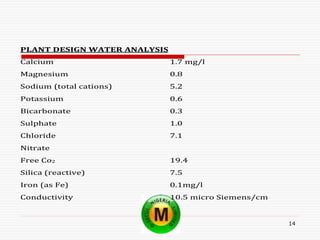
PLANT DESIGN WATER ANALYSIS
Calcium 1.7 mg/l
Magnesium 0.8
Sodium (total cations) 5.2
Potassium 0.6
Bicarbonate 0.3
Sulphate 1.0
Chloride 7.1
Nitrate
Free Co2 19.4
Silica (reactive) 7.5
Iron (as Fe) 0.1mg/l
Conductivity 10.5 micro Siemens/cm
15
TREATED WATER QUALITY [IDEAL]
Sodium (as Na) 0.015 mg/l
Sulphate (as so4) 0.01
Chloride (as cl) 0.01
Free co2 (as caco3) 0.02
Iron (as Fe) 0.01
Total dissolved solids (TDS) 0.5mg/l
Conductivity 0.1 micro Siemens/cm
Turbidity 0.1
Color .02
PH 6.8 – 7.3
16
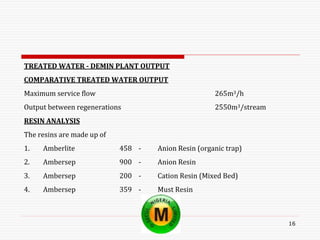
TREATED WATER - DEMIN PLANT OUTPUT
COMPARATIVE TREATED WATER OUTPUT
Maximum service flow 265m3/h
Output between regenerations 2550m3/stream
RESIN ANALYSIS
The resins are made up of
1. Amberlite 458 - Anion Resin (organic trap)
2. Ambersep 900 - Anion Resin
3. Ambersep 200 - Cation Resin (Mixed Bed)
4. Ambersep 359 - Must Resin
17
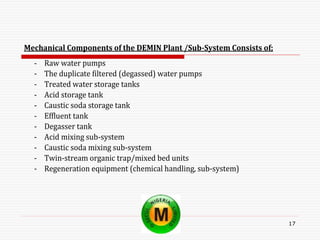
Mechanical Components of the DEMIN Plant /Sub-System Consists of;
- Raw water pumps
- The duplicate filtered (degassed) water pumps
- Treated water storage tanks
- Acid storage tank
- Caustic soda storage tank
- Effluent tank
- Degasser tank
- Acid mixing sub-system
- Caustic soda mixing sub-system
- Twin-stream organic trap/mixed bed units
- Regeneration equipment (chemical handling, sub-system)
18
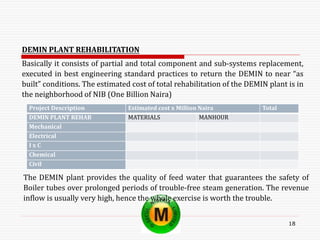
DEMIN PLANT REHABILITATION
Basically it consists of partial and total component and sub-systems replacement,
executed in best engineering standard practices to return the DEMIN to near “as
built” conditions. The estimated cost of total rehabilitation of the DEMIN plant is in
the neighborhood of NIB (One Billion Naira)
Project Description Estimated cost x Million Naira Total
DEMIN PLANT REHAB MATERIALS MANHOUR
Mechanical
Electrical
I x C
Chemical
Civil
The DEMIN plant provides the quality of feed water that guarantees the safety of
Boiler tubes over prolonged periods of trouble-free steam generation. The revenue
inflow is usually very high, hence the whole exercise is worth the trouble.
19
STEAM BOILER BURNER OPERATION
Boiler burner work principle;
The burner mixes the fuel and air (oxygen) and with the assistance of an ignition
device provides a platform for combustion. This combustion takes place in the
CC, and the heat it generates is transferred to the water through the heat
exchanger.
WHAT CONTROLS THE BURNER
The modulation control is the gas pedal of a boiler. The burner modulates
between low and high firing rates depending on the steam pressure inside the
boiler and where the modulation control is set.
The grater the difference between the heating load and the boiler
output, the greater the number of boiler cycles. On fan-equipped boilers,
modulation is accomplished by reducing the air and gas flow into the boiler. The
ratio of the low fire to high fire rates is defined as the boiler’s turndown
capability.
20
BURNER MAINTENANCE
What is burner maintenance?
Discuss in line with the type of fuel and cleaning method.
21

Boiler Operation and Maintenance - New.ppt

  • 1.
  • 2.
    2 STEAM BOILERS: WHATIS IT? HOW DOES IT WORK A Steam boiler is a steam producing heating system. It can be referred to as a heat exchanger, producing steam for outside usage. A steam boiler burns fuel to heat water. TYPES Steam boilers are defined by their; - Construction portability; tube type, fuel type, and the pressure they produce. First generation boilers were dangerous because of few control mechanisms: the size, fuel and dimensions of a boiler varies with the type of job it is designed to perform and the industry in which is deployed. - Fuels; the types of fuel include electricity, wood, natural gas, coal, and fossil fuels. The difference between the fuels is their cost, eco – friendliness and efficiency.
  • 3.
    3 SIMPLE CLASSIFICATION TYPES DESCRIPTIONCOST/LIMITATION Hot water boiler Made of stainless steel, cast iron aluminum. Used for heating purpose Prone to scaling, requiring maintenance at intervals Electric boiler It uses electric element. To generate heat Eco – friendly, fast, cleaner system. Ease of maintenance Gas boiler Powered by natural gas or propane, the fuel is piped directly into the boiler. Gas steam boilers are used for industrial purposes and low pressure applications. Not easily fouled Oil boilers Oil boilers operate on the same principles as gas boilers, oil is ignited in the combustion chamber. More expensive than gas steam boilers. High level of fouling, requiring scavenging; implying high cost.
  • 4.
    4 FIRE TUBE/Water tubeboilers, with economizer SHELL BOILERS – enclosed in shell made of steel also known as flue boilers can have more than one pass. They produce steam efficiently and economically. METHODS USED TO HEAT A BOILER - A Steam boiler absorbs heat that is released from combustion, the heat is transferred either by Radiation, Convection or Conduction. the proportion of heat transferred is dependent upon the type of steam, fuel and transfer surface
  • 5.
    5 BASIC ELEMENTS COMMONTO STEAM BOILERS A. BURNER – To inject fuel and air into the combustion area. Damper are used to regulate the amount of air entering the burner, an impeller or swirled ensures even circulation around the burner. Pipes referred to as spuds inject the fuel into the boiler and are ignited by an igniter. B. COMBUSTION CHAMBER -The combustion chamber has tubes containing water and Steam that pass through the open box with the burner and controls. The heat produced in the combustion chamber is absorbed on the surface of the boiler at the top of the combustion chamber.
  • 6.
    6 C. HEAT EXCHANGERS -A long coiled pipe that is immersed in the fluid to be heated. Gas or a heated liquid passes through the pipe and heats the water around it. They are made of a variety of materials with stainless steel being the best, as it does not corrode. D. EXPANSION TANK OR VESSEL - Expansion tank helps to maintain the pressure in a boiler by providing a place for water to expand, absorb the pressure and thus regulate it. The tank has a diaphragm that is divided into two sections, one portion accepts water from the boiler and the other side being controlled by the air valve to alleviate pressure. The air valve pushes against the water in the other section until normal pressure is attained.
  • 7.
    7 E. STEAM TEMPERATURECONTROL - This prevents thermal stresses. This is achieved by: a. By using an attemperator or desuperheater. b. By flue gas bypass. c. By adjusting the tilting angle at which the burners fire the furnace. The simplest method is to monitor the steam as it exits the boiler and change the position of the spray water value. F. SAFETY RELIEF VALVE - It ensures that the buildup of pressure in a steam boiler will be relieved, to avoid a catastrophic disaster. The valve lifts when the pressure reaches a critical level and closes when the pressure returns to normal.
  • 8.
    8 G. LOW WATERCUTOFF - This turns off the burner or shuts off fuel to a steam boiler when the water level drops below a set point. A dry fired boiler can explode, rupture or suffer significant failure. It is another safety feature of the boiler.
  • 9.
    9 COMPARISM OF WATERAND FIRE TUBE BOILERS Advantages Advantages - Rapid heat transmission. - Lower initial cost. - Fast reaction to steam demand. - Few controls (less complex). - High efficiency. - Simple operation. - Safer to operate. - Outputs higher Tonnes/hr of steam and at higher pressure. Disadvantages Disadvantages - Higher initial cost. - Drum exposed to heat, increasing the risk of explosion. - More control than fire-tube boilers. - Larger water volume, resulting to poor circulation. - More complicated to operate. - Limited steam pressure and evaporation. - Drum corrosion - Maximum steam output very low and at pressure range of 10bar.
  • 10.
    10 MAINTAINING PROPER BOILERINSPECTIONS A. What is involved in a boiler inspection? B. How do I prepare for boiler inspection? Maintenance C. What type of maintenance does a boiler need? Boiler system drum inspection - Firebox Tube and Drum External Inspection Firebox Refractory/Insulation Fire Scale Boiler Convection Section Deposits Boiler Steam Mud Drum Deposits Thickness Measurement Ultrasound – Ultrasound Measurement Pitting Cracking Tube Deposits Scale Boiler Hydrostatic Testing
  • 11.
    11  Testing procedure Testing objective  Filling operation for hydrostatic testing: Valves to be closed: Root valves of all instruments Chemical dosing line valves Sooth blowing system and sample cooler system isolation valves Valves to be opened: Hydro test connection valve Filling line valve Drum vent valve Superheater vent valve Hydro test pressure indication isolating valves Ensure that the following DM water quality is maintained; - PH between 8.5 – 10.5 - DM water temperature 21oc – 50oc
  • 12.
    12 OVERVIEW OF WATERREQUIREMENT AND WATER TREATMENT A. What is boiler feed water overview? B. What are the requirements of boiler water C. What is boiler water treatment: - Preliminary filtration - Water softening through ion exchange - Mechanical deaeration - Chemical injection - Ultra purification through processes like reverse osmosis and other membrane filters.
  • 13.
    13 SAMPLE ANALYTICAL DATA[WATER] Water to be treated Source: River (e.g. River Benin) History of source: Highly acidic water due to organic activities of mangrove forest that constitute the entire embankment. These activities release high values of co2 into water body, thus rendering it acidic.
  • 14.
    14 PLANT DESIGN WATERANALYSIS Calcium 1.7 mg/l Magnesium 0.8 Sodium (total cations) 5.2 Potassium 0.6 Bicarbonate 0.3 Sulphate 1.0 Chloride 7.1 Nitrate Free Co2 19.4 Silica (reactive) 7.5 Iron (as Fe) 0.1mg/l Conductivity 10.5 micro Siemens/cm
  • 15.
    15 TREATED WATER QUALITY[IDEAL] Sodium (as Na) 0.015 mg/l Sulphate (as so4) 0.01 Chloride (as cl) 0.01 Free co2 (as caco3) 0.02 Iron (as Fe) 0.01 Total dissolved solids (TDS) 0.5mg/l Conductivity 0.1 micro Siemens/cm Turbidity 0.1 Color .02 PH 6.8 – 7.3
  • 16.
    16 TREATED WATER -DEMIN PLANT OUTPUT COMPARATIVE TREATED WATER OUTPUT Maximum service flow 265m3/h Output between regenerations 2550m3/stream RESIN ANALYSIS The resins are made up of 1. Amberlite 458 - Anion Resin (organic trap) 2. Ambersep 900 - Anion Resin 3. Ambersep 200 - Cation Resin (Mixed Bed) 4. Ambersep 359 - Must Resin
  • 17.
    17 Mechanical Components ofthe DEMIN Plant /Sub-System Consists of; - Raw water pumps - The duplicate filtered (degassed) water pumps - Treated water storage tanks - Acid storage tank - Caustic soda storage tank - Effluent tank - Degasser tank - Acid mixing sub-system - Caustic soda mixing sub-system - Twin-stream organic trap/mixed bed units - Regeneration equipment (chemical handling, sub-system)
  • 18.
    18 DEMIN PLANT REHABILITATION Basicallyit consists of partial and total component and sub-systems replacement, executed in best engineering standard practices to return the DEMIN to near “as built” conditions. The estimated cost of total rehabilitation of the DEMIN plant is in the neighborhood of NIB (One Billion Naira) Project Description Estimated cost x Million Naira Total DEMIN PLANT REHAB MATERIALS MANHOUR Mechanical Electrical I x C Chemical Civil The DEMIN plant provides the quality of feed water that guarantees the safety of Boiler tubes over prolonged periods of trouble-free steam generation. The revenue inflow is usually very high, hence the whole exercise is worth the trouble.
  • 19.
    19 STEAM BOILER BURNEROPERATION Boiler burner work principle; The burner mixes the fuel and air (oxygen) and with the assistance of an ignition device provides a platform for combustion. This combustion takes place in the CC, and the heat it generates is transferred to the water through the heat exchanger. WHAT CONTROLS THE BURNER The modulation control is the gas pedal of a boiler. The burner modulates between low and high firing rates depending on the steam pressure inside the boiler and where the modulation control is set. The grater the difference between the heating load and the boiler output, the greater the number of boiler cycles. On fan-equipped boilers, modulation is accomplished by reducing the air and gas flow into the boiler. The ratio of the low fire to high fire rates is defined as the boiler’s turndown capability.
  • 20.
    20 BURNER MAINTENANCE What isburner maintenance? Discuss in line with the type of fuel and cleaning method.
  • 21.