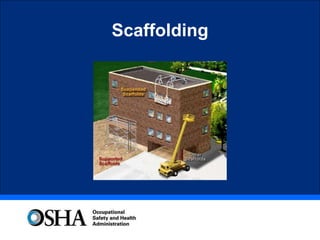
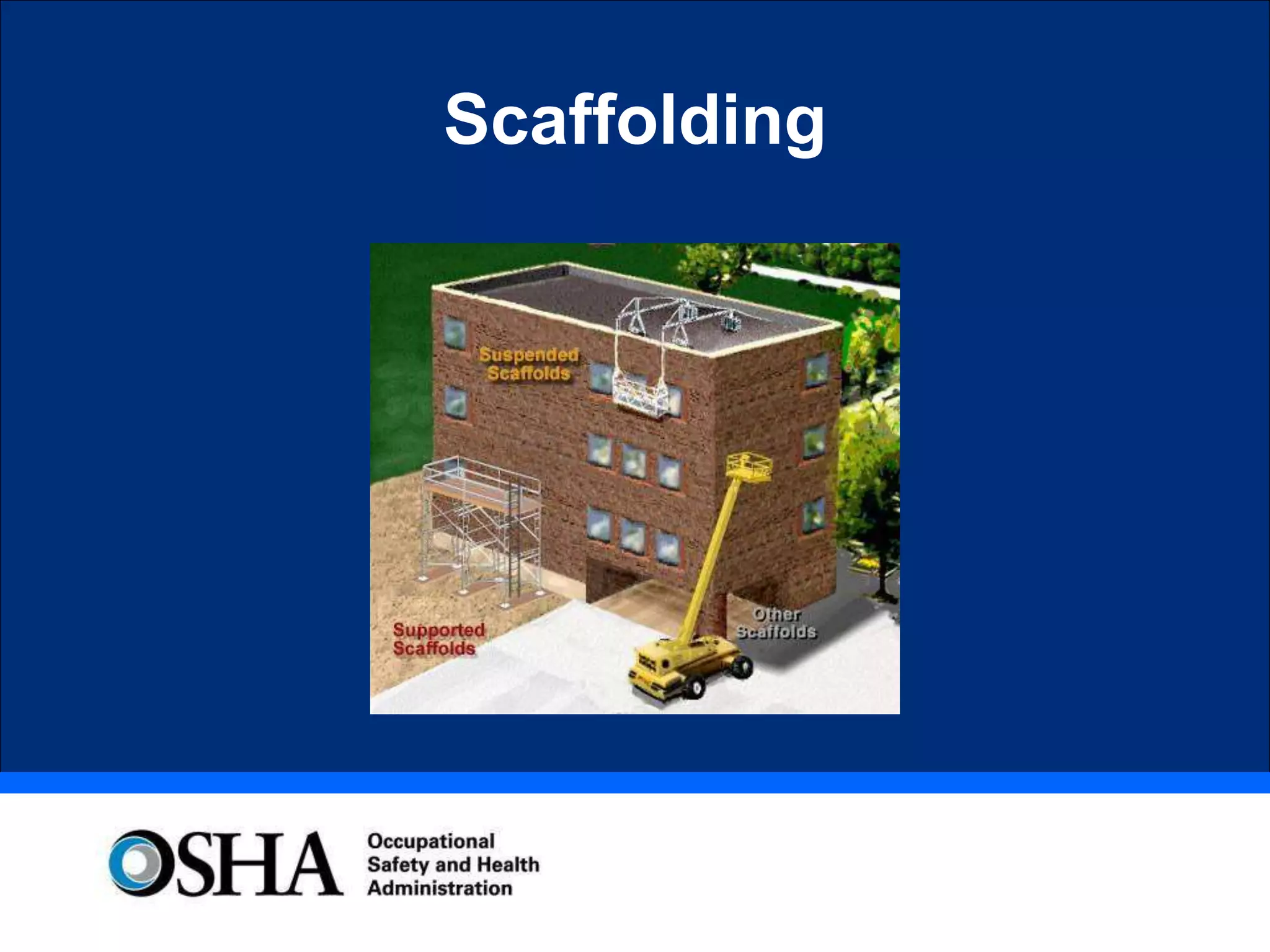
Scaffolding
1926.450 - Scope, Application
• Covers all scaffolds used in workplaces
• Does not apply to crane or derrick
suspended personnel platforms, which are
covered by 1926.550(g)
• Aerial lifts are covered exclusively by
1926.453
1926.450 – Purpose
• Updates existing standard to include types
of scaffolds such as catenary and step
trestle
• Allows flexibility in the use of fall protection
systems to protect employees
• Simplifies language, eliminates duplicative
outdated provisions, consolidates
overlapping requirements
• Allows employers compliance flexibility
Organization of Standard
• 1926.450 Scope, application and
definitions applicable to this subpart
• 1926.451 General requirements
• 1926.452 Additional requirements
applicable to specific types of scaffolds
• 1926.453 Aerial lifts
• 1926.454 Training
Organization of Standard (cont’d)
• Appendix A – Scaffold specification
• Appendix B – (Reserved) Criteria for
determining the feasibility of providing safe
access and fall protection for scaffold erectors
and dismantlers
• Appendix C – List of National Consensus
Standards
• Appendix D – List of Training Tropics for
Scaffold Erectors and Dismantlers
• Appendix E – Drawing and Illustrations
1926.450 – Effective Dates
• Effective on November 29, 1996, except
for 1926.453(a)(2)
• Paragraphs (e)(9) and (g)(2) for 1926.451
which address safe access and fall
protection for employees erecting and
dismantling supported scaffolds is
effective September 2, 1997
1926.450 – Major Points
• 10 foot trigger height for fall protection on scaffolds
• 36 inch minimum guardrail height where fall arrest
systems are primary fall protection
• 38 inch minimum guardrail height where guardrail is
primary fall protection
• Provides for use of cross-bracing as guardrail under
certain conditions, in lieu of either a mid-rail or a top-rail
• Requires after 1 year, that competent person determines
feasibility of providing fall protection for built-up scaffold
erectors and dismantlers
Scaffold Definition
Means any temporary elevated platform
(supported or suspended) and its
supporting structure (including points of
anchorage), used for supporting
employees or materials or both.
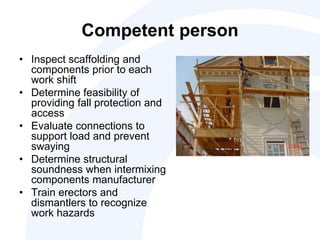
Competent person
• Inspect scaffolding and
components prior to each
work shift
• Determine feasibility of
providing fall protection and
access
• Evaluate connections to
support load and prevent
swaying
• Determine structural
soundness when intermixing
components manufacturer
• Train erectors and
dismantlers to recognize
work hazards
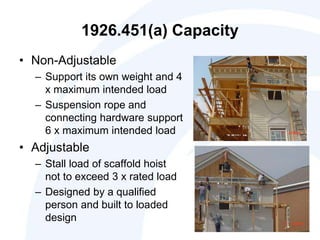
1926.451(a) Capacity
• Non-Adjustable
– Support its own weight and 4
x maximum intended load
– Suspension rope and
connecting hardware support
6 x maximum intended load
• Adjustable
– Stall load of scaffold hoist
not to exceed 3 x rated load
– Designed by a qualified
person and built to loaded
design
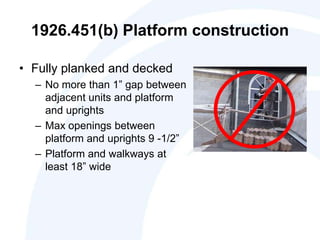
1926.451(b) Platform construction
• Fully planked and decked
– No more than 1” gap between
adjacent units and platform
and uprights
– Max openings between
platform and uprights 9 -1/2”
– Platform and walkways at
least 18” wide
1926.451(b) Platform construction
(cont’d)
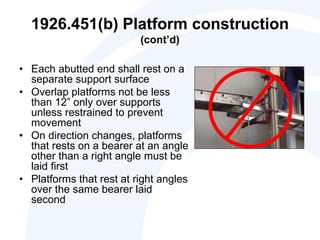
• Each abutted end shall rest on a
separate support surface
• Overlap platforms not be less
than 12” only over supports
unless restrained to prevent
movement
• On direction changes, platforms
that rests on a bearer at an angle
other than a right angle must be
laid first
• Platforms that rest at right angles
over the same bearer laid
second
1926.451(b) Platform construction
(cont’d)
• Front edge of all platforms
– No more than 14” from face of work
– 3” from face for outrigger scaffolds
– 18” from face for plastering and lathing
operations
• Platforms 10’ and less to extend at least 6”
but not more than 12” past support
• Platforms greater than 10’ nor more than
18” past support unless
1926.451(b) Platform construction
(cont’d)
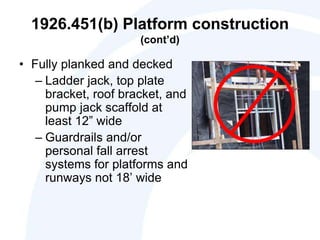
• Fully planked and decked
– Ladder jack, top plate
bracket, roof bracket, and
pump jack scaffold at
least 12” wide
– Guardrails and/or
personal fall arrest
systems for platforms and
runways not 18’ wide
1926.451(b) Platform construction
(cont’d)
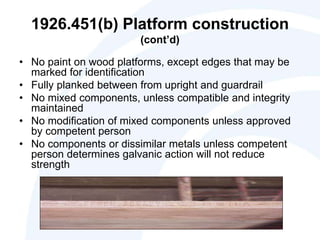
• No paint on wood platforms, except edges that may be
marked for identification
• Fully planked between from upright and guardrail
• No mixed components, unless compatible and integrity
maintained
• No modification of mixed components unless approved
by competent person
• No components or dissimilar metals unless competent
person determines galvanic action will not reduce
strength
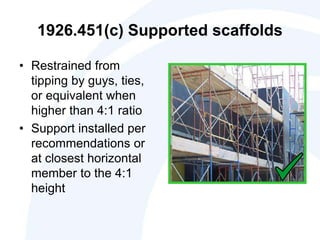
1926.451(c) Supported scaffolds
• Restrained from
tipping by guys, ties,
or equivalent when
higher than 4:1 ratio
• Support installed per
recommendations or
at closest horizontal
member to the 4:1
height
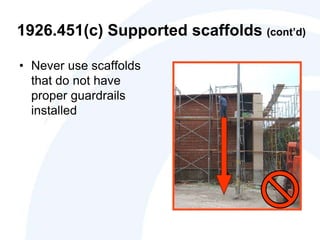
1926.451(c) Supported scaffolds (cont’d)
• Never use scaffolds
that do not have
proper guardrails
installed
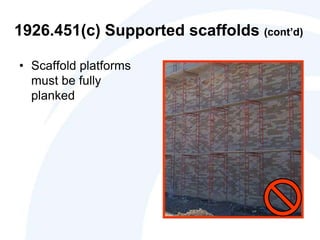
1926.451(c) Supported scaffolds (cont’d)
• Scaffold platforms
must be fully
planked
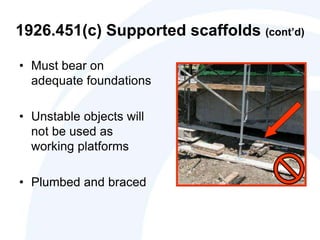
1926.451(c) Supported scaffolds (cont’d)
• Must bear on
adequate foundations
• Unstable objects will
not be used as
working platforms
• Plumbed and braced
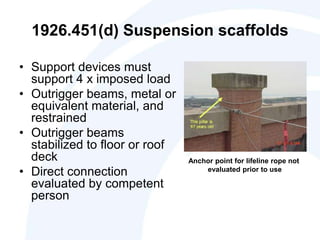
1926.451(d) Suspension scaffolds
• Support devices must
support 4 x imposed load
• Outrigger beams, metal or
equivalent material, and
restrained
• Outrigger beams
stabilized to floor or roof
deck
• Direct connection
evaluated by competent
person
Anchor point for lifeline rope not
evaluated prior to use
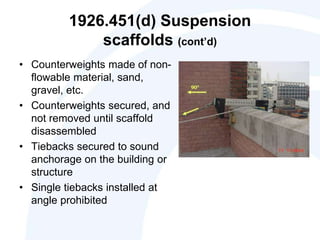
1926.451(d) Suspension
scaffolds (cont’d)
• Counterweights made of non-
flowable material, sand,
gravel, etc.
• Counterweights secured, and
not removed until scaffold
disassembled
• Tiebacks secured to sound
anchorage on the building or
structure
• Single tiebacks installed at
angle prohibited
1926.451(d) Suspension
scaffolds (cont’d)
• Minimum lengths for suspension ropes on
hoists
• No repaired wire rope
• Proper sized eye splice thimbles
• Ropes inspected by competent person
• No swaged attachment unless approved
1926.451(d) Suspension
scaffolds (cont’d)
• No gasoline powered equipment or hoist
• Automatic brakes on powered and manual
hoists
• Positive crank force to descend
• Tied to prevent swaying
• Safety devices not used as platforms
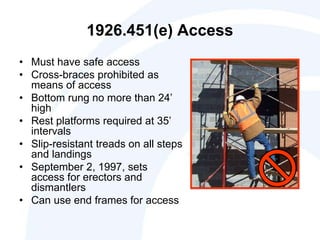
1926.451(e) Access
• Must have safe access
• Cross-braces prohibited as
means of access
• Bottom rung no more than 24’
high
• Rest platforms required at 35’
intervals
• Slip-resistant treads on all steps
and landings
• September 2, 1997, sets
access for erectors and
dismantlers
• Can use end frames for access
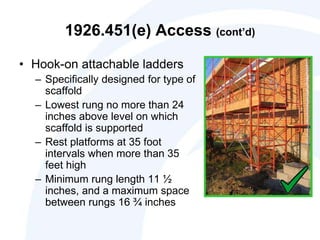
1926.451(e) Access (cont’d)
• Hook-on attachable ladders
– Specifically designed for type of
scaffold
– Lowest rung no more than 24
inches above level on which
scaffold is supported
– Rest platforms at 35 foot
intervals when more than 35
feet high
– Minimum rung length 11 ½
inches, and a maximum space
between rungs 16 ¾ inches
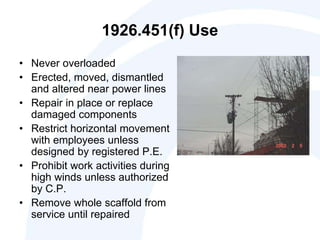
1926.451(f) Use
• Never overloaded
• Erected, moved, dismantled
and altered near power lines
• Repair in place or replace
damaged components
• Restrict horizontal movement
with employees unless
designed by registered P.E.
• Prohibit work activities during
high winds unless authorized
by C.P.
• Remove whole scaffold from
service until repaired
1926.451(f) Use (cont’d)
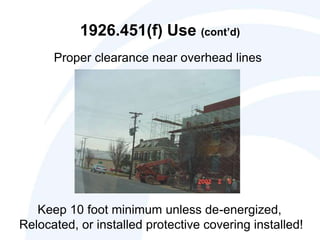
Proper clearance near overhead lines
Keep 10 foot minimum unless de-energized,
Relocated, or installed protective covering installed!
1926.451(f) Use (cont’d)
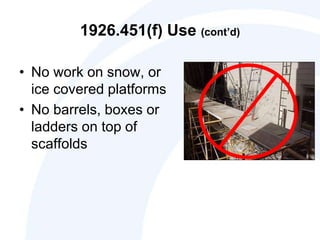
• No work on snow, or
ice covered platforms
• No barrels, boxes or
ladders on top of
scaffolds
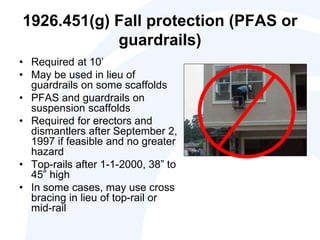
1926.451(g) Fall protection (PFAS or
guardrails)
• Required at 10’
• May be used in lieu of
guardrails on some scaffolds
• PFAS and guardrails on
suspension scaffolds
• Required for erectors and
dismantlers after September 2,
1997 if feasible and no greater
hazard
• Top-rails after 1-1-2000, 38” to
45” high
• In some cases, may use cross
bracing in lieu of top-rail or
mid-rail
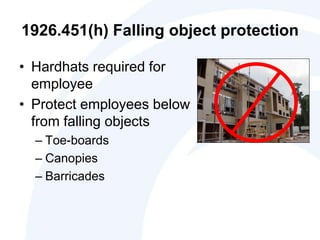
1926.451(h) Falling object protection
• Hardhats required for
employee
• Protect employees below
from falling objects
– Toe-boards
– Canopies
– Barricades
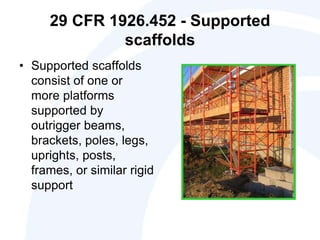
29 CFR 1926.452 - Supported
scaffolds
• Supported scaffolds
consist of one or
more platforms
supported by
outrigger beams,
brackets, poles, legs,
uprights, posts,
frames, or similar rigid
support
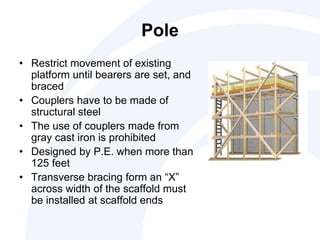
Pole
• Restrict movement of existing
platform until bearers are set, and
braced
• Couplers have to be made of
structural steel
• The use of couplers made from
gray cast iron is prohibited
• Designed by P.E. when more than
125 feet
• Transverse bracing form an “X”
across width of the scaffold must
be installed at scaffold ends
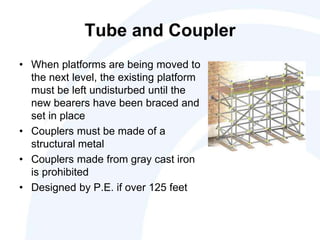
Tube and Coupler
• When platforms are being moved to
the next level, the existing platform
must be left undisturbed until the
new bearers have been braced and
set in place
• Couplers must be made of a
structural metal
• Couplers made from gray cast iron
is prohibited
• Designed by P.E. if over 125 feet
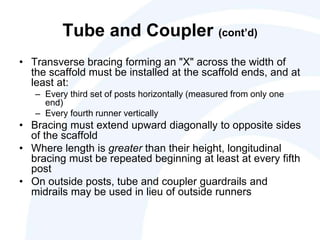
Tube and Coupler (cont’d)
• Transverse bracing forming an "X" across the width of
the scaffold must be installed at the scaffold ends, and at
least at:
– Every third set of posts horizontally (measured from only one
end)
– Every fourth runner vertically
• Bracing must extend upward diagonally to opposite sides
of the scaffold
• Where length is greater than their height, longitudinal
bracing must be repeated beginning at least at every fifth
post
• On outside posts, tube and coupler guardrails and
midrails may be used in lieu of outside runners
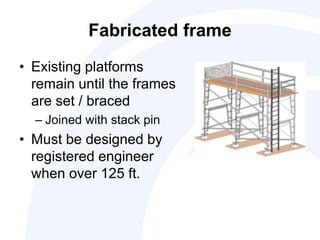
Fabricated frame
• Existing platforms
remain until the frames
are set / braced
– Joined with stack pin
• Must be designed by
registered engineer
when over 125 ft.
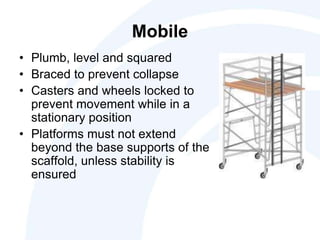
Mobile
• Plumb, level and squared
• Braced to prevent collapse
• Casters and wheels locked to
prevent movement while in a
stationary position
• Platforms must not extend
beyond the base supports of the
scaffold, unless stability is
ensured
Mobile (cont’d)
• Not allowed to ride on scaffolds unless the following exist
– Surface on which scaffold is being moved is within 3
degrees of level, and free of pits, holes and
obstructions
– Height to base width ratio during movement is 2:1 or
less
– Outrigger frames, when used, are installed on both
sides of the scaffold
• When power systems are used, the propelling force is:
– Applied directly to the wheels
– Does not produce a speed in excess of 1 foot per
second
• No employee is on any part of the scaffold that extends
beyond the wheels, casters, or other supports
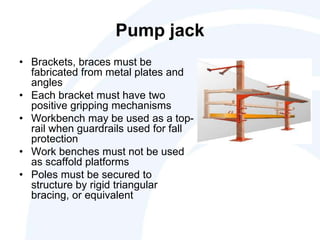
Pump jack
• Brackets, braces must be
fabricated from metal plates and
angles
• Each bracket must have two
positive gripping mechanisms
• Workbench may be used as a top-
rail when guardrails used for fall
protection
• Work benches must not be used
as scaffold platforms
• Poles must be secured to
structure by rigid triangular
bracing, or equivalent
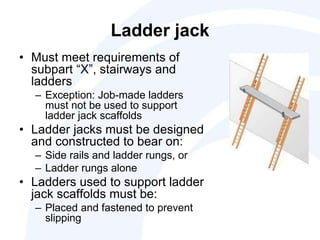
Ladder jack
• Must meet requirements of
subpart “X”, stairways and
ladders
– Exception: Job-made ladders
must not be used to support
ladder jack scaffolds
• Ladder jacks must be designed
and constructed to bear on:
– Side rails and ladder rungs, or
– Ladder rungs alone
• Ladders used to support ladder
jack scaffolds must be:
– Placed and fastened to prevent
slipping
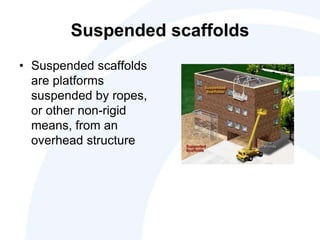
Suspended scaffolds
• Suspended scaffolds
are platforms
suspended by ropes,
or other non-rigid
means, from an
overhead structure
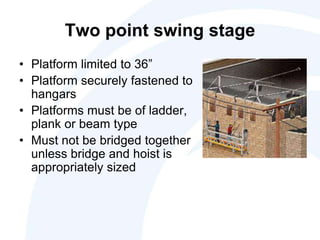
Two point swing stage
• Platform limited to 36”
• Platform securely fastened to
hangars
• Platforms must be of ladder,
plank or beam type
• Must not be bridged together
unless bridge and hoist is
appropriately sized
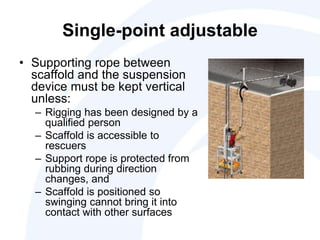
Single-point adjustable
• Supporting rope between
scaffold and the suspension
device must be kept vertical
unless:
– Rigging has been designed by a
qualified person
– Scaffold is accessible to
rescuers
– Support rope is protected from
rubbing during direction
changes, and
– Scaffold is positioned so
swinging cannot bring it into
contact with other surfaces
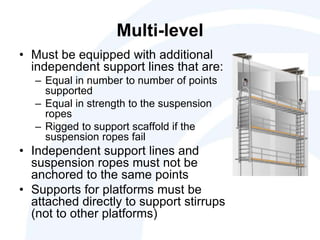
Multi-level
• Must be equipped with additional
independent support lines that are:
– Equal in number to number of points
supported
– Equal in strength to the suspension
ropes
– Rigged to support scaffold if the
suspension ropes fail
• Independent support lines and
suspension ropes must not be
anchored to the same points
• Supports for platforms must be
attached directly to support stirrups
(not to other platforms)
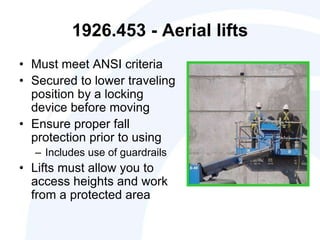
1926.453 - Aerial lifts
• Must meet ANSI criteria
• Secured to lower traveling
position by a locking
device before moving
• Ensure proper fall
protection prior to using
– Includes use of guardrails
• Lifts must allow you to
access heights and work
from a protected area
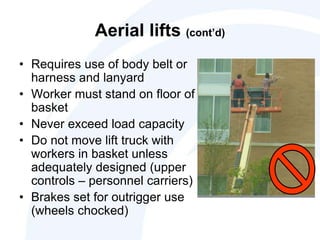
Aerial lifts (cont’d)
• Requires use of body belt or
harness and lanyard
• Worker must stand on floor of
basket
• Never exceed load capacity
• Do not move lift truck with
workers in basket unless
adequately designed (upper
controls – personnel carriers)
• Brakes set for outrigger use
(wheels chocked)
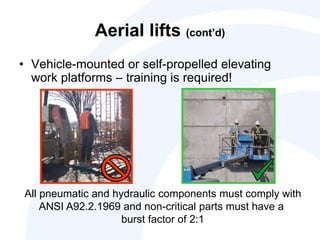
Aerial lifts (cont’d)
• Vehicle-mounted or self-propelled elevating
work platforms – training is required!
All pneumatic and hydraulic components must comply with
ANSI A92.2.1969 and non-critical parts must have a
burst factor of 2:1
1926.454 Training
• Employees must receive training from
qualified person that covers:
– Nature of hazards, electrical, falls, and falling
items
– Use of scaffold / handling
– Maximum intended load and load carrying
capabilities of scaffold
– Procedures for setup, dismantling or moving
the system
– Requirements of subpart “L”
Retraining
• When the employer has reason to believe an
employee lacks the skill or understanding
needed for safe work involving scaffolds,
retraining shall be performed until proficiency is
established
• Retraining is also required when:
– Additional or new hazards exists
– Changes occur in the type of scaffold and fall
protection exist
– Where there are inadequacies in an employee’s work
Common OSHA Citations
• 451(g)(1) Fall protection at 10 feet
• 453(b)(2)(v) Aerial lifts – Body belt and
lanyard
• 451(e)(1) Scaffold access
• 451(b)(1) Scaffold platform construction
• 454(a) Scaffold user training
Resources
• www.osha.gov
– 29 CFR 1926.451
– NSHA-OSHA Job Site Safety Handbook
• http://www.osha.gov/publications/osha2202.
html
– Construction Industry Digest
– Scaffolding Industry Association
• http://www.scaffold.org
– American National Standards Institute
– A92 (SIA): Scaffolds and other elevating devices

Scaffolding

  • 1.
  • 2.
    1926.450 - Scope,Application • Covers all scaffolds used in workplaces • Does not apply to crane or derrick suspended personnel platforms, which are covered by 1926.550(g) • Aerial lifts are covered exclusively by 1926.453
  • 3.
    1926.450 – Purpose •Updates existing standard to include types of scaffolds such as catenary and step trestle • Allows flexibility in the use of fall protection systems to protect employees • Simplifies language, eliminates duplicative outdated provisions, consolidates overlapping requirements • Allows employers compliance flexibility
  • 4.
    Organization of Standard •1926.450 Scope, application and definitions applicable to this subpart • 1926.451 General requirements • 1926.452 Additional requirements applicable to specific types of scaffolds • 1926.453 Aerial lifts • 1926.454 Training
  • 5.
    Organization of Standard(cont’d) • Appendix A – Scaffold specification • Appendix B – (Reserved) Criteria for determining the feasibility of providing safe access and fall protection for scaffold erectors and dismantlers • Appendix C – List of National Consensus Standards • Appendix D – List of Training Tropics for Scaffold Erectors and Dismantlers • Appendix E – Drawing and Illustrations
  • 6.
    1926.450 – EffectiveDates • Effective on November 29, 1996, except for 1926.453(a)(2) • Paragraphs (e)(9) and (g)(2) for 1926.451 which address safe access and fall protection for employees erecting and dismantling supported scaffolds is effective September 2, 1997
  • 7.
    1926.450 – MajorPoints • 10 foot trigger height for fall protection on scaffolds • 36 inch minimum guardrail height where fall arrest systems are primary fall protection • 38 inch minimum guardrail height where guardrail is primary fall protection • Provides for use of cross-bracing as guardrail under certain conditions, in lieu of either a mid-rail or a top-rail • Requires after 1 year, that competent person determines feasibility of providing fall protection for built-up scaffold erectors and dismantlers
  • 8.
    Scaffold Definition Means anytemporary elevated platform (supported or suspended) and its supporting structure (including points of anchorage), used for supporting employees or materials or both.
  • 9.
    Competent person • Inspectscaffolding and components prior to each work shift • Determine feasibility of providing fall protection and access • Evaluate connections to support load and prevent swaying • Determine structural soundness when intermixing components manufacturer • Train erectors and dismantlers to recognize work hazards
  • 10.
    1926.451(a) Capacity • Non-Adjustable –Support its own weight and 4 x maximum intended load – Suspension rope and connecting hardware support 6 x maximum intended load • Adjustable – Stall load of scaffold hoist not to exceed 3 x rated load – Designed by a qualified person and built to loaded design
  • 11.
    1926.451(b) Platform construction •Fully planked and decked – No more than 1” gap between adjacent units and platform and uprights – Max openings between platform and uprights 9 -1/2” – Platform and walkways at least 18” wide
  • 12.
    1926.451(b) Platform construction (cont’d) •Each abutted end shall rest on a separate support surface • Overlap platforms not be less than 12” only over supports unless restrained to prevent movement • On direction changes, platforms that rests on a bearer at an angle other than a right angle must be laid first • Platforms that rest at right angles over the same bearer laid second
  • 13.
    1926.451(b) Platform construction (cont’d) •Front edge of all platforms – No more than 14” from face of work – 3” from face for outrigger scaffolds – 18” from face for plastering and lathing operations • Platforms 10’ and less to extend at least 6” but not more than 12” past support • Platforms greater than 10’ nor more than 18” past support unless
  • 14.
    1926.451(b) Platform construction (cont’d) •Fully planked and decked – Ladder jack, top plate bracket, roof bracket, and pump jack scaffold at least 12” wide – Guardrails and/or personal fall arrest systems for platforms and runways not 18’ wide
  • 15.
    1926.451(b) Platform construction (cont’d) •No paint on wood platforms, except edges that may be marked for identification • Fully planked between from upright and guardrail • No mixed components, unless compatible and integrity maintained • No modification of mixed components unless approved by competent person • No components or dissimilar metals unless competent person determines galvanic action will not reduce strength
  • 16.
    1926.451(c) Supported scaffolds •Restrained from tipping by guys, ties, or equivalent when higher than 4:1 ratio • Support installed per recommendations or at closest horizontal member to the 4:1 height
  • 17.
    1926.451(c) Supported scaffolds(cont’d) • Never use scaffolds that do not have proper guardrails installed
  • 18.
    1926.451(c) Supported scaffolds(cont’d) • Scaffold platforms must be fully planked
  • 19.
    1926.451(c) Supported scaffolds(cont’d) • Must bear on adequate foundations • Unstable objects will not be used as working platforms • Plumbed and braced
  • 20.
    1926.451(d) Suspension scaffolds •Support devices must support 4 x imposed load • Outrigger beams, metal or equivalent material, and restrained • Outrigger beams stabilized to floor or roof deck • Direct connection evaluated by competent person Anchor point for lifeline rope not evaluated prior to use
  • 21.
    1926.451(d) Suspension scaffolds (cont’d) •Counterweights made of non- flowable material, sand, gravel, etc. • Counterweights secured, and not removed until scaffold disassembled • Tiebacks secured to sound anchorage on the building or structure • Single tiebacks installed at angle prohibited
  • 22.
    1926.451(d) Suspension scaffolds (cont’d) •Minimum lengths for suspension ropes on hoists • No repaired wire rope • Proper sized eye splice thimbles • Ropes inspected by competent person • No swaged attachment unless approved
  • 23.
    1926.451(d) Suspension scaffolds (cont’d) •No gasoline powered equipment or hoist • Automatic brakes on powered and manual hoists • Positive crank force to descend • Tied to prevent swaying • Safety devices not used as platforms
  • 24.
    1926.451(e) Access • Musthave safe access • Cross-braces prohibited as means of access • Bottom rung no more than 24’ high • Rest platforms required at 35’ intervals • Slip-resistant treads on all steps and landings • September 2, 1997, sets access for erectors and dismantlers • Can use end frames for access
  • 25.
    1926.451(e) Access (cont’d) •Hook-on attachable ladders – Specifically designed for type of scaffold – Lowest rung no more than 24 inches above level on which scaffold is supported – Rest platforms at 35 foot intervals when more than 35 feet high – Minimum rung length 11 ½ inches, and a maximum space between rungs 16 ¾ inches
  • 26.
    1926.451(f) Use • Neveroverloaded • Erected, moved, dismantled and altered near power lines • Repair in place or replace damaged components • Restrict horizontal movement with employees unless designed by registered P.E. • Prohibit work activities during high winds unless authorized by C.P. • Remove whole scaffold from service until repaired
  • 27.
    1926.451(f) Use (cont’d) Properclearance near overhead lines Keep 10 foot minimum unless de-energized, Relocated, or installed protective covering installed!
  • 28.
    1926.451(f) Use (cont’d) •No work on snow, or ice covered platforms • No barrels, boxes or ladders on top of scaffolds
  • 29.
    1926.451(g) Fall protection(PFAS or guardrails) • Required at 10’ • May be used in lieu of guardrails on some scaffolds • PFAS and guardrails on suspension scaffolds • Required for erectors and dismantlers after September 2, 1997 if feasible and no greater hazard • Top-rails after 1-1-2000, 38” to 45” high • In some cases, may use cross bracing in lieu of top-rail or mid-rail
  • 30.
    1926.451(h) Falling objectprotection • Hardhats required for employee • Protect employees below from falling objects – Toe-boards – Canopies – Barricades
  • 31.
    29 CFR 1926.452- Supported scaffolds • Supported scaffolds consist of one or more platforms supported by outrigger beams, brackets, poles, legs, uprights, posts, frames, or similar rigid support
  • 32.
    Pole • Restrict movementof existing platform until bearers are set, and braced • Couplers have to be made of structural steel • The use of couplers made from gray cast iron is prohibited • Designed by P.E. when more than 125 feet • Transverse bracing form an “X” across width of the scaffold must be installed at scaffold ends
  • 33.
    Tube and Coupler •When platforms are being moved to the next level, the existing platform must be left undisturbed until the new bearers have been braced and set in place • Couplers must be made of a structural metal • Couplers made from gray cast iron is prohibited • Designed by P.E. if over 125 feet
  • 34.
    Tube and Coupler(cont’d) • Transverse bracing forming an "X" across the width of the scaffold must be installed at the scaffold ends, and at least at: – Every third set of posts horizontally (measured from only one end) – Every fourth runner vertically • Bracing must extend upward diagonally to opposite sides of the scaffold • Where length is greater than their height, longitudinal bracing must be repeated beginning at least at every fifth post • On outside posts, tube and coupler guardrails and midrails may be used in lieu of outside runners
  • 35.
    Fabricated frame • Existingplatforms remain until the frames are set / braced – Joined with stack pin • Must be designed by registered engineer when over 125 ft.
  • 36.
    Mobile • Plumb, leveland squared • Braced to prevent collapse • Casters and wheels locked to prevent movement while in a stationary position • Platforms must not extend beyond the base supports of the scaffold, unless stability is ensured
  • 37.
    Mobile (cont’d) • Notallowed to ride on scaffolds unless the following exist – Surface on which scaffold is being moved is within 3 degrees of level, and free of pits, holes and obstructions – Height to base width ratio during movement is 2:1 or less – Outrigger frames, when used, are installed on both sides of the scaffold • When power systems are used, the propelling force is: – Applied directly to the wheels – Does not produce a speed in excess of 1 foot per second • No employee is on any part of the scaffold that extends beyond the wheels, casters, or other supports
  • 38.
    Pump jack • Brackets,braces must be fabricated from metal plates and angles • Each bracket must have two positive gripping mechanisms • Workbench may be used as a top- rail when guardrails used for fall protection • Work benches must not be used as scaffold platforms • Poles must be secured to structure by rigid triangular bracing, or equivalent
  • 39.
    Ladder jack • Mustmeet requirements of subpart “X”, stairways and ladders – Exception: Job-made ladders must not be used to support ladder jack scaffolds • Ladder jacks must be designed and constructed to bear on: – Side rails and ladder rungs, or – Ladder rungs alone • Ladders used to support ladder jack scaffolds must be: – Placed and fastened to prevent slipping
  • 40.
    Suspended scaffolds • Suspendedscaffolds are platforms suspended by ropes, or other non-rigid means, from an overhead structure
  • 41.
    Two point swingstage • Platform limited to 36” • Platform securely fastened to hangars • Platforms must be of ladder, plank or beam type • Must not be bridged together unless bridge and hoist is appropriately sized
  • 42.
    Single-point adjustable • Supportingrope between scaffold and the suspension device must be kept vertical unless: – Rigging has been designed by a qualified person – Scaffold is accessible to rescuers – Support rope is protected from rubbing during direction changes, and – Scaffold is positioned so swinging cannot bring it into contact with other surfaces
  • 43.
    Multi-level • Must beequipped with additional independent support lines that are: – Equal in number to number of points supported – Equal in strength to the suspension ropes – Rigged to support scaffold if the suspension ropes fail • Independent support lines and suspension ropes must not be anchored to the same points • Supports for platforms must be attached directly to support stirrups (not to other platforms)
  • 44.
    1926.453 - Aeriallifts • Must meet ANSI criteria • Secured to lower traveling position by a locking device before moving • Ensure proper fall protection prior to using – Includes use of guardrails • Lifts must allow you to access heights and work from a protected area
  • 45.
    Aerial lifts (cont’d) •Requires use of body belt or harness and lanyard • Worker must stand on floor of basket • Never exceed load capacity • Do not move lift truck with workers in basket unless adequately designed (upper controls – personnel carriers) • Brakes set for outrigger use (wheels chocked)
  • 46.
    Aerial lifts (cont’d) •Vehicle-mounted or self-propelled elevating work platforms – training is required! All pneumatic and hydraulic components must comply with ANSI A92.2.1969 and non-critical parts must have a burst factor of 2:1
  • 47.
    1926.454 Training • Employeesmust receive training from qualified person that covers: – Nature of hazards, electrical, falls, and falling items – Use of scaffold / handling – Maximum intended load and load carrying capabilities of scaffold – Procedures for setup, dismantling or moving the system – Requirements of subpart “L”
  • 48.
    Retraining • When theemployer has reason to believe an employee lacks the skill or understanding needed for safe work involving scaffolds, retraining shall be performed until proficiency is established • Retraining is also required when: – Additional or new hazards exists – Changes occur in the type of scaffold and fall protection exist – Where there are inadequacies in an employee’s work
  • 49.
    Common OSHA Citations •451(g)(1) Fall protection at 10 feet • 453(b)(2)(v) Aerial lifts – Body belt and lanyard • 451(e)(1) Scaffold access • 451(b)(1) Scaffold platform construction • 454(a) Scaffold user training
  • 50.
    Resources • www.osha.gov – 29CFR 1926.451 – NSHA-OSHA Job Site Safety Handbook • http://www.osha.gov/publications/osha2202. html – Construction Industry Digest – Scaffolding Industry Association • http://www.scaffold.org – American National Standards Institute – A92 (SIA): Scaffolds and other elevating devices