Fairy
Tales
@ccareylit
craigcarey.net
Why fairy tales?
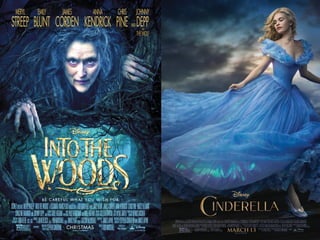
Preview to Into the Woods
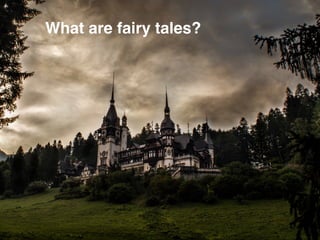
What are fairy tales?
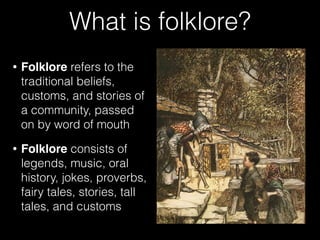
What is folklore?
• Folklore refers to the
traditional beliefs,
customs, and stories of
a community, passed
on by word of mouth
• Folklore consists of
legends, music, oral
history, jokes, proverbs,
fairy tales, stories, tall
tales, and customs
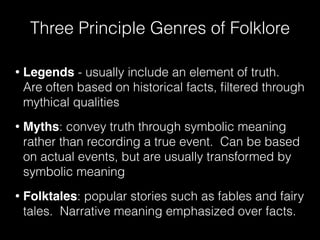
Three Principle Genres of Folklore
• Legends - usually include an element of truth.
Are often based on historical facts, filtered through
mythical qualities
• Myths: convey truth through symbolic meaning
rather than recording a true event. Can be based
on actual events, but are usually transformed by
symbolic meaning
• Folktales: popular stories such as fables and fairy
tales. Narrative meaning emphasized over facts.
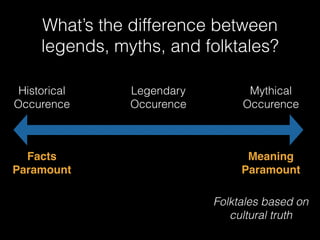
Historical
Occurence
Legendary
Occurence
Mythical
Occurence
Facts
Paramount
Meaning
Paramount
What’s the difference between
legends, myths, and folktales?
Folktales based on
cultural truth
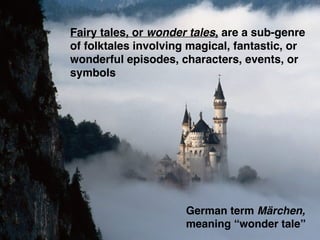
Fairy tales, or wonder tales, are a sub-genre
of folktales involving magical, fantastic, or
wonderful episodes, characters, events, or
symbols
German term Märchen,
meaning “wonder tale”
Some Characteristics of Fairy Tales
• Usually in timeless settings (once upon a time)
in generic and unspecified places (the woods),
with one-dimensional characters (good or bad)
• Typically feature talking animals and European
folkloric fantasy characters such as dwarves,
fairies, giants, gnomes, goblins, trolls, witches
• They function to entertain, inspire, and instruct.
They are not always didactic.
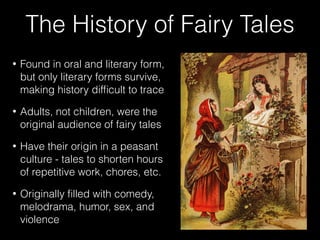
The History of Fairy Tales
• Found in oral and literary form,
but only literary forms survive,
making history difficult to trace
• Adults, not children, were the
original audience of fairy tales
• Have their origin in a peasant
culture - tales to shorten hours
of repetitive work, chores, etc.
• Originally filled with comedy,
melodrama, humor, sex, and
violence
Variations & Adaptations
• Fairy tales circulate in multiple versions; cross-
cultural transmissions
• Remixed and reconfigured by each new telling
• They take on the color of the time and place in
which they are told
• Variations can include location, motifs, style,
character, ending, context, etc.
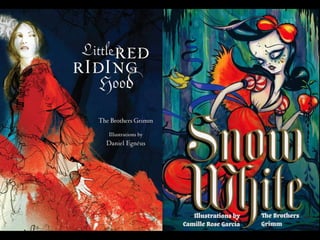
• What are some variations in “Little Red Riding
Hood”?
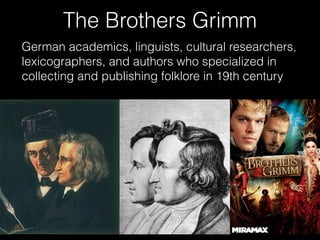
The Brothers Grimm
German academics, linguists, cultural researchers,
lexicographers, and authors who specialized in
collecting and publishing folklore in 19th century
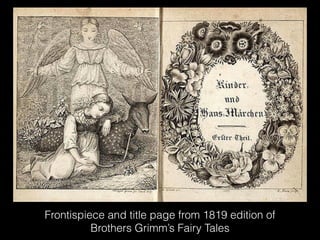
Frontispiece and title page from 1819 edition of
Brothers Grimm’s Fairy Tales
This slideshow by Craig Carey is
licensed under a Creative Commons
Attribution-NonCommercial-
ShareAlike 3.0 Unported License

Fairy Tales: An Introduction

  • 1.
  • 3.
  • 4.
    Preview to Intothe Woods
  • 9.
  • 10.
    What is folklore? •Folklore refers to the traditional beliefs, customs, and stories of a community, passed on by word of mouth • Folklore consists of legends, music, oral history, jokes, proverbs, fairy tales, stories, tall tales, and customs
  • 11.
    Three Principle Genresof Folklore • Legends - usually include an element of truth. Are often based on historical facts, filtered through mythical qualities • Myths: convey truth through symbolic meaning rather than recording a true event. Can be based on actual events, but are usually transformed by symbolic meaning • Folktales: popular stories such as fables and fairy tales. Narrative meaning emphasized over facts.
  • 12.
  • 13.
    Fairy tales, orwonder tales, are a sub-genre of folktales involving magical, fantastic, or wonderful episodes, characters, events, or symbols German term Märchen, meaning “wonder tale”
  • 14.
    Some Characteristics ofFairy Tales • Usually in timeless settings (once upon a time) in generic and unspecified places (the woods), with one-dimensional characters (good or bad) • Typically feature talking animals and European folkloric fantasy characters such as dwarves, fairies, giants, gnomes, goblins, trolls, witches • They function to entertain, inspire, and instruct. They are not always didactic.
  • 15.
    The History ofFairy Tales • Found in oral and literary form, but only literary forms survive, making history difficult to trace • Adults, not children, were the original audience of fairy tales • Have their origin in a peasant culture - tales to shorten hours of repetitive work, chores, etc. • Originally filled with comedy, melodrama, humor, sex, and violence
  • 16.
    Variations & Adaptations •Fairy tales circulate in multiple versions; cross- cultural transmissions • Remixed and reconfigured by each new telling • They take on the color of the time and place in which they are told • Variations can include location, motifs, style, character, ending, context, etc. • What are some variations in “Little Red Riding Hood”?
  • 17.
    The Brothers Grimm Germanacademics, linguists, cultural researchers, lexicographers, and authors who specialized in collecting and publishing folklore in 19th century
  • 19.
    Frontispiece and titlepage from 1819 edition of Brothers Grimm’s Fairy Tales
  • 20.
    This slideshow byCraig Carey is licensed under a Creative Commons Attribution-NonCommercial- ShareAlike 3.0 Unported License