Planetary system and Earth
Stellar System
• Earth-Insignificant speck of dust.
• Universe-Expanse of space and matter (Mostly empty space).
• Nebulae-Enormous masses of gaseous clouds without any structural
differentiation.
• Galaxies-Assembles of billion stars by gravity force.
• Stellar System-Single galaxy with stars.
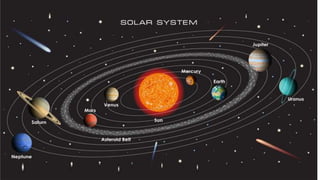
Solar system
• Star-radiant body, planet-non radiant body.
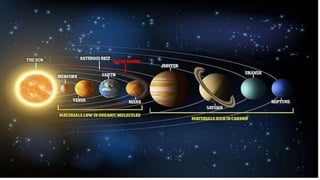
• Solar system-sun and planets are together (milky way)
• Astronomical unit- mean distance of sun from earth (149,642,000
km).
• Earth revolution-36 5.25 days, rotation-23hr 56min & 4sec.
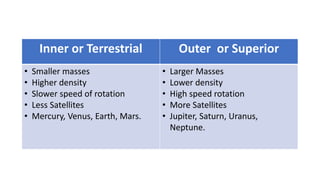
Inner or Terrestrial Outer or Superior
• Smaller masses
• Higher density
• Slower speed of rotation
• Less Satellites
• Mercury, Venus, Earth, Mars.
• Larger Masses
• Lower density
• High speed rotation
• More Satellites
• Jupiter, Saturn, Uranus,
Neptune.
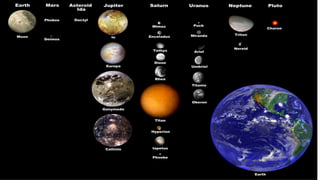
Moons
• Moonlets- belt of objects, asteroids moons sub satellites
• 0-Mercury, Venus, 1-earth, Pluto, 2-mars, 63-Jupiter, 31-Saturn, 21-
Uranus, 11-Neptune.
• Moves around in elliptical orbit (27d 7h 43min).
• Asteroids-between mars & Jupiter, planet like masses.
• Meteors-shooting stars, enters the atmosphere shines.
• Meteorite-reaching the surface, grouped into stony, intermediate,
iron.
• Comets-elliptical orbit motion around sun, tailed stars, Hailey‘s orbit
or comet – 76 years.
Parts of the earth
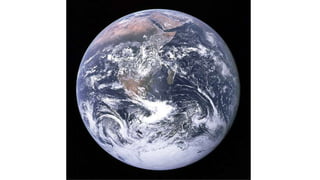
• Shape- spheroid
• Equatorial of diameter- 12,757 km, polar diameter- 12,713
• Mean density - 5.517 gm/cm.sq.
• Volume- 1.083×10^27cm.cube.
• Mass- 5.975×10^27 gram.
• Sustain life.
• Artificial & natural satellite’s.
• Introduction to atmosphere, lithosphere, hydrosphere.
The atmosphere
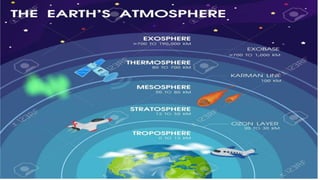
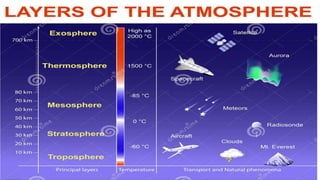
• Outer gaseous part, held due to gravitational pull, layered structure.
• Air-mechanical mixture of gases
• Homosphere-uniform composition within 80Km.
• Heterosphere-different composition above 80 km.
• Zigzag thermal variation based on classification.
A.Troposphere
• Lower most zone, weather and metrological process.
• Tropo pause-as per boundary, low temperature.
• Mixing and turbulence of gases.
• T.de.Bort in 1908 coined troposphere.
B.Strarosphere
• Temperature increases, Ozone layer from 9 to 35km. (Solar radiation).
• Strato pause-upper boundary, natural shield.
• Ozone hole- NASA on 2000 September, 28 mile sq.km.
C.Mesosphere
• Fall in temperature – 100°C.
D.Thermosphere
• Rising once again reaches 1000°C.
• Very rarefied Nature, individual gas particles separated by distance.
• Solar radiation Present.
E.Ionosphere
• Specialized zone, from 80km, absorbs solar radiation.
• Gases break up into ions, entirely of ions.
• 5 layers of ionisation not uniform.
• Most strongly ionized layer is D-layer or Kennelly-Heaviside layer.
• Boon for long distance radio communication by reflecting property.
F.Exosphere
• Extremely rarefied, low density and high temperature region.
• With minimum atomic collision.
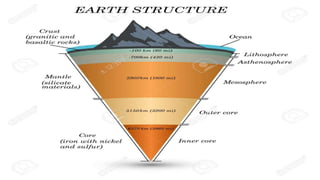
Lithosphere (Interior of the earth)
• Litho- Stony part of earth, Solid matter composing the earth from
surface downwards.
• Lithosphere- Crust+ Upper mantle. (Up to the materials in solid state).
A.Crust
• Various thickness in different areas are as follows,
• Chemical composition of the crust, analyses by Clarke, Washington,
Goldschmidt and plodervaat on rock samples on different geographic
zones.
• Sio2-50% to 60%, Al2O3-13 to 16%, Iron oxide-8%, Tip-2%.
• Cao-6%, Sodium oxide-4%, Mgo-4%, Tio-2%.
• Solid aggregate that makes crust is called rocks.
B.Mantle
• Prof.Mohorovicic, A seismologist of Yugoslavia 1904 discovered
discontinuity named after him is M or Mohorovicic discontinuity or
Moho (Crust to mantle).
• Mostly made up of ultra-basic (rich in Fe and Mg) poor in silica.
• High density and viscous in nature.
• Overlying crustal blocks virtually float over it.
• Volcanism, seismic activity & mountain orogeny originate from
mantle.
• Indirectly study with seismic waves.
C.Core
• Remains a mystery.
• Not uniform throughout its depth.
• Very high density at mantle core boundary, above 10g/cc.
• Outer core behaves like a liquid.
• Inner core behaves like a liquid.
• This view gets support from composition of meteorites.
The hydrosphere
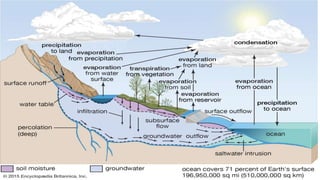
• Collective name of all water bodies.
• Hydrosphere makes 0.03% of earth masses.
• 98% of water bodies are oceans and seas (Pacific, Atlantic, Indian,
Arctic, Antarctic oceans).
• Associated bay’s and seas.
• Fresh water lakes, ponds and river’s.
• Ice and snow is 3rd Major components.
• Water occurring in pores and cavities called groundwater.
• Water cycle ( evaporation and condensation).
The Biosphere
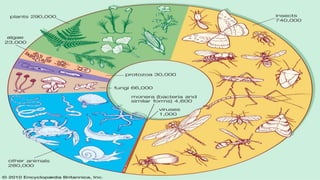
• Collective life forms on the surface and under water.
• Depends all 3 spheres.
• Responsible for many geological process’s like vast coal deposits and
oil reservoirs ( anthropogenic activity).
The End

Planetary system and earth

  • 1.
  • 3.
    Stellar System • Earth-Insignificantspeck of dust. • Universe-Expanse of space and matter (Mostly empty space). • Nebulae-Enormous masses of gaseous clouds without any structural differentiation. • Galaxies-Assembles of billion stars by gravity force. • Stellar System-Single galaxy with stars.
  • 5.
    Solar system • Star-radiantbody, planet-non radiant body. • Solar system-sun and planets are together (milky way) • Astronomical unit- mean distance of sun from earth (149,642,000 km). • Earth revolution-36 5.25 days, rotation-23hr 56min & 4sec.
  • 7.
    Inner or TerrestrialOuter or Superior • Smaller masses • Higher density • Slower speed of rotation • Less Satellites • Mercury, Venus, Earth, Mars. • Larger Masses • Lower density • High speed rotation • More Satellites • Jupiter, Saturn, Uranus, Neptune.
  • 9.
    Moons • Moonlets- beltof objects, asteroids moons sub satellites • 0-Mercury, Venus, 1-earth, Pluto, 2-mars, 63-Jupiter, 31-Saturn, 21- Uranus, 11-Neptune. • Moves around in elliptical orbit (27d 7h 43min). • Asteroids-between mars & Jupiter, planet like masses. • Meteors-shooting stars, enters the atmosphere shines. • Meteorite-reaching the surface, grouped into stony, intermediate, iron. • Comets-elliptical orbit motion around sun, tailed stars, Hailey‘s orbit or comet – 76 years.
  • 11.
    Parts of theearth • Shape- spheroid • Equatorial of diameter- 12,757 km, polar diameter- 12,713 • Mean density - 5.517 gm/cm.sq. • Volume- 1.083×10^27cm.cube. • Mass- 5.975×10^27 gram. • Sustain life. • Artificial & natural satellite’s. • Introduction to atmosphere, lithosphere, hydrosphere.
  • 13.
    The atmosphere • Outergaseous part, held due to gravitational pull, layered structure. • Air-mechanical mixture of gases • Homosphere-uniform composition within 80Km. • Heterosphere-different composition above 80 km. • Zigzag thermal variation based on classification.
  • 14.
    A.Troposphere • Lower mostzone, weather and metrological process. • Tropo pause-as per boundary, low temperature. • Mixing and turbulence of gases. • T.de.Bort in 1908 coined troposphere.
  • 15.
    B.Strarosphere • Temperature increases,Ozone layer from 9 to 35km. (Solar radiation). • Strato pause-upper boundary, natural shield. • Ozone hole- NASA on 2000 September, 28 mile sq.km.
  • 16.
    C.Mesosphere • Fall intemperature – 100°C.
  • 17.
    D.Thermosphere • Rising onceagain reaches 1000°C. • Very rarefied Nature, individual gas particles separated by distance. • Solar radiation Present.
  • 18.
    E.Ionosphere • Specialized zone,from 80km, absorbs solar radiation. • Gases break up into ions, entirely of ions. • 5 layers of ionisation not uniform. • Most strongly ionized layer is D-layer or Kennelly-Heaviside layer. • Boon for long distance radio communication by reflecting property.
  • 19.
    F.Exosphere • Extremely rarefied,low density and high temperature region. • With minimum atomic collision.
  • 22.
    Lithosphere (Interior ofthe earth) • Litho- Stony part of earth, Solid matter composing the earth from surface downwards. • Lithosphere- Crust+ Upper mantle. (Up to the materials in solid state).
  • 23.
    A.Crust • Various thicknessin different areas are as follows, • Chemical composition of the crust, analyses by Clarke, Washington, Goldschmidt and plodervaat on rock samples on different geographic zones. • Sio2-50% to 60%, Al2O3-13 to 16%, Iron oxide-8%, Tip-2%. • Cao-6%, Sodium oxide-4%, Mgo-4%, Tio-2%. • Solid aggregate that makes crust is called rocks.
  • 24.
    B.Mantle • Prof.Mohorovicic, Aseismologist of Yugoslavia 1904 discovered discontinuity named after him is M or Mohorovicic discontinuity or Moho (Crust to mantle). • Mostly made up of ultra-basic (rich in Fe and Mg) poor in silica. • High density and viscous in nature. • Overlying crustal blocks virtually float over it. • Volcanism, seismic activity & mountain orogeny originate from mantle. • Indirectly study with seismic waves.
  • 25.
    C.Core • Remains amystery. • Not uniform throughout its depth. • Very high density at mantle core boundary, above 10g/cc. • Outer core behaves like a liquid. • Inner core behaves like a liquid. • This view gets support from composition of meteorites.
  • 27.
    The hydrosphere • Collectivename of all water bodies. • Hydrosphere makes 0.03% of earth masses. • 98% of water bodies are oceans and seas (Pacific, Atlantic, Indian, Arctic, Antarctic oceans). • Associated bay’s and seas. • Fresh water lakes, ponds and river’s. • Ice and snow is 3rd Major components. • Water occurring in pores and cavities called groundwater. • Water cycle ( evaporation and condensation).
  • 29.
    The Biosphere • Collectivelife forms on the surface and under water. • Depends all 3 spheres. • Responsible for many geological process’s like vast coal deposits and oil reservoirs ( anthropogenic activity).
  • 30.