Facilitator Training Program
“Train the Trainer”
Synchronous 3-day model
Cristen C. Yancey
April 4, 2016
Cur-532
Melinda Medina
Welcome & Overview
Congratulations! You have been selected to participate in the online training course
designed to educate traditional corporate classroom instructors in distance education.
In an effort to increase customer satisfaction and training effectiveness, this 3-day
training module provides the organization the necessary resources to train employees
using distance learning; essentially we are training the trainer.
Distance learning training allows the presentation of new materials and additional
continuing professional education training to happen at the same time, where each
student at each location across the country receives the same information.
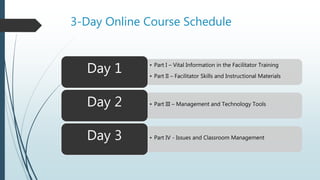
3-Day Online Course Schedule
• Part I – Vital Information in the Facilitator Training
• Part II – Facilitator Skills and Instructional Materials
Day 1
• Part III – Management and Technology ToolsDay 2
• Part IV - Issues and Classroom ManagementDay 3
Part I –Vital Information in the
Facilitator Training
Day 1
Vital Information in the Facilitator Training
Training Program Audience
 Traditional corporate classroom instructors
 Basic literacy skills
 Efficient Windows operation skills
 At least 3 years of traditional adult classroom instruction
Vital Information in the Facilitator Training
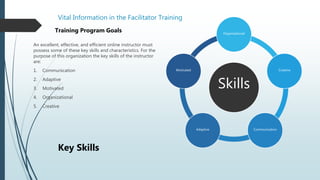
Skills
Organizational
Creative
CommunicationAdaptive
Motivated
Training Program Goals
An excellent, effective, and efficient online instructor must
possess some of these key skills and characteristics. For the
purpose of this organization the key skills of the instructor
are:
1. Communication
2. Adaptive
3. Motivated
4. Organizational
5. Creative
Key Skills
Vital Information in the Facilitator Training
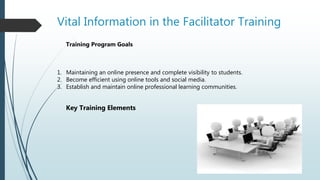
Key Training Elements
1. Maintaining an online presence and complete visibility to students.
2. Become efficient using online tools and social media.
3. Establish and maintain online professional learning communities.
Training Program Goals
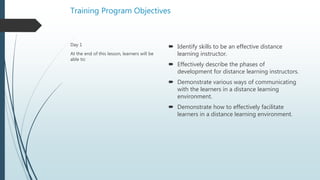
Training Program Objectives
 Identify skills to be an effective distance
learning instructor.
 Effectively describe the phases of
development for distance learning instructors.
 Demonstrate various ways of communicating
with the learners in a distance learning
environment.
 Demonstrate how to effectively facilitate
learners in a distance learning environment.
Day 1
At the end of this lesson, learners will be
able to:
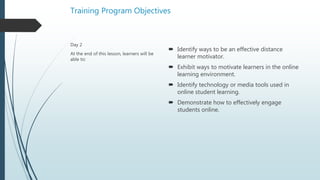
Training Program Objectives
 Identify ways to be an effective distance
learner motivator.
 Exhibit ways to motivate learners in the online
learning environment.
 Identify technology or media tools used in
online student learning.
 Demonstrate how to effectively engage
students online.
Day 2
At the end of this lesson, learners will be
able to:
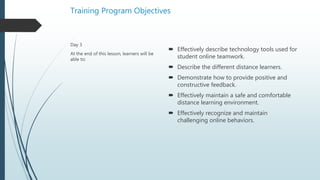
Training Program Objectives
 Effectively describe technology tools used for
student online teamwork.
 Describe the different distance learners.
 Demonstrate how to provide positive and
constructive feedback.
 Effectively maintain a safe and comfortable
distance learning environment.
 Effectively recognize and maintain
challenging online behaviors.
Day 3
At the end of this lesson, learners will be
able to:
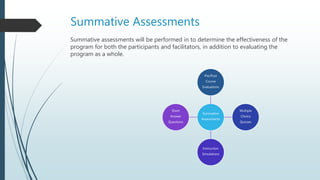
Summative Assessments
Summative assessments will be performed in to determine the effectiveness of the
program for both the participants and facilitators, in addition to evaluating the
program as a whole.
Summative
Assessments
Pre/Post
Course
Evaluations
Multiple
Choice
Quizzes
Instruction
Simulations
Short
Answer
Questions
Part II –Facilitator Skills and
Instructional Materials
Day 1
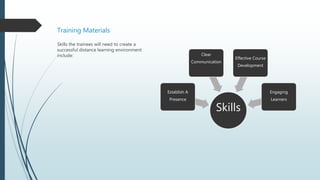
Training Materials
Skills
Establish A
Presence
Clear
Communication
Effective Course
Development
Engaging
Learners
Skills the trainees will need to create a
successful distance learning environment
include:
Training Materials – Possible Strategies
1.Discussion boards
2.Visual Aids
3.Active Learning
4.Cooperative Learning
5.Integrate Technology
Phases of Development for Distance
Learning Facilitators
According to Palloff and Pratt (2011), there are five phases of development for online
facilitators:
1. Visitor
2. Novice
3. Apprentice
4. Insider
5. Master
Phases of Development for Distance
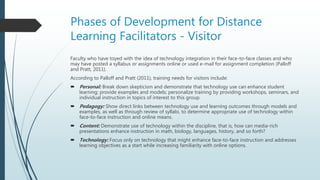
Learning Facilitators - Visitor
Faculty who have toyed with the idea of technology integration in their face-to-face classes and who
may have posted a syllabus or assignments online or used e-mail for assignment completion (Palloff
and Pratt, 2011).
According to Palloff and Pratt (2011), training needs for visitors include:
 Personal: Break down skepticism and demonstrate that technology use can enhance student
learning; provide examples and models; personalize training by providing workshops, seminars, and
individual instruction in topics of interest to this group.
 Pedagogy: Show direct links between technology use and learning outcomes through models and
examples, as well as through review of syllabi, to determine appropriate use of technology within
face-to-face instruction and online means.
 Content: Demonstrate use of technology within the discipline, that is, how can media-rich
presentations enhance instruction in math, biology, languages, history, and so forth?
 Technology: Focus only on technology that might enhance face-to-face instruction and addresses
learning objectives as a start while increasing familiarity with online options.
Phases of Development for Distance
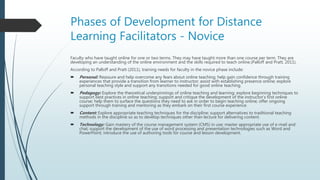
Learning Facilitators - Novice
Faculty who have taught online for one or two terms. They may have taught more than one course per term. They are
developing an understanding of the online environment and the skills required to teach online.(Palloff and Pratt, 2011).
According to Palloff and Pratt (2011), training needs for faculty in the novice phase include:
 Personal: Reassure and help overcome any fears about online teaching; help gain confidence through training
experiences that provide a transition from learner to instructor; assist with establishing presence online; explore
personal teaching style and support any transitions needed for good online teaching.
 Pedagogy: Explore the theoretical underpinnings of online teaching and learning; explore beginning techniques to
support best practices in online teaching; support and critique the development of the instructor’s first online
course; help them to surface the questions they need to ask in order to begin teaching online; offer ongoing
support through training and mentoring as they embark on their first course experience.
 Content: Explore appropriate teaching techniques for the discipline; support alternatives to traditional teaching
methods in the discipline so as to develop techniques other than lecture for delivering content.
 Technology: Gain mastery of the course management system (CMS) in use; master appropriate use of e-mail and
chat; support the development of the use of word processing and presentation technologies such as Word and
PowerPoint; introduce the use of authoring tools for course and lesson development.
Phases of Development for Distance
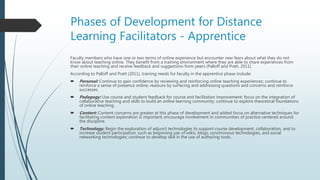
Learning Facilitators - Apprentice
Faculty members who have one or two terms of online experience but encounter new fears about what they do not
know about teaching online. They benefit from a training environment where they are able to share experiences from
their online teaching and receive feedback and suggestions from peers (Palloff and Pratt, 2011).
According to Palloff and Pratt (2011), training needs for faculty in the apprentice phase include:
 Personal: Continue to gain confidence by reviewing and reinforcing online teaching experiences; continue to
reinforce a sense of presence online; reassure by surfacing and addressing questions and concerns and reinforce
successes.
 Pedagogy: Use course and student feedback for course and facilitation improvement; focus on the integration of
collaborative teaching and skills to build an online learning community; continue to explore theoretical foundations
of online teaching.
 Content: Content concerns are greater at this phase of development and added focus on alternative techniques for
facilitating content exploration is important; encourage involvement in communities of practice centered around
the discipline.
 Technology: Begin the exploration of adjunct technologies to support course development, collaboration, and to
increase student participation, such as beginning use of wikis, blogs, synchronous technologies, and social
networking technologies; continue to develop skill in the use of authoring tools.
Phases of Development for Distance
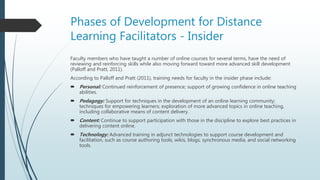
Learning Facilitators - Insider
Faculty members who have taught a number of online courses for several terms, have the need of
reviewing and reinforcing skills while also moving forward toward more advanced skill development
(Palloff and Pratt, 2011).
According to Palloff and Pratt (2011), training needs for faculty in the insider phase include:
 Personal: Continued reinforcement of presence; support of growing confidence in online teaching
abilities.
 Pedagogy: Support for techniques in the development of an online learning community;
techniques for empowering learners; exploration of more advanced topics in online teaching,
including collaborative means of content delivery.
 Content: Continue to support participation with those in the discipline to explore best practices in
delivering content online.
 Technology: Advanced training in adjunct technologies to support course development and
facilitation, such as course authoring tools, wikis, blogs, synchronous media, and social networking
tools.
Phases of Development for Distance
Learning Facilitators - Master
Faculty members who have a great deal of experience with online teaching and who are
willing to experiment with new techniques for course development and delivery (Palloff and
Pratt, 2011).
According to Palloff and Pratt (2011), training needs for faculty in the master phase include:
 Personal: Support for leadership development and expertise in online teaching;
presentation to their peers and at conferences; support for publication.
 Pedagogy: Support for exploration and study of advanced facilitation techniques;
encourage development for peer training.
 Content: Support continued exploration of best practices for online teaching within the
discipline and encourage research into the outcomes of such practices.
 Technology: Support for development and inclusion of new technologies and new
approaches in the use of technology in online teaching.
Theories of Distance Learning
According to Haythornthwaite and Andrews (2011), there are three foundational
notions associated with learning theory that help lay our groundwork for making sense
of e-learning.
 Transformation
 Framing
 Emergence
Theories of Distance Learning
 Transformation discusses how users change
frameworks according to the resources
available. According to Haythornthwaite and
Andrews (2011), when these frames are
changed, learning takes place.
 “Transformation is at the heart of learning”
(Haythornthwaite and Andrews, 2011).
Transformation
Theories of Distance Learning
Framing refers to the way we se certain kinds of
rules and experiences as interpretive frames for
action (Haythornthwaite and Andrews, 2011).
Framing
Theories of Distance Learning
According to Haythornthwaite and Andrews
(2011), emergence is when a new state of
knowledge is attained and consolidated, where
the individual is again ready to experience and
integrate new learning.
Emergence
Theories of Distance Learning
Transactional Distance
Involves a set of three variable that
operate in relation to the degree of
transactional distance between the
teachers and learners.
 Dialogue
 Program Structure
 Learner Autonomy
Haythornthwaite and Andrews (2011)
Multimodality
According to Kress (2016), multimodality
is a theory which looks at the many
different modes that people use to
communicate and express themselves;
This theory becomes more relevant as
technology increases.
Theories of Distance Learning
Intrinsic Motivation
To be successful in distance learning
motivation is required. Students have to
be self-directed as well as self-motivated.
The student has to be wiling and ready
to put in the necessary work to be
successful.
Digital Media
 Computers/Laptop/Tablets
 Smartphones
 Social Networking
 Other types of media used to deliver
online instruction:
• Prezi
• SlideShare
Theories for Engaging Distance Learners
 Establish an effective online presence
 Clearly state goals and objectives of the course in the beginning
 Collaboration
 Build an online community
Management and Technology Tools
Day 2
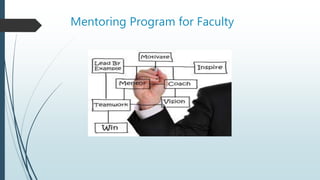
Mentoring Program for Faculty
Goals and Objectives of the Mentoring
Program
Goals:
1. Increase professional togetherness amongst colleagues.
2. Provide effective and efficient feedback and support.
3. Help mentees reach the level of success that they are striving to reach.
Objectives:
1. Mentors will increase trust and respect within the organization by establishing an
open exchange of ideas and joint relationships.
2. Mentors will provide assistance with technology, by working one on one with
students.
3. Mentors will openly share information regarding past experiences that relates
them with their students to serve as motivation.
Performance Status & Experience of
Mentor
 The mentor must have at least 5-7 years of traditional facilitating skills and at least
3 years of distance learning facilitating.
 The facilitator who volunteers to serve as a mentor must have completed a
minimum of 4 online training course.
 The potential mentor must have facilitated at least 3 distance learning training
courses within the last 12 months.
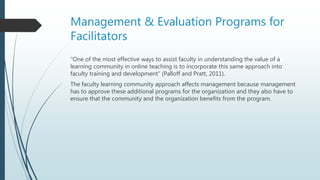
Management & Evaluation Programs for
Facilitators
“One of the most effective ways to assist faculty in understanding the value of a
learning community in online teaching is to incorporate this same approach into
faculty training and development” (Palloff and Pratt, 2011).
The faculty learning community approach affects management because management
has to approve these additional programs for the organization and they also have to
ensure that the community and the organization benefits from the program.
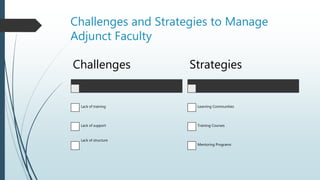
Challenges and Strategies to Manage
Adjunct Faculty
Challenges
Lack of training
Lack of support
Lack of structure
Strategies
Learning Communities
Training Courses
Mentoring Programs
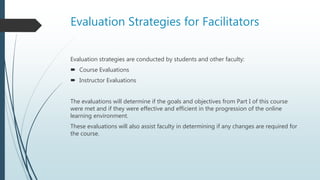
Evaluation Strategies for Facilitators
Evaluation strategies are conducted by students and other faculty:
 Course Evaluations
 Instructor Evaluations
The evaluations will determine if the goals and objectives from Part I of this course
were met and if they were effective and efficient in the progression of the online
learning environment.
These evaluations will also assist faculty in determining if any changes are required for
the course.
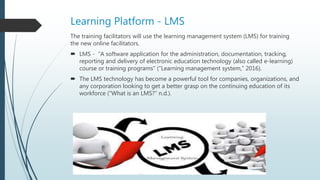
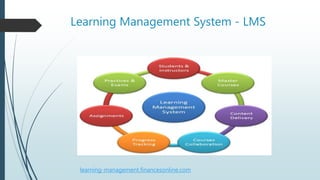
Learning Platform - LMS
The training facilitators will use the learning management system (LMS) for training
the new online facilitators.
 LMS - “A software application for the administration, documentation, tracking,
reporting and delivery of electronic education technology (also called e-learning)
course or training programs” (“Learning management system,” 2016).
 The LMS technology has become a powerful tool for companies, organizations, and
any corporation looking to get a better grasp on the continuing education of its
workforce (“What is an LMS?” n.d.).
Learning Management System - LMS
learning-management.financesonline.com
Tool that Engage and Enhance Student
Learning
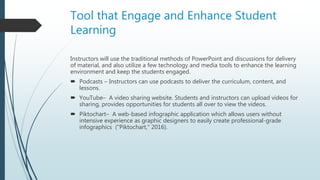
Instructors will use the traditional methods of PowerPoint and discussions for delivery
of material, and also utilize a few technology and media tools to enhance the learning
environment and keep the students engaged.
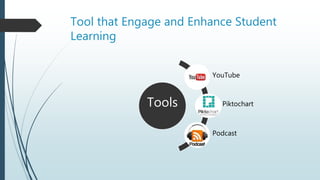
 Podcasts – Instructors can use podcasts to deliver the curriculum, content, and
lessons.
 YouTube– A video sharing website. Students and instructors can upload videos for
sharing, provides opportunities for students all over to view the videos.
 Piktochart– A web-based infographic application which allows users without
intensive experience as graphic designers to easily create professional-grade
infographics ("Piktochart," 2016).
Tool that Engage and Enhance Student
Learning
Tools
YouTube
Piktochart
Podcast
Part IV – Issues and Classroom
Management
Day 3
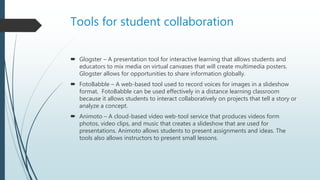
Tools for student collaboration
 Glogster – A presentation tool for interactive learning that allows students and
educators to mix media on virtual canvases that will create multimedia posters.
Glogster allows for opportunities to share information globally.
 FotoBabble – A web-based tool used to record voices for images in a slideshow
format. FotoBabble can be used effectively in a distance learning classroom
because it allows students to interact collaboratively on projects that tell a story or
analyze a concept.
 Animoto – A cloud-based video web-tool service that produces videos form
photos, video clips, and music that creates a slideshow that are used for
presentations. Animoto allows students to present assignments and ideas. The
tools also allows instructors to present small lessons.
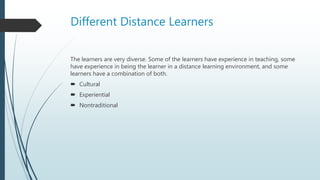
Different Distance Learners
The learners are very diverse. Some of the learners have experience in teaching, some
have experience in being the learner in a distance learning environment, and some
learners have a combination of both.
 Cultural
 Experiential
 Nontraditional
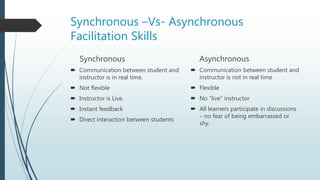
Synchronous –Vs- Asynchronous
Facilitation Skills
Synchronous
 Communication between student and
instructor is in real time.
 Not flexible
 Instructor is Live.
 Instant feedback
 Direct interaction between students
Asynchronous
 Communication between student and
instructor is not in real time
 Flexible
 No “live” instructor
 All learners participate in discussions
– no fear of being embarrassed or
shy.
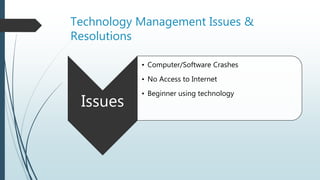
Technology Management Issues &
Resolutions
Issues
• Computer/Software Crashes
• No Access to Internet
• Beginner using technology
Technology Management Issues &
Resolutions
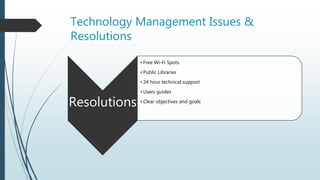
Resolutions
• Free Wi-Fi Spots
• Public Libraries
• 24 hour technical support
• Users guides
• Clear objectives and goals
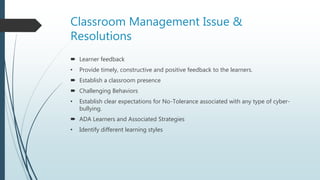
Classroom Management Issue &
Resolutions
 Learner feedback
• Provide timely, constructive and positive feedback to the learners.
 Establish a classroom presence
 Challenging Behaviors
• Establish clear expectations for No-Tolerance associated with any type of cyber-
bullying.
 ADA Learners and Associated Strategies
• Identify different learning styles
References
 Animoto. (2016). In Wikipedia. Retrieved from https://en.wikipedia.org/wiki/Animoto
 Glogster. (2016). In Wikipedia. Retrieved from https://en.wikipedia.org/wiki/Glogster
 Haythornthwaite, C., & Andrews, R. (2011). E-Learning Theory and Practice (Rev ed.). London: SAGE Publications Ltd.
 Laan, K. (2012). 11 Essential tools for better project-based learning. Retrieved from http://www.teachthought.com/learning/project-
based-learning/11-tools-for-better-project-based-learning/
 Learning management system. (2016). In Wikipedia. Retrieved from https://en.wikipedia.org/wiki/Learning_management_system
 Palloff, R. M., & Pratt, K. (2011). The Excellent online instructor : strategies for professional development. San Francisco: Jossey-Bass.
 Piktochart. (2016). In Wikipedia. Retrieved from https://en.wikipedia.org/wiki/Piktochart
 Teacher's guide on the use of podcasting in education. (n.d.). Retrieved from http://www.educatorstechnology.com/2012/12/teachers-
guide-on-use-of-podcasting-in.html
 What is an LMS?. (n.d.). Retrieved from https://www.mindflash.com/lms
 YouTube. (2016). In Wikipedia. Retrieved from https://en.wikipedia.org/wiki/YouTube

Facilitator Training Program

  • 1.
    Facilitator Training Program “Trainthe Trainer” Synchronous 3-day model Cristen C. Yancey April 4, 2016 Cur-532 Melinda Medina
  • 2.
    Welcome & Overview Congratulations!You have been selected to participate in the online training course designed to educate traditional corporate classroom instructors in distance education. In an effort to increase customer satisfaction and training effectiveness, this 3-day training module provides the organization the necessary resources to train employees using distance learning; essentially we are training the trainer. Distance learning training allows the presentation of new materials and additional continuing professional education training to happen at the same time, where each student at each location across the country receives the same information.
  • 3.
    3-Day Online CourseSchedule • Part I – Vital Information in the Facilitator Training • Part II – Facilitator Skills and Instructional Materials Day 1 • Part III – Management and Technology ToolsDay 2 • Part IV - Issues and Classroom ManagementDay 3
  • 4.
    Part I –VitalInformation in the Facilitator Training Day 1
  • 5.
    Vital Information inthe Facilitator Training Training Program Audience  Traditional corporate classroom instructors  Basic literacy skills  Efficient Windows operation skills  At least 3 years of traditional adult classroom instruction
  • 6.
    Vital Information inthe Facilitator Training Skills Organizational Creative CommunicationAdaptive Motivated Training Program Goals An excellent, effective, and efficient online instructor must possess some of these key skills and characteristics. For the purpose of this organization the key skills of the instructor are: 1. Communication 2. Adaptive 3. Motivated 4. Organizational 5. Creative Key Skills
  • 7.
    Vital Information inthe Facilitator Training Key Training Elements 1. Maintaining an online presence and complete visibility to students. 2. Become efficient using online tools and social media. 3. Establish and maintain online professional learning communities. Training Program Goals
  • 8.
    Training Program Objectives Identify skills to be an effective distance learning instructor.  Effectively describe the phases of development for distance learning instructors.  Demonstrate various ways of communicating with the learners in a distance learning environment.  Demonstrate how to effectively facilitate learners in a distance learning environment. Day 1 At the end of this lesson, learners will be able to:
  • 9.
    Training Program Objectives Identify ways to be an effective distance learner motivator.  Exhibit ways to motivate learners in the online learning environment.  Identify technology or media tools used in online student learning.  Demonstrate how to effectively engage students online. Day 2 At the end of this lesson, learners will be able to:
  • 10.
    Training Program Objectives Effectively describe technology tools used for student online teamwork.  Describe the different distance learners.  Demonstrate how to provide positive and constructive feedback.  Effectively maintain a safe and comfortable distance learning environment.  Effectively recognize and maintain challenging online behaviors. Day 3 At the end of this lesson, learners will be able to:
  • 11.
    Summative Assessments Summative assessmentswill be performed in to determine the effectiveness of the program for both the participants and facilitators, in addition to evaluating the program as a whole. Summative Assessments Pre/Post Course Evaluations Multiple Choice Quizzes Instruction Simulations Short Answer Questions
  • 12.
    Part II –FacilitatorSkills and Instructional Materials Day 1
  • 13.
    Training Materials Skills Establish A Presence Clear Communication EffectiveCourse Development Engaging Learners Skills the trainees will need to create a successful distance learning environment include:
  • 14.
    Training Materials –Possible Strategies 1.Discussion boards 2.Visual Aids 3.Active Learning 4.Cooperative Learning 5.Integrate Technology
  • 15.
    Phases of Developmentfor Distance Learning Facilitators According to Palloff and Pratt (2011), there are five phases of development for online facilitators: 1. Visitor 2. Novice 3. Apprentice 4. Insider 5. Master
  • 16.
    Phases of Developmentfor Distance Learning Facilitators - Visitor Faculty who have toyed with the idea of technology integration in their face-to-face classes and who may have posted a syllabus or assignments online or used e-mail for assignment completion (Palloff and Pratt, 2011). According to Palloff and Pratt (2011), training needs for visitors include:  Personal: Break down skepticism and demonstrate that technology use can enhance student learning; provide examples and models; personalize training by providing workshops, seminars, and individual instruction in topics of interest to this group.  Pedagogy: Show direct links between technology use and learning outcomes through models and examples, as well as through review of syllabi, to determine appropriate use of technology within face-to-face instruction and online means.  Content: Demonstrate use of technology within the discipline, that is, how can media-rich presentations enhance instruction in math, biology, languages, history, and so forth?  Technology: Focus only on technology that might enhance face-to-face instruction and addresses learning objectives as a start while increasing familiarity with online options.
  • 17.
    Phases of Developmentfor Distance Learning Facilitators - Novice Faculty who have taught online for one or two terms. They may have taught more than one course per term. They are developing an understanding of the online environment and the skills required to teach online.(Palloff and Pratt, 2011). According to Palloff and Pratt (2011), training needs for faculty in the novice phase include:  Personal: Reassure and help overcome any fears about online teaching; help gain confidence through training experiences that provide a transition from learner to instructor; assist with establishing presence online; explore personal teaching style and support any transitions needed for good online teaching.  Pedagogy: Explore the theoretical underpinnings of online teaching and learning; explore beginning techniques to support best practices in online teaching; support and critique the development of the instructor’s first online course; help them to surface the questions they need to ask in order to begin teaching online; offer ongoing support through training and mentoring as they embark on their first course experience.  Content: Explore appropriate teaching techniques for the discipline; support alternatives to traditional teaching methods in the discipline so as to develop techniques other than lecture for delivering content.  Technology: Gain mastery of the course management system (CMS) in use; master appropriate use of e-mail and chat; support the development of the use of word processing and presentation technologies such as Word and PowerPoint; introduce the use of authoring tools for course and lesson development.
  • 18.
    Phases of Developmentfor Distance Learning Facilitators - Apprentice Faculty members who have one or two terms of online experience but encounter new fears about what they do not know about teaching online. They benefit from a training environment where they are able to share experiences from their online teaching and receive feedback and suggestions from peers (Palloff and Pratt, 2011). According to Palloff and Pratt (2011), training needs for faculty in the apprentice phase include:  Personal: Continue to gain confidence by reviewing and reinforcing online teaching experiences; continue to reinforce a sense of presence online; reassure by surfacing and addressing questions and concerns and reinforce successes.  Pedagogy: Use course and student feedback for course and facilitation improvement; focus on the integration of collaborative teaching and skills to build an online learning community; continue to explore theoretical foundations of online teaching.  Content: Content concerns are greater at this phase of development and added focus on alternative techniques for facilitating content exploration is important; encourage involvement in communities of practice centered around the discipline.  Technology: Begin the exploration of adjunct technologies to support course development, collaboration, and to increase student participation, such as beginning use of wikis, blogs, synchronous technologies, and social networking technologies; continue to develop skill in the use of authoring tools.
  • 19.
    Phases of Developmentfor Distance Learning Facilitators - Insider Faculty members who have taught a number of online courses for several terms, have the need of reviewing and reinforcing skills while also moving forward toward more advanced skill development (Palloff and Pratt, 2011). According to Palloff and Pratt (2011), training needs for faculty in the insider phase include:  Personal: Continued reinforcement of presence; support of growing confidence in online teaching abilities.  Pedagogy: Support for techniques in the development of an online learning community; techniques for empowering learners; exploration of more advanced topics in online teaching, including collaborative means of content delivery.  Content: Continue to support participation with those in the discipline to explore best practices in delivering content online.  Technology: Advanced training in adjunct technologies to support course development and facilitation, such as course authoring tools, wikis, blogs, synchronous media, and social networking tools.
  • 20.
    Phases of Developmentfor Distance Learning Facilitators - Master Faculty members who have a great deal of experience with online teaching and who are willing to experiment with new techniques for course development and delivery (Palloff and Pratt, 2011). According to Palloff and Pratt (2011), training needs for faculty in the master phase include:  Personal: Support for leadership development and expertise in online teaching; presentation to their peers and at conferences; support for publication.  Pedagogy: Support for exploration and study of advanced facilitation techniques; encourage development for peer training.  Content: Support continued exploration of best practices for online teaching within the discipline and encourage research into the outcomes of such practices.  Technology: Support for development and inclusion of new technologies and new approaches in the use of technology in online teaching.
  • 21.
    Theories of DistanceLearning According to Haythornthwaite and Andrews (2011), there are three foundational notions associated with learning theory that help lay our groundwork for making sense of e-learning.  Transformation  Framing  Emergence
  • 22.
    Theories of DistanceLearning  Transformation discusses how users change frameworks according to the resources available. According to Haythornthwaite and Andrews (2011), when these frames are changed, learning takes place.  “Transformation is at the heart of learning” (Haythornthwaite and Andrews, 2011). Transformation
  • 23.
    Theories of DistanceLearning Framing refers to the way we se certain kinds of rules and experiences as interpretive frames for action (Haythornthwaite and Andrews, 2011). Framing
  • 24.
    Theories of DistanceLearning According to Haythornthwaite and Andrews (2011), emergence is when a new state of knowledge is attained and consolidated, where the individual is again ready to experience and integrate new learning. Emergence
  • 25.
    Theories of DistanceLearning Transactional Distance Involves a set of three variable that operate in relation to the degree of transactional distance between the teachers and learners.  Dialogue  Program Structure  Learner Autonomy Haythornthwaite and Andrews (2011) Multimodality According to Kress (2016), multimodality is a theory which looks at the many different modes that people use to communicate and express themselves; This theory becomes more relevant as technology increases.
  • 26.
    Theories of DistanceLearning Intrinsic Motivation To be successful in distance learning motivation is required. Students have to be self-directed as well as self-motivated. The student has to be wiling and ready to put in the necessary work to be successful. Digital Media  Computers/Laptop/Tablets  Smartphones  Social Networking  Other types of media used to deliver online instruction: • Prezi • SlideShare
  • 27.
    Theories for EngagingDistance Learners  Establish an effective online presence  Clearly state goals and objectives of the course in the beginning  Collaboration  Build an online community
  • 28.
  • 29.
  • 30.
    Goals and Objectivesof the Mentoring Program Goals: 1. Increase professional togetherness amongst colleagues. 2. Provide effective and efficient feedback and support. 3. Help mentees reach the level of success that they are striving to reach. Objectives: 1. Mentors will increase trust and respect within the organization by establishing an open exchange of ideas and joint relationships. 2. Mentors will provide assistance with technology, by working one on one with students. 3. Mentors will openly share information regarding past experiences that relates them with their students to serve as motivation.
  • 31.
    Performance Status &Experience of Mentor  The mentor must have at least 5-7 years of traditional facilitating skills and at least 3 years of distance learning facilitating.  The facilitator who volunteers to serve as a mentor must have completed a minimum of 4 online training course.  The potential mentor must have facilitated at least 3 distance learning training courses within the last 12 months.
  • 32.
    Management & EvaluationPrograms for Facilitators “One of the most effective ways to assist faculty in understanding the value of a learning community in online teaching is to incorporate this same approach into faculty training and development” (Palloff and Pratt, 2011). The faculty learning community approach affects management because management has to approve these additional programs for the organization and they also have to ensure that the community and the organization benefits from the program.
  • 33.
    Challenges and Strategiesto Manage Adjunct Faculty Challenges Lack of training Lack of support Lack of structure Strategies Learning Communities Training Courses Mentoring Programs
  • 34.
    Evaluation Strategies forFacilitators Evaluation strategies are conducted by students and other faculty:  Course Evaluations  Instructor Evaluations The evaluations will determine if the goals and objectives from Part I of this course were met and if they were effective and efficient in the progression of the online learning environment. These evaluations will also assist faculty in determining if any changes are required for the course.
  • 35.
    Learning Platform -LMS The training facilitators will use the learning management system (LMS) for training the new online facilitators.  LMS - “A software application for the administration, documentation, tracking, reporting and delivery of electronic education technology (also called e-learning) course or training programs” (“Learning management system,” 2016).  The LMS technology has become a powerful tool for companies, organizations, and any corporation looking to get a better grasp on the continuing education of its workforce (“What is an LMS?” n.d.).
  • 36.
    Learning Management System- LMS learning-management.financesonline.com
  • 37.
    Tool that Engageand Enhance Student Learning Instructors will use the traditional methods of PowerPoint and discussions for delivery of material, and also utilize a few technology and media tools to enhance the learning environment and keep the students engaged.  Podcasts – Instructors can use podcasts to deliver the curriculum, content, and lessons.  YouTube– A video sharing website. Students and instructors can upload videos for sharing, provides opportunities for students all over to view the videos.  Piktochart– A web-based infographic application which allows users without intensive experience as graphic designers to easily create professional-grade infographics ("Piktochart," 2016).
  • 38.
    Tool that Engageand Enhance Student Learning Tools YouTube Piktochart Podcast
  • 39.
    Part IV –Issues and Classroom Management Day 3
  • 40.
    Tools for studentcollaboration  Glogster – A presentation tool for interactive learning that allows students and educators to mix media on virtual canvases that will create multimedia posters. Glogster allows for opportunities to share information globally.  FotoBabble – A web-based tool used to record voices for images in a slideshow format. FotoBabble can be used effectively in a distance learning classroom because it allows students to interact collaboratively on projects that tell a story or analyze a concept.  Animoto – A cloud-based video web-tool service that produces videos form photos, video clips, and music that creates a slideshow that are used for presentations. Animoto allows students to present assignments and ideas. The tools also allows instructors to present small lessons.
  • 41.
    Different Distance Learners Thelearners are very diverse. Some of the learners have experience in teaching, some have experience in being the learner in a distance learning environment, and some learners have a combination of both.  Cultural  Experiential  Nontraditional
  • 42.
    Synchronous –Vs- Asynchronous FacilitationSkills Synchronous  Communication between student and instructor is in real time.  Not flexible  Instructor is Live.  Instant feedback  Direct interaction between students Asynchronous  Communication between student and instructor is not in real time  Flexible  No “live” instructor  All learners participate in discussions – no fear of being embarrassed or shy.
  • 43.
    Technology Management Issues& Resolutions Issues • Computer/Software Crashes • No Access to Internet • Beginner using technology
  • 44.
    Technology Management Issues& Resolutions Resolutions • Free Wi-Fi Spots • Public Libraries • 24 hour technical support • Users guides • Clear objectives and goals
  • 45.
    Classroom Management Issue& Resolutions  Learner feedback • Provide timely, constructive and positive feedback to the learners.  Establish a classroom presence  Challenging Behaviors • Establish clear expectations for No-Tolerance associated with any type of cyber- bullying.  ADA Learners and Associated Strategies • Identify different learning styles
  • 46.
    References  Animoto. (2016).In Wikipedia. Retrieved from https://en.wikipedia.org/wiki/Animoto  Glogster. (2016). In Wikipedia. Retrieved from https://en.wikipedia.org/wiki/Glogster  Haythornthwaite, C., & Andrews, R. (2011). E-Learning Theory and Practice (Rev ed.). London: SAGE Publications Ltd.  Laan, K. (2012). 11 Essential tools for better project-based learning. Retrieved from http://www.teachthought.com/learning/project- based-learning/11-tools-for-better-project-based-learning/  Learning management system. (2016). In Wikipedia. Retrieved from https://en.wikipedia.org/wiki/Learning_management_system  Palloff, R. M., & Pratt, K. (2011). The Excellent online instructor : strategies for professional development. San Francisco: Jossey-Bass.  Piktochart. (2016). In Wikipedia. Retrieved from https://en.wikipedia.org/wiki/Piktochart  Teacher's guide on the use of podcasting in education. (n.d.). Retrieved from http://www.educatorstechnology.com/2012/12/teachers- guide-on-use-of-podcasting-in.html  What is an LMS?. (n.d.). Retrieved from https://www.mindflash.com/lms  YouTube. (2016). In Wikipedia. Retrieved from https://en.wikipedia.org/wiki/YouTube