Facilitator Training
Program
Penny L. Valentine
October 3, 2016
CUR 532
Garth Beerman
Welcome
Hi, my name is Penny L. Valentine and I will be your instructor for this online training
program. I would like to welcome each and everyone of you to my class and I look
forward to facilitating and sharing information to help you develop the skills that you need
to teach others to be successful in the online environment.
This is a asynchronous training program that will be exclusively online for the course of
three days. The training will be broken down into three parts over the course of the three
day period.
I will be here to assist you in any way possible. It is my job to make sure that you get the
information that you need to be successful. I will be monitoring your online progress
several times during the day. If you should have any questions or concerns, please feel
free to contact me by email at plvalentine@cox.net or by phone at (225) 571-6224
between the hours of 9:00 am – 8:30 pm EST.
Training Program Audience
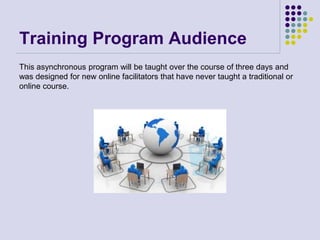
This asynchronous program will be taught over the course of three days and
was designed for new online facilitators that have never taught a traditional or
online course.
Course Requirements
ïŹ Must be 24 years of age
ïŹ Must have a Bachelors degree
ïŹ No teaching experience is necessary
ïŹ Must have basic knowledge in the use of technology
ïŹ Learners must participate in online discussions
ïŹ Read and respond to their peers post
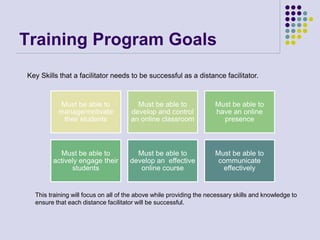
Training Program Goals
Key Skills that a facilitator needs to be successful as a distance facilitator.
Must be able to
manage/motivate
their students
Must be able to
develop and control
an online classroom
Must be able to
have an online
presence
Must be able to
actively engage their
students
Must be able to
develop an effective
online course
Must be able to
communicate
effectively
This training will focus on all of the above while providing the necessary skills and knowledge to
ensure that each distance facilitator will be successful.
Training Program Objectives
Program objectives
Learners will be able to provide constructive feedback
Learners will be introduced to different technologies
Learners will be able to actively engage their students
Learners will be able to have an online presence
Learners will be able to develop and maintain a learning community
Learners will better understand the concept of online learning
Learners will develop the skills necessary to be a online facilitator
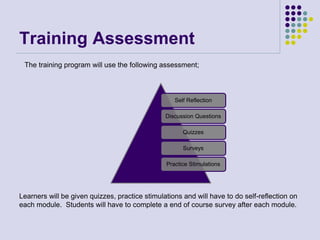
Training Assessment
The training program will use the following assessment;
Self Reflection
Discussion Questions
Quizzes
Surveys
Practice Stimulations
Learners will be given quizzes, practice stimulations and will have to do self-reflection on
each module. Students will have to complete a end of course survey after each module.
Module 1
Day 1
 Introduction
 Skills needed for effective distance learning facilitators
Please read
https://elearningindustry.com/top-5-online-learning-skills-online-instructors
 Theories of distance learning
 Theories foe engaging distance learners
Introduction
Assignment 1
Post an introduction/bio on the discussion board
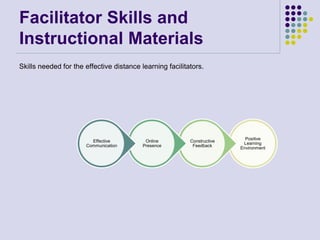
Facilitator Skills and
Instructional Materials
Skills needed for the effective distance learning facilitators.
Positive
Learning
Environment
Constructive
Feedback
Online
Presence
Effective
Communication
Skills Needed for Effective
Distance Learning Facilitators
There are several skills that an effective facilitator should have in order to be successful
in the online environment.
The two skills that stood out to me the most were;
ïŹ Effective Communication
ïŹ The Ability to Manage/Motivate Learners
Communication is key. In order to be an effective facilitator one must be able to
communicate and interact with his or her class. It is the job of the instructor to guide
discussions and ensure that students are understanding the materials presented to them.
Communication is what makes the course interesting. Feedback is given by the
instructor which helps enhance learning and sparks further discussion and class
interaction. The instructor plays a major role in the communication process by asking and
answering any questions that his or her students may have. According to Palloff and
Pratt (2011), the excellent online instructor is always active and engaged throughout the
course and makes time for their students.
Business skills tutorial: Effective
communication | lynda.com
https://youtu.be/zMUSEYR80E8
Please watch this video on Effective communication.
Once you have completed watching this video please logon to Lynda.com and find an
additional video on effective communication that will help your peers better understand
effective communication. Write down two important tips to share on the online discussion
forum that will help your peers become better communicators.
Facilitator Skills
Please answer the following questions and email to me at plvalentine@cox.net
1. How can an online instructor establish presence in the online community?
2. What can an online instructor do to motivate his or her learners?
3. Name one skill that is needed for an online instructor to communicate effectively?
Phases of Development for
Distance Learning Facilitators
There are five phases of online faculty development;
ïŹ Visitor – Faculty who has some idea of technology integration in traditional courses
and who has posted a syllabus, assignment or used e-mail to complete an
assignment
ïŹ Novice – Faculty who has never taught or taken an online course but who has used
some communications technologies to supplement face to face teaching
ïŹ Apprentice – Faculty who has taught an online course for one or two terms. They
have an understanding of the online environment
ïŹ Insider – Faculty that has taught more than two terms and are comfortable with the
online environment
ïŹ Master – Faculty that has taught multiple online courses and are skilled in online
course design. These instructors are very comfortable in the online environment
(Palloff and Pratt 2011).
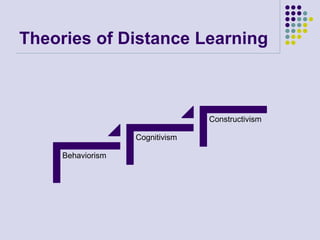
Theories of Distance Learning
Behaviorism
Cognitivism
Constructivism
Theories of Learning
YouTube Video
Behaviorism, Cognitivism, Constructivism & Learning and Instructional Theory
https://youtu.be/0YOqgXjynd0
* A Short Quiz will be given at the end of the video
Theories of Engaging Distance
Learners
ïŹ Make sure goals and objectives are clearly stated.
ïŹ Keep an online presence
ïŹ Make learning fun
ïŹ Instructor will get to know each student
ïŹ Give constructive feedback
ïŹ Engage your learners by providing them with the tools and the information that they
need to be successful
ïŹ Keep the discussions flowing
ïŹ Know your learning community
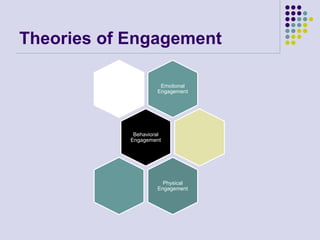
Theories of Engagement
Emotional
Engagement
Behavioral
Engagement
Physical
Engagement
Group Assignment
Write a 500 word paper on the theories of engagement and upload it to the group
assignment tab.
* Please logon to your learning team tab to see the members of your group
Module 2
Day 2
 Identify the goals and objectives of the mentoring program
 Guide to understanding the role of a mentor
https://www.thebalance.com/a-guide-to-understanding-the-role-of-a-mentor-2275318
 Management and Evaluation Programs for Facilitators
 Learning Platform
 Technology
Mentoring Goals & Objectives
ïŹ To help guide the new instructor to be successful
ïŹ To help train and develop the new online instructor
ïŹ To help the new online instructor to gain confidence
ïŹ To help the new online instructor to find different teaching strategies
ïŹ To listen
ïŹ To give guidance
ïŹ To be an outlet to help the new online instructor the tools that they need to help their
students
Criteria
ïŹ Have at least six years or more of online teaching experience
ïŹ Must have successfully taught four online classes
ïŹ Must be advanced with technology
Mentors
ïŹ A good mentor must have patience. The individual that you are mentoring may not
fully understand what and why you are having them do a certain activity or task. They
may not even know why they are interested in becoming an online instructor.
Therefore, the mentor has to show compassion and be patience with the mentee.
ïŹ In all things that we do we must have patience. Everyone is not born with this trait.
Patience is a learned behavior and is something that a good mentor has to have in
order to ensure that the person that they are mentoring is successful.
ïŹ A good mentor has to be caring in order to mentor others. They have to first care
about educating others and have the will to want to make sure that the world is
equipped with great educators. These mentors care about training instructors the
right way and always make sure that they have the tools that they need to be great.
ïŹ If the mentor does not care about the future of our educators he or she will not be a
good mentor.
Mentors
ïŹ A good mentor has to be knowledgeable in order to mentor others. He or she has to
be willing to share information with their mentee so that they can get the information
needed to be good online instructors. They should be willing to share contact
information with their mentors so that they can build relationships with others that can
help them. Also, they have to be willing to know who to call to get valuable
information that they may need to help others.
ïŹ The mentor should know everything possible about the subject that they are
mentoring in. It is important that if you are going to mentor someone, you should
have the knowledge needed to do so.
ïŹ A good mentor is a role model for others. They should carry themselves with pride
and confidence. They should lead by example by being organized and they should
know everything there is to know about their profession. They should be open and
honest with the person that they are mentoring. They should tell them the good and
the bad about the profession. A role model takes the time to listen and answer any
question or concerns that their mentor may have.
Mentors
ïŹ A role model is someone that we look up to. A good mentor is just that type of
person. He or she will ensure that their mentee is groomed and ready to be
successful as an online instructor.
ïŹ A good mentor must be reliable. They should make time to meet with their mentors
on a regular basis. They should call and check on their mentors to make sure that
they do not have any questions and are getting the information that they need to be
great. Mentors should make themselves available to assist their mentees when
needed. A good mentor always keeps their word and will do whatever it takes to help
his or her mentor.
ïŹ Being a reliable mentor plays a big part in making the person that you are mentoring
great. It lets them know that you are there to mold and guide them to be excellent
educators. They know that if they need you are only a phone call away
Activity on Mentors
Please complete the crossword puzzle on mentors and upload to your assignment tab.
Management and Evaluation
Programs for facilitators
Please read article about mentors
http://files.eric.ed.gov/fulltext/ED509629.pdf
‱ All new mentors must go through a six week online training program to ensure that he
or she is prepared to mentor
‱ In order to be active mentor one has to take 2 hours of online training to keep up with
the latest information and technology
Challenges
ïŹ Ensuring that online instructors are properly trained
ïŹ Making sure that there is a good match between mentor and mentee
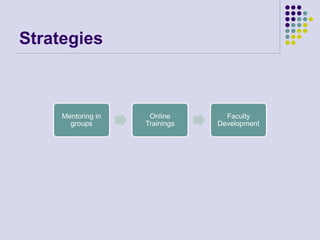
Strategies
Mentoring in
groups
Online
Trainings
Faculty
Development
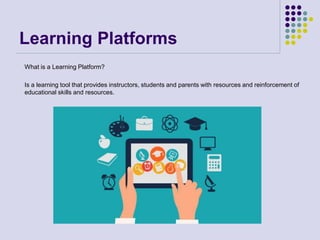
Learning Platforms
What is a Learning Platform?
Is a learning tool that provides instructors, students and parents with resources and reinforcement of
educational skills and resources.
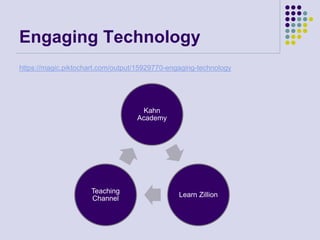
Engaging Technology
https://magic.piktochart.com/output/15929770-engaging-technology
Kahn
Academy
Learn Zillion
Teaching
Channel
Assignment
Research one learning platform and start an online discussion about it with your peers.
Module 3
Day 3
 Tools for Project-Based Learning
 Distance Learners
 Synchronous & Asynchronous
 Classroom Management Issues
Tools for Project Based
Learning
https://prezi.com/uq-o6tzft-q1/top-web-tools-for-project-based-learning/
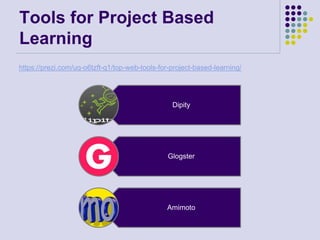
Dipity
Glogster
Amimoto
Tools for Collaboration
https://magic.piktochart.com/output/16516383-social-networking
Google
Classroom
Facebook
Distance Learner
ïŹ Non-Traditional
ïŹ Individuals who are interested in advancing in their career
ïŹ Individuals with families and who work fulltime
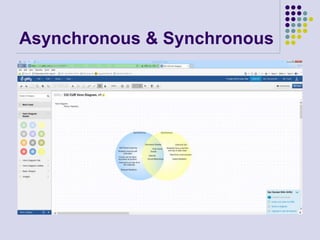
Asynchronous & Synchronous
Quiz
A quiz will be given on what we have learned thus far.
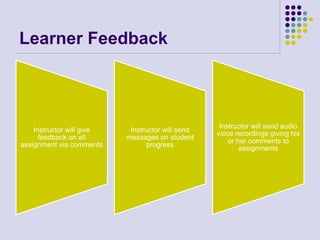
Learner Feedback
Instructor will give
feedback on all
assignment via comments
Instructor will send
messages on student
progress
Instructor will send audio
voice recordings giving his
or her comments to
assignments
Challenging
ïŹ Lack of student participation
ïŹ Individuals that may post negative or inappropriate feedback in discussion forum
ïŹ Making sure that all students are clear of what the rules and regulations are for the
class
ïŹ Ensuring that everyone is clear/sure of their expectations
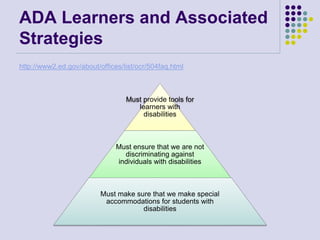
ADA Learners and Associated
Strategies
http://www2.ed.gov/about/offices/list/ocr/504faq.html
Must provide tools for
learners with
disabilities
Must ensure that we are not
discriminating against
individuals with disabilities
Must make sure that we make special
accommodations for students with
disabilities
End of Course Assessment
Learner will be given a end of course test followed by a online survey of the class
Thank You
It has been a pleasure being your online facilitator for this class. I hope that the
information provided was beneficial to you. Thank you for making this class a enjoyable
experience.
Penny L. Valentine
References
eLearning Industry. (2016).
Retrieved from https://elearningindustry.com/top-5-online-learning-skills-online-instructors
Haythornthwaite, C., & Andrews, R. (2011). E-learning theory and practice . Los Angeles, CA: Sage
Publications Ltd.
Khan academy. (2016). Retrieved from https://www.khanacademy.org/
Learn zillion. (2016). Retrieved from https://learnzillion.com/
Palloff, R., & Pratt, K. (2011).
The excellent online instructor: Strategies for professional development . San Francisco, CA: Jossey-Bass.
Reilly, Janet Resop et al. "Faculty Development for E-Learning: A Multi-Campus Community of Practice (COP)
Approach." Journal of Asynchronous Learning Networks 16.2 (2012): 99-110.
Teaching channel. (2016). Retrieved from https://www.teachingchannel.org
Valentine, P. (2016). Facilitator Training Program. Unpublished paper, CUR 532-Faciliting Online Learning,
University of Phoenix, Phoenix, AZ

Facilitator training program

  • 1.
    Facilitator Training Program Penny L.Valentine October 3, 2016 CUR 532 Garth Beerman
  • 2.
    Welcome Hi, my nameis Penny L. Valentine and I will be your instructor for this online training program. I would like to welcome each and everyone of you to my class and I look forward to facilitating and sharing information to help you develop the skills that you need to teach others to be successful in the online environment. This is a asynchronous training program that will be exclusively online for the course of three days. The training will be broken down into three parts over the course of the three day period. I will be here to assist you in any way possible. It is my job to make sure that you get the information that you need to be successful. I will be monitoring your online progress several times during the day. If you should have any questions or concerns, please feel free to contact me by email at plvalentine@cox.net or by phone at (225) 571-6224 between the hours of 9:00 am – 8:30 pm EST.
  • 3.
    Training Program Audience Thisasynchronous program will be taught over the course of three days and was designed for new online facilitators that have never taught a traditional or online course.
  • 4.
    Course Requirements ïŹ Mustbe 24 years of age ïŹ Must have a Bachelors degree ïŹ No teaching experience is necessary ïŹ Must have basic knowledge in the use of technology ïŹ Learners must participate in online discussions ïŹ Read and respond to their peers post
  • 5.
    Training Program Goals KeySkills that a facilitator needs to be successful as a distance facilitator. Must be able to manage/motivate their students Must be able to develop and control an online classroom Must be able to have an online presence Must be able to actively engage their students Must be able to develop an effective online course Must be able to communicate effectively This training will focus on all of the above while providing the necessary skills and knowledge to ensure that each distance facilitator will be successful.
  • 6.
    Training Program Objectives Programobjectives Learners will be able to provide constructive feedback Learners will be introduced to different technologies Learners will be able to actively engage their students Learners will be able to have an online presence Learners will be able to develop and maintain a learning community Learners will better understand the concept of online learning Learners will develop the skills necessary to be a online facilitator
  • 7.
    Training Assessment The trainingprogram will use the following assessment; Self Reflection Discussion Questions Quizzes Surveys Practice Stimulations Learners will be given quizzes, practice stimulations and will have to do self-reflection on each module. Students will have to complete a end of course survey after each module.
  • 8.
  • 9.
    Day 1  Introduction Skills needed for effective distance learning facilitators Please read https://elearningindustry.com/top-5-online-learning-skills-online-instructors  Theories of distance learning  Theories foe engaging distance learners
  • 10.
    Introduction Assignment 1 Post anintroduction/bio on the discussion board
  • 11.
    Facilitator Skills and InstructionalMaterials Skills needed for the effective distance learning facilitators. Positive Learning Environment Constructive Feedback Online Presence Effective Communication
  • 12.
    Skills Needed forEffective Distance Learning Facilitators There are several skills that an effective facilitator should have in order to be successful in the online environment. The two skills that stood out to me the most were; ïŹ Effective Communication ïŹ The Ability to Manage/Motivate Learners Communication is key. In order to be an effective facilitator one must be able to communicate and interact with his or her class. It is the job of the instructor to guide discussions and ensure that students are understanding the materials presented to them. Communication is what makes the course interesting. Feedback is given by the instructor which helps enhance learning and sparks further discussion and class interaction. The instructor plays a major role in the communication process by asking and answering any questions that his or her students may have. According to Palloff and Pratt (2011), the excellent online instructor is always active and engaged throughout the course and makes time for their students.
  • 13.
    Business skills tutorial:Effective communication | lynda.com https://youtu.be/zMUSEYR80E8 Please watch this video on Effective communication. Once you have completed watching this video please logon to Lynda.com and find an additional video on effective communication that will help your peers better understand effective communication. Write down two important tips to share on the online discussion forum that will help your peers become better communicators.
  • 14.
    Facilitator Skills Please answerthe following questions and email to me at plvalentine@cox.net 1. How can an online instructor establish presence in the online community? 2. What can an online instructor do to motivate his or her learners? 3. Name one skill that is needed for an online instructor to communicate effectively?
  • 15.
    Phases of Developmentfor Distance Learning Facilitators There are five phases of online faculty development; ïŹ Visitor – Faculty who has some idea of technology integration in traditional courses and who has posted a syllabus, assignment or used e-mail to complete an assignment ïŹ Novice – Faculty who has never taught or taken an online course but who has used some communications technologies to supplement face to face teaching ïŹ Apprentice – Faculty who has taught an online course for one or two terms. They have an understanding of the online environment ïŹ Insider – Faculty that has taught more than two terms and are comfortable with the online environment ïŹ Master – Faculty that has taught multiple online courses and are skilled in online course design. These instructors are very comfortable in the online environment (Palloff and Pratt 2011).
  • 16.
    Theories of DistanceLearning Behaviorism Cognitivism Constructivism
  • 17.
    Theories of Learning YouTubeVideo Behaviorism, Cognitivism, Constructivism & Learning and Instructional Theory https://youtu.be/0YOqgXjynd0 * A Short Quiz will be given at the end of the video
  • 18.
    Theories of EngagingDistance Learners ïŹ Make sure goals and objectives are clearly stated. ïŹ Keep an online presence ïŹ Make learning fun ïŹ Instructor will get to know each student ïŹ Give constructive feedback ïŹ Engage your learners by providing them with the tools and the information that they need to be successful ïŹ Keep the discussions flowing ïŹ Know your learning community
  • 19.
  • 20.
    Group Assignment Write a500 word paper on the theories of engagement and upload it to the group assignment tab. * Please logon to your learning team tab to see the members of your group
  • 21.
  • 22.
    Day 2  Identifythe goals and objectives of the mentoring program  Guide to understanding the role of a mentor https://www.thebalance.com/a-guide-to-understanding-the-role-of-a-mentor-2275318  Management and Evaluation Programs for Facilitators  Learning Platform  Technology
  • 23.
    Mentoring Goals &Objectives ïŹ To help guide the new instructor to be successful ïŹ To help train and develop the new online instructor ïŹ To help the new online instructor to gain confidence ïŹ To help the new online instructor to find different teaching strategies ïŹ To listen ïŹ To give guidance ïŹ To be an outlet to help the new online instructor the tools that they need to help their students
  • 24.
    Criteria ïŹ Have atleast six years or more of online teaching experience ïŹ Must have successfully taught four online classes ïŹ Must be advanced with technology
  • 25.
    Mentors ïŹ A goodmentor must have patience. The individual that you are mentoring may not fully understand what and why you are having them do a certain activity or task. They may not even know why they are interested in becoming an online instructor. Therefore, the mentor has to show compassion and be patience with the mentee. ïŹ In all things that we do we must have patience. Everyone is not born with this trait. Patience is a learned behavior and is something that a good mentor has to have in order to ensure that the person that they are mentoring is successful. ïŹ A good mentor has to be caring in order to mentor others. They have to first care about educating others and have the will to want to make sure that the world is equipped with great educators. These mentors care about training instructors the right way and always make sure that they have the tools that they need to be great. ïŹ If the mentor does not care about the future of our educators he or she will not be a good mentor.
  • 26.
    Mentors ïŹ A goodmentor has to be knowledgeable in order to mentor others. He or she has to be willing to share information with their mentee so that they can get the information needed to be good online instructors. They should be willing to share contact information with their mentors so that they can build relationships with others that can help them. Also, they have to be willing to know who to call to get valuable information that they may need to help others. ïŹ The mentor should know everything possible about the subject that they are mentoring in. It is important that if you are going to mentor someone, you should have the knowledge needed to do so. ïŹ A good mentor is a role model for others. They should carry themselves with pride and confidence. They should lead by example by being organized and they should know everything there is to know about their profession. They should be open and honest with the person that they are mentoring. They should tell them the good and the bad about the profession. A role model takes the time to listen and answer any question or concerns that their mentor may have.
  • 27.
    Mentors ïŹ A rolemodel is someone that we look up to. A good mentor is just that type of person. He or she will ensure that their mentee is groomed and ready to be successful as an online instructor. ïŹ A good mentor must be reliable. They should make time to meet with their mentors on a regular basis. They should call and check on their mentors to make sure that they do not have any questions and are getting the information that they need to be great. Mentors should make themselves available to assist their mentees when needed. A good mentor always keeps their word and will do whatever it takes to help his or her mentor. ïŹ Being a reliable mentor plays a big part in making the person that you are mentoring great. It lets them know that you are there to mold and guide them to be excellent educators. They know that if they need you are only a phone call away
  • 28.
    Activity on Mentors Pleasecomplete the crossword puzzle on mentors and upload to your assignment tab.
  • 29.
    Management and Evaluation Programsfor facilitators Please read article about mentors http://files.eric.ed.gov/fulltext/ED509629.pdf ‱ All new mentors must go through a six week online training program to ensure that he or she is prepared to mentor ‱ In order to be active mentor one has to take 2 hours of online training to keep up with the latest information and technology
  • 30.
    Challenges ïŹ Ensuring thatonline instructors are properly trained ïŹ Making sure that there is a good match between mentor and mentee
  • 31.
  • 32.
    Learning Platforms What isa Learning Platform? Is a learning tool that provides instructors, students and parents with resources and reinforcement of educational skills and resources.
  • 33.
  • 34.
    Assignment Research one learningplatform and start an online discussion about it with your peers.
  • 35.
  • 36.
    Day 3  Toolsfor Project-Based Learning  Distance Learners  Synchronous & Asynchronous  Classroom Management Issues
  • 37.
    Tools for ProjectBased Learning https://prezi.com/uq-o6tzft-q1/top-web-tools-for-project-based-learning/ Dipity Glogster Amimoto
  • 38.
  • 39.
    Distance Learner ïŹ Non-Traditional ïŹIndividuals who are interested in advancing in their career ïŹ Individuals with families and who work fulltime
  • 40.
  • 41.
    Quiz A quiz willbe given on what we have learned thus far.
  • 42.
    Learner Feedback Instructor willgive feedback on all assignment via comments Instructor will send messages on student progress Instructor will send audio voice recordings giving his or her comments to assignments
  • 43.
    Challenging ïŹ Lack ofstudent participation ïŹ Individuals that may post negative or inappropriate feedback in discussion forum ïŹ Making sure that all students are clear of what the rules and regulations are for the class ïŹ Ensuring that everyone is clear/sure of their expectations
  • 44.
    ADA Learners andAssociated Strategies http://www2.ed.gov/about/offices/list/ocr/504faq.html Must provide tools for learners with disabilities Must ensure that we are not discriminating against individuals with disabilities Must make sure that we make special accommodations for students with disabilities
  • 45.
    End of CourseAssessment Learner will be given a end of course test followed by a online survey of the class
  • 46.
    Thank You It hasbeen a pleasure being your online facilitator for this class. I hope that the information provided was beneficial to you. Thank you for making this class a enjoyable experience. Penny L. Valentine
  • 47.
    References eLearning Industry. (2016). Retrievedfrom https://elearningindustry.com/top-5-online-learning-skills-online-instructors Haythornthwaite, C., & Andrews, R. (2011). E-learning theory and practice . Los Angeles, CA: Sage Publications Ltd. Khan academy. (2016). Retrieved from https://www.khanacademy.org/ Learn zillion. (2016). Retrieved from https://learnzillion.com/ Palloff, R., & Pratt, K. (2011). The excellent online instructor: Strategies for professional development . San Francisco, CA: Jossey-Bass. Reilly, Janet Resop et al. "Faculty Development for E-Learning: A Multi-Campus Community of Practice (COP) Approach." Journal of Asynchronous Learning Networks 16.2 (2012): 99-110. Teaching channel. (2016). Retrieved from https://www.teachingchannel.org Valentine, P. (2016). Facilitator Training Program. Unpublished paper, CUR 532-Faciliting Online Learning, University of Phoenix, Phoenix, AZ