COMPENSATION MANAGEMENT
(or Reward Management
or

Compensation & Benefit Management )

Session on 01

MBA
PART 1 THE FUNDAMENTALS OF REWARD
MANAGEMENT
PART 2 THE CONCEPTUAL FRAMEWORK
PART 3 ESTABLISHING JOB VALUES AND
RELATIVITIES

PART 4 GRADE AND PAY STRUCTURES
PART 5 REWARDING AND REVIEWING
CONTRIBUTION AND PERFORMANCE
PART 6 REWARD MANAGEMENT FOR SPECIAL
GROUPS
PART 7 EMPLOYEE BENEFITS AND PENSION SCHEMES
REWARD MANAGEMENT PROCEDURES
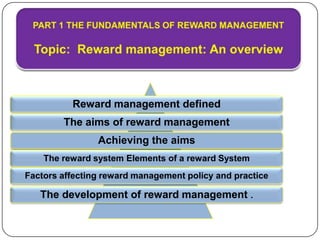
Reward management defined
The aims of reward management
Achieving the aims
The reward system Elements of a reward System
Factors affecting reward management policy and practice

The development of reward management .
Question??????
Dear students do you know?
WHAT IS REWARD MANAGEMENT ?
Or
Compensation & Benefit Management ?
 Compensation?
 Benefit ?
 Management?
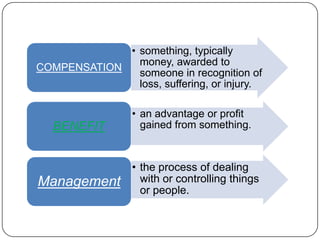
• something, typically
money, awarded to
COMPENSATION
someone in recognition of
loss, suffering, or injury.

BENEFIT

Management

• an advantage or profit
gained from something.

• the process of dealing
with or controlling things
or people.
REWARD MANAGEMENT
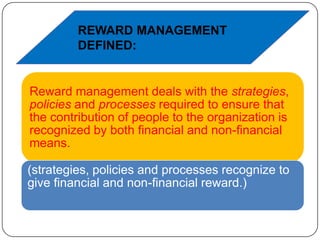
DEFINED:

Reward management deals with the strategies,
policies and processes required to ensure that
the contribution of people to the organization is
recognized by both financial and non-financial
means.
(strategies, policies and processes recognize to
give financial and non-financial reward.)
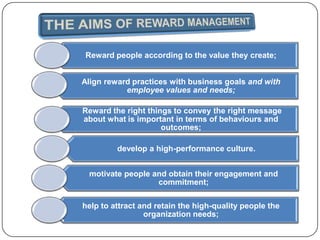
Reward people according to the value they create;
Align reward practices with business goals and with
employee values and needs;
Reward the right things to convey the right message
about what is important in terms of behaviours and
outcomes;
develop a high-performance culture.
motivate people and obtain their engagement and
commitment;
help to attract and retain the high-quality people the
organization needs;
ACHIEVING THE AIMS

The aims of reward management
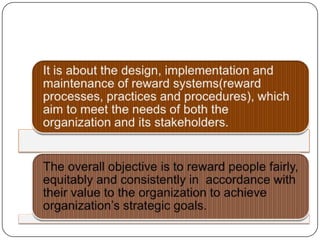
are achieved by developing and
implementing strategies, policies,
processes and practices.
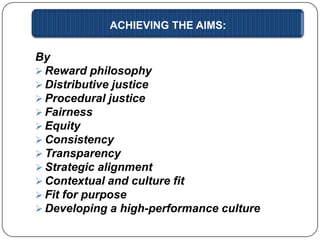
ACHIEVING THE AIMS:

By
 Reward philosophy
 Distributive justice
 Procedural justice
 Fairness
 Equity
 Consistency
 Transparency
 Strategic alignment
 Contextual and culture fit
 Fit for purpose
 Developing a high-performance culture
Reward philosophy
 Reward management is based on a set of beliefs

and guiding principles.
Reward management is based on a well-articulated
philosophy – a set of beliefs and guiding principles that are
consistent with the values of the organization and help to
enact them.
HR initiatives designed to achieve the motivation,
commitment, engagement and development of employees
at long term .
Distributive justice

Distributive justice refers to how rewards are
provided to people
(They receive what was promised to them and
that they get what they need.)
Procedural justice refers to the
ways in which managerial
decisions are made and reward
policies are put into practice.
Fairness
A fair reward system is one
that operates in accordance
with the principles of
distributive and procedural
justice. It also conforms to the
‘felt-fair’ principle formulated
by Eliot Jaques (3). This
states that pay systems will be
fair if they are felt to be fair.
Equity

Equity is achieved
when people are
rewarded appropriately
in relation to others
within the organization.
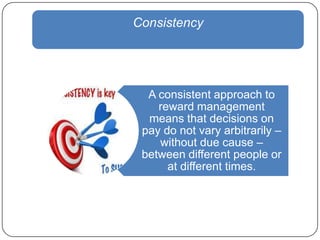
Consistency

A consistent approach to
reward management
means that decisions on
pay do not vary arbitrarily –
without due cause –
between different people or
at different times.
Transparency
Transparency exists
when people
understand how
reward processes
function and
Strategic alignment

The strategic alignment of
reward practices ensures that
reward initiatives are planned by
reference to the requirements of
the business strategy and are
designed to support the
achievement of business goals.
Contextual and culture fit
The design of reward
processes should be
governed by the context
.either university level
or college etc.
Fit for purpose

The formulation of reward
strategy and the design of the
reward system should be based
on an understanding of the
objectives of reward management
and should be developed to
achieve that purpose.
Developing a high-performance culture

A high-performance
culture is one in which
people are aware of the
need to perform well
and behave accordingly
in order to meet or
exceed expectations.
THE REWARD SYSTEM

What is the
reward
system?????
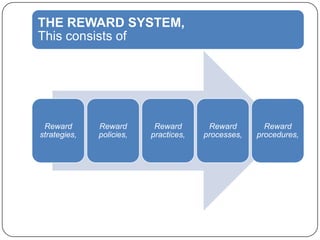
THE REWARD SYSTEM,
This consists of

Reward
strategies,

Reward
policies,

Reward
practices,

Reward
processes,

Reward
procedures,
REWARD STRATEGIES,

Reward
strategies

Are set out what the
organization intends
to do in the longer
term
to develop and
implement reward
policies, practices,
processes and
procedures
that will further the
achievement of its
business goals.

For example, an
organization may
have a strategy to
maintain
competitive rates
of pay.
Reward policies,

Reward policies, which set guidelines for decision
making and action.
For example, an organization may have a policy that sets the
levels of pay in the organization compared with median market
rates.
REWARD PRACTICES,

It consist of the grade and pay structures,
techniques such as job evaluation, and schemes
such as contingent pay used to implement reward
strategy and policy.

For example, the policy on pay levels will lead to
the practice of collecting and analyzing market
rate data, and making pay adjustments that reflect
market rates of increase.
Reward processes,

Reward processes, which consist of
the ways in which policies are
implemented and practices carried
out,
for example the way in which the outcomes of
surveys are applied and how managers
manage the pay adjustment and review
process.
REWARD PROCEDURES,

 Reward procedures, which are operated in order

to maintain the system and to ensure that it
operates efficiently and flexibly and provides
value for money.
 For example, a procedure will be used for

conducting the annual pay review.
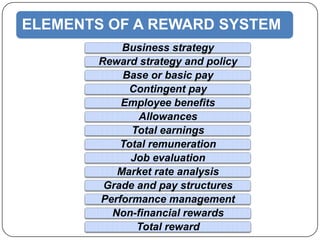
ELEMENTS OF A REWARD SYSTEM
Business strategy
Reward strategy and policy
Base or basic pay
Contingent pay
Employee benefits
Allowances
Total earnings
Total remuneration
Job evaluation
Market rate analysis
Grade and pay structures
Performance management
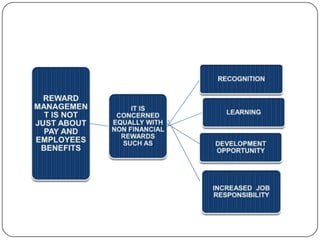
Non-financial rewards
Total reward
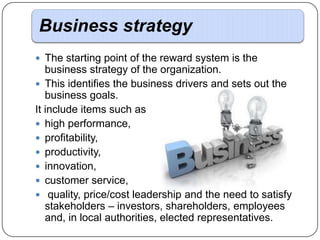
Business strategy
 The starting point of the reward system is the

business strategy of the organization.
 This identifies the business drivers and sets out the
business goals.
It include items such as
 high performance,
 profitability,
 productivity,
 innovation,
 customer service,
 quality, price/cost leadership and the need to satisfy
stakeholders – investors, shareholders, employees
and, in local authorities, elected representatives.
Reward strategy and policy
 The reward strategy flows from an analysis of the

business drivers
 The reward strategy will define longer-term
intentions in such areas as pay structures,
contingent pay, employee benefits, steps to
increase engagement and commitment and
adopting a total reward approach.
Base or basic pay
 The base rate is the amount of pay (the fixed

salary or wage) that constitutes the rate for the
job.
 It may be varied according to the grade of the job
or, for shop floor workers, the level of skill
required.
Contingent pay
Additional financial
rewards may be
provided that are
related to performance,
competence,
contribution, skill or
experience.
Employee benefits
 Employee benefits include
 pensions,
 sick pay,
 insurance cover,
 company cars and a number of other ‘bonus’.

 They consist of elements of remuneration

additional to the various forms of cash pay and
also include provisions for employees that are not
strictly remuneration, such as annual holidays
Allowances
 Allowances are paid in addition to basic pay for

special circumstances (e.g. living in London) or
features of employment (e.g. working unsocial
hours).
Total earnings
 Total earnings (financial rewards) consist of the

value of all cash payments
(base pay, contingent pay and allowances, i.e.
total earnings).
Total remuneration
 Total remuneration consists of the financial

rewards represented by total earnings plus the
value of the benefits received by employees.
Job evaluation
 Job evaluation is a systematic process for

defining the relative worth or size of jobs within an
organization in order to establish internal
relativities and provide the basis for designing an
equitable grade structure, grading jobs in the
structure and managing relativities.
Market rate analysis
 Market rate analysis is the process of identifying

the rates of pay in the labour market for
comparable jobs to inform decisions on levels of
pay within the organization and on pay structures.
Grade and pay structures
 Jobs may be placed in a graded structure

according to their relative size. In such a
structure, pay is influenced by market rates, and
the pay ranges attached to grades provide scope
for pay progression based on performance,
competence, contribution or service.
 Define individual performance and contribution

expectations, assess performance against those
expectations, provide for regular constructive
feedback, and result in agreed plans for
performance improvement, learning and personal
development.
Non-financial rewards
 Non-financial rewards do not involve any direct

payments and often arise from the work itself,
for example







achievement,
autonomy,
recognition,
scope to use and develop skills,
training,
career development opportunities and high-quality
leadership.
Total reward
Total reward is the
combination of financial
and non-financial
rewards available to
employees
FACTORS AFFECTING REWARD MANAGEMENT
POLICY AND PRACTICE

These consist of contextual factors and
conceptual factors
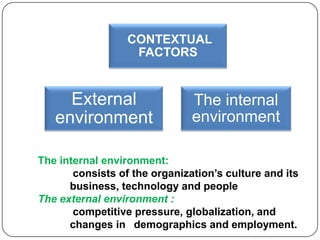
CONTEXTUAL
FACTORS

External
environment

The internal
environment

The internal environment:
consists of the organization’s culture and its
business, technology and people
The external environment :
competitive pressure, globalization, and
changes in demographics and employment.
conceptual factors
 Are relating to theories and beliefs about
 strategic management,
 total reward,
 human capital management,
 the factors affecting pay levels,

 motivation,
 engagement,
 commitment and the psychological contract.
COMPENSATION MANAGEMENT
(or Reward Management
Compensation & Benefit Management )

Session on 02

MBA

Compensation managt 01 session.

  • 1.
    COMPENSATION MANAGEMENT (or RewardManagement or Compensation & Benefit Management ) Session on 01 MBA
  • 2.
    PART 1 THEFUNDAMENTALS OF REWARD MANAGEMENT PART 2 THE CONCEPTUAL FRAMEWORK PART 3 ESTABLISHING JOB VALUES AND RELATIVITIES PART 4 GRADE AND PAY STRUCTURES PART 5 REWARDING AND REVIEWING CONTRIBUTION AND PERFORMANCE PART 6 REWARD MANAGEMENT FOR SPECIAL GROUPS PART 7 EMPLOYEE BENEFITS AND PENSION SCHEMES REWARD MANAGEMENT PROCEDURES
  • 3.
    Reward management defined Theaims of reward management Achieving the aims The reward system Elements of a reward System Factors affecting reward management policy and practice The development of reward management .
  • 4.
    Question?????? Dear students doyou know? WHAT IS REWARD MANAGEMENT ? Or Compensation & Benefit Management ?
  • 5.
  • 6.
    • something, typically money,awarded to COMPENSATION someone in recognition of loss, suffering, or injury. BENEFIT Management • an advantage or profit gained from something. • the process of dealing with or controlling things or people.
  • 7.
    REWARD MANAGEMENT DEFINED: Reward managementdeals with the strategies, policies and processes required to ensure that the contribution of people to the organization is recognized by both financial and non-financial means. (strategies, policies and processes recognize to give financial and non-financial reward.)
  • 10.
    Reward people accordingto the value they create; Align reward practices with business goals and with employee values and needs; Reward the right things to convey the right message about what is important in terms of behaviours and outcomes; develop a high-performance culture. motivate people and obtain their engagement and commitment; help to attract and retain the high-quality people the organization needs;
  • 11.
    ACHIEVING THE AIMS Theaims of reward management are achieved by developing and implementing strategies, policies, processes and practices.
  • 12.
    ACHIEVING THE AIMS: By Reward philosophy  Distributive justice  Procedural justice  Fairness  Equity  Consistency  Transparency  Strategic alignment  Contextual and culture fit  Fit for purpose  Developing a high-performance culture
  • 13.
    Reward philosophy  Rewardmanagement is based on a set of beliefs and guiding principles. Reward management is based on a well-articulated philosophy – a set of beliefs and guiding principles that are consistent with the values of the organization and help to enact them. HR initiatives designed to achieve the motivation, commitment, engagement and development of employees at long term .
  • 14.
    Distributive justice Distributive justicerefers to how rewards are provided to people (They receive what was promised to them and that they get what they need.)
  • 15.
    Procedural justice refersto the ways in which managerial decisions are made and reward policies are put into practice.
  • 16.
    Fairness A fair rewardsystem is one that operates in accordance with the principles of distributive and procedural justice. It also conforms to the ‘felt-fair’ principle formulated by Eliot Jaques (3). This states that pay systems will be fair if they are felt to be fair.
  • 18.
    Equity Equity is achieved whenpeople are rewarded appropriately in relation to others within the organization.
  • 19.
    Consistency A consistent approachto reward management means that decisions on pay do not vary arbitrarily – without due cause – between different people or at different times.
  • 20.
  • 21.
    Strategic alignment The strategicalignment of reward practices ensures that reward initiatives are planned by reference to the requirements of the business strategy and are designed to support the achievement of business goals.
  • 22.
    Contextual and culturefit The design of reward processes should be governed by the context .either university level or college etc.
  • 23.
    Fit for purpose Theformulation of reward strategy and the design of the reward system should be based on an understanding of the objectives of reward management and should be developed to achieve that purpose.
  • 24.
    Developing a high-performanceculture A high-performance culture is one in which people are aware of the need to perform well and behave accordingly in order to meet or exceed expectations.
  • 25.
    THE REWARD SYSTEM Whatis the reward system?????
  • 26.
    THE REWARD SYSTEM, Thisconsists of Reward strategies, Reward policies, Reward practices, Reward processes, Reward procedures,
  • 27.
    REWARD STRATEGIES, Reward strategies Are setout what the organization intends to do in the longer term to develop and implement reward policies, practices, processes and procedures that will further the achievement of its business goals. For example, an organization may have a strategy to maintain competitive rates of pay.
  • 28.
    Reward policies, Reward policies,which set guidelines for decision making and action. For example, an organization may have a policy that sets the levels of pay in the organization compared with median market rates.
  • 29.
    REWARD PRACTICES, It consistof the grade and pay structures, techniques such as job evaluation, and schemes such as contingent pay used to implement reward strategy and policy. For example, the policy on pay levels will lead to the practice of collecting and analyzing market rate data, and making pay adjustments that reflect market rates of increase.
  • 30.
    Reward processes, Reward processes,which consist of the ways in which policies are implemented and practices carried out, for example the way in which the outcomes of surveys are applied and how managers manage the pay adjustment and review process.
  • 31.
    REWARD PROCEDURES,  Rewardprocedures, which are operated in order to maintain the system and to ensure that it operates efficiently and flexibly and provides value for money.  For example, a procedure will be used for conducting the annual pay review.
  • 32.
    ELEMENTS OF AREWARD SYSTEM Business strategy Reward strategy and policy Base or basic pay Contingent pay Employee benefits Allowances Total earnings Total remuneration Job evaluation Market rate analysis Grade and pay structures Performance management Non-financial rewards Total reward
  • 33.
    Business strategy  Thestarting point of the reward system is the business strategy of the organization.  This identifies the business drivers and sets out the business goals. It include items such as  high performance,  profitability,  productivity,  innovation,  customer service,  quality, price/cost leadership and the need to satisfy stakeholders – investors, shareholders, employees and, in local authorities, elected representatives.
  • 34.
    Reward strategy andpolicy  The reward strategy flows from an analysis of the business drivers  The reward strategy will define longer-term intentions in such areas as pay structures, contingent pay, employee benefits, steps to increase engagement and commitment and adopting a total reward approach.
  • 35.
    Base or basicpay  The base rate is the amount of pay (the fixed salary or wage) that constitutes the rate for the job.  It may be varied according to the grade of the job or, for shop floor workers, the level of skill required.
  • 36.
    Contingent pay Additional financial rewardsmay be provided that are related to performance, competence, contribution, skill or experience.
  • 37.
    Employee benefits  Employeebenefits include  pensions,  sick pay,  insurance cover,  company cars and a number of other ‘bonus’.  They consist of elements of remuneration additional to the various forms of cash pay and also include provisions for employees that are not strictly remuneration, such as annual holidays
  • 38.
    Allowances  Allowances arepaid in addition to basic pay for special circumstances (e.g. living in London) or features of employment (e.g. working unsocial hours).
  • 39.
    Total earnings  Totalearnings (financial rewards) consist of the value of all cash payments (base pay, contingent pay and allowances, i.e. total earnings).
  • 40.
    Total remuneration  Totalremuneration consists of the financial rewards represented by total earnings plus the value of the benefits received by employees.
  • 41.
    Job evaluation  Jobevaluation is a systematic process for defining the relative worth or size of jobs within an organization in order to establish internal relativities and provide the basis for designing an equitable grade structure, grading jobs in the structure and managing relativities.
  • 42.
    Market rate analysis Market rate analysis is the process of identifying the rates of pay in the labour market for comparable jobs to inform decisions on levels of pay within the organization and on pay structures.
  • 43.
    Grade and paystructures  Jobs may be placed in a graded structure according to their relative size. In such a structure, pay is influenced by market rates, and the pay ranges attached to grades provide scope for pay progression based on performance, competence, contribution or service.
  • 44.
     Define individualperformance and contribution expectations, assess performance against those expectations, provide for regular constructive feedback, and result in agreed plans for performance improvement, learning and personal development.
  • 45.
    Non-financial rewards  Non-financialrewards do not involve any direct payments and often arise from the work itself, for example       achievement, autonomy, recognition, scope to use and develop skills, training, career development opportunities and high-quality leadership.
  • 46.
    Total reward Total rewardis the combination of financial and non-financial rewards available to employees
  • 47.
    FACTORS AFFECTING REWARDMANAGEMENT POLICY AND PRACTICE These consist of contextual factors and conceptual factors
  • 48.
    CONTEXTUAL FACTORS External environment The internal environment The internalenvironment: consists of the organization’s culture and its business, technology and people The external environment : competitive pressure, globalization, and changes in demographics and employment.
  • 49.
    conceptual factors  Arerelating to theories and beliefs about  strategic management,  total reward,  human capital management,  the factors affecting pay levels,  motivation,  engagement,  commitment and the psychological contract.
  • 50.
    COMPENSATION MANAGEMENT (or RewardManagement Compensation & Benefit Management ) Session on 02 MBA