Audrey L Allen
CUR 532
October 3,2016
Garth Beerman
Facilitator Training Program
Option II
Asynchronous Learning
Welcome
Hello my name is Audrey L. Allen and I will be guiding you through this
Facilitator Training Program for “Skyview Airlines” new hire trainers.
This will be an Asynchronous Module Model. "The myth asserts that it is
easy to teach online—all one needs to do is to move exactly
what was being done in the face-to-face classroom into the online
classroom." (Palloff &
Pratt, 2011, Chapter 1,What are the characteristics of excellent online
teaching).
Effective Facilitators in a distance learning environment must possess
fundamental skills. Today the goal is to prepare you as an effective online
facilitator trainer by providing the knowledge and skills necessary to train
others. If you have any questions , feel free to ask at anytime throughout
the course.
NOTE: It is necessary that you the learner click on all provided links,
read PowerPoints, videos and articles.
Contact Information
for
Audrey L Allen
(Trainer)
• Phone: (315)516-2076
• Email: lanonadarling@email.phoenix.edu
• Gmail chat or video: justus2aa@gmail.com
Part I- Vital Information
• Training Program Audience
• Training Program Goals
• Training Program Objectives
• Summative Assessment of Trainee Learning
The Audience
 50 new asynchronous
Skyview Airlines instructors
 Corporate Flight Attendant
Trainer Team
Note: No prior distance learning education
Assumed Current Skill Set and
Experience of Trainees:
O Skill Set
Personalized computer skills to include Microsoft Office products and
particular skill required for equipment used in the airline industry
O Experience
At least three years of classroom training experience with little or no online
training instruction
O Current level of knowledge
Proficient in training techniques and most are SME (Subject Matter Expert)
in their field.
Upon completion of this course, trainers will be able to
facilitate an online course to support the training needs of
airline employees around the world.
:
Essential Skills Needed
 Establish Presence
 Facilitation
 Feedback
 Maintain a learning
community
(Palloff &Pratt, 2011)
https://daystead.wordpress.com/2012/04/25/
the-adaptable-teacher/
 After taking this course, trainers will be able to create and
maintain an online presence.
 After taking this course, trainers will be able to develop and
maintain facilitation and
feedback skills
 After taking this course, trainers will be able to establish and
become proficient in feedback skills
 After taking this course, trainers will be able to create and
maintain a learning community
Program Goals to Develop Distance
Learning Facilitator Skills Are:
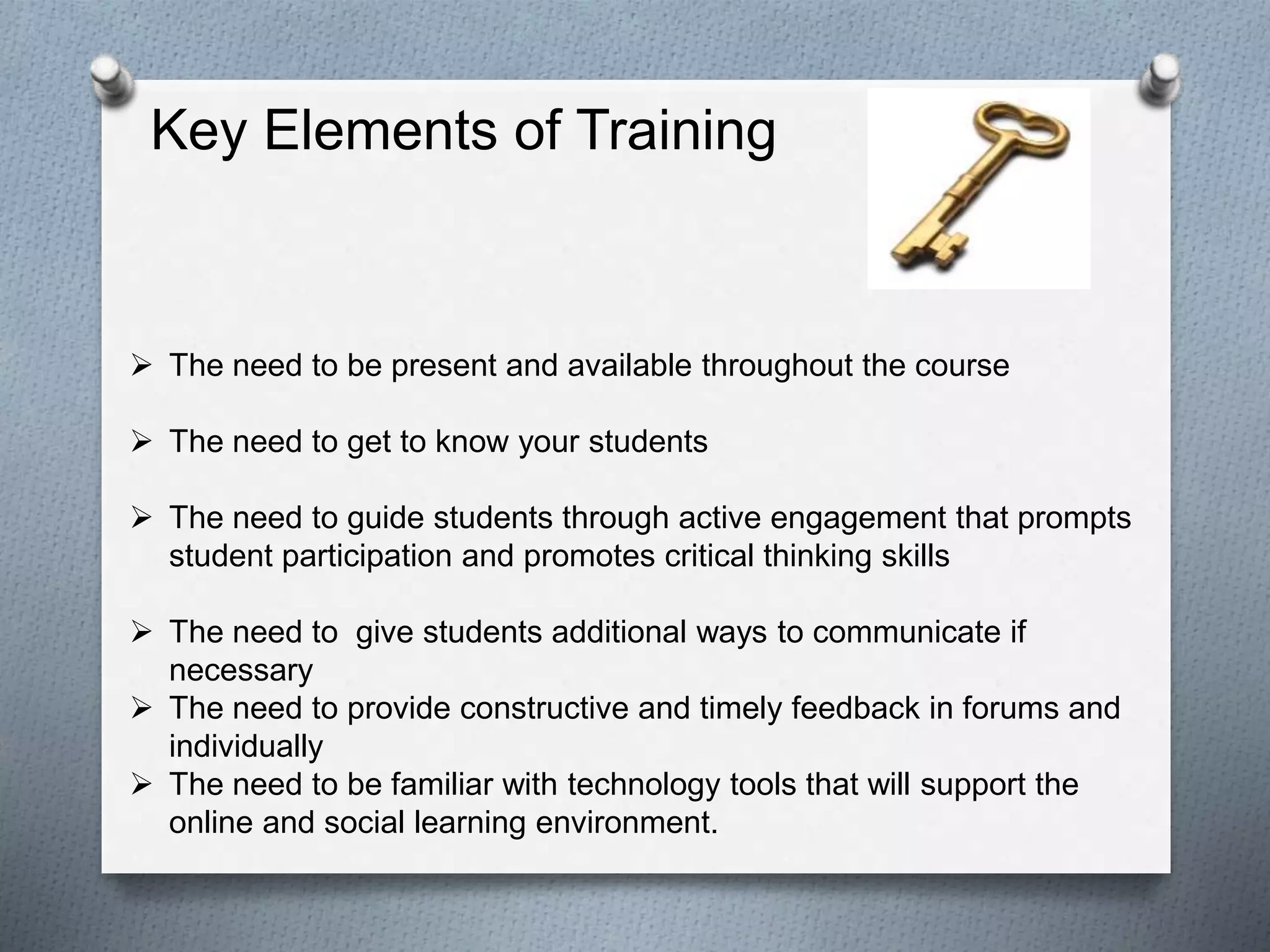
 The need to be present and available throughout the course
 The need to get to know your students
 The need to guide students through active engagement that prompts
student participation and promotes critical thinking skills
 The need to give students additional ways to communicate if
necessary
 The need to provide constructive and timely feedback in forums and
individually
 The need to be familiar with technology tools that will support the
online and social learning environment.
Key Elements of Training
Training Program
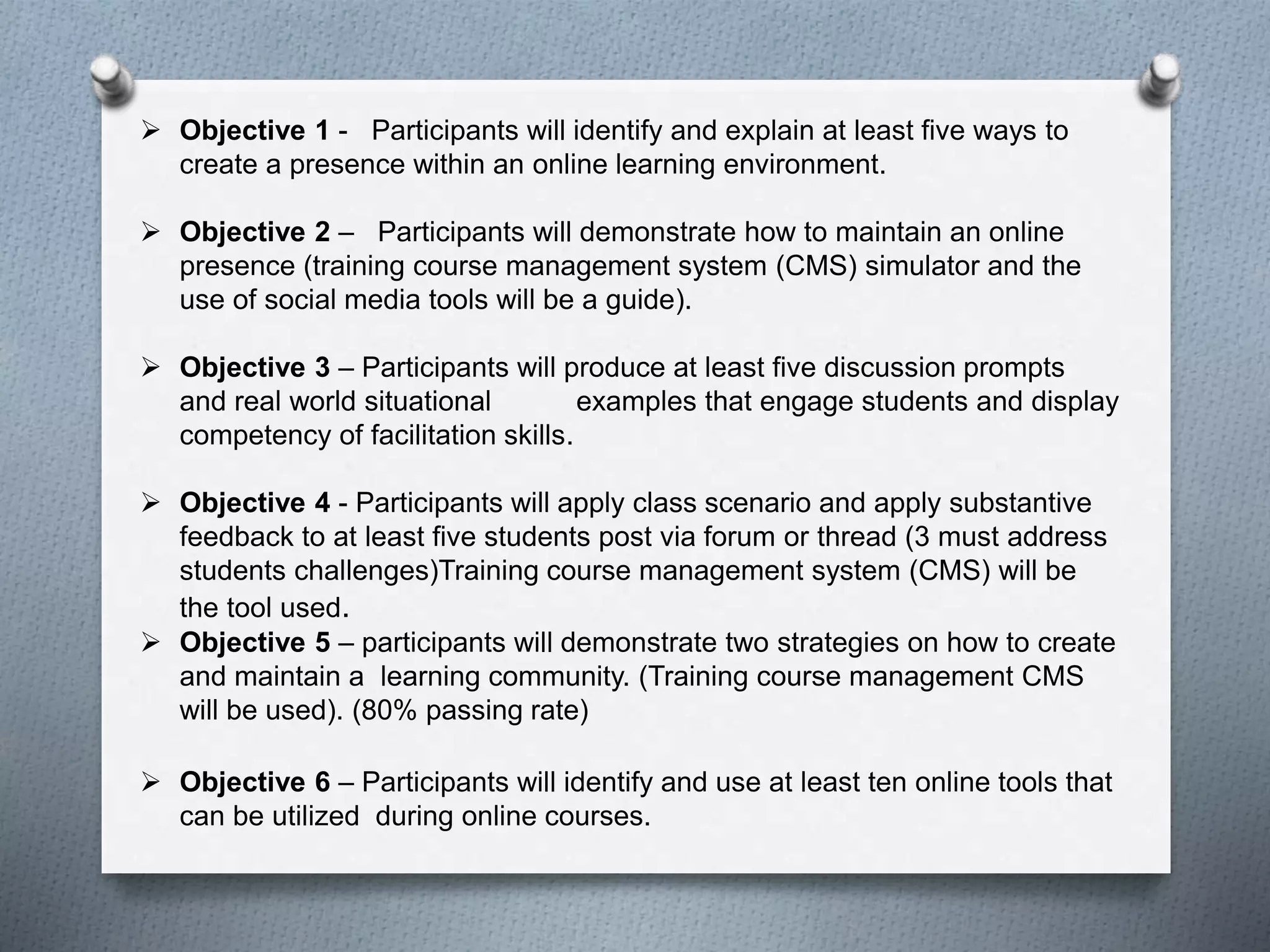
 Objective 1 - Participants will identify and explain at least five ways to
create a presence within an online learning environment.
 Objective 2 – Participants will demonstrate how to maintain an online
presence (training course management system (CMS) simulator and the
use of social media tools will be a guide).
 Objective 3 – Participants will produce at least five discussion prompts
and real world situational examples that engage students and display
competency of facilitation skills.
 Objective 4 - Participants will apply class scenario and apply substantive
feedback to at least five students post via forum or thread (3 must address
students challenges)Training course management system (CMS) will be
the tool used.
 Objective 5 – participants will demonstrate two strategies on how to create
and maintain a learning community. (Training course management CMS
will be used). (80% passing rate)
 Objective 6 – Participants will identify and use at least ten online tools that
can be utilized during online courses.
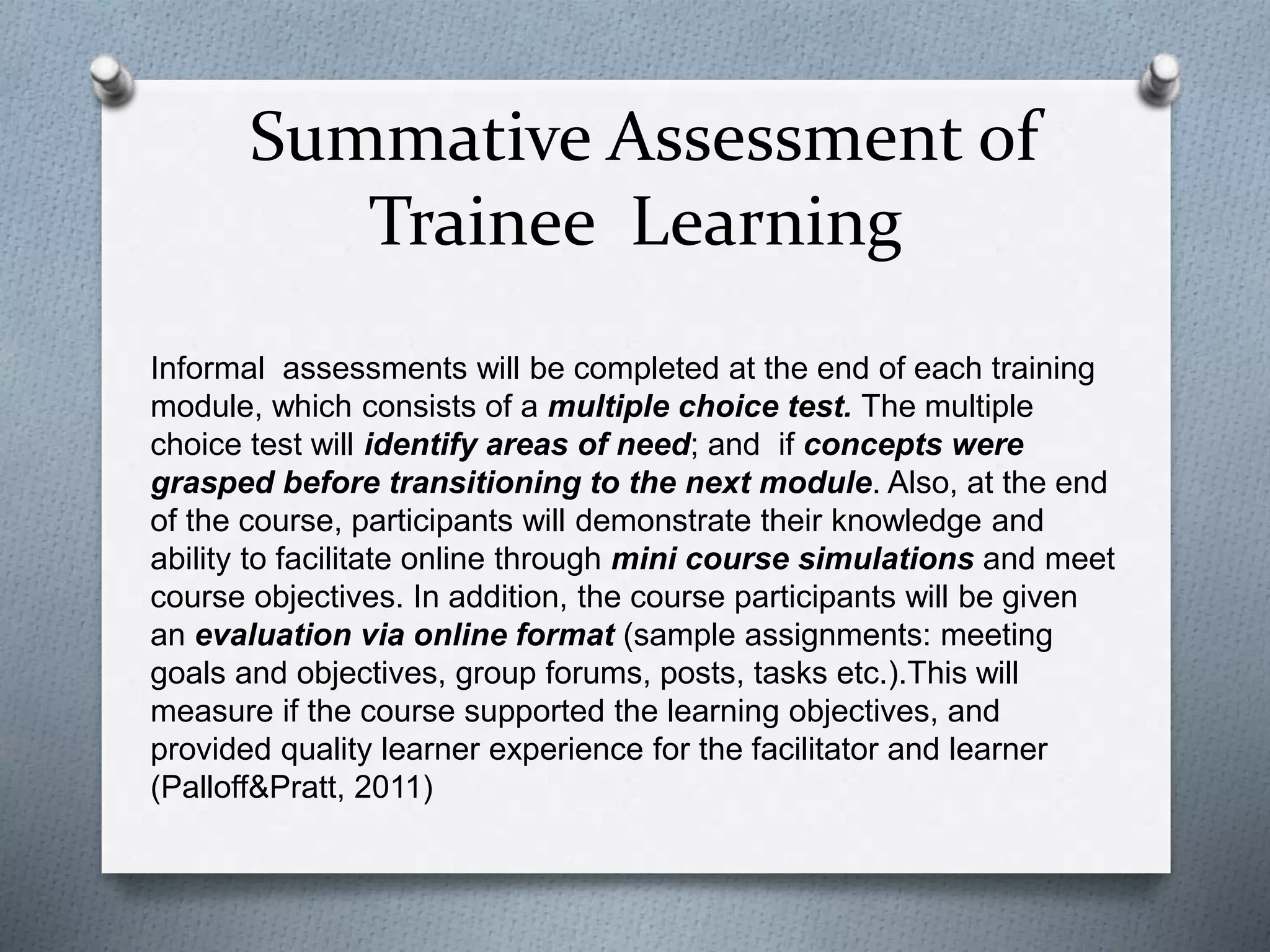
Summative Assessment of
Trainee Learning
Informal assessments will be completed at the end of each training
module, which consists of a multiple choice test. The multiple
choice test will identify areas of need; and if concepts were
grasped before transitioning to the next module. Also, at the end
of the course, participants will demonstrate their knowledge and
ability to facilitate online through mini course simulations and meet
course objectives. In addition, the course participants will be given
an evaluation via online format (sample assignments: meeting
goals and objectives, group forums, posts, tasks etc.).This will
measure if the course supported the learning objectives, and
provided quality learner experience for the facilitator and learner
(Palloff&Pratt, 2011)
Part II- Skills and Materials
Training Materials
Phases in Development
Theories of Distance Learning
Theories of Engaging Distance Learners
Training Materials
Materials:
 (Trainer) laptop,
 Smart Board,
 Laptop,
 Social media tools
 Short media lessons (Livebinders, YouTube)
 Online airline industry library of documents.
 Podcast (ITunes, Glogster, and AudioBoom
 Audio casts for auditory learners.
Facilitator Skills and
Instructional Materials
Skills Needed for Effective
Distance Learning/Training
Facilitators
 Establish an online presence
To develop and maintain facilitation skills
establish proficient feedback skills
create and sustain a learning community
 Video Sharing
 Glogster
 Discussion Boards
 Social media tools in which Facebook can be used as a means of
connectivity and visibility
 Introductions through Icebreakers, social thread presence, course
introduction and developing substantive questions
 Practice feedback through online class scenarios to ensure time
management and learner improvement based on timely responses
 Active Interaction - Learner-focused activities via collaborative
learning tasks and projects that support learner group and community
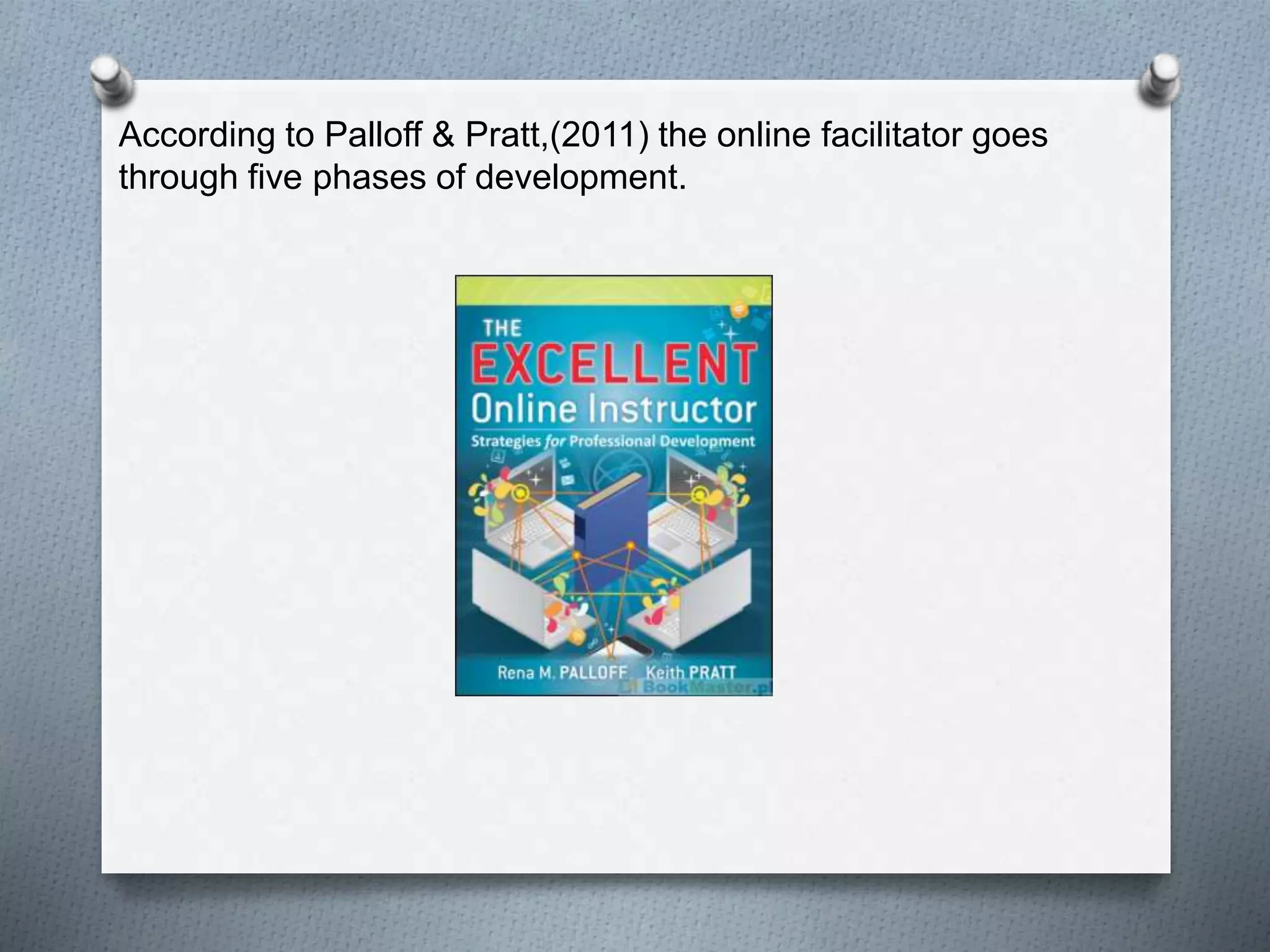
According to Palloff & Pratt,(2011) the online facilitator goes
through five phases of development.
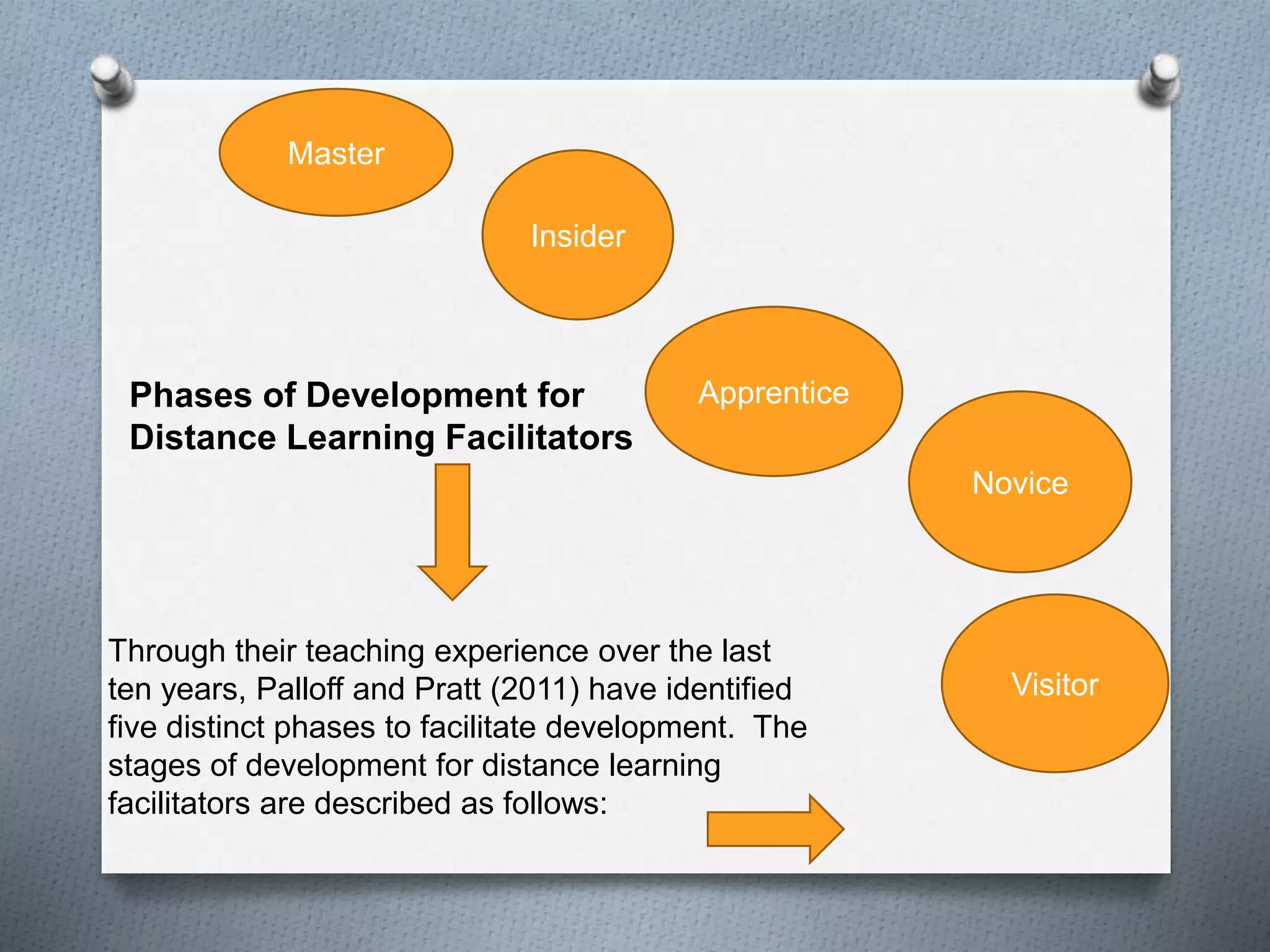
Visitor
Novice
Apprentice
Insider
Master
Phases of Development for
Distance Learning Facilitators
Through their teaching experience over the last
ten years, Palloff and Pratt (2011) have identified
five distinct phases to facilitate development. The
stages of development for distance learning
facilitators are described as follows:
Although hesitant to conduct online class, they embrace the idea but lack
technological knowledge. Preference is face to face communication;
however, they will attempt to use some technology. (ex. Posting online
syllabus or informational email). To create faculty interest, exploring with
technical tools can enhance the learning environment. (Palloff&Pratt,
2011)
Visitor Phase of Development
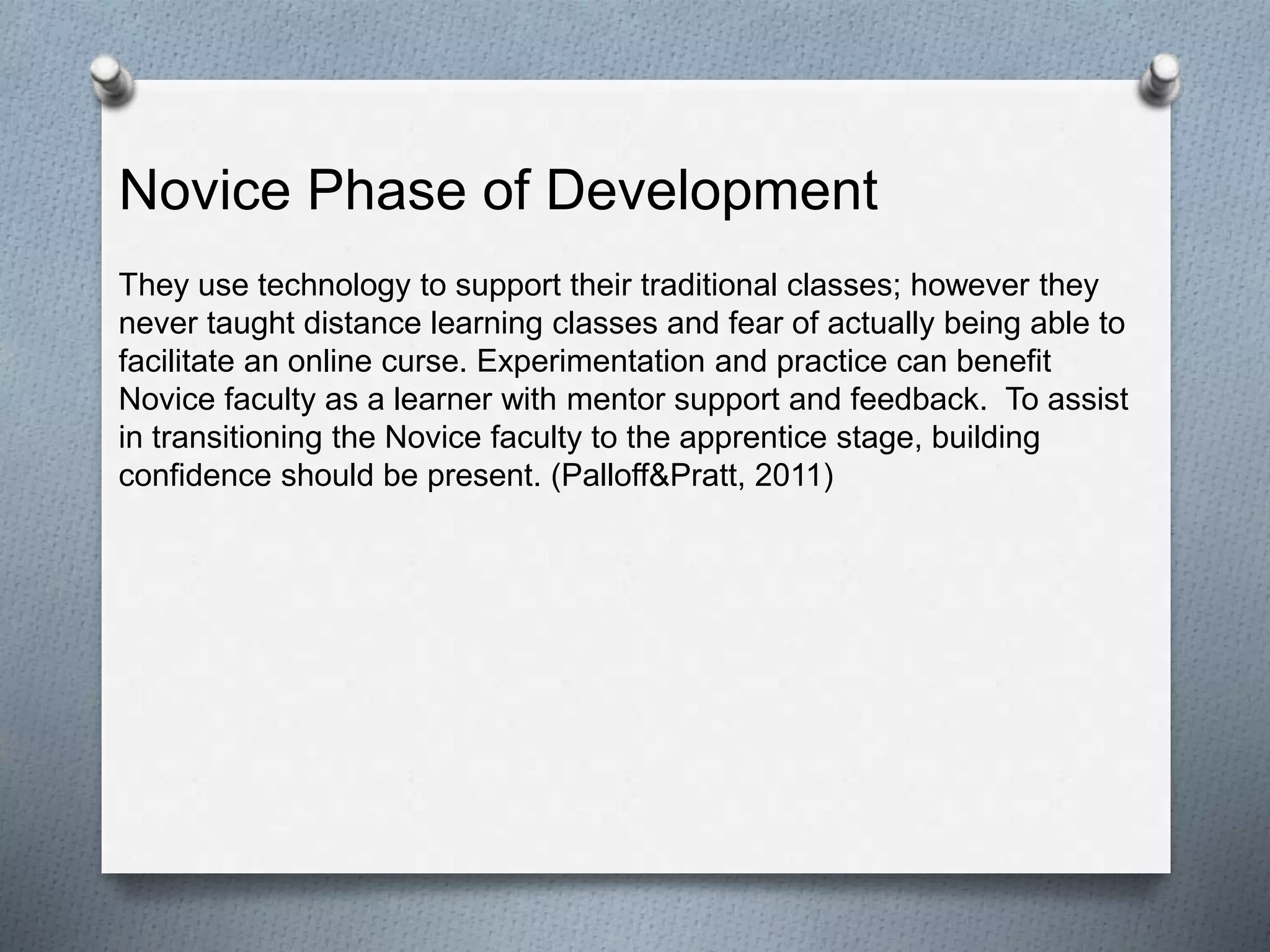
They use technology to support their traditional classes; however they
never taught distance learning classes and fear of actually being able to
facilitate an online curse. Experimentation and practice can benefit
Novice faculty as a learner with mentor support and feedback. To assist
in transitioning the Novice faculty to the apprentice stage, building
confidence should be present. (Palloff&Pratt, 2011)
Novice Phase of Development
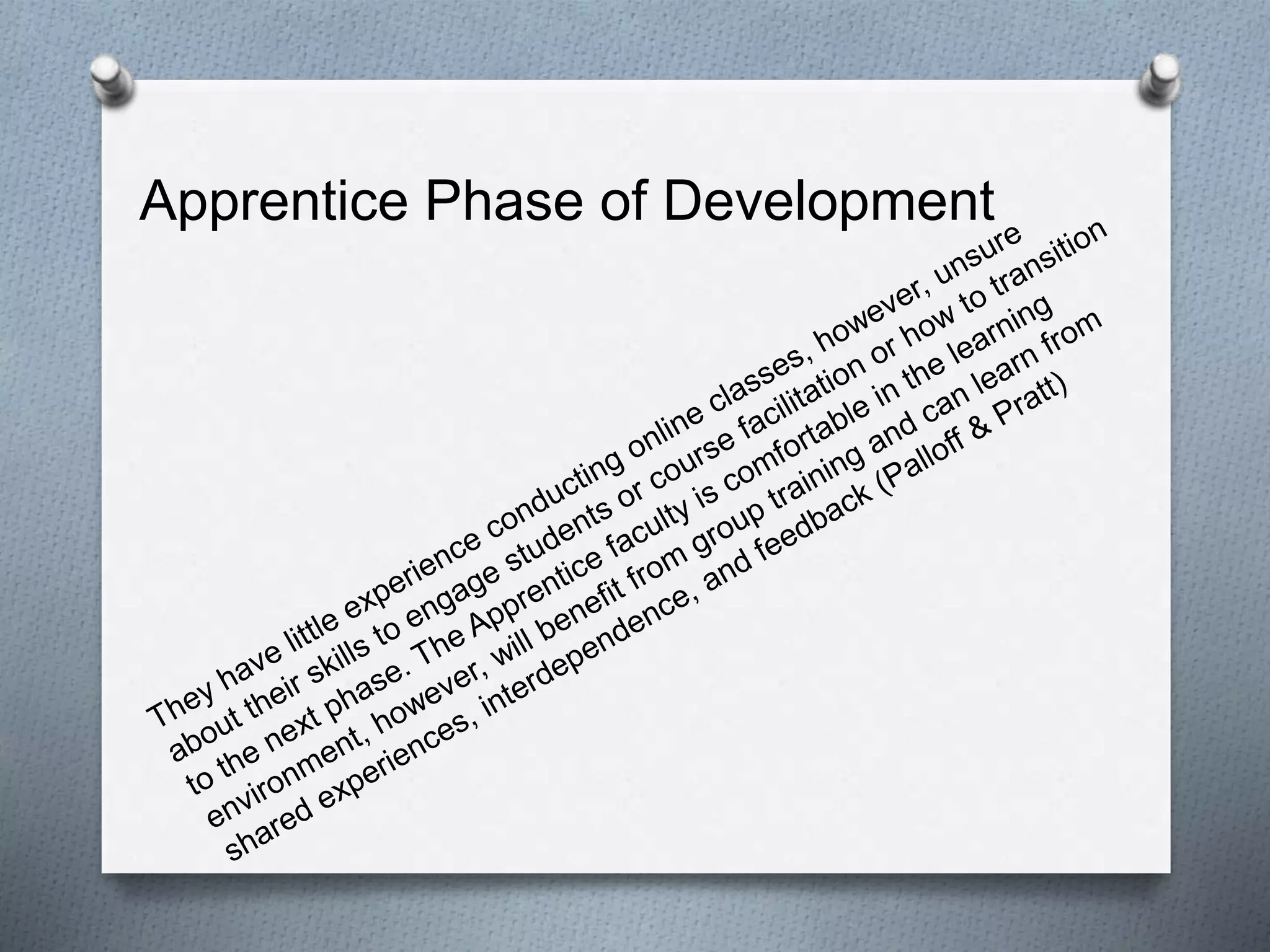
Apprentice Phase of Development
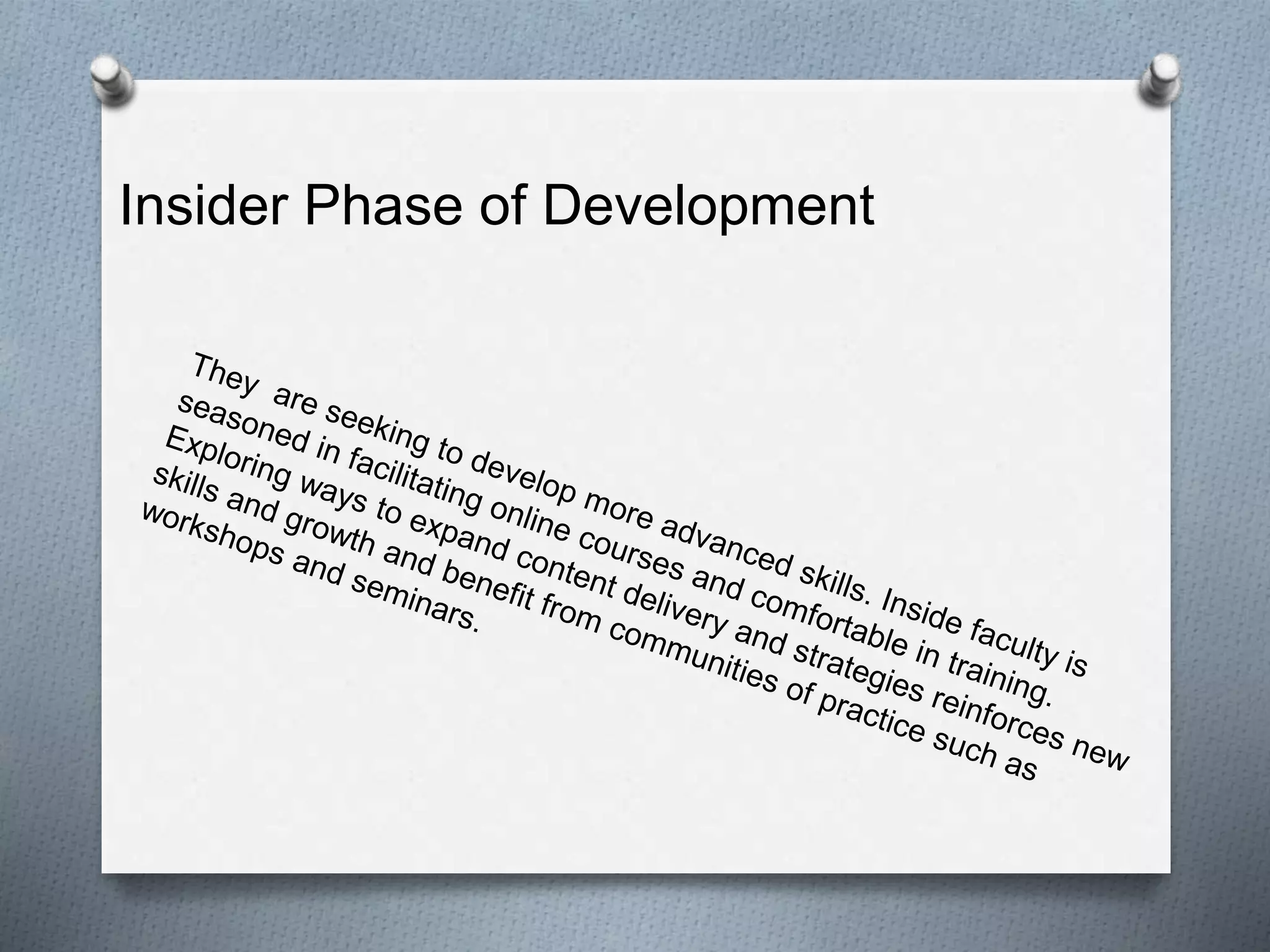
Insider Phase of Development
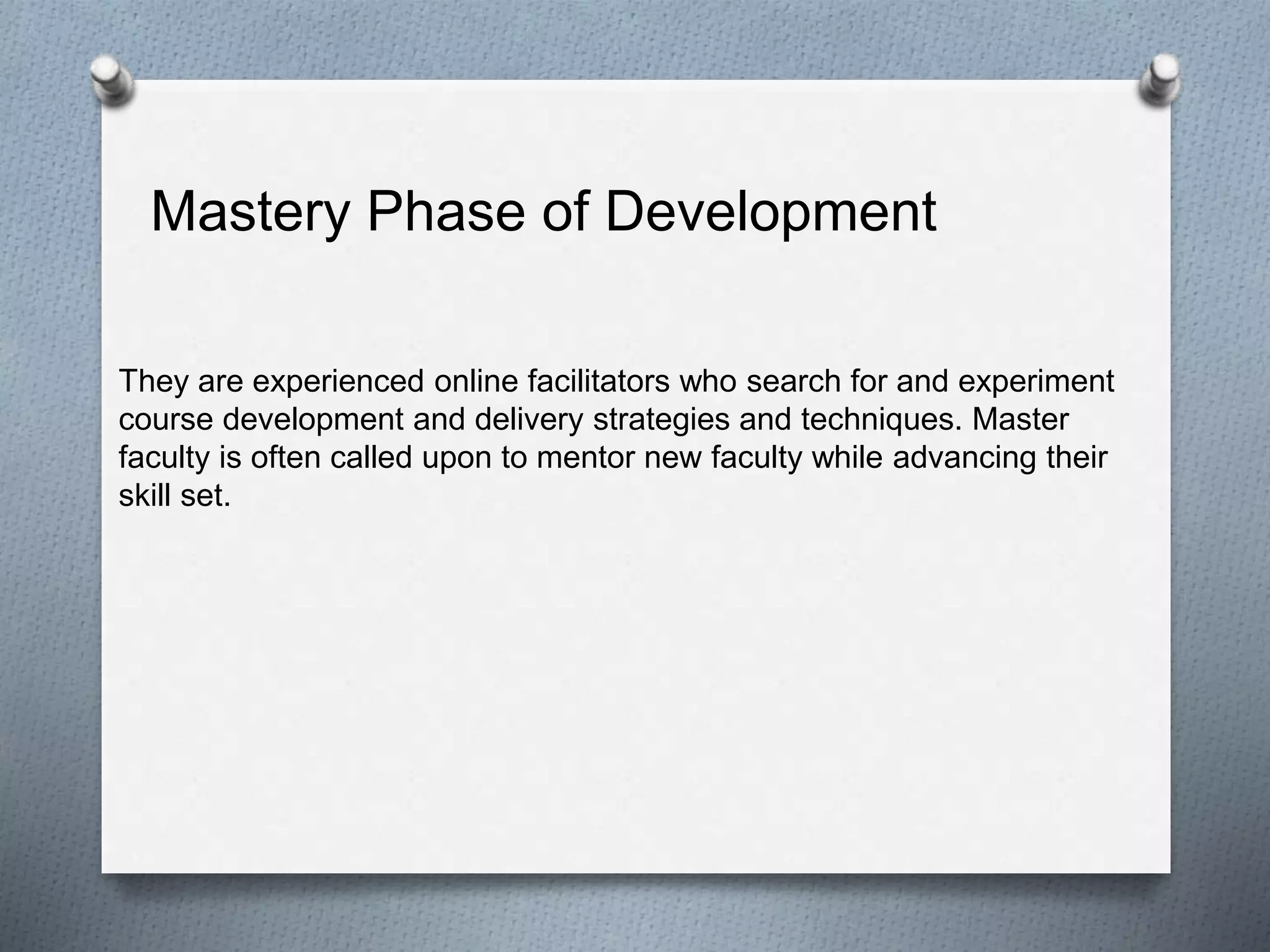
Mastery Phase of Development
They are experienced online facilitators who search for and experiment
course development and delivery strategies and techniques. Master
faculty is often called upon to mentor new faculty while advancing their
skill set.
 Example.
Teacher as a learner: The information gathering
stage where instructors develop technology skills to
use within their individual course.
Teacher as adopter: The experimental stage where
instructors were trying out different technology tools
while share experiences with another faculty.
 Example
 Example
Teacher as co-learner: The instructor recognizes the connection
between technology and course delivery through the use of workshop
and seminars
 Example
Teacher as reaffirmer or rejector: The instructor develops an
awareness of learning outcomes through trial and error scenarios, and
the ability to see how different strategies impact student learning.
 Example
Teacher as Leader: The instructor is a researcher and has enough
experience to teach others about the technology they are familiar with.
Stage 5
Theories
of Distance Learning
Communal Constructivism Theory
 The Transformative Learning Theory
Transactional Distance Learning Theory
Theories
of Engaging Distance Learners
 Communal Constructivism Theory by
Homes and Gardner suggest:
 Individuals receive support from a community
 Considered a repository of knowledge
 Enable individuals to collaborate
 Connect and learn from each other through social
interactions
 enhance participation where social rules and skills
are learned
(Haythornthwaite & Andrews, 2011).
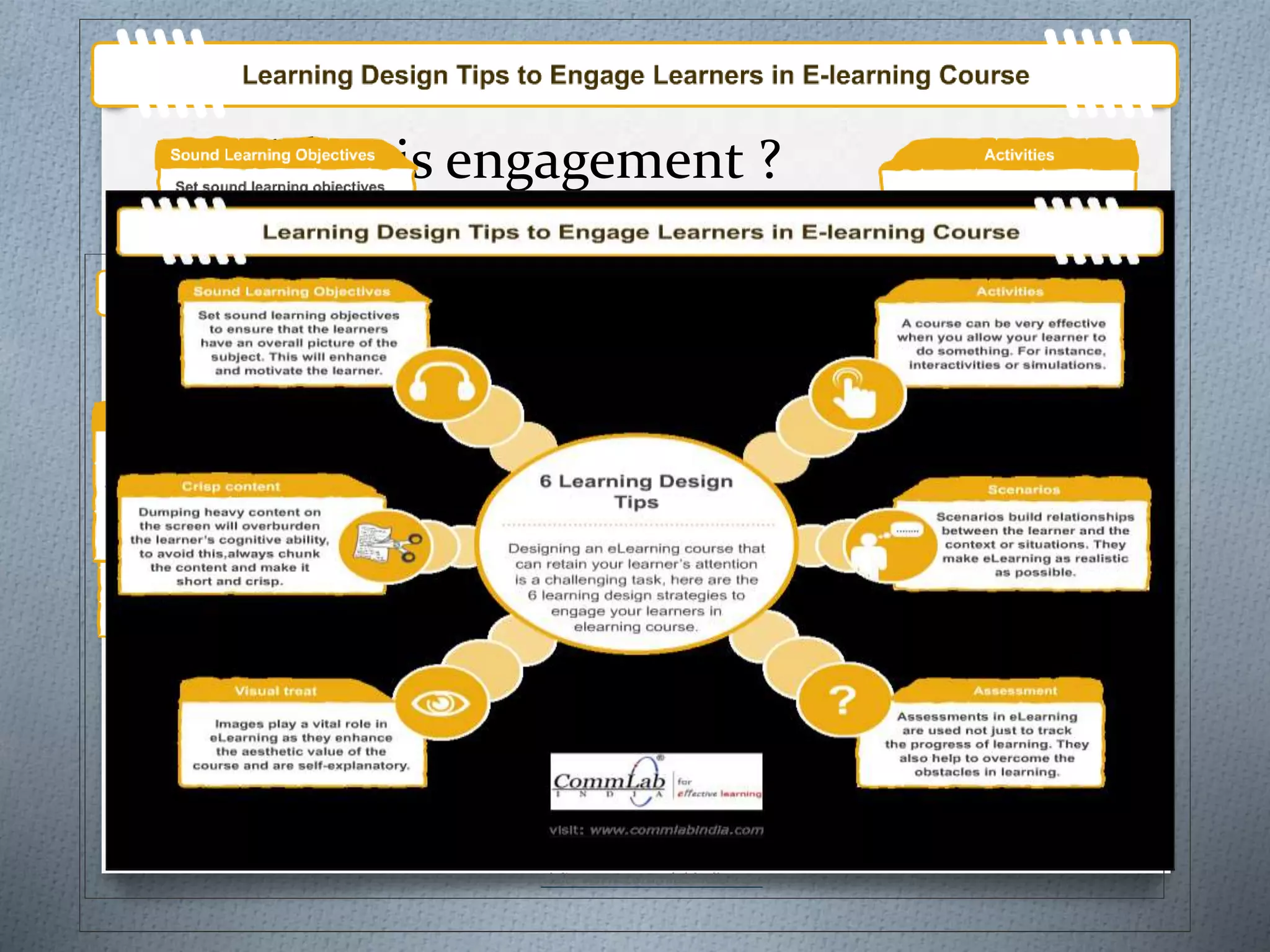
What is engagement ?
Theories
of Engaging Distance Learners
 Transformative Learning Theory by Mezirow
suggests:
 How individuals accept information to add to their
existing understanding
 Change their opinion based on what is important
to them
 Distance learners can utilize available resources
 Process the information
 Make connections that support the shift in
understanding
Theories
of Engaging Distance Learners
 Moore’s Theory of Transactional Distance
Learning suggests:
 Effective learning is based on dialogue
 Structure of the program
 Learner autonomy
Haythornwaite & Andrews,2004
Application of Theories
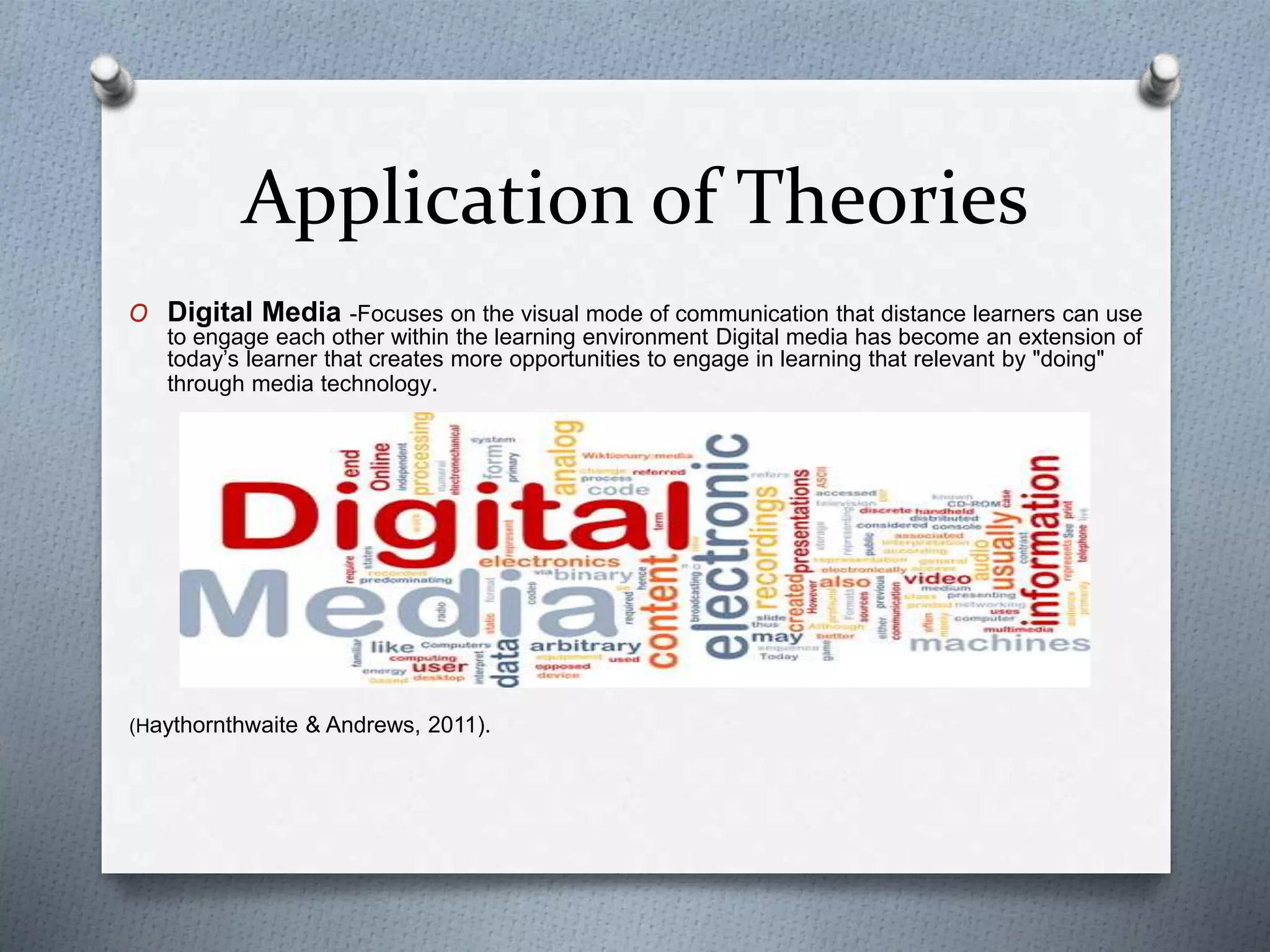
O Digital Media -Focuses on the visual mode of communication that distance learners can use
to engage each other within the learning environment Digital media has become an extension of
today’s learner that creates more opportunities to engage in learning that relevant by "doing"
through media technology.
(Haythornthwaite & Andrews, 2011).
Application of Theories
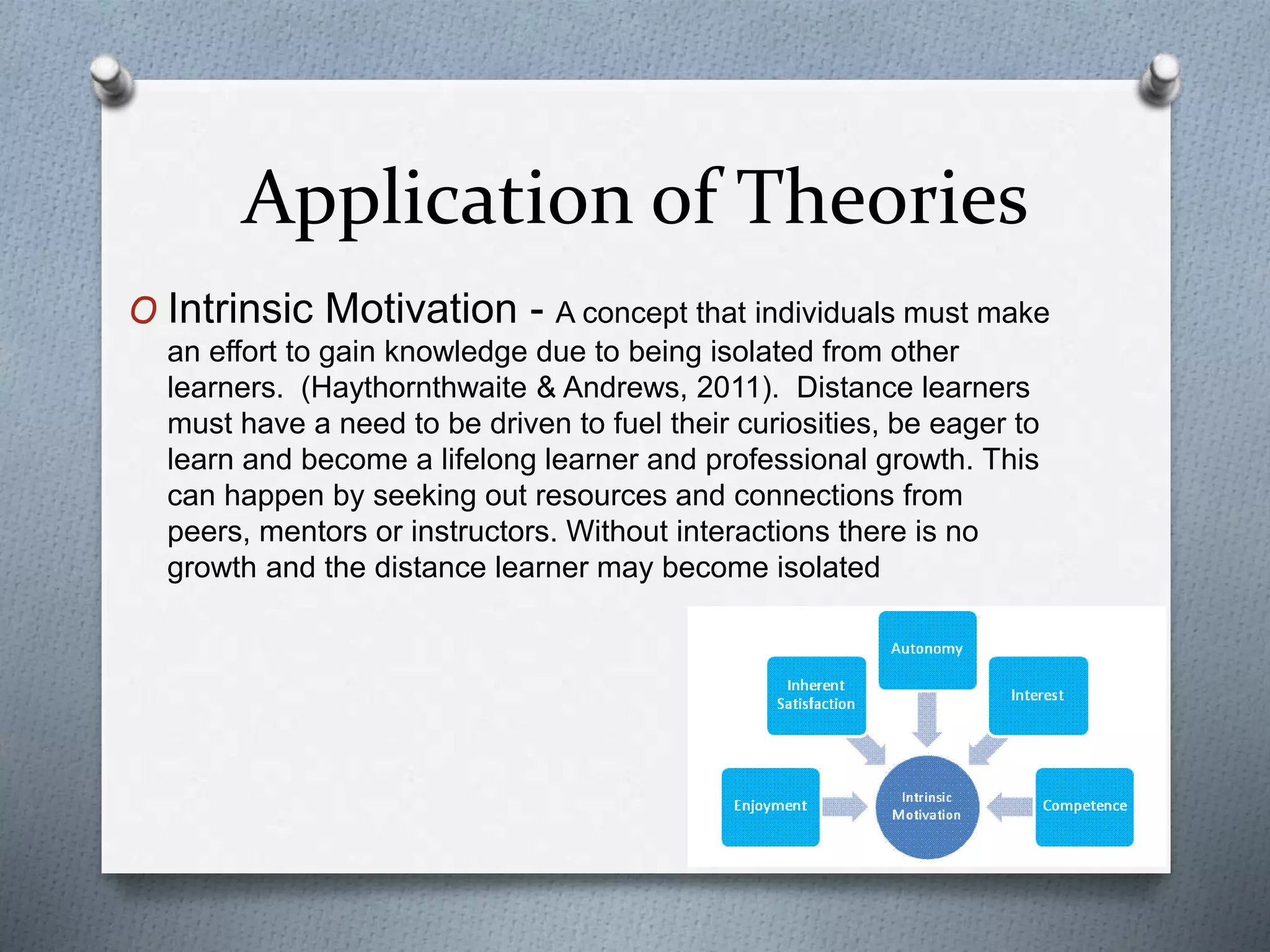
O Intrinsic Motivation - A concept that individuals must make
an effort to gain knowledge due to being isolated from other
learners. (Haythornthwaite & Andrews, 2011). Distance learners
must have a need to be driven to fuel their curiosities, be eager to
learn and become a lifelong learner and professional growth. This
can happen by seeking out resources and connections from
peers, mentors or instructors. Without interactions there is no
growth and the distance learner may become isolated
Application of Theories
O Social Informatics -Haythornthwaite and Andrews (2011) state that
“social informatics is an interdisciplinary body of theory that includes
consideration of the design, uses and affordances of information and
communication technologies” that learners use socially, institutionally and
culturally. Multiple media tools and modes of communication can be used
by distance learners to engage with others without geographical barriers.
This changes the mindset of how distance learners can relate to each
other (instructors, experts, classmates) in the learning environment. This
can be used to make connections through a personal learning network to
support professional growth and lifelong learning
Summary of Theories to
Engage Distance Learning
O Using various forms of interactive technology
O Visual and audio
O Create real world experiences
O Incorporate live streams in “real time”
O Ask follow up questions to promote critical thinking
O Encourage participation
Management and Technology
Tools
Part III –Management and
Technology Tools
Learning Platform – LMS/CMS for
Facilitation
Technology and Media Tools
Mentoring Program
Evaluations for Programs
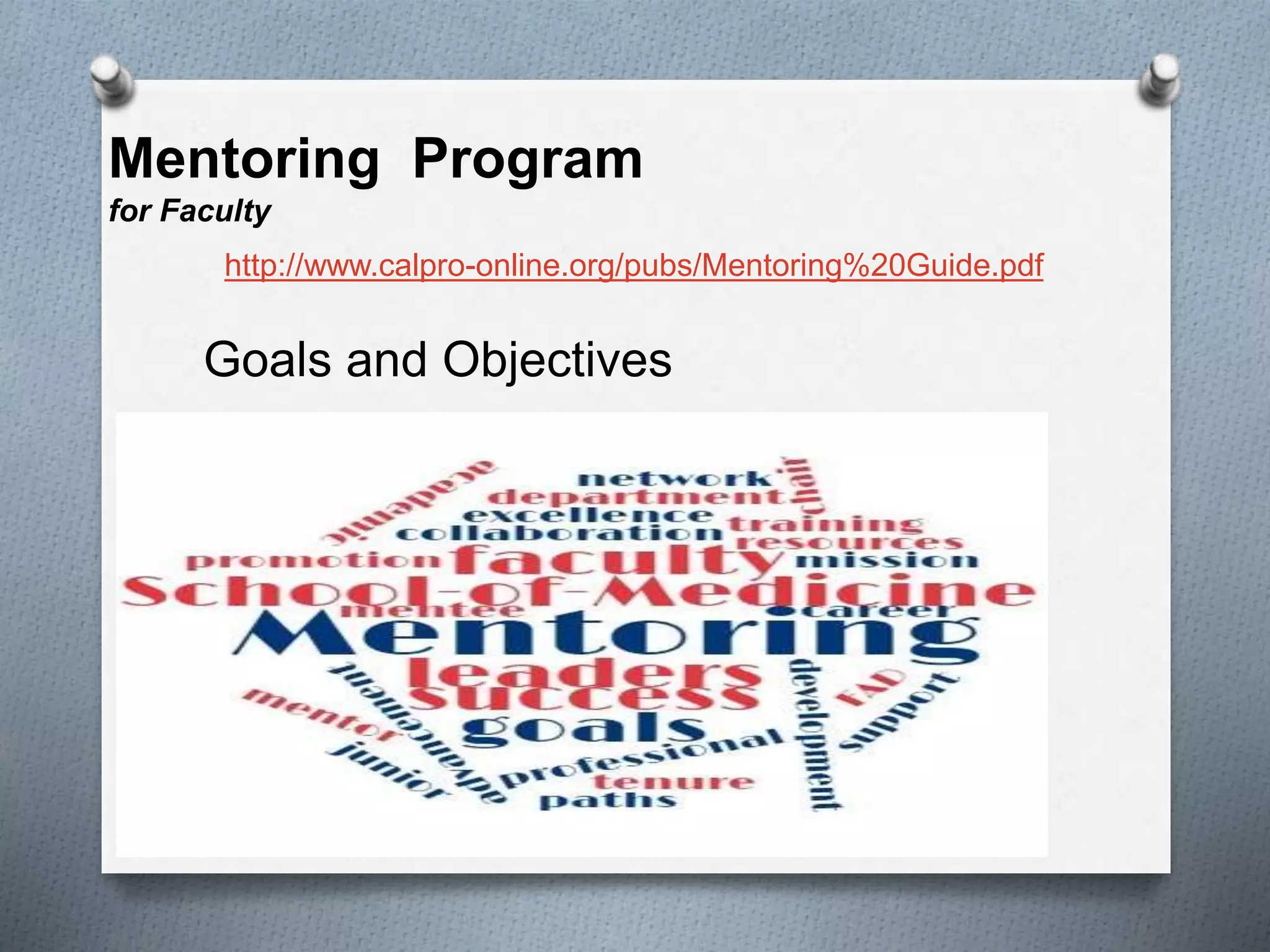
Mentoring Program
for Faculty
Goals and Objectives
http://www.calpro-online.org/pubs/Mentoring%20Guide.pdf
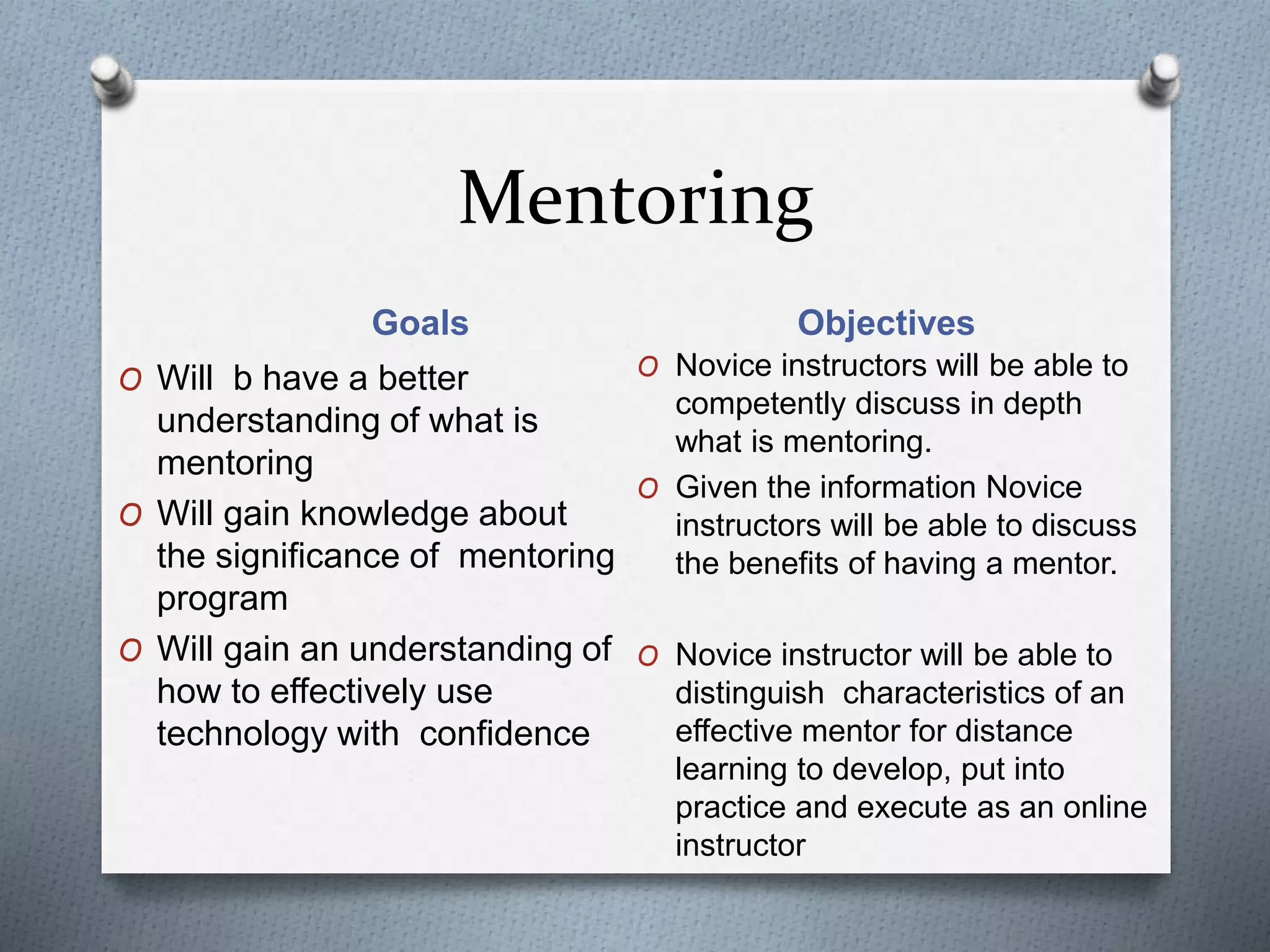
Mentoring
Goals Objectives
O Will b have a better
understanding of what is
mentoring
O Will gain knowledge about
the significance of mentoring
program
O Will gain an understanding of
how to effectively use
technology with confidence
O Novice instructors will be able to
competently discuss in depth
what is mentoring.
O Given the information Novice
instructors will be able to discuss
the benefits of having a mentor.
O Novice instructor will be able to
distinguish characteristics of an
effective mentor for distance
learning to develop, put into
practice and execute as an online
instructor
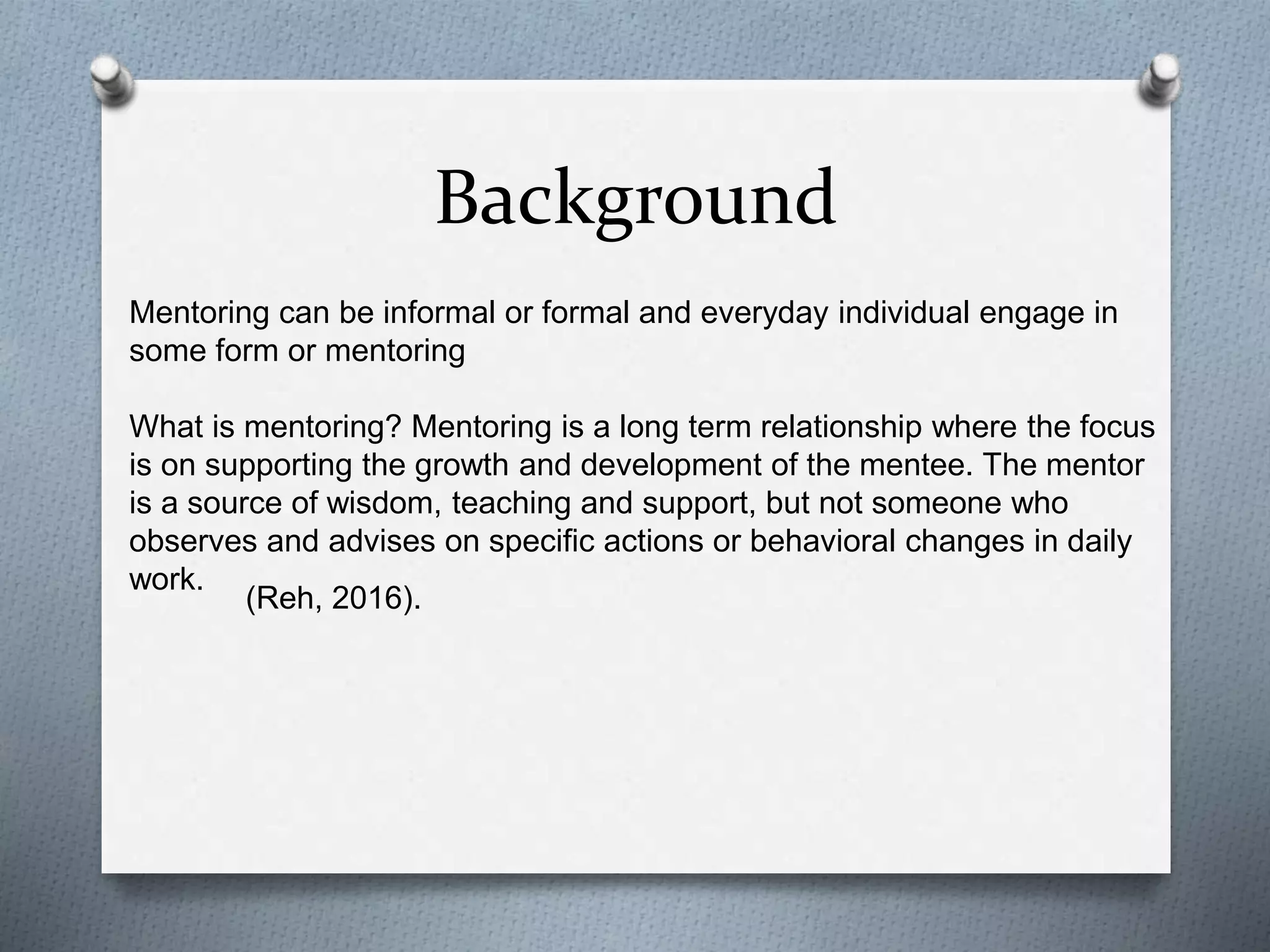
Background
Mentoring can be informal or formal and everyday individual engage in
some form or mentoring
What is mentoring? Mentoring is a long term relationship where the focus
is on supporting the growth and development of the mentee. The mentor
is a source of wisdom, teaching and support, but not someone who
observes and advises on specific actions or behavioral changes in daily
work.
(Reh, 2016).
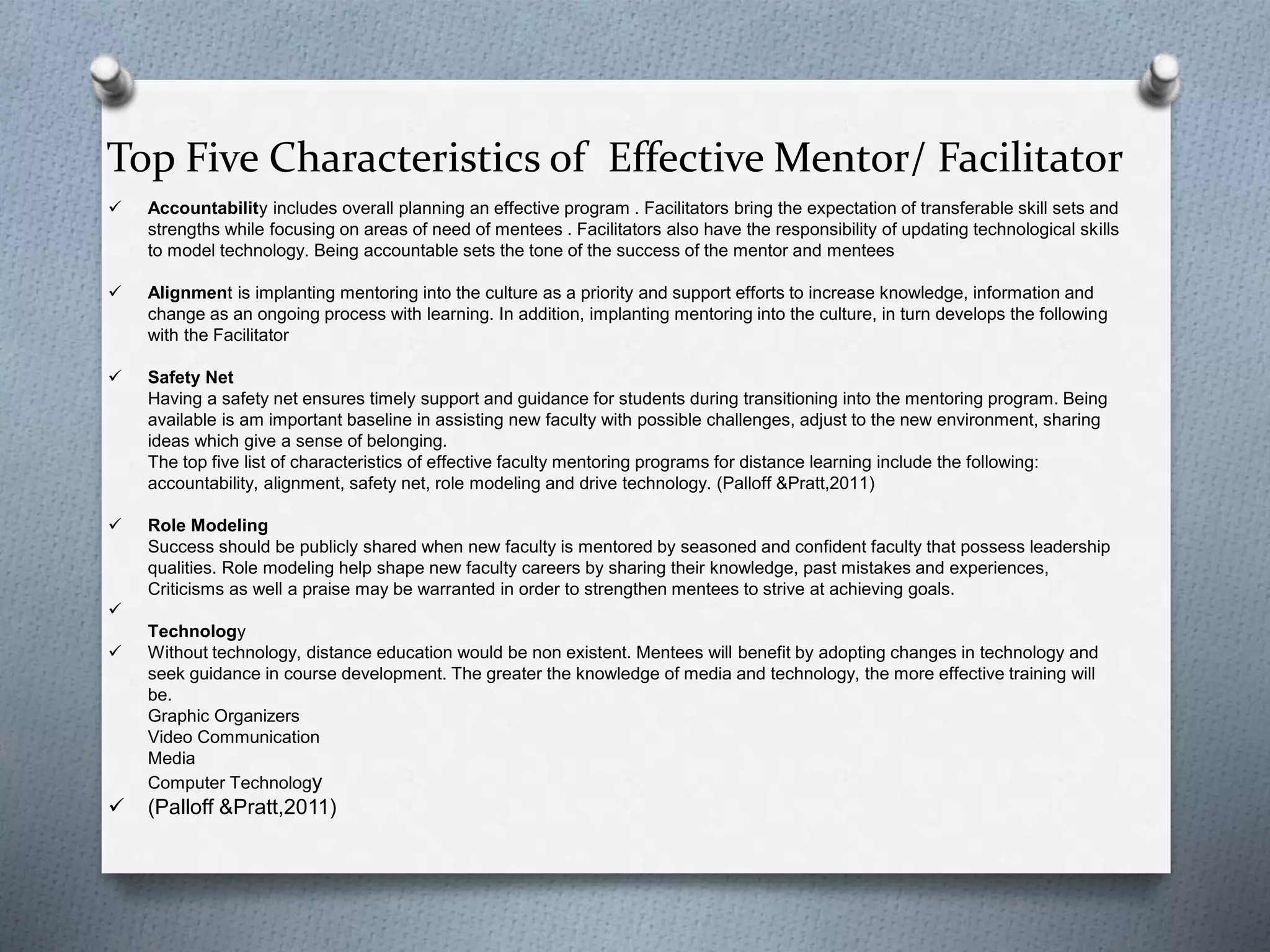
Top Five Characteristics of Effective Mentor/ Facilitator
 Accountability includes overall planning an effective program . Facilitators bring the expectation of transferable skill sets and
strengths while focusing on areas of need of mentees . Facilitators also have the responsibility of updating technological skills
to model technology. Being accountable sets the tone of the success of the mentor and mentees
 Alignment is implanting mentoring into the culture as a priority and support efforts to increase knowledge, information and
change as an ongoing process with learning. In addition, implanting mentoring into the culture, in turn develops the following
with the Facilitator
 Safety Net
Having a safety net ensures timely support and guidance for students during transitioning into the mentoring program. Being
available is am important baseline in assisting new faculty with possible challenges, adjust to the new environment, sharing
ideas which give a sense of belonging.
The top five list of characteristics of effective faculty mentoring programs for distance learning include the following:
accountability, alignment, safety net, role modeling and drive technology. (Palloff &Pratt,2011)
 Role Modeling
Success should be publicly shared when new faculty is mentored by seasoned and confident faculty that possess leadership
qualities. Role modeling help shape new faculty careers by sharing their knowledge, past mistakes and experiences,
Criticisms as well a praise may be warranted in order to strengthen mentees to strive at achieving goals.

Technology
 Without technology, distance education would be non existent. Mentees will benefit by adopting changes in technology and
seek guidance in course development. The greater the knowledge of media and technology, the more effective training will
be.
Graphic Organizers
Video Communication
Media
Computer Technology
 (Palloff &Pratt,2011)
Novice Facilitator
Identification of Criteria
O New to distance learning environment
O Have existing experience in traditional learning
environments
O Unsure how to set up technology and deliver class
instruction
O Have experience in their field
O Require assistance with technology and how to
effectively utilize interactive tools in the learning
environment
Experience with Distance
Education
 A master of insider facilitator could be a mentor
 Have taught several online classes successfully
 Knows how to engage with the online learners
Mentoring: What it is
and is not
https://www.alnmag.com/article/2011/01/mentoring-
what-it-and-not
Please Read: (click the link below)
Management and Evaluation
Programs
O Faculty learning community approach helps to reduce the
feeling of isolation.
O People learn from others and it is important to have a strong
support system in the online learning environment.
O The ability to interact with others can really impact all parties
involved in the learning environment.
O Allowing ongoing support for faculty members
O Adhere to budget guidelines
O Building a string network which can decrease the feeling of
isolation and apprehension for new members
O Take feedback from post course evaluations and make
necessary changes
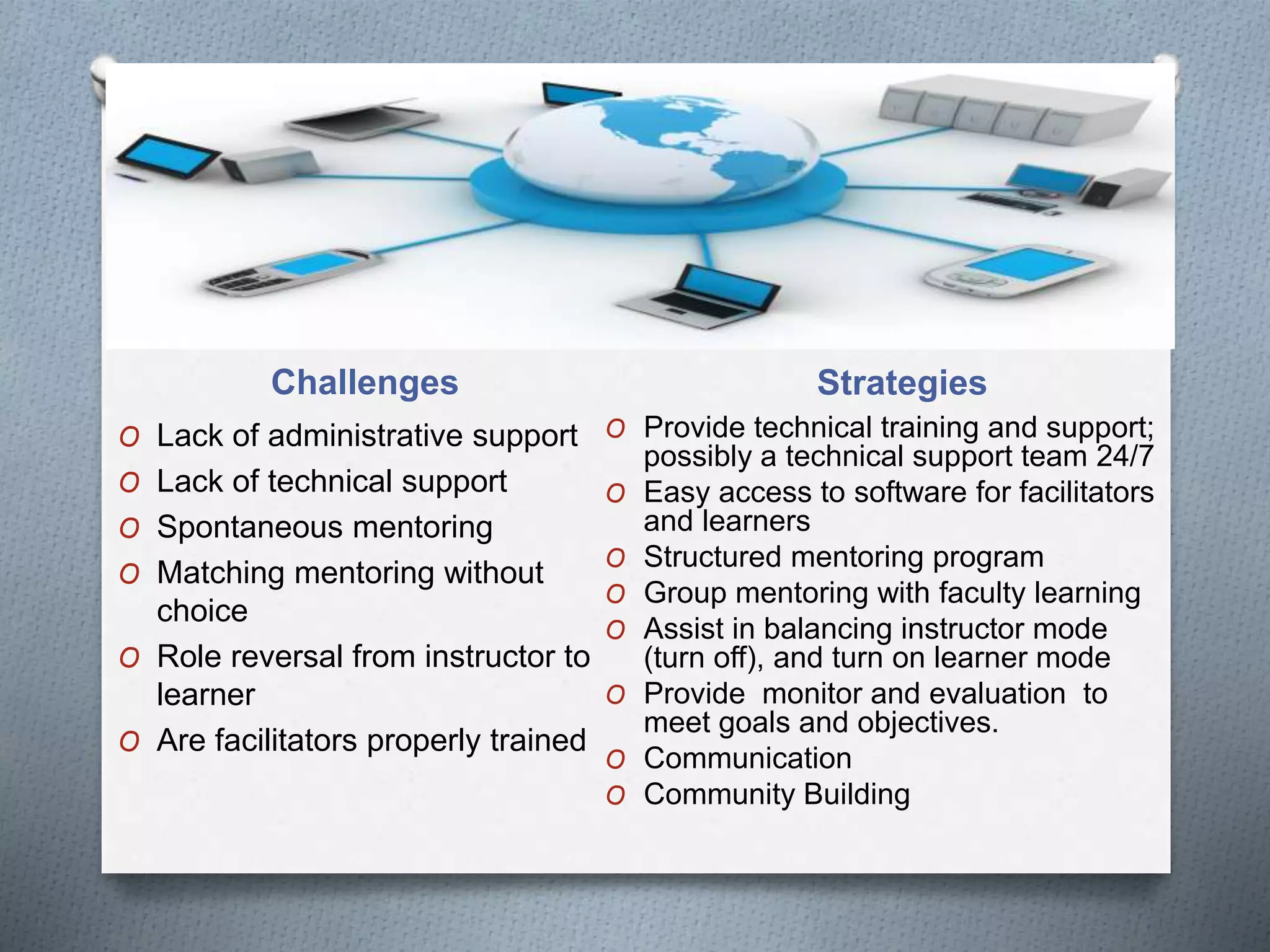
Challenges Strategies
O Lack of administrative support
O Lack of technical support
O Spontaneous mentoring
O Matching mentoring without
choice
O Role reversal from instructor to
learner
O Are facilitators properly trained
O Provide technical training and support;
possibly a technical support team 24/7
O Easy access to software for facilitators
and learners
O Structured mentoring program
O Group mentoring with faculty learning
O Assist in balancing instructor mode
(turn off), and turn on learner mode
O Provide monitor and evaluation to
meet goals and objectives.
O Communication
O Community Building
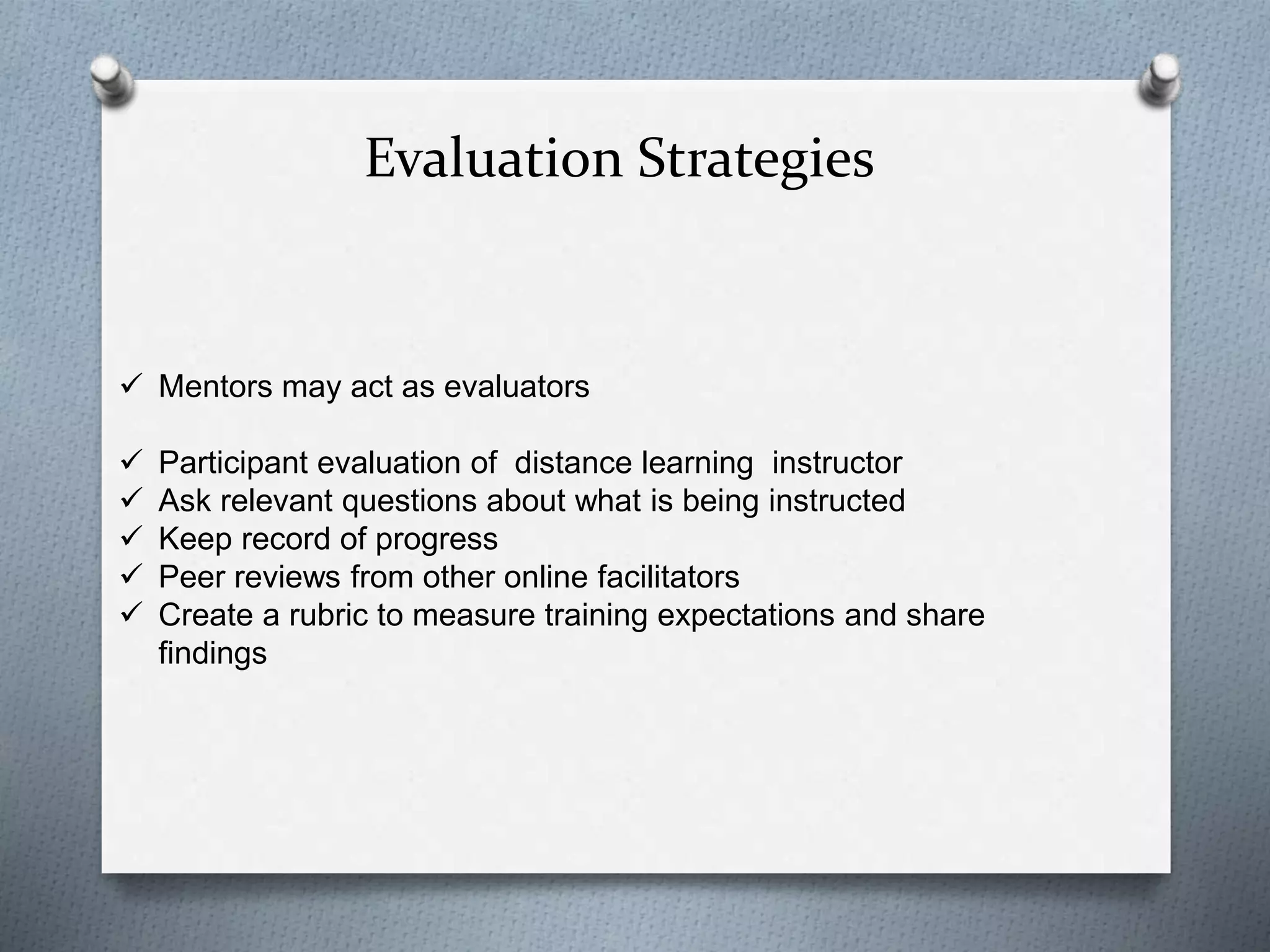
Evaluation Strategies
 Mentors may act as evaluators
 Participant evaluation of distance learning instructor
 Ask relevant questions about what is being instructed
 Keep record of progress
 Peer reviews from other online facilitators
 Create a rubric to measure training expectations and share
findings
Platform for Facilitating : CMS (Content Management System)
Platform for Facilitating : LMS (Learning Management Systems
Issues and Classroom
Management
Technology and Media Tools for
Collaboration
Video – You Tube
https://youtu.be/nz6SwliUWoE
Visual or Infographics
http://edu.glogster.com/?ref=com
LiveBinder
https://www.youtube.com/watch?v=NFTzLUPBJ6g#action=share
http://livebinders.wikispaces.com/A%29+What+is+LiveBinder%3F
Audio – Audioboom
 https://audioboom.com/
Video sharing website and learning tools that allow users to
upload original content and share topics of interest. YouTube
supports interactive learning with vast resources for topic
specific content. Both learners and facilitators can engage in
collaborative efforts through presentations, introduction to new
topics and step by step simulations.
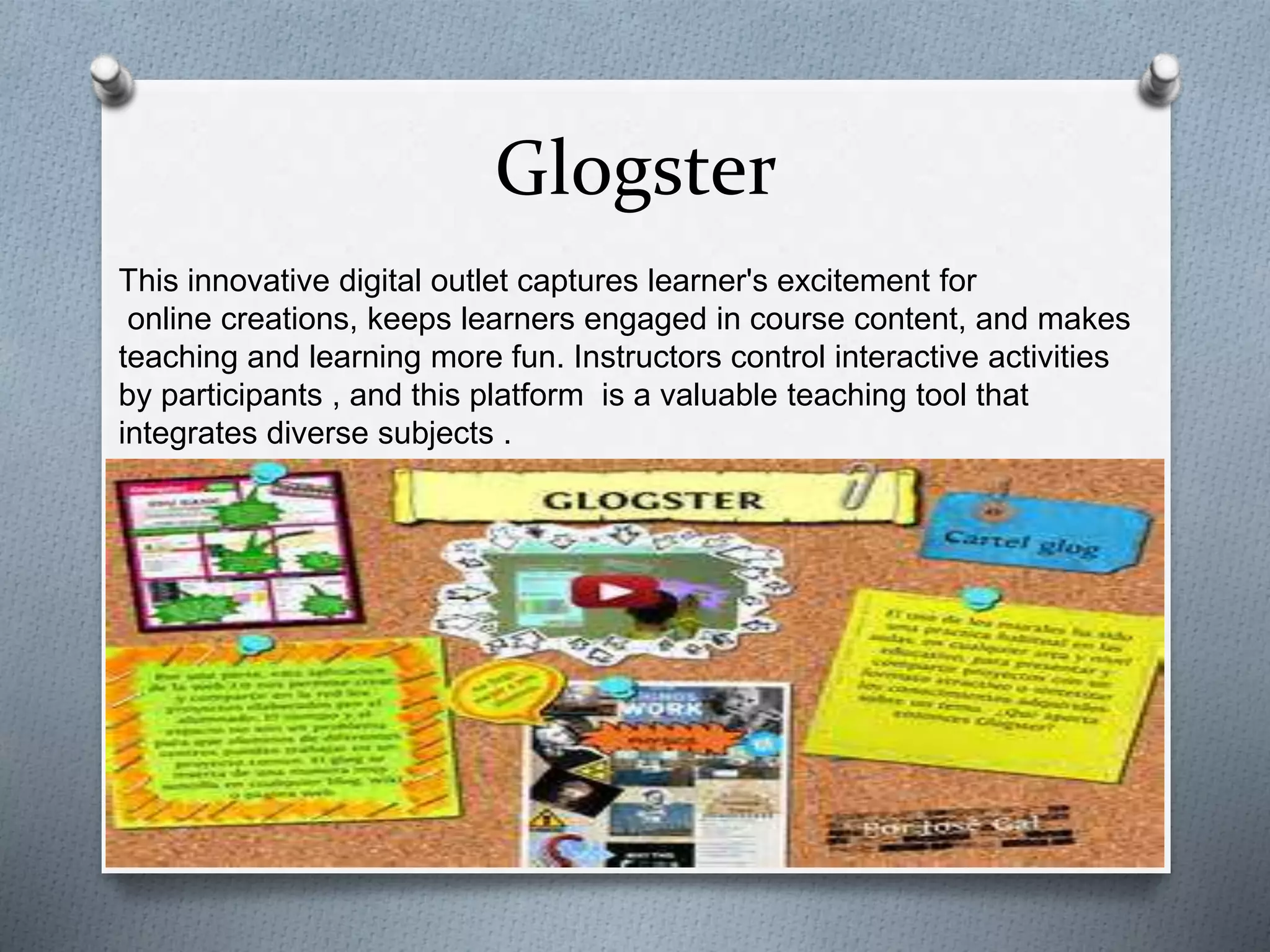
Glogster
This innovative digital outlet captures learner's excitement for
online creations, keeps learners engaged in course content, and makes
teaching and learning more fun. Instructors control interactive activities
by participants , and this platform is a valuable teaching tool that
integrates diverse subjects .
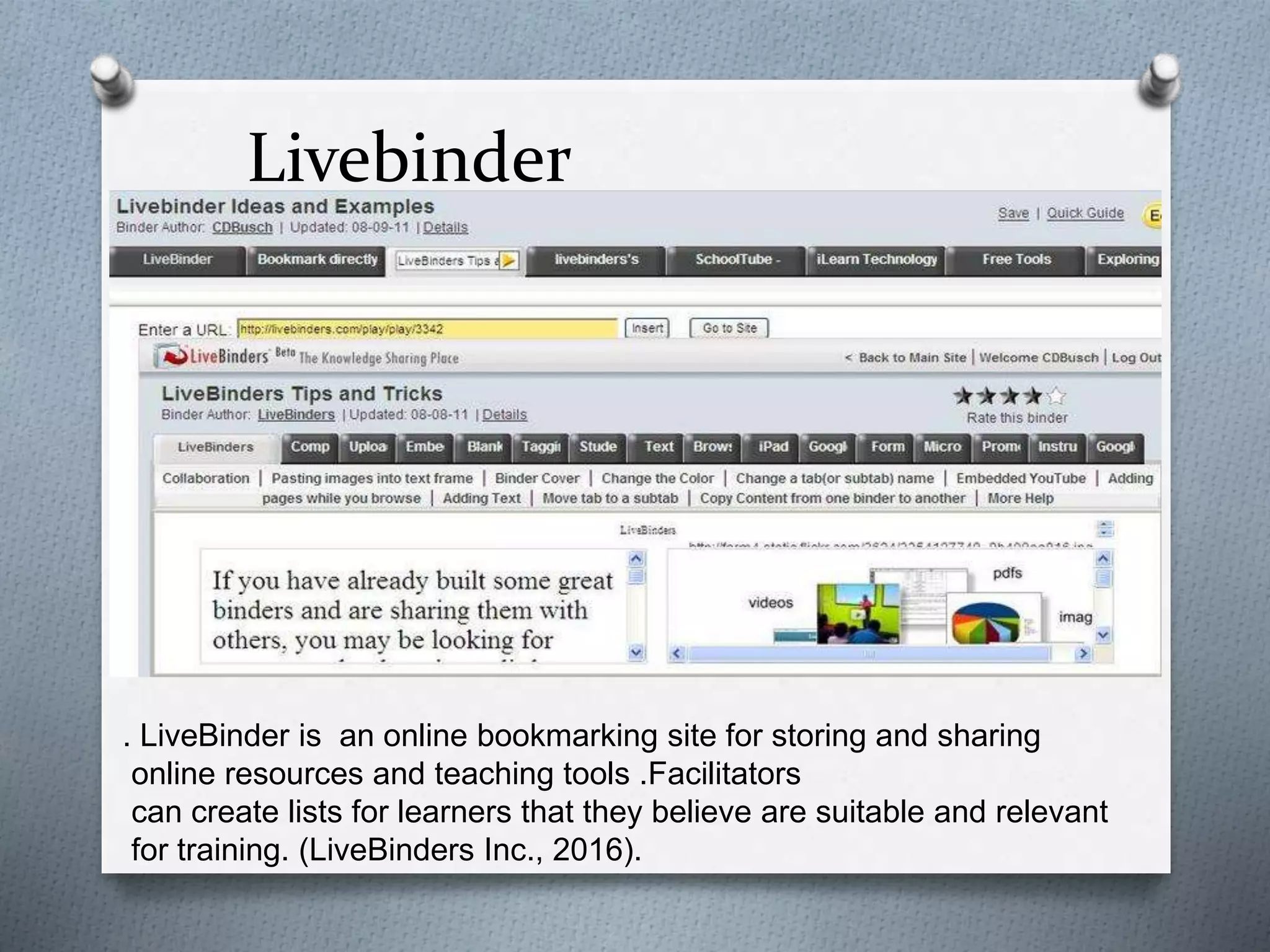
Livebinder
. LiveBinder is an online bookmarking site for storing and sharing
online resources and teaching tools .Facilitators
can create lists for learners that they believe are suitable and relevant
for training. (LiveBinders Inc., 2016).
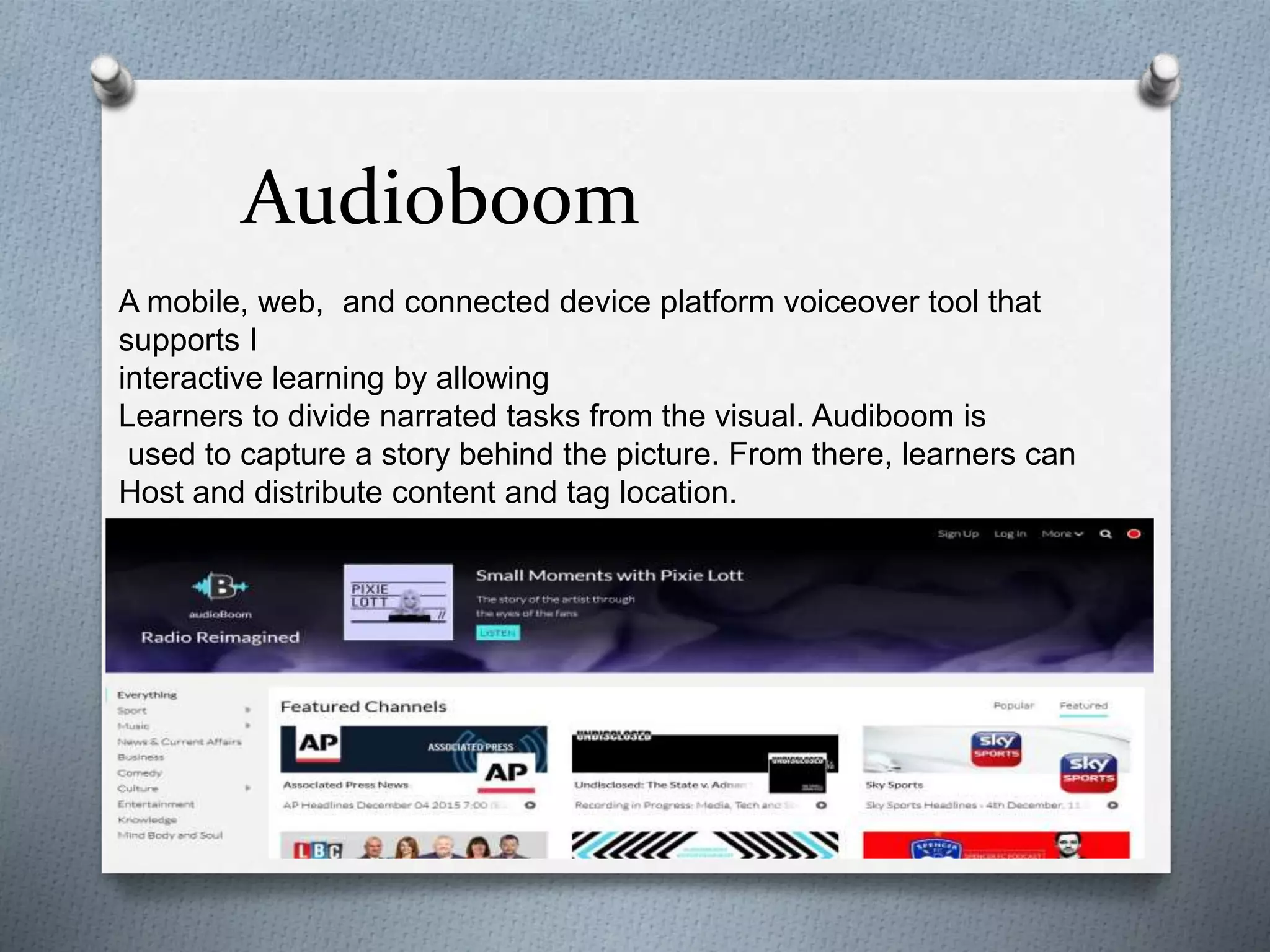
Audioboom
A mobile, web, and connected device platform voiceover tool that
supports I
interactive learning by allowing
Learners to divide narrated tasks from the visual. Audiboom is
used to capture a story behind the picture. From there, learners can
Host and distribute content and tag location.
Processes facilitators will use:
 Introduction of self/ Icebreakers
 Make presence known by remaining available and engaged
 Maintaining organization with instruction and teaching tools
 Encourage learner to learner interaction
 Execute facilitator to learner interaction
 Welcome questions
 Monitor discussions/guide on the side
 Acknowledgement of questions and responses
 Establish clear instructions on assignments due date, location
 and time frame
 Constructive feedback in professional tone
Click on link for b Distance Learning Classroom Management:
https://www.powtoon.com/online-presentation/gn1h4mfGClh/distance-education-classroom/?mode=movie#/
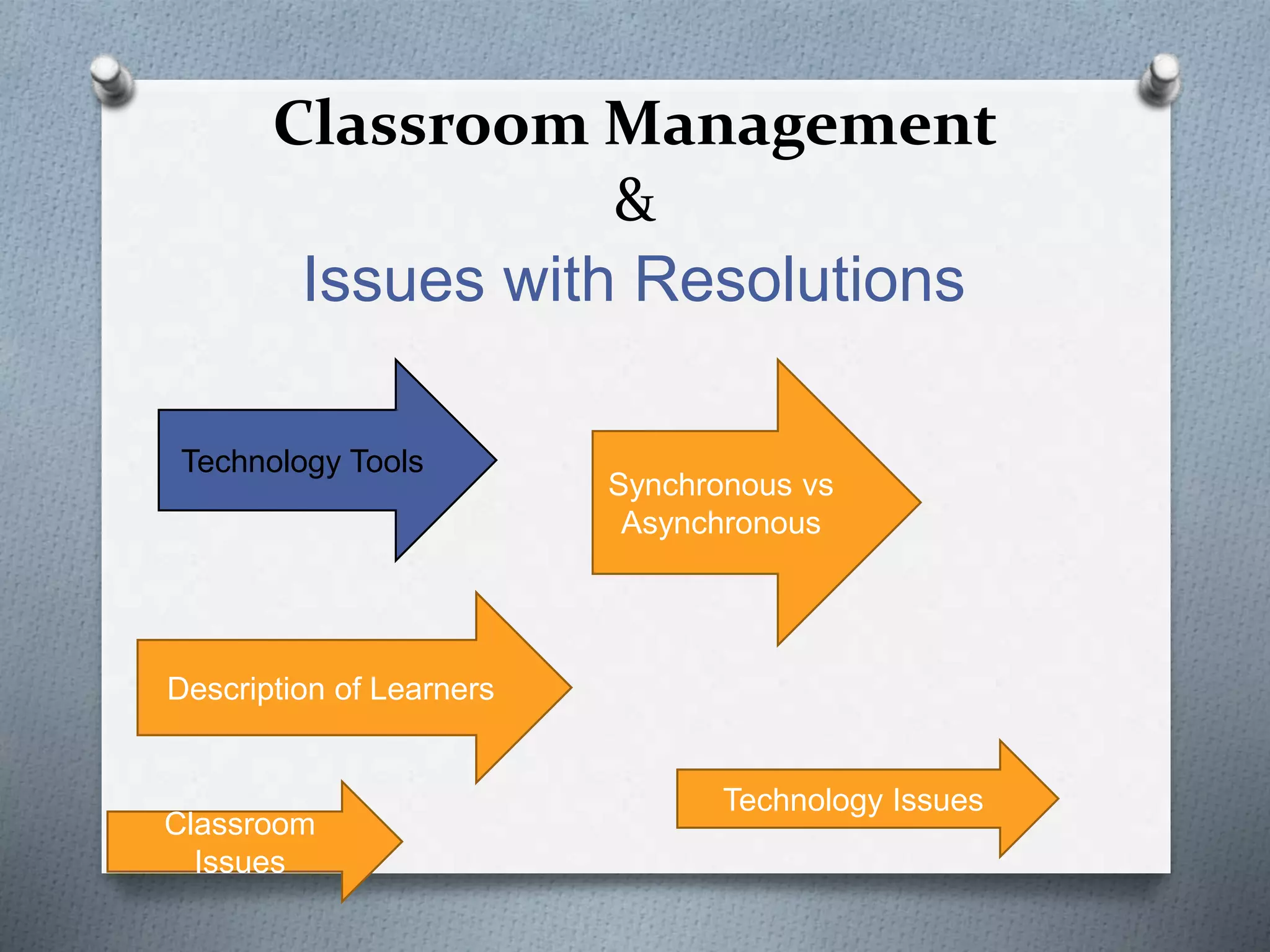
Classroom Management
&
Issues with Resolutions
Technology Tools
Description of Learners
Synchronous vs
Asynchronous
Technology Issues
Classroom
Issues
Description of Distance
Learners
O Non Traditional
O Experiential
O Cultural
The distance learners are primarily new hire
trainers of Skyview Airlines that support training
of all new hires per department; both Corporate
Trainers and Support Airport Staff have over 10
years in the transportation/airline industry.
Learners have little or no online training,
however are very comfortable in a traditional
learning environment.
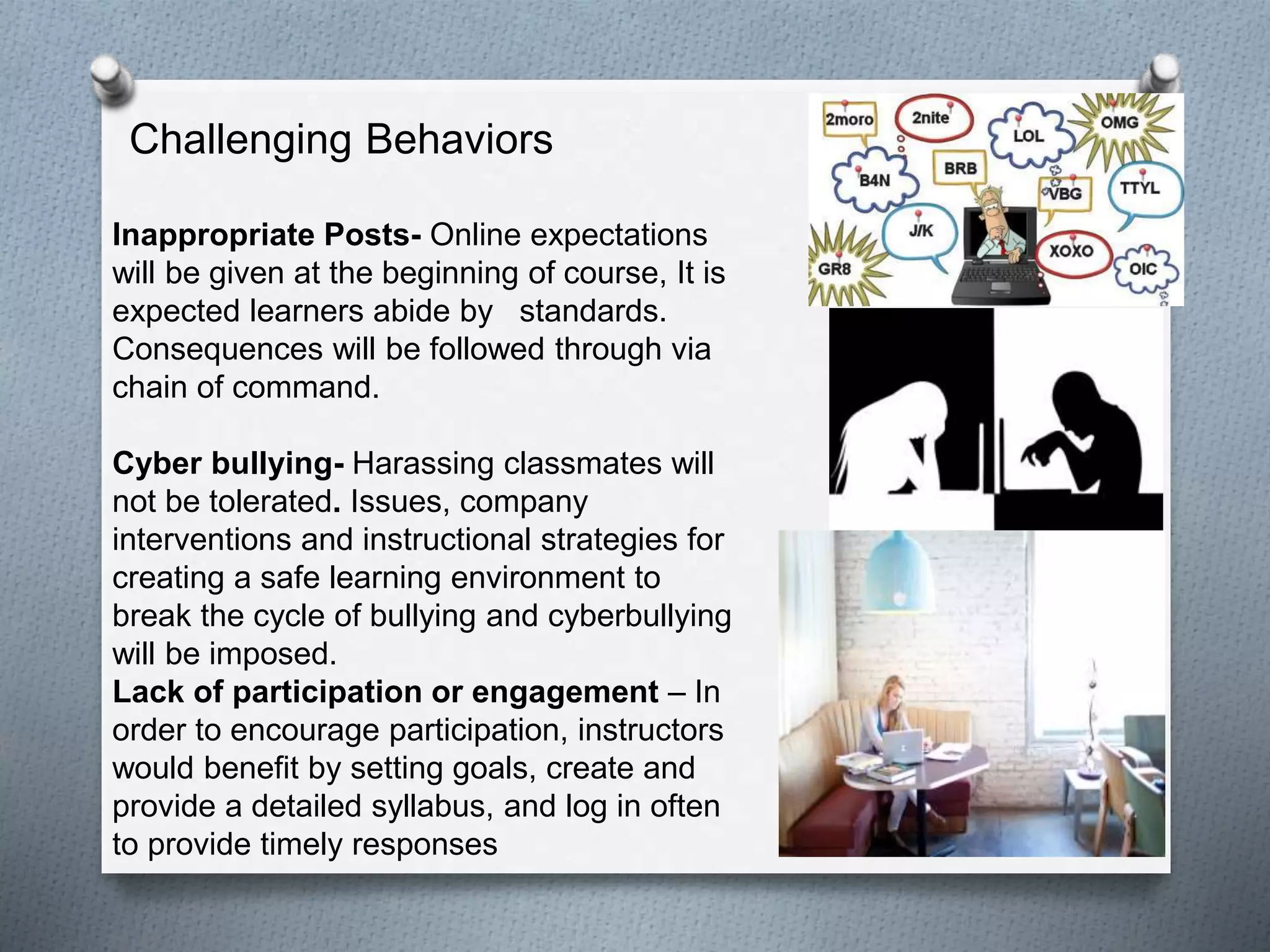
Challenging Behaviors
Inappropriate Posts- Online expectations
will be given at the beginning of course, It is
expected learners abide by standards.
Consequences will be followed through via
chain of command.
Cyber bullying- Harassing classmates will
not be tolerated. Issues, company
interventions and instructional strategies for
creating a safe learning environment to
break the cycle of bullying and cyberbullying
will be imposed.
Lack of participation or engagement – In
order to encourage participation, instructors
would benefit by setting goals, create and
provide a detailed syllabus, and log in often
to provide timely responses
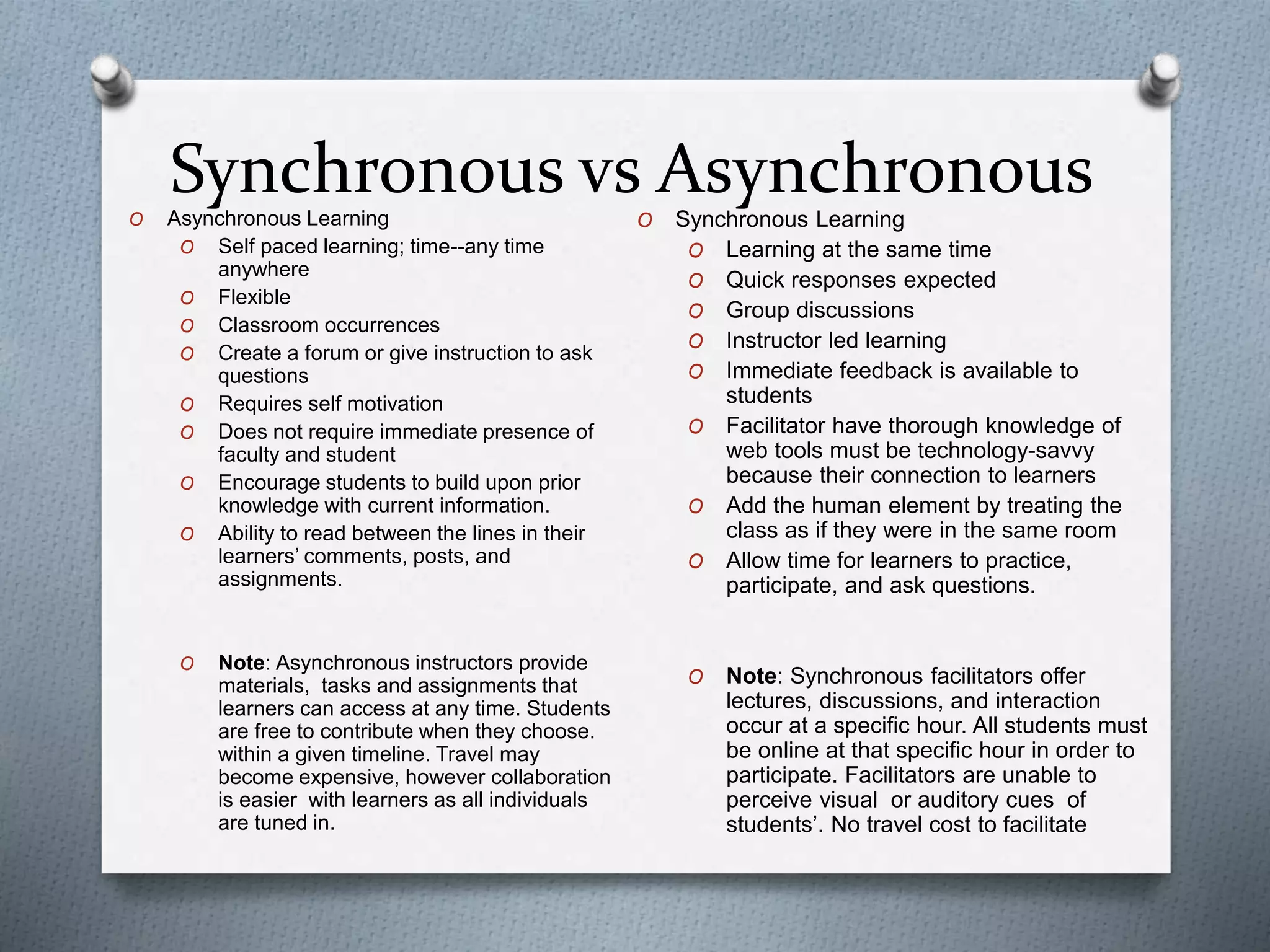
Synchronous vs AsynchronousO Asynchronous Learning
O Self paced learning; time--any time
anywhere
O Flexible
O Classroom occurrences
O Create a forum or give instruction to ask
questions
O Requires self motivation
O Does not require immediate presence of
faculty and student
O Encourage students to build upon prior
knowledge with current information.
O Ability to read between the lines in their
learners’ comments, posts, and
assignments.
O Note: Asynchronous instructors provide
materials, tasks and assignments that
learners can access at any time. Students
are free to contribute when they choose.
within a given timeline. Travel may
become expensive, however collaboration
is easier with learners as all individuals
are tuned in.
O Synchronous Learning
O Learning at the same time
O Quick responses expected
O Group discussions
O Instructor led learning
O Immediate feedback is available to
students
O Facilitator have thorough knowledge of
web tools must be technology-savvy
because their connection to learners
O Add the human element by treating the
class as if they were in the same room
O Allow time for learners to practice,
participate, and ask questions.
O Note: Synchronous facilitators offer
lectures, discussions, and interaction
occur at a specific hour. All students must
be online at that specific hour in order to
participate. Facilitators are unable to
perceive visual or auditory cues of
students’. No travel cost to facilitate
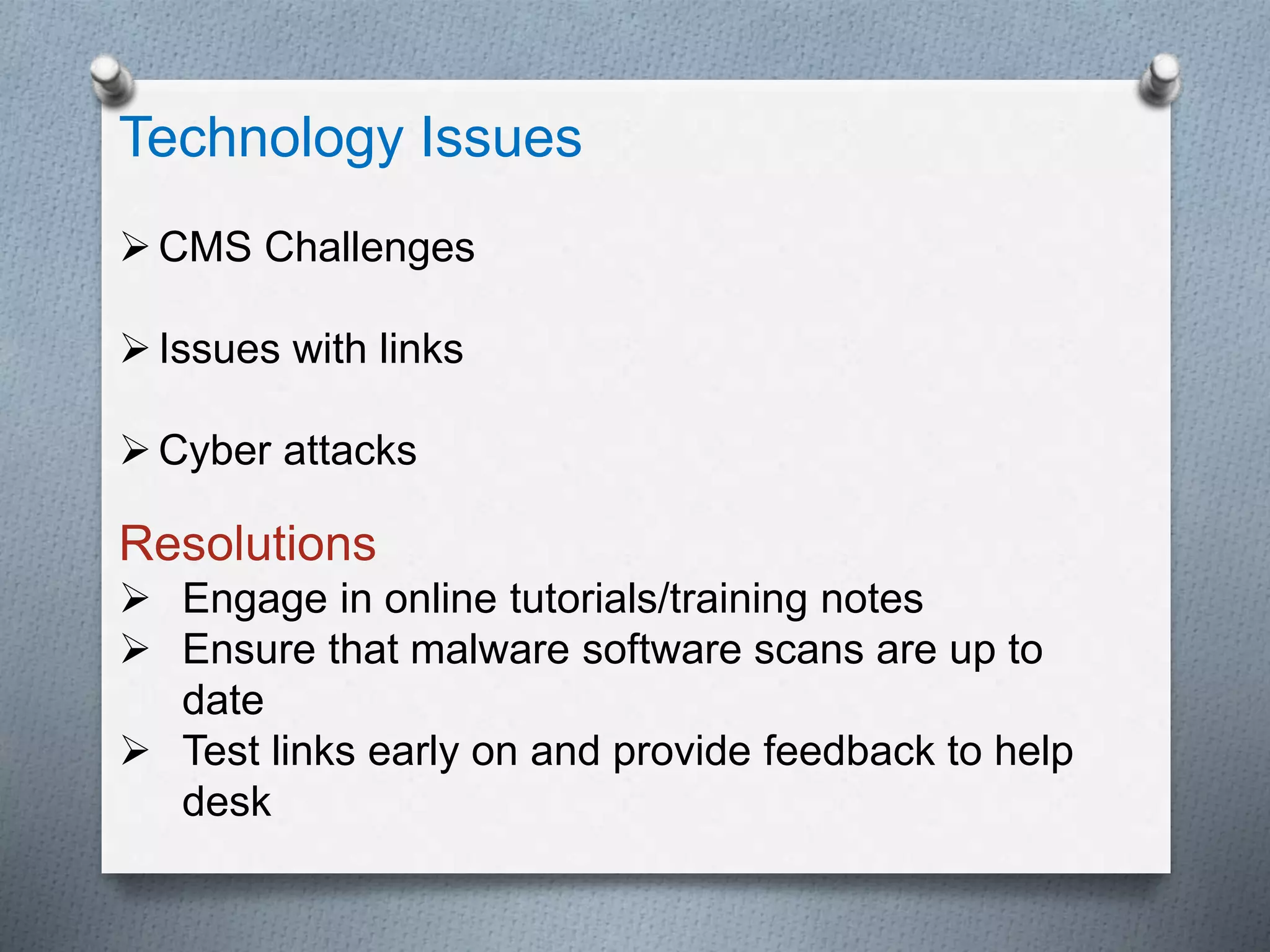
Technology Issues
CMS Challenges
Issues with links
Cyber attacks
Resolutions
 Engage in online tutorials/training notes
 Ensure that malware software scans are up to
date
 Test links early on and provide feedback to help
desk
 Classroom Issues and Resolutions
Messages, Comments, and Audio
Learner feedback will be sent via email, Instant Messaging, voice mail
depending on how the facilitator provided communication tools and
how learner initiates communication.
ADA Learners and Associated Strategies
Facilitators must familiarize themselves with the Americas with Disability Act.
Students that fall into these eligibility categories and under the ADA are not to
discriminated against by law and have reasonable accommodations available
in the learning environment such as electronic devices for the hearing
impaired, has a physical or mental impairment that substantially limits one or
more major life activities, . Learners must disclose disability and needs prior
to class to make accommodations available. Academic adjustment or auxiliary
aids, adaptive equipment and services. Tips for instructors:
 Consider any accommodation request
 Use caution in inquiring about the specific nature of the disabling
condition; respect confidentiality
 Section 504 of the Rehabilitation Act of 1973 and the ADA
No otherwise qualified person with advisability shall be denied a benefit or
opportunity or be excluded from participation solely on the basis of that
disability.
* Accommodations will alleviate any feeling of isolation and exclusion and
digital divide in the distance learning environment. (Office of Civil Rights & Title
IX, 2016).
References
Audioboom. (n.d.). Retrieved from
http://audioboom.com/about/education
Dubowy, M. (2013). LMS vs LMCMS vs CMS Changing One
Letter Makes a Dig Difference. Retrieved from
https://www.opensesame.com/blog/lms-vs-lcms-vs-
cmschanging-one-letter-makes-big-difference
Glogster. (2014). Retrieved from http://edu.glogster.com/.
References
Reh, J. F. (2016, August). A Guide to Understanding the Role of a Mentor . the balance, (), .
https://www.thebalance.com/a-guide-to-understanding-the-role-of-a-mentor-2275318.
Haythornthwaite, C., & Andrews, R. (2011). E-learning Theory and Practice. Thousand Oaks, CA: SAGE
Publications Inc.
Hrastinski, S. (2008). Asynchronous and Synchronous E-Learning. Retrieved from
https://net.educause.edu/ir/library/pdf/eqm0848.pdf
Jones, R. C. (2014). Keeping students engaged in the online classroom. Retrieved from
http://www.facultyfocus.com/articles/online-education/ keeping-students-engaged-in-the-online-classroom/
Kelly, R. (2013, March). Managing controversy in the online classroom. Retrieved from
http://www.facultyfocus.com/articles/online-education/ managing-controversy-in-the-online-classroom/
LiveBinders Inc.. (2016). LiveBinders. Retrieved from http://www.livebinders.com/welcome/education
Office of Civil Rights & Title IX. (2016). Accessibility and ADA Education. Retrieved from
http://ada.missouri.edu/classroom.php
Palloff,R.M., &Pratt, K. (2011). The excellent online instructor: Strategies for professional development. San
Francisco, CA: Jossey-Bass

Facilitator Training Manual Option II Asynchronous by Audrey Allen CUR 532

  • 1.
    Audrey L Allen CUR532 October 3,2016 Garth Beerman Facilitator Training Program Option II Asynchronous Learning
  • 2.
    Welcome Hello my nameis Audrey L. Allen and I will be guiding you through this Facilitator Training Program for “Skyview Airlines” new hire trainers. This will be an Asynchronous Module Model. "The myth asserts that it is easy to teach online—all one needs to do is to move exactly what was being done in the face-to-face classroom into the online classroom." (Palloff & Pratt, 2011, Chapter 1,What are the characteristics of excellent online teaching). Effective Facilitators in a distance learning environment must possess fundamental skills. Today the goal is to prepare you as an effective online facilitator trainer by providing the knowledge and skills necessary to train others. If you have any questions , feel free to ask at anytime throughout the course. NOTE: It is necessary that you the learner click on all provided links, read PowerPoints, videos and articles.
  • 3.
    Contact Information for Audrey LAllen (Trainer) • Phone: (315)516-2076 • Email: lanonadarling@email.phoenix.edu • Gmail chat or video: justus2aa@gmail.com
  • 4.
    Part I- VitalInformation • Training Program Audience • Training Program Goals • Training Program Objectives • Summative Assessment of Trainee Learning
  • 5.
    The Audience  50new asynchronous Skyview Airlines instructors  Corporate Flight Attendant Trainer Team Note: No prior distance learning education
  • 6.
    Assumed Current SkillSet and Experience of Trainees: O Skill Set Personalized computer skills to include Microsoft Office products and particular skill required for equipment used in the airline industry O Experience At least three years of classroom training experience with little or no online training instruction O Current level of knowledge Proficient in training techniques and most are SME (Subject Matter Expert) in their field.
  • 7.
    Upon completion ofthis course, trainers will be able to facilitate an online course to support the training needs of airline employees around the world. : Essential Skills Needed  Establish Presence  Facilitation  Feedback  Maintain a learning community (Palloff &Pratt, 2011) https://daystead.wordpress.com/2012/04/25/ the-adaptable-teacher/
  • 8.
     After takingthis course, trainers will be able to create and maintain an online presence.  After taking this course, trainers will be able to develop and maintain facilitation and feedback skills  After taking this course, trainers will be able to establish and become proficient in feedback skills  After taking this course, trainers will be able to create and maintain a learning community Program Goals to Develop Distance Learning Facilitator Skills Are:
  • 9.
     The needto be present and available throughout the course  The need to get to know your students  The need to guide students through active engagement that prompts student participation and promotes critical thinking skills  The need to give students additional ways to communicate if necessary  The need to provide constructive and timely feedback in forums and individually  The need to be familiar with technology tools that will support the online and social learning environment. Key Elements of Training
  • 10.
  • 11.
     Objective 1- Participants will identify and explain at least five ways to create a presence within an online learning environment.  Objective 2 – Participants will demonstrate how to maintain an online presence (training course management system (CMS) simulator and the use of social media tools will be a guide).  Objective 3 – Participants will produce at least five discussion prompts and real world situational examples that engage students and display competency of facilitation skills.  Objective 4 - Participants will apply class scenario and apply substantive feedback to at least five students post via forum or thread (3 must address students challenges)Training course management system (CMS) will be the tool used.  Objective 5 – participants will demonstrate two strategies on how to create and maintain a learning community. (Training course management CMS will be used). (80% passing rate)  Objective 6 – Participants will identify and use at least ten online tools that can be utilized during online courses.
  • 12.
    Summative Assessment of TraineeLearning Informal assessments will be completed at the end of each training module, which consists of a multiple choice test. The multiple choice test will identify areas of need; and if concepts were grasped before transitioning to the next module. Also, at the end of the course, participants will demonstrate their knowledge and ability to facilitate online through mini course simulations and meet course objectives. In addition, the course participants will be given an evaluation via online format (sample assignments: meeting goals and objectives, group forums, posts, tasks etc.).This will measure if the course supported the learning objectives, and provided quality learner experience for the facilitator and learner (Palloff&Pratt, 2011)
  • 13.
    Part II- Skillsand Materials Training Materials Phases in Development Theories of Distance Learning Theories of Engaging Distance Learners
  • 14.
    Training Materials Materials:  (Trainer)laptop,  Smart Board,  Laptop,  Social media tools  Short media lessons (Livebinders, YouTube)  Online airline industry library of documents.  Podcast (ITunes, Glogster, and AudioBoom  Audio casts for auditory learners.
  • 15.
  • 16.
    Skills Needed forEffective Distance Learning/Training Facilitators  Establish an online presence To develop and maintain facilitation skills establish proficient feedback skills create and sustain a learning community
  • 17.
     Video Sharing Glogster  Discussion Boards  Social media tools in which Facebook can be used as a means of connectivity and visibility  Introductions through Icebreakers, social thread presence, course introduction and developing substantive questions  Practice feedback through online class scenarios to ensure time management and learner improvement based on timely responses  Active Interaction - Learner-focused activities via collaborative learning tasks and projects that support learner group and community
  • 18.
    According to Palloff& Pratt,(2011) the online facilitator goes through five phases of development.
  • 19.
    Visitor Novice Apprentice Insider Master Phases of Developmentfor Distance Learning Facilitators Through their teaching experience over the last ten years, Palloff and Pratt (2011) have identified five distinct phases to facilitate development. The stages of development for distance learning facilitators are described as follows:
  • 20.
    Although hesitant toconduct online class, they embrace the idea but lack technological knowledge. Preference is face to face communication; however, they will attempt to use some technology. (ex. Posting online syllabus or informational email). To create faculty interest, exploring with technical tools can enhance the learning environment. (Palloff&Pratt, 2011) Visitor Phase of Development
  • 21.
    They use technologyto support their traditional classes; however they never taught distance learning classes and fear of actually being able to facilitate an online curse. Experimentation and practice can benefit Novice faculty as a learner with mentor support and feedback. To assist in transitioning the Novice faculty to the apprentice stage, building confidence should be present. (Palloff&Pratt, 2011) Novice Phase of Development
  • 22.
  • 23.
    Insider Phase ofDevelopment
  • 24.
    Mastery Phase ofDevelopment They are experienced online facilitators who search for and experiment course development and delivery strategies and techniques. Master faculty is often called upon to mentor new faculty while advancing their skill set.
  • 25.
     Example. Teacher asa learner: The information gathering stage where instructors develop technology skills to use within their individual course.
  • 26.
    Teacher as adopter:The experimental stage where instructors were trying out different technology tools while share experiences with another faculty.  Example
  • 27.
     Example Teacher asco-learner: The instructor recognizes the connection between technology and course delivery through the use of workshop and seminars
  • 28.
     Example Teacher asreaffirmer or rejector: The instructor develops an awareness of learning outcomes through trial and error scenarios, and the ability to see how different strategies impact student learning.
  • 29.
     Example Teacher asLeader: The instructor is a researcher and has enough experience to teach others about the technology they are familiar with. Stage 5
  • 30.
    Theories of Distance Learning CommunalConstructivism Theory  The Transformative Learning Theory Transactional Distance Learning Theory
  • 31.
    Theories of Engaging DistanceLearners  Communal Constructivism Theory by Homes and Gardner suggest:  Individuals receive support from a community  Considered a repository of knowledge  Enable individuals to collaborate  Connect and learn from each other through social interactions  enhance participation where social rules and skills are learned (Haythornthwaite & Andrews, 2011).
  • 32.
  • 33.
    Theories of Engaging DistanceLearners  Transformative Learning Theory by Mezirow suggests:  How individuals accept information to add to their existing understanding  Change their opinion based on what is important to them  Distance learners can utilize available resources  Process the information  Make connections that support the shift in understanding
  • 34.
    Theories of Engaging DistanceLearners  Moore’s Theory of Transactional Distance Learning suggests:  Effective learning is based on dialogue  Structure of the program  Learner autonomy Haythornwaite & Andrews,2004
  • 35.
    Application of Theories ODigital Media -Focuses on the visual mode of communication that distance learners can use to engage each other within the learning environment Digital media has become an extension of today’s learner that creates more opportunities to engage in learning that relevant by "doing" through media technology. (Haythornthwaite & Andrews, 2011).
  • 36.
    Application of Theories OIntrinsic Motivation - A concept that individuals must make an effort to gain knowledge due to being isolated from other learners. (Haythornthwaite & Andrews, 2011). Distance learners must have a need to be driven to fuel their curiosities, be eager to learn and become a lifelong learner and professional growth. This can happen by seeking out resources and connections from peers, mentors or instructors. Without interactions there is no growth and the distance learner may become isolated
  • 37.
    Application of Theories OSocial Informatics -Haythornthwaite and Andrews (2011) state that “social informatics is an interdisciplinary body of theory that includes consideration of the design, uses and affordances of information and communication technologies” that learners use socially, institutionally and culturally. Multiple media tools and modes of communication can be used by distance learners to engage with others without geographical barriers. This changes the mindset of how distance learners can relate to each other (instructors, experts, classmates) in the learning environment. This can be used to make connections through a personal learning network to support professional growth and lifelong learning
  • 38.
    Summary of Theoriesto Engage Distance Learning O Using various forms of interactive technology O Visual and audio O Create real world experiences O Incorporate live streams in “real time” O Ask follow up questions to promote critical thinking O Encourage participation
  • 39.
  • 40.
    Part III –Managementand Technology Tools Learning Platform – LMS/CMS for Facilitation Technology and Media Tools Mentoring Program Evaluations for Programs
  • 41.
    Mentoring Program for Faculty Goalsand Objectives http://www.calpro-online.org/pubs/Mentoring%20Guide.pdf
  • 42.
    Mentoring Goals Objectives O Willb have a better understanding of what is mentoring O Will gain knowledge about the significance of mentoring program O Will gain an understanding of how to effectively use technology with confidence O Novice instructors will be able to competently discuss in depth what is mentoring. O Given the information Novice instructors will be able to discuss the benefits of having a mentor. O Novice instructor will be able to distinguish characteristics of an effective mentor for distance learning to develop, put into practice and execute as an online instructor
  • 43.
    Background Mentoring can beinformal or formal and everyday individual engage in some form or mentoring What is mentoring? Mentoring is a long term relationship where the focus is on supporting the growth and development of the mentee. The mentor is a source of wisdom, teaching and support, but not someone who observes and advises on specific actions or behavioral changes in daily work. (Reh, 2016).
  • 44.
    Top Five Characteristicsof Effective Mentor/ Facilitator  Accountability includes overall planning an effective program . Facilitators bring the expectation of transferable skill sets and strengths while focusing on areas of need of mentees . Facilitators also have the responsibility of updating technological skills to model technology. Being accountable sets the tone of the success of the mentor and mentees  Alignment is implanting mentoring into the culture as a priority and support efforts to increase knowledge, information and change as an ongoing process with learning. In addition, implanting mentoring into the culture, in turn develops the following with the Facilitator  Safety Net Having a safety net ensures timely support and guidance for students during transitioning into the mentoring program. Being available is am important baseline in assisting new faculty with possible challenges, adjust to the new environment, sharing ideas which give a sense of belonging. The top five list of characteristics of effective faculty mentoring programs for distance learning include the following: accountability, alignment, safety net, role modeling and drive technology. (Palloff &Pratt,2011)  Role Modeling Success should be publicly shared when new faculty is mentored by seasoned and confident faculty that possess leadership qualities. Role modeling help shape new faculty careers by sharing their knowledge, past mistakes and experiences, Criticisms as well a praise may be warranted in order to strengthen mentees to strive at achieving goals.  Technology  Without technology, distance education would be non existent. Mentees will benefit by adopting changes in technology and seek guidance in course development. The greater the knowledge of media and technology, the more effective training will be. Graphic Organizers Video Communication Media Computer Technology  (Palloff &Pratt,2011)
  • 45.
    Novice Facilitator Identification ofCriteria O New to distance learning environment O Have existing experience in traditional learning environments O Unsure how to set up technology and deliver class instruction O Have experience in their field O Require assistance with technology and how to effectively utilize interactive tools in the learning environment
  • 46.
    Experience with Distance Education A master of insider facilitator could be a mentor  Have taught several online classes successfully  Knows how to engage with the online learners
  • 47.
    Mentoring: What itis and is not https://www.alnmag.com/article/2011/01/mentoring- what-it-and-not Please Read: (click the link below)
  • 48.
    Management and Evaluation Programs OFaculty learning community approach helps to reduce the feeling of isolation. O People learn from others and it is important to have a strong support system in the online learning environment. O The ability to interact with others can really impact all parties involved in the learning environment. O Allowing ongoing support for faculty members O Adhere to budget guidelines O Building a string network which can decrease the feeling of isolation and apprehension for new members O Take feedback from post course evaluations and make necessary changes
  • 49.
    Challenges Strategies O Lackof administrative support O Lack of technical support O Spontaneous mentoring O Matching mentoring without choice O Role reversal from instructor to learner O Are facilitators properly trained O Provide technical training and support; possibly a technical support team 24/7 O Easy access to software for facilitators and learners O Structured mentoring program O Group mentoring with faculty learning O Assist in balancing instructor mode (turn off), and turn on learner mode O Provide monitor and evaluation to meet goals and objectives. O Communication O Community Building
  • 50.
    Evaluation Strategies  Mentorsmay act as evaluators  Participant evaluation of distance learning instructor  Ask relevant questions about what is being instructed  Keep record of progress  Peer reviews from other online facilitators  Create a rubric to measure training expectations and share findings
  • 51.
    Platform for Facilitating: CMS (Content Management System)
  • 52.
    Platform for Facilitating: LMS (Learning Management Systems
  • 53.
  • 54.
    Technology and MediaTools for Collaboration Video – You Tube https://youtu.be/nz6SwliUWoE Visual or Infographics http://edu.glogster.com/?ref=com LiveBinder https://www.youtube.com/watch?v=NFTzLUPBJ6g#action=share http://livebinders.wikispaces.com/A%29+What+is+LiveBinder%3F Audio – Audioboom  https://audioboom.com/
  • 55.
    Video sharing websiteand learning tools that allow users to upload original content and share topics of interest. YouTube supports interactive learning with vast resources for topic specific content. Both learners and facilitators can engage in collaborative efforts through presentations, introduction to new topics and step by step simulations.
  • 56.
    Glogster This innovative digitaloutlet captures learner's excitement for online creations, keeps learners engaged in course content, and makes teaching and learning more fun. Instructors control interactive activities by participants , and this platform is a valuable teaching tool that integrates diverse subjects .
  • 57.
    Livebinder . LiveBinder isan online bookmarking site for storing and sharing online resources and teaching tools .Facilitators can create lists for learners that they believe are suitable and relevant for training. (LiveBinders Inc., 2016).
  • 58.
    Audioboom A mobile, web,and connected device platform voiceover tool that supports I interactive learning by allowing Learners to divide narrated tasks from the visual. Audiboom is used to capture a story behind the picture. From there, learners can Host and distribute content and tag location.
  • 59.
    Processes facilitators willuse:  Introduction of self/ Icebreakers  Make presence known by remaining available and engaged  Maintaining organization with instruction and teaching tools  Encourage learner to learner interaction  Execute facilitator to learner interaction  Welcome questions  Monitor discussions/guide on the side  Acknowledgement of questions and responses  Establish clear instructions on assignments due date, location  and time frame  Constructive feedback in professional tone Click on link for b Distance Learning Classroom Management: https://www.powtoon.com/online-presentation/gn1h4mfGClh/distance-education-classroom/?mode=movie#/
  • 60.
    Classroom Management & Issues withResolutions Technology Tools Description of Learners Synchronous vs Asynchronous Technology Issues Classroom Issues
  • 61.
    Description of Distance Learners ONon Traditional O Experiential O Cultural The distance learners are primarily new hire trainers of Skyview Airlines that support training of all new hires per department; both Corporate Trainers and Support Airport Staff have over 10 years in the transportation/airline industry. Learners have little or no online training, however are very comfortable in a traditional learning environment.
  • 62.
    Challenging Behaviors Inappropriate Posts-Online expectations will be given at the beginning of course, It is expected learners abide by standards. Consequences will be followed through via chain of command. Cyber bullying- Harassing classmates will not be tolerated. Issues, company interventions and instructional strategies for creating a safe learning environment to break the cycle of bullying and cyberbullying will be imposed. Lack of participation or engagement – In order to encourage participation, instructors would benefit by setting goals, create and provide a detailed syllabus, and log in often to provide timely responses
  • 63.
    Synchronous vs AsynchronousOAsynchronous Learning O Self paced learning; time--any time anywhere O Flexible O Classroom occurrences O Create a forum or give instruction to ask questions O Requires self motivation O Does not require immediate presence of faculty and student O Encourage students to build upon prior knowledge with current information. O Ability to read between the lines in their learners’ comments, posts, and assignments. O Note: Asynchronous instructors provide materials, tasks and assignments that learners can access at any time. Students are free to contribute when they choose. within a given timeline. Travel may become expensive, however collaboration is easier with learners as all individuals are tuned in. O Synchronous Learning O Learning at the same time O Quick responses expected O Group discussions O Instructor led learning O Immediate feedback is available to students O Facilitator have thorough knowledge of web tools must be technology-savvy because their connection to learners O Add the human element by treating the class as if they were in the same room O Allow time for learners to practice, participate, and ask questions. O Note: Synchronous facilitators offer lectures, discussions, and interaction occur at a specific hour. All students must be online at that specific hour in order to participate. Facilitators are unable to perceive visual or auditory cues of students’. No travel cost to facilitate
  • 64.
    Technology Issues CMS Challenges Issueswith links Cyber attacks Resolutions  Engage in online tutorials/training notes  Ensure that malware software scans are up to date  Test links early on and provide feedback to help desk
  • 65.
     Classroom Issuesand Resolutions Messages, Comments, and Audio Learner feedback will be sent via email, Instant Messaging, voice mail depending on how the facilitator provided communication tools and how learner initiates communication.
  • 66.
    ADA Learners andAssociated Strategies Facilitators must familiarize themselves with the Americas with Disability Act. Students that fall into these eligibility categories and under the ADA are not to discriminated against by law and have reasonable accommodations available in the learning environment such as electronic devices for the hearing impaired, has a physical or mental impairment that substantially limits one or more major life activities, . Learners must disclose disability and needs prior to class to make accommodations available. Academic adjustment or auxiliary aids, adaptive equipment and services. Tips for instructors:  Consider any accommodation request  Use caution in inquiring about the specific nature of the disabling condition; respect confidentiality  Section 504 of the Rehabilitation Act of 1973 and the ADA No otherwise qualified person with advisability shall be denied a benefit or opportunity or be excluded from participation solely on the basis of that disability. * Accommodations will alleviate any feeling of isolation and exclusion and digital divide in the distance learning environment. (Office of Civil Rights & Title IX, 2016).
  • 67.
    References Audioboom. (n.d.). Retrievedfrom http://audioboom.com/about/education Dubowy, M. (2013). LMS vs LMCMS vs CMS Changing One Letter Makes a Dig Difference. Retrieved from https://www.opensesame.com/blog/lms-vs-lcms-vs- cmschanging-one-letter-makes-big-difference Glogster. (2014). Retrieved from http://edu.glogster.com/.
  • 68.
    References Reh, J. F.(2016, August). A Guide to Understanding the Role of a Mentor . the balance, (), . https://www.thebalance.com/a-guide-to-understanding-the-role-of-a-mentor-2275318. Haythornthwaite, C., & Andrews, R. (2011). E-learning Theory and Practice. Thousand Oaks, CA: SAGE Publications Inc. Hrastinski, S. (2008). Asynchronous and Synchronous E-Learning. Retrieved from https://net.educause.edu/ir/library/pdf/eqm0848.pdf Jones, R. C. (2014). Keeping students engaged in the online classroom. Retrieved from http://www.facultyfocus.com/articles/online-education/ keeping-students-engaged-in-the-online-classroom/ Kelly, R. (2013, March). Managing controversy in the online classroom. Retrieved from http://www.facultyfocus.com/articles/online-education/ managing-controversy-in-the-online-classroom/ LiveBinders Inc.. (2016). LiveBinders. Retrieved from http://www.livebinders.com/welcome/education Office of Civil Rights & Title IX. (2016). Accessibility and ADA Education. Retrieved from http://ada.missouri.edu/classroom.php Palloff,R.M., &Pratt, K. (2011). The excellent online instructor: Strategies for professional development. San Francisco, CA: Jossey-Bass
Editor's Notes

  • #2 1- Cover Page – Audrey L. Allen CUR 532 October 3,2016 Facilitator Program Asynchronous Learning Option II
  • #3 2 – Welcome
  • #4 3- Contact Information
  • #5 4- Part I – Vital Information in the Facilitator Training
  • #6 5- The Audience
  • #7 6- Assumed Current Skill Set, Experience and Current knowledge
  • #8 7 - Program Goals: Essential skills a teacher needs to be successful distance facilitators (1) establish presence (2) facilitation (3) feedback, and (4) maintain a learning community (Palloff &Pratt, 2011)
  • #9 8- Program Goals to Develop Distance Learning Facilitator Skills
  • #10 9- Key Elements of Training
  • #11 10 – Training Program Objectives
  • #12 11- Training Program Objectives: Participants will be given a manual as a guide and have supporting background information throughout the training .)
  • #13 12- Measurements for Program and Trainee Success
  • #14 13- Skills and Materials
  • #15 14- Training Materials
  • #16 15- Module 1 Facilitator Skills and Instructional Materials
  • #17 16 – Skills Needed for Effective Distance Learning/ Training Facilitators
  • #18 17 - Strategies
  • #19 18 – The Excellent Online Instructor
  • #20 19 – Phases of Development for Distance Learning Facilitators
  • #21 20 – Visitor Phase
  • #22 21- Novice Phase
  • #23 22- Apprentice Phase
  • #24 23- Insider Phase
  • #25 24- Mastery Phase
  • #26 25 - Example Stage One
  • #27 26- Example Stage Two
  • #28 27 – Example Stage Three
  • #29 28 – Example Stage Four
  • #30 29 – Example Stage Five
  • #31 30 - TheoroesThe communal constructivism theory by Homes and Gardner The transformative learning theory by Mezirow Moore’s Theory of Transactional Distance Learning 30 – Theories of Distance Learning ( Communal, Constructivism, and Transactional )
  • #32 31- Example when students begin an online distance course, or new employee orientation for the first time, it is then where adults learn how to navigate the system and communicate with each other and understand social norms through discussion boards and communities of practice. (Haythornthwaite & Andrews, 2011).
  • #33 32- What is engagement? In an online environment it is key to interact form the beginning of any training or course by greeting participants by name .Once interaction begins, it is important to keep up the momentum as learners becomes comfortable with the platform. To engage online learners, keep the focus on them by asking thought provoking questions on learners, acknowledge contributions and appreciate input. Creating dialogue and promote collaboration by directing learners to each other through content.
  • #34  33- For example, multiple sources of information can be found in discussion boards, personal learning networks and communities of practice which defines an exchange of ideas and perspectives from a diverse community. Different perspectives can provide clarity but more in depth in assessing one's knowledge and comprehension of the topic of discussion
  • #35 34- Theories of Engaging Distance Learners
  • #36 35- Application of Theories (Digital Media)
  • #37 36- Application of Theories (Intrinsic Motivation)
  • #38 37- Application of Theories (Social Informatics)
  • #39 38 – Summary of Theories to Engage Distance Larning
  • #40 39- Module 2 - Management and Technology Tools
  • #41 40- Part II – Management and Technology Tools
  • #42 41- Mentoring Program for Faculty link
  • #43 42- Mentoring Goals and Objectives
  • #44 43- Background
  • #45 44- Top 5 Characteristics
  • #46 45 Novice Facilitator Criteria
  • #47 46- Experience with Distance Education
  • #48 47- Mentoring: What it is and is not link
  • #49 48- Management and Evaluation Programs
  • #50 49- Challenges and Strategies
  • #51 50- Evaluation Strategies
  • #52 51- CMS (Dubowy, 2013).
  • #53 52- LMS (Dubowy, 2013).
  • #54 53- Module 3 - Issues and Classroom Management
  • #55 54- Technology and Media Tools for Collaboration
  • #56 55 - YouTube
  • #57 56- Glogster
  • #58 57- Livebinder
  • #59 58 - Audioboom
  • #60 59- Processes
  • #61 60- Classroom Management & Issues with Resolutions
  • #62 61- Description of Distance Learners
  • #63 62- Challenging Behaviors
  • #64 63- Asynchronous - Time delay in communication  Self-discipline  Flexible  Tech-savvy  Lack of collaboration  Interacts with media based assignments - Synchronous - Communication more immediately  Lacks self-motivation  Interacts with people  Not flexible People oriented  Ability to identify confusion or frustration
  • #65 64- Technology Issues
  • #66 65- Classroom Issues and Resolutions
  • #67 67- ADA Learners and Associated Strategies
  • #68 67 – References - Audioboom. (n.d.). Retrieved from http://audioboom.com/about/education Dubowy, M. (2013). LMS vs LMCMS vs CMS Changing One Letter Makes a Dig Difference. Retrieved from https://www.opensesame.com/blog/lms-vs-lcms-vs-cmschanging-one-letter-makes-big-difference Glogster. (2014). Retrieved from http://edu.glogster.com/.
  • #69 68- References - Haythornthwaite, C., & Andrews, R. (2011). E-learning Theory and Practice. Thousand Oaks, CA: SAGE Publications Inc. Hrastinski, S. (2008). Asynchronous and Synchronous E-Learning. Retrieved from https://net.educause.edu/ir/library/pdf/eqm0848.pdf Jones, R. C. (2014). Keeping students engaged in the online classroom. Retrieved from http://www.facultyfocus.com/articles/online-education/ keeping-students-engaged-in-the-online-classroom/ Kelly, R. (2013, March). Managing controversy in the online classroom. Retrieved from http://www.facultyfocus.com/articles/online-education/ managing-controversy-in-the-online-classroom/  LiveBinders Inc.. (2016). LiveBinders. Retrieved from http://www.livebinders.com/welcome/education Office of Civil Rights & Title IX. (2016). Accessibility and ADA Education. Retrieved from http://ada.missouri.edu/classroom.php Palloff,R.M., &Pratt, K. (2011). The excellent online instructor: Strategies for professional development. San Francisco, CA: Jossey-Bass