1 3
6
2
5 8
4
7
1 2 3 4 5
6 7 8 9 10
1 2 3 4 5
6 7 8 9 10
ACTIVITY
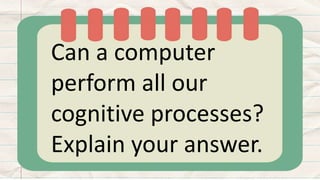
Can a computer
perform all our
cognitive processes?
Explain your answer.
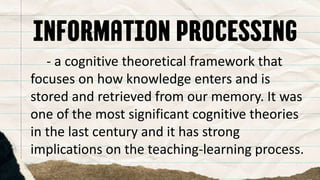
Information processing
- a cognitive theoretical framework that
focuses on how knowledge enters and is
stored and retrieved from our memory. It was
one of the most significant cognitive theories
in the last century and it has strong
implications on the teaching-learning process.
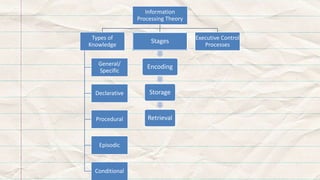
Information
Processing Theory
Types of
Knowledge
General/
Specific
Declarative
Procedural
Episodic
Conditional
Stages
Executive Control
Processes
Stages
Encoding
Storage
Retrieval
Cognitive psychologists believed that
cognitive processes influenced the nature
of what is learned. They consider learning
as largely an internal process, not an
external behavior change. They look into
how we receive, perceive, store and
retrieve information.
Information Processing Theory
IPT describes how the learner receives
information (stimuli) from the environment
through the senses and what takes place in
between determines whether the
information will continue to pass through
the sensory register, then the short term
memory and the long term memory.
1 GENERAL VS. SPECIFIC
This involves whether the
knowledge useful in many
tasks, or only in one.
2 declarative
This refers to factual
knowledge. They relate to the
nature of how things are. They
may be in the form of a word or
an image.
3 procedural
This includes knowledge on
how to do things. Examples
include making a lesson plan,
baking a cake, or getting the
least common denominator.
4 episodic
This includes memories of life
events, like your high school
graduation.
5 conditional
This is about “knowing when
and why” to apply declarative
or procedural strategies.
The stages of IPT involves the functioning
of the senses, sensory register, short term
memory and the long term memory.
Basically, IPT asserts three primary stages in
the progression of external information
becoming incorporated into the internal
cognitive structure of choice (schema,
concept, script, frame, mental model, etc.)
1 Encoding
Information is sensed, perceived,
and attended to.
2 storage
The information is stored for
either a brief or extended period
of time, depending upon the
processes following encoding.
3 Retrieval
The information is brought back
at the appropriate time, and
reactivated for use on a current
task, the true measure of
effective memory.
What made IPT plausible was the
notion that cognitive processes could be
described in a stage-like model. The
stages to processing follow a trail along
which information is taken into the
memory system, and brought back
(recalled) when needed.
The first step in the IP
model, holds all sensory
information for a very brief
time.
Capacity: Our mind
receives a great amount of
information but it is more
than what our minds can
hold or perceive.
Duration: The sensory
register only holds the
information for an extremely
brief , in the order of 1 to 3
seconds.
Duration: There is a
difference in duration based
on modality: auditory
memory is more persistent
than visual.
 To bring information into
consciousness, it is necessary that
we give attention to it. Such that,
we can only perceive and
remember later those things that
pass through our attention “gate”.
 Getting through this attentional
filter is done when the learner is
interested in the material; when
there is conscious control over
attention, or when information
involves novelty, surprise, salience,
and distinctiveness.
 Before information is perceive, it is
known as “precategorical”
information. This means that until
that point, the learner has not
established a determination of the
categorical membership of the
information.
To this point, the information is coming
in as uninterpreted patterns of stimuli.
Once it is perceived, we can categorize,
judge, interpret, and place meaning to
the stimuli. If we fail to perceive, we
have no means by which to recognize
that the stimulus was ever encountered.
Capacity: The STM can only hold 5
to 9 “chunks” of information,
sometimes described as 7 +/- 2. It is
called working memory because it is
where new information is temporarily
placed while it is mentally processed.
Capacity: STM maintain
information for a limited time, until
the learner has adequate resources
to process the information, or until
the information is forgotten.
Duration: Around 18 seconds
or less.
 To reduce the loss of information
in 18 seconds, you need to do
maintenance rehearsal. It is using
repetition to keep the information
active in STM.
Capacity: LTM has
unlimited capacity.
Duration: Duration in the
LTM is indefinite.
The executive control processes
involve the executive processor or
what is referred to as metacognitive
skills. These processes guide the flow
of information through the system,
helps the learner make informed
decisions about how to categorize,
organize, or interpret information.
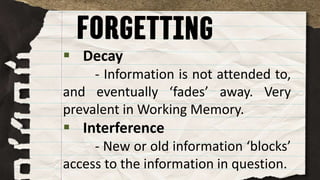
- is the inability to retrieve or
access information when
needed.
 There are two main ways in
which forgetting likely occurs:
 Decay
- Information is not attended to,
and eventually ‘fades’ away. Very
prevalent in Working Memory.
 Interference
- New or old information ‘blocks’
access to the information in question.
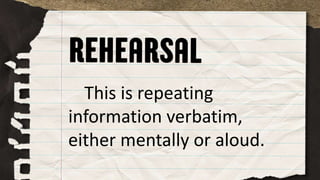
This is repeating
information verbatim,
either mentally or aloud.
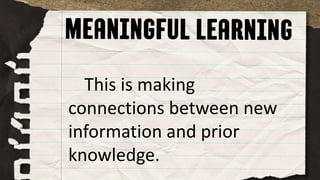
This is making
connections between new
information and prior
knowledge.
It is making connections
among various pieces of
information. Information that
is organized efficiently should
be recalled.
This is adding additional
ideas to new information
based on what one already
knows. It is connecting new
info with old, to gain meaning.
This means forming a
“picture” of the information.
Things we ‘produce’ are
easier to remember than
things we ‘hear’.
Remembering the
situation helps recover
information.
It is making the
information relevant to
the individual.
You will remember the
beginning and end of ‘list’
mostly readily.
Break up the ‘list’ or
“chunk” information to
increase memorization.
Break up learning sessions,
rather than cramming all the
info in at once. (Massed
Practice)
These are memory
techniques that learners may
employ to help them retain and
retrieve information more
effectively.
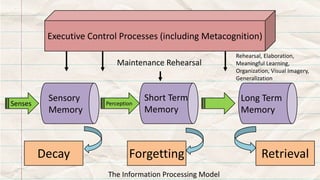
Executive Control Processes (including Metacognition)
Senses Perception
Decay Forgetting Retrieval
Maintenance Rehearsal
Rehearsal, Elaboration,
Meaningful Learning,
Organization, Visual Imagery,
Generalization
Sensory
Memory
Short Term
Memory
Long Term
Memory
The Information Processing Model

Prof. Ed 6 BEED Information-Processing.pptx

  • 3.
  • 5.
    1 2 34 5 6 7 8 9 10
  • 7.
    1 2 34 5 6 7 8 9 10
  • 10.
  • 11.
    Can a computer performall our cognitive processes? Explain your answer.
  • 12.
    Information processing - acognitive theoretical framework that focuses on how knowledge enters and is stored and retrieved from our memory. It was one of the most significant cognitive theories in the last century and it has strong implications on the teaching-learning process.
  • 13.
  • 14.
    Cognitive psychologists believedthat cognitive processes influenced the nature of what is learned. They consider learning as largely an internal process, not an external behavior change. They look into how we receive, perceive, store and retrieve information.
  • 15.
    Information Processing Theory IPTdescribes how the learner receives information (stimuli) from the environment through the senses and what takes place in between determines whether the information will continue to pass through the sensory register, then the short term memory and the long term memory.
  • 17.
    1 GENERAL VS.SPECIFIC This involves whether the knowledge useful in many tasks, or only in one.
  • 18.
    2 declarative This refersto factual knowledge. They relate to the nature of how things are. They may be in the form of a word or an image.
  • 19.
    3 procedural This includesknowledge on how to do things. Examples include making a lesson plan, baking a cake, or getting the least common denominator.
  • 20.
    4 episodic This includesmemories of life events, like your high school graduation.
  • 21.
    5 conditional This isabout “knowing when and why” to apply declarative or procedural strategies.
  • 23.
    The stages ofIPT involves the functioning of the senses, sensory register, short term memory and the long term memory. Basically, IPT asserts three primary stages in the progression of external information becoming incorporated into the internal cognitive structure of choice (schema, concept, script, frame, mental model, etc.)
  • 24.
    1 Encoding Information issensed, perceived, and attended to.
  • 25.
    2 storage The informationis stored for either a brief or extended period of time, depending upon the processes following encoding.
  • 26.
    3 Retrieval The informationis brought back at the appropriate time, and reactivated for use on a current task, the true measure of effective memory.
  • 27.
    What made IPTplausible was the notion that cognitive processes could be described in a stage-like model. The stages to processing follow a trail along which information is taken into the memory system, and brought back (recalled) when needed.
  • 29.
    The first stepin the IP model, holds all sensory information for a very brief time.
  • 30.
    Capacity: Our mind receivesa great amount of information but it is more than what our minds can hold or perceive.
  • 31.
    Duration: The sensory registeronly holds the information for an extremely brief , in the order of 1 to 3 seconds.
  • 32.
    Duration: There isa difference in duration based on modality: auditory memory is more persistent than visual.
  • 33.
     To bringinformation into consciousness, it is necessary that we give attention to it. Such that, we can only perceive and remember later those things that pass through our attention “gate”.
  • 34.
     Getting throughthis attentional filter is done when the learner is interested in the material; when there is conscious control over attention, or when information involves novelty, surprise, salience, and distinctiveness.
  • 35.
     Before informationis perceive, it is known as “precategorical” information. This means that until that point, the learner has not established a determination of the categorical membership of the information.
  • 36.
    To this point,the information is coming in as uninterpreted patterns of stimuli. Once it is perceived, we can categorize, judge, interpret, and place meaning to the stimuli. If we fail to perceive, we have no means by which to recognize that the stimulus was ever encountered.
  • 38.
    Capacity: The STMcan only hold 5 to 9 “chunks” of information, sometimes described as 7 +/- 2. It is called working memory because it is where new information is temporarily placed while it is mentally processed.
  • 39.
    Capacity: STM maintain informationfor a limited time, until the learner has adequate resources to process the information, or until the information is forgotten.
  • 40.
    Duration: Around 18seconds or less.  To reduce the loss of information in 18 seconds, you need to do maintenance rehearsal. It is using repetition to keep the information active in STM.
  • 42.
    Capacity: LTM has unlimitedcapacity. Duration: Duration in the LTM is indefinite.
  • 44.
    The executive controlprocesses involve the executive processor or what is referred to as metacognitive skills. These processes guide the flow of information through the system, helps the learner make informed decisions about how to categorize, organize, or interpret information.
  • 46.
    - is theinability to retrieve or access information when needed.  There are two main ways in which forgetting likely occurs:
  • 47.
     Decay - Informationis not attended to, and eventually ‘fades’ away. Very prevalent in Working Memory.  Interference - New or old information ‘blocks’ access to the information in question.
  • 49.
    This is repeating informationverbatim, either mentally or aloud.
  • 50.
    This is making connectionsbetween new information and prior knowledge.
  • 51.
    It is makingconnections among various pieces of information. Information that is organized efficiently should be recalled.
  • 52.
    This is addingadditional ideas to new information based on what one already knows. It is connecting new info with old, to gain meaning.
  • 53.
    This means forminga “picture” of the information.
  • 54.
    Things we ‘produce’are easier to remember than things we ‘hear’.
  • 55.
    Remembering the situation helpsrecover information.
  • 56.
    It is makingthe information relevant to the individual.
  • 58.
    You will rememberthe beginning and end of ‘list’ mostly readily.
  • 59.
    Break up the‘list’ or “chunk” information to increase memorization.
  • 60.
    Break up learningsessions, rather than cramming all the info in at once. (Massed Practice)
  • 61.
    These are memory techniquesthat learners may employ to help them retain and retrieve information more effectively.
  • 62.
    Executive Control Processes(including Metacognition) Senses Perception Decay Forgetting Retrieval Maintenance Rehearsal Rehearsal, Elaboration, Meaningful Learning, Organization, Visual Imagery, Generalization Sensory Memory Short Term Memory Long Term Memory The Information Processing Model

Editor's Notes

  • #15 How the people thinks and interprets what he/she receives shapes what he/she learn. All this notions comprise what is called the information processing theory.
  • #16 There are also factors that would determine whether the information will be retrieved or remembered when the learners needs it.
  • #41 Like when you repeat a phone number just given over and over.
  • #43 Like when you repeat a phone number just given over and over.
  • #45 Example of processes are attention, rehearsal, and organization.
  • #62 Examples are; acronyms, sentence construction