FACE SPOOFING DETECTION
USING
COLOUR TEXTURE ANALYSIS
CONTENTS
• INTRODUCTION
• EXISTING METHOD
• PROPOSED METHOD
• ADVANTAGES
• APPLICATIONS
• CONCLUSION AND FUTURE SCOPE
• REFERENCES
INTRODUCTION
• Detection using colour texture analysis
• Information from luminanace and chrominance are collected
• Existing method focussed on analysis of luminanace
information of face images and discarding chroma component
• Observed fake image have lower image quality with lack of
high frequency information
Contd…
• Fake images are identified by analysing chroma component
than luminance
• Preliminary colour texture analysis approach is proposed
• Non intrusive software based detection focus on gray scale
images, discarding colour information
EXISTING METHOD
• Hardware based solution appoach
 Surface reflectance properties are used
 Thermal information are for detecting printed and replayed
video attacks
 But are intrusive, expensive or impractical since
unconventional imaging devices are required
Contd…
• Challenge response approach
 Specific action is choosed as challenge and actually performed
or not, is response
• Non intrusive approach
 No user co-operation is required
 Assessed by commonly used any database
 Categorized into static and dynamic tech
Contd…
 High resolution input image are required to extract fine details
 Generation capabilities are not clear due to lack of training and
testing set
 Colour local binary patterns descriptor is only used
PROPOSED METHOD
• Face spoofing attacks mostly performed by displaying using
prints, video displays or masks
• Detect by analysing texture and quality of captured gray scale
image
• Discriminating genuine faces from fake ones by insight image
into three colour spaces RGB, HSV, YCbCr
Contd…
• Performance of different facial colour texture representation is
compared to their gray scale
Contd…
• Similarity between LBP descriptions extracted from face 1 and
face 2 for printed and video attacks
• Similarity is measured using the chi-square distance
• Hx and Hy are two LBP histograms
• Chi-square distance between gray-scale LBP histograms of the
genuine face and the printed fake face is smaller than the one
between two genuine face images
Contd…
• Mean LBP histograms for both real and fake face images to
compute a Chi-square distance as
• Hx is the LBP histogram of test sample and Hr & Hf are the
reference histograms for real and fake faces
Contd…
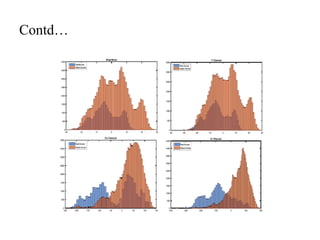
• Score distributions of the real faces and spoofs in the gray-
scale and YCbCr colour space.
• Chi-square statistics of the real and fake face descriptions in
the gray-scale space and Y channel are overlapping
• Better separated in the chroma components of the YCbCr
space.
Contd…
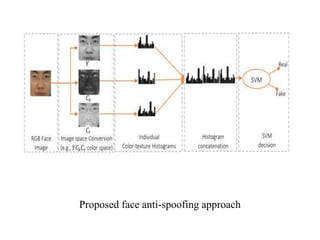
Proposed face anti-spoofing approach
Contd…
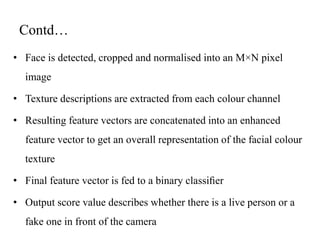
• Face is detected, cropped and normalised into an M×N pixel
image
• Texture descriptions are extracted from each colour channel
• Resulting feature vectors are concatenated into an enhanced
feature vector to get an overall representation of the facial colour
texture
• Final feature vector is fed to a binary classifier
• Output score value describes whether there is a live person or a
fake one in front of the camera
Contd…
• Facial representations extracted from different colour spaces
using different texture descriptors can also be concatenated
• Colour space
 Two other colour spaces, HSV and YCbCr, to explore the
colour texture information in addition to RGB
 HSV colour space, hue and saturation dimensions define the
chrominance and while the value dimension corresponds to the
luminance
Contd…
 YCbCr space separates the RGB components into Y, Cb and
Cr
• Texture Descriptors
 Designed for gray- scale images can be applied on colour
images by combining the features extracted from different
colour channels
 5 descriptors
Contd…
 Local Binary Patterns (LBP)
• Binary code computed by thresholding
• Binary patterns are collected into histograms
 Co-occurrence of Adjacent Local Binary Patterns (CoALBP)
• LBP discards spatial information
• To exploit the spatial relation between patterns
Contd…
 Local Phase Quantization (LPQ)
• Deal with blurred image
• Phase information extracted by STFT to analyse
neighbourhood
• Quantized and collected into histograms
 Binarized Statistical Image Features (BSIF)
• Convolving the image with linear filter and binarizing filter
response
Contd…
 Scale-Invariant Descriptor (SID)
• Image is first re-sampled densely enough on a log-polar grid,
rotations and scalings in the original image domain
• Fourier transform is applied on the re-sampled image,
invariance to both scale and rotation is achieved
ADVANTAGES
• Do not require any additional sensor
• Focused on both printed and replayed video attacks
• Good generalization ability
• Low computational complexity
• Fast response
• CTA features are more robust
APPLICATIONS
• Authentication system
• Registration purpose
• Mobile payment
• Unlocking system
• Security purpose
CONCLUSION AND FUTURE SCOPE
• Approach the problem of face anti-spoofing from the colour
texture analysis
• Colour image representations can used for describing the intrinsic
disparities in colour texture
• Facial colour texture representations studied by extracting
different local descriptors
• Improving generalization capabilities of colour texture analysis
based face spoofing detection
REFERENCES
[1] Zinelabidine Boulkenafet, Jukka Komulainen, and Abdenour Hadid,”Face
Spoofing Detection Using Colour Texture Analysis”, IEEE Transactions On
Information Forensics And Security, Vol. 11, No. 8, August 2016.
[2] Y. Li, K. Xu, Q. Yan, Y. Li, and R. H. Deng, “Understanding OSN-based
facial disclosure against face authentication systems,” in Proc. 9th ACM Symp.
Inf., Comput. Commun. Secur. (ASIA CCS), 2014, pp. 413–424.
[3] J. Li, Y. Wang, T. Tan, and A. K. Jain, “Live face detection based on
the analysis of Fourier spectra,” Proc. SPIE, vol. 5404, pp. 296–303,
Aug. 2004.
[4] X. Tan, Y. Li, J. Liu, and L. Jiang, “Face liveness detection from a single
image with sparse low rank bilinear discriminative model,” in Proc. 11th Eur.
Conf. Comput. Vis., VI (ECCV), 2010, pp. 504–517.
[5] Z. Zhang, J. Yan, S. Liu, Z. Lei, D. Yi, and S. Z. Li, “A face antispoofing
database with diverse attacks,” in Proc. 5th IAPR Int. Conf. Biometrics (ICB),
Mar./Apr. 2012, pp. 26–31.

Face spoofing detection using texture analysis

  • 1.
  • 2.
    CONTENTS • INTRODUCTION • EXISTINGMETHOD • PROPOSED METHOD • ADVANTAGES • APPLICATIONS • CONCLUSION AND FUTURE SCOPE • REFERENCES
  • 3.
    INTRODUCTION • Detection usingcolour texture analysis • Information from luminanace and chrominance are collected • Existing method focussed on analysis of luminanace information of face images and discarding chroma component • Observed fake image have lower image quality with lack of high frequency information
  • 4.
    Contd… • Fake imagesare identified by analysing chroma component than luminance • Preliminary colour texture analysis approach is proposed • Non intrusive software based detection focus on gray scale images, discarding colour information
  • 5.
    EXISTING METHOD • Hardwarebased solution appoach  Surface reflectance properties are used  Thermal information are for detecting printed and replayed video attacks  But are intrusive, expensive or impractical since unconventional imaging devices are required
  • 6.
    Contd… • Challenge responseapproach  Specific action is choosed as challenge and actually performed or not, is response • Non intrusive approach  No user co-operation is required  Assessed by commonly used any database  Categorized into static and dynamic tech
  • 7.
    Contd…  High resolutioninput image are required to extract fine details  Generation capabilities are not clear due to lack of training and testing set  Colour local binary patterns descriptor is only used
  • 8.
    PROPOSED METHOD • Facespoofing attacks mostly performed by displaying using prints, video displays or masks • Detect by analysing texture and quality of captured gray scale image • Discriminating genuine faces from fake ones by insight image into three colour spaces RGB, HSV, YCbCr
  • 9.
    Contd… • Performance ofdifferent facial colour texture representation is compared to their gray scale
  • 10.
    Contd… • Similarity betweenLBP descriptions extracted from face 1 and face 2 for printed and video attacks • Similarity is measured using the chi-square distance • Hx and Hy are two LBP histograms
  • 11.
    • Chi-square distancebetween gray-scale LBP histograms of the genuine face and the printed fake face is smaller than the one between two genuine face images
  • 12.
    Contd… • Mean LBPhistograms for both real and fake face images to compute a Chi-square distance as • Hx is the LBP histogram of test sample and Hr & Hf are the reference histograms for real and fake faces
  • 13.
  • 14.
    • Score distributionsof the real faces and spoofs in the gray- scale and YCbCr colour space. • Chi-square statistics of the real and fake face descriptions in the gray-scale space and Y channel are overlapping • Better separated in the chroma components of the YCbCr space. Contd…
  • 15.
  • 16.
    Contd… • Face isdetected, cropped and normalised into an M×N pixel image • Texture descriptions are extracted from each colour channel • Resulting feature vectors are concatenated into an enhanced feature vector to get an overall representation of the facial colour texture • Final feature vector is fed to a binary classifier • Output score value describes whether there is a live person or a fake one in front of the camera
  • 17.
    Contd… • Facial representationsextracted from different colour spaces using different texture descriptors can also be concatenated • Colour space  Two other colour spaces, HSV and YCbCr, to explore the colour texture information in addition to RGB  HSV colour space, hue and saturation dimensions define the chrominance and while the value dimension corresponds to the luminance
  • 18.
    Contd…  YCbCr spaceseparates the RGB components into Y, Cb and Cr • Texture Descriptors  Designed for gray- scale images can be applied on colour images by combining the features extracted from different colour channels  5 descriptors
  • 19.
    Contd…  Local BinaryPatterns (LBP) • Binary code computed by thresholding • Binary patterns are collected into histograms  Co-occurrence of Adjacent Local Binary Patterns (CoALBP) • LBP discards spatial information • To exploit the spatial relation between patterns
  • 20.
    Contd…  Local PhaseQuantization (LPQ) • Deal with blurred image • Phase information extracted by STFT to analyse neighbourhood • Quantized and collected into histograms  Binarized Statistical Image Features (BSIF) • Convolving the image with linear filter and binarizing filter response
  • 21.
    Contd…  Scale-Invariant Descriptor(SID) • Image is first re-sampled densely enough on a log-polar grid, rotations and scalings in the original image domain • Fourier transform is applied on the re-sampled image, invariance to both scale and rotation is achieved
  • 22.
    ADVANTAGES • Do notrequire any additional sensor • Focused on both printed and replayed video attacks • Good generalization ability • Low computational complexity • Fast response • CTA features are more robust
  • 23.
    APPLICATIONS • Authentication system •Registration purpose • Mobile payment • Unlocking system • Security purpose
  • 24.
    CONCLUSION AND FUTURESCOPE • Approach the problem of face anti-spoofing from the colour texture analysis • Colour image representations can used for describing the intrinsic disparities in colour texture • Facial colour texture representations studied by extracting different local descriptors • Improving generalization capabilities of colour texture analysis based face spoofing detection
  • 25.
    REFERENCES [1] Zinelabidine Boulkenafet,Jukka Komulainen, and Abdenour Hadid,”Face Spoofing Detection Using Colour Texture Analysis”, IEEE Transactions On Information Forensics And Security, Vol. 11, No. 8, August 2016. [2] Y. Li, K. Xu, Q. Yan, Y. Li, and R. H. Deng, “Understanding OSN-based facial disclosure against face authentication systems,” in Proc. 9th ACM Symp. Inf., Comput. Commun. Secur. (ASIA CCS), 2014, pp. 413–424. [3] J. Li, Y. Wang, T. Tan, and A. K. Jain, “Live face detection based on the analysis of Fourier spectra,” Proc. SPIE, vol. 5404, pp. 296–303, Aug. 2004. [4] X. Tan, Y. Li, J. Liu, and L. Jiang, “Face liveness detection from a single image with sparse low rank bilinear discriminative model,” in Proc. 11th Eur. Conf. Comput. Vis., VI (ECCV), 2010, pp. 504–517. [5] Z. Zhang, J. Yan, S. Liu, Z. Lei, D. Yi, and S. Z. Li, “A face antispoofing database with diverse attacks,” in Proc. 5th IAPR Int. Conf. Biometrics (ICB), Mar./Apr. 2012, pp. 26–31.