Under the guidance of Project
Mrs. J.SUSHMA By
K.GOPIKRISHNA
FACE RECOGNITION ACROSS
NON-UNIFORM MOTION BLUR AND ILLUMINATION
Contents
• Abstract
• Blur
• Illumination
• Face Recognition
• LBP Technique
• LBP Histogram
• Simulated Output
• Conclusion
Objective
• To implement face recognition system using
enhanced local features.
• The accuracy of the face recognition systems
degrades quite rapidly in unconstrained
settings.
• This arises from Blur and changes in
illumination.
ABSTRACT
Need of Face Recognition
• Everyday actions are increasingly being handled electronically,
instead of paper and pencil or face to face.
• This growth in electronic transactions results in great demand for
fast and accurate user identification and authentication.
• Access code for buildings, bank accounts and computer systems
often use PIN’s for identification and security clearances.
• Using the proper pin gains access, but the user of the PIN is not
verified. When credit or ATM cards are lost or stolen, an
unauthorised person can come up with the correct personal codes.
• Face recognition technology may solve this problem since a face is
undeniably connected to its owner except in the case of identical
twins.
Advantages of using face recognition
• It requires no physical interaction on behalf of the
user.
• It is accurate and allows for high enrolment and
verification rates.
• It can use your existing hardware infrastructure,
existing cameras and image capture devices, with no
problems.
Digital Image Processing
• The field of Digital image processing refers to
the processing digital images by means of a
digital computer.
Image
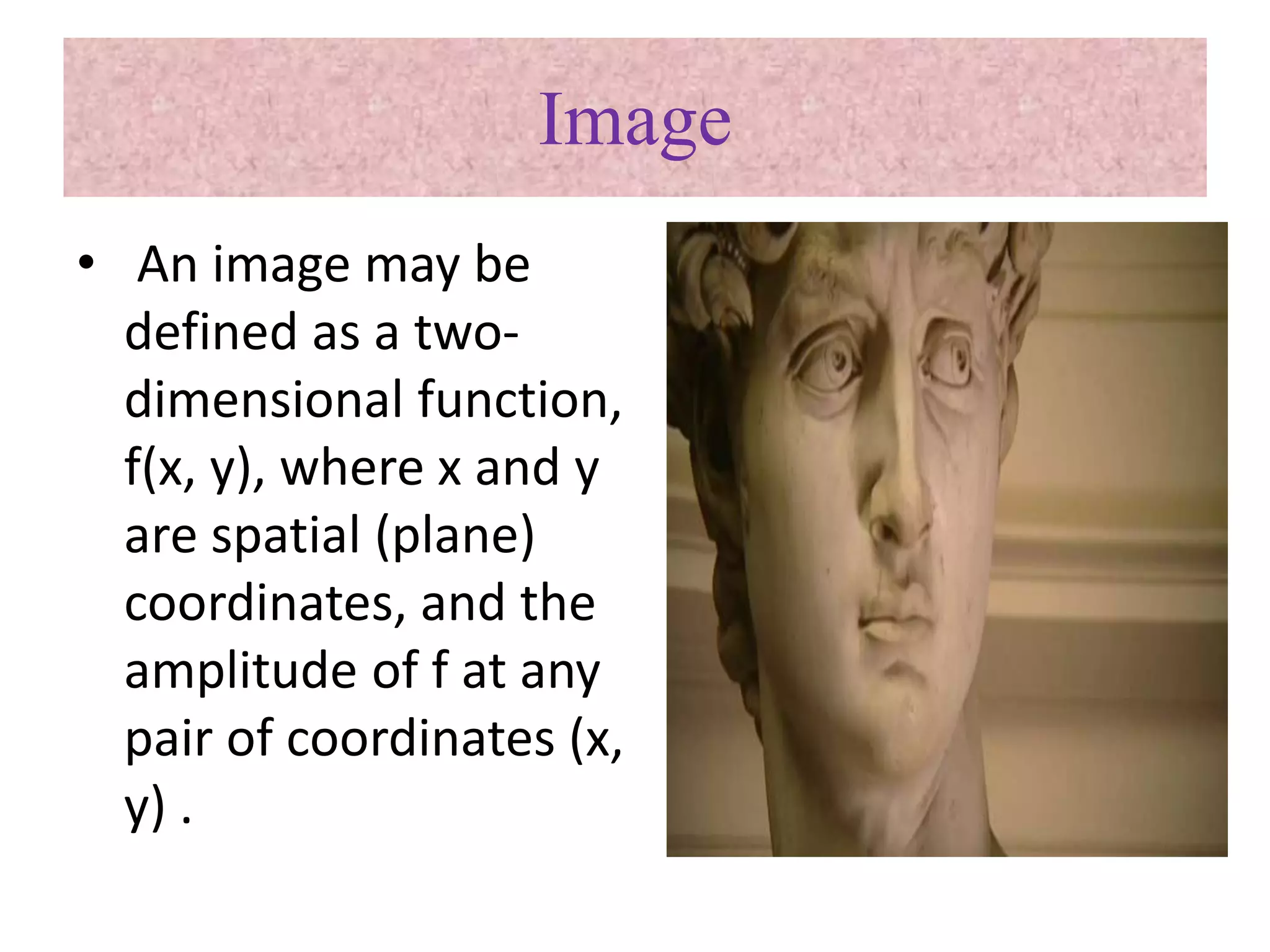
• An image may be
defined as a two-
dimensional function,
f(x, y), where x and y
are spatial (plane)
coordinates, and the
amplitude of f at any
pair of coordinates (x,
y) .
Types Of Digital Images
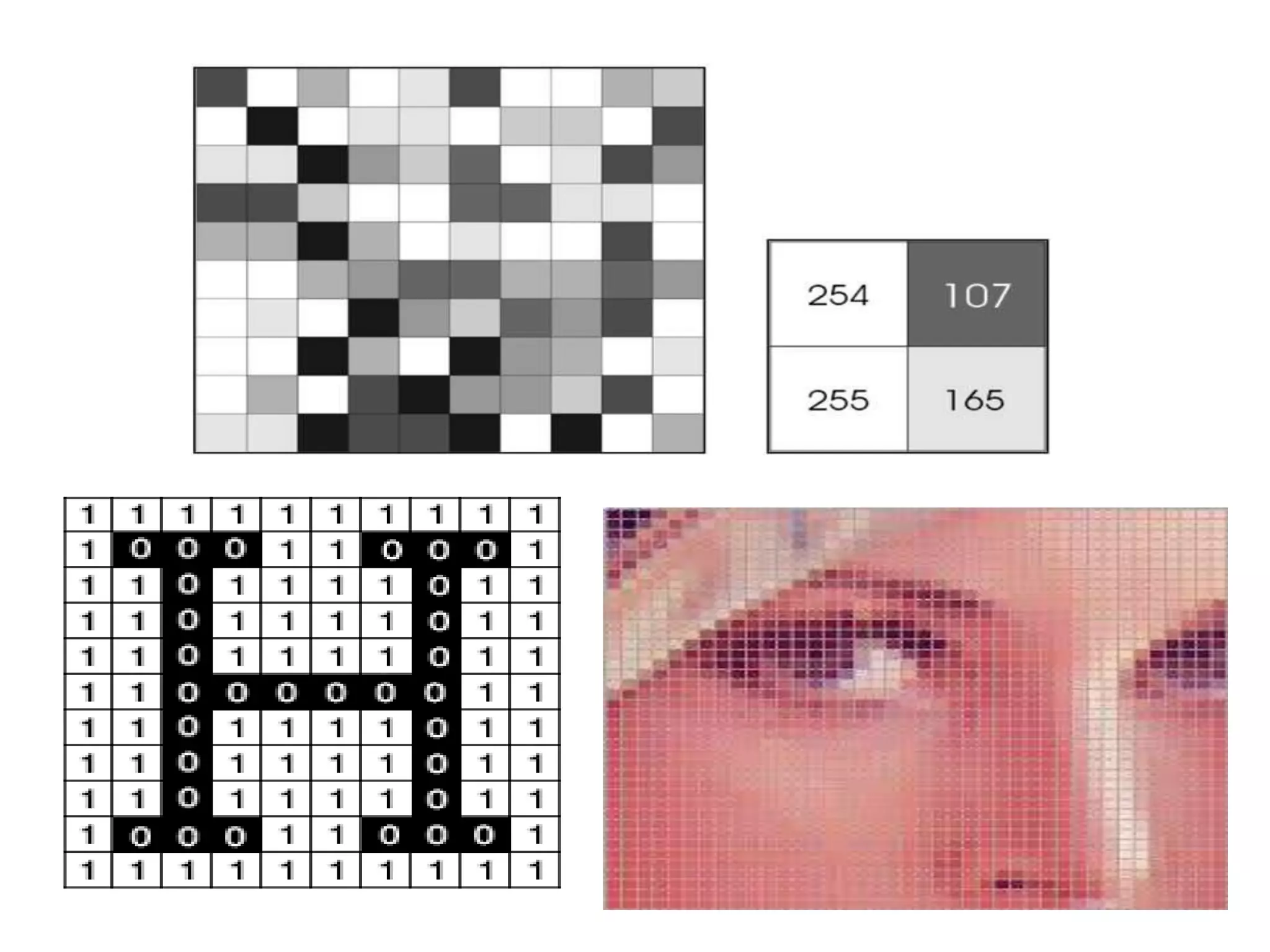
• Binary images
• Gray scale images
• Color images
• Indexed images
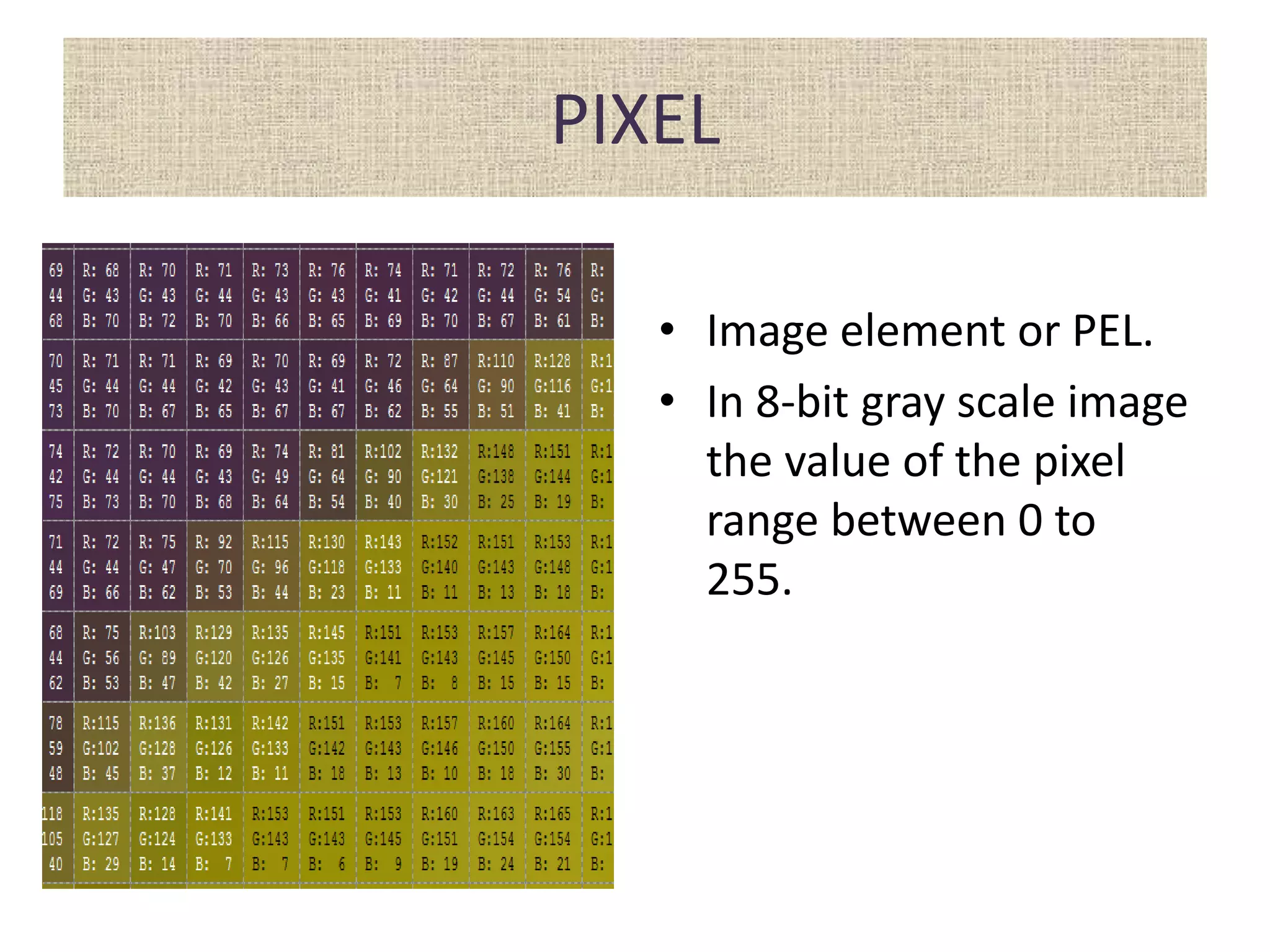
PIXEL
• Image element or PEL.
• In 8-bit gray scale image
the value of the pixel
range between 0 to
255.
SOFTWARE REQUIREMENT
MATLAB
• The MATLAB high-performance language for technical computing integrates
computation, visualization, and programming in an easy-to-use environment where
problems and solutions are expressed in familiar mathematical notation.
• Data Exploration ,Acquisition ,Analyzing &Visualization
• Application development programming using GUI building environment.
• Using MATLAB, you can solve technical computing problems faster than with
traditional programming languages, such as C, C++, and Fortran.
ADVANTAGES
• Very high accuracy.
• Verification time is generally less.
• Is the most economical.
• Easy to use.
• Small storage space required for the biometric template,
reducing the size of the database memory required.
• It is a cheap technology.
Practical implementation of some
image fundamental commands
Reading an image:
I = imread(‘i.tiff’);
Displaying an image:
imshow(I)
Resizing an image:
I = imread(‘1.tiff');
J = imresize(I, 0.5);
figure, imshow(I), figure, imshow(J)
Finding the size of an image:
[x y]=size(I)
[C D]=size(J)
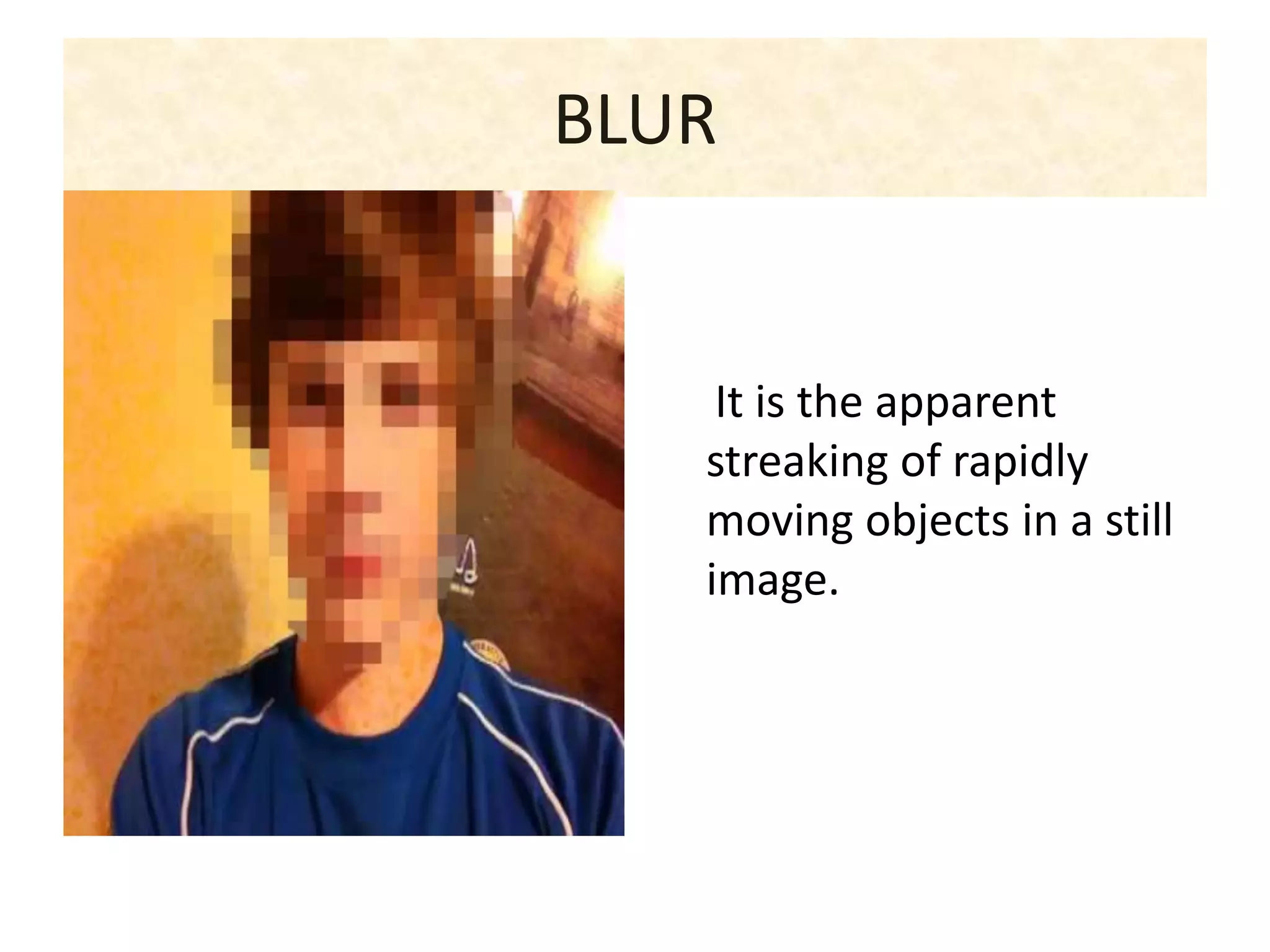
BLUR
It is the apparent
streaking of rapidly
moving objects in a still
image.
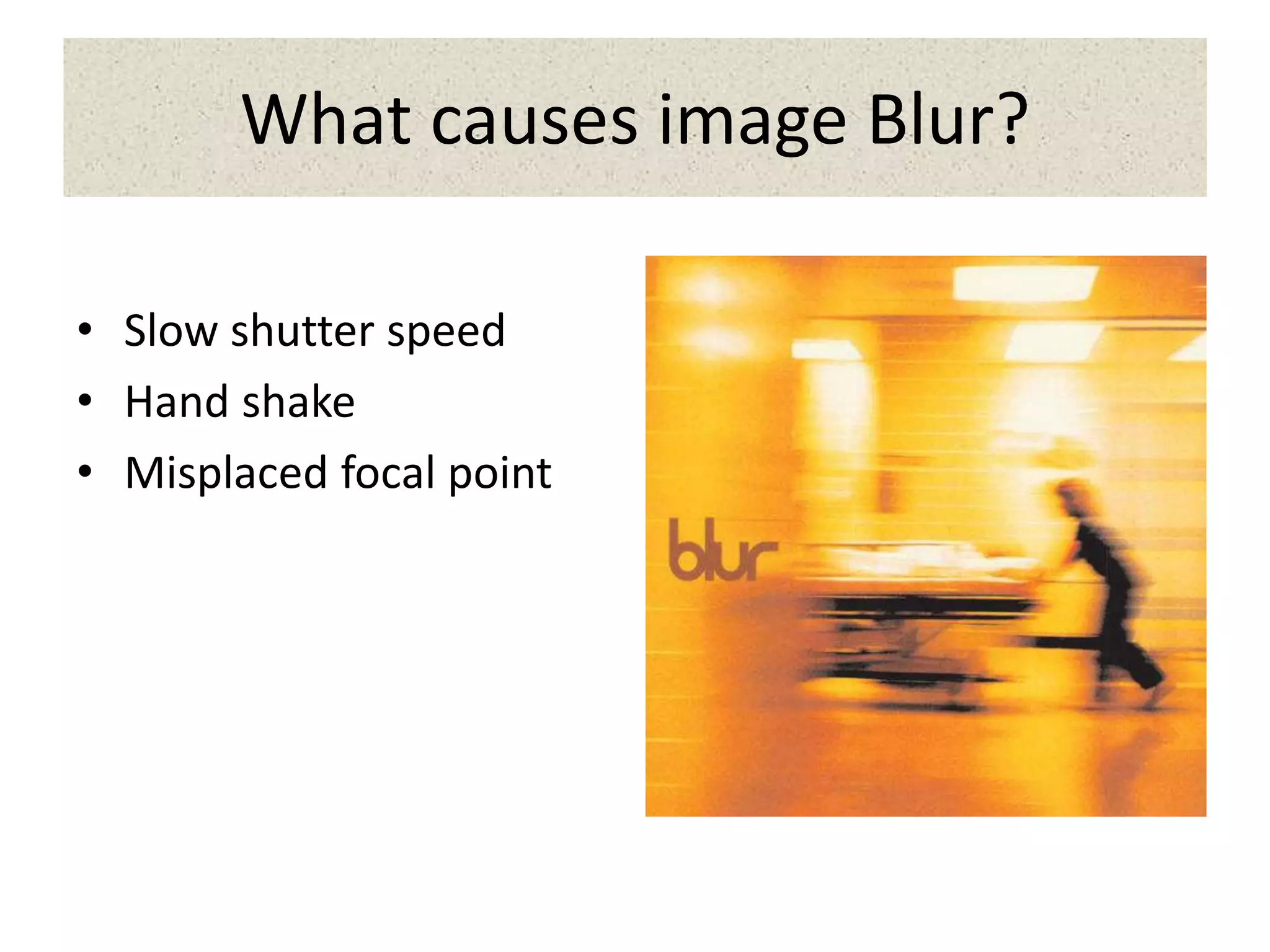
What causes image Blur?
• Slow shutter speed
• Hand shake
• Misplaced focal point
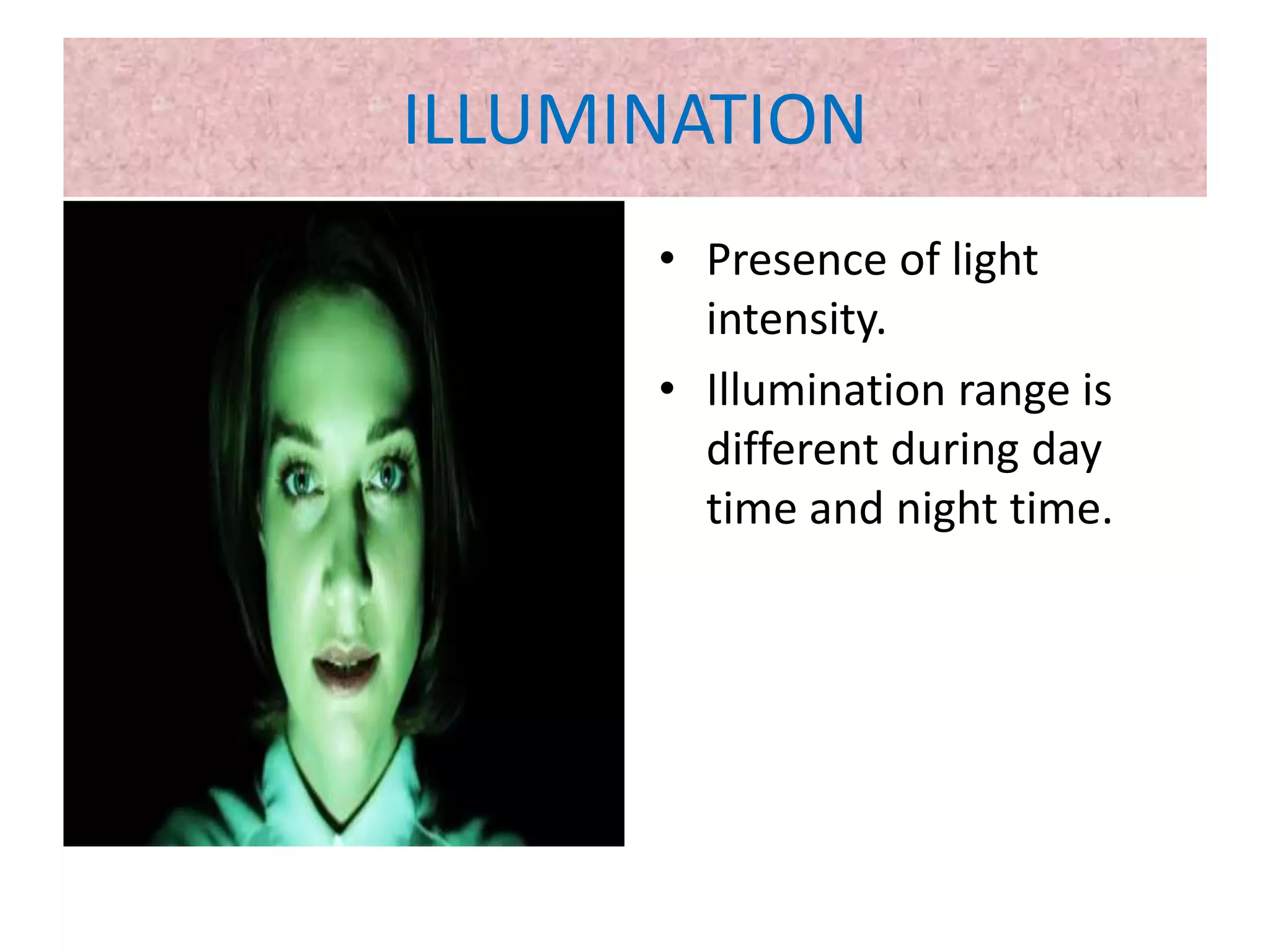
ILLUMINATION
• Presence of light
intensity.
• Illumination range is
different during day
time and night time.
Face Recognition
In facial recognition there are two types of
comparisons:-
• Verification : The system compares the given
individual with who they say they are and gives a yes
or no decision.
• Identification : The system compares the given
individual to all the other individuals in the database
and give a ranked list of matches.
APPLICATION
• Face recognition is also useful in human computer interaction, virtual reality, database recovery, multimedia,
computer entertainment, information security e.g. operating system, medical records, online banking., Biometric
e.g. Personal Identification - Passports, driver licenses , Automated identity verification - border controls , Law
enforcement e.g. video surveillances , investigation , Personal Security - driver monitoring system, home video
surveillance system.
• Applications & examples: Face Identification: Face recognition systems identify people by their face images. Face
recognition systems establish the presence of an authorized person rather than just checking whether a valid
identification (ID) or key is being used or whether the user knows the secret personal identification numbers (Pins)
or passwords. The following are example.
• To eliminate duplicates in a nationwide voter registration system because there are cases where the same person was
assigned more than one identification number. The face recognition system directly compares the face images of the
voters and does not use ID numbers to differentiate one from the others. When the top two matched faces are highly
similar to the query face image, manual review is required to make sure they are indeed different persons so as to
eliminate duplicates.
Face Recognition Features
• Global features:
- Focus in the whole entire image
- Less accuracy
• Local features:
- Focus on the local features of the face which
help to identify and verify the persons using
the unique details in the face.
- More accuracy.
LBP(Local Binary Pattern)
• LBP works on the local features.
• LBP is defined as an ordered set of binary
comparisons of pixel intensities between the
centre pixel and its eight surrounding pixels.
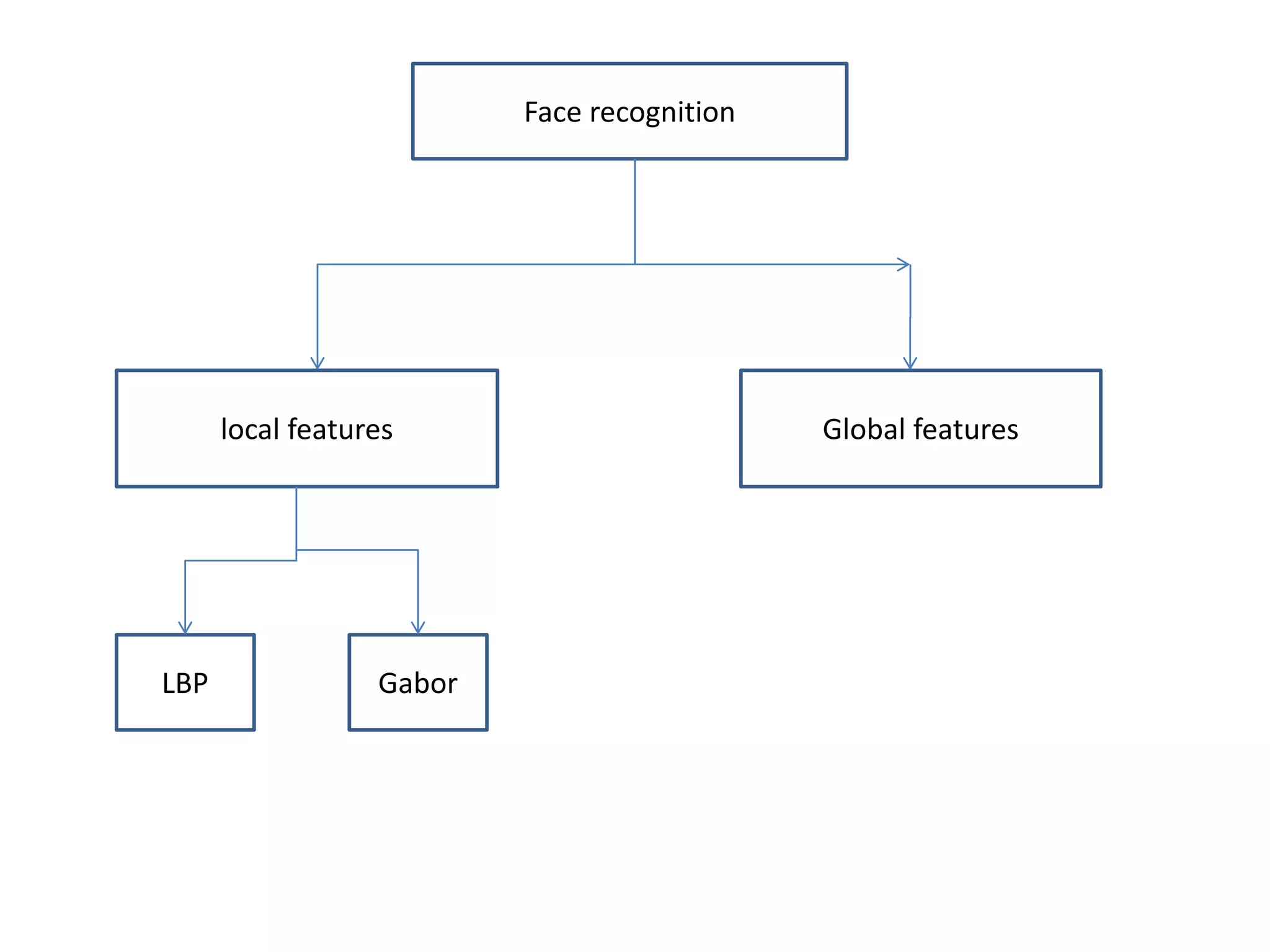
Face recognition
local features Global features
LBP Gabor
LBP
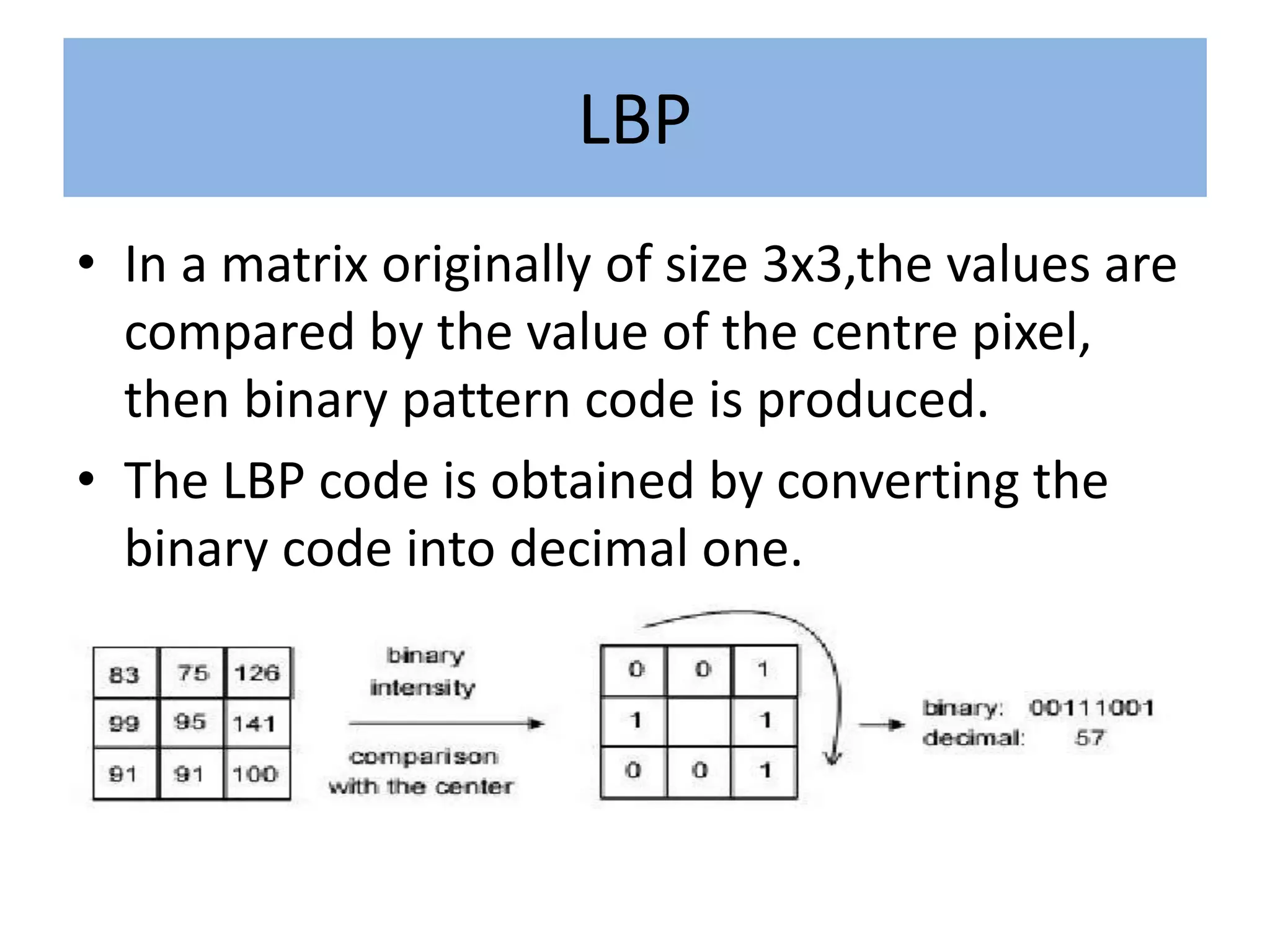
• In a matrix originally of size 3x3,the values are
compared by the value of the centre pixel,
then binary pattern code is produced.
• The LBP code is obtained by converting the
binary code into decimal one.
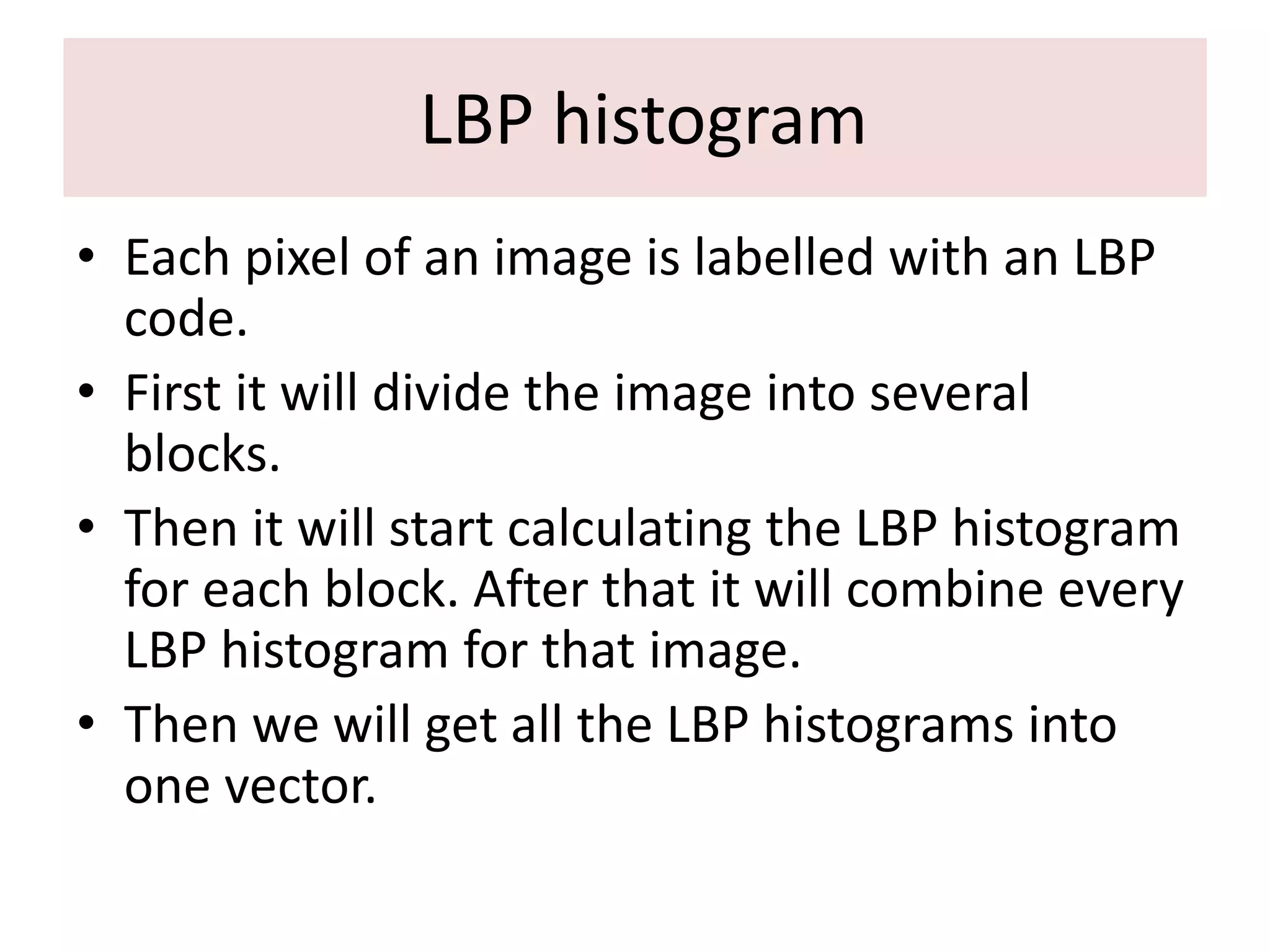
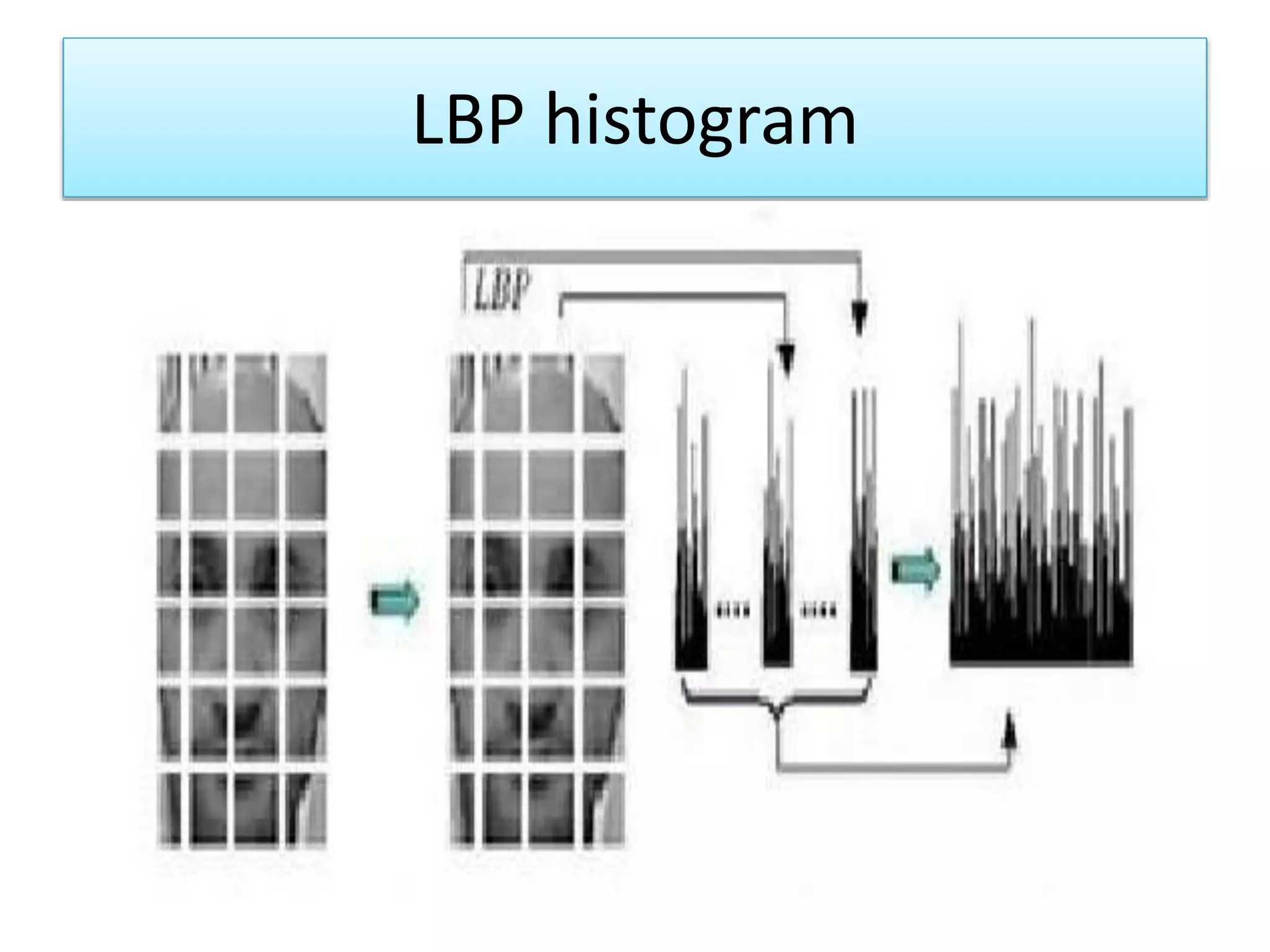
LBP histogram
• Each pixel of an image is labelled with an LBP
code.
• First it will divide the image into several
blocks.
• Then it will start calculating the LBP histogram
for each block. After that it will combine every
LBP histogram for that image.
• Then we will get all the LBP histograms into
one vector.
LBP histogramLBP histogram
Conclusion
We proposed a methodology to perform face
recognition under the combined effects of non-
uniform blur and illumination using the LBP
technique and showed the closest match
image by comparing with all other images in
the database.
Simulated output for Blur
Simulated output for illumination
REFERENCES
• P. Vageeswaran, K. Mitra, and R. Chellappa, “Blur and illumination robust
face recognition via set-theoretic characterization,” IEEE Trans. Image
Process., vol. 22, no. 4, pp. 1362–1372, Apr. 2013.
• R. Gopalan, S. Taheri, P. Turaga, and R. Chellappa, “A blur-robust
descriptor with applications to face recognition,” IEEE Trans. Pattern Anal.
Mach. Intell., vol. 34, no. 6, pp. 1220–1226, Jun. 2012.
• V. M. Patel, T. Wu, S. Biswas, P. J. Phillips, and R. Chellappa, “Dictionary-
based face recognition under variable lighting and pose,” IEEE Trans. Inf.
Forensics Security, vol. 7, no. 3, pp. 954–965, Jun. 2012.
• D. Yi, Z. Lei, and S. Z. Li, “Towards pose robust face recognition,” in Proc.
IEEE Conf. Comput. Vis. Pattern Recognit., Jun. 2013, pp. 3539–3545.
• ] S. Cho, Y. Matsushita, and S. Lee, “Removing non-uniform motion blur
from images,” in Proc. Int. Conf. Comput. Vis., Oct. 2007, pp. 1–8.
FACE RECOGNITION ACROSS  NON-UNIFORM MOTION BLUR

FACE RECOGNITION ACROSS NON-UNIFORM MOTION BLUR

  • 1.
    Under the guidanceof Project Mrs. J.SUSHMA By K.GOPIKRISHNA FACE RECOGNITION ACROSS NON-UNIFORM MOTION BLUR AND ILLUMINATION
  • 2.
    Contents • Abstract • Blur •Illumination • Face Recognition • LBP Technique • LBP Histogram • Simulated Output • Conclusion
  • 3.
    Objective • To implementface recognition system using enhanced local features.
  • 4.
    • The accuracyof the face recognition systems degrades quite rapidly in unconstrained settings. • This arises from Blur and changes in illumination. ABSTRACT
  • 5.
    Need of FaceRecognition • Everyday actions are increasingly being handled electronically, instead of paper and pencil or face to face. • This growth in electronic transactions results in great demand for fast and accurate user identification and authentication. • Access code for buildings, bank accounts and computer systems often use PIN’s for identification and security clearances. • Using the proper pin gains access, but the user of the PIN is not verified. When credit or ATM cards are lost or stolen, an unauthorised person can come up with the correct personal codes. • Face recognition technology may solve this problem since a face is undeniably connected to its owner except in the case of identical twins.
  • 6.
    Advantages of usingface recognition • It requires no physical interaction on behalf of the user. • It is accurate and allows for high enrolment and verification rates. • It can use your existing hardware infrastructure, existing cameras and image capture devices, with no problems.
  • 7.
    Digital Image Processing •The field of Digital image processing refers to the processing digital images by means of a digital computer.
  • 8.
    Image • An imagemay be defined as a two- dimensional function, f(x, y), where x and y are spatial (plane) coordinates, and the amplitude of f at any pair of coordinates (x, y) .
  • 9.
    Types Of DigitalImages • Binary images • Gray scale images • Color images • Indexed images
  • 10.
    PIXEL • Image elementor PEL. • In 8-bit gray scale image the value of the pixel range between 0 to 255.
  • 12.
    SOFTWARE REQUIREMENT MATLAB • TheMATLAB high-performance language for technical computing integrates computation, visualization, and programming in an easy-to-use environment where problems and solutions are expressed in familiar mathematical notation. • Data Exploration ,Acquisition ,Analyzing &Visualization • Application development programming using GUI building environment. • Using MATLAB, you can solve technical computing problems faster than with traditional programming languages, such as C, C++, and Fortran.
  • 13.
    ADVANTAGES • Very highaccuracy. • Verification time is generally less. • Is the most economical. • Easy to use. • Small storage space required for the biometric template, reducing the size of the database memory required. • It is a cheap technology.
  • 14.
    Practical implementation ofsome image fundamental commands Reading an image: I = imread(‘i.tiff’); Displaying an image: imshow(I) Resizing an image: I = imread(‘1.tiff'); J = imresize(I, 0.5); figure, imshow(I), figure, imshow(J) Finding the size of an image: [x y]=size(I) [C D]=size(J)
  • 15.
    BLUR It is theapparent streaking of rapidly moving objects in a still image.
  • 16.
    What causes imageBlur? • Slow shutter speed • Hand shake • Misplaced focal point
  • 17.
    ILLUMINATION • Presence oflight intensity. • Illumination range is different during day time and night time.
  • 18.
    Face Recognition In facialrecognition there are two types of comparisons:- • Verification : The system compares the given individual with who they say they are and gives a yes or no decision. • Identification : The system compares the given individual to all the other individuals in the database and give a ranked list of matches.
  • 19.
    APPLICATION • Face recognitionis also useful in human computer interaction, virtual reality, database recovery, multimedia, computer entertainment, information security e.g. operating system, medical records, online banking., Biometric e.g. Personal Identification - Passports, driver licenses , Automated identity verification - border controls , Law enforcement e.g. video surveillances , investigation , Personal Security - driver monitoring system, home video surveillance system. • Applications & examples: Face Identification: Face recognition systems identify people by their face images. Face recognition systems establish the presence of an authorized person rather than just checking whether a valid identification (ID) or key is being used or whether the user knows the secret personal identification numbers (Pins) or passwords. The following are example. • To eliminate duplicates in a nationwide voter registration system because there are cases where the same person was assigned more than one identification number. The face recognition system directly compares the face images of the voters and does not use ID numbers to differentiate one from the others. When the top two matched faces are highly similar to the query face image, manual review is required to make sure they are indeed different persons so as to eliminate duplicates.
  • 20.
    Face Recognition Features •Global features: - Focus in the whole entire image - Less accuracy • Local features: - Focus on the local features of the face which help to identify and verify the persons using the unique details in the face. - More accuracy.
  • 21.
    LBP(Local Binary Pattern) •LBP works on the local features. • LBP is defined as an ordered set of binary comparisons of pixel intensities between the centre pixel and its eight surrounding pixels.
  • 22.
    Face recognition local featuresGlobal features LBP Gabor
  • 23.
    LBP • In amatrix originally of size 3x3,the values are compared by the value of the centre pixel, then binary pattern code is produced. • The LBP code is obtained by converting the binary code into decimal one.
  • 24.
    LBP histogram • Eachpixel of an image is labelled with an LBP code. • First it will divide the image into several blocks. • Then it will start calculating the LBP histogram for each block. After that it will combine every LBP histogram for that image. • Then we will get all the LBP histograms into one vector.
  • 25.
  • 26.
    Conclusion We proposed amethodology to perform face recognition under the combined effects of non- uniform blur and illumination using the LBP technique and showed the closest match image by comparing with all other images in the database.
  • 27.
  • 28.
  • 29.
    REFERENCES • P. Vageeswaran,K. Mitra, and R. Chellappa, “Blur and illumination robust face recognition via set-theoretic characterization,” IEEE Trans. Image Process., vol. 22, no. 4, pp. 1362–1372, Apr. 2013. • R. Gopalan, S. Taheri, P. Turaga, and R. Chellappa, “A blur-robust descriptor with applications to face recognition,” IEEE Trans. Pattern Anal. Mach. Intell., vol. 34, no. 6, pp. 1220–1226, Jun. 2012. • V. M. Patel, T. Wu, S. Biswas, P. J. Phillips, and R. Chellappa, “Dictionary- based face recognition under variable lighting and pose,” IEEE Trans. Inf. Forensics Security, vol. 7, no. 3, pp. 954–965, Jun. 2012. • D. Yi, Z. Lei, and S. Z. Li, “Towards pose robust face recognition,” in Proc. IEEE Conf. Comput. Vis. Pattern Recognit., Jun. 2013, pp. 3539–3545. • ] S. Cho, Y. Matsushita, and S. Lee, “Removing non-uniform motion blur from images,” in Proc. Int. Conf. Comput. Vis., Oct. 2007, pp. 1–8.