

Manufactured in Bangladesh
Azmir Latif MSc. in TE
Md.Azmir Latif Beg
Preface
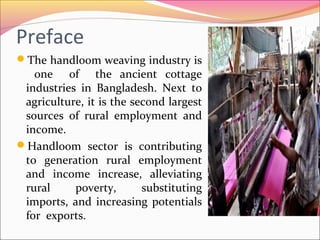
The handloom weaving industry is
one of the ancient cottage
industries in Bangladesh. Next to
agriculture, it is the second largest
sources of rural employment and
income.
Handloom sector is contributing
to generation rural employment
and income increase, alleviating
rural poverty, substituting
imports, and increasing potentials
for exports.
PRESENT SCENARIO OF HANDLOOM
 Handloom sector in Bangladesh consists of more than 0.505 million
Handlooms and 1.0 million Handloom weavers. But only 0.3 million looms are
active (59% of existed looms) and that provides around 620 million meters of
fabric (about 40% total demand of the population) annually.
 About more than 1.5 million people are directly and indirectly involved for
their livelihood.
 The knowledge and skills needed for this sector transformed from their
forefathers. Thus, the cottage-based industry has been build up by inheritance.
Handloom fabric is more producer -driven than buyer-driven.
 An international experts study reveals that the technical skill of the weavers of
Bangladesh is second to none in the world (i.e. Dhaka muslin products, the
finest cotton fabric).
 Handloom products are best known for their eco-friendly nature. The world is
solely concentrating on „green technology , therefore „green products and „social‟ ‟
business concept to save the struggling world, where „Handloom technology‟ ‟
could be best „green technology to fulfill basic needs of human i.e.,‟
clothing.
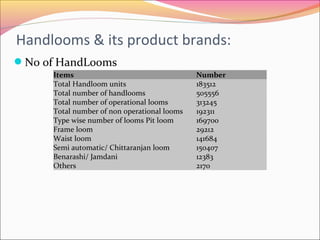
Handlooms & its product brands:
Items Number
Total Handloom units 183512
Total number of handlooms 505556
Total number of operational looms 313245
Total number of non operational looms 192311
Type wise number of looms Pit loom 169700
Frame loom 29212
Waist loom 141684
Semi automatic/ Chittaranjan loom 150407
Benarashi/ Jamdani 12383
Others 2170
No of HandLooms
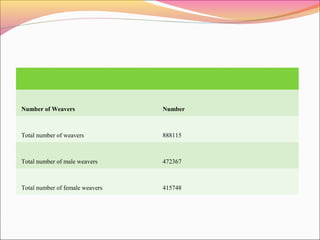
Number of Weavers Number
Total number of weavers 888115
Total number of male weavers 472367
Total number of female weavers 415748
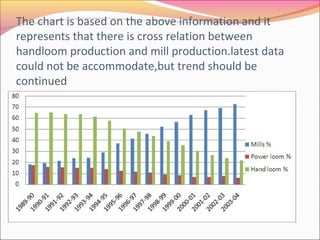
The chart is based on the above information and it
represents that there is cross relation between
handloom production and mill production.latest data
could not be accommodate,but trend should be
continued
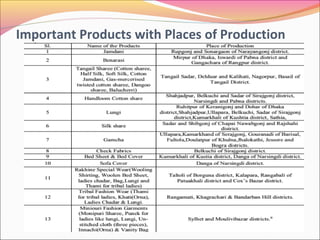
Important Products with Places of Production
Present Product of Handloom
Famous areas for silk weaving are Rajshahi, Tangail and
Nobabgonj . Rajshahi produces mainly
Tangail produces also silk saree namely Tangail Muslin .
 Narayangonj produces the famous Jamdani saree, silk
sarees Tangail Muslins and famous jamdani.
Zari work called brocade is also famous in Mirpur,
Dhaka .In Bangladesh there are different schools of
weaving on jacquard, dobby, frame and pit looms .
Product assortments made of other are saree ,lungie,
gamsa, grameen check fabrics, printed bed covers, pillow
covers, table mats, kitchen and hand towels, apron,
curtain and upholstery, furnishing fabrics, bags bandage
etc.
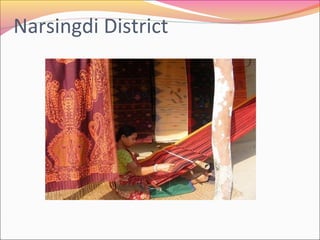
Narsingdi District
Mirpur Benarashi Palli
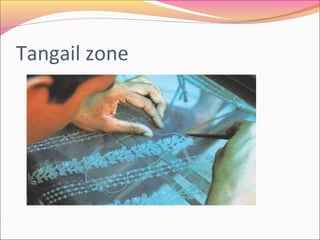
Tangail zone
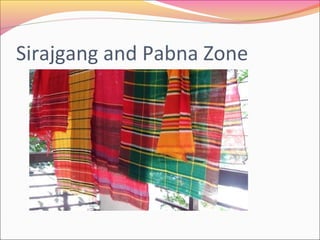
Sirajgang and Pabna Zone
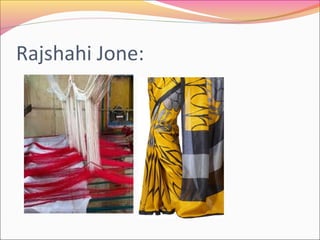
Rajshahi Jone:
Raw Material Used
Bangladesh has remained a net importer of yarn at least
since 1947. Almost all yarns are imported;
warp silk from China,
cotton from China and India.
Some local silk and cotton can be used for weft.
 Jute, which is locally grown and an important
agricultural crop, has a lot of potential, The Jute
Research Institute has made an interesting 40
%jute/60 % cotton yarn.
Interesting yarns are made only for exports.Thin yarns for
the handloom industry are machine spun.
Hand spun cotton is used in the fabric called “khaki”, a
thicker cotton quality.
Linen also has to be imported and is too expensive to be
used in any quantity. Synthetic dyes are imported.
POWER LOOMS DEVELOPMENTThe power loom was designed in 1784 by Edmund Cartwright and first
built in 1785.
When it was first built, it wasn't the best loom on the market and
needed additional development. It was initially limited by its reliance
on water power, which required workshops equipped with power
looms to be located near a source of running water.
The power loom allowed large amounts of cloth to be made in a
shorter time than a human could do it.
Originally, powered looms were shuttle-operated but in the early part
of the 20th century the faster and more efficient shuttleless loom
came into use.
Today, advances in technology have produced a variety of looms
designed to maximize production for specific types of material. The
most common of these are air-jet looms and water-jet looms.
Computer-driven looms are now also available to individual home
(non-factory) weavers. Industrial looms can weave at speeds of six
rows per second and faster .
Analyse some properties of fabric manufactured
from power loom and handloom
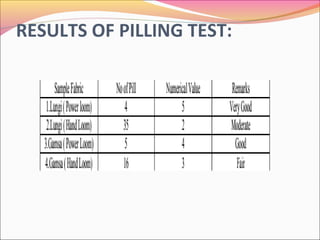
To judge fabric performance we have to work with
the following parameter:
[1] Color fastness to washing
[2] Color fastness to rubbing
[3] Tensile strength
[4] Dimensional stability
[5] Abrasion resistance
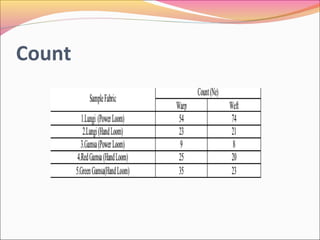
[6] Count
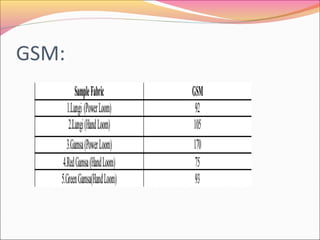
[7] GSM
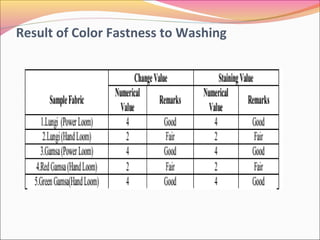
Result of Color Fastness to Washing
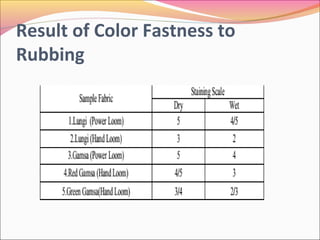
Result of Color Fastness to
Rubbing
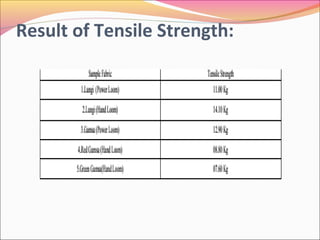
Result of Tensile Strength:
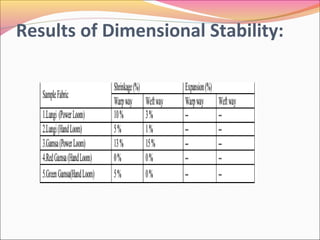
Results of Dimensional Stability:
RESULTS OF PILLING TEST:
Count
GSM:
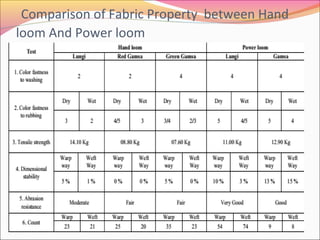
Comparison of Fabric Property between Hand
loom And Power loom
Coments
By considering above data it can be said that the
power loom product has much more acceptable
quality than the hand loom product .For this reason
we are going towards the power loom production
today.Now a day s most of the hand looms are‟
replaced by the power loom.
Handlooms are a part of Bangladesh history,
economics, aesthetics and culture.
As handloom industry is the biggest handicraft
industry in our country,it is the scond largest source of
rural imployment after agriculture
Day by day energy consumption in the textile sector is
increasing and shortage of power is barring the growth
and the production of the industry.Right now so
many factories are waiting to come into action but
shortage in handloom product made of electricity
and gas are restricting.Manpower based hand loom
industry can be considered as green industry.
Why Handloom are prefered than Powerloom in
Bangladesh?
Why Handloom are prefered than Powerloom in
Bangladesh?
The world is solely concentrating on „green technology , therefore‟
„green products and „social business concept to save the struggling‟ ‟
world, where „Handloom technology could be best „green‟
technology to fulfill basic needs of human i.e., clothing.‟
The Handloom sector has a great deal of potential for further value
addition in the RMG sector for further meeting local needs of fabrics
and expanding sales of its products directly in foreign countries.
This sector is an important channel for balanced sustainable
economic growth
if the handloom industry reaches to the effective level then around
one lakh eighty four thousand loom can be activated,it will help to
produce40 crore meter of extra cloth which will produce work for
more five lakh people.It will also help to export around 10 crore meter
fabric according to international demand.
Reasons behind declining productivity of
Handloom The declining productivity of handloom industry is caused by
simultaneous activation of internal and external factors
 Weavers do not get quality raw materials at right time and right
price.
 Government supports to Handloom Industry are not sufficient and
effective.
 Promotion of handloom products is not effective.
 Weavers don’t have skill deficiency.
 High level of skill is required to produce handloom products.
 Weavers Association is not efficient.
 Production of handloom products is sufficient to meet demand.
 Weavers are suffering from inadequate contemporary technology.
 Weavers face scarcity of working capital.
 Existing distribution channel of handloom products is not efficient.
 Handloom industry faces intense competition from mill and power
Recommended Steps For Improvement
Government should have a monitoring cell under Handloom
Board of Bangladesh to monitor activities of those wholesalers
and retailers who are engaged in selling raw materials for
handloom products to prevent any unfair advantage. In
addition, all tax and levies should be waived on all kinds of raw
materials which will ensure the right price.
Government should take necessary steps to make available
these technologies in local market and should waive all taxes on
these technologies.
Another major finding is- weavers suffer from scarcity of
working capital. Most of the time, weavers acquire their
working capital from their own money and sometimes they
acquire capital from various institutions like govt. banks,
private banks and some other financial institutions. Both
government and private sectors should work to solve this
problem of working capital.
Steps For Improvement
Various specialized trainings program should be launched
for weavers that will keep them updated. Both private and
public sectors can work for this.
Intensive promotional programs like trade fairs, public
relations, sales promotions and advertising should be
undertaken.
We have found that handloom industry faces intense
competition from mill and power loom sector. So
government can create a quota system for handloom
industry, under which, some special products such as
Sharee, Lungi, Bed sheet etc which have high demand in
national and international markets, can exclusively be
produced by handloom
Conclusion
The importance of the textile industry in the economy of
Bangladesh is very high. Many people get employment
opportunity from this industry and Govt. is getting huge
income tax from the loom industry. In addition, most
developed countries are turning away from industries like
the textile industry and investing in other sectors, thus
creating a vacuum in the market. There is currently a
serious lack of coordination among the various
government agencies that are connected in some way with
the textile industry. Bangladesh's low labor cost, skill
development potential, a presently expanding market,
and favorable conversion cost can be used to turn the
challenges of the quota-free market into a window of
opportunity.
33

Fabric Properties

  • 1.
    Manufactured in Bangladesh AzmirLatif MSc. in TE Md.Azmir Latif Beg
  • 3.
    Preface The handloom weavingindustry is one of the ancient cottage industries in Bangladesh. Next to agriculture, it is the second largest sources of rural employment and income. Handloom sector is contributing to generation rural employment and income increase, alleviating rural poverty, substituting imports, and increasing potentials for exports.
  • 4.
    PRESENT SCENARIO OFHANDLOOM  Handloom sector in Bangladesh consists of more than 0.505 million Handlooms and 1.0 million Handloom weavers. But only 0.3 million looms are active (59% of existed looms) and that provides around 620 million meters of fabric (about 40% total demand of the population) annually.  About more than 1.5 million people are directly and indirectly involved for their livelihood.  The knowledge and skills needed for this sector transformed from their forefathers. Thus, the cottage-based industry has been build up by inheritance. Handloom fabric is more producer -driven than buyer-driven.  An international experts study reveals that the technical skill of the weavers of Bangladesh is second to none in the world (i.e. Dhaka muslin products, the finest cotton fabric).  Handloom products are best known for their eco-friendly nature. The world is solely concentrating on „green technology , therefore „green products and „social‟ ‟ business concept to save the struggling world, where „Handloom technology‟ ‟ could be best „green technology to fulfill basic needs of human i.e.,‟ clothing.
  • 5.
    Handlooms & itsproduct brands: Items Number Total Handloom units 183512 Total number of handlooms 505556 Total number of operational looms 313245 Total number of non operational looms 192311 Type wise number of looms Pit loom 169700 Frame loom 29212 Waist loom 141684 Semi automatic/ Chittaranjan loom 150407 Benarashi/ Jamdani 12383 Others 2170 No of HandLooms
  • 6.
    Number of WeaversNumber Total number of weavers 888115 Total number of male weavers 472367 Total number of female weavers 415748
  • 7.
    The chart isbased on the above information and it represents that there is cross relation between handloom production and mill production.latest data could not be accommodate,but trend should be continued
  • 8.
    Important Products withPlaces of Production
  • 9.
    Present Product ofHandloom Famous areas for silk weaving are Rajshahi, Tangail and Nobabgonj . Rajshahi produces mainly Tangail produces also silk saree namely Tangail Muslin .  Narayangonj produces the famous Jamdani saree, silk sarees Tangail Muslins and famous jamdani. Zari work called brocade is also famous in Mirpur, Dhaka .In Bangladesh there are different schools of weaving on jacquard, dobby, frame and pit looms . Product assortments made of other are saree ,lungie, gamsa, grameen check fabrics, printed bed covers, pillow covers, table mats, kitchen and hand towels, apron, curtain and upholstery, furnishing fabrics, bags bandage etc.
  • 10.
  • 11.
  • 12.
  • 13.
  • 14.
  • 15.
    Raw Material Used Bangladeshhas remained a net importer of yarn at least since 1947. Almost all yarns are imported; warp silk from China, cotton from China and India. Some local silk and cotton can be used for weft.  Jute, which is locally grown and an important agricultural crop, has a lot of potential, The Jute Research Institute has made an interesting 40 %jute/60 % cotton yarn. Interesting yarns are made only for exports.Thin yarns for the handloom industry are machine spun. Hand spun cotton is used in the fabric called “khaki”, a thicker cotton quality. Linen also has to be imported and is too expensive to be used in any quantity. Synthetic dyes are imported.
  • 16.
    POWER LOOMS DEVELOPMENTThepower loom was designed in 1784 by Edmund Cartwright and first built in 1785. When it was first built, it wasn't the best loom on the market and needed additional development. It was initially limited by its reliance on water power, which required workshops equipped with power looms to be located near a source of running water. The power loom allowed large amounts of cloth to be made in a shorter time than a human could do it. Originally, powered looms were shuttle-operated but in the early part of the 20th century the faster and more efficient shuttleless loom came into use. Today, advances in technology have produced a variety of looms designed to maximize production for specific types of material. The most common of these are air-jet looms and water-jet looms. Computer-driven looms are now also available to individual home (non-factory) weavers. Industrial looms can weave at speeds of six rows per second and faster .
  • 17.
    Analyse some propertiesof fabric manufactured from power loom and handloom To judge fabric performance we have to work with the following parameter: [1] Color fastness to washing [2] Color fastness to rubbing [3] Tensile strength [4] Dimensional stability [5] Abrasion resistance [6] Count [7] GSM
  • 18.
    Result of ColorFastness to Washing
  • 19.
    Result of ColorFastness to Rubbing
  • 20.
  • 21.
  • 22.
  • 23.
  • 24.
  • 25.
    Comparison of FabricProperty between Hand loom And Power loom
  • 26.
    Coments By considering abovedata it can be said that the power loom product has much more acceptable quality than the hand loom product .For this reason we are going towards the power loom production today.Now a day s most of the hand looms are‟ replaced by the power loom.
  • 27.
    Handlooms are apart of Bangladesh history, economics, aesthetics and culture. As handloom industry is the biggest handicraft industry in our country,it is the scond largest source of rural imployment after agriculture Day by day energy consumption in the textile sector is increasing and shortage of power is barring the growth and the production of the industry.Right now so many factories are waiting to come into action but shortage in handloom product made of electricity and gas are restricting.Manpower based hand loom industry can be considered as green industry. Why Handloom are prefered than Powerloom in Bangladesh?
  • 28.
    Why Handloom areprefered than Powerloom in Bangladesh? The world is solely concentrating on „green technology , therefore‟ „green products and „social business concept to save the struggling‟ ‟ world, where „Handloom technology could be best „green‟ technology to fulfill basic needs of human i.e., clothing.‟ The Handloom sector has a great deal of potential for further value addition in the RMG sector for further meeting local needs of fabrics and expanding sales of its products directly in foreign countries. This sector is an important channel for balanced sustainable economic growth if the handloom industry reaches to the effective level then around one lakh eighty four thousand loom can be activated,it will help to produce40 crore meter of extra cloth which will produce work for more five lakh people.It will also help to export around 10 crore meter fabric according to international demand.
  • 29.
    Reasons behind decliningproductivity of Handloom The declining productivity of handloom industry is caused by simultaneous activation of internal and external factors  Weavers do not get quality raw materials at right time and right price.  Government supports to Handloom Industry are not sufficient and effective.  Promotion of handloom products is not effective.  Weavers don’t have skill deficiency.  High level of skill is required to produce handloom products.  Weavers Association is not efficient.  Production of handloom products is sufficient to meet demand.  Weavers are suffering from inadequate contemporary technology.  Weavers face scarcity of working capital.  Existing distribution channel of handloom products is not efficient.  Handloom industry faces intense competition from mill and power
  • 30.
    Recommended Steps ForImprovement Government should have a monitoring cell under Handloom Board of Bangladesh to monitor activities of those wholesalers and retailers who are engaged in selling raw materials for handloom products to prevent any unfair advantage. In addition, all tax and levies should be waived on all kinds of raw materials which will ensure the right price. Government should take necessary steps to make available these technologies in local market and should waive all taxes on these technologies. Another major finding is- weavers suffer from scarcity of working capital. Most of the time, weavers acquire their working capital from their own money and sometimes they acquire capital from various institutions like govt. banks, private banks and some other financial institutions. Both government and private sectors should work to solve this problem of working capital.
  • 31.
    Steps For Improvement Variousspecialized trainings program should be launched for weavers that will keep them updated. Both private and public sectors can work for this. Intensive promotional programs like trade fairs, public relations, sales promotions and advertising should be undertaken. We have found that handloom industry faces intense competition from mill and power loom sector. So government can create a quota system for handloom industry, under which, some special products such as Sharee, Lungi, Bed sheet etc which have high demand in national and international markets, can exclusively be produced by handloom
  • 32.
    Conclusion The importance ofthe textile industry in the economy of Bangladesh is very high. Many people get employment opportunity from this industry and Govt. is getting huge income tax from the loom industry. In addition, most developed countries are turning away from industries like the textile industry and investing in other sectors, thus creating a vacuum in the market. There is currently a serious lack of coordination among the various government agencies that are connected in some way with the textile industry. Bangladesh's low labor cost, skill development potential, a presently expanding market, and favorable conversion cost can be used to turn the challenges of the quota-free market into a window of opportunity.
  • 33.