1
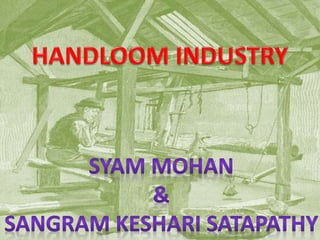
Loom is a device used to weave cloths. The cloths
which are weaved by hand played looms are called
handloom products.
Handloom industry in India is an ancient cottage
industry which is seems to have started between 5000
& 3000 BC.
This is a green production and employee oriented
work.
Handloom industry is the largest cottage industry of
India with 23,77,000 looms. It is also providing direct
employment to over 65 lakh peoples engaged in
weaving and other activities. 2
About
3
Sector over view
→ The handloom sector occupies a distinct and
unique place in the Indian economy beside being
the largest generator of non-farm rural
employment.
→ The handloom industry is largely house hold
base carried out with labour contributed by
the entire family.
→ It is despaired, spread across thousand of
villages and towns in the country.
4
→ Along with the artistry of wavers the Indian
handloom industry demonstrates the richness
and diversity of India culture.
→ This sector is the second largest employment
provider for the rural population of India after
agriculture.
→ The sector account for 14.9% of the total
cloth produced in country.
→ Handloom industry in India is best know for
it’s distinctiveness style, traditionalism and
modern technology .
5
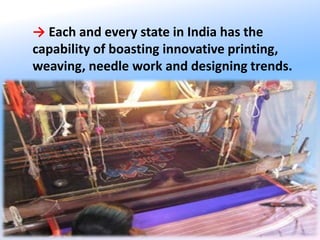
→ Each and every state in India has the
capability of boasting innovative printing,
weaving, needle work and designing trends.
6
Famous handloom products of India
•Muslin of Chanderi
•Silk brocades of Varanasi
•Tie & dye products of Rajasthan
•Chintas of Machhlipatnam
•Himroos of Hyderabad
•Khes of Punjab
•Bottle designs of Assam & Manipur
•Maheswari sarees of MP
•Patola sarees of Baroda
7
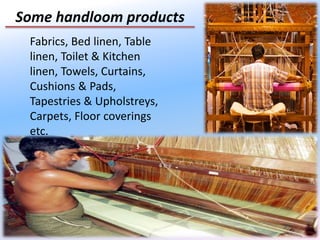
Some handloom products
Fabrics, Bed linen, Table
linen, Toilet & Kitchen
linen, Towels, Curtains,
Cushions & Pads,
Tapestries & Upholstreys,
Carpets, Floor coverings
etc.
8
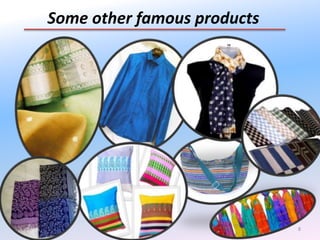
Some other famous products
9
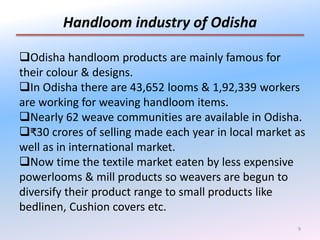
Handloom industry of Odisha
Odisha handloom products are mainly famous for
their colour & designs.
In Odisha there are 43,652 looms & 1,92,339 workers
are working for weaving handloom items.
Nearly 62 weave communities are available in Odisha.
₹30 crores of selling made each year in local market as
well as in international market.
Now time the textile market eaten by less expensive
powerlooms & mill products so weavers are begun to
diversify their product range to small products like
bedlinen, Cushion covers etc.
10
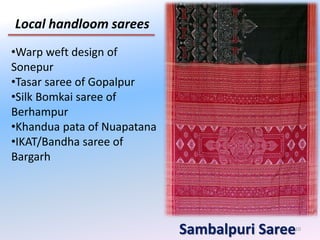
Local handloom sarees
Sambalpuri Saree
•Warp weft design of
Sonepur
•Tasar saree of Gopalpur
•Silk Bomkai saree of
Berhampur
•Khandua pata of Nuapatana
•IKAT/Bandha saree of
Bargarh
11
MAJOR PLAYERS OF HANDLOOM INDUSTRY
→All India handloom apparels pvt. Ltd.
→HP state handicrafts and handloom corporation
ltd.
→Handloom export promotion council
→Institute of handloom and textile technology
12
→National handloom development corporation ltd.
→Nirmal handloom house pvt. Ltd.
→Tamilnadu handloom weavers cooperative
society ltd.
→The handicraft and handlooms export
corporation of India ltd.
13
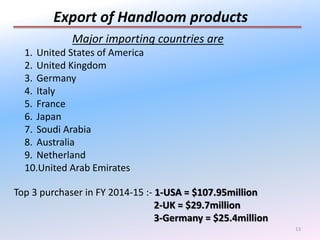
Export of Handloom products
Major importing countries are
1. United States of America
2. United Kingdom
3. Germany
4. Italy
5. France
6. Japan
7. Soudi Arabia
8. Australia
9. Netherland
10.United Arab Emirates
Top 3 purchaser in FY 2014-15 :- 1-USA = $107.95million
2-UK = $29.7million
3-Germany = $25.4million
14
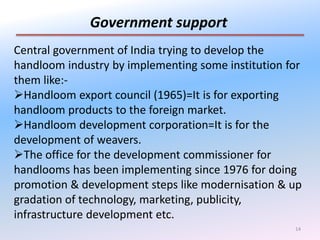
Government support
Central government of India trying to develop the
handloom industry by implementing some institution for
them like:-
Handloom export council (1965)=It is for exporting
handloom products to the foreign market.
Handloom development corporation=It is for the
development of weavers.
The office for the development commissioner for
handlooms has been implementing since 1976 for doing
promotion & development steps like modernisation & up
gradation of technology, marketing, publicity,
infrastructure development etc.
15
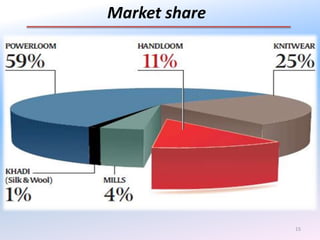
Market share
16
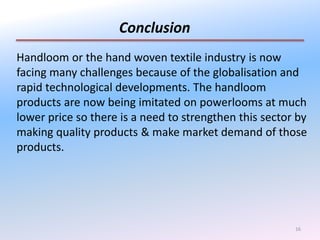
Conclusion
Handloom or the hand woven textile industry is now
facing many challenges because of the globalisation and
rapid technological developments. The handloom
products are now being imitated on powerlooms at much
lower price so there is a need to strengthen this sector by
making quality products & make market demand of those
products.
17

HANDLOOM INDUSTRY

  • 1.
  • 2.
    Loom is adevice used to weave cloths. The cloths which are weaved by hand played looms are called handloom products. Handloom industry in India is an ancient cottage industry which is seems to have started between 5000 & 3000 BC. This is a green production and employee oriented work. Handloom industry is the largest cottage industry of India with 23,77,000 looms. It is also providing direct employment to over 65 lakh peoples engaged in weaving and other activities. 2 About
  • 3.
    3 Sector over view →The handloom sector occupies a distinct and unique place in the Indian economy beside being the largest generator of non-farm rural employment. → The handloom industry is largely house hold base carried out with labour contributed by the entire family. → It is despaired, spread across thousand of villages and towns in the country.
  • 4.
    4 → Along withthe artistry of wavers the Indian handloom industry demonstrates the richness and diversity of India culture. → This sector is the second largest employment provider for the rural population of India after agriculture. → The sector account for 14.9% of the total cloth produced in country. → Handloom industry in India is best know for it’s distinctiveness style, traditionalism and modern technology .
  • 5.
    5 → Each andevery state in India has the capability of boasting innovative printing, weaving, needle work and designing trends.
  • 6.
    6 Famous handloom productsof India •Muslin of Chanderi •Silk brocades of Varanasi •Tie & dye products of Rajasthan •Chintas of Machhlipatnam •Himroos of Hyderabad •Khes of Punjab •Bottle designs of Assam & Manipur •Maheswari sarees of MP •Patola sarees of Baroda
  • 7.
    7 Some handloom products Fabrics,Bed linen, Table linen, Toilet & Kitchen linen, Towels, Curtains, Cushions & Pads, Tapestries & Upholstreys, Carpets, Floor coverings etc.
  • 8.
  • 9.
    9 Handloom industry ofOdisha Odisha handloom products are mainly famous for their colour & designs. In Odisha there are 43,652 looms & 1,92,339 workers are working for weaving handloom items. Nearly 62 weave communities are available in Odisha. ₹30 crores of selling made each year in local market as well as in international market. Now time the textile market eaten by less expensive powerlooms & mill products so weavers are begun to diversify their product range to small products like bedlinen, Cushion covers etc.
  • 10.
    10 Local handloom sarees SambalpuriSaree •Warp weft design of Sonepur •Tasar saree of Gopalpur •Silk Bomkai saree of Berhampur •Khandua pata of Nuapatana •IKAT/Bandha saree of Bargarh
  • 11.
    11 MAJOR PLAYERS OFHANDLOOM INDUSTRY →All India handloom apparels pvt. Ltd. →HP state handicrafts and handloom corporation ltd. →Handloom export promotion council →Institute of handloom and textile technology
  • 12.
    12 →National handloom developmentcorporation ltd. →Nirmal handloom house pvt. Ltd. →Tamilnadu handloom weavers cooperative society ltd. →The handicraft and handlooms export corporation of India ltd.
  • 13.
    13 Export of Handloomproducts Major importing countries are 1. United States of America 2. United Kingdom 3. Germany 4. Italy 5. France 6. Japan 7. Soudi Arabia 8. Australia 9. Netherland 10.United Arab Emirates Top 3 purchaser in FY 2014-15 :- 1-USA = $107.95million 2-UK = $29.7million 3-Germany = $25.4million
  • 14.
    14 Government support Central governmentof India trying to develop the handloom industry by implementing some institution for them like:- Handloom export council (1965)=It is for exporting handloom products to the foreign market. Handloom development corporation=It is for the development of weavers. The office for the development commissioner for handlooms has been implementing since 1976 for doing promotion & development steps like modernisation & up gradation of technology, marketing, publicity, infrastructure development etc.
  • 15.
  • 16.
    16 Conclusion Handloom or thehand woven textile industry is now facing many challenges because of the globalisation and rapid technological developments. The handloom products are now being imitated on powerlooms at much lower price so there is a need to strengthen this sector by making quality products & make market demand of those products.
  • 17.