Self-production and craft:
advanced processes
towards social innovation
5th International Forum of Design as a Process | Advanced Design Cultures
September 18th - 20th 2014 | Tecnológico de Monterrey, Guadalajara, Mexico
Francesco Mazzarella, PhD Candidate
Loughborough University, United Kingdom
Rita Engler, Dr
UEMG, Brazil
CRAFTSMANSHIP
creative
COMMUNITIES
bottom-up
social
cultural
economic
environmental
RELATIONSHIPS
enabling
ECOSYSTEM
networkpeer-to-peer
QUALITY
oflife
SYSTEMIC
design
HAPPINESS
index
CIRCULAR
economy
COLLABORATIVE
services
sharing
great
DISRUPTION
SELF
production
micro
ENTREPRENEURSHIP
SERVICE DESIGN
SOCIAL INNOVATION
SUSTAINABILITY
small
local
open
connected
framework
Social Innovation
Design has become
the key tool to transform
human needs and desires
into innovative and
sustainable products,
services and systems
(Manzini, 2008)
framework
Creative Communities
Groups of people who
collaboratively invent,
enhance and manage
innovative solutions
toward new sustainable
lifestyles (Meroni, 2007)
framework
Sustainability
A holistic environmental,
social and economic issue
output systemic
design
input
product efficiency
less waste
less logistics
more income
new jobs
localne
tw
ork of resources
Humanist Design
The designer places the man
at the center of the project,
reacquiring connection
with the territory
(Celaschi, 2008)
management
fine arts
humanities
design
technology
framework
strategies
services
systems
Humanist Design
Design as a mediation
between areas of knowledge
(Celaschi, 2008)
industry
crafts
prod
ucer
facili
tator
design
framework
object of research
self
production
co-design
self
construction design
collective
self
promotion
small
entrepreneur
art
design
craftsmanship
vernacular
design D.I.Y.
digital
fabrication
e
conomic cris
is
challenge
limits of Fordism
outsourcing
lack of services
......
macro
top-down
support
micro
bottom-up
initiatives
self
production
creative co
m
m
unity
flex
ible product
ion
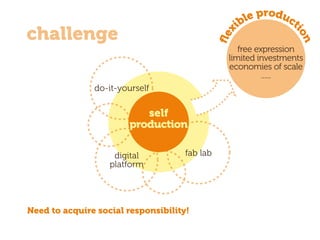
challenge
do-it-yourself
fab labdigital
platform
self
production
free expression
limited investments
economies of scale
......
Need to acquire social responsibility!
field
research
MSc student
Politecnico di Torino
2 years
erasmus
Twente University (Enschede)
5 months
MSc thesis
UEMG (Belo Horizonte)
4 months
italy
micro-enterpreneurship
brazil
artisans’ communities
netherlands
digital fabrication
case studies
italy
local
artisans
e-commerce
production
on demand
italy
crafthipsmans
digital
fabrication
diffused
micro
enterprise
99,4%
0,5%0,1%
65%
13 %
68,2%
12,2 %19,6 %
22%
n°
source: Eurostat, 2013
weaknesses
crisis of
design system
......
muse
um
merchan
dising
cultural souvenir
tourism lever
......
design
design
system
italy
syne
rgy
design
m
ethodology,in
novation guid
e
technolog
y,traditions
crafthipsmans
netherlands
diversified
series
custom
platforms
creative
research
co-design
labs
netherlands
arts&crafts
tradition
young
experiments
digital
fabrication
design
s
ystem
weaknesses
conceptual
hardly feasible
isolated attempts
......
4
design universities
710 bil
gdp
8,5%
unemployment
73,2%
no
industry
24,1%
services
trading, finance
12,2 %
>5
living labs
source: personal interviews, 2013
netherlands
arts&crafts
tradition
young
experiments
digital
fabrication
design
s
ystem
co-working
cooperation
resource optimization
stronger visibility
......
brazil
handmade
low resources
tradition
local
identity
modernity
handicraft
comm
u
nities
weaknesses
weak industry
not widespread culture
imitation of foreign models
......
50÷300%
increase in income
18 bilfrom handicraft
64,3%
of brazilian municipalities
own craft production
graphicfashion
furniture
gastronom
y
85%craftswomen
8,5mln
artisans
professional
register
6°
world economy
85°
HDI in the world
source: Broges, 2011
SEBRAE
brazil
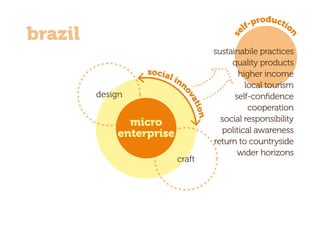
design
craft
micro
enterprise
social inn
ovation
brazil
s
elf-productio
n
sustainabile practices
quality products
higher income
local tourism
self-confidence
cooperation
social responsibility
political awareness
return to countryside
wider horizons
local
tourism
areas of intervention
micro
enterprise
macro
top-down
support
macro
top-down
support
investmentsinvestments
educationeducation
promotionpromotion
network
of resources
network
of resources
sharing
of plants
sharing
of plants
online
platforms
online
platforms
enabling
ecosystem
micro
bottom-up
initiaties
micro
bottom-up
initiaties
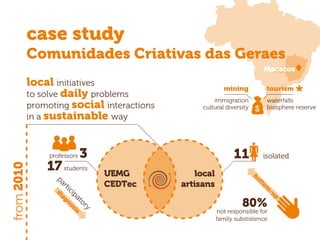
case study
Comunidades Criativas das Geraes
mining tourism
waterfalls
biosphere reserve
immigration
cultural diversity
Macacos
UEMG
CEDTec
local
artisans
11professors 3
17students
local initiatives
to solve daily problems
promoting social interactions
in a sustainable way
from2010
isolated
participatory
diagnosis
80%
not responsible for
family substistence
bottom
-up
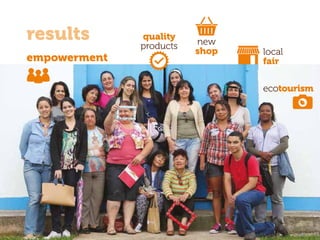
results
empowerment
quality
products new
shop local
fair
ecotourism
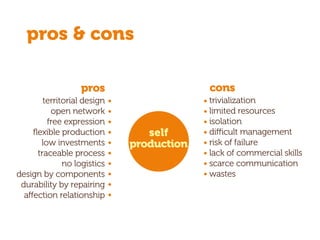
territorial design
open network
free expression
flexible production
low investments
traceable process
no logistics
design by components
durability by repairing
affection relationship
pros
trivialization
limited resources
isolation
difficult management
risk of failure
lack of commercial skills
scarce communication
wastes
cons
pros & cons
self
production
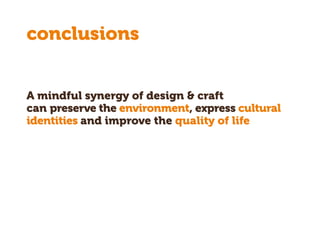
conclusions
A mindful synergy of design & craft
can preserve the environment, express cultural
identities and improve the quality of life
Relocalizing towards glocal markets
Designing for repairing and disassembly
Exploring new segments
Spreading the culture of self-production
Designing an open ecosystem to boost artisans’
communities towards sustainability and
social innovation
what to do?
Francesco Mazzarella
F.Mazzarella@lboro.ac.uk
Rita Engler
rcengler@uol.com.br
questions?

Self-production and Craft: Advanced Processes Towards Social Innovation