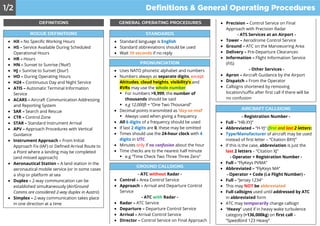
• HX –No Specific Working Hours
• HS – Service Available During Scheduled
Operational Hours
• HR – Hours
• HN – Sunset to Sunrise (‘Nuit’)
• HJ – Sunrise to Sunset (‘Jour’)
• HO – During Operating Hours
• H24 – Continuous Day and Night Service
• ATIS – Automatic Terminal Information
Service
• ACARS – Aircraft Communication Addressing
and Reporting System
• SAR – Search and Rescue
• CTR – Control Zone
• STAR – Standard Instrument Arrival
• APV – Approach Procedures with Vertical
Guidance
• Instrument Approach – From Initial
Approach Fix (IAF) or Defined Arrival Route to
a Point where a landing may be completed
(and missed approach)
• Aeronautical Station – A land station in the
aeronautical mobile service (or in some cases
a ship or platform at sea
• Duplex – 2-way communication can be
established simultaneously (Air/Ground
Comms are considered 2-way duplex in Austro)
• Simplex – 2-way communication takes place
in one direction at a time
• Standard language is English
• Standard abbreviations should be used
• Wait 10 seconds if no reply
• Precision – Control Service on Final
Approach with Precision Radar
- ATS Services at an Airport -
• Tower – Aerodrome Control Service
• Ground – ATC on the Manoeuvring Area
• Delivery – Pre-Departure Clearances
• Information – Flight Information Service
(FIS)
- Other Services -
• Apron – Aircraft Guidance by the Airport
• Dispatch – From the Operator
• Callsigns shortened by removing
location/suffix after first call if there will be
no confusion
• Uses NATO phonetic alphabet and numbers
• Numbers always as separate digits, except
Altitudes, cloud heights, visibility’s and
RVRs may use the whole number
▪ For numbers >9,999, the number of
thousands should be said
▪ e.g 12,000ft = “One Two Thousand”
• Decimal points transmitted as ‘day-se-mal’
▪ Always used when giving a frequency
• All 6 digits of a frequency should be used
• If last 2 digits are 0, these may be omitted
• Times should use the 24-hour clock with 4
digits in UTC
• Minutes only if no confusion about the hour
• Time checks are to the nearest half minute
▪ e.g “Time Check Two Three Three Zero”
- Registration Number -
• Full – “HB-XYJ”
• Abbreviated – “H-YJ” (first and last 2 letters)
• Type/Manufacturer of aircraft may be used
instead of first letter – “Citation BXYJ”
• If this is the case, abbreviation is just the
last 2 letters – “Citation XJ”
- Operator + Registration Number -
• Full – “FlyKeys PVMA”
• Abbreviated – “FlyKeys MA”
- Operator + Code (i.e Flight Number) -
• Full – “Jersey 1234”
• This may NOT be abbreviated
• Full callsigns used until addressed by ATC
in abbreviated form
• ATC may temporarily change callsign
• “Heavy” used if in heavy wake turbulence
category (>136,000kg) on first call –
“Speedbird 123 Heavy”
- ATC without Radar -
• Control – Area Control Service
• Approach – Arrival and Departure Control
Service
- ATC with Radar -
• Radar – ATC Service
• Departure – Departure Control Service
• Arrival – Arrival Control Service
• Director – Control Service on Final Approach
3.
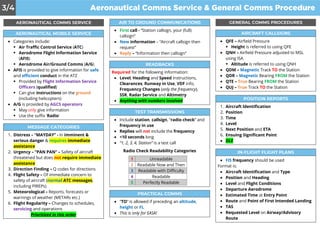
• Categories include:
▪Air Traffic Control Service (ATC)
▪ Aerodrome Flight Information Service
(AFIS)
▪ Aerodrome Air/Ground Comms (A/G)
• AFIS is provided to give information for safe
and efficient conduct in the ATZ
▪ Provided by Flight Information Service
Officers (qualified)
▪ Can give instructions on the ground
(including helicopters)
• A/G is provided by AGCS operators
▪ May only give information
▪ Use the suffix ‘Radio’
• First call - “Station callsign, your (full)
callsign”
• New information – “Aircraft callsign then
request”
• Reply – “Information then callsign”
Required for the following information:
• Level, Heading and Speed Instructions,
Clearances, Runway in Use, VDF info,
Frequency Changes (only the frequency),
SSR, Radar Service and Altimetry
• Anything with numbers involved
• QFE – Airfield Pressure
▪ Height is referred to using QFE
• QNH – Airfield Pressure adjusted to MSL
using ISA
▪ Altitude is referred to using QNH
• QDM – Magnetic Track TO the Station
• QDR – Magnetic Bearing FROM the Station
• QTE – True Bearing FROM the Station
• QUJ – True Track TO the Station
1. Distress – “MAYDAY” - In imminent &
serious danger & requires immediate
assistance
2. Urgency – “PAN PAN” – Safety of aircraft
threatened but does not require immediate
assistance
3. Direction Finding – Q codes for directions
4. Flight Safety – Of immediate concern to
safety of aircraft (normal ATC messages,
including PIREPs)
5. Meteorological – Reports, forecasts or
warnings of weather (METARs etc.)
6. Flight Regularity – Changes to schedules,
servicing and operations
Prioritized in this order
• Include station, callsign, “radio check” and
frequency in use
• Replies will not include the frequency
• <10 seconds long
• “1, 2, 3, 4, Station” is a test call
Radio Check Readability Categories
1 Unreadable
2 Readable Now and Then
3 Readable with Difficulty
4 Readable
5 Perfectly Readable
• “TO” is allowed if preceding an altitude,
height or FL
• This is only for EASA!
1. Aircraft Identification
2. Position
3. Time
4. Level
5. Next Position and ETA
6. Ensuing Significant Point
• OLE
• FIS frequency should be used
Format is:
• Aircraft Identification and Type
• Position and Heading
• Level and Flight Conditions
• Departure Aerodrome
• Estimated Time at Entry Point
• Route and Point of First Intended Landing
• TAS
• Requested Level on Airway/Advisory
Route
4.
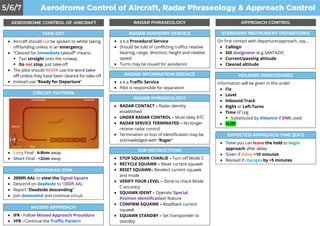
• Aircraft shouldnot be spoken to whilst taking
off/landing unless in an emergency
• “Cleared for immediate takeoff” means:
▪ Taxi straight onto the runway
▪ Do not stop, just take-off
• The pilot should NEVER use the word take-
off unless they have been cleared for take-off
• Instead use “Ready for Departure”
• a.k.a Procedural Service
• Should be told of conflicting traffics relative
bearing, range, direction, height and relative
speed
• Turns may be issued for avoidance
• a.k.a Traffic Service
• Pilot is responsible for separation
On first contact with departure/approach, say…
• Callsign
• SID designator (e.g SANTA2V)
• Current/passing altitude
• Cleared altitude
• RADAR CONTACT – Radar identity
established
• UNDER RADAR CONTROL – Must obey ATC
• RADAR SERVICE TERMINATED – No longer
receive radar control
• Termination or loss of identification may be
acknowledged with “Roger”
Information will be given in this order:
• Fix
• Level
• Inbound Track
• Right or Left Turns
• Time of Leg
▪ Substituted by distance if DME used
• FLIRT
• Long Final - 4-8nm away
• Short Final - <2nm away
• 2000ft AAL to view the Signal Square
• Descend on deadside to 1000ft AAL
• Report “Deadside descending”
• Join downwind and continue circuit
• IFR - Follow Missed Approach Procedure
• VFR - Continue the Traffic Pattern
• STOP SQUAWK CHARLIE – Turn off Mode C
• RECYCLE SQUAWK – Reset current squawk
• RESET SQUAWK– Reselect current squawk
and mode
• VERIFY YOUR LEVEL – Done to check Mode
C accuracy
• SQUAWK IDENT – Operate ‘Special
Position Identification’ feature
• CONFIRM SQUAWK – Readback current
squawk
• SQUAWK STANDBY – Set transponder to
standby
• Time you can leave the hold to begin
approach after delay
• Given if delay >10 minutes
• Revised if changes by >5 minutes
5.
• In theair, ATC, ATIS and VOLMET may give
weather information
• Broadcast on VHF and UHF
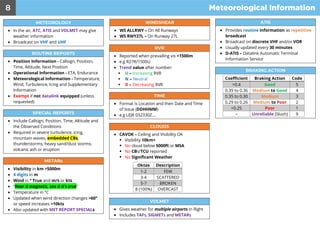
• WS ALLRWY – On All Runways
• WS RWY27L – On Runway 27L
• Reported when prevailing vis <1500m
• e.g R27R/1500U
• Trend value after number:
▪ U – Increasing RVR
▪ N – Neutral
▪ D – Decreasing RVR
• Provides routine information as repetitive
broadcast
• Broadcast on discrete VHF and/or VOR
• Usually updated every 30 minutes
• D-ATIS – Datalink Automatic Terminal
Information Service
Coefficient Braking Action Code
>0.4 Good 5
0.39 to 0.36 Medium to Good 4
0.35 to 0.30 Medium 3
0.29 to 0.26 Medium to Poor 2
<0.25 Poor 1
- Unreliable (Slush) 9
• Position Information - Callsign, Position,
Time, Altitude, Next Position
• Operational Information - ETA, Endurance
• Meteorological Information - Temperature,
Wind, Turbulence, Icing and Supplementary
Information
• Exempt if not datalink equipped (unless
requested)
• Include Callsign, Position, Time, Altitude and
the Observed Conditions
• Required in severe turbulence, icing,
mountain waves, embedded CBs,
thunderstorms, heavy sand/dust storms,
volcanic ash or eruption
• Visibility in km >5000m
• 4 digits in m
• Wind in ° True and m/s or kts
• “Hear it magnetic, see it it’s true”
• Temperature in °C
• Updated when wind direction changes >60°
or speed increases >10kts
• Also updated with MET REPORT SPECIALs
• Format is Location and then Date and Time
of Issue (DDHHMM)
• e.g LEJR 032330Z….
• CAVOK – Ceiling and Visibility OK
▪ Visibility 10km+
▪ No cloud below 5000ft or MSA
▪ No CBs/TCU reported
▪ No Significant Weather
Oktas Description
1-2 FEW
3-4 SCATTERED
5-7 BROKEN
8 (100%) OVERCAST
• Gives weather for multiple airports in flight
• Includes TAFs, SIGMETs and METARs
6.
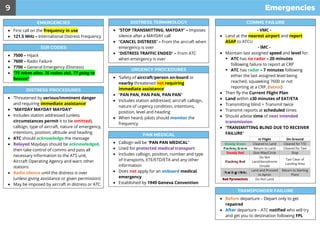
• First callon the frequency in use
• 121.5 MHz – International Distress Frequency
- VMC -
• Land at the nearest airport and report
ASAP to ATCU
- IMC -
• Maintain last assigned speed and level for:
▪ ATC has no radar – 20 minutes
following failure to report at CRP
▪ ATC has radar – 7 minutes following
either the last assigned level being
reached, squawking 7600 or not
reporting at a CRP, (latest)
• Then fly the Current Flight Plan
• Land within ±30 minutes of EAT/ETA
• Transmitting blind = Transmit twice
• Transmit reports at scheduled times
• Should advise time of next intended
transmission
• “TRANSMITTING BLIND DUE TO RECEIVER
FAILURE”
• 7500 – Hijack
• 7600 – Radio Failure
• 7700 – General Emergency (Distress)
• “75 taken alive, 76 radios shit, 77 going to
heaven”
• ‘Threatened by serious/imminent danger
and requiring immediate assistance’
• “MAYDAY MAYDAY MAYDAY”
• Includes station addressed (unless
circumstances permit it to be omitted),
callsign, type of aircraft, nature of emergency,
intentions, position, altitude and heading
• ATC should acknowledge the message
• Relayed Maydays should be acknowledged,
then take control of comms and pass all
necessary information to the ATS unit,
Aircraft Operating Agency and warn other
stations
• Radio silence until the distress is over
(unless giving assistance or given permission)
• May be imposed by aircraft in distress or ATC
• Callsign will be “PAN PAN MEDICAL”
• Used for protected medical transport
• Includes callsign, position, number and type
of transports, ETE/ETD/ETA and any other
information
• Does not apply for an onboard medical
emergency
• Established by 1949 Geneva Convention
• “STOP TRANSMITTING, MAYDAY” – Imposes
silence after a MAYDAY call
• “CANCEL DISTRESS” – From the aircraft when
emergency is over
• “DISTRESS TRAFFIC ENDED” – From ATC
when emergency is over
• ‘Safety of aircraft/person on-board or
nearby threatened not requiring
immediate assistance’
• “PAN PAN, PAN PAN, PAN PAN”
• Includes station addressed, aircraft callsign,
nature of urgency condition, intentions,
position, level and heading
• When heard, pilots should monitor the
frequency
• Before departure – Depart only to get
repaired
• After departure – ATC notified who will try
and get you to destination following FPL
7.
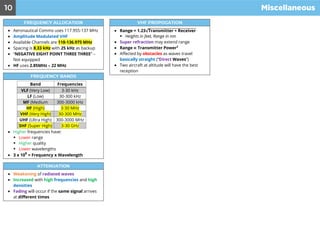
• Aeronautical Commsuses 117.955-137 MHz
• Amplitude Modulated VHF
• Available Channels are 118-136.975 MHz
• Spacing is 8.33 kHz with 25 kHz as backup
• “NEGATIVE EIGHT POINT THREE THREE” –
Not equipped
• HF uses 2.85MHz – 22 MHz
Band Frequencies
VLF (Very Low) 3-30 kHz
LF (Low) 30-300 kHz
MF (Medium 300-3000 kHz
HF (High) 3-30 MHz
VHF (Very High) 30-300 MHz
UHF (Ultra High) 300-3000 MHz
SHF (Super High) 3-30 GHz
• Higher frequencies have:
▪ Lower range
▪ Higher quality
▪ Lower wavelengths
• 3 x 108
= Frequency x Wavelength
• Range = 1.23√Transmitter + Receiver
▪ Heights in feet, Range in nm
• Super refraction may extend range
• Range ∝ Transmitter Power2
• Affected by obstacles as waves travel
basically straight (“Direct Waves”)
• Two aircraft at altitude will have the best
reception
• Weakening of radiated waves
• Increased with high frequencies and high
densities
• Fading will occur if the same signal arrives
at different times