International Research Journal of Engineering and Technology (IRJET) e-ISSN: 2395-0056
Volume: 06 Issue: 05 | May 2019 www.irjet.net p-ISSN: 2395-0072
© 2019, IRJET | Impact Factor value: 7.211 | ISO 9001:2008 Certified Journal | Page 7792
Smart Irrigation System using Soil moisture sensor and PLC
Sudeep Pradhan1, Ram Sundar Kumar2, Saksham Tiwari3, Prof. Deven Vatsal4
1,2,3Student, Anand Engineering College Technical Campus, Agra, Uttar Pradesh, India
4Assistant Professor, Department of Electrical and Electronics Engineering, AEC, Agra Uttar Pradesh, India
---------------------------------------------------------------------***---------------------------------------------------------------------
Abstract – Over the past two decades, the need is felt to
conserve the water thus this project aims to minimize the
wastage of water or over flow of water in fields using soil
moisture sensors and solenoid valves along with the pump.
Eventually the moisture goes down by certain value, pumps
will automatically on the supply and fields will get water
There is improper supply of water to the landwhichaffects the
production. Thus it is necessary to find an automatic system
which can provide required water to the farm depending on
the crop water demands and the electricity availability
timings. Thus this project is concentrated on automation
based opportunities that can be utilized in irrigation methods
and through that we can get best results out of that.
Key Words: (soil moisture sensors, solenoidvalves,pumps)
1. INTRODUCTION
Water is one of the most fundamental parts of agriculture.
But, nowadays the competition for water resources is much
more intense. Successful agriculture is dependent upon
farmers having sufficient access to water. However water
scarcity is already a critical constraint to farming in many
parts of the world. Hence controlled supply of water is
required to be given to the crops. It helps grow agriculture
crops, maintain landscapes and revegetate disturbedsoilsin
dry areas and during periods of inadequate rainfall. In this
system two sensors are used which will sense the moisture
level in the soil which are placed at different intervals.
Sensor will send the data to plc which will compare it with a
predefined value and depending upon the analysis the
system will perform the task automatically. The main
objective of the system is a) Reduce the water consumption
in agriculture by using automation strategies.
1.1 LITERATURE SURVEY
1. Prashant .S. Patil author said “There should be
modernization in the conventional agricultural practices for
better results. Here a microcontroller along with various
sensors like soil moisture sensor, water flow meter are used
to check the water used and provided to the crops. It states
that the system monitors the flow of water and it also
provides following aspects a) Detects the level of water. b)
Builds such system which enhances crop productivity. c)
Handles the system automatically.
2. Santosh Sanket author said, atomizing drip irrigation can
save 70% of water. Here a moisture sensor, fire detector,
water level sensor, intruder sensor and a vegetable washer
are used to provide inputs to the PLC to control the whole
system.
3. Chetna V. Maheshwari author said “Due to the affordable
prices of PLC it can be used as standalone controllers”. Here
soil moisturesensors have been used to detect theamountof
moisture present in the soil.
4. Here plc is used as a mode of communication with the soil
moisture sensors and the solenoid valves. Thus suitable at
any climatic condition and even affordable, so it can be
utilized formaking a goodand trustworthyprojectwhichcan
give a profitable outcome.
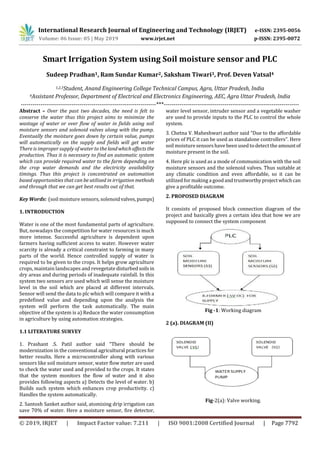
2. PROPOSED DIAGRAM
It consists of proposed block connection diagram of the
project and basically gives a certain idea that how we are
supposed to connect the system component
Fig -1: Working diagram
2 (a). DIAGRAM (II)
Fig-2(a): Valve working.
International Research Journal of Engineering and Technology (IRJET) e-ISSN: 2395-0056
Volume: 06 Issue: 05 | May 2019 www.irjet.net p-ISSN: 2395-0072
© 2019, IRJET | Impact Factor value: 7.211 | ISO 9001:2008 Certified Journal | Page 7793
3. FLOW CHART
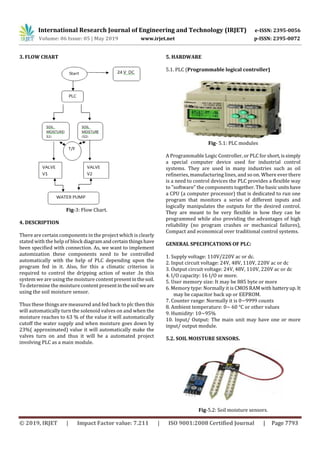
Fig-3: Flow Chart.
4. DESCRIPTION
There are certain components in the project which is clearly
stated with the help of block diagramandcertainthingshave
been specified with connection. As, we want to implement
automization these components need to be controlled
automatically with the help of PLC depending upon the
program fed in it. Also, for this a climatic criterion is
required to control the dripping action of water .In this
system we are using the moisture content presentinthesoil.
To determine the moisture content presentinthesoil we are
using the soil moisture sensor.
Thus these things are measured and fed back to plc thenthis
will automatically turn the solenoid valves on and when the
moisture reaches to 63 % of the value it will automatically
cutoff the water supply and when moisture goes down by
23%( approximated) value it will automatically make the
valves turn on and thus it will be a automated project
involving PLC as a main module.
5. HARDWARE
5.1. PLC (Programmable logical controller)
Fig- 5.1: PLC modules
A Programmable Logic Controller, or PLC for short,issimply
a special computer device used for industrial control
systems. They are used in many industries such as oil
refineries, manufacturing lines, and so on. Where ever there
is a need to control devices the PLC provides a flexible way
to "software" the components together. The basicunitshave
a CPU (a computer processor) that is dedicated to run one
program that monitors a series of different inputs and
logically manipulates the outputs for the desired control.
They are meant to be very flexible in how they can be
programmed while also providing the advantages of high
reliability (no program crashes or mechanical failures),
Compact and economical over traditional control systems.
GENERAL SPECIFICATIONS OF PLC:
1. Supply voltage: 110V/220V ac or dc.
2. Input circuit voltage: 24V, 48V, 110V, 220V ac or dc
3. Output circuit voltage: 24V, 48V, 110V, 220V ac or dc
4. I/O capacity: 16 I/O or more.
5. User memory size: It may be 885 byte or more
6. Memory type: Normally it is CMOS RAM with batteryup. It
may be capacitor back up or EEPROM.
7. Counter range: Normally it is 0~9999 counts
8. Ambient temperature: 0~ 60 °C or other values
9. Humidity: 10~95%
10. Input/ Output: The main unit may have one or more
input/ output module.
5.2. SOIL MOISTURE SENSORS.
Fig-5.2: Soil moisture sensors.
International Research Journal of Engineering and Technology (IRJET) e-ISSN: 2395-0056
Volume: 06 Issue: 05 | May 2019 www.irjet.net p-ISSN: 2395-0072
© 2019, IRJET | Impact Factor value: 7.211 | ISO 9001:2008 Certified Journal | Page 7794
Soil moisture sensors measure the water content in soil. A
soil moisture probe is made up of multiple soil moisture
sensors. This Soil Moisture Sensor can be used to detect the
moisture of soil or judge if there is water around the sensor,
let the plants in your garden reachoutforhumanhelp. Insert
this module into the soil and then adjust the on-board
potentiometer to adjust the sensitivity. The sensor would
outputs logic HIGH/LOW whenthemoistureishigher/lower
than the threshold set by the potentiometer.
5.2.1 SPECIFICATIONS
This sensor has the following specifications:
1. Digital output: easy to adjust.
2. Analog output: 0V-5V.
3. Nickel plating to avoid corrosion.
4. Working voltage: 3.3V-5V.
5. On-board LM393 chip.
6. Dimension of the board: 3. 2cm * 1.4cm.
5.3 WATER PUMP
Fig: 5.3 Water pump.
Water pumps move water that does not contain suspended
solids or particulates. These pumps are notsomucha typeof
pump as they are a classification based on the media being
transferred.
Nearly every pump type that is defined by either a
complementary application (fountain water pumps,
submersible water pumps) or by motive type (such as
centrifugal, cantilever, or hand water pumps) can be used in
water service applications. See the main pumps page for
links to pumps classified by motive force.
5.3.1 POWER SOURCE
There are a variety of power sourcesthatareusedtooperate
water pumps. Power source comes down to availability,
safety. If the pump is not supplied with a power source the
pump mechanism is the onlypowersource.Typically,a drive
shaft for connection of motor or other power source is
provided.
1. AC voltage
2. DC voltage
3. Compressed or pneumatic air source
4. Gasoline or diesel engine
5. Hydraulic system
6. Manual
7. Natural gas
8. Solar powered
9. Steam
10. Water
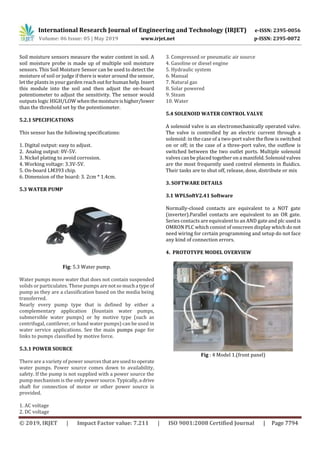
5.4 SOLENOID WATER CONTROL VALVE
A solenoid valve is an electromechanically operated valve.
The valve is controlled by an electric current through a
solenoid: in the case of a two-port valve the flow is switched
on or off; in the case of a three-port valve, the outflow is
switched between the two outlet ports. Multiple solenoid
valves can be placed together on a manifold. Solenoid valves
are the most frequently used control elements in fluidics.
Their tasks are to shut off, release, dose, distribute or mix
3. SOFTWARE DETAILS
3.1 WPLSoftV2.41 Software
Normally-closed contacts are equivalent to a NOT gate
(inverter).Parallel contacts are equivalent to an OR gate.
Series contacts are equivalent to an AND gate and plc usedis
OMRON PLC which consist of onscreen display which do not
need wiring for certain programming and setup do not face
any kind of connection errors.
4. PROTOTYPE MODEL OVERVIEW
Fig : 4 Model 1.(front panel)
International Research Journal of Engineering and Technology (IRJET) e-ISSN: 2395-0056
Volume: 06 Issue: 05 | May 2019 www.irjet.net p-ISSN: 2395-0072
© 2019, IRJET | Impact Factor value: 7.211 | ISO 9001:2008 Certified Journal | Page 7795
Fig: 4(a) Model 1( side view)
Fig: 4(b) Model 2( PLC unit)
5. CONCLUSION
We conclude that the system reduces water Consumption
and hence minimizes the wastage of water. In this system as
we provide controlled supply of water and fertilizers to the
crop it improves the Productivity. Also due to an automated
system the manpower is reduced. By implementing such a
system using plc and sensors we can increase Agricultural
yield and upgrade Indian economy.
6. ACKNOWLEDGEMENT
We would like to express our sincere thanks to Prof.Deven
Vatsal for his valuable guidance, great Support and
encouraged us to work hard. And we Also want to thanks
Electrical and Electronics Engineering department and our
college.
7. REFERENCES
[1] Prashant S. Patil, Shubham R. Alai, Ashish C. Malpure,
Prashant L. Patil, “An Intelligent and Automated Drip
Irrigation System Using Sensors Network Control System”,
International Journal of Innovative Research in Computer
and Communication Engineering, 2014.
[2]Chetna V. Maheshwari, Dipal Sindha, “Water Irrigation
system Using Controller”, International Journal of Advanced
Technology in Engineering and Science, 2014.
[3] Santosh, Sanket, Shriyo, Sugandha, Sakina, Priyanka
harsha, Anuradha Desai, “Plc Based Automated Drip
Irrigation”, International Journal of Current Research in
Multidisciplinary (IJCRM), 2016.
[4] Shweta Bopshetty, Mrunali Yadav, Rithvika Rae, Sheril
Silvister, Prof. Parth Sagar, “Monitoring and Controlling of
Drip Irrigation using IOT with Embedded Linux Board”,
International Journal ofAdvancedResearchinComputerand
Communication Engineering, 2017.
[5] Vaishnavi mantra,Namrata mohite, Aishwarya Patil,Prof.
Yadav NC. “Automatic Drip Irrigation Using PLC”,
International Research Journal of Engineering and
Technology (IRJET) 2018

IRJET- Smart Irrigation System using Soil Moisture Sensor and PLC

  • 1.
    International Research Journalof Engineering and Technology (IRJET) e-ISSN: 2395-0056 Volume: 06 Issue: 05 | May 2019 www.irjet.net p-ISSN: 2395-0072 © 2019, IRJET | Impact Factor value: 7.211 | ISO 9001:2008 Certified Journal | Page 7792 Smart Irrigation System using Soil moisture sensor and PLC Sudeep Pradhan1, Ram Sundar Kumar2, Saksham Tiwari3, Prof. Deven Vatsal4 1,2,3Student, Anand Engineering College Technical Campus, Agra, Uttar Pradesh, India 4Assistant Professor, Department of Electrical and Electronics Engineering, AEC, Agra Uttar Pradesh, India ---------------------------------------------------------------------***--------------------------------------------------------------------- Abstract – Over the past two decades, the need is felt to conserve the water thus this project aims to minimize the wastage of water or over flow of water in fields using soil moisture sensors and solenoid valves along with the pump. Eventually the moisture goes down by certain value, pumps will automatically on the supply and fields will get water There is improper supply of water to the landwhichaffects the production. Thus it is necessary to find an automatic system which can provide required water to the farm depending on the crop water demands and the electricity availability timings. Thus this project is concentrated on automation based opportunities that can be utilized in irrigation methods and through that we can get best results out of that. Key Words: (soil moisture sensors, solenoidvalves,pumps) 1. INTRODUCTION Water is one of the most fundamental parts of agriculture. But, nowadays the competition for water resources is much more intense. Successful agriculture is dependent upon farmers having sufficient access to water. However water scarcity is already a critical constraint to farming in many parts of the world. Hence controlled supply of water is required to be given to the crops. It helps grow agriculture crops, maintain landscapes and revegetate disturbedsoilsin dry areas and during periods of inadequate rainfall. In this system two sensors are used which will sense the moisture level in the soil which are placed at different intervals. Sensor will send the data to plc which will compare it with a predefined value and depending upon the analysis the system will perform the task automatically. The main objective of the system is a) Reduce the water consumption in agriculture by using automation strategies. 1.1 LITERATURE SURVEY 1. Prashant .S. Patil author said “There should be modernization in the conventional agricultural practices for better results. Here a microcontroller along with various sensors like soil moisture sensor, water flow meter are used to check the water used and provided to the crops. It states that the system monitors the flow of water and it also provides following aspects a) Detects the level of water. b) Builds such system which enhances crop productivity. c) Handles the system automatically. 2. Santosh Sanket author said, atomizing drip irrigation can save 70% of water. Here a moisture sensor, fire detector, water level sensor, intruder sensor and a vegetable washer are used to provide inputs to the PLC to control the whole system. 3. Chetna V. Maheshwari author said “Due to the affordable prices of PLC it can be used as standalone controllers”. Here soil moisturesensors have been used to detect theamountof moisture present in the soil. 4. Here plc is used as a mode of communication with the soil moisture sensors and the solenoid valves. Thus suitable at any climatic condition and even affordable, so it can be utilized formaking a goodand trustworthyprojectwhichcan give a profitable outcome. 2. PROPOSED DIAGRAM It consists of proposed block connection diagram of the project and basically gives a certain idea that how we are supposed to connect the system component Fig -1: Working diagram 2 (a). DIAGRAM (II) Fig-2(a): Valve working.
  • 2.
    International Research Journalof Engineering and Technology (IRJET) e-ISSN: 2395-0056 Volume: 06 Issue: 05 | May 2019 www.irjet.net p-ISSN: 2395-0072 © 2019, IRJET | Impact Factor value: 7.211 | ISO 9001:2008 Certified Journal | Page 7793 3. FLOW CHART Fig-3: Flow Chart. 4. DESCRIPTION There are certain components in the project which is clearly stated with the help of block diagramandcertainthingshave been specified with connection. As, we want to implement automization these components need to be controlled automatically with the help of PLC depending upon the program fed in it. Also, for this a climatic criterion is required to control the dripping action of water .In this system we are using the moisture content presentinthesoil. To determine the moisture content presentinthesoil we are using the soil moisture sensor. Thus these things are measured and fed back to plc thenthis will automatically turn the solenoid valves on and when the moisture reaches to 63 % of the value it will automatically cutoff the water supply and when moisture goes down by 23%( approximated) value it will automatically make the valves turn on and thus it will be a automated project involving PLC as a main module. 5. HARDWARE 5.1. PLC (Programmable logical controller) Fig- 5.1: PLC modules A Programmable Logic Controller, or PLC for short,issimply a special computer device used for industrial control systems. They are used in many industries such as oil refineries, manufacturing lines, and so on. Where ever there is a need to control devices the PLC provides a flexible way to "software" the components together. The basicunitshave a CPU (a computer processor) that is dedicated to run one program that monitors a series of different inputs and logically manipulates the outputs for the desired control. They are meant to be very flexible in how they can be programmed while also providing the advantages of high reliability (no program crashes or mechanical failures), Compact and economical over traditional control systems. GENERAL SPECIFICATIONS OF PLC: 1. Supply voltage: 110V/220V ac or dc. 2. Input circuit voltage: 24V, 48V, 110V, 220V ac or dc 3. Output circuit voltage: 24V, 48V, 110V, 220V ac or dc 4. I/O capacity: 16 I/O or more. 5. User memory size: It may be 885 byte or more 6. Memory type: Normally it is CMOS RAM with batteryup. It may be capacitor back up or EEPROM. 7. Counter range: Normally it is 0~9999 counts 8. Ambient temperature: 0~ 60 °C or other values 9. Humidity: 10~95% 10. Input/ Output: The main unit may have one or more input/ output module. 5.2. SOIL MOISTURE SENSORS. Fig-5.2: Soil moisture sensors.
  • 3.
    International Research Journalof Engineering and Technology (IRJET) e-ISSN: 2395-0056 Volume: 06 Issue: 05 | May 2019 www.irjet.net p-ISSN: 2395-0072 © 2019, IRJET | Impact Factor value: 7.211 | ISO 9001:2008 Certified Journal | Page 7794 Soil moisture sensors measure the water content in soil. A soil moisture probe is made up of multiple soil moisture sensors. This Soil Moisture Sensor can be used to detect the moisture of soil or judge if there is water around the sensor, let the plants in your garden reachoutforhumanhelp. Insert this module into the soil and then adjust the on-board potentiometer to adjust the sensitivity. The sensor would outputs logic HIGH/LOW whenthemoistureishigher/lower than the threshold set by the potentiometer. 5.2.1 SPECIFICATIONS This sensor has the following specifications: 1. Digital output: easy to adjust. 2. Analog output: 0V-5V. 3. Nickel plating to avoid corrosion. 4. Working voltage: 3.3V-5V. 5. On-board LM393 chip. 6. Dimension of the board: 3. 2cm * 1.4cm. 5.3 WATER PUMP Fig: 5.3 Water pump. Water pumps move water that does not contain suspended solids or particulates. These pumps are notsomucha typeof pump as they are a classification based on the media being transferred. Nearly every pump type that is defined by either a complementary application (fountain water pumps, submersible water pumps) or by motive type (such as centrifugal, cantilever, or hand water pumps) can be used in water service applications. See the main pumps page for links to pumps classified by motive force. 5.3.1 POWER SOURCE There are a variety of power sourcesthatareusedtooperate water pumps. Power source comes down to availability, safety. If the pump is not supplied with a power source the pump mechanism is the onlypowersource.Typically,a drive shaft for connection of motor or other power source is provided. 1. AC voltage 2. DC voltage 3. Compressed or pneumatic air source 4. Gasoline or diesel engine 5. Hydraulic system 6. Manual 7. Natural gas 8. Solar powered 9. Steam 10. Water 5.4 SOLENOID WATER CONTROL VALVE A solenoid valve is an electromechanically operated valve. The valve is controlled by an electric current through a solenoid: in the case of a two-port valve the flow is switched on or off; in the case of a three-port valve, the outflow is switched between the two outlet ports. Multiple solenoid valves can be placed together on a manifold. Solenoid valves are the most frequently used control elements in fluidics. Their tasks are to shut off, release, dose, distribute or mix 3. SOFTWARE DETAILS 3.1 WPLSoftV2.41 Software Normally-closed contacts are equivalent to a NOT gate (inverter).Parallel contacts are equivalent to an OR gate. Series contacts are equivalent to an AND gate and plc usedis OMRON PLC which consist of onscreen display which do not need wiring for certain programming and setup do not face any kind of connection errors. 4. PROTOTYPE MODEL OVERVIEW Fig : 4 Model 1.(front panel)
  • 4.
    International Research Journalof Engineering and Technology (IRJET) e-ISSN: 2395-0056 Volume: 06 Issue: 05 | May 2019 www.irjet.net p-ISSN: 2395-0072 © 2019, IRJET | Impact Factor value: 7.211 | ISO 9001:2008 Certified Journal | Page 7795 Fig: 4(a) Model 1( side view) Fig: 4(b) Model 2( PLC unit) 5. CONCLUSION We conclude that the system reduces water Consumption and hence minimizes the wastage of water. In this system as we provide controlled supply of water and fertilizers to the crop it improves the Productivity. Also due to an automated system the manpower is reduced. By implementing such a system using plc and sensors we can increase Agricultural yield and upgrade Indian economy. 6. ACKNOWLEDGEMENT We would like to express our sincere thanks to Prof.Deven Vatsal for his valuable guidance, great Support and encouraged us to work hard. And we Also want to thanks Electrical and Electronics Engineering department and our college. 7. REFERENCES [1] Prashant S. Patil, Shubham R. Alai, Ashish C. Malpure, Prashant L. Patil, “An Intelligent and Automated Drip Irrigation System Using Sensors Network Control System”, International Journal of Innovative Research in Computer and Communication Engineering, 2014. [2]Chetna V. Maheshwari, Dipal Sindha, “Water Irrigation system Using Controller”, International Journal of Advanced Technology in Engineering and Science, 2014. [3] Santosh, Sanket, Shriyo, Sugandha, Sakina, Priyanka harsha, Anuradha Desai, “Plc Based Automated Drip Irrigation”, International Journal of Current Research in Multidisciplinary (IJCRM), 2016. [4] Shweta Bopshetty, Mrunali Yadav, Rithvika Rae, Sheril Silvister, Prof. Parth Sagar, “Monitoring and Controlling of Drip Irrigation using IOT with Embedded Linux Board”, International Journal ofAdvancedResearchinComputerand Communication Engineering, 2017. [5] Vaishnavi mantra,Namrata mohite, Aishwarya Patil,Prof. Yadav NC. “Automatic Drip Irrigation Using PLC”, International Research Journal of Engineering and Technology (IRJET) 2018