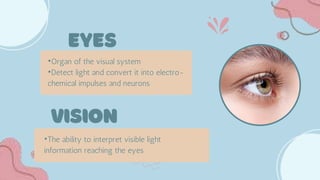
•Organ of the visual system
•Detect light and convert it into electro-
chemical impulses and neurons
•The ability to interpret visible light
information reaching the eyes
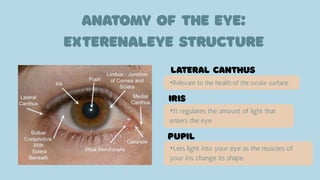
•Relevant to the health of the ocular surface.
•It regulates the amount of light that
enters the eye
•Lets light into your eye as the muscles of
your iris change its shape.
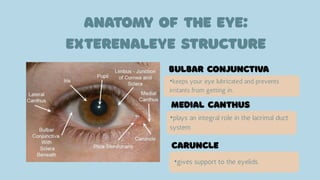
•keeps your eye lubricated and prevents
irritants from getting in..
•plays an integral role in the lacrimal duct
system
•gives support to the eyelids.
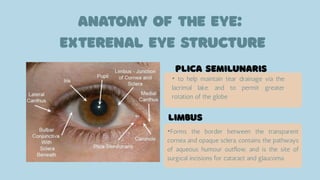
• to help maintain tear drainage via the
lacrimal lake, and to permit greater
rotation of the globe
•Forms the border between the transparent
cornea and opaque sclera, contains the pathways
of aqueous humour outflow, and is the site of
surgical incisions for cataract and glaucoma.
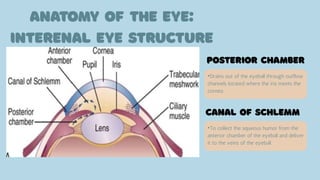
•Drains out of the eyeball through outflow
channels located where the iris meets the
cornea.
•To collect the aqueous humor from the
anterior chamber of the eyeball and deliver
it to the veins of the eyeball.
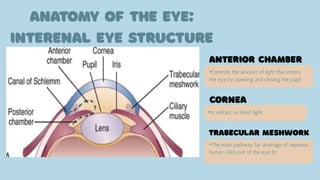
•Controls the amount of light that enters
the eye by opening and closing the pupil
•to refract, or bend, light.
•The main pathway for drainage of aqueous
humor (AH) out of the eye Dr
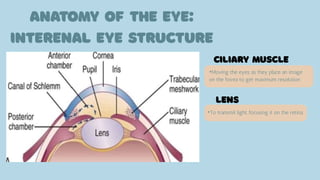
•Moving the eyes as they place an image
on the fovea to get maximum resolution
•To transmit light, focusing it on the retina.
• <40 years old without family history of
hypertension, diabetes or eye disease: every 3-5
years
• >40 years old: every 2 years
• If the client wears reading glasses, let the client
wears it during the examination
• Checks for:
•External eye structure
•Accommodation
•Visual fields
•Extraocular muscle
•Visual activity
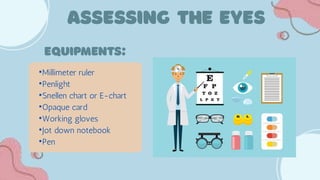
•Millimeter ruler
•Penlight
•Snellen chart or E-chart
•Opaque card
•Working gloves
•Jot down notebook
•Pen
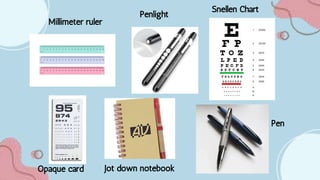
Millimeter ruler
Penlight
Snellen Chart
Opaque card Jot down notebook
Pen
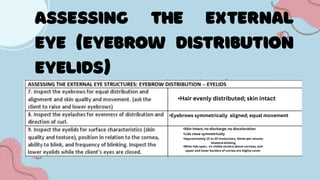
•Hair evenly distributed; skin intact
•Eyebrows symmetrically aligned; equal movement
•Skin intact; no discharge; no discoloration
•Lids close symmetrically
•Approximately 15 to 20 involuntary blinks per minute;
bilateral blinking
•When lids open, no visible esclera above corneas, and
upper and lower borders of cornea are slighty cover
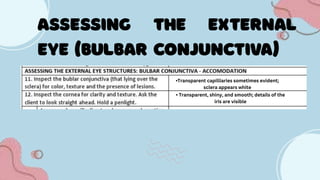
•Transparent capilliaries sometimes evident;
sclera appears white
• Transparent, shiny, and smooth; details of the
iris are visible
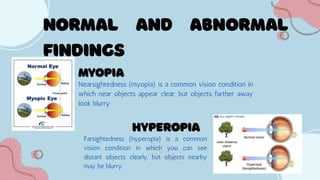
Nearsightedness (myopia) is a common vision condition in
which near objects appear clear, but objects farther away
look blurry
Farsightedness (hyperopia) is a common
vision condition in which you can see
distant objects clearly, but objects nearby
may be blurry.
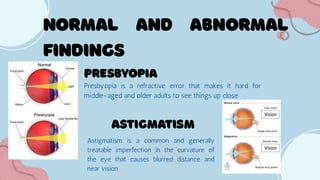
Presbyopia is a refractive error that makes it hard for
middle-aged and older adults to see things up close
Astigmatism is a common and generally
treatable imperfection in the curvature of
the eye that causes blurred distance and
near vision
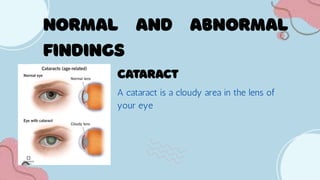
A cataract is a cloudy area in the lens of
your eye
EYE ASSESSMENT FOR NURSING STUDENTS.pptx

EYE ASSESSMENT FOR NURSING STUDENTS.pptx

  • 2.
    •Organ of thevisual system •Detect light and convert it into electro- chemical impulses and neurons •The ability to interpret visible light information reaching the eyes
  • 3.
    •Relevant to thehealth of the ocular surface. •It regulates the amount of light that enters the eye •Lets light into your eye as the muscles of your iris change its shape.
  • 4.
    •keeps your eyelubricated and prevents irritants from getting in.. •plays an integral role in the lacrimal duct system •gives support to the eyelids.
  • 5.
    • to helpmaintain tear drainage via the lacrimal lake, and to permit greater rotation of the globe •Forms the border between the transparent cornea and opaque sclera, contains the pathways of aqueous humour outflow, and is the site of surgical incisions for cataract and glaucoma.
  • 6.
    •Drains out ofthe eyeball through outflow channels located where the iris meets the cornea. •To collect the aqueous humor from the anterior chamber of the eyeball and deliver it to the veins of the eyeball.
  • 7.
    •Controls the amountof light that enters the eye by opening and closing the pupil •to refract, or bend, light. •The main pathway for drainage of aqueous humor (AH) out of the eye Dr
  • 8.
    •Moving the eyesas they place an image on the fovea to get maximum resolution •To transmit light, focusing it on the retina.
  • 9.
    • <40 yearsold without family history of hypertension, diabetes or eye disease: every 3-5 years • >40 years old: every 2 years • If the client wears reading glasses, let the client wears it during the examination • Checks for: •External eye structure •Accommodation •Visual fields •Extraocular muscle •Visual activity
  • 10.
    •Millimeter ruler •Penlight •Snellen chartor E-chart •Opaque card •Working gloves •Jot down notebook •Pen
  • 11.
  • 13.
    •Hair evenly distributed;skin intact •Eyebrows symmetrically aligned; equal movement •Skin intact; no discharge; no discoloration •Lids close symmetrically •Approximately 15 to 20 involuntary blinks per minute; bilateral blinking •When lids open, no visible esclera above corneas, and upper and lower borders of cornea are slighty cover
  • 14.
    •Transparent capilliaries sometimesevident; sclera appears white • Transparent, shiny, and smooth; details of the iris are visible
  • 15.
    Nearsightedness (myopia) isa common vision condition in which near objects appear clear, but objects farther away look blurry Farsightedness (hyperopia) is a common vision condition in which you can see distant objects clearly, but objects nearby may be blurry.
  • 16.
    Presbyopia is arefractive error that makes it hard for middle-aged and older adults to see things up close Astigmatism is a common and generally treatable imperfection in the curvature of the eye that causes blurred distance and near vision
  • 17.
    A cataract isa cloudy area in the lens of your eye