Medical plants abound in nature. Since most
of them are available and easily accessible,
these medicines are more affordable compared
to synthetic drugs.
Herbal medicine refers to the use of
plant-derived substances, including raw or
processed parts of plants, for therapeutic
purposes to promote health and treat various
medical conditions.
Herbal medicines are those with active
ingredients made from plant parts, such as
leaves, roots or flowers.
But being "natural" doesn't necessarily mean
they're safe for you to take. Just like
conventional medicines, herbal medicines will
have an effect on the body, and can be
potentially harmful if not used correctly.
As part of PHC and because of the increasing
cost of drugs, the use of locally available
medicinal plants has been advocated by the
DOH.
Many plants and herbs in the Philippine
backyard and field are effective in the
treatment of common ailments as attested to
by the National Science Development Board,
and other government and private
agencies/persons engaged in research.
Republic Act 8423 (R.A. 8423)
There are Ten medicinal plants have been
endorsed by the DOH-PITAHC (Philippine
Institute of Traditional and Alternative
Health Care),after they have been
scientifically validated to ensure
safety and efficacy.
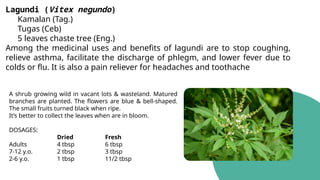
Lagundi (Vitex negundo)
Kamalan (Tag.)
Tugas (Ceb)
5 leaves chaste tree (Eng.)
Among the medicinal uses and benefits of lagundi are to stop coughing,
relieve asthma, facilitate the discharge of phlegm, and lower fever due to
colds or flu. It is also a pain reliever for headaches and toothache
A shrub growing wild in vacant lots & wasteland. Matured
branches are planted. The flowers are blue & bell-shaped.
The small fruits turned black when ripe.
It’s better to collect the leaves when are in bloom.
DOSAGES:
Dried Fresh
Adults 4 tbsp 6 tbsp
7-12 y.o. 2 tbsp 3 tbsp
2-6 y.o. 1 tbsp 11/2 tbsp
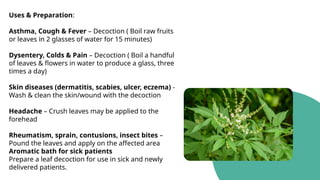
Uses & Preparation:
Asthma, Cough & Fever – Decoction ( Boil raw fruits
or leaves in 2 glasses of water for 15 minutes)
Dysentery, Colds & Pain – Decoction ( Boil a handful
of leaves & flowers in water to produce a glass, three
times a day)
Skin diseases (dermatitis, scabies, ulcer, eczema) -
Wash & clean the skin/wound with the decoction
Headache – Crush leaves may be applied to the
forehead
Rheumatism, sprain, contusions, insect bites –
Pound the leaves and apply on the affected area
Aromatic bath for sick patients
Prepare a leaf decoction for use in sick and newly
delivered patients.
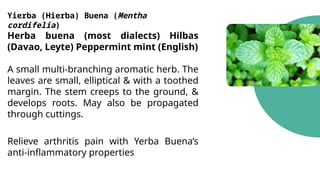
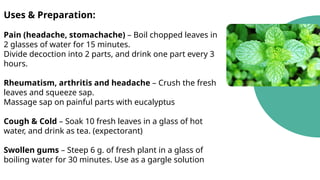
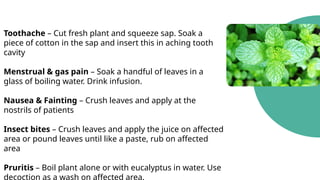
Yierba (Hierba) Buena (Mentha
cordifelia)
Herba buena (most dialects) Hilbas
(Davao, Leyte) Peppermint mint (English)
A small multi-branching aromatic herb. The
leaves are small, elliptical & with a toothed
margin. The stem creeps to the ground, &
develops roots. May also be propagated
through cuttings.
Relieve arthritis pain with Yerba Buena’s
anti-inflammatory properties
Uses & Preparation:
Pain (headache, stomachache) – Boil chopped leaves in
2 glasses of water for 15 minutes.
Divide decoction into 2 parts, and drink one part every 3
hours.
Rheumatism, arthritis and headache – Crush the fresh
leaves and squeeze sap.
Massage sap on painful parts with eucalyptus
Cough & Cold – Soak 10 fresh leaves in a glass of hot
water, and drink as tea. (expectorant)
Swollen gums – Steep 6 g. of fresh plant in a glass of
boiling water for 30 minutes. Use as a gargle solution
Toothache – Cut fresh plant and squeeze sap. Soak a
piece of cotton in the sap and insert this in aching tooth
cavity
Menstrual & gas pain – Soak a handful of leaves in a
glass of boiling water. Drink infusion.
Nausea & Fainting – Crush leaves and apply at the
nostrils of patients
Insect bites – Crush leaves and apply the juice on affected
area or pound leaves until like a paste, rub on affected
area
Pruritis – Boil plant alone or with eucalyptus in water. Use
decoction as a wash on affected area.
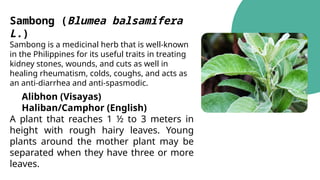
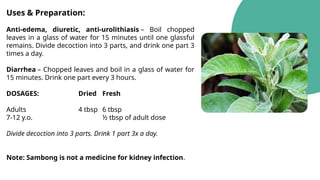
Sambong (Blumea balsamifera
L.)
Sambong is a medicinal herb that is well-known
in the Philippines for its useful traits in treating
kidney stones, wounds, and cuts as well in
healing rheumatism, colds, coughs, and acts as
an anti-diarrhea and anti-spasmodic.
Alibhon (Visayas)
Haliban/Camphor (English)
A plant that reaches 1 ½ to 3 meters in
height with rough hairy leaves. Young
plants around the mother plant may be
separated when they have three or more
leaves.
Uses & Preparation:
Anti-edema, diuretic, anti-urolithiasis – Boil chopped
leaves in a glass of water for 15 minutes until one glassful
remains. Divide decoction into 3 parts, and drink one part 3
times a day.
Diarrhea – Chopped leaves and boil in a glass of water for
15 minutes. Drink one part every 3 hours.
DOSAGES: Dried Fresh
Adults 4 tbsp 6 tbsp
7-12 y.o. ½ tbsp of adult dose
Divide decoction into 3 parts. Drink 1 part 3x a day.
Note: Sambong is not a medicine for kidney infection.
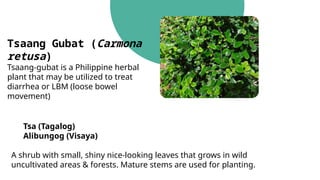
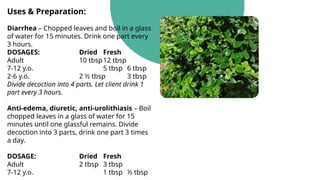
Tsaang Gubat (Carmona
retusa)
Tsaang-gubat is a Philippine herbal
plant that may be utilized to treat
diarrhea or LBM (loose bowel
movement)
Tsa (Tagalog)
Alibungog (Visaya)
A shrub with small, shiny nice-looking leaves that grows in wild
uncultivated areas & forests. Mature stems are used for planting.
Uses & Preparation:
Diarrhea – Chopped leaves and boil in a glass
of water for 15 minutes. Drink one part every
3 hours.
DOSAGES: Dried Fresh
Adult 10 tbsp12 tbsp
7-12 y.o. 5 tbsp 6 tbsp
2-6 y.o. 2 ½ tbsp 3 tbsp
Divide decoction into 4 parts. Let client drink 1
part every 3 hours.
Anti-edema, diuretic, anti-urolithiasis – Boil
chopped leaves in a glass of water for 15
minutes until one glassful remains. Divide
decoction into 3 parts, drink one part 3 times
a day.
DOSAGE: Dried Fresh
Adult 2 tbsp 3 tbsp
7-12 y.o. 1 tbsp ½ tbsp
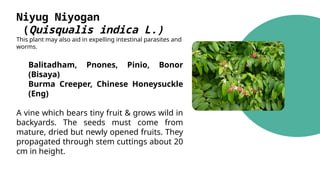
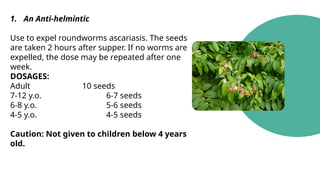
Niyug Niyogan
(Quisqualis indica L.)
This plant may also aid in expelling intestinal parasites and
worms.
Balitadham, Pnones, Pinio, Bonor
(Bisaya)
Burma Creeper, Chinese Honeysuckle
(Eng)
A vine which bears tiny fruit & grows wild in
backyards. The seeds must come from
mature, dried but newly opened fruits. They
propagated through stem cuttings about 20
cm in height.
1. An Anti-helmintic
Use to expel roundworms ascariasis. The seeds
are taken 2 hours after supper. If no worms are
expelled, the dose may be repeated after one
week.
DOSAGES:
Adult 10 seeds
7-12 y.o. 6-7 seeds
6-8 y.o. 5-6 seeds
4-5 y.o. 4-5 seeds
Caution: Not given to children below 4 years
old.
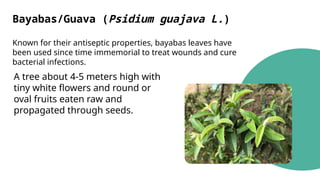
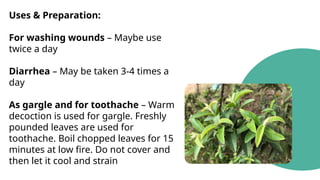
Bayabas/Guava (Psidium guajava L.)
Known for their antiseptic properties, bayabas leaves have
been used since time immemorial to treat wounds and cure
bacterial infections.
A tree about 4-5 meters high with
tiny white flowers and round or
oval fruits eaten raw and
propagated through seeds.
Uses & Preparation:
For washing wounds – Maybe use
twice a day
Diarrhea – May be taken 3-4 times a
day
As gargle and for toothache – Warm
decoction is used for gargle. Freshly
pounded leaves are used for
toothache. Boil chopped leaves for 15
minutes at low fire. Do not cover and
then let it cool and strain
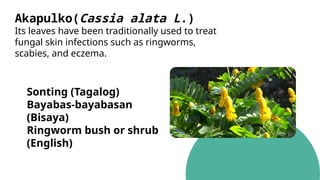
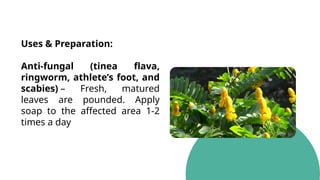
Akapulko(Cassia alata L.)
Its leaves have been traditionally used to treat
fungal skin infections such as ringworms,
scabies, and eczema.
Sonting (Tagalog)
Bayabas-bayabasan
(Bisaya)
Ringworm bush or shrub
(English)
Uses & Preparation:
Anti-fungal (tinea flava,
ringworm, athlete’s foot, and
scabies) – Fresh, matured
leaves are pounded. Apply
soap to the affected area 1-2
times a day
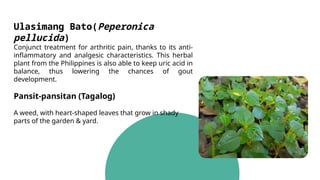
Ulasimang Bato(Peperonica
pellucida)
Conjunct treatment for arthritic pain, thanks to its anti-
inflammatory and analgesic characteristics. This herbal
plant from the Philippines is also able to keep uric acid in
balance, thus lowering the chances of gout
development.
Pansit-pansitan (Tagalog)
A weed, with heart-shaped leaves that grow in shady
parts of the garden & yard.
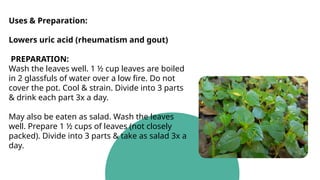
Uses & Preparation:
Lowers uric acid (rheumatism and gout)
PREPARATION:
Wash the leaves well. 1 ½ cup leaves are boiled
in 2 glassfuls of water over a low fire. Do not
cover the pot. Cool & strain. Divide into 3 parts
& drink each part 3x a day.
May also be eaten as salad. Wash the leaves
well. Prepare 1 ½ cups of leaves (not closely
packed). Divide into 3 parts & take as salad 3x a
day.
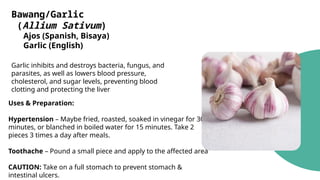
Bawang/Garlic
(Allium Sativum)
Ajos (Spanish, Bisaya)
Garlic (English)
Garlic inhibits and destroys bacteria, fungus, and
parasites, as well as lowers blood pressure,
cholesterol, and sugar levels, preventing blood
clotting and protecting the liver
Uses & Preparation:
Hypertension – Maybe fried, roasted, soaked in vinegar for 30
minutes, or blanched in boiled water for 15 minutes. Take 2
pieces 3 times a day after meals.
Toothache – Pound a small piece and apply to the affected area
CAUTION: Take on a full stomach to prevent stomach &
intestinal ulcers.
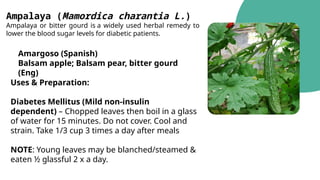
Ampalaya (Mamordica charantia L.)
Ampalaya or bitter gourd is a widely used herbal remedy to
lower the blood sugar levels for diabetic patients.
Amargoso (Spanish)
Balsam apple; Balsam pear, bitter gourd
(Eng)
Uses & Preparation:
Diabetes Mellitus (Mild non-insulin
dependent) – Chopped leaves then boil in a glass
of water for 15 minutes. Do not cover. Cool and
strain. Take 1/3 cup 3 times a day after meals
NOTE: Young leaves may be blanched/steamed &
eaten ½ glassful 2 x a day.
Reminders on the Use of Herbal Medicine
Avoid the use of insecticide as these may leave poison on plants.
In the preparation of herbal medicine, use a clay pot and remove cover while
boiling at low heat.
Use only part of the plant being advocated.
Follow accurate dose of suggested preparation.
Use only one kind of herbal plant for each type of symptoms or sickness.
Stop giving the herbal medication in case untoward reaction such as allergy
occurs.
If signs and symptoms are not relieved after 2 to 3 doses of herbal medication,
consult a doctor.

Bsn HERBAL MEDICATION PREPARATION-KAT.pptx

  • 2.
    Medical plants aboundin nature. Since most of them are available and easily accessible, these medicines are more affordable compared to synthetic drugs. Herbal medicine refers to the use of plant-derived substances, including raw or processed parts of plants, for therapeutic purposes to promote health and treat various medical conditions.
  • 3.
    Herbal medicines arethose with active ingredients made from plant parts, such as leaves, roots or flowers. But being "natural" doesn't necessarily mean they're safe for you to take. Just like conventional medicines, herbal medicines will have an effect on the body, and can be potentially harmful if not used correctly.
  • 4.
    As part ofPHC and because of the increasing cost of drugs, the use of locally available medicinal plants has been advocated by the DOH. Many plants and herbs in the Philippine backyard and field are effective in the treatment of common ailments as attested to by the National Science Development Board, and other government and private agencies/persons engaged in research.
  • 5.
    Republic Act 8423(R.A. 8423) There are Ten medicinal plants have been endorsed by the DOH-PITAHC (Philippine Institute of Traditional and Alternative Health Care),after they have been scientifically validated to ensure safety and efficacy.
  • 6.
    Lagundi (Vitex negundo) Kamalan(Tag.) Tugas (Ceb) 5 leaves chaste tree (Eng.) Among the medicinal uses and benefits of lagundi are to stop coughing, relieve asthma, facilitate the discharge of phlegm, and lower fever due to colds or flu. It is also a pain reliever for headaches and toothache A shrub growing wild in vacant lots & wasteland. Matured branches are planted. The flowers are blue & bell-shaped. The small fruits turned black when ripe. It’s better to collect the leaves when are in bloom. DOSAGES: Dried Fresh Adults 4 tbsp 6 tbsp 7-12 y.o. 2 tbsp 3 tbsp 2-6 y.o. 1 tbsp 11/2 tbsp
  • 7.
    Uses & Preparation: Asthma,Cough & Fever – Decoction ( Boil raw fruits or leaves in 2 glasses of water for 15 minutes) Dysentery, Colds & Pain – Decoction ( Boil a handful of leaves & flowers in water to produce a glass, three times a day) Skin diseases (dermatitis, scabies, ulcer, eczema) - Wash & clean the skin/wound with the decoction Headache – Crush leaves may be applied to the forehead Rheumatism, sprain, contusions, insect bites – Pound the leaves and apply on the affected area Aromatic bath for sick patients Prepare a leaf decoction for use in sick and newly delivered patients.
  • 8.
    Yierba (Hierba) Buena(Mentha cordifelia) Herba buena (most dialects) Hilbas (Davao, Leyte) Peppermint mint (English) A small multi-branching aromatic herb. The leaves are small, elliptical & with a toothed margin. The stem creeps to the ground, & develops roots. May also be propagated through cuttings. Relieve arthritis pain with Yerba Buena’s anti-inflammatory properties
  • 9.
    Uses & Preparation: Pain(headache, stomachache) – Boil chopped leaves in 2 glasses of water for 15 minutes. Divide decoction into 2 parts, and drink one part every 3 hours. Rheumatism, arthritis and headache – Crush the fresh leaves and squeeze sap. Massage sap on painful parts with eucalyptus Cough & Cold – Soak 10 fresh leaves in a glass of hot water, and drink as tea. (expectorant) Swollen gums – Steep 6 g. of fresh plant in a glass of boiling water for 30 minutes. Use as a gargle solution
  • 10.
    Toothache – Cutfresh plant and squeeze sap. Soak a piece of cotton in the sap and insert this in aching tooth cavity Menstrual & gas pain – Soak a handful of leaves in a glass of boiling water. Drink infusion. Nausea & Fainting – Crush leaves and apply at the nostrils of patients Insect bites – Crush leaves and apply the juice on affected area or pound leaves until like a paste, rub on affected area Pruritis – Boil plant alone or with eucalyptus in water. Use decoction as a wash on affected area.
  • 11.
    Sambong (Blumea balsamifera L.) Sambongis a medicinal herb that is well-known in the Philippines for its useful traits in treating kidney stones, wounds, and cuts as well in healing rheumatism, colds, coughs, and acts as an anti-diarrhea and anti-spasmodic. Alibhon (Visayas) Haliban/Camphor (English) A plant that reaches 1 ½ to 3 meters in height with rough hairy leaves. Young plants around the mother plant may be separated when they have three or more leaves.
  • 12.
    Uses & Preparation: Anti-edema,diuretic, anti-urolithiasis – Boil chopped leaves in a glass of water for 15 minutes until one glassful remains. Divide decoction into 3 parts, and drink one part 3 times a day. Diarrhea – Chopped leaves and boil in a glass of water for 15 minutes. Drink one part every 3 hours. DOSAGES: Dried Fresh Adults 4 tbsp 6 tbsp 7-12 y.o. ½ tbsp of adult dose Divide decoction into 3 parts. Drink 1 part 3x a day. Note: Sambong is not a medicine for kidney infection.
  • 13.
    Tsaang Gubat (Carmona retusa) Tsaang-gubatis a Philippine herbal plant that may be utilized to treat diarrhea or LBM (loose bowel movement) Tsa (Tagalog) Alibungog (Visaya) A shrub with small, shiny nice-looking leaves that grows in wild uncultivated areas & forests. Mature stems are used for planting.
  • 14.
    Uses & Preparation: Diarrhea– Chopped leaves and boil in a glass of water for 15 minutes. Drink one part every 3 hours. DOSAGES: Dried Fresh Adult 10 tbsp12 tbsp 7-12 y.o. 5 tbsp 6 tbsp 2-6 y.o. 2 ½ tbsp 3 tbsp Divide decoction into 4 parts. Let client drink 1 part every 3 hours. Anti-edema, diuretic, anti-urolithiasis – Boil chopped leaves in a glass of water for 15 minutes until one glassful remains. Divide decoction into 3 parts, drink one part 3 times a day. DOSAGE: Dried Fresh Adult 2 tbsp 3 tbsp 7-12 y.o. 1 tbsp ½ tbsp
  • 15.
    Niyug Niyogan (Quisqualis indicaL.) This plant may also aid in expelling intestinal parasites and worms. Balitadham, Pnones, Pinio, Bonor (Bisaya) Burma Creeper, Chinese Honeysuckle (Eng) A vine which bears tiny fruit & grows wild in backyards. The seeds must come from mature, dried but newly opened fruits. They propagated through stem cuttings about 20 cm in height.
  • 16.
    1. An Anti-helmintic Useto expel roundworms ascariasis. The seeds are taken 2 hours after supper. If no worms are expelled, the dose may be repeated after one week. DOSAGES: Adult 10 seeds 7-12 y.o. 6-7 seeds 6-8 y.o. 5-6 seeds 4-5 y.o. 4-5 seeds Caution: Not given to children below 4 years old.
  • 17.
    Bayabas/Guava (Psidium guajavaL.) Known for their antiseptic properties, bayabas leaves have been used since time immemorial to treat wounds and cure bacterial infections. A tree about 4-5 meters high with tiny white flowers and round or oval fruits eaten raw and propagated through seeds.
  • 18.
    Uses & Preparation: Forwashing wounds – Maybe use twice a day Diarrhea – May be taken 3-4 times a day As gargle and for toothache – Warm decoction is used for gargle. Freshly pounded leaves are used for toothache. Boil chopped leaves for 15 minutes at low fire. Do not cover and then let it cool and strain
  • 19.
    Akapulko(Cassia alata L.) Itsleaves have been traditionally used to treat fungal skin infections such as ringworms, scabies, and eczema. Sonting (Tagalog) Bayabas-bayabasan (Bisaya) Ringworm bush or shrub (English)
  • 20.
    Uses & Preparation: Anti-fungal(tinea flava, ringworm, athlete’s foot, and scabies) – Fresh, matured leaves are pounded. Apply soap to the affected area 1-2 times a day
  • 21.
    Ulasimang Bato(Peperonica pellucida) Conjunct treatmentfor arthritic pain, thanks to its anti- inflammatory and analgesic characteristics. This herbal plant from the Philippines is also able to keep uric acid in balance, thus lowering the chances of gout development. Pansit-pansitan (Tagalog) A weed, with heart-shaped leaves that grow in shady parts of the garden & yard.
  • 22.
    Uses & Preparation: Lowersuric acid (rheumatism and gout) PREPARATION: Wash the leaves well. 1 ½ cup leaves are boiled in 2 glassfuls of water over a low fire. Do not cover the pot. Cool & strain. Divide into 3 parts & drink each part 3x a day. May also be eaten as salad. Wash the leaves well. Prepare 1 ½ cups of leaves (not closely packed). Divide into 3 parts & take as salad 3x a day.
  • 23.
    Bawang/Garlic (Allium Sativum) Ajos (Spanish,Bisaya) Garlic (English) Garlic inhibits and destroys bacteria, fungus, and parasites, as well as lowers blood pressure, cholesterol, and sugar levels, preventing blood clotting and protecting the liver Uses & Preparation: Hypertension – Maybe fried, roasted, soaked in vinegar for 30 minutes, or blanched in boiled water for 15 minutes. Take 2 pieces 3 times a day after meals. Toothache – Pound a small piece and apply to the affected area CAUTION: Take on a full stomach to prevent stomach & intestinal ulcers.
  • 24.
    Ampalaya (Mamordica charantiaL.) Ampalaya or bitter gourd is a widely used herbal remedy to lower the blood sugar levels for diabetic patients. Amargoso (Spanish) Balsam apple; Balsam pear, bitter gourd (Eng) Uses & Preparation: Diabetes Mellitus (Mild non-insulin dependent) – Chopped leaves then boil in a glass of water for 15 minutes. Do not cover. Cool and strain. Take 1/3 cup 3 times a day after meals NOTE: Young leaves may be blanched/steamed & eaten ½ glassful 2 x a day.
  • 25.
    Reminders on theUse of Herbal Medicine Avoid the use of insecticide as these may leave poison on plants. In the preparation of herbal medicine, use a clay pot and remove cover while boiling at low heat. Use only part of the plant being advocated. Follow accurate dose of suggested preparation. Use only one kind of herbal plant for each type of symptoms or sickness. Stop giving the herbal medication in case untoward reaction such as allergy occurs. If signs and symptoms are not relieved after 2 to 3 doses of herbal medication, consult a doctor.