DEFINITION
 any dye, pigment or substance that
imparts color when it is added to food or drink
 derived from coal tar and petroleum
 come in many forms consisting of liquids, powders,
gels and pastes
 tested for safety by various bodies around the world
 United States > FD&C(Federal Food, Drug, and
Cosmetic Act) are given to approved synthetic food
dyes that do not exist in nature
 European Union > E numbers are used for all
additives, both synthetic and natural, that are
approved in food applications
Color additives are used in foods
for many reasons including:
 offset color loss due to exposure to light,
air, temperature extremes, moisture and
storage conditions
 correct natural variations in color
 enhance colors that occur naturally
 provide color to colorless and "fun"
foods
Seven dyes approved under
the Pure Food and Drug Act of
1906
 FD&C Blue No. 1 – Brilliant Blue FCF, E133 (blue
shade)
 FD&C Blue No. 2 – Indigotine, E132 (indigo shade)
 FD&C Green No. 3 – Fast Green FCF, E143
(turquoise shade)
 FD&C Red No. 40 – Allura Red AC, E129 (red
shade)
 FD&C Red No. 3 – Erythrosine, E127 (pink shade)
 FD&C Yellow No. 5 – Tartrazine, E102 (yellow
shade)
 FD&C Yellow No. 6 – Sunset Yellow FCF, E110
(orange shade)
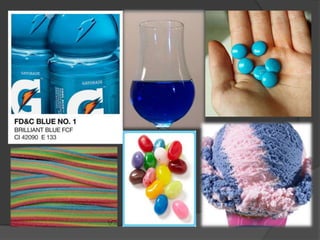
1. Brilliant Blue FCF (E133)
FD&C Blue No. 1
 IUPAC NAME > ethyl - [4 - [ [4 - [ethyl -[(3 - sulfophenyl)
methyl] amino] phenyl] - (2 - sulfophenyl) methylidene] - 1 -
cyclohexa - 2, 5 - dienylidene] - [(3 - sulfophenyl) methyl]
azanium
 MOLECULAR FORMULA > C37H34N2Na2O9S3
 synthetic dye produced using aromatic
hydrocarbons from petroleum
 has the appearance
of a reddish-blue powder
 soluble in water
 has the capacity for inducing
anallergic reaction in individuals
with pre-existing moderate asthma
 Banned in Austria, Belgium, Denmark, France,
Germany, Greece, Italy, Spain, Sweden, and Switzerland
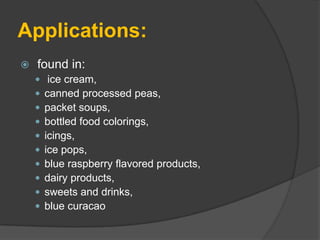
Applications:
 found in:
 ice cream,
 canned processed peas,
 packet soups,
 bottled food colorings,
 icings,
 ice pops,
 blue raspberry flavored products,
 dairy products,
 sweets and drinks,
 blue curacao
2. Indigotine (E132)
FD&C Blue No. 2
 IUPAC NAME > 3,3'-dioxo-2,2'-bis-indolyden-5,5'-disulfonic acid
disodium salt or indigotine; 5,5'-indigodisulfonic acid sodium salt
 MOLECULAR FORMULA > C16H8N2Na2O8S2
 6mg/kg – 500mg/kg
 a pH indicator; blue at pH 11.4 and yellow at 13.0
 is used chiefly as a biological stain and food color
 can cause fetal harm when administered to a pregnant woman or
can affect reproduction capacity
 harmful to the respiratory tract if inhaled
 irritant to the skin and eyes
3. Fast Green FCF (E143)
FD&C Green No. 3
 IUPAC NAME > ethyl - [4 - [ [4 - [ethyl -[(3 - sulfophenyl) methyl] amino]
phenyl] - (4 - hydroxy - 2 - sulfophenyl) methylidene] - 1 - cyclohexa - 2, 5 -
dienylidene] - [(3 - sulfophenyl) methyl] azanium
 MOLECULAR FORMULA > C37H37N2O10S3+
 sea green triarylmethane food dye
 color is more brilliant and less likely to fade
 used for tinned green peas and
other vegetables, jellies, sauces, fish, desserts, and dry bakery mixes at
level of up to 100 mg/kg
 have tumorigenic effects
 risks irritation of eyes, skin, digestive tract, and respiratory tract in its
undiluted form
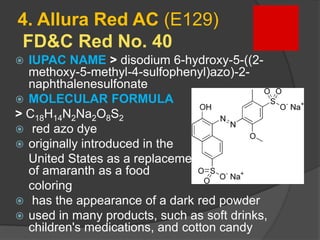
4. Allura Red AC (E129)
FD&C Red No. 40
 IUPAC NAME > disodium 6-hydroxy-5-((2-
methoxy-5-methyl-4-sulfophenyl)azo)-2-
naphthalenesulfonate
 MOLECULAR FORMULA
> C18H14N2Na2O8S2
 red azo dye
 originally introduced in the
United States as a replacement for the use
of amaranth as a food
coloring
 has the appearance of a dark red powder
 used in many products, such as soft drinks,
children's medications, and cotton candy
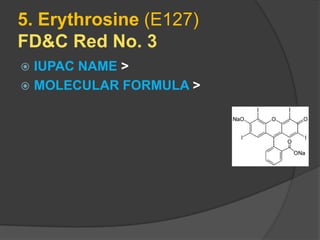
5. Erythrosine (E127)
FD&C Red No. 3
 IUPAC NAME >
 MOLECULAR FORMULA >
 IUPAC NAME >
 MOLECULAR FORMULA >
 IUPAC NAME >
 MOLECULAR FORMULA >

Synthetic Food coloring

  • 2.
    DEFINITION  any dye,pigment or substance that imparts color when it is added to food or drink  derived from coal tar and petroleum  come in many forms consisting of liquids, powders, gels and pastes  tested for safety by various bodies around the world  United States > FD&C(Federal Food, Drug, and Cosmetic Act) are given to approved synthetic food dyes that do not exist in nature  European Union > E numbers are used for all additives, both synthetic and natural, that are approved in food applications
  • 3.
    Color additives areused in foods for many reasons including:  offset color loss due to exposure to light, air, temperature extremes, moisture and storage conditions  correct natural variations in color  enhance colors that occur naturally  provide color to colorless and "fun" foods
  • 4.
    Seven dyes approvedunder the Pure Food and Drug Act of 1906  FD&C Blue No. 1 – Brilliant Blue FCF, E133 (blue shade)  FD&C Blue No. 2 – Indigotine, E132 (indigo shade)  FD&C Green No. 3 – Fast Green FCF, E143 (turquoise shade)  FD&C Red No. 40 – Allura Red AC, E129 (red shade)  FD&C Red No. 3 – Erythrosine, E127 (pink shade)  FD&C Yellow No. 5 – Tartrazine, E102 (yellow shade)  FD&C Yellow No. 6 – Sunset Yellow FCF, E110 (orange shade)
  • 5.
    1. Brilliant BlueFCF (E133) FD&C Blue No. 1  IUPAC NAME > ethyl - [4 - [ [4 - [ethyl -[(3 - sulfophenyl) methyl] amino] phenyl] - (2 - sulfophenyl) methylidene] - 1 - cyclohexa - 2, 5 - dienylidene] - [(3 - sulfophenyl) methyl] azanium  MOLECULAR FORMULA > C37H34N2Na2O9S3  synthetic dye produced using aromatic hydrocarbons from petroleum  has the appearance of a reddish-blue powder  soluble in water  has the capacity for inducing anallergic reaction in individuals with pre-existing moderate asthma  Banned in Austria, Belgium, Denmark, France, Germany, Greece, Italy, Spain, Sweden, and Switzerland
  • 6.
    Applications:  found in: ice cream,  canned processed peas,  packet soups,  bottled food colorings,  icings,  ice pops,  blue raspberry flavored products,  dairy products,  sweets and drinks,  blue curacao
  • 8.
    2. Indigotine (E132) FD&CBlue No. 2  IUPAC NAME > 3,3'-dioxo-2,2'-bis-indolyden-5,5'-disulfonic acid disodium salt or indigotine; 5,5'-indigodisulfonic acid sodium salt  MOLECULAR FORMULA > C16H8N2Na2O8S2  6mg/kg – 500mg/kg  a pH indicator; blue at pH 11.4 and yellow at 13.0  is used chiefly as a biological stain and food color  can cause fetal harm when administered to a pregnant woman or can affect reproduction capacity  harmful to the respiratory tract if inhaled  irritant to the skin and eyes
  • 10.
    3. Fast GreenFCF (E143) FD&C Green No. 3  IUPAC NAME > ethyl - [4 - [ [4 - [ethyl -[(3 - sulfophenyl) methyl] amino] phenyl] - (4 - hydroxy - 2 - sulfophenyl) methylidene] - 1 - cyclohexa - 2, 5 - dienylidene] - [(3 - sulfophenyl) methyl] azanium  MOLECULAR FORMULA > C37H37N2O10S3+  sea green triarylmethane food dye  color is more brilliant and less likely to fade  used for tinned green peas and other vegetables, jellies, sauces, fish, desserts, and dry bakery mixes at level of up to 100 mg/kg  have tumorigenic effects  risks irritation of eyes, skin, digestive tract, and respiratory tract in its undiluted form
  • 12.
    4. Allura RedAC (E129) FD&C Red No. 40  IUPAC NAME > disodium 6-hydroxy-5-((2- methoxy-5-methyl-4-sulfophenyl)azo)-2- naphthalenesulfonate  MOLECULAR FORMULA > C18H14N2Na2O8S2  red azo dye  originally introduced in the United States as a replacement for the use of amaranth as a food coloring  has the appearance of a dark red powder  used in many products, such as soft drinks, children's medications, and cotton candy
  • 14.
    5. Erythrosine (E127) FD&CRed No. 3  IUPAC NAME >  MOLECULAR FORMULA >
  • 15.
     IUPAC NAME>  MOLECULAR FORMULA >
  • 16.
     IUPAC NAME>  MOLECULAR FORMULA >

Editor's Notes

  • #3 FD&C- set of laws passed by Congress in 1938 giving authority to the U.S. Food and Drug Administration (FDA) to oversee the safety of food, drugs, and cosmetics
  • #5 FCF > For Coloring Food[1] / For Colouring of Food,[2][3] a term to describe a number of food colorings
  • #9 Fermented milks (plain), heat-treated after fermentation > 6 mg/kg. Dairy-based desserts (e.g., ice cream, ice milk, pudding, fruit or flavoured yoghurt) > 300 mg/kg. Jams, jellies and marmelades > 500 mg/kg
  • #13 Azo compounds are compounds bearing the functional group R-N=N-R', in which R and R' can be either aryl or alkyl. Amaranth, FD&C Red No. 2, E123, C.I. Food Red 9, Acid Red 27, Azorubin S, or C.I. 16185, is a dark red to purple azo dye once used as a food dye and to color cosmetics, but since 1976 it has been banned in the United States by the Food and Drug Administration (FDA) as it is a suspectedcarcinogen.