Department of Informatics, University of Rijeka
Radmile Matejčić 2, 51000 Rijeka, Croatia
Tel.: + 385 51 584 700 Fax: + 385 51 584 749
www.langnet.uniri.hr
Extracting keywords
from texts
Sanda Martinčić-Ipšić
smarti@uniri.hr
langnet.uniri.hr
Data Science 4.0 Conference
Introduction 1/4
Keyword extraction
automatically identify a that best describe the
document
the most representative features (terms) of the source text
huge amount of multi topic textual sources
applications:
summarization, indexing, labeling, categorization, clustering
document-oriented task (single documents)
collection-oriented task (i.e. entire web site)
more demanding
1
Data Science 4.0 Conference
2
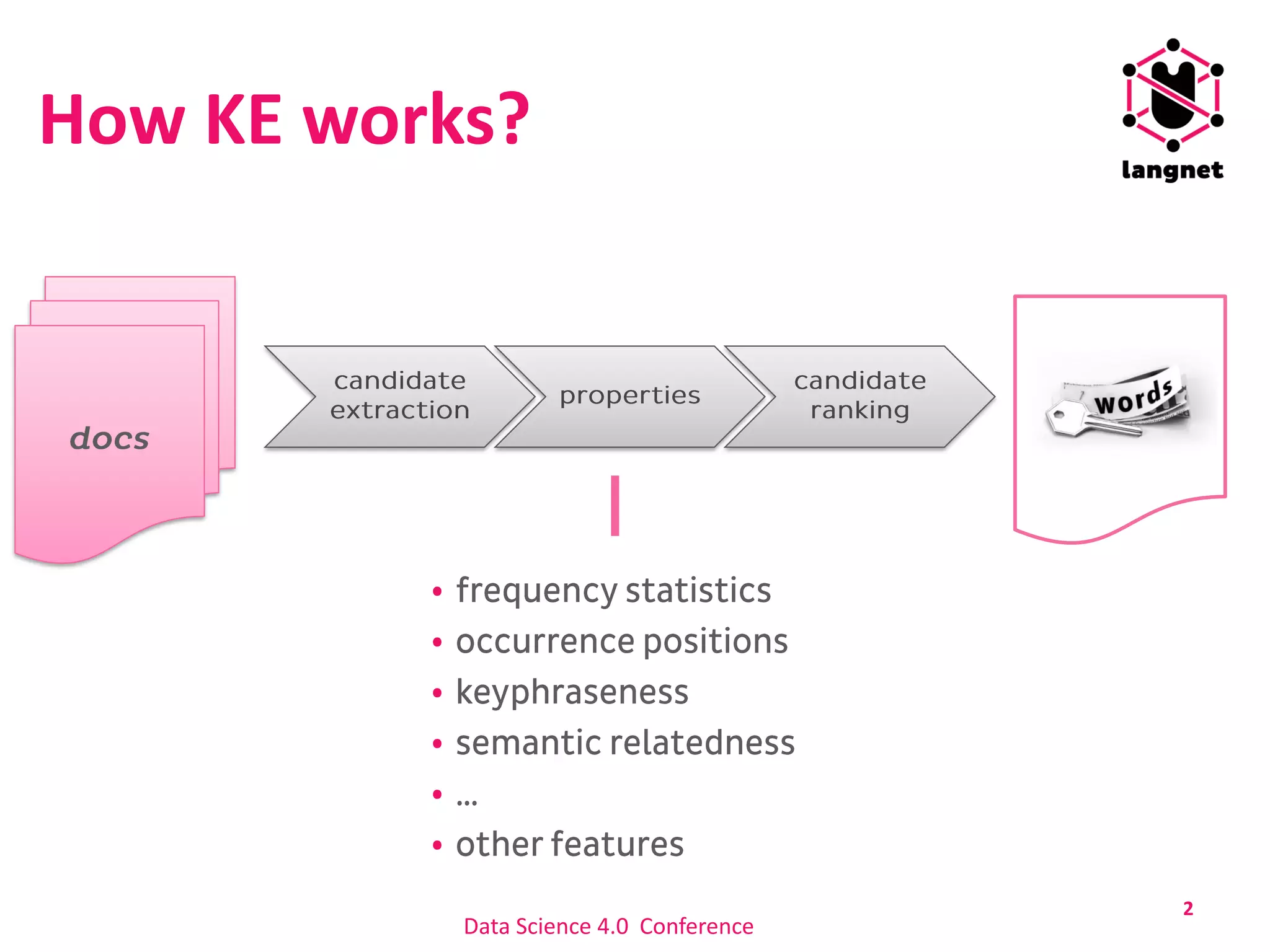
How KE works?
Data Science 4.0 Conference
Introduction 2/4
keyword extraction is traditionally
based on statistical methods
learning from
or graph, since the number of words in isolated documents is limited
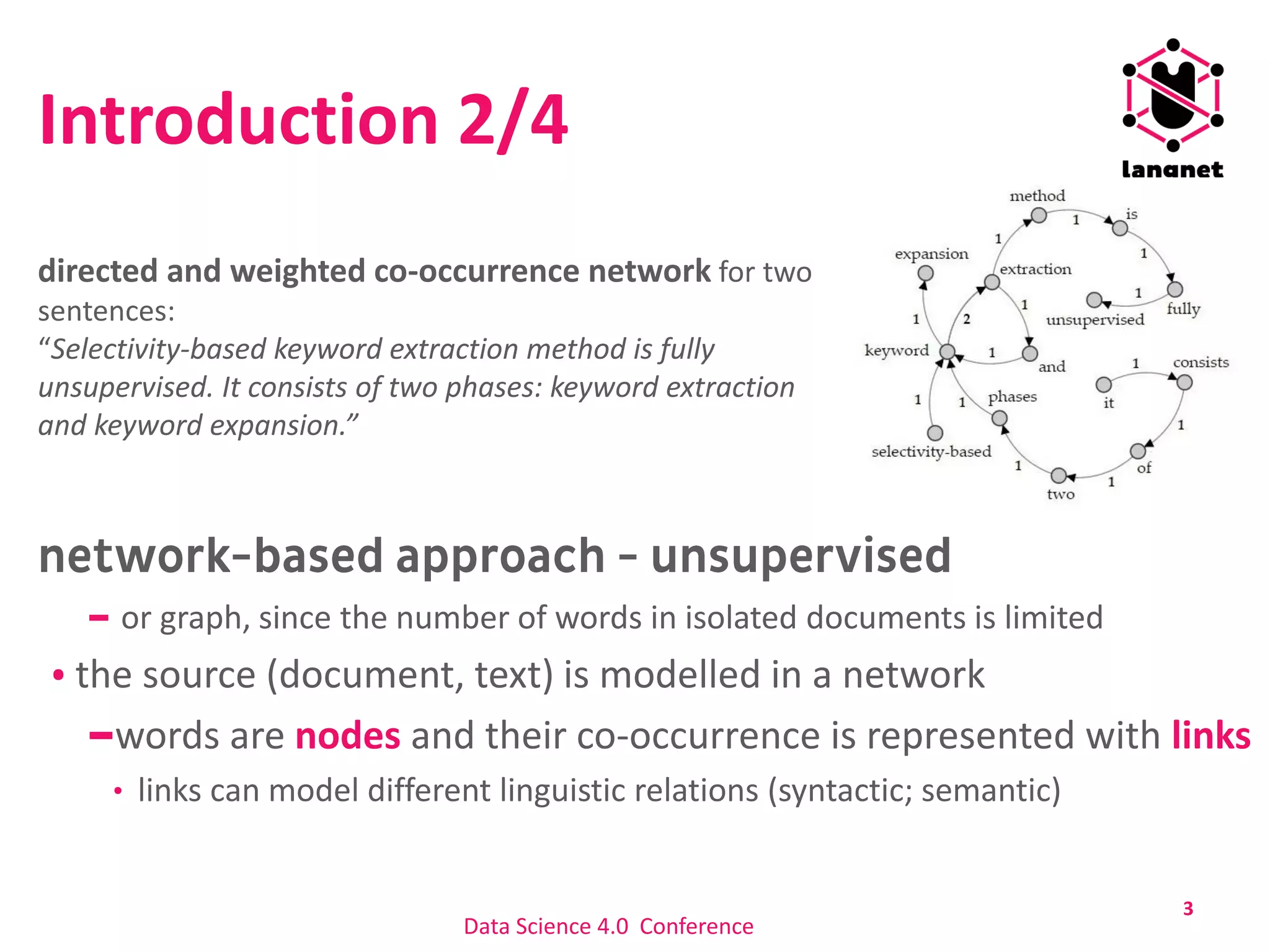
the source (document, text) is modelled in a network
words are nodes and their co-occurrence is represented with links
links can model different linguistic relations (syntactic; semantic)
3
directed and weighted co-occurrence network for two
sentences:
“Selectivity-based keyword extraction method is fully
unsupervised. It consists of two phases: keyword extraction
and keyword expansion.”
Data Science 4.0 Conference
Introduction 3/4
can exploit:
or level measures:
coreness, clustering coefficient
PageRank motivated ranking score or
HITS motivated hub and authority score
communities
strength, centrality
and eigenvector
centrality
the average strength of the node
4
Data Science 4.0 Conference
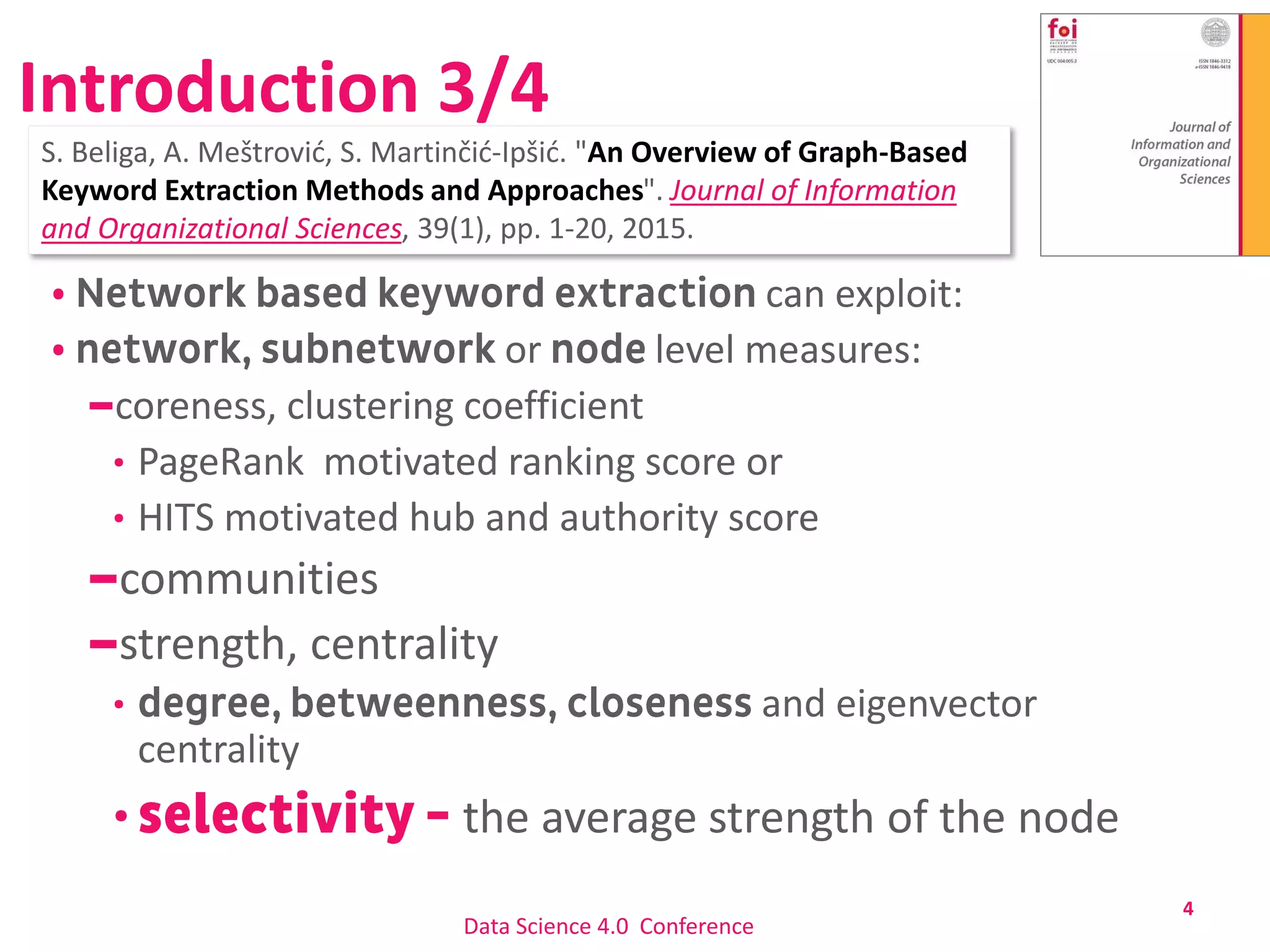
S. Beliga, A. Meštrović, S. Martinčić-Ipšić. "An Overview of Graph-Based
Keyword Extraction Methods and Approaches". Journal of Information
and Organizational Sciences, 39(1), pp. 1-20, 2015.
Complex network analysis 1/2
Directed and weighted network [Newman, 2010]
N – number of nodes
M – number of links
wij – weight for link which connects nodes i and j
Ki – node degree: number of links incident upon a node
5
𝒅𝒄𝒊
(𝒊𝒏/𝒐𝒖𝒕)
=
𝒌𝒊
(𝒊𝒏/𝒐𝒖𝒕)
𝑵 − 𝟏
𝒄𝒄𝒊 =
𝑵 − 𝟏
σ𝒊≠𝒋 𝒅𝒊𝒋
𝒃𝒄𝒊 =
σ𝒊≠𝒋≠𝒌
𝝈𝒋𝒌(𝒊)
𝝈𝒋𝒌
(𝑵 − 𝟏)(𝑵 − 𝟐)
Data Science 4.0 Conference
3. Complex network analysis 1/2
strength and selectivity
selectivity
average weight distribution on the links of the single node
generalized selectivity
6
𝒔𝒊
𝒊𝒏/𝒐𝒖𝒕
= ෍
𝒋
𝒘𝒋𝒊/𝒊𝒋
𝒈𝒆𝒊
α 𝒊𝒏/𝒐𝒖𝒕
= 𝒌𝒊
𝒊𝒏/𝒐𝒖𝒕 𝒔𝒊
𝒊𝒏/𝒐𝒖𝒕
𝒌𝒊
𝒊𝒏/𝒐𝒖𝒕
α
[Masucci &
Rodgers, 2009]𝒆𝒊
𝒊𝒏/𝒐𝒖𝒕
=
𝒔𝒊
𝒊𝒏/𝒐𝒖𝒕
𝒌𝒊
𝒊𝒏/𝒐𝒖𝒕
adapted from [Opsahl et al., 2010] in
[Beliga, Meštrović, Martinčić-Ipšić, 2016]
α∈ [0,1] – prefers nodes with higher
degrees
α ∈ [1, +∞] – prefers nodes with
lower degrees
𝛼 = 1– node strength
Data Science 4.0 Conference
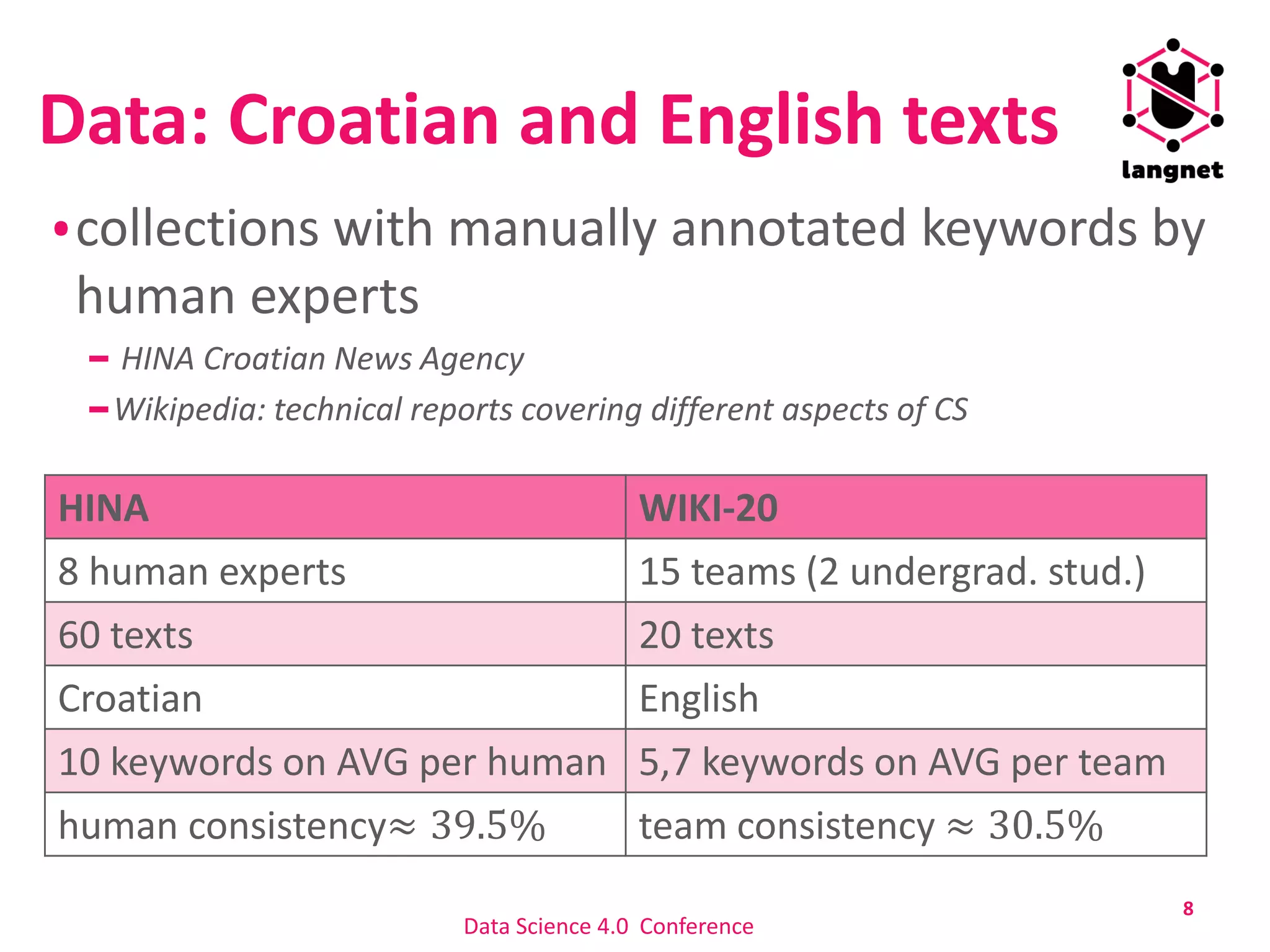
Data: Croatian and English texts
collections with manually annotated keywords by
human experts
HINA Croatian News Agency
Wikipedia: technical reports covering different aspects of CS
8
HINA WIKI-20
8 human experts 15 teams (2 undergrad. stud.)
60 texts 20 texts
Croatian English
10 keywords on AVG per human 5,7 keywords on AVG per team
human consistency≈ 39.5% team consistency ≈ 30.5%
Data Science 4.0 Conference
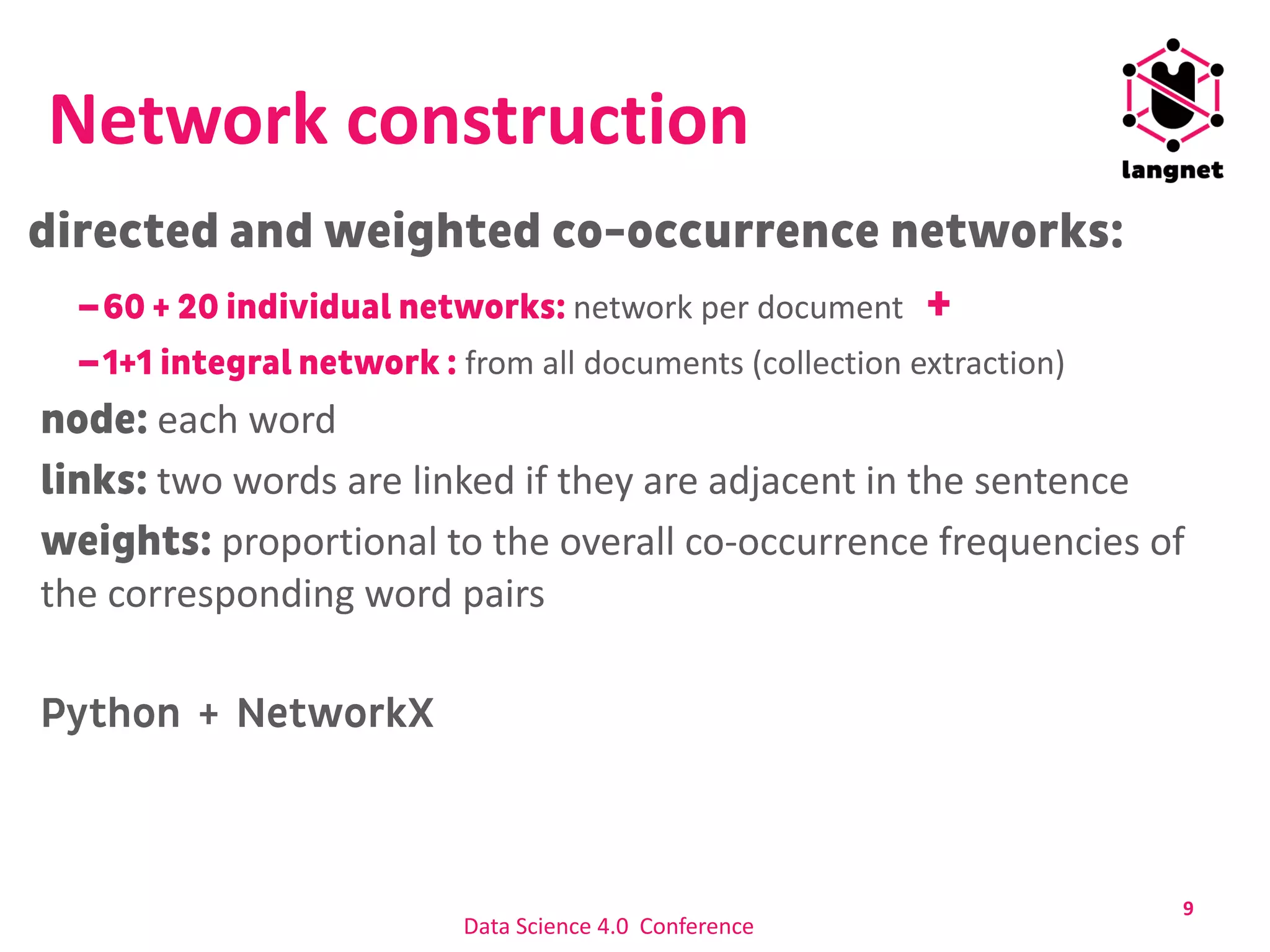
Network construction
network per document
from all documents (collection extraction)
each word
two words are linked if they are adjacent in the sentence
proportional to the overall co-occurrence frequencies of
the corresponding word pairs
9
Data Science 4.0 Conference
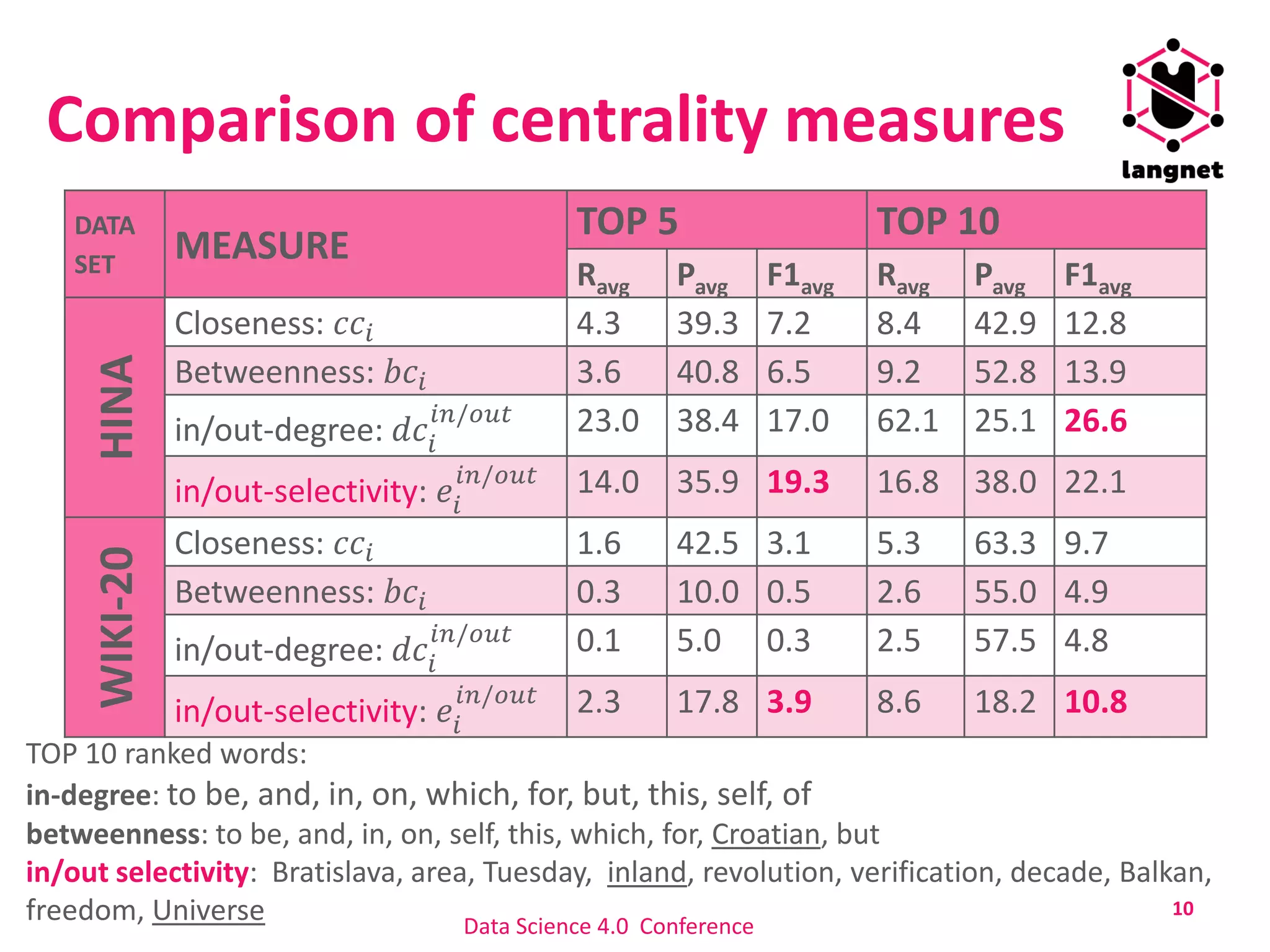
Comparison of centrality measures
10
DATA
SET
MEASURE
TOP 5 TOP 10
Ravg Pavg F1avg Ravg Pavg F1avg
HINA
Closeness: 𝑐𝑐𝑖 4.3 39.3 7.2 8.4 42.9 12.8
Betweenness: 𝑏𝑐𝑖 3.6 40.8 6.5 9.2 52.8 13.9
in/out-degree: 𝑑𝑐𝑖
𝑖𝑛/𝑜𝑢𝑡 23.0 38.4 17.0 62.1 25.1 26.6
in/out-selectivity: 𝑒𝑖
𝑖𝑛/𝑜𝑢𝑡 14.0 35.9 19.3 16.8 38.0 22.1
WIKI-20
Closeness: 𝑐𝑐𝑖 1.6 42.5 3.1 5.3 63.3 9.7
Betweenness: 𝑏𝑐𝑖 0.3 10.0 0.5 2.6 55.0 4.9
in/out-degree: 𝑑𝑐𝑖
𝑖𝑛/𝑜𝑢𝑡 0.1 5.0 0.3 2.5 57.5 4.8
in/out-selectivity: 𝑒𝑖
𝑖𝑛/𝑜𝑢𝑡 2.3 17.8 3.9 8.6 18.2 10.8
TOP 10 ranked words:
in-degree: to be, and, in, on, which, for, but, this, self, of
betweenness: to be, and, in, on, self, this, which, for, Croatian, but
in/out selectivity: Bratislava, area, Tuesday, inland, revolution, verification, decade, Balkan,
freedom, Universe Data Science 4.0 Conference
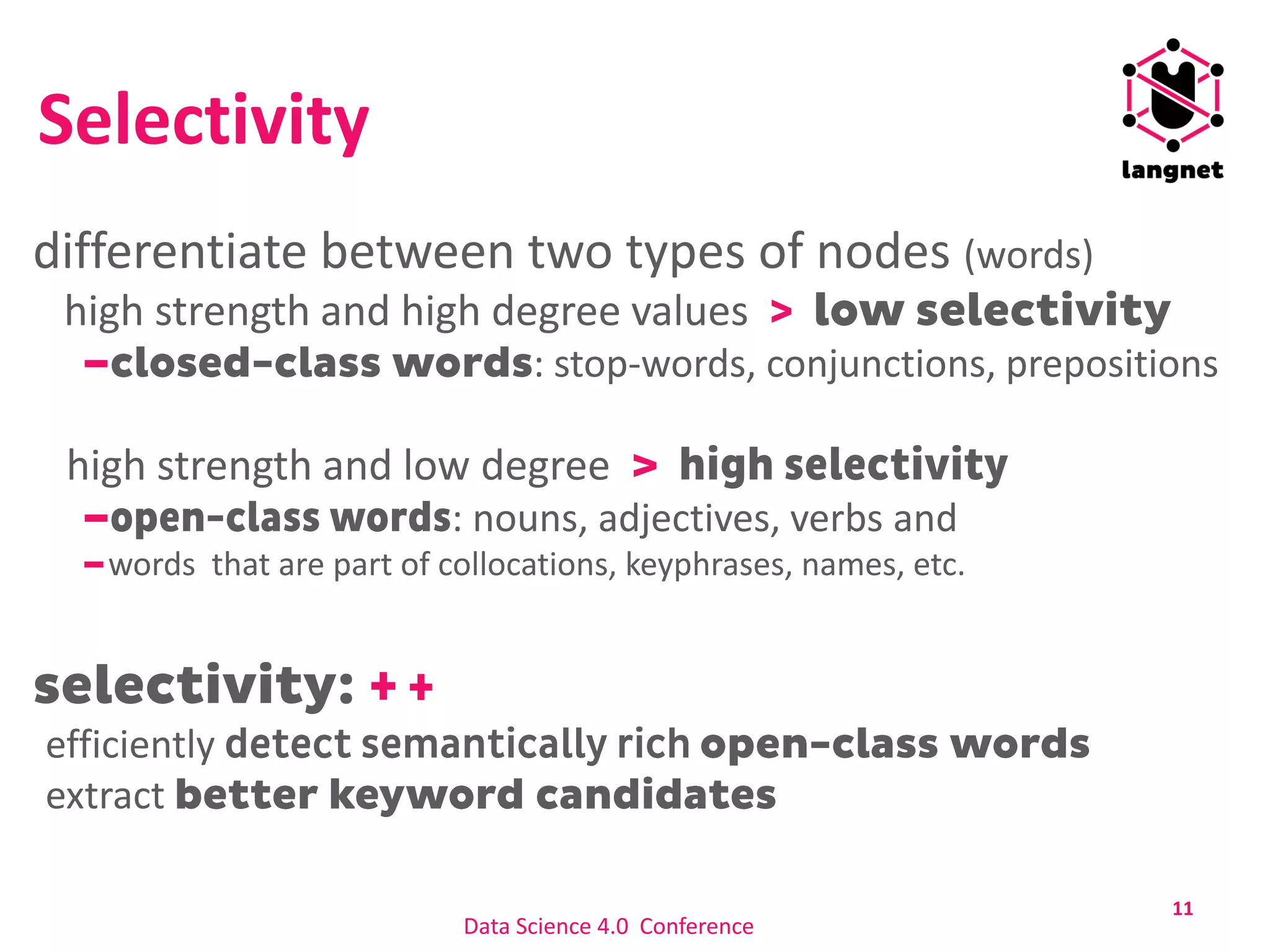
Selectivity
differentiate between two types of nodes (words)
high strength and high degree values
: stop-words, conjunctions, prepositions
high strength and low degree
: nouns, adjectives, verbs and
words that are part of collocations, keyphrases, names, etc.
efficiently
extract
11
Data Science 4.0 Conference
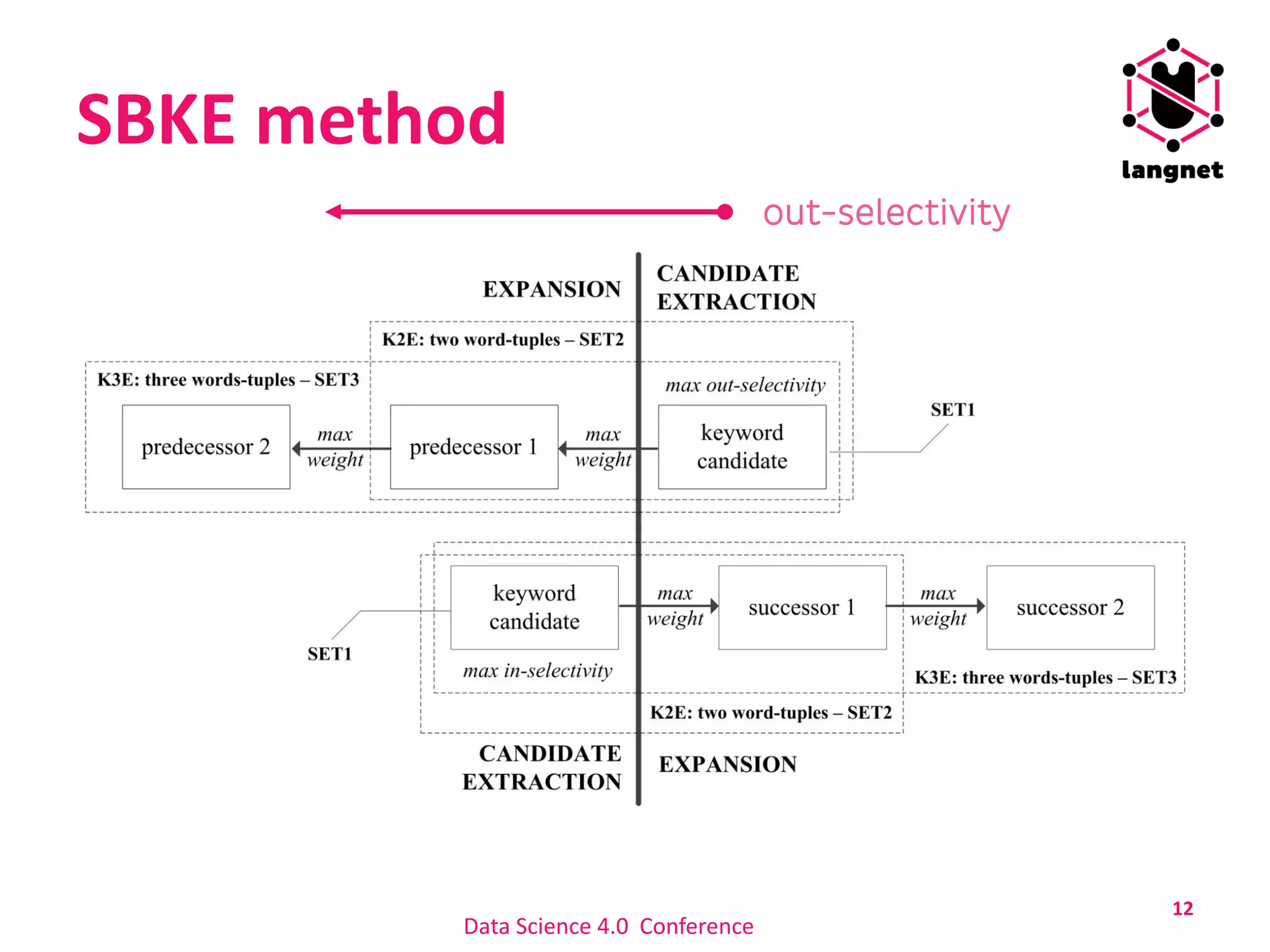
SBKE method
12
Data Science 4.0 Conference
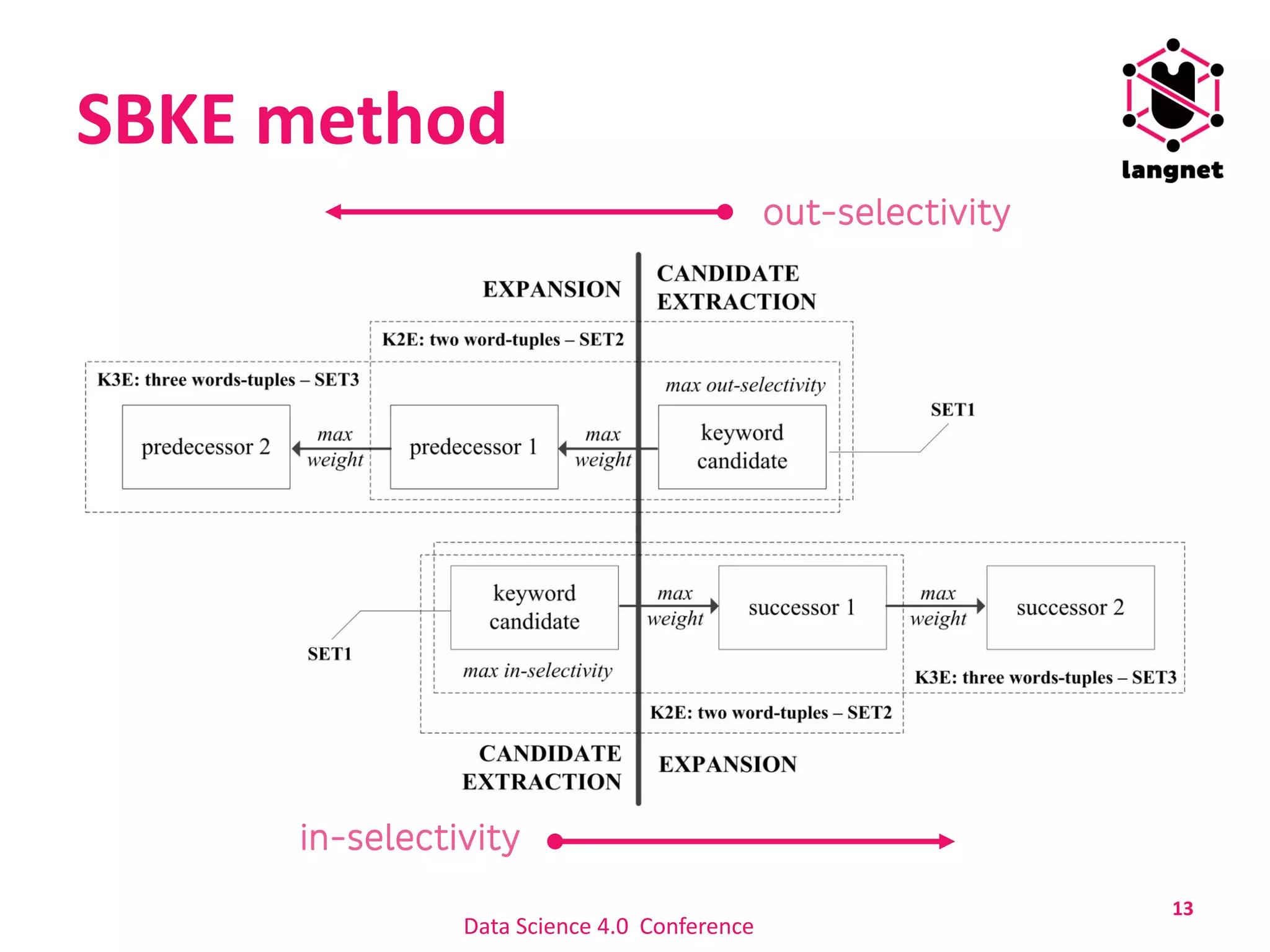
SBKE method
13
Data Science 4.0 Conference
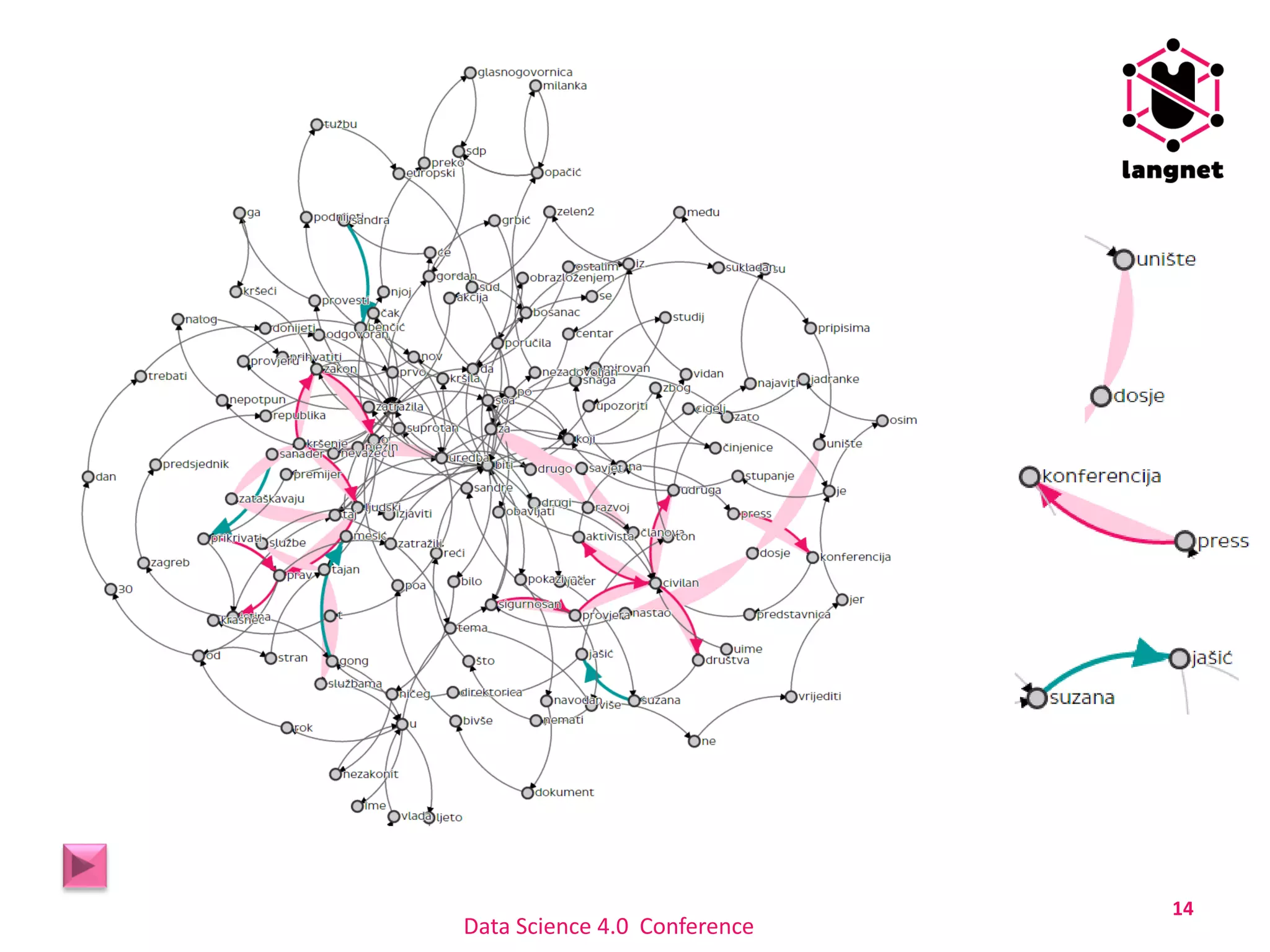
14
Data Science 4.0 Conference
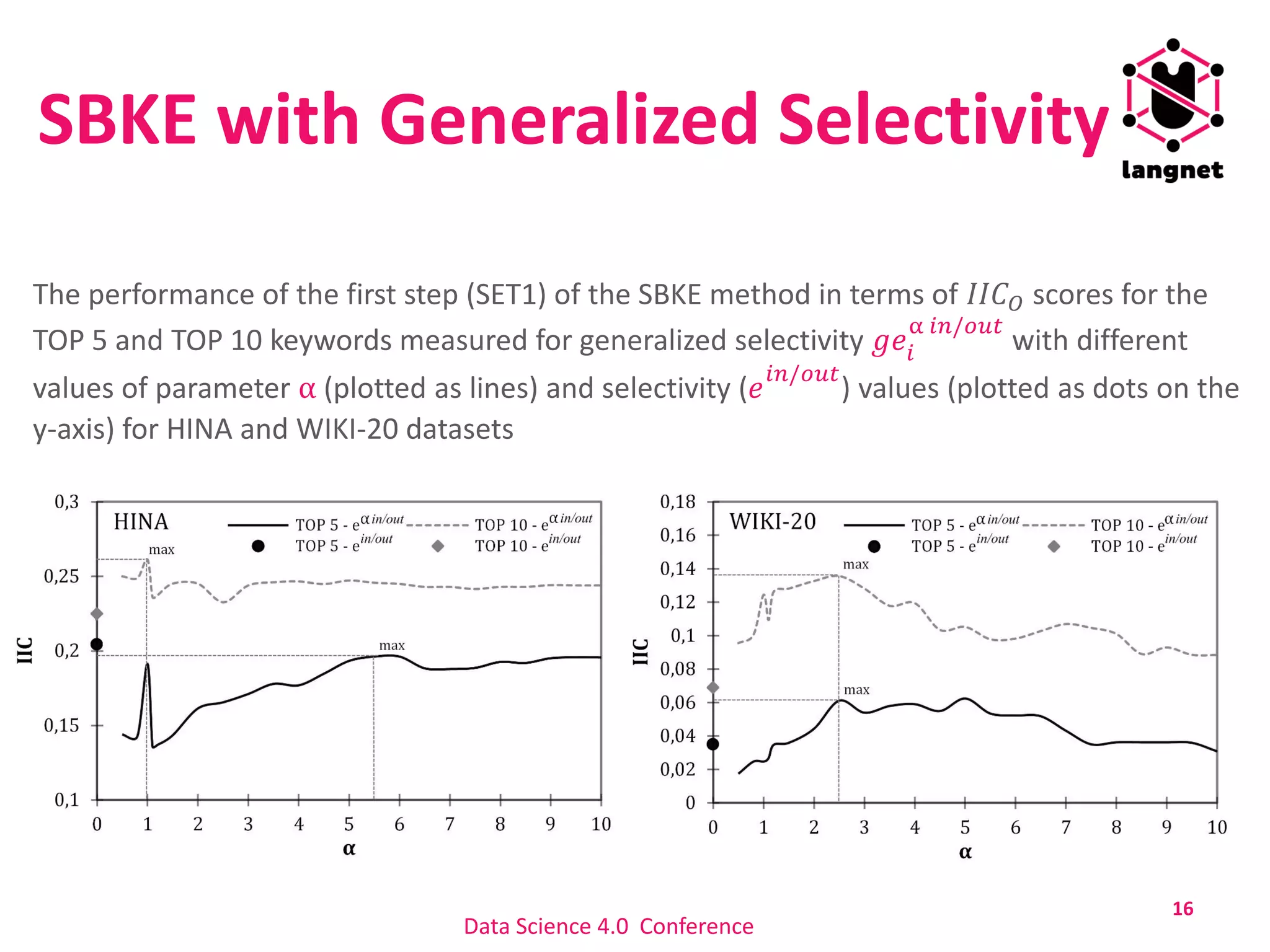
SBKE with Generalized Selectivity
SBKE method can be easily adjusted with new
measures
generalized selectivity measure: 𝑔𝑒𝑖
α 𝑖𝑛/𝑜𝑢𝑡
α adjust the relationship between the node degree and strength –
provide different set of keywords
Find the α parameter which best fits the experimental settings
according to 𝐼𝐼𝐶 𝑂 scores
tuning to the data set
15
Data Science 4.0 Conference
SBKE with Generalized Selectivity
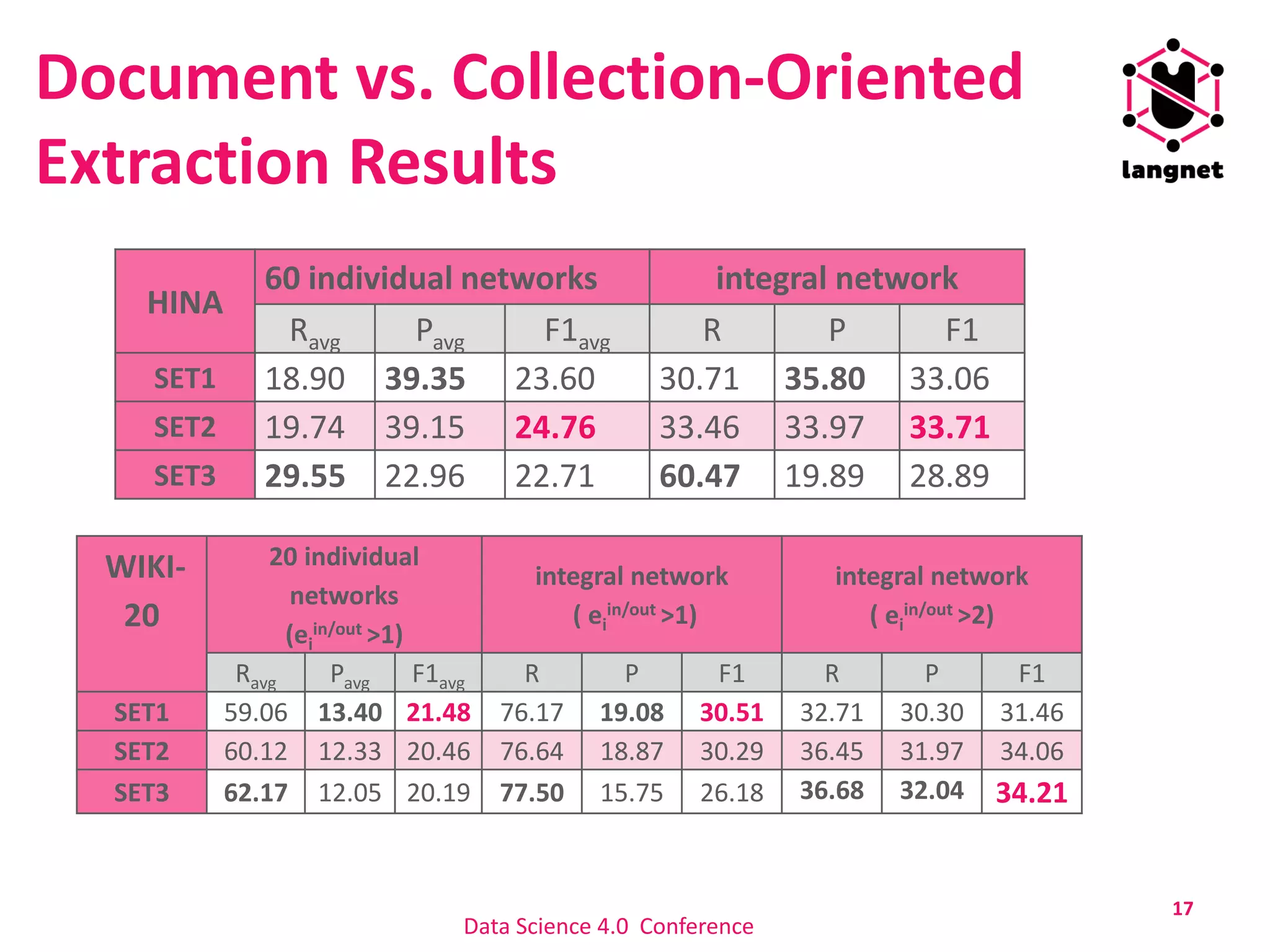
The performance of the first step (SET1) of the SBKE method in terms of 𝐼𝐼𝐶 𝑂 scores for the
TOP 5 and TOP 10 keywords measured for generalized selectivity 𝑔𝑒𝑖
α 𝑖𝑛/𝑜𝑢𝑡
with different
values of parameter α (plotted as lines) and selectivity (𝑒
𝑖𝑛/𝑜𝑢𝑡
) values (plotted as dots on the
y-axis) for HINA and WIKI-20 datasets
16
Data Science 4.0 Conference
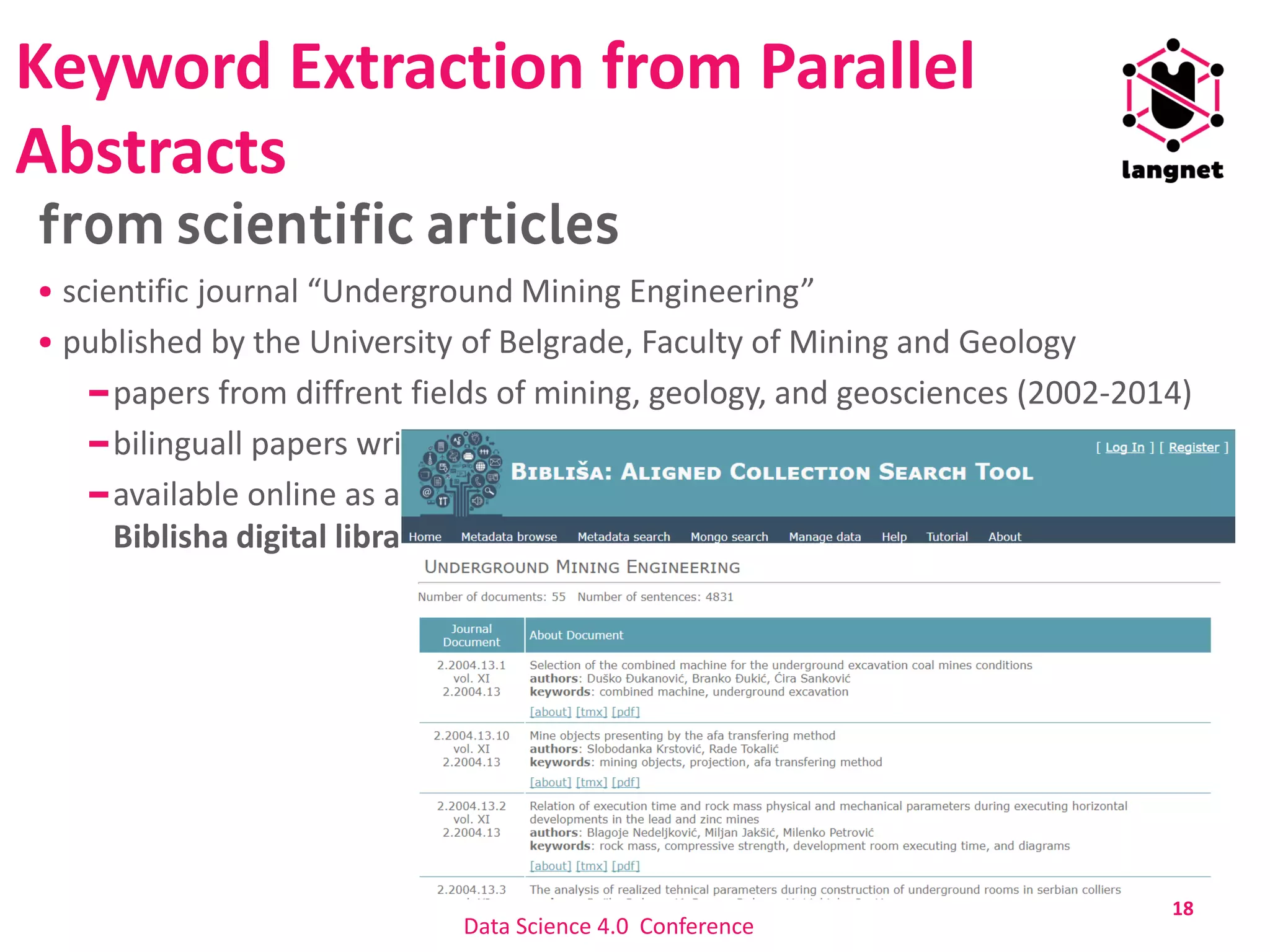
Document vs. Collection-Oriented
Extraction Results
17
HINA
60 individual networks integral network
Ravg Pavg F1avg R P F1
SET1 18.90 39.35 23.60 30.71 35.80 33.06
SET2 19.74 39.15 24.76 33.46 33.97 33.71
SET3 29.55 22.96 22.71 60.47 19.89 28.89
WIKI-
20
20 individual
networks
(ei
in/out >1)
integral network
( ei
in/out >1)
integral network
( ei
in/out >2)
Ravg Pavg F1avg R P F1 R P F1
SET1 59.06 13.40 21.48 76.17 19.08 30.51 32.71 30.30 31.46
SET2 60.12 12.33 20.46 76.64 18.87 30.29 36.45 31.97 34.06
SET3 62.17 12.05 20.19 77.50 15.75 26.18 36.68 32.04 34.21
Data Science 4.0 Conference
Keyword Extraction from Parallel
Abstracts
scientific journal “Underground Mining Engineering”
published by the University of Belgrade, Faculty of Mining and Geology
papers from diffrent fields of mining, geology, and geosciences (2002-2014)
bilinguall papers written in Serbian and in English
available online as aligned parallel text in the
Biblisha digital library: http://jerteh.rs/biblisha/ListaDokumenata.aspx?JCID=2&lng=en
18
Data Science 4.0 Conference
Data
Experiment
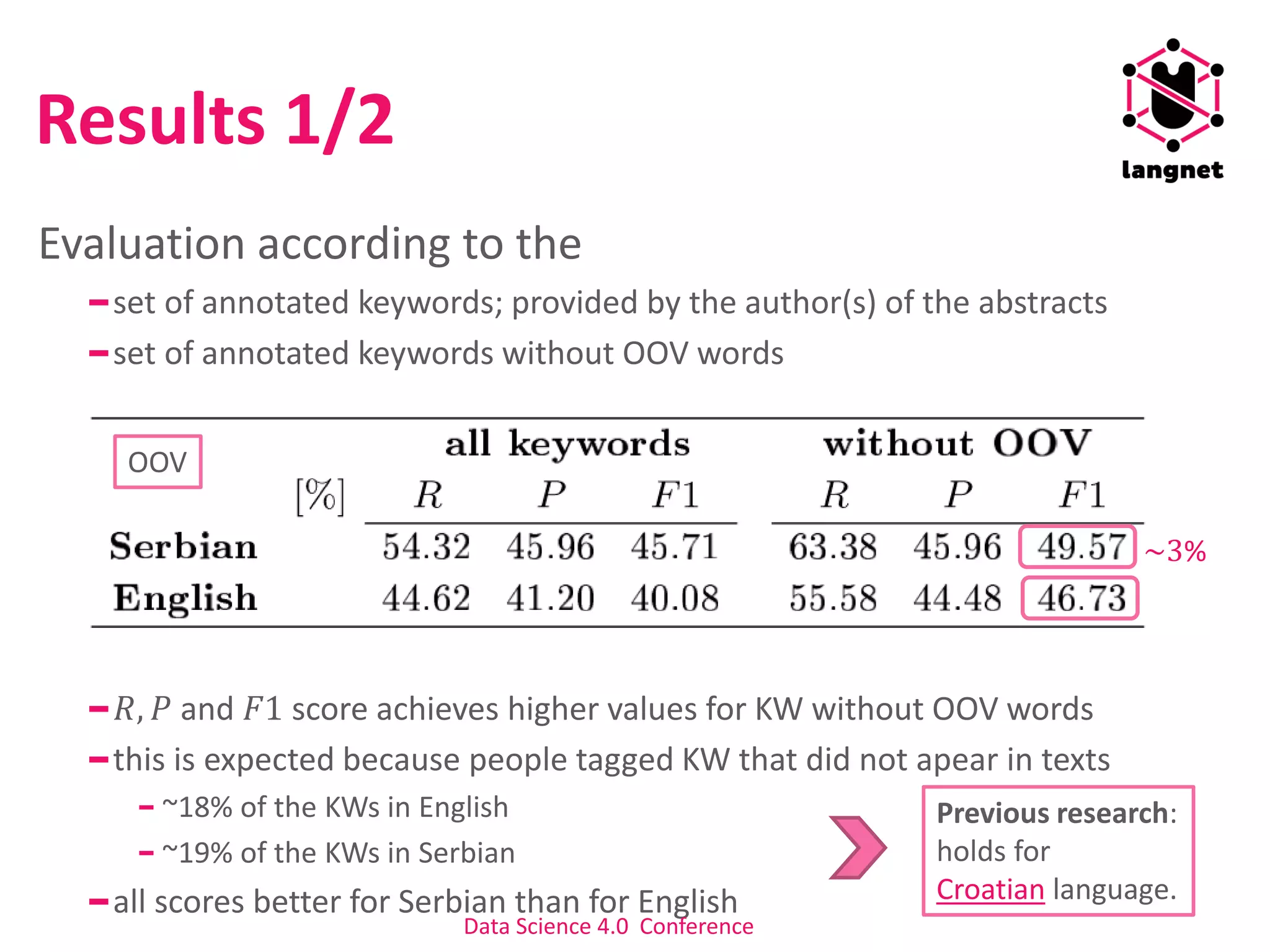
collection of 50 bilingual documents
with approximately 4,800 aligned sentences
originally written in Serbian and then translated into English by professionals
translators
Bilingual Serbian-English KE dataset introduced in this paper is
publicly available from http://langnet.uniri.hr/resources.html
19
Data Science 4.0 Conference
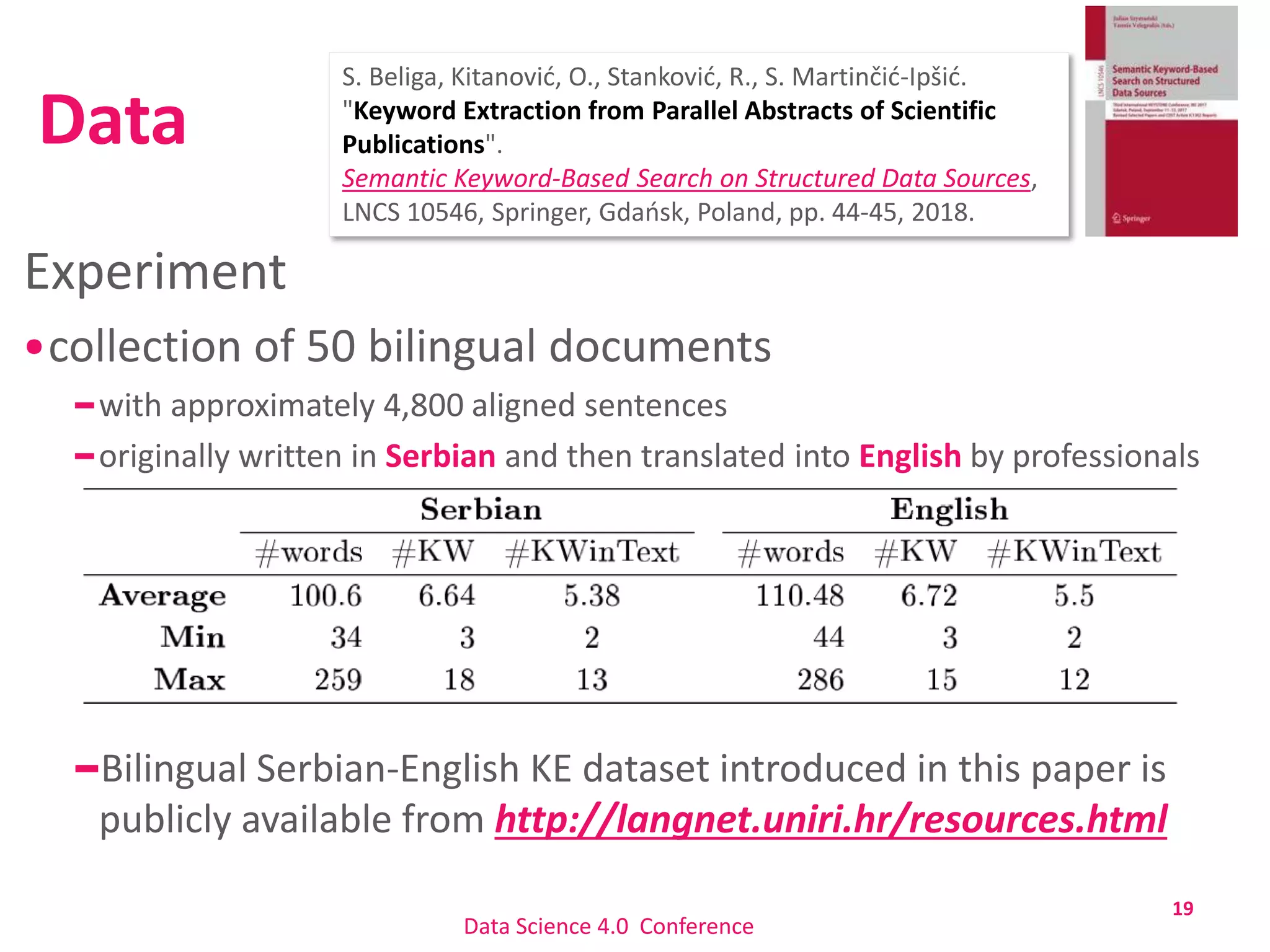
S. Beliga, Kitanović, O., Stanković, R., S. Martinčić-Ipšić.
"Keyword Extraction from Parallel Abstracts of Scientific
Publications".
Semantic Keyword-Based Search on Structured Data Sources,
LNCS 10546, Springer, Gdańsk, Poland, pp. 44-45, 2018.
Results 1/2
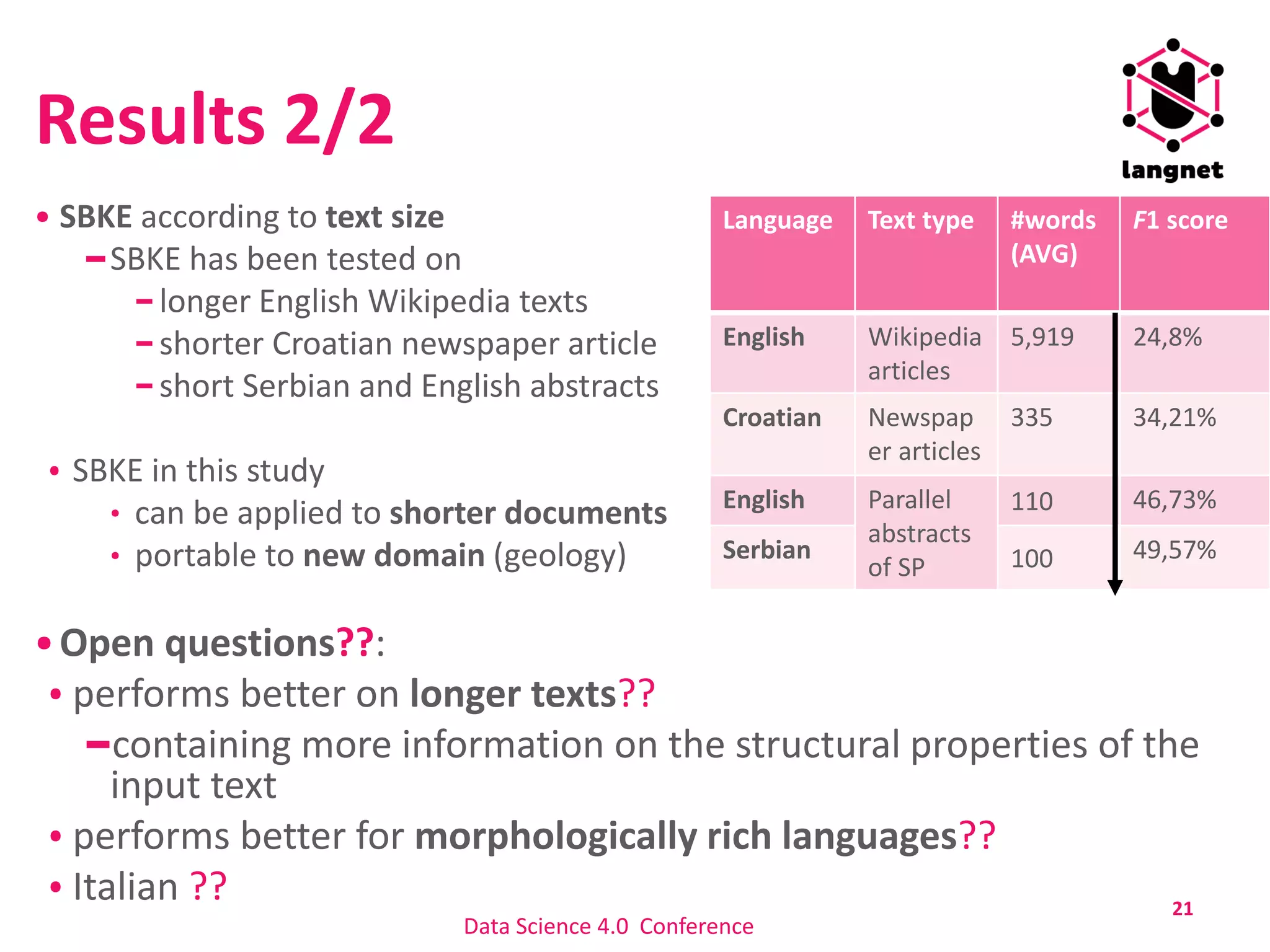
Evaluation according to the
set of annotated keywords; provided by the author(s) of the abstracts
set of annotated keywords without OOV words
𝑅, 𝑃 and 𝐹1 score achieves higher values for KW without OOV words
this is expected because people tagged KW that did not apear in texts
~18% of the KWs in English
~19% of the KWs in Serbian
all scores better for Serbian than for English 20
~3%
OOV
Previous research:
holds for
Croatian language.
Data Science 4.0 Conference
Results 2/2
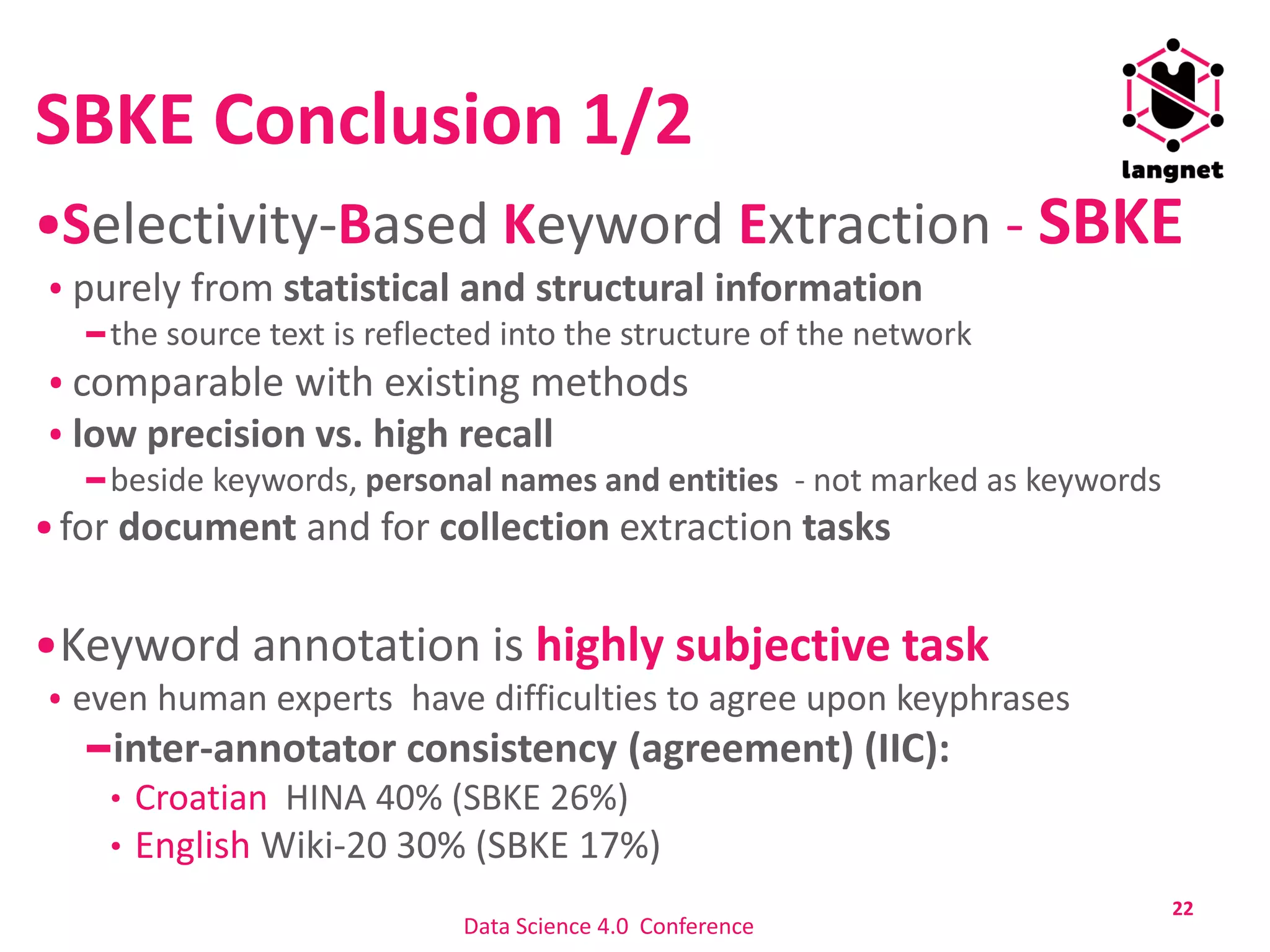
Open questions??:
performs better on longer texts??
containing more information on the structural properties of the
input text
performs better for morphologically rich languages??
Italian ?? 21
Language Text type #words
(AVG)
F1 score
English Wikipedia
articles
5,919 24,8%
Croatian Newspap
er articles
335 34,21%
English Parallel
abstracts
of SP
110 46,73%
Serbian 100 49,57%
Data Science 4.0 Conference
SBKE according to text size
SBKE has been tested on
longer English Wikipedia texts
shorter Croatian newspaper article
short Serbian and English abstracts
SBKE in this study
can be applied to shorter documents
portable to new domain (geology)
SBKE Conclusion 1/2
Selectivity-Based Keyword Extraction - SBKE
purely from statistical and structural information
the source text is reflected into the structure of the network
comparable with existing methods
low precision vs. high recall
beside keywords, personal names and entities - not marked as keywords
for document and for collection extraction tasks
Keyword annotation is highly subjective task
even human experts have difficulties to agree upon keyphrases
inter-annotator consistency (agreement) (IIC):
Croatian HINA 40% (SBKE 26%)
English Wiki-20 30% (SBKE 17%)
22
Data Science 4.0 Conference
SBKE Conclusion 2/2
SBKE method
does not require linguistic knowledge (from statistical and structural
information )
main advantages:
networks constructed from co-occurrence of words in the input texts
the method achieves results which are above the TFxIDF but below
humans
documet or collection oriented tasks
preprocessing is not necessary (works without stemming/lemmatization)
easily portable to new languages
23
Data Science 4.0 Conference
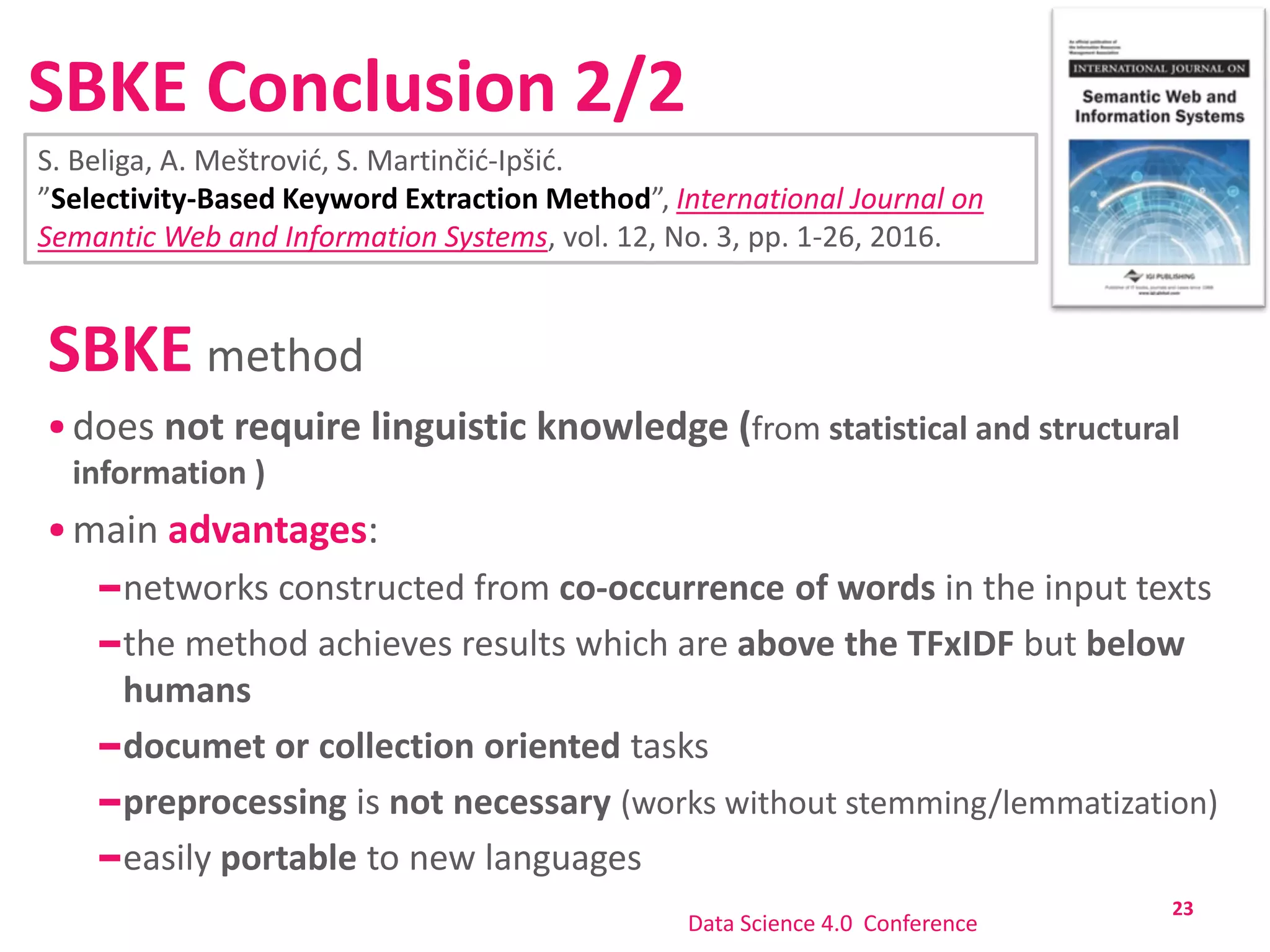
S. Beliga, A. Meštrović, S. Martinčić-Ipšić.
”Selectivity-Based Keyword Extraction Method”, International Journal on
Semantic Web and Information Systems, vol. 12, No. 3, pp. 1-26, 2016.
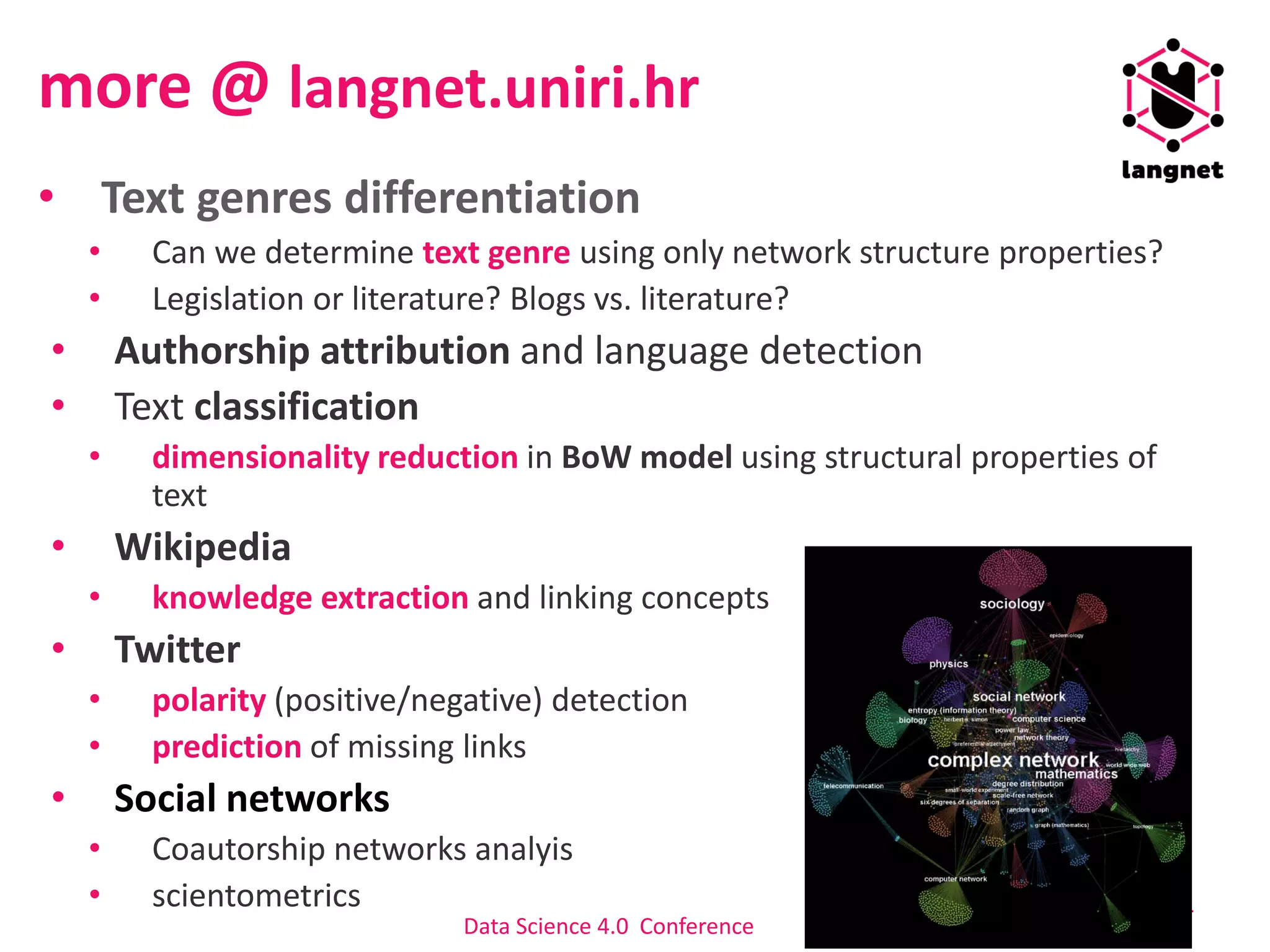
more @ langnet.uniri.hr
• Text genres differentiation
• Can we determine text genre using only network structure properties?
• Legislation or literature? Blogs vs. literature?
• Authorship attribution and language detection
• Text classification
• dimensionality reduction in BoW model using structural properties of
text
• Wikipedia
• knowledge extraction and linking concepts
• Twitter
• polarity (positive/negative) detection
• prediction of missing links
• Social networks
• Coautorship networks analyis
• scientometrics 24
Data Science 4.0 Conference
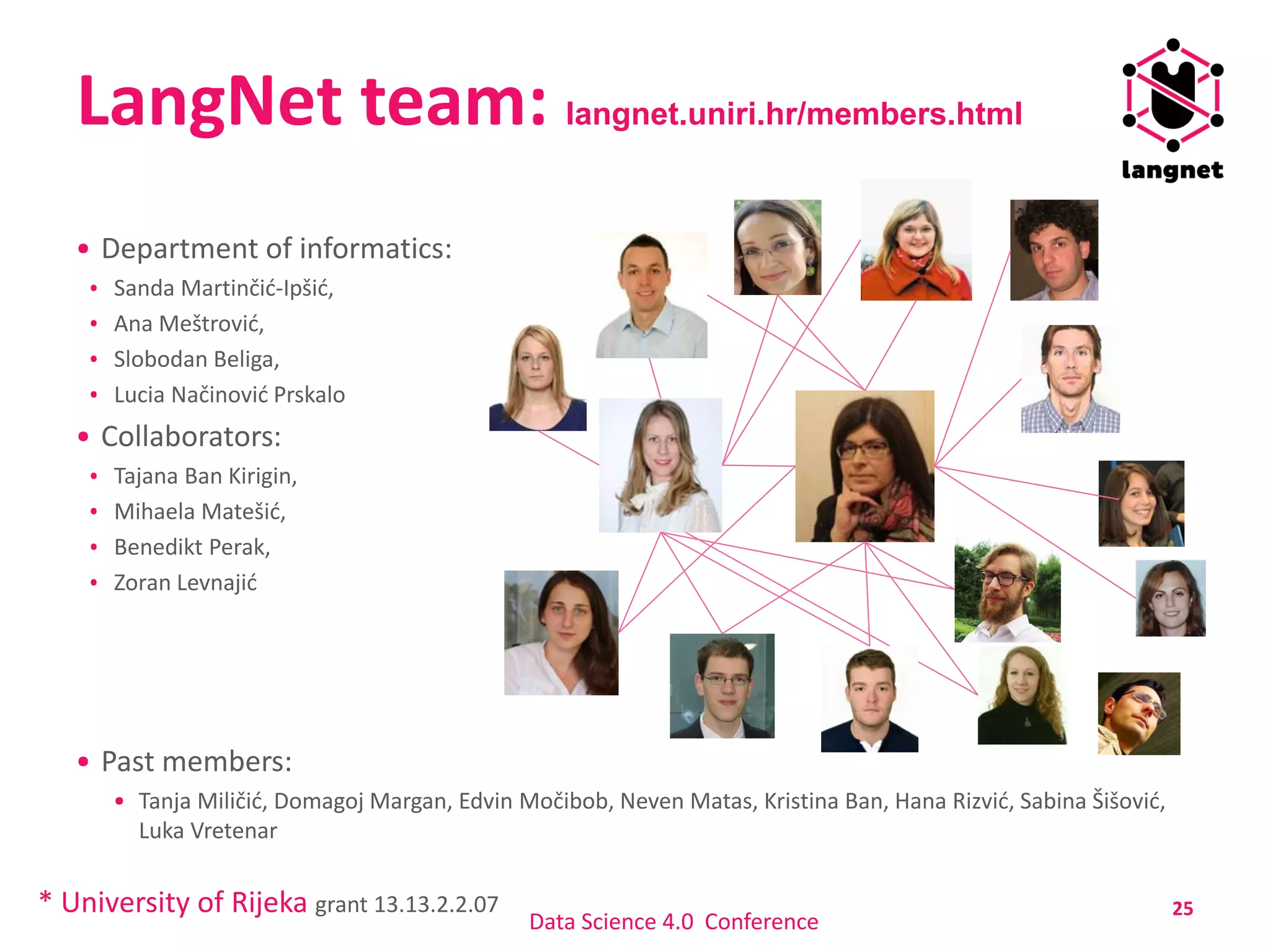
LangNet team: langnet.uniri.hr/members.html
Department of informatics:
Sanda Martinčić-Ipšić,
Ana Meštrović,
Slobodan Beliga,
Lucia Načinović Prskalo
Collaborators:
Tajana Ban Kirigin,
Mihaela Matešić,
Benedikt Perak,
Zoran Levnajić
Past members:
Tanja Miličić, Domagoj Margan, Edvin Močibob, Neven Matas, Kristina Ban, Hana Rizvić, Sabina Šišović,
Luka Vretenar
25* University of Rijeka grant 13.13.2.2.07
Data Science 4.0 Conference
Sanda Martinčić-Ipšić
smarti@uniri.hr
langnet.uniri.hr
?

Extracting keywords from texts - Sanda Martincic Ipsic

  • 1.
    Department of Informatics,University of Rijeka Radmile Matejčić 2, 51000 Rijeka, Croatia Tel.: + 385 51 584 700 Fax: + 385 51 584 749 www.langnet.uniri.hr Extracting keywords from texts Sanda Martinčić-Ipšić smarti@uniri.hr langnet.uniri.hr Data Science 4.0 Conference
  • 2.
    Introduction 1/4 Keyword extraction automaticallyidentify a that best describe the document the most representative features (terms) of the source text huge amount of multi topic textual sources applications: summarization, indexing, labeling, categorization, clustering document-oriented task (single documents) collection-oriented task (i.e. entire web site) more demanding 1 Data Science 4.0 Conference
  • 3.
    2 How KE works? DataScience 4.0 Conference
  • 4.
    Introduction 2/4 keyword extractionis traditionally based on statistical methods learning from or graph, since the number of words in isolated documents is limited the source (document, text) is modelled in a network words are nodes and their co-occurrence is represented with links links can model different linguistic relations (syntactic; semantic) 3 directed and weighted co-occurrence network for two sentences: “Selectivity-based keyword extraction method is fully unsupervised. It consists of two phases: keyword extraction and keyword expansion.” Data Science 4.0 Conference
  • 5.
    Introduction 3/4 can exploit: orlevel measures: coreness, clustering coefficient PageRank motivated ranking score or HITS motivated hub and authority score communities strength, centrality and eigenvector centrality the average strength of the node 4 Data Science 4.0 Conference S. Beliga, A. Meštrović, S. Martinčić-Ipšić. "An Overview of Graph-Based Keyword Extraction Methods and Approaches". Journal of Information and Organizational Sciences, 39(1), pp. 1-20, 2015.
  • 6.
    Complex network analysis1/2 Directed and weighted network [Newman, 2010] N – number of nodes M – number of links wij – weight for link which connects nodes i and j Ki – node degree: number of links incident upon a node 5 𝒅𝒄𝒊 (𝒊𝒏/𝒐𝒖𝒕) = 𝒌𝒊 (𝒊𝒏/𝒐𝒖𝒕) 𝑵 − 𝟏 𝒄𝒄𝒊 = 𝑵 − 𝟏 σ𝒊≠𝒋 𝒅𝒊𝒋 𝒃𝒄𝒊 = σ𝒊≠𝒋≠𝒌 𝝈𝒋𝒌(𝒊) 𝝈𝒋𝒌 (𝑵 − 𝟏)(𝑵 − 𝟐) Data Science 4.0 Conference
  • 7.
    3. Complex networkanalysis 1/2 strength and selectivity selectivity average weight distribution on the links of the single node generalized selectivity 6 𝒔𝒊 𝒊𝒏/𝒐𝒖𝒕 = ෍ 𝒋 𝒘𝒋𝒊/𝒊𝒋 𝒈𝒆𝒊 α 𝒊𝒏/𝒐𝒖𝒕 = 𝒌𝒊 𝒊𝒏/𝒐𝒖𝒕 𝒔𝒊 𝒊𝒏/𝒐𝒖𝒕 𝒌𝒊 𝒊𝒏/𝒐𝒖𝒕 α [Masucci & Rodgers, 2009]𝒆𝒊 𝒊𝒏/𝒐𝒖𝒕 = 𝒔𝒊 𝒊𝒏/𝒐𝒖𝒕 𝒌𝒊 𝒊𝒏/𝒐𝒖𝒕 adapted from [Opsahl et al., 2010] in [Beliga, Meštrović, Martinčić-Ipšić, 2016] α∈ [0,1] – prefers nodes with higher degrees α ∈ [1, +∞] – prefers nodes with lower degrees 𝛼 = 1– node strength Data Science 4.0 Conference
  • 8.
    Data: Croatian andEnglish texts collections with manually annotated keywords by human experts HINA Croatian News Agency Wikipedia: technical reports covering different aspects of CS 8 HINA WIKI-20 8 human experts 15 teams (2 undergrad. stud.) 60 texts 20 texts Croatian English 10 keywords on AVG per human 5,7 keywords on AVG per team human consistency≈ 39.5% team consistency ≈ 30.5% Data Science 4.0 Conference
  • 9.
    Network construction network perdocument from all documents (collection extraction) each word two words are linked if they are adjacent in the sentence proportional to the overall co-occurrence frequencies of the corresponding word pairs 9 Data Science 4.0 Conference
  • 10.
    Comparison of centralitymeasures 10 DATA SET MEASURE TOP 5 TOP 10 Ravg Pavg F1avg Ravg Pavg F1avg HINA Closeness: 𝑐𝑐𝑖 4.3 39.3 7.2 8.4 42.9 12.8 Betweenness: 𝑏𝑐𝑖 3.6 40.8 6.5 9.2 52.8 13.9 in/out-degree: 𝑑𝑐𝑖 𝑖𝑛/𝑜𝑢𝑡 23.0 38.4 17.0 62.1 25.1 26.6 in/out-selectivity: 𝑒𝑖 𝑖𝑛/𝑜𝑢𝑡 14.0 35.9 19.3 16.8 38.0 22.1 WIKI-20 Closeness: 𝑐𝑐𝑖 1.6 42.5 3.1 5.3 63.3 9.7 Betweenness: 𝑏𝑐𝑖 0.3 10.0 0.5 2.6 55.0 4.9 in/out-degree: 𝑑𝑐𝑖 𝑖𝑛/𝑜𝑢𝑡 0.1 5.0 0.3 2.5 57.5 4.8 in/out-selectivity: 𝑒𝑖 𝑖𝑛/𝑜𝑢𝑡 2.3 17.8 3.9 8.6 18.2 10.8 TOP 10 ranked words: in-degree: to be, and, in, on, which, for, but, this, self, of betweenness: to be, and, in, on, self, this, which, for, Croatian, but in/out selectivity: Bratislava, area, Tuesday, inland, revolution, verification, decade, Balkan, freedom, Universe Data Science 4.0 Conference
  • 11.
    Selectivity differentiate between twotypes of nodes (words) high strength and high degree values : stop-words, conjunctions, prepositions high strength and low degree : nouns, adjectives, verbs and words that are part of collocations, keyphrases, names, etc. efficiently extract 11 Data Science 4.0 Conference
  • 12.
  • 13.
  • 14.
  • 15.
    SBKE with GeneralizedSelectivity SBKE method can be easily adjusted with new measures generalized selectivity measure: 𝑔𝑒𝑖 α 𝑖𝑛/𝑜𝑢𝑡 α adjust the relationship between the node degree and strength – provide different set of keywords Find the α parameter which best fits the experimental settings according to 𝐼𝐼𝐶 𝑂 scores tuning to the data set 15 Data Science 4.0 Conference
  • 16.
    SBKE with GeneralizedSelectivity The performance of the first step (SET1) of the SBKE method in terms of 𝐼𝐼𝐶 𝑂 scores for the TOP 5 and TOP 10 keywords measured for generalized selectivity 𝑔𝑒𝑖 α 𝑖𝑛/𝑜𝑢𝑡 with different values of parameter α (plotted as lines) and selectivity (𝑒 𝑖𝑛/𝑜𝑢𝑡 ) values (plotted as dots on the y-axis) for HINA and WIKI-20 datasets 16 Data Science 4.0 Conference
  • 17.
    Document vs. Collection-Oriented ExtractionResults 17 HINA 60 individual networks integral network Ravg Pavg F1avg R P F1 SET1 18.90 39.35 23.60 30.71 35.80 33.06 SET2 19.74 39.15 24.76 33.46 33.97 33.71 SET3 29.55 22.96 22.71 60.47 19.89 28.89 WIKI- 20 20 individual networks (ei in/out >1) integral network ( ei in/out >1) integral network ( ei in/out >2) Ravg Pavg F1avg R P F1 R P F1 SET1 59.06 13.40 21.48 76.17 19.08 30.51 32.71 30.30 31.46 SET2 60.12 12.33 20.46 76.64 18.87 30.29 36.45 31.97 34.06 SET3 62.17 12.05 20.19 77.50 15.75 26.18 36.68 32.04 34.21 Data Science 4.0 Conference
  • 18.
    Keyword Extraction fromParallel Abstracts scientific journal “Underground Mining Engineering” published by the University of Belgrade, Faculty of Mining and Geology papers from diffrent fields of mining, geology, and geosciences (2002-2014) bilinguall papers written in Serbian and in English available online as aligned parallel text in the Biblisha digital library: http://jerteh.rs/biblisha/ListaDokumenata.aspx?JCID=2&lng=en 18 Data Science 4.0 Conference
  • 19.
    Data Experiment collection of 50bilingual documents with approximately 4,800 aligned sentences originally written in Serbian and then translated into English by professionals translators Bilingual Serbian-English KE dataset introduced in this paper is publicly available from http://langnet.uniri.hr/resources.html 19 Data Science 4.0 Conference S. Beliga, Kitanović, O., Stanković, R., S. Martinčić-Ipšić. "Keyword Extraction from Parallel Abstracts of Scientific Publications". Semantic Keyword-Based Search on Structured Data Sources, LNCS 10546, Springer, Gdańsk, Poland, pp. 44-45, 2018.
  • 20.
    Results 1/2 Evaluation accordingto the set of annotated keywords; provided by the author(s) of the abstracts set of annotated keywords without OOV words 𝑅, 𝑃 and 𝐹1 score achieves higher values for KW without OOV words this is expected because people tagged KW that did not apear in texts ~18% of the KWs in English ~19% of the KWs in Serbian all scores better for Serbian than for English 20 ~3% OOV Previous research: holds for Croatian language. Data Science 4.0 Conference
  • 21.
    Results 2/2 Open questions??: performsbetter on longer texts?? containing more information on the structural properties of the input text performs better for morphologically rich languages?? Italian ?? 21 Language Text type #words (AVG) F1 score English Wikipedia articles 5,919 24,8% Croatian Newspap er articles 335 34,21% English Parallel abstracts of SP 110 46,73% Serbian 100 49,57% Data Science 4.0 Conference SBKE according to text size SBKE has been tested on longer English Wikipedia texts shorter Croatian newspaper article short Serbian and English abstracts SBKE in this study can be applied to shorter documents portable to new domain (geology)
  • 22.
    SBKE Conclusion 1/2 Selectivity-BasedKeyword Extraction - SBKE purely from statistical and structural information the source text is reflected into the structure of the network comparable with existing methods low precision vs. high recall beside keywords, personal names and entities - not marked as keywords for document and for collection extraction tasks Keyword annotation is highly subjective task even human experts have difficulties to agree upon keyphrases inter-annotator consistency (agreement) (IIC): Croatian HINA 40% (SBKE 26%) English Wiki-20 30% (SBKE 17%) 22 Data Science 4.0 Conference
  • 23.
    SBKE Conclusion 2/2 SBKEmethod does not require linguistic knowledge (from statistical and structural information ) main advantages: networks constructed from co-occurrence of words in the input texts the method achieves results which are above the TFxIDF but below humans documet or collection oriented tasks preprocessing is not necessary (works without stemming/lemmatization) easily portable to new languages 23 Data Science 4.0 Conference S. Beliga, A. Meštrović, S. Martinčić-Ipšić. ”Selectivity-Based Keyword Extraction Method”, International Journal on Semantic Web and Information Systems, vol. 12, No. 3, pp. 1-26, 2016.
  • 24.
    more @ langnet.uniri.hr •Text genres differentiation • Can we determine text genre using only network structure properties? • Legislation or literature? Blogs vs. literature? • Authorship attribution and language detection • Text classification • dimensionality reduction in BoW model using structural properties of text • Wikipedia • knowledge extraction and linking concepts • Twitter • polarity (positive/negative) detection • prediction of missing links • Social networks • Coautorship networks analyis • scientometrics 24 Data Science 4.0 Conference
  • 25.
    LangNet team: langnet.uniri.hr/members.html Departmentof informatics: Sanda Martinčić-Ipšić, Ana Meštrović, Slobodan Beliga, Lucia Načinović Prskalo Collaborators: Tajana Ban Kirigin, Mihaela Matešić, Benedikt Perak, Zoran Levnajić Past members: Tanja Miličić, Domagoj Margan, Edvin Močibob, Neven Matas, Kristina Ban, Hana Rizvić, Sabina Šišović, Luka Vretenar 25* University of Rijeka grant 13.13.2.2.07 Data Science 4.0 Conference
  • 26.