NITROSAMINES IN HUMAN
MEDICINAL PRODUCTS
By-
Dr. Nityanand S. Zadbuke
DOI: 10.13140/RG.2.2.11844.96643
FEB 2021
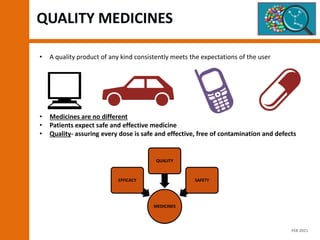
QUALITY MEDICINES
• A quality product of any kind consistently meets the expectations of the user
• Medicines are no different
• Patients expect safe and effective medicine
• Quality- assuring every dose is safe and effective, free of contamination and defects
MEDICINES
EFFICACY
QUALITY
SAFETY
FEB 2021
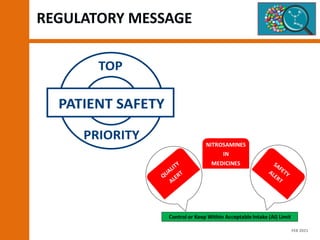
REGULATORY MESSAGE
FEB 2021
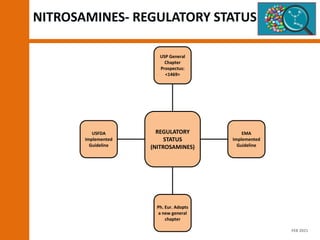
NITROSAMINES- REGULATORY STATUS
REGULATORY
STATUS
(NITROSAMINES)
USP General
Chapter
Prospectus:
<1469>
EMA
Implemented
Guideline
Ph. Eur. Adopts
a new general
chapter
USFDA
Implemented
Guideline
FEB 2021
Has my
medication been
recalled ???
What is my
Risk of getting
cancer ???
How can I get
more information
about
Nitrosamines ???
I got a recall
notice. Am I in
danger ???
Should I stop
taking my
medication ???
STAY UP TO DATE WITH REGULATORY RESOURCES
STAY UP TO DATE
FEB 2021
IMPACT OF NITROSAMINES
Import
Alert
Product
Recall
Safety
&
Quality
Change in ROS /
Reformulation
Risk
Assessment
Business Loss
GLOBAL IMPACT
OF
PRESENCE NITROSAMINES IN MEDICINAL PRODUCTS
Drug
Shortage
Warning
Letters
FEB 2021
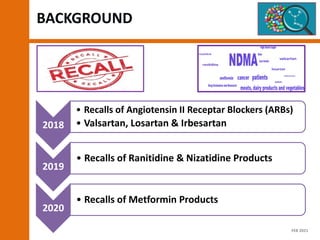
2018
• Recalls of Angiotensin II Receptar Blockers (ARBs)
• Valsartan, Losartan & Irbesartan
2019
• Recalls of Ranitidine & Nizatidine Products
2020
• Recalls of Metformin Products
BACKGROUND
FEB 2021
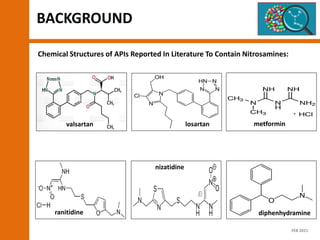
BACKGROUND
ranitidine
valsartan metformin
nizatidine
losartan
Chemical Structures of APIs Reported In Literature To Contain Nitrosamines:
diphenhydramine
FEB 2021
BACKGROUND
N-Nitroso compound (NDMA) Formation In Metformin HCl
FEB 2021
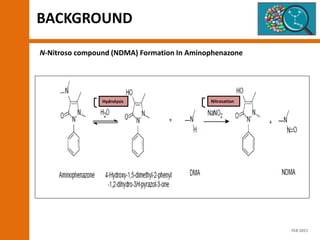
N-Nitroso compound (NDMA) Formation In Aminophenazone
Hydrolysis Nitrosation
BACKGROUND
FEB 2021
NITROSAMINES
• Nitrosamines are organic compounds that we are
exposed to in our everyday lives
• They exist in low levels in:
 Meat
 Vegetables
 Dairy Products
 Water
• Regulatory alert- for presence of Nitrosamines in
human medicinal products
FEB 2021
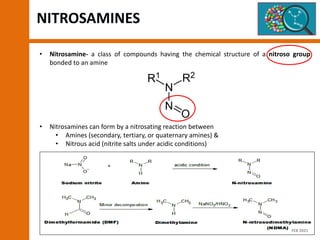
• Nitrosamine- a class of compounds having the chemical structure of a nitroso group
bonded to an amine
• Nitrosamines can form by a nitrosating reaction between
• Amines (secondary, tertiary, or quaternary amines) &
• Nitrous acid (nitrite salts under acidic conditions)
NITROSAMINES
FEB 2021
RISKS OF NITROSAMINES
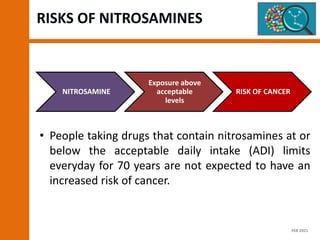
• People taking drugs that contain nitrosamines at or
below the acceptable daily intake (ADI) limits
everyday for 70 years are not expected to have an
increased risk of cancer.
NITROSAMINE
Exposure above
acceptable
levels
RISK OF CANCER
FEB 2021
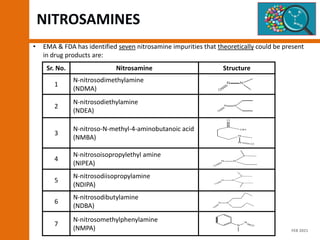
• EMA & FDA has identified seven nitrosamine impurities that theoretically could be present
in drug products are:
NITROSAMINES
Sr. No. Nitrosamine Structure
1
N-nitrosodimethylamine
(NDMA)
2
N-nitrosodiethylamine
(NDEA)
3
N-nitroso-N-methyl-4-aminobutanoic acid
(NMBA)
4
N-nitrosoisopropylethyl amine
(NIPEA)
5
N-nitrosodiisopropylamine
(NDIPA)
6
N-nitrosodibutylamine
(NDBA)
7
N-nitrosomethylphenylamine
(NMPA) FEB 2021
NITROSAMINES- REGULATORY CONSIDERATIONS
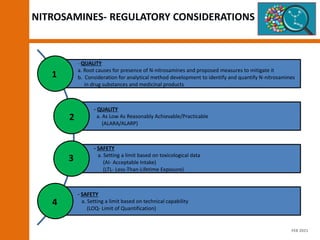
- QUALITY
a. Root causes for presence of N-nitrosamines and proposed measures to mitigate it
b. Consideration for analytical method development to identify and quantify N-nitrosamines
in drug substances and medicinal products
- QUALITY
a. As Low As Reasonably Achievable/Practicable
(ALARA/ALARP)
- SAFETY
a. Setting a limit based on toxicological data
(AI- Acceptable Intake)
(LTL- Less-Than-Lifetime Exposure)
- SAFETY
a. Setting a limit based on technical capability
(LOQ- Limit of Quantification)
1
2
3
4
FEB 2021
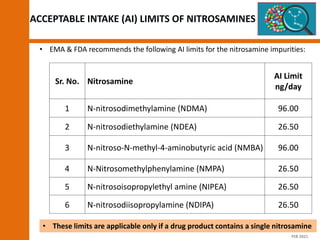
ACCEPTABLE INTAKE (AI) LIMITS OF NITROSAMINES
• EMA & FDA recommends the following AI limits for the nitrosamine impurities:
Sr. No. Nitrosamine
AI Limit
ng/day
1 N-nitrosodimethylamine (NDMA) 96.00
2 N-nitrosodiethylamine (NDEA) 26.50
3 N-nitroso-N-methyl-4-aminobutyric acid (NMBA) 96.00
4 N-Nitrosomethylphenylamine (NMPA) 26.50
5 N-nitrosoisopropylethyl amine (NIPEA) 26.50
6 N-nitrosodiisopropylamine (NDIPA) 26.50
• These limits are applicable only if a drug product contains a single nitrosamine
FEB 2021
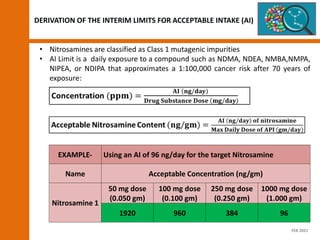
DERIVATION OF THE INTERIM LIMITS FOR ACCEPTABLE INTAKE (AI)
• Nitrosamines are classified as Class 1 mutagenic impurities
• AI Limit is a daily exposure to a compound such as NDMA, NDEA, NMBA,NMPA,
NIPEA, or NDIPA that approximates a 1:100,000 cancer risk after 70 years of
exposure:
EXAMPLE- Using an AI of 96 ng/day for the target Nitrosamine
Name Acceptable Concentration (ng/gm)
Nitrosamine 1
50 mg dose
(0.050 gm)
100 mg dose
(0.100 gm)
250 mg dose
(0.250 gm)
1000 mg dose
(1.000 gm)
1920 960 384 96
FEB 2021
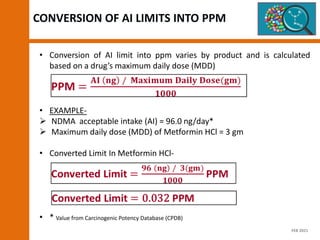
CONVERSION OF AI LIMITS INTO PPM
• Conversion of AI limit into ppm varies by product and is calculated
based on a drug’s maximum daily dose (MDD)
• EXAMPLE-
 NDMA acceptable intake (AI) = 96.0 ng/day*
 Maximum daily dose (MDD) of Metformin HCl = 3 gm
• Converted Limit In Metformin HCl-
• * Value from Carcinogenic Potency Database (CPDB)
FEB 2021
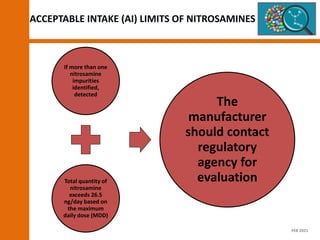
ACCEPTABLE INTAKE (AI) LIMITS OF NITROSAMINES
If more than one
nitrosamine
impurities
identified,
detected
Total quantity of
nitrosamine
exceeds 26.5
ng/day based on
the maximum
daily dose (MDD)
The
manufacturer
should contact
regulatory
agency for
evaluation
FEB 2021
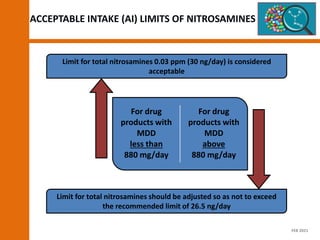
ACCEPTABLE INTAKE (AI) LIMITS OF NITROSAMINES
For drug
products with
MDD
less than
880 mg/day
For drug
products with
MDD
above
880 mg/day
f
f
Limit for total nitrosamines 0.03 ppm (30 ng/day) is considered
acceptable
Limit for total nitrosamines should be adjusted so as not to exceed
the recommended limit of 26.5 ng/day
FEB 2021
ACCEPTABLE INTAKE (AI) LIMITS OF NITROSAMINES
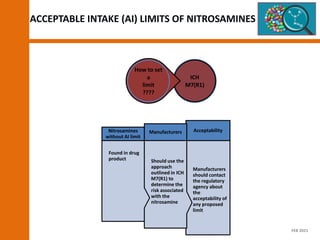
Manufacturers
should contact
the regulatory
agency about
the
acceptability of
any proposed
limit
Acceptability
Should use the
approach
outlined in ICH
M7(R1) to
determine the
risk associated
with the
nitrosamine
Manufacturers
Found in drug
product
Nitrosamines
without AI limit
ICH
M7(R1)
How to set
a
limit
????
FEB 2021
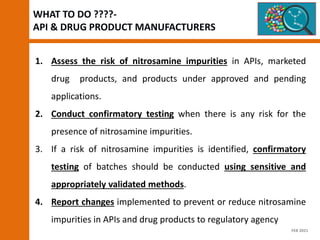
WHAT TO DO ????-
API & DRUG PRODUCT MANUFACTURERS
1. Assess the risk of nitrosamine impurities in APIs, marketed
drug products, and products under approved and pending
applications.
2. Conduct confirmatory testing when there is any risk for the
presence of nitrosamine impurities.
3. If a risk of nitrosamine impurities is identified, confirmatory
testing of batches should be conducted using sensitive and
appropriately validated methods.
4. Report changes implemented to prevent or reduce nitrosamine
impurities in APIs and drug products to regulatory agency
FEB 2021
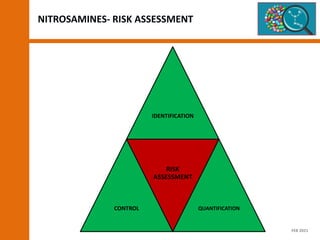
NITROSAMINES- RISK ASSESSMENT
IDENTIFICATION
CONTROL
RISK
ASSESSMENT
QUANTIFICATION
FEB 2021
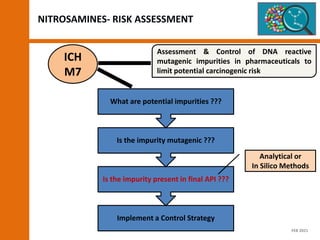
NITROSAMINES- RISK ASSESSMENT
Implement a Control Strategy
Is the impurity present in final API ???
Is the impurity mutagenic ???
What are potential impurities ???
Analytical or
In Silico Methods
ICH
M7
Assessment & Control of DNA reactive
mutagenic impurities in pharmaceuticals to
limit potential carcinogenic risk
FEB 2021
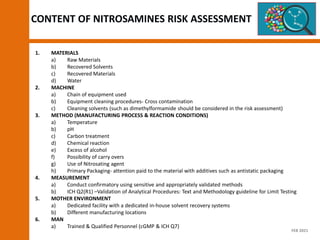
CONTENT OF NITROSAMINES RISK ASSESSMENT
1. MATERIALS
a) Raw Materials
b) Recovered Solvents
c) Recovered Materials
d) Water
2. MACHINE
a) Chain of equipment used
b) Equipment cleaning procedures- Cross contamination
c) Cleaning solvents (such as dimethylformamide should be considered in the risk assessment)
3. METHOD (MANUFACTURING PROCESS & REACTION CONDITIONS)
a) Temperature
b) pH
c) Carbon treatment
d) Chemical reaction
e) Excess of alcohol
f) Possibility of carry overs
g) Use of Nitrosating agent
h) Primary Packaging- attention paid to the material with additives such as antistatic packaging
4. MEASUREMENT
a) Conduct confirmatory using sensitive and appropriately validated methods
b) ICH Q2(R1) –Validation of Analytical Procedures: Text and Methodology guideline for Limit Testing
5. MOTHER ENVIRONMENT
a) Dedicated facility with a dedicated in-house solvent recovery systems
b) Different manufacturing locations
6. MAN
a) Trained & Qualified Personnel (cGMP & ICH Q7)
FEB 2021
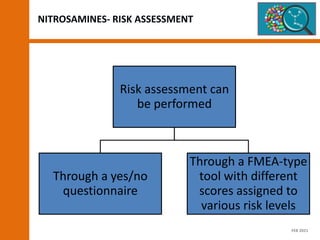
NITROSAMINES- RISK ASSESSMENT
Risk assessment can
be performed
Through a yes/no
questionnaire
Through a FMEA-type
tool with different
scores assigned to
various risk levels
FEB 2021
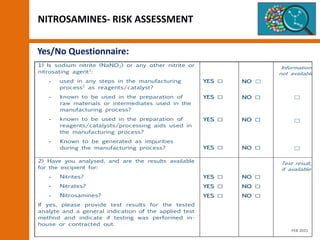
NITROSAMINES- RISK ASSESSMENT
Yes/No Questionnaire:
1) Is sodium nitrite (NaNO2) or any other nitrite or
nitrosating agent1
:
- used in any steps in the manufacturing
process2
as reagents/catalyst?
- known to be used in the preparation of
raw materials or intermediates used in the
manufacturing process?
- known to be used in the preparation of
reagents/catalysts/processing aids used in
the manufacturing process?
- Known to be generated as impurities
during the manufacturing process?
YES ☐
YES ☐
YES ☐
YES ☐
NO ☐
NO ☐
NO ☐
NO ☐
Information
not available
☐
☐
☐
2) Have you analysed, and are the results available
for the excipient for:
- Nitrites?
- Nitrates?
- Nitrosamines?
If yes, please provide test results for the tested
analyte and a general indication of the applied test
method and indicate if testing was performed in-
house or contracted out.
YES ☐
YES ☐
YES ☐
NO ☐
NO ☐
NO ☐
Test result,
if available
FEB 2021
NITROSAMINES- RISK ASSESSMENT
Yes/No Questionnaire:
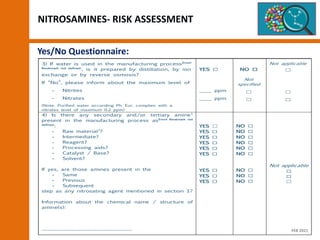
3) If water is used in the manufacturing processError!
Bookmark not defined.
, is it prepared by distillation, by ion
exchange or by reverse osmosis?
If “No”, please inform about the maximum level of
- Nitrites
- Nitrates
(Note: Purified water according Ph. Eur. complies with a
nitrates level of maximum 0.2 ppm)
YES ☐
____ ppm
____ ppm
NO ☐
Not
specified
☐
☐
Not applicable
☐
☐
☐
4) Is there any secondary and/or tertiary amine1
present in the manufacturing process asError! Bookmark not
defined.
:
- Raw material2
?
- Intermediate?
- Reagent?
- Processing aids?
- Catalyst / Base?
- Solvent?
If yes, are those amines present in the
- Same
- Previous
- Subsequent
step as any nitrosating agent mentioned in section 1?
Information about the chemical name / structure of
amine(s):
……………………………………………………
YES ☐
YES ☐
YES ☐
YES ☐
YES ☐
YES ☐
YES ☐
YES ☐
YES ☐
NO ☐
NO ☐
NO ☐
NO ☐
NO ☐
NO ☐
NO ☐
NO ☐
NO ☐
Not applicable
☐
☐
☐
FEB 2021
NITROSAMINES- RISK ASSESSMENT
Yes/No Questionnaire:
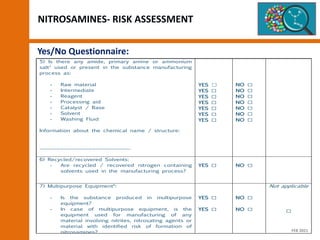
5) Is there any amide, primary amine or ammonium
salt1
used or present in the substance manufacturing
process as:
- Raw material
- Intermediate
- Reagent
- Processing aid
- Catalyst / Base
- Solvent
- Washing Fluid
Information about the chemical name / structure:
……………………………………………………
YES ☐
YES ☐
YES ☐
YES ☐
YES ☐
YES ☐
YES ☐
NO ☐
NO ☐
NO ☐
NO ☐
NO ☐
NO ☐
NO ☐
6) Recycled/recovered Solvents:
- Are recycled / recovered nitrogen containing
solvents used in the manufacturing process?
YES ☐ NO ☐
7) Multipurpose Equipment6
:
- Is the substance produced in multipurpose
equipment?
- In case of multipurpose equipment, is the
equipment used for manufacturing of any
material involving nitrites, nitrosating agents or
material with identified risk of formation of
nitrosamines?
YES ☐
YES ☐
NO ☐
NO ☐
Not applicable
☐
FEB 2021
NITROSAMINES- RISK ASSESSMENT
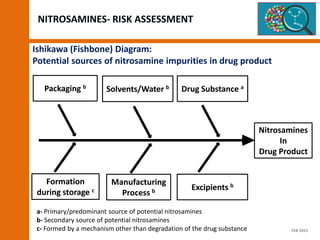
Packaging b
Solvents/Water b Drug Substance a
Formation
during storage c
Manufacturing
Process b Excipients b
Nitrosamines
In
Drug Product
Ishikawa (Fishbone) Diagram:
Potential sources of nitrosamine impurities in drug product
a- Primary/predominant source of potential nitrosamines
b- Secondary source of potential nitrosamines
c- Formed by a mechanism other than degradation of the drug substance FEB 2021
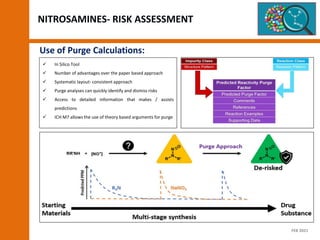
 In Silico Tool
 Number of advantages over the paper based approach
 Systematic layout- consistent approach
 Purge analyses can quickly identify and dismiss risks
 Access to detailed information that makes / assists
predictions
 ICH M7 allows the use of theory based arguments for purge
Use of Purge Calculations:
NITROSAMINES- RISK ASSESSMENT
FEB 2021
NITROSAMINES- RISK ASSESSMENT
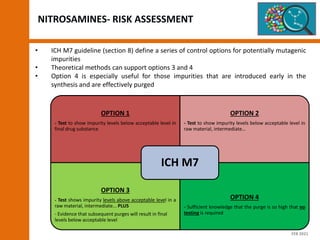
• ICH M7 guideline (section 8) define a series of control options for potentially mutagenic
impurities
• Theoretical methods can support options 3 and 4
• Option 4 is especially useful for those impurities that are introduced early in the
synthesis and are effectively purged
OPTION 1
- Test to show impurity levels below acceptable level in
final drug substance
OPTION 2
- Test to show impurity levels below acceptable level in
raw material, intermediate…
OPTION 3
- Test shows impurity levels above acceptable level in a
raw material, intermediate... PLUS
- Evidence that subsequent purges will result in final
levels below acceptable level
OPTION 4
- Sufficient knowledge that the purge is so high that no
testing is required
ICH M7
FEB 2021
NITROSAMINES- RISK ASSESSMENT
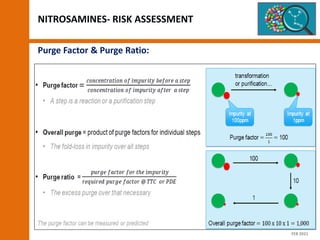
Purge Factor & Purge Ratio:
FEB 2021
NITROSAMINES- RISK ASSESSMENT
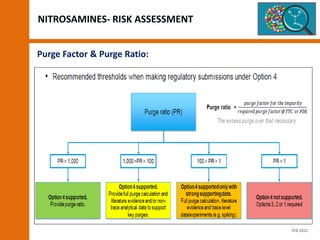
Purge Factor & Purge Ratio:
FEB 2021
NITROSAMINES- RISK ASSESSMENT
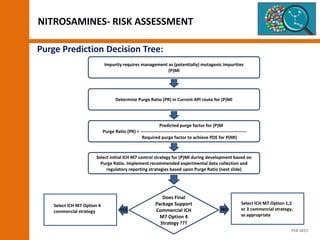
Impurity requires management as (potentially) mutagenic impurities
(P)MI
Determine Purge Ratio (PR) in Current API route for (P)MI
Predicted purge factor for (P)M
Purge Ratio (PR) = -----------------------------------------------------------------------
Required purge factor to achieve PDE for P(MI)
Select initial ICH M7 control strategy for (P)MI during development based on
Purge Ratio. Implement recommended experimental data collection and
regulatory reporting strategies based upon Purge Ratio (next slide)
Does Final
Package Support
Commercial ICH
M7 Option 4
Strategy ???
Purge Prediction Decision Tree:
Select ICH M7 Option 1,2
or 3 commercial strategy,
as appropriate
Select ICH M7 Option 4
commercial strategy NO
YES
FEB 2021
SOURCE/PATHWAYS FOR PRESENCE OF NITROSAMINES
API
EXCIPIENT
SOLVENT
MANUFACTURING
PROCESS
DRUG PRODUCT
STABILITY
HEAT
HYDROLYSIS
WATER
HYDROLYTIC/THERMAL
DEGRADATION
CONTAINER-
CLOSURE SYSTEM
NITROSATION
FEB 2021
SOURCE/PATHWAYS FOR PRESENCE OF NITROSAMINES
Sr. No.
Source/Pathway For Presence
Nitrosamines
Observed Risk
1 Impurities In Solvents
 Presence of residual dialkyl amines or tri-substituted amines that can
degrade to form dialkyl amines (e.g., triethylamine)
 Presence of nitrites (NaNO2) or other nitrosating agents
 Presence of acid
 Limited controls/specification limits for recycled solvents
 Poor quality water or solvents
2 Impurities In Water
 Presence of residual dialkyl amines or tri-substituted amines that can
degrade to form dialkyl amines (e.g., triethylamine)
 Presence of nitrites (NaNO2) or other nitrosating agents
 Presence of acid
3 Impurities In Excipients  Presence of nitrites or other nitrosating agents
4 Impurities In Drug Substance/API
 Use of sodium azide and nitrite for azide quenching in the synthesis in
acid media
 Use of di- or tri-alkylamines and amides (e.g., dimethylformamide
[DMF], dimethylamine [DMA], triethylamine [TEA], N-
methylpyrrolidone [NMP]) in the presence of nitrites and acid media
 Use of recycled solvents that may contain nitrosamines or their
precursors
 Use of sanitized water (e.g., chloramines)
 Need of additional purification steps (e.g., crystallization)
FEB 2021
Sr. No.
Source/Pathway For Presence
Nitrosamines
Observed Risk
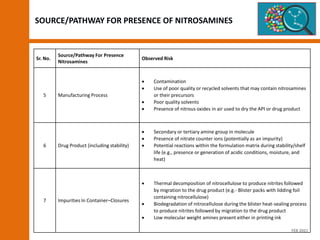
5 Manufacturing Process
 Contamination
 Use of poor quality or recycled solvents that may contain nitrosamines
or their precursors
 Poor quality solvents
 Presence of nitrous oxides in air used to dry the API or drug product
6 Drug Product (including stability)
 Secondary or tertiary amine group in molecule
 Presence of nitrate counter ions (potentially as an impurity)
 Potential reactions within the formulation matrix during stability/shelf
life (e.g., presence or generation of acidic conditions, moisture, and
heat)
7 Impurities In Container–Closures
 Thermal decomposition of nitrocellulose to produce nitrites followed
by migration to the drug product (e.g.- Blister packs with lidding foil
containing nitrocellulose)
 Biodegradation of nitrocellulose during the blister heat-sealing process
to produce nitrites followed by migration to the drug product
 Low molecular weight amines present either in printing ink
SOURCE/PATHWAY FOR PRESENCE OF NITROSAMINES
FEB 2021
NITROSAMINES- CONTROL STRATEGY
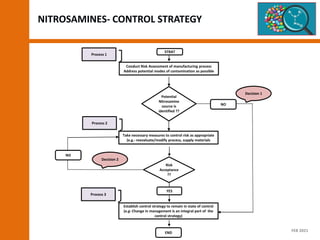
STRAT
Conduct Risk Assessment of manufacturing process
Address potential modes of contamination as possible
Potential
Nitrosamine
source is
identified ??
Take necessary measures to control risk as appropriate
(e.g.- reevaluate/modify process, supply materials
Risk
Acceptance
??
Establish control strategy to remain in state of control
(e.g- Change in management is an integral part of the
control strategy)
END
NO
NO
Process 1
Process 2
Process 3
YES
Decision 2
Decision 1
FEB 2021
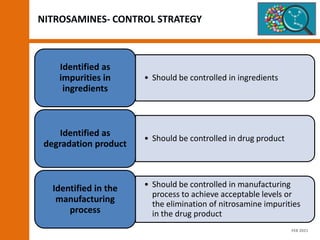
• Should be controlled in ingredients
Identified as
impurities in
ingredients
• Should be controlled in drug product
Identified as
degradation product
• Should be controlled in manufacturing
process to achieve acceptable levels or
the elimination of nitrosamine impurities
in the drug product
Identified in the
manufacturing
process
NITROSAMINES- CONTROL STRATEGY
FEB 2021
NITROSAMINES- RISK ASSESSMENT OUTCOME
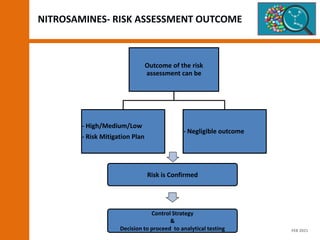
Outcome of the risk
assessment can be
- High/Medium/Low
- Risk Mitigation Plan
- Negligible outcome
Risk is Confirmed
Control Strategy
&
Decision to proceed to analytical testing FEB 2021
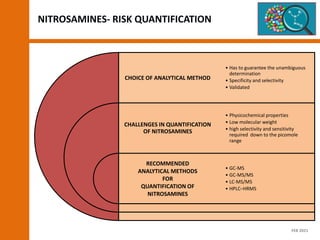
NITROSAMINES- RISK QUANTIFICATION
CHOICE OF ANALYTICAL METHOD
CHALLENGES IN QUANTIFICATION
OF NITROSAMINES
RECOMMENDED
ANALYTICAL METHODS
FOR
QUANTIFICATION OF
NITROSAMINES
• Has to guarantee the unambiguous
determination
• Specificity and selectivity
• Validated
• Physicochemical properties
• Low molecular weight
• high selectivity and sensitivity
required down to the picomole
range
• GC-MS
• GC-MS/MS
• LC-MS/MS
• HPLC–HRMS
FEB 2021
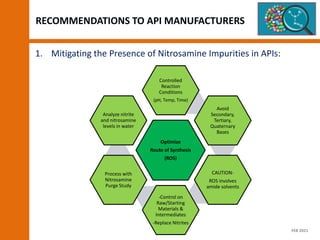
RECOMMENDATIONS TO API MANUFACTURERS
1. Mitigating the Presence of Nitrosamine Impurities in APIs:
Optimize
Route of Synthesis
(ROS)
Controlled
Reaction
Conditions
(pH, Temp, Time)
Avoid
Secondary,
Tertiary,
Quaternary
Bases
CAUTION-
ROS involves
amide solvents
-Control on
Raw/Starting
Materials &
Intermediates
-Replace Nitrites
Process with
Nitrosamine
Purge Study
Analyze nitrite
and nitrosamine
levels in water
FEB 2021
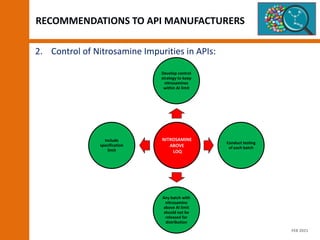
RECOMMENDATIONS TO API MANUFACTURERS
2. Control of Nitrosamine Impurities in APIs:
NITROSAMINE
ABOVE
LOQ
Develop control
strategy to keep
nitrosamines
within AI limit
Conduct testing
of each batch
Any batch with
nitrosamine
above AI limit
should not be
released for
distribution
Include
specification
limit
FEB 2021
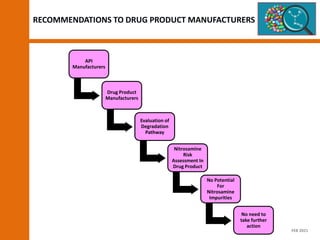
RECOMMENDATIONS TO DRUG PRODUCT MANUFACTURERS
API
Manufacturers
Drug Product
Manufacturers
Evaluation of
Degradation
Pathway
Nitrosamine
Risk
Assessment In
Drug Product
No Potential
For
Nitrosamine
Impurities
No need to
take further
action
FEB 2021
RECOMMENDATIONS TO DRUG PRODUCT MANUFACTURERS
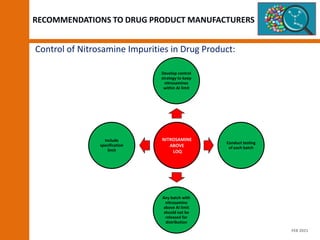
Control of Nitrosamine Impurities in Drug Product:
NITROSAMINE
ABOVE
LOQ
Develop control
strategy to keep
nitrosamines
within AI limit
Conduct testing
of each batch
Any batch with
nitrosamine
above AI limit
should not be
released for
distribution
Include
specification
limit
FEB 2021
RECOMMENDATIONS TO DRUG PRODUCT MANUFACTURERS
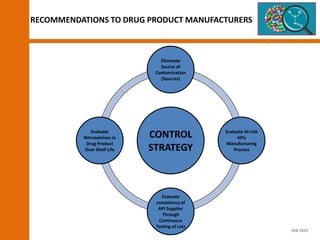
CONTROL
STRATEGY
Eliminate
Source of
Contamination
(Sources)
Evaluate At-risk
APIs
Manufacturing
Process
Evaluate
consistency of
API Supplier
Through
Continuous
Testing of Lots
Evaluate
Nitrosamines in
Drug Product
Over Shelf Life
FEB 2021
RECOMMENDATIONS TO API & DRUG PRODUCT MANUFACTURERS
CONTROL STRATEGY
LIFECYCLE
ICH Q10
Pharmaceutical
Quality System
ICH M7(R1)
Assessment and
Control of DNA
Reactive (Mutagenic)
Impurities in
Pharmaceuticals To
Limit Potential
Carcinogenic Risk
ICH Q9
Quality Risk
Management
FEB 2021
RECOMMENDATIONS TO API & DRUG PRODUCT MANUFACTURERS
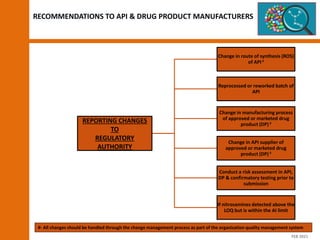
REPORTING CHANGES
TO
REGULATORY
AUTHORITY
Change in route of synthesis (ROS)
of API #
Reprocessed or reworked batch of
API
Change in manufacturing process
of approved or marketed drug
product (DP) #
Change in API supplier of
approved or marketed drug
product (DP) #
Conduct a risk assessment in API,
DP & confirmatory testing prior to
submission
If nitrosamines detected above the
LOQ but is within the AI limit
#- All changes should be handled through the change management process as part of the organization quality management system
FEB 2021
CONCLUSION
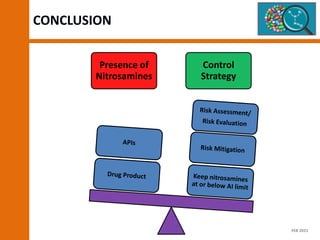
Presence of
Nitrosamines
Control
Strategy
FEB 2021
REFERENCES
1. General Chapter: ˂2.5.42˃ N-Nitrosamines in active substances Ph.Eur. (Adopted by the European
Pharmacopoeia Commission (Dec 2020)
2. General Chapter: <1469> Nitrosamine Impurities USP-NF (Jan 2021)
3. ICH guidance for industry Q9 Quality Risk Management (June 2006)
4. ICH guidance for industry Q10 Pharmaceutical Quality System (April 2009)
5. ICH guidance for industry Q11 Development and Manufacture of Drug Substances (November 2012)
6. ICH guidance for industry Q7 Good Manufacturing Practice Guidance for Active 23 Pharmaceutical Ingredients
(September 2016)
7. ICH guidance for industry M7(R1) Assessment and Control of DNA Reactive (Mutagenic) Impurities in
Pharmaceuticals To Limit Potential Carcinogenic Risk (March 2018)
8. EMA/189634/2019 - Information on Nitrosamines for Marketing Authorization Holders
9. Health Canada - Information to Marketing Authorization Holders (MAH) of Human Pharmaceutical Products
Regarding Nitrosamines Impurities (Letter- October 2019)
10. EFPIA decision tree “Drug substance manufacturing process risk assessment for presence of Nnitrosamines”
11. IPEC Europe. Questionnaire for Excipient Nitrosamines Risk Evaluation. Guidance, Conducting purge assessments
12. https://www.ema.europa.eu/en/human-regulatory/post-authorisation/referral-procedures/nitrosamine-
impurities
13. APIC Additional guidance on the assessment on the risk assessment for presence of N-nitrosamines in APIs
(2020)
14. Dr Andrew Teasdale, AstraZeneca, Presentation On “N-Nitrosamines Status / Implications” (Jan 2020)
15. Michael J. Burns, Andrew Teasdale, Eric Elliott, and Chris G. Barber, Controlling a Cohort: Use of Mirabilis-Based
Purge Calculations to Understand Nitrosamine-Related Risk and Control Strategy Options, Org. Process Res. Dev.
2020, 24, 1531−1535.
16. Chris Barber, Lhasa Ltd, Presentation On “Use of Mirabilis based purge calculations to understand
17. MI related risk and control strategy options” (Nov 2019)
18. https://www.fda.gov/about-fda/fda-pharmacy-student-experiential-program/nitrosamine-impurities-drugs-
what-health-care-professionals-need-know FEB 2021
THANK YOU
FOR YOUR ATTENTION
NITROSAMINE
CONTROL IN
MEDICINAL
PRODUCTS
TEAM WORK
FEB 2021

Nitrosamines In Human Medicinal Products

  • 1.
    NITROSAMINES IN HUMAN MEDICINALPRODUCTS By- Dr. Nityanand S. Zadbuke DOI: 10.13140/RG.2.2.11844.96643 FEB 2021
  • 2.
    QUALITY MEDICINES • Aquality product of any kind consistently meets the expectations of the user • Medicines are no different • Patients expect safe and effective medicine • Quality- assuring every dose is safe and effective, free of contamination and defects MEDICINES EFFICACY QUALITY SAFETY FEB 2021
  • 3.
  • 4.
    NITROSAMINES- REGULATORY STATUS REGULATORY STATUS (NITROSAMINES) USPGeneral Chapter Prospectus: <1469> EMA Implemented Guideline Ph. Eur. Adopts a new general chapter USFDA Implemented Guideline FEB 2021
  • 5.
    Has my medication been recalled??? What is my Risk of getting cancer ??? How can I get more information about Nitrosamines ??? I got a recall notice. Am I in danger ??? Should I stop taking my medication ??? STAY UP TO DATE WITH REGULATORY RESOURCES STAY UP TO DATE FEB 2021
  • 6.
    IMPACT OF NITROSAMINES Import Alert Product Recall Safety & Quality Changein ROS / Reformulation Risk Assessment Business Loss GLOBAL IMPACT OF PRESENCE NITROSAMINES IN MEDICINAL PRODUCTS Drug Shortage Warning Letters FEB 2021
  • 7.
    2018 • Recalls ofAngiotensin II Receptar Blockers (ARBs) • Valsartan, Losartan & Irbesartan 2019 • Recalls of Ranitidine & Nizatidine Products 2020 • Recalls of Metformin Products BACKGROUND FEB 2021
  • 8.
    BACKGROUND ranitidine valsartan metformin nizatidine losartan Chemical Structuresof APIs Reported In Literature To Contain Nitrosamines: diphenhydramine FEB 2021
  • 9.
    BACKGROUND N-Nitroso compound (NDMA)Formation In Metformin HCl FEB 2021
  • 10.
    N-Nitroso compound (NDMA)Formation In Aminophenazone Hydrolysis Nitrosation BACKGROUND FEB 2021
  • 11.
    NITROSAMINES • Nitrosamines areorganic compounds that we are exposed to in our everyday lives • They exist in low levels in:  Meat  Vegetables  Dairy Products  Water • Regulatory alert- for presence of Nitrosamines in human medicinal products FEB 2021
  • 12.
    • Nitrosamine- aclass of compounds having the chemical structure of a nitroso group bonded to an amine • Nitrosamines can form by a nitrosating reaction between • Amines (secondary, tertiary, or quaternary amines) & • Nitrous acid (nitrite salts under acidic conditions) NITROSAMINES FEB 2021
  • 13.
    RISKS OF NITROSAMINES •People taking drugs that contain nitrosamines at or below the acceptable daily intake (ADI) limits everyday for 70 years are not expected to have an increased risk of cancer. NITROSAMINE Exposure above acceptable levels RISK OF CANCER FEB 2021
  • 14.
    • EMA &FDA has identified seven nitrosamine impurities that theoretically could be present in drug products are: NITROSAMINES Sr. No. Nitrosamine Structure 1 N-nitrosodimethylamine (NDMA) 2 N-nitrosodiethylamine (NDEA) 3 N-nitroso-N-methyl-4-aminobutanoic acid (NMBA) 4 N-nitrosoisopropylethyl amine (NIPEA) 5 N-nitrosodiisopropylamine (NDIPA) 6 N-nitrosodibutylamine (NDBA) 7 N-nitrosomethylphenylamine (NMPA) FEB 2021
  • 15.
    NITROSAMINES- REGULATORY CONSIDERATIONS -QUALITY a. Root causes for presence of N-nitrosamines and proposed measures to mitigate it b. Consideration for analytical method development to identify and quantify N-nitrosamines in drug substances and medicinal products - QUALITY a. As Low As Reasonably Achievable/Practicable (ALARA/ALARP) - SAFETY a. Setting a limit based on toxicological data (AI- Acceptable Intake) (LTL- Less-Than-Lifetime Exposure) - SAFETY a. Setting a limit based on technical capability (LOQ- Limit of Quantification) 1 2 3 4 FEB 2021
  • 16.
    ACCEPTABLE INTAKE (AI)LIMITS OF NITROSAMINES • EMA & FDA recommends the following AI limits for the nitrosamine impurities: Sr. No. Nitrosamine AI Limit ng/day 1 N-nitrosodimethylamine (NDMA) 96.00 2 N-nitrosodiethylamine (NDEA) 26.50 3 N-nitroso-N-methyl-4-aminobutyric acid (NMBA) 96.00 4 N-Nitrosomethylphenylamine (NMPA) 26.50 5 N-nitrosoisopropylethyl amine (NIPEA) 26.50 6 N-nitrosodiisopropylamine (NDIPA) 26.50 • These limits are applicable only if a drug product contains a single nitrosamine FEB 2021
  • 17.
    DERIVATION OF THEINTERIM LIMITS FOR ACCEPTABLE INTAKE (AI) • Nitrosamines are classified as Class 1 mutagenic impurities • AI Limit is a daily exposure to a compound such as NDMA, NDEA, NMBA,NMPA, NIPEA, or NDIPA that approximates a 1:100,000 cancer risk after 70 years of exposure: EXAMPLE- Using an AI of 96 ng/day for the target Nitrosamine Name Acceptable Concentration (ng/gm) Nitrosamine 1 50 mg dose (0.050 gm) 100 mg dose (0.100 gm) 250 mg dose (0.250 gm) 1000 mg dose (1.000 gm) 1920 960 384 96 FEB 2021
  • 18.
    CONVERSION OF AILIMITS INTO PPM • Conversion of AI limit into ppm varies by product and is calculated based on a drug’s maximum daily dose (MDD) • EXAMPLE-  NDMA acceptable intake (AI) = 96.0 ng/day*  Maximum daily dose (MDD) of Metformin HCl = 3 gm • Converted Limit In Metformin HCl- • * Value from Carcinogenic Potency Database (CPDB) FEB 2021
  • 19.
    ACCEPTABLE INTAKE (AI)LIMITS OF NITROSAMINES If more than one nitrosamine impurities identified, detected Total quantity of nitrosamine exceeds 26.5 ng/day based on the maximum daily dose (MDD) The manufacturer should contact regulatory agency for evaluation FEB 2021
  • 20.
    ACCEPTABLE INTAKE (AI)LIMITS OF NITROSAMINES For drug products with MDD less than 880 mg/day For drug products with MDD above 880 mg/day f f Limit for total nitrosamines 0.03 ppm (30 ng/day) is considered acceptable Limit for total nitrosamines should be adjusted so as not to exceed the recommended limit of 26.5 ng/day FEB 2021
  • 21.
    ACCEPTABLE INTAKE (AI)LIMITS OF NITROSAMINES Manufacturers should contact the regulatory agency about the acceptability of any proposed limit Acceptability Should use the approach outlined in ICH M7(R1) to determine the risk associated with the nitrosamine Manufacturers Found in drug product Nitrosamines without AI limit ICH M7(R1) How to set a limit ???? FEB 2021
  • 22.
    WHAT TO DO????- API & DRUG PRODUCT MANUFACTURERS 1. Assess the risk of nitrosamine impurities in APIs, marketed drug products, and products under approved and pending applications. 2. Conduct confirmatory testing when there is any risk for the presence of nitrosamine impurities. 3. If a risk of nitrosamine impurities is identified, confirmatory testing of batches should be conducted using sensitive and appropriately validated methods. 4. Report changes implemented to prevent or reduce nitrosamine impurities in APIs and drug products to regulatory agency FEB 2021
  • 23.
  • 24.
    NITROSAMINES- RISK ASSESSMENT Implementa Control Strategy Is the impurity present in final API ??? Is the impurity mutagenic ??? What are potential impurities ??? Analytical or In Silico Methods ICH M7 Assessment & Control of DNA reactive mutagenic impurities in pharmaceuticals to limit potential carcinogenic risk FEB 2021
  • 25.
    CONTENT OF NITROSAMINESRISK ASSESSMENT 1. MATERIALS a) Raw Materials b) Recovered Solvents c) Recovered Materials d) Water 2. MACHINE a) Chain of equipment used b) Equipment cleaning procedures- Cross contamination c) Cleaning solvents (such as dimethylformamide should be considered in the risk assessment) 3. METHOD (MANUFACTURING PROCESS & REACTION CONDITIONS) a) Temperature b) pH c) Carbon treatment d) Chemical reaction e) Excess of alcohol f) Possibility of carry overs g) Use of Nitrosating agent h) Primary Packaging- attention paid to the material with additives such as antistatic packaging 4. MEASUREMENT a) Conduct confirmatory using sensitive and appropriately validated methods b) ICH Q2(R1) –Validation of Analytical Procedures: Text and Methodology guideline for Limit Testing 5. MOTHER ENVIRONMENT a) Dedicated facility with a dedicated in-house solvent recovery systems b) Different manufacturing locations 6. MAN a) Trained & Qualified Personnel (cGMP & ICH Q7) FEB 2021
  • 26.
    NITROSAMINES- RISK ASSESSMENT Riskassessment can be performed Through a yes/no questionnaire Through a FMEA-type tool with different scores assigned to various risk levels FEB 2021
  • 27.
    NITROSAMINES- RISK ASSESSMENT Yes/NoQuestionnaire: 1) Is sodium nitrite (NaNO2) or any other nitrite or nitrosating agent1 : - used in any steps in the manufacturing process2 as reagents/catalyst? - known to be used in the preparation of raw materials or intermediates used in the manufacturing process? - known to be used in the preparation of reagents/catalysts/processing aids used in the manufacturing process? - Known to be generated as impurities during the manufacturing process? YES ☐ YES ☐ YES ☐ YES ☐ NO ☐ NO ☐ NO ☐ NO ☐ Information not available ☐ ☐ ☐ 2) Have you analysed, and are the results available for the excipient for: - Nitrites? - Nitrates? - Nitrosamines? If yes, please provide test results for the tested analyte and a general indication of the applied test method and indicate if testing was performed in- house or contracted out. YES ☐ YES ☐ YES ☐ NO ☐ NO ☐ NO ☐ Test result, if available FEB 2021
  • 28.
    NITROSAMINES- RISK ASSESSMENT Yes/NoQuestionnaire: 3) If water is used in the manufacturing processError! Bookmark not defined. , is it prepared by distillation, by ion exchange or by reverse osmosis? If “No”, please inform about the maximum level of - Nitrites - Nitrates (Note: Purified water according Ph. Eur. complies with a nitrates level of maximum 0.2 ppm) YES ☐ ____ ppm ____ ppm NO ☐ Not specified ☐ ☐ Not applicable ☐ ☐ ☐ 4) Is there any secondary and/or tertiary amine1 present in the manufacturing process asError! Bookmark not defined. : - Raw material2 ? - Intermediate? - Reagent? - Processing aids? - Catalyst / Base? - Solvent? If yes, are those amines present in the - Same - Previous - Subsequent step as any nitrosating agent mentioned in section 1? Information about the chemical name / structure of amine(s): …………………………………………………… YES ☐ YES ☐ YES ☐ YES ☐ YES ☐ YES ☐ YES ☐ YES ☐ YES ☐ NO ☐ NO ☐ NO ☐ NO ☐ NO ☐ NO ☐ NO ☐ NO ☐ NO ☐ Not applicable ☐ ☐ ☐ FEB 2021
  • 29.
    NITROSAMINES- RISK ASSESSMENT Yes/NoQuestionnaire: 5) Is there any amide, primary amine or ammonium salt1 used or present in the substance manufacturing process as: - Raw material - Intermediate - Reagent - Processing aid - Catalyst / Base - Solvent - Washing Fluid Information about the chemical name / structure: …………………………………………………… YES ☐ YES ☐ YES ☐ YES ☐ YES ☐ YES ☐ YES ☐ NO ☐ NO ☐ NO ☐ NO ☐ NO ☐ NO ☐ NO ☐ 6) Recycled/recovered Solvents: - Are recycled / recovered nitrogen containing solvents used in the manufacturing process? YES ☐ NO ☐ 7) Multipurpose Equipment6 : - Is the substance produced in multipurpose equipment? - In case of multipurpose equipment, is the equipment used for manufacturing of any material involving nitrites, nitrosating agents or material with identified risk of formation of nitrosamines? YES ☐ YES ☐ NO ☐ NO ☐ Not applicable ☐ FEB 2021
  • 30.
    NITROSAMINES- RISK ASSESSMENT Packagingb Solvents/Water b Drug Substance a Formation during storage c Manufacturing Process b Excipients b Nitrosamines In Drug Product Ishikawa (Fishbone) Diagram: Potential sources of nitrosamine impurities in drug product a- Primary/predominant source of potential nitrosamines b- Secondary source of potential nitrosamines c- Formed by a mechanism other than degradation of the drug substance FEB 2021
  • 31.
     In SilicoTool  Number of advantages over the paper based approach  Systematic layout- consistent approach  Purge analyses can quickly identify and dismiss risks  Access to detailed information that makes / assists predictions  ICH M7 allows the use of theory based arguments for purge Use of Purge Calculations: NITROSAMINES- RISK ASSESSMENT FEB 2021
  • 32.
    NITROSAMINES- RISK ASSESSMENT •ICH M7 guideline (section 8) define a series of control options for potentially mutagenic impurities • Theoretical methods can support options 3 and 4 • Option 4 is especially useful for those impurities that are introduced early in the synthesis and are effectively purged OPTION 1 - Test to show impurity levels below acceptable level in final drug substance OPTION 2 - Test to show impurity levels below acceptable level in raw material, intermediate… OPTION 3 - Test shows impurity levels above acceptable level in a raw material, intermediate... PLUS - Evidence that subsequent purges will result in final levels below acceptable level OPTION 4 - Sufficient knowledge that the purge is so high that no testing is required ICH M7 FEB 2021
  • 33.
    NITROSAMINES- RISK ASSESSMENT PurgeFactor & Purge Ratio: FEB 2021
  • 34.
    NITROSAMINES- RISK ASSESSMENT PurgeFactor & Purge Ratio: FEB 2021
  • 35.
    NITROSAMINES- RISK ASSESSMENT Impurityrequires management as (potentially) mutagenic impurities (P)MI Determine Purge Ratio (PR) in Current API route for (P)MI Predicted purge factor for (P)M Purge Ratio (PR) = ----------------------------------------------------------------------- Required purge factor to achieve PDE for P(MI) Select initial ICH M7 control strategy for (P)MI during development based on Purge Ratio. Implement recommended experimental data collection and regulatory reporting strategies based upon Purge Ratio (next slide) Does Final Package Support Commercial ICH M7 Option 4 Strategy ??? Purge Prediction Decision Tree: Select ICH M7 Option 1,2 or 3 commercial strategy, as appropriate Select ICH M7 Option 4 commercial strategy NO YES FEB 2021
  • 36.
    SOURCE/PATHWAYS FOR PRESENCEOF NITROSAMINES API EXCIPIENT SOLVENT MANUFACTURING PROCESS DRUG PRODUCT STABILITY HEAT HYDROLYSIS WATER HYDROLYTIC/THERMAL DEGRADATION CONTAINER- CLOSURE SYSTEM NITROSATION FEB 2021
  • 37.
    SOURCE/PATHWAYS FOR PRESENCEOF NITROSAMINES Sr. No. Source/Pathway For Presence Nitrosamines Observed Risk 1 Impurities In Solvents  Presence of residual dialkyl amines or tri-substituted amines that can degrade to form dialkyl amines (e.g., triethylamine)  Presence of nitrites (NaNO2) or other nitrosating agents  Presence of acid  Limited controls/specification limits for recycled solvents  Poor quality water or solvents 2 Impurities In Water  Presence of residual dialkyl amines or tri-substituted amines that can degrade to form dialkyl amines (e.g., triethylamine)  Presence of nitrites (NaNO2) or other nitrosating agents  Presence of acid 3 Impurities In Excipients  Presence of nitrites or other nitrosating agents 4 Impurities In Drug Substance/API  Use of sodium azide and nitrite for azide quenching in the synthesis in acid media  Use of di- or tri-alkylamines and amides (e.g., dimethylformamide [DMF], dimethylamine [DMA], triethylamine [TEA], N- methylpyrrolidone [NMP]) in the presence of nitrites and acid media  Use of recycled solvents that may contain nitrosamines or their precursors  Use of sanitized water (e.g., chloramines)  Need of additional purification steps (e.g., crystallization) FEB 2021
  • 38.
    Sr. No. Source/Pathway ForPresence Nitrosamines Observed Risk 5 Manufacturing Process  Contamination  Use of poor quality or recycled solvents that may contain nitrosamines or their precursors  Poor quality solvents  Presence of nitrous oxides in air used to dry the API or drug product 6 Drug Product (including stability)  Secondary or tertiary amine group in molecule  Presence of nitrate counter ions (potentially as an impurity)  Potential reactions within the formulation matrix during stability/shelf life (e.g., presence or generation of acidic conditions, moisture, and heat) 7 Impurities In Container–Closures  Thermal decomposition of nitrocellulose to produce nitrites followed by migration to the drug product (e.g.- Blister packs with lidding foil containing nitrocellulose)  Biodegradation of nitrocellulose during the blister heat-sealing process to produce nitrites followed by migration to the drug product  Low molecular weight amines present either in printing ink SOURCE/PATHWAY FOR PRESENCE OF NITROSAMINES FEB 2021
  • 39.
    NITROSAMINES- CONTROL STRATEGY STRAT ConductRisk Assessment of manufacturing process Address potential modes of contamination as possible Potential Nitrosamine source is identified ?? Take necessary measures to control risk as appropriate (e.g.- reevaluate/modify process, supply materials Risk Acceptance ?? Establish control strategy to remain in state of control (e.g- Change in management is an integral part of the control strategy) END NO NO Process 1 Process 2 Process 3 YES Decision 2 Decision 1 FEB 2021
  • 40.
    • Should becontrolled in ingredients Identified as impurities in ingredients • Should be controlled in drug product Identified as degradation product • Should be controlled in manufacturing process to achieve acceptable levels or the elimination of nitrosamine impurities in the drug product Identified in the manufacturing process NITROSAMINES- CONTROL STRATEGY FEB 2021
  • 41.
    NITROSAMINES- RISK ASSESSMENTOUTCOME Outcome of the risk assessment can be - High/Medium/Low - Risk Mitigation Plan - Negligible outcome Risk is Confirmed Control Strategy & Decision to proceed to analytical testing FEB 2021
  • 42.
    NITROSAMINES- RISK QUANTIFICATION CHOICEOF ANALYTICAL METHOD CHALLENGES IN QUANTIFICATION OF NITROSAMINES RECOMMENDED ANALYTICAL METHODS FOR QUANTIFICATION OF NITROSAMINES • Has to guarantee the unambiguous determination • Specificity and selectivity • Validated • Physicochemical properties • Low molecular weight • high selectivity and sensitivity required down to the picomole range • GC-MS • GC-MS/MS • LC-MS/MS • HPLC–HRMS FEB 2021
  • 43.
    RECOMMENDATIONS TO APIMANUFACTURERS 1. Mitigating the Presence of Nitrosamine Impurities in APIs: Optimize Route of Synthesis (ROS) Controlled Reaction Conditions (pH, Temp, Time) Avoid Secondary, Tertiary, Quaternary Bases CAUTION- ROS involves amide solvents -Control on Raw/Starting Materials & Intermediates -Replace Nitrites Process with Nitrosamine Purge Study Analyze nitrite and nitrosamine levels in water FEB 2021
  • 44.
    RECOMMENDATIONS TO APIMANUFACTURERS 2. Control of Nitrosamine Impurities in APIs: NITROSAMINE ABOVE LOQ Develop control strategy to keep nitrosamines within AI limit Conduct testing of each batch Any batch with nitrosamine above AI limit should not be released for distribution Include specification limit FEB 2021
  • 45.
    RECOMMENDATIONS TO DRUGPRODUCT MANUFACTURERS API Manufacturers Drug Product Manufacturers Evaluation of Degradation Pathway Nitrosamine Risk Assessment In Drug Product No Potential For Nitrosamine Impurities No need to take further action FEB 2021
  • 46.
    RECOMMENDATIONS TO DRUGPRODUCT MANUFACTURERS Control of Nitrosamine Impurities in Drug Product: NITROSAMINE ABOVE LOQ Develop control strategy to keep nitrosamines within AI limit Conduct testing of each batch Any batch with nitrosamine above AI limit should not be released for distribution Include specification limit FEB 2021
  • 47.
    RECOMMENDATIONS TO DRUGPRODUCT MANUFACTURERS CONTROL STRATEGY Eliminate Source of Contamination (Sources) Evaluate At-risk APIs Manufacturing Process Evaluate consistency of API Supplier Through Continuous Testing of Lots Evaluate Nitrosamines in Drug Product Over Shelf Life FEB 2021
  • 48.
    RECOMMENDATIONS TO API& DRUG PRODUCT MANUFACTURERS CONTROL STRATEGY LIFECYCLE ICH Q10 Pharmaceutical Quality System ICH M7(R1) Assessment and Control of DNA Reactive (Mutagenic) Impurities in Pharmaceuticals To Limit Potential Carcinogenic Risk ICH Q9 Quality Risk Management FEB 2021
  • 49.
    RECOMMENDATIONS TO API& DRUG PRODUCT MANUFACTURERS REPORTING CHANGES TO REGULATORY AUTHORITY Change in route of synthesis (ROS) of API # Reprocessed or reworked batch of API Change in manufacturing process of approved or marketed drug product (DP) # Change in API supplier of approved or marketed drug product (DP) # Conduct a risk assessment in API, DP & confirmatory testing prior to submission If nitrosamines detected above the LOQ but is within the AI limit #- All changes should be handled through the change management process as part of the organization quality management system FEB 2021
  • 50.
  • 51.
    REFERENCES 1. General Chapter:˂2.5.42˃ N-Nitrosamines in active substances Ph.Eur. (Adopted by the European Pharmacopoeia Commission (Dec 2020) 2. General Chapter: <1469> Nitrosamine Impurities USP-NF (Jan 2021) 3. ICH guidance for industry Q9 Quality Risk Management (June 2006) 4. ICH guidance for industry Q10 Pharmaceutical Quality System (April 2009) 5. ICH guidance for industry Q11 Development and Manufacture of Drug Substances (November 2012) 6. ICH guidance for industry Q7 Good Manufacturing Practice Guidance for Active 23 Pharmaceutical Ingredients (September 2016) 7. ICH guidance for industry M7(R1) Assessment and Control of DNA Reactive (Mutagenic) Impurities in Pharmaceuticals To Limit Potential Carcinogenic Risk (March 2018) 8. EMA/189634/2019 - Information on Nitrosamines for Marketing Authorization Holders 9. Health Canada - Information to Marketing Authorization Holders (MAH) of Human Pharmaceutical Products Regarding Nitrosamines Impurities (Letter- October 2019) 10. EFPIA decision tree “Drug substance manufacturing process risk assessment for presence of Nnitrosamines” 11. IPEC Europe. Questionnaire for Excipient Nitrosamines Risk Evaluation. Guidance, Conducting purge assessments 12. https://www.ema.europa.eu/en/human-regulatory/post-authorisation/referral-procedures/nitrosamine- impurities 13. APIC Additional guidance on the assessment on the risk assessment for presence of N-nitrosamines in APIs (2020) 14. Dr Andrew Teasdale, AstraZeneca, Presentation On “N-Nitrosamines Status / Implications” (Jan 2020) 15. Michael J. Burns, Andrew Teasdale, Eric Elliott, and Chris G. Barber, Controlling a Cohort: Use of Mirabilis-Based Purge Calculations to Understand Nitrosamine-Related Risk and Control Strategy Options, Org. Process Res. Dev. 2020, 24, 1531−1535. 16. Chris Barber, Lhasa Ltd, Presentation On “Use of Mirabilis based purge calculations to understand 17. MI related risk and control strategy options” (Nov 2019) 18. https://www.fda.gov/about-fda/fda-pharmacy-student-experiential-program/nitrosamine-impurities-drugs- what-health-care-professionals-need-know FEB 2021
  • 52.
    THANK YOU FOR YOURATTENTION NITROSAMINE CONTROL IN MEDICINAL PRODUCTS TEAM WORK FEB 2021