IJSRD - International Journal for Scientific Research & Development| Vol. 1, Issue 3, 2013 | ISSN (online): 2321-0613
All rights reserved by www.ijsrd.com 788
Extractable and Leachable Testing In Prefilled Syringes Components
Prakash Patel1
Bharat Shah2
1, 2
L. D. College Of Engineering, Ahmedabad, Gujarat, INDIA
Abstract—In prefilled syringes (PFS) two words are namely
Leachable and Extractable are becoming a centre for
discussion in therapeutic protein produces to patients.
So understanding and testing of leachable and extractable of
prefilled syringe components is of utmost requirement in
parental drug delivery formulation development.
Keywords: Rubber Plunger, Leachable, Extractable, Parental
Drug delivery formulation development.
I. LEACHING TYPE
Leachable are compounds that leach into the drug or
biological product from the container-closure system – such
as the elastomeric or plastic components, or coatings of the
container and closure system.
Leaching is mainly as a result of direct contact with
the formulation under normal conditions of use.
Leachable are typically a subset of extractable, and
have potential to affect the product in various ways.
II. HOW EXTRABLES AND LEACHABLE DIFFER
FROM EACH OTHER
1) Different extracting conditions
2) Different time frames
Particular Extractable or Leachable can occur in more than
one component of the container
e.g. Calcium from both plastic resin and elastomer
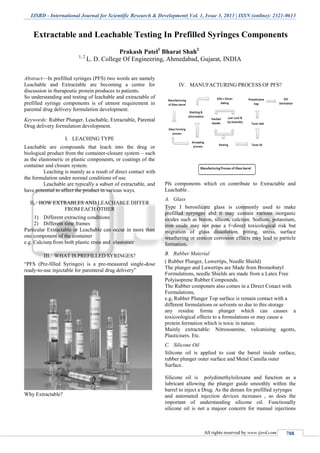
III. WHAT IS PREFILLED SYRINGES?
“PFS (Pre-filled Syringes) is a pre-measured single-dose
ready-to-use injectable for parenteral drug delivery”
Why Extractable?
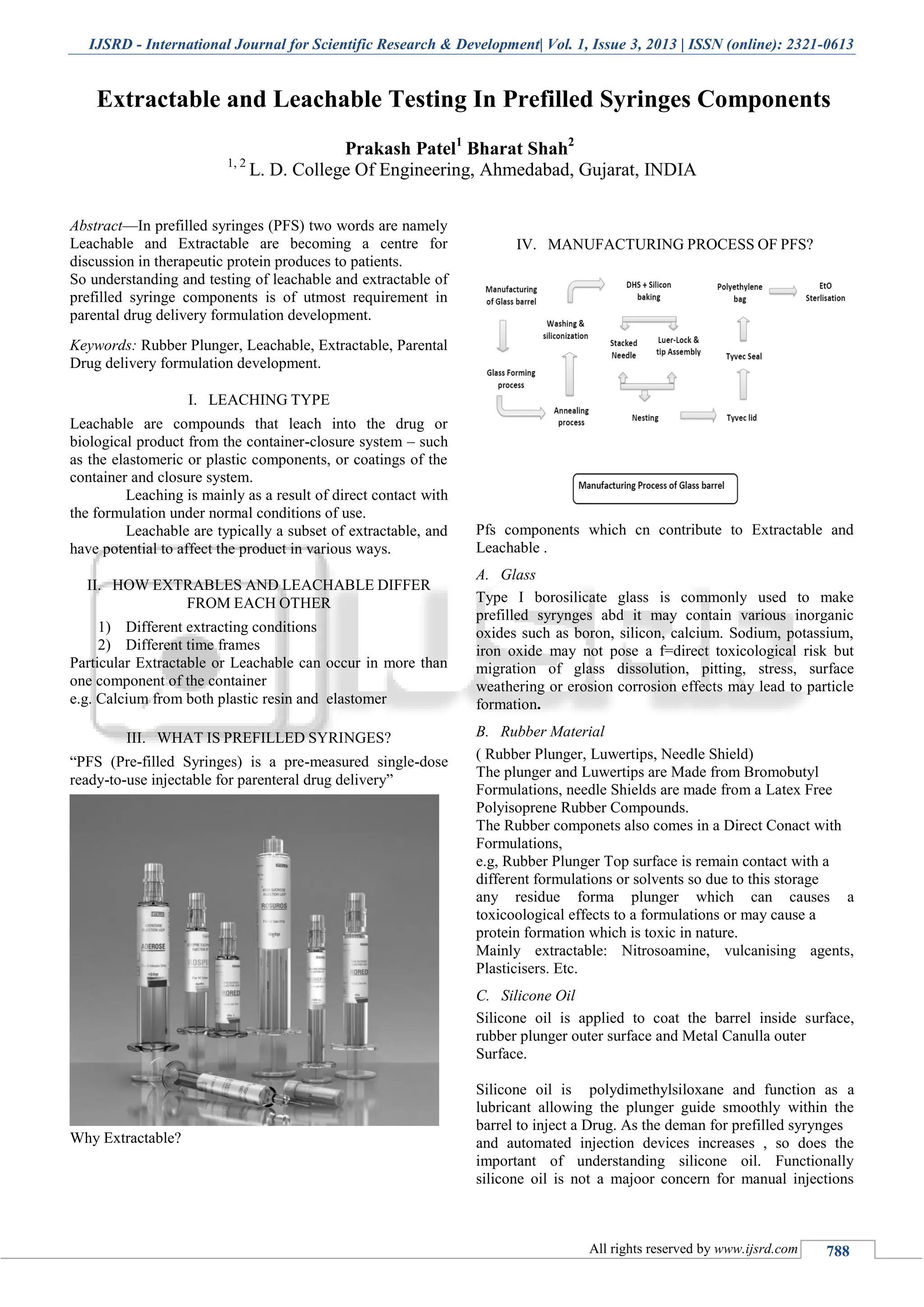
IV. MANUFACTURING PROCESS OF PFS?
Pfs components which cn contribute to Extractable and
Leachable .
A. Glass
Type I borosilicate glass is commonly used to make
prefilled syrynges abd it may contain various inorganic
oxides such as boron, silicon, calcium. Sodium, potassium,
iron oxide may not pose a f=direct toxicological risk but
migration of glass dissolution, pitting, stress, surface
weathering or erosion corrosion effects may lead to particle
formation.
B. Rubber Material
( Rubber Plunger, Luwertips, Needle Shield)
The plunger and Luwertips are Made from Bromobutyl
Formulations, needle Shields are made from a Latex Free
Polyisoprene Rubber Compounds.
The Rubber componets also comes in a Direct Conact with
Formulations,
e.g, Rubber Plunger Top surface is remain contact with a
different formulations or solvents so due to this storage
any residue forma plunger which can causes a
toxicoological effects to a formulations or may cause a
protein formation which is toxic in nature.
Mainly extractable: Nitrosoamine, vulcanising agents,
Plasticisers. Etc.
C. Silicone Oil
Silicone oil is applied to coat the barrel inside surface,
rubber plunger outer surface and Metal Canulla outer
Surface.
Silicone oil is polydimethylsiloxane and function as a
lubricant allowing the plunger guide smoothly within the
barrel to inject a Drug. As the deman for prefilled syrynges
and automated injection devices increases , so does the
important of understanding silicone oil. Functionally
silicone oil is not a majoor concern for manual injections
Extractable and Leachable Testing In Prefilled Syringes Components
(IJSRD/Vol. 1/Issue 3/2013/0096)
All rights reserved by www.ijsrd.com 789
since a nurse r a doctor is capble of applying the necesaary
forces to push the plunger to end point. However a spring
can provide a fixed amount of of forces and unanticipated
friction may cause the plunger to stall before complete drug
delivery.
Silicone oil is a inert insoluble in water it may
interact with in a formulation causing a protein
aggregation,droplets and particles
Ideally the silicone oil application process should
balance the need to minimise the quantity of silicone oil
also. The silicone oil distribution is non uniformely
distributed with least amount located near needle end of
syrynge.
D. Syrynge Pin-Tungsten Pin:
Lee obvious sources of PFS extractable are
contamination from tools that were used to manufacturer
and process syrynges. Glass syrynges are made from Cutting
and molding Glass tubing at high temprature. Heated glass
incontact with various processing tools like a Canulla Fix
sizes is made at more than 1,200 Degree C. now a tungsten
pin is used to make a size for Canulla capillary, and at 150
>c a tungsten metal comes in contact with air and it cinvert
as Oxide as white substance residue in the syrynges.
These residue may survive the syrynge washing
step and may contact the drug upon syrynge filling and
storage.
E. Hypodermic Needle
The attached hypodermic needle is made if stainess steel.
Inorganic metal is used in stainless steel formulation such as
Fe, Cr, Mn,Ni and Mo may Leach from a Syrynge.and may
be a toxic in nature.
V. ANALYTICAL TECHNIQUES FOR TESTING OF
EXTRACTABLE AND LEACHABLE
Analytical charactrerization and quantitation techniques
associated with organic and inorganic chemicals are
commonly used to analyse extractable/ leachable.
Gas chromatography mass spectrometry(GCMS), solid
phase micro extraction (SPME) – GCMS, liquid
chromatography (HPLC), and nuclear magnetic resonance
(NMR) spectrometry techinques are used to analyze unkown
organic extractable compounds. Inductively coupled plasma
mass spectrometry (ICPMS) can be used to identify and
quantitate inorganic metallic elements. Evaporative light
supplemental detection (ELSD) can be supplemental to
HPLC and suitable for oligomers/polymers and non-
chromophores molecule analysis.
VI. CONCLUSION
To sum up ,PFS components and residues from processing
tools may leach organic and inorgenic chemicals into
formulated drugs. Leachable information is often not readily
available from the syringe manuftacturer promoting drug
manufacturers to initiate extractable and leachable
investigation. Leachable from PFS may have contributed
safety concern related to protien aggrigation, particle
formation and toxicological risk factors. Identifying
extractable and leachable provides key information enabling
safety assesment that addresses toxicology and drug quality
impact for evaluating PFS
REFERENCES
[1] Novel Drug Delivery System: “Extractable and
Leachable study in Drug Delivery System”
Report2005,Autumn/Winter,47-49.
[2] CDER/CBER Guidance for Industry: conainer Closure
System for Packaging Human Drugs.and Biologics-
Chemistry, MAnufacuring and Controls
Documentations. US Food And Drug Adminstration:
Rockville, MD, April 1999: www.
FDA.Gov/Downloads/Drugs/Guidance C Ompliance
Regulatory Information/Guidances/UCM07055.Pdf.
[3] Jenke D.R. Evaluation of Model Solvent system for
assessing the accumulation of Container Extractable in
Drug Formulations. J. Pharm. Sci. 2001,224 (1-2).51-60
[4] Jenke ,D.R. Linking Extractable and Leachables in
Container/closure applications.PDA J.Pharm
,Sci.Technol.2005.59 (4),265-281.
[5] wang, Q, selectionn of Analytical Techniques for
Pharmaceutical leachables studies. Am Pharm, Rev.
2005,8(6) . 38-44.
[6] Wakankar, A,A: Wang, J.Y: Canova-Davis,E; Ma S;
Schmalzing, D; Griego,J: Mibly,S; Martin-Moe, S; on
Developing a Process for Cundctiong Extractable and
leachable Assesment Of Components Used For Storage
of Bio-Pharmaceutical . J.Pharm Sci. 2010, 99(5) 2209-
2218.
[7] Nashed. Y: Torraca, G; Liu, D: Fujimori, K:Zhang, Z;
Wen, Z; Lee,H, Particle in a Glass Syrynges:
extractable /Leachable Cas Study.”PDA J.Pharm. Sci.
Tech.2010,64 242-248.
[8] Jiang , y; Nashed-Samuel. Y: Li,C.Liu, W.: Pollastrinji,
J; Mallard, D; Wen. ZQ: Fujimori. K: Pallitto, M:
Donahue,L:Chu,G:Torraca,G:Vance,A:Mire-
sluis,T:Freund,E:Davis,J:NAhrhi,L.J.Pharm
Sci.2009,98 9(12),4695-710
[9] Hung G.W. Nunez L.J.: Autian J. Correlation of
Kinematic Parameters and thermal behaviour of
segmented polyurathane elastomer with biological
response. J Pharm.Sci.1975.64,1492—1497.
[10]Danielle L. Advanced Innovations on a New Generation
of Prefilled syrynges. Cedar Cottage, New Timber
Place Lane, west Sussex, BN 6, United Kingdom: ON
drug Delivery Ltd. 2010
[11]Walther, M: Rupertus, V: Seenmann, C; Bechcht, J;
Hormes, R; Swift, R.W. Pharmaceutical Vials With
Extremely High Chemical Inertness. PDA. J. Pharm,
Sci/ Technol, 2002 , 56( 3), 124-129.
[12]Jones L.S. Kafumann A. and Middaugh, C.R. Silicone
Oil Is Induced Aggregation of Proteins. J. Pharm
Sci.2005,94(4).918-927.
[13]Thirumangaathu , R. Krishanan, S. Ricci, M.S. Brems,
D. N.Randolph, T.W. and Carpenter, J.F.Silicone Oil-
and Agitation- induced Aggregation of a Monolcional
Antibody in Aqueous Solution. J. Pharm,Sci.
2009,98(9)
[14]Lee. H; nashed- saumel, Y: Fujimori,k: Liu, D; Perez,
L.Tungsten Leaching from Prefilled Syrynges in
Extractable and Leachable Testing In Prefilled Syringes Components
(IJSRD/Vol. 1/Issue 3/2013/0096)
All rights reserved by www.ijsrd.com 790
Therapeutic Biologic Protein Products. Am.Pharm,
Rev.2006,9( 6) 3167-3181.
[15]Deman ,J.M. Principles of food chemistry 3 rd Edition.
(1999) Aspen Publisher. ISBN: 0-8342-1234-X,131-
132.
[16]Thompson, I : “New-Generation Autoinjector
Completing the scale of Convenience for self-
injection.”

Extractable and Leachable Testing In Prefilled Syringes Components

  • 1.
    IJSRD - InternationalJournal for Scientific Research & Development| Vol. 1, Issue 3, 2013 | ISSN (online): 2321-0613 All rights reserved by www.ijsrd.com 788 Extractable and Leachable Testing In Prefilled Syringes Components Prakash Patel1 Bharat Shah2 1, 2 L. D. College Of Engineering, Ahmedabad, Gujarat, INDIA Abstract—In prefilled syringes (PFS) two words are namely Leachable and Extractable are becoming a centre for discussion in therapeutic protein produces to patients. So understanding and testing of leachable and extractable of prefilled syringe components is of utmost requirement in parental drug delivery formulation development. Keywords: Rubber Plunger, Leachable, Extractable, Parental Drug delivery formulation development. I. LEACHING TYPE Leachable are compounds that leach into the drug or biological product from the container-closure system – such as the elastomeric or plastic components, or coatings of the container and closure system. Leaching is mainly as a result of direct contact with the formulation under normal conditions of use. Leachable are typically a subset of extractable, and have potential to affect the product in various ways. II. HOW EXTRABLES AND LEACHABLE DIFFER FROM EACH OTHER 1) Different extracting conditions 2) Different time frames Particular Extractable or Leachable can occur in more than one component of the container e.g. Calcium from both plastic resin and elastomer III. WHAT IS PREFILLED SYRINGES? “PFS (Pre-filled Syringes) is a pre-measured single-dose ready-to-use injectable for parenteral drug delivery” Why Extractable? IV. MANUFACTURING PROCESS OF PFS? Pfs components which cn contribute to Extractable and Leachable . A. Glass Type I borosilicate glass is commonly used to make prefilled syrynges abd it may contain various inorganic oxides such as boron, silicon, calcium. Sodium, potassium, iron oxide may not pose a f=direct toxicological risk but migration of glass dissolution, pitting, stress, surface weathering or erosion corrosion effects may lead to particle formation. B. Rubber Material ( Rubber Plunger, Luwertips, Needle Shield) The plunger and Luwertips are Made from Bromobutyl Formulations, needle Shields are made from a Latex Free Polyisoprene Rubber Compounds. The Rubber componets also comes in a Direct Conact with Formulations, e.g, Rubber Plunger Top surface is remain contact with a different formulations or solvents so due to this storage any residue forma plunger which can causes a toxicoological effects to a formulations or may cause a protein formation which is toxic in nature. Mainly extractable: Nitrosoamine, vulcanising agents, Plasticisers. Etc. C. Silicone Oil Silicone oil is applied to coat the barrel inside surface, rubber plunger outer surface and Metal Canulla outer Surface. Silicone oil is polydimethylsiloxane and function as a lubricant allowing the plunger guide smoothly within the barrel to inject a Drug. As the deman for prefilled syrynges and automated injection devices increases , so does the important of understanding silicone oil. Functionally silicone oil is not a majoor concern for manual injections
  • 2.
    Extractable and LeachableTesting In Prefilled Syringes Components (IJSRD/Vol. 1/Issue 3/2013/0096) All rights reserved by www.ijsrd.com 789 since a nurse r a doctor is capble of applying the necesaary forces to push the plunger to end point. However a spring can provide a fixed amount of of forces and unanticipated friction may cause the plunger to stall before complete drug delivery. Silicone oil is a inert insoluble in water it may interact with in a formulation causing a protein aggregation,droplets and particles Ideally the silicone oil application process should balance the need to minimise the quantity of silicone oil also. The silicone oil distribution is non uniformely distributed with least amount located near needle end of syrynge. D. Syrynge Pin-Tungsten Pin: Lee obvious sources of PFS extractable are contamination from tools that were used to manufacturer and process syrynges. Glass syrynges are made from Cutting and molding Glass tubing at high temprature. Heated glass incontact with various processing tools like a Canulla Fix sizes is made at more than 1,200 Degree C. now a tungsten pin is used to make a size for Canulla capillary, and at 150 >c a tungsten metal comes in contact with air and it cinvert as Oxide as white substance residue in the syrynges. These residue may survive the syrynge washing step and may contact the drug upon syrynge filling and storage. E. Hypodermic Needle The attached hypodermic needle is made if stainess steel. Inorganic metal is used in stainless steel formulation such as Fe, Cr, Mn,Ni and Mo may Leach from a Syrynge.and may be a toxic in nature. V. ANALYTICAL TECHNIQUES FOR TESTING OF EXTRACTABLE AND LEACHABLE Analytical charactrerization and quantitation techniques associated with organic and inorganic chemicals are commonly used to analyse extractable/ leachable. Gas chromatography mass spectrometry(GCMS), solid phase micro extraction (SPME) – GCMS, liquid chromatography (HPLC), and nuclear magnetic resonance (NMR) spectrometry techinques are used to analyze unkown organic extractable compounds. Inductively coupled plasma mass spectrometry (ICPMS) can be used to identify and quantitate inorganic metallic elements. Evaporative light supplemental detection (ELSD) can be supplemental to HPLC and suitable for oligomers/polymers and non- chromophores molecule analysis. VI. CONCLUSION To sum up ,PFS components and residues from processing tools may leach organic and inorgenic chemicals into formulated drugs. Leachable information is often not readily available from the syringe manuftacturer promoting drug manufacturers to initiate extractable and leachable investigation. Leachable from PFS may have contributed safety concern related to protien aggrigation, particle formation and toxicological risk factors. Identifying extractable and leachable provides key information enabling safety assesment that addresses toxicology and drug quality impact for evaluating PFS REFERENCES [1] Novel Drug Delivery System: “Extractable and Leachable study in Drug Delivery System” Report2005,Autumn/Winter,47-49. [2] CDER/CBER Guidance for Industry: conainer Closure System for Packaging Human Drugs.and Biologics- Chemistry, MAnufacuring and Controls Documentations. US Food And Drug Adminstration: Rockville, MD, April 1999: www. FDA.Gov/Downloads/Drugs/Guidance C Ompliance Regulatory Information/Guidances/UCM07055.Pdf. [3] Jenke D.R. Evaluation of Model Solvent system for assessing the accumulation of Container Extractable in Drug Formulations. J. Pharm. Sci. 2001,224 (1-2).51-60 [4] Jenke ,D.R. Linking Extractable and Leachables in Container/closure applications.PDA J.Pharm ,Sci.Technol.2005.59 (4),265-281. [5] wang, Q, selectionn of Analytical Techniques for Pharmaceutical leachables studies. Am Pharm, Rev. 2005,8(6) . 38-44. [6] Wakankar, A,A: Wang, J.Y: Canova-Davis,E; Ma S; Schmalzing, D; Griego,J: Mibly,S; Martin-Moe, S; on Developing a Process for Cundctiong Extractable and leachable Assesment Of Components Used For Storage of Bio-Pharmaceutical . J.Pharm Sci. 2010, 99(5) 2209- 2218. [7] Nashed. Y: Torraca, G; Liu, D: Fujimori, K:Zhang, Z; Wen, Z; Lee,H, Particle in a Glass Syrynges: extractable /Leachable Cas Study.”PDA J.Pharm. Sci. Tech.2010,64 242-248. [8] Jiang , y; Nashed-Samuel. Y: Li,C.Liu, W.: Pollastrinji, J; Mallard, D; Wen. ZQ: Fujimori. K: Pallitto, M: Donahue,L:Chu,G:Torraca,G:Vance,A:Mire- sluis,T:Freund,E:Davis,J:NAhrhi,L.J.Pharm Sci.2009,98 9(12),4695-710 [9] Hung G.W. Nunez L.J.: Autian J. Correlation of Kinematic Parameters and thermal behaviour of segmented polyurathane elastomer with biological response. J Pharm.Sci.1975.64,1492—1497. [10]Danielle L. Advanced Innovations on a New Generation of Prefilled syrynges. Cedar Cottage, New Timber Place Lane, west Sussex, BN 6, United Kingdom: ON drug Delivery Ltd. 2010 [11]Walther, M: Rupertus, V: Seenmann, C; Bechcht, J; Hormes, R; Swift, R.W. Pharmaceutical Vials With Extremely High Chemical Inertness. PDA. J. Pharm, Sci/ Technol, 2002 , 56( 3), 124-129. [12]Jones L.S. Kafumann A. and Middaugh, C.R. Silicone Oil Is Induced Aggregation of Proteins. J. Pharm Sci.2005,94(4).918-927. [13]Thirumangaathu , R. Krishanan, S. Ricci, M.S. Brems, D. N.Randolph, T.W. and Carpenter, J.F.Silicone Oil- and Agitation- induced Aggregation of a Monolcional Antibody in Aqueous Solution. J. Pharm,Sci. 2009,98(9) [14]Lee. H; nashed- saumel, Y: Fujimori,k: Liu, D; Perez, L.Tungsten Leaching from Prefilled Syrynges in
  • 3.
    Extractable and LeachableTesting In Prefilled Syringes Components (IJSRD/Vol. 1/Issue 3/2013/0096) All rights reserved by www.ijsrd.com 790 Therapeutic Biologic Protein Products. Am.Pharm, Rev.2006,9( 6) 3167-3181. [15]Deman ,J.M. Principles of food chemistry 3 rd Edition. (1999) Aspen Publisher. ISBN: 0-8342-1234-X,131- 132. [16]Thompson, I : “New-Generation Autoinjector Completing the scale of Convenience for self- injection.”