Context and
external validity in
impact evaluation
Michael-Paul James
Student led discussion on
Beyond ‘context matters’: Context and external validity in impact evaluation
Martin J. Williams
In service of PPOL 8630: Advanced Program Evaluation
Dr. Jacqueline Chattopadhyay
2
Threats
3
Internal Validity
✘ History
✘ Selection
✘ Maturation
✘ Statistical Regression
✘ Mortality
✘ Testing Effects
✘ Instrumentation
✘ Contamination
Different
People
Different
Places
Across
Different
Times
ExternalValidity?
ExternalValidity?
External Validity
The extent to which one can apply the findings of a
scientific study to the world at large.
4
Can sample be generalized to population?
5
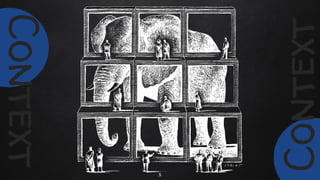
Context
Context
The Problem
✘ Constructability
○ What is a framework for understanding how context matters for policy
effectiveness?
✘ Generalizability
○ Will the impacts of a policy evaluated in a specific context be the same
in other, unspecified, contexts?
✘ Applicability
○ How do we apply evidence gathered from another context to our
specific context?
6
?
Existing Methods to Testing External Validity
✘ Various combinations of meta-analysis
○ A statistical process that synthesizes findings from many studies
✘ Extrapolation based on structural modelling
○ Estimating while assuming that existing trends will continue
✘ Exploiting selection and non-compliance within RCTs
○ Identifies a range of heterogeneous treatment effects.
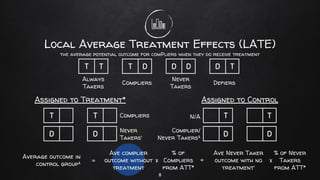
○ Local Average Treatment Effects (LATE)
✘ Principal stratum analysis
○ Compute causal effects only within identified strata (race, gender, etc)
✘ Reweighting based on observable characteristics to make predictions
about a policy's effectiveness in other contexts
7
Local Average Treatment Effects (LATE)
the average potential outcome for comPliers when they do receive treatment
T T
8
T D D D D T
Always
Takers
Compliers
Never
Takers
Defiers
Assigned to Treatment* Assigned to Control
T T
D D
T T
D D
Compliers
Never
Takers¹
Complier/
Never Takers²
N/A
Average outcome in
control group²
Ave complier
outcome without
treatment
% of
Compliers
from ATT*
Ave Never Taker
outcome with no
treatment¹
% of Never
Takers
from ATT*
= x + x
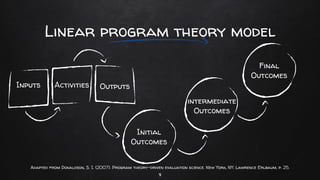
Linear program theory model
9
Inputs Activities Outputs
Initial
Outcomes
intermediate
Outcomes
Final
Outcomes
Adapted from Donaldson, S. I. (2007). Program theory-driven evaluation science. New York, NY: Lawrence Erlbaum, p. 25.
Mechanism Mapping Method
1. Map out the policies intended Theory of Change
2. Map the contextual assumptions that must hold for the Theory of
Change to work
3. Map the actual characteristics of the context and compare them to
the assumptions
4. Adapt the policy to eliminate these mismatches between
assumptions and characteristics
10
Funds,
potential
workers
Procure food,
hire and train
workers
Gov’t provides
supplies, food,
and nutrition
advice to
mothers
Mother’s
nutrition
awareness
improves
Mothers
decide to use
food for selves
and infants
Mother and
infant
nutrition
improves
Funds will be
dedicated and
suitable
workers
available
Adequate
procurement,
logistics,
training
processes
Food and
advice
delivered to
target
mothers in
timely fashion
Mothers able
to attend
sessions, trust
advice
Mothers
control
household
food
allocation
More food will
improve
nutrition
Funds will be
dedicated and
suitable
workers
available
Adequate
procurement,
logistics,
training
processes
Food and
advice
delivered to
target
mothers in
timely fashion
Mothers able
to attend
sessions, trust
advice
Mothers do
not control
household
food
allocation
More food will
improve
nutrition
11
Inputs Activities Outputs
Intermediate
Outcomes 1
Intermediate
Outcomes 2
Final
Outcomes
Theoryof
Change
Contextual
Assumptions
Actual
Context
MechanismMappingExample Tamil Nadu Integrated Nutrition Programme v. Bangladesh Integrated Nutrition Programme
Funds,
potential
workers + extra
funds for home
visits
Procure food,
hire and train
workers +
Different types
of workers for
home visits
Gov’t provides
supplies, food,
and nutrition
advice to
mothers,
husbands, and
mothers in-law
through home
visits
Mother’s,
husband’s, and
mothers
in-law’s
nutrition
awareness
improves
Mothers,
husbands, and
mothers in-law
decide to use
food for selves
and infants
Mother and
infant nutrition
improves
Funds will be
dedicated and
suitable
workers
available +
Funds available
for home visit
cost
Adequate
procurement,
logistics,
training
processes +
Suitable home
visit workers
hired
Food and
advice
delivered to
target mothers
in timely
fashion +
Homes are
accessible for
visits
Mothers able
to attend
sessions +
Husbands &
Mothers in-law
Reached
through home
Visits, trust
advice
Better
awareness by
mothers,
husbands, and
mothers in-law
will improve
household food
allocation
More food will
improve
nutrition
12
Inputs Activities Outputs
Intermediate
Outcomes 1
Intermediate
Outcomes 2
Final
Outcomes
AdaptedTheoryof
Change
AdaptedContextual
Assumptions
MechanismMappingExample Tamil Nadu Integrated Nutrition Programme v. Bangladesh Integrated Nutrition Programme
1.
Mechanism Mapping is arguably already informally
executed in the rational process by practitioners and
theorists. What is the value add of the additional step of
charting it?
13
2.
Mechanism Mapping greatly oversimplifies behavior.
What are some of the risks in the process of
simplification?
14
Original
Target
Population
New
Target
Population
Total Population
3.
Mechanism Mapping visualizes behavior through a linear
theory of change. What are some of the risks of thinking
about behavioral change linearly?
15
activities outputs outcomeinputs
4.
Mechanism Mapping relies on judgement and
predispositions. What are some of the dangers or
potential downfalls of personal judgements in
anticipating inputs, activities, outputs, and outcomes?
16
5.
Mechanism Mapping is an intuitive technique for
analyzing the differences between similar programs
exhibiting different results. Is there a value in mapping
when only a single study is available?
17
You are Amazing!
Ask me all the questions you desire. I will do my
best to answer honestly and strive to grasp
your intent and creativity.
18

External Validity and Mechanism Mapping

  • 1.
    Context and external validityin impact evaluation
  • 2.
    Michael-Paul James Student leddiscussion on Beyond ‘context matters’: Context and external validity in impact evaluation Martin J. Williams In service of PPOL 8630: Advanced Program Evaluation Dr. Jacqueline Chattopadhyay 2
  • 3.
    Threats 3 Internal Validity ✘ History ✘Selection ✘ Maturation ✘ Statistical Regression ✘ Mortality ✘ Testing Effects ✘ Instrumentation ✘ Contamination Different People Different Places Across Different Times ExternalValidity? ExternalValidity?
  • 4.
    External Validity The extentto which one can apply the findings of a scientific study to the world at large. 4 Can sample be generalized to population?
  • 5.
  • 6.
    The Problem ✘ Constructability ○What is a framework for understanding how context matters for policy effectiveness? ✘ Generalizability ○ Will the impacts of a policy evaluated in a specific context be the same in other, unspecified, contexts? ✘ Applicability ○ How do we apply evidence gathered from another context to our specific context? 6 ?
  • 7.
    Existing Methods toTesting External Validity ✘ Various combinations of meta-analysis ○ A statistical process that synthesizes findings from many studies ✘ Extrapolation based on structural modelling ○ Estimating while assuming that existing trends will continue ✘ Exploiting selection and non-compliance within RCTs ○ Identifies a range of heterogeneous treatment effects. ○ Local Average Treatment Effects (LATE) ✘ Principal stratum analysis ○ Compute causal effects only within identified strata (race, gender, etc) ✘ Reweighting based on observable characteristics to make predictions about a policy's effectiveness in other contexts 7
  • 8.
    Local Average TreatmentEffects (LATE) the average potential outcome for comPliers when they do receive treatment T T 8 T D D D D T Always Takers Compliers Never Takers Defiers Assigned to Treatment* Assigned to Control T T D D T T D D Compliers Never Takers¹ Complier/ Never Takers² N/A Average outcome in control group² Ave complier outcome without treatment % of Compliers from ATT* Ave Never Taker outcome with no treatment¹ % of Never Takers from ATT* = x + x
  • 9.
    Linear program theorymodel 9 Inputs Activities Outputs Initial Outcomes intermediate Outcomes Final Outcomes Adapted from Donaldson, S. I. (2007). Program theory-driven evaluation science. New York, NY: Lawrence Erlbaum, p. 25.
  • 10.
    Mechanism Mapping Method 1.Map out the policies intended Theory of Change 2. Map the contextual assumptions that must hold for the Theory of Change to work 3. Map the actual characteristics of the context and compare them to the assumptions 4. Adapt the policy to eliminate these mismatches between assumptions and characteristics 10
  • 11.
    Funds, potential workers Procure food, hire andtrain workers Gov’t provides supplies, food, and nutrition advice to mothers Mother’s nutrition awareness improves Mothers decide to use food for selves and infants Mother and infant nutrition improves Funds will be dedicated and suitable workers available Adequate procurement, logistics, training processes Food and advice delivered to target mothers in timely fashion Mothers able to attend sessions, trust advice Mothers control household food allocation More food will improve nutrition Funds will be dedicated and suitable workers available Adequate procurement, logistics, training processes Food and advice delivered to target mothers in timely fashion Mothers able to attend sessions, trust advice Mothers do not control household food allocation More food will improve nutrition 11 Inputs Activities Outputs Intermediate Outcomes 1 Intermediate Outcomes 2 Final Outcomes Theoryof Change Contextual Assumptions Actual Context MechanismMappingExample Tamil Nadu Integrated Nutrition Programme v. Bangladesh Integrated Nutrition Programme
  • 12.
    Funds, potential workers + extra fundsfor home visits Procure food, hire and train workers + Different types of workers for home visits Gov’t provides supplies, food, and nutrition advice to mothers, husbands, and mothers in-law through home visits Mother’s, husband’s, and mothers in-law’s nutrition awareness improves Mothers, husbands, and mothers in-law decide to use food for selves and infants Mother and infant nutrition improves Funds will be dedicated and suitable workers available + Funds available for home visit cost Adequate procurement, logistics, training processes + Suitable home visit workers hired Food and advice delivered to target mothers in timely fashion + Homes are accessible for visits Mothers able to attend sessions + Husbands & Mothers in-law Reached through home Visits, trust advice Better awareness by mothers, husbands, and mothers in-law will improve household food allocation More food will improve nutrition 12 Inputs Activities Outputs Intermediate Outcomes 1 Intermediate Outcomes 2 Final Outcomes AdaptedTheoryof Change AdaptedContextual Assumptions MechanismMappingExample Tamil Nadu Integrated Nutrition Programme v. Bangladesh Integrated Nutrition Programme
  • 13.
    1. Mechanism Mapping isarguably already informally executed in the rational process by practitioners and theorists. What is the value add of the additional step of charting it? 13
  • 14.
    2. Mechanism Mapping greatlyoversimplifies behavior. What are some of the risks in the process of simplification? 14 Original Target Population New Target Population Total Population
  • 15.
    3. Mechanism Mapping visualizesbehavior through a linear theory of change. What are some of the risks of thinking about behavioral change linearly? 15 activities outputs outcomeinputs
  • 16.
    4. Mechanism Mapping relieson judgement and predispositions. What are some of the dangers or potential downfalls of personal judgements in anticipating inputs, activities, outputs, and outcomes? 16
  • 17.
    5. Mechanism Mapping isan intuitive technique for analyzing the differences between similar programs exhibiting different results. Is there a value in mapping when only a single study is available? 17
  • 18.
    You are Amazing! Askme all the questions you desire. I will do my best to answer honestly and strive to grasp your intent and creativity. 18