Downloaded 17 times
![Clin Child Fam Psychol Rev
glasses occasionally. When the social isolation pre- Theoretical Taxonomy of Kernels
scription was applied, glasses throwing decreased
from about twice per day to zero. But the hospital Although simple enumeration of kernels may support
staff doubted that it was due to the procedure, effective practice, their contribution may be more sub-
because Dicky didn’t seem to mind being taken to his stantial if we organize them within a theoretical framework
room; he just rocked in his rocking chair and hum- to delineate the key influences on behavior. Such a frame-
med to himself. Because throwing glasses was both work would facilitate generating new kernels and could
less serious and more reliably measured than tan- point to overlooked procedures for influencing behavior.
trums, Wolf agreed to discontinue the procedure— Kernels are understandable in terms of the operant
and glasses throwing soon increased to the previous behavior of biological organisms, viewed within a
level. The social isolation procedure was reinstated, developmental and evolutionary perspective. Human
and glasses throwing decreased again to zero. behavior—including verbal, cognitive, and emotional
(pp. 281–282) functioning—has developed over time as a function of the
biological capacities of the organism and the consequences
Thus was born timeout, shown since in hundreds of
to behavior. Human behavioral tendencies are adaptive
studies to reduce the frequency of a vast range of behav-
functions of current situations and a history of consequences
iors. It is a staple of nearly every evidence-based
for behaving in similar situations (e.g., Biglan 1995).
prevention program for parenting (e.g., Incredible Years
Kernels involve one of four primary processes. Many
[Webster-Stratton and Reid 2007]; Triple P [Sanders and
involve consequation of behavior—the presentation or
Markie-Dadds 1996]; Parent Management Training
removal of reinforcing or aversive consequences (Biglan
[Forgatch et al. 2005a, b]). It is also part of popular culture.
1995, Chap. 3). Others involve an antecedent stimulus
Shows like Nanny 911 display its use; websites with advice
affecting motivation to behave due to a history of conse-
to parents describe it (e.g., http://www.thelaboroflove.com/
quences for responding to that stimulus (e.g., teachers’ use of
forum/quality/timeout.html). Although there is no popula-
standard signals to prompt students to sit down; Jason, Neal,
tion-based data on the prevalence of families and schools
and Marinakis 1985; Wasserman 1977). A third type pri-
using timeout, it seems that in many areas, timeout is the
marily involves altering the relations that people derive
normative replacement for harsh methods of discipline.
among verbal stimuli in ways that affect motivation. For
example, to elicit a public commitment to engage in a
The Example of Nasal Breathing or ‘‘Doing Turtle’’ behavior (Chassin et al. 1990), a person feels prompted to
associate a network of consequences (such as others’
Humans are amazing at noticing the effects of small approval) with engaging in the behavior and other conse-
physiological interventions that influence human behavior. quences with not engaging in the behavior (e.g.,
Grandmothers and experienced teachers, for example, disapproval). Each of these three types of kernels involves
often tell children who are emotionally overwrought and ways in which a person’s social environment affects his or
hyperventilating to close their mouths and breathe through her behavior. In a sense, kernels provide prescriptions for
the nose while exhaling through the mouth. This strategy how the social environment can show more support of human
is taught formally in such evidence-based prevention development.
programs as the Incredible Years and PATHS (Positive A fourth type of kernel alters a biological function of the
Alternative Thinking Skills), and even has a child-friendly organisms in ways that affect behavior. An example is sup-
name and story of ‘‘doing turtle’’ (Robin et al. 1976). The plementation of diets with omega-3 fatty acid (Haag 2003).
strategy is based in empirical observations of the rela- Indeed, any pharmacological agent that affects behavior
tionship among breathing patterns, physiological would fall into this category, although we stress the impor-
measures, behavior, and children’s emotional states tance of distinguishing prescription medications from non-
(McDonnell and Bowden 1989; Naveen et al. 1997; Perna prescription, scientifically proven kernels that individuals or
et al. 2002; Pine et al. 1998; Telles et al. 1997; Zaich- organizations might choose to use without a prescription.
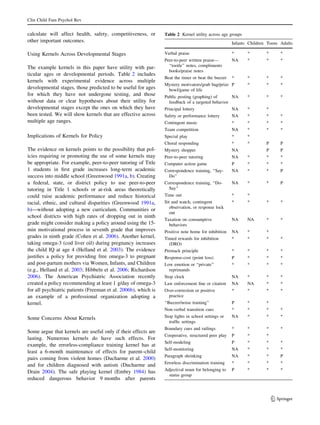
kowsky et al. 1986). This kernel also illustrates how a Table 1 presents a list of kernels organized according to
simple strategy might be independently discovered and this theoretical framework. We categorize each kernel in
tested from very different theoretical perspectives (e.g., terms of the primary mechanism by which it affects
pediatric medical practice, basic research, child psychol- behavior, although clearly many kernels involve more than
ogy, prevention, parenting, and even alternative bodywork one process. Space precludes a complete review of the
such as yoga). Like most kernels, it can be used and empirical evidence for each kernel, but we cite all exper-
proven on its own, or incorporated in programmatic imental evaluations done for each kernel along with the
efforts. types of experimental evaluations that have occurred. In
123](https://image.slidesharecdn.com/embry-biglan-kernels-2008-published-8-20-08fulltext-101018124014-phpapp01/85/Embry-Biglan-Evidence-Based-Kernels-Review-paper-2008-5-320.jpg)
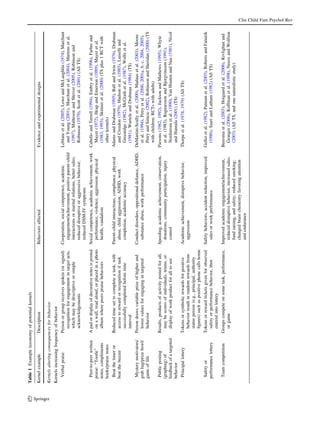
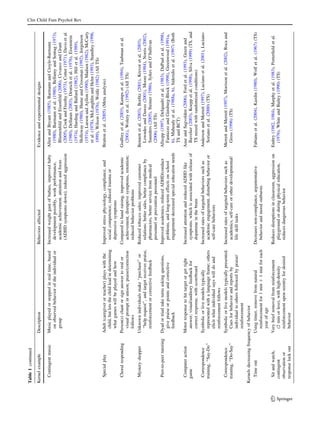
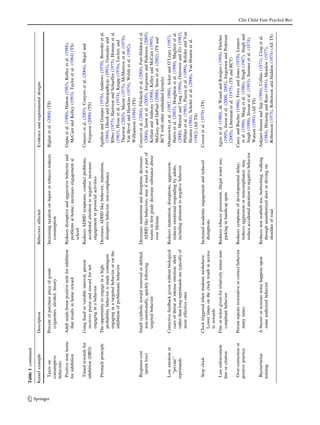
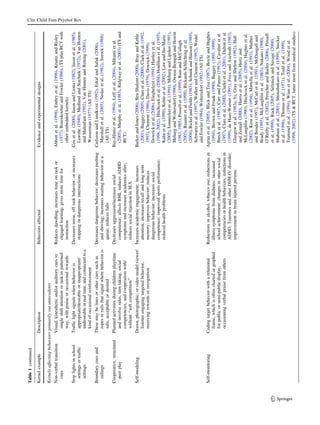
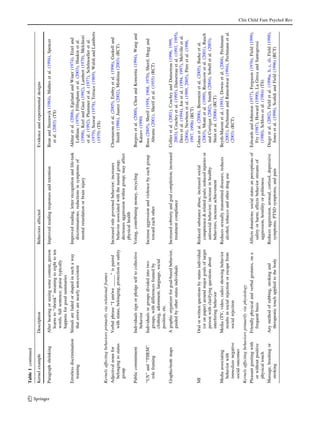
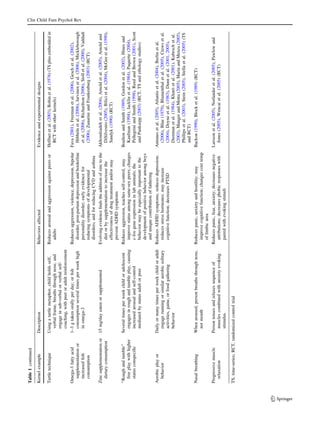
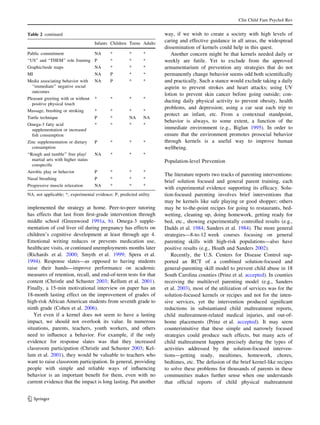
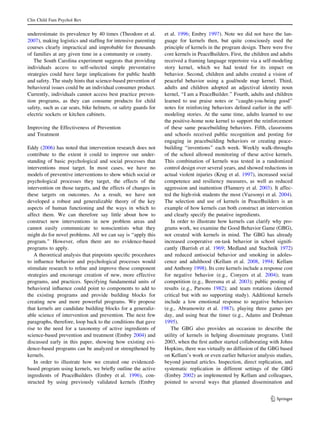
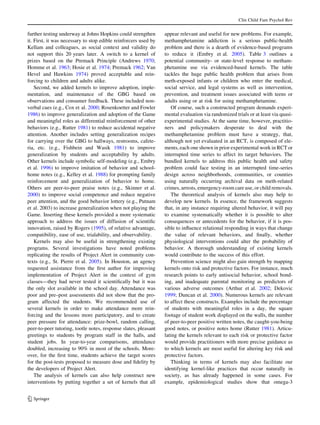
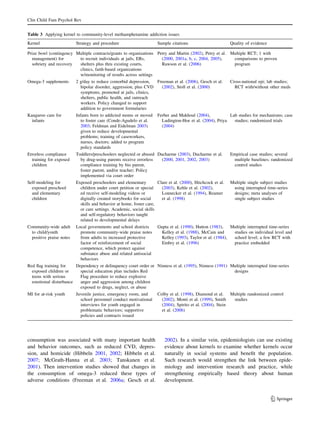

This article discusses evidence-based kernels, which are fundamental units of behavioral influence identified as effective in prevention and treatment for children and families. Kernels are defined as indivisible behavioral strategies shown through experimental analysis to reliably affect specific behaviors, with the potential to enhance intervention effectiveness. The authors analyze 52 kernels and emphasize the importance of understanding these elements to improve prevention strategies and address limitations of existing programs.


![[International] Improving the educational achievement of young people in out-...](https://cdn.slidesharecdn.com/ss_thumbnails/13-24aug2012dillandflynn-120812191750-phpapp01-thumbnail.jpg?width=640&height=640&fit=bounds)


![Nick Axford - evidence-based prevention [March 7 ADEPIS seminar]](https://cdn.slidesharecdn.com/ss_thumbnails/namentorukliverpool7thmarch2016-160316151401-thumbnail.jpg?width=640&height=640&fit=bounds)


