
How qualitative research
contributes to evaluation
Professor Alicia O’Cathain
ScHARR University of Sheffield
22 June 2015
What is qualitative research?
• Normal in evaluation
• Understanding not
measuring
• Set of methods
– Focus groups
– Semi-structured or in
depth interviews
– Non-participant
observation
– Diaries
What is evaluation?
• Researcher led
evaluation
• Policy evaluation
Researcher-led
• MRC Framework developing
an evaluating complex
interventions
• ACTIF programme
– 5 years
– RCT
– Qualitative at each phase
O’Cathain A, Thomas KJ, Drabble SJ, Rudolph A, Hewison J. What can
qualitative research do for randomised controlled trials? A systematic
mapping review. BMJ Open 2013;3:e002889
Intervention
Trial design
and conduct
Outcomes
Measures
Health
conditions
Intervention n=254
Develop
n=48
Describe it
n=10
Understand
how it works
n=23
Value and
benefits
n=42Acceptability
in principle
n=32
Feasibility and
acceptability
n=83
Fidelity,
reach and
dose n=12
Implementation in
real world n=4
Trial design and conduct n=54
Recruitment
Diversity
Participation in
trials
Acceptability in
principle
Acceptability in
practice
Ethics/informed
consent
Adapting to local
circumstances
Impact on staff,
researchers, patients
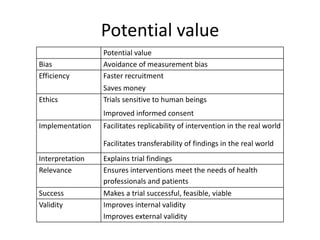
Potential value
Potential value
Bias Avoidance of measurement bias
Efficiency Faster recruitment
Saves money
Ethics Trials sensitive to human beings
Improved informed consent
Implementation Facilitates replicability of intervention in the real world
Facilitates transferability of findings in the real world
Interpretation Explains trial findings
Relevance Ensures interventions meet the needs of health
professionals and patients
Success Makes a trial successful, feasible, viable
Validity Improves internal validity
Improves external validity
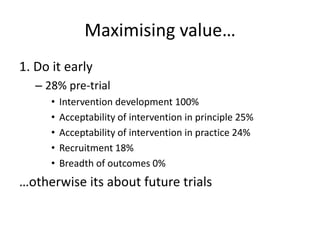
Maximising value…
1. Do it early
– 28% pre-trial
• Intervention development 100%
• Acceptability of intervention in principle 25%
• Acceptability of intervention in practice 24%
• Recruitment 18%
• Breadth of outcomes 0%
…otherwise its about future trials
2. Publish learning for specific trial or future trials
3. Think beyond interviews: non-participant
observation
4. Try iterative or dynamic or participatory
approaches at feasibility phase
5. Not just complex interventions
• 38% of 104 data extracted were drugs or devices
6. Think about the range of work
Problems with quantitative only
• Null RCTs….explain findings
(context, mechanisms of
action, implementation)
• Failed trials….prevent this at
pilot stage
• It works but what is ‘it’?
…..qualitative can fix
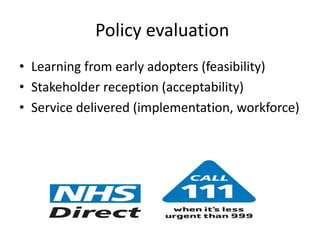
Policy evaluation
• Learning from early adopters (feasibility)
• Stakeholder reception (acceptability)
• Service delivered (implementation, workforce)
Useful but challenges remain
– Fast evaluation
– When to evaluate
– Moving target
– Replacement of difficult-to-measure outcomes
with understanding of processes
Conclusions
• Useful contribution no matter what type of
evaluation – essential due to complexity
• Can help to fix problems faced in researcher-
led evaluation
• Challenges in policy evaluation need reflection

Alicia O' Cathain: qualitative research and evaluation

  • 1.
    How qualitative research contributesto evaluation Professor Alicia O’Cathain ScHARR University of Sheffield 22 June 2015
  • 2.
    What is qualitativeresearch? • Normal in evaluation • Understanding not measuring • Set of methods – Focus groups – Semi-structured or in depth interviews – Non-participant observation – Diaries
  • 3.
    What is evaluation? •Researcher led evaluation • Policy evaluation
  • 4.
    Researcher-led • MRC Frameworkdeveloping an evaluating complex interventions • ACTIF programme – 5 years – RCT – Qualitative at each phase
  • 5.
    O’Cathain A, ThomasKJ, Drabble SJ, Rudolph A, Hewison J. What can qualitative research do for randomised controlled trials? A systematic mapping review. BMJ Open 2013;3:e002889 Intervention Trial design and conduct Outcomes Measures Health conditions
  • 6.
    Intervention n=254 Develop n=48 Describe it n=10 Understand howit works n=23 Value and benefits n=42Acceptability in principle n=32 Feasibility and acceptability n=83 Fidelity, reach and dose n=12 Implementation in real world n=4
  • 7.
    Trial design andconduct n=54 Recruitment Diversity Participation in trials Acceptability in principle Acceptability in practice Ethics/informed consent Adapting to local circumstances Impact on staff, researchers, patients
  • 8.
    Potential value Potential value BiasAvoidance of measurement bias Efficiency Faster recruitment Saves money Ethics Trials sensitive to human beings Improved informed consent Implementation Facilitates replicability of intervention in the real world Facilitates transferability of findings in the real world Interpretation Explains trial findings Relevance Ensures interventions meet the needs of health professionals and patients Success Makes a trial successful, feasible, viable Validity Improves internal validity Improves external validity
  • 9.
    Maximising value… 1. Doit early – 28% pre-trial • Intervention development 100% • Acceptability of intervention in principle 25% • Acceptability of intervention in practice 24% • Recruitment 18% • Breadth of outcomes 0% …otherwise its about future trials
  • 10.
    2. Publish learningfor specific trial or future trials 3. Think beyond interviews: non-participant observation 4. Try iterative or dynamic or participatory approaches at feasibility phase 5. Not just complex interventions • 38% of 104 data extracted were drugs or devices 6. Think about the range of work
  • 11.
    Problems with quantitativeonly • Null RCTs….explain findings (context, mechanisms of action, implementation) • Failed trials….prevent this at pilot stage • It works but what is ‘it’? …..qualitative can fix
  • 12.
    Policy evaluation • Learningfrom early adopters (feasibility) • Stakeholder reception (acceptability) • Service delivered (implementation, workforce)
  • 13.
    Useful but challengesremain – Fast evaluation – When to evaluate – Moving target – Replacement of difficult-to-measure outcomes with understanding of processes
  • 14.
    Conclusions • Useful contributionno matter what type of evaluation – essential due to complexity • Can help to fix problems faced in researcher- led evaluation • Challenges in policy evaluation need reflection