A reflection on frameworks to assess
implementation fidelity of an adaptive dengue
community-based intervention in Cuba
METHODS FOR IMPLEMENTATION SCIENCE
IN GLOBAL HEALTH
April, 20th. 2017
McGill University
Workshop co-organised by REALISME Chair and McGill of Global Health Programs
Dennis Pérez Chacón
Postdoctoral researcher
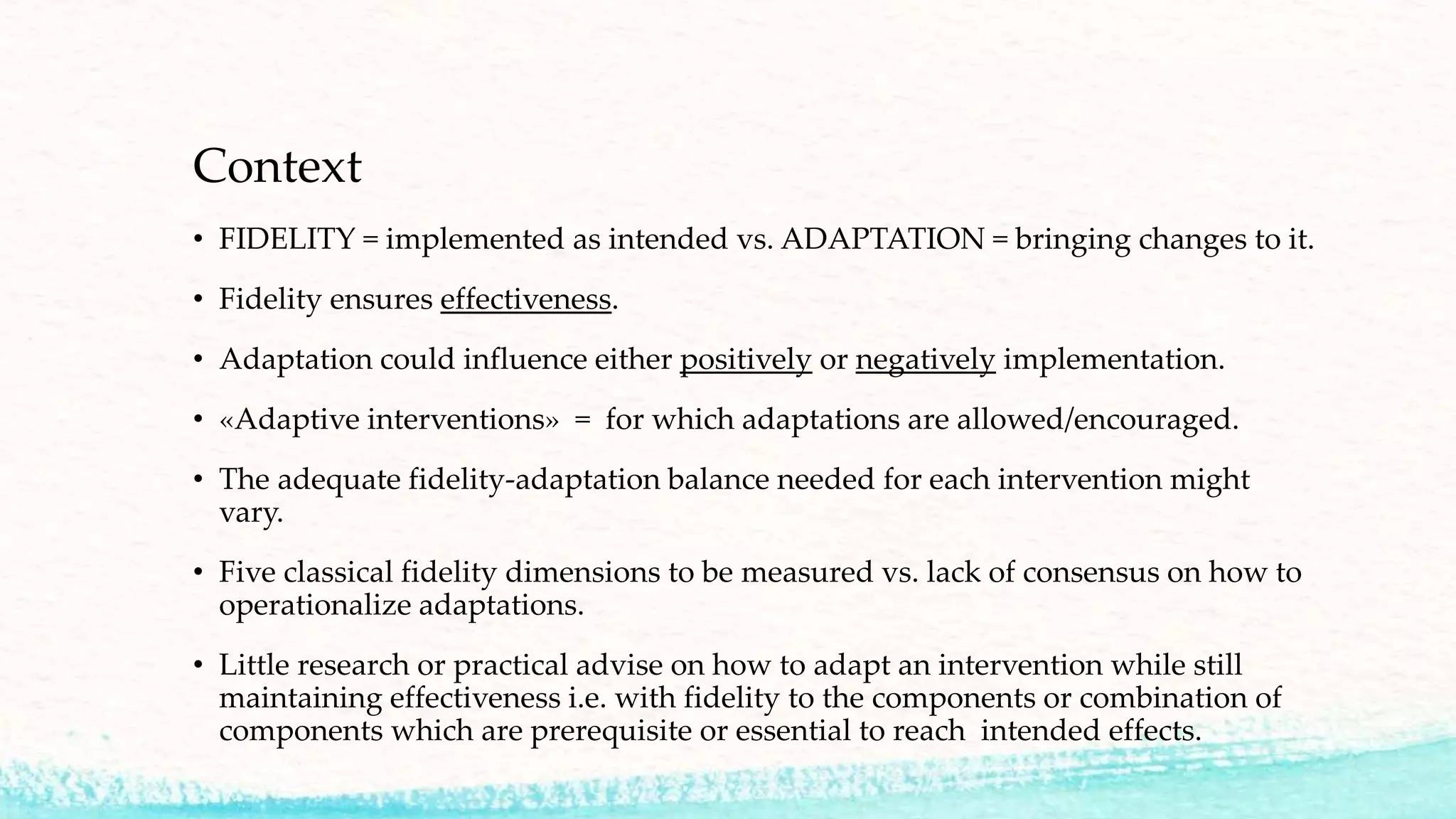
• FIDELITY = implemented as intended vs. ADAPTATION = bringing changes to it.
• Fidelity ensures effectiveness.
• Adaptation could influence either positively or negatively implementation.
• «Adaptive interventions» = for which adaptations are allowed/encouraged.
• The adequate fidelity-adaptation balance needed for each intervention might
vary.
• Five classical fidelity dimensions to be measured vs. lack of consensus on how to
operationalize adaptations.
• Little research or practical advise on how to adapt an intervention while still
maintaining effectiveness i.e. with fidelity to the components or combination of
components which are prerequisite or essential to reach intended effects.
Context
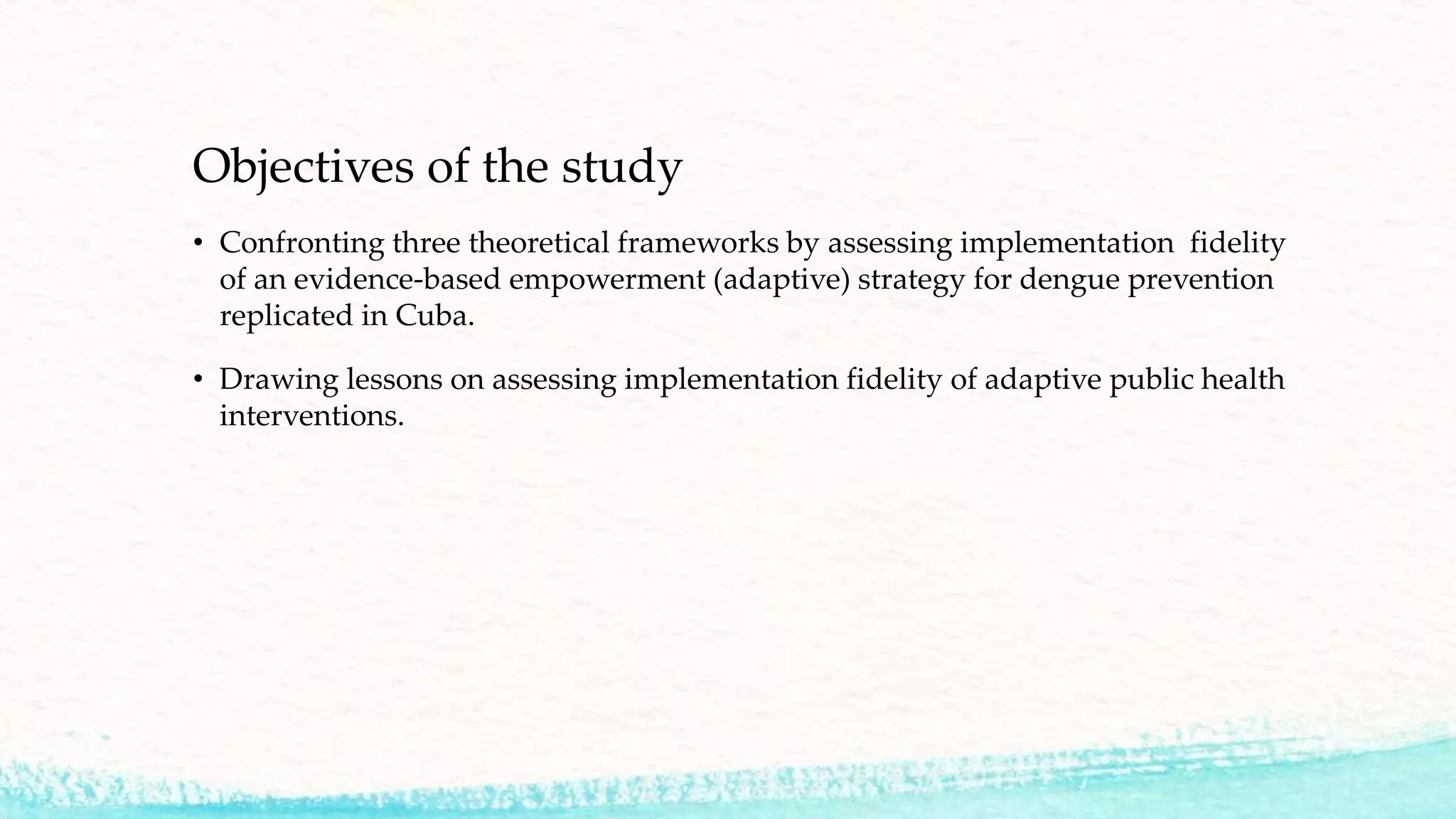
Objectives of the study
• Confronting three theoretical frameworks by assessing implementation fidelity
of an evidence-based empowerment (adaptive) strategy for dengue prevention
replicated in Cuba.
• Drawing lessons on assessing implementation fidelity of adaptive public health
interventions.
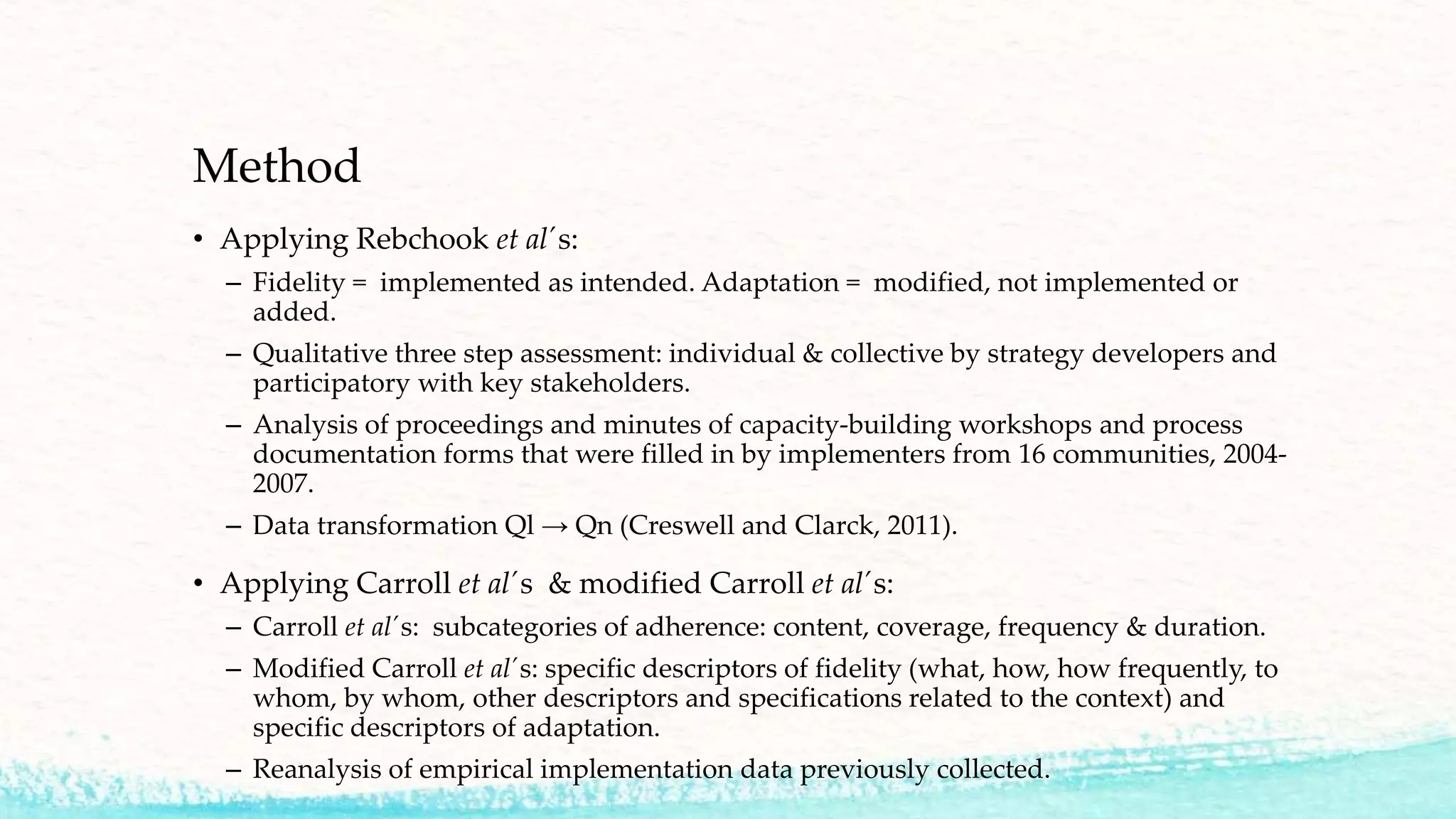
Method
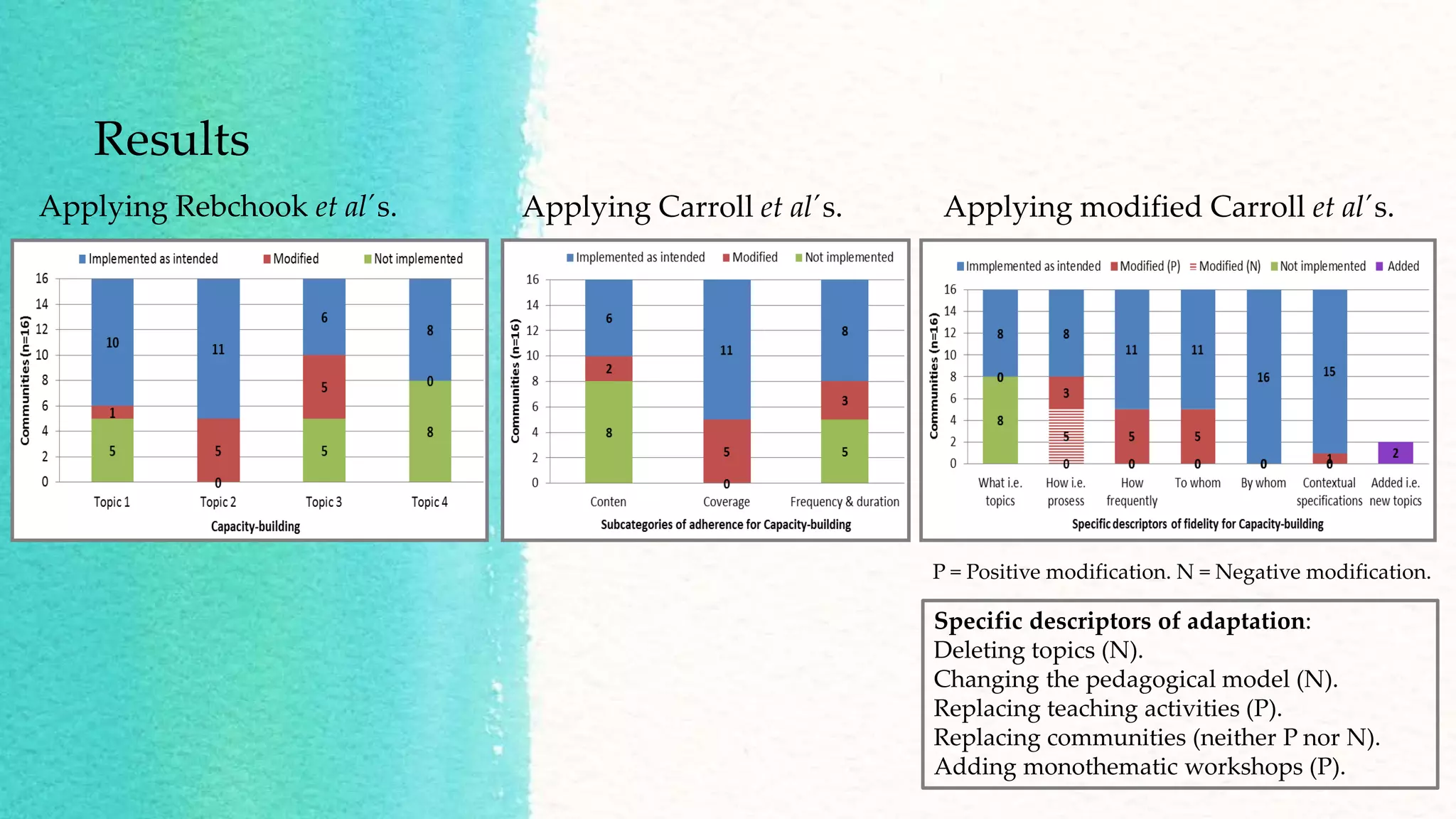
• Applying Rebchook et al´s:
– Fidelity = implemented as intended. Adaptation = modified, not implemented or
added.
– Qualitative three step assessment: individual & collective by strategy developers and
participatory with key stakeholders.
– Analysis of proceedings and minutes of capacity-building workshops and process
documentation forms that were filled in by implementers from 16 communities, 2004-
2007.
– Data transformation Ql → Qn (Creswell and Clarck, 2011).
• Applying Carroll et al´s & modified Carroll et al´s:
– Carroll et al´s: subcategories of adherence: content, coverage, frequency & duration.
– Modified Carroll et al´s: specific descriptors of fidelity (what, how, how frequently, to
whom, by whom, other descriptors and specifications related to the context) and
specific descriptors of adaptation.
– Reanalysis of empirical implementation data previously collected.
Results
Applying Rebchook et al´s. Applying Carroll et al´s. Applying modified Carroll et al´s.
Specific descriptors of adaptation:
Deleting topics (N).
Changing the pedagogical model (N).
Replacing teaching activities (P).
Replacing communities (neither P nor N).
Adding monothematic workshops (P).
P = Positive modification. N = Negative modification.
Lessons learned for
implementation
science in global
health
Fidelity & adaptation matter.
Allowed adaptations depends
on the intervention.
Prospective fidelity
assessment will permit to
correct negative adaptations.
Strengths
• Determining the minimum requirements (i.e. essential
components) for high implementation fidelity to ensure
the intended effects in the process of large scale
implementation.
• Discriminating between intervention failure and
implementation failure.
Limits
• A standardized methodology to assess fidelity is not
available yet and proposed measures have been weak
and program-specific.
• Lack of consensus on how to operationalize
adaptations.
To go further
• REBCHOOK, M., KEGELES, S., HUEBNER, D. & TRIP RESEARCH TEAM. 2006.
Translating research into practice: the dissemination and initial implementation
of an evidence-based HIV Prevention Program. AIDS Education and Prevention,
18, 119-136.
• CARROLL, C., PATTERSON, M., WOOD, S., BOOTH, A., RICK, J. & BALAIN, S.
2007. A conceptual framework for implementation fidelity. Implementation Science,
2, 20. doi:10.1186/1748-5908-2-40.
• PÉREZ, D., VAN DER STUYFT, P., ZABALA, M. CASTRO, M. & LEFÈVRE, P.
2016. A modified theoretical framework to assess implementation fidelity of
adaptive public health interventions. Implementation Science. 11:91. doi:
10.1186/s13012-016-0457-8.
Let’s discuss together!
Meet the experts
Thank you for your attention

A reflection on frameworks to assess implementation fidelity of an adaptive dengue community-based intervention in Cuba.

  • 1.
    A reflection onframeworks to assess implementation fidelity of an adaptive dengue community-based intervention in Cuba METHODS FOR IMPLEMENTATION SCIENCE IN GLOBAL HEALTH April, 20th. 2017 McGill University Workshop co-organised by REALISME Chair and McGill of Global Health Programs Dennis Pérez Chacón Postdoctoral researcher
  • 2.
    • FIDELITY =implemented as intended vs. ADAPTATION = bringing changes to it. • Fidelity ensures effectiveness. • Adaptation could influence either positively or negatively implementation. • «Adaptive interventions» = for which adaptations are allowed/encouraged. • The adequate fidelity-adaptation balance needed for each intervention might vary. • Five classical fidelity dimensions to be measured vs. lack of consensus on how to operationalize adaptations. • Little research or practical advise on how to adapt an intervention while still maintaining effectiveness i.e. with fidelity to the components or combination of components which are prerequisite or essential to reach intended effects. Context
  • 3.
    Objectives of thestudy • Confronting three theoretical frameworks by assessing implementation fidelity of an evidence-based empowerment (adaptive) strategy for dengue prevention replicated in Cuba. • Drawing lessons on assessing implementation fidelity of adaptive public health interventions.
  • 4.
    Method • Applying Rebchooket al´s: – Fidelity = implemented as intended. Adaptation = modified, not implemented or added. – Qualitative three step assessment: individual & collective by strategy developers and participatory with key stakeholders. – Analysis of proceedings and minutes of capacity-building workshops and process documentation forms that were filled in by implementers from 16 communities, 2004- 2007. – Data transformation Ql → Qn (Creswell and Clarck, 2011). • Applying Carroll et al´s & modified Carroll et al´s: – Carroll et al´s: subcategories of adherence: content, coverage, frequency & duration. – Modified Carroll et al´s: specific descriptors of fidelity (what, how, how frequently, to whom, by whom, other descriptors and specifications related to the context) and specific descriptors of adaptation. – Reanalysis of empirical implementation data previously collected.
  • 5.
    Results Applying Rebchook etal´s. Applying Carroll et al´s. Applying modified Carroll et al´s. Specific descriptors of adaptation: Deleting topics (N). Changing the pedagogical model (N). Replacing teaching activities (P). Replacing communities (neither P nor N). Adding monothematic workshops (P). P = Positive modification. N = Negative modification.
  • 6.
    Lessons learned for implementation sciencein global health Fidelity & adaptation matter. Allowed adaptations depends on the intervention. Prospective fidelity assessment will permit to correct negative adaptations. Strengths • Determining the minimum requirements (i.e. essential components) for high implementation fidelity to ensure the intended effects in the process of large scale implementation. • Discriminating between intervention failure and implementation failure. Limits • A standardized methodology to assess fidelity is not available yet and proposed measures have been weak and program-specific. • Lack of consensus on how to operationalize adaptations.
  • 7.
    To go further •REBCHOOK, M., KEGELES, S., HUEBNER, D. & TRIP RESEARCH TEAM. 2006. Translating research into practice: the dissemination and initial implementation of an evidence-based HIV Prevention Program. AIDS Education and Prevention, 18, 119-136. • CARROLL, C., PATTERSON, M., WOOD, S., BOOTH, A., RICK, J. & BALAIN, S. 2007. A conceptual framework for implementation fidelity. Implementation Science, 2, 20. doi:10.1186/1748-5908-2-40. • PÉREZ, D., VAN DER STUYFT, P., ZABALA, M. CASTRO, M. & LEFÈVRE, P. 2016. A modified theoretical framework to assess implementation fidelity of adaptive public health interventions. Implementation Science. 11:91. doi: 10.1186/s13012-016-0457-8.
  • 8.
    Let’s discuss together! Meetthe experts Thank you for your attention