

Immunohematology
Workshop
27th of March
2019
Presented by : - Dr. G.D.A. Samaranayaka
Prepared by :- Dr. Susudu Jayanetti, Dr. Dineesha Subasinghe
Case 1
History
• 28 years old lady
• P4C1
• Managed for Pregnancy Induced Hypertension
• Blood requested due to postpartum hemorrhage
• No history of recent anti D prophylaxis
• History of red cell transfusion >3 months)
Investigations done at the local
hospital
• Full blood count
• Hemoglobin - 10.4 g/dl
• Platelet count - 201x109/l
• WBC - 8.96x10¹¹/l
• Blood Bank investigations
• Blood group - B Rh D positive
• Direct Antiglobulin Test - Negative
Anti A Anti AB Anti B Anti D A1 Cell B cell O cell
0 +4 +4 +4 +4 0 0
Investigations done at the local
hospital
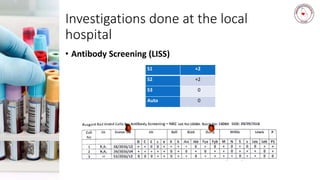
• Antibody Screening (LISS)
S1 +2
S2 +2
S3 0
Auto 0
Investigations done at IHRL
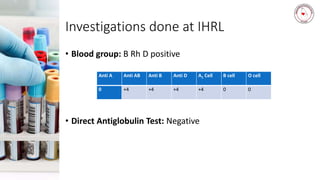
• Blood group: B Rh D positive
• Direct Antiglobulin Test: Negative
Anti A Anti AB Anti B Anti D A1 Cell B cell O cell
0 +4 +4 +4 +4 0 0
Investigations done at IHRL
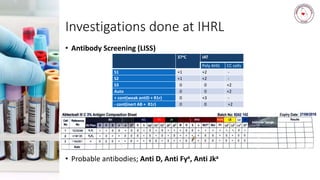
• Antibody Screening (LISS)
• Probable antibodies; Anti D, Anti Fya, Anti Jka
37oC IAT
Poly AHG CC cells
S1 +1 +2 -
S2 +1 +2 -
S3 0 0 +2
Auto 0 0 +2
+ cont(weak antiD + R1r) 0 +3 -
- cont(inert AB + R1r) 0 0 +2
Investigations done at IHRL
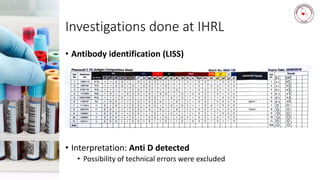
• Antibody identification (LISS)
• Interpretation: Anti D detected
• Possibility of technical errors were excluded
Investigations done at IHRL
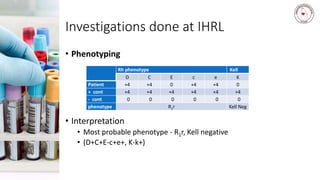
• Phenotyping
• Interpretation
• Most probable phenotype - R1r, Kell negative
• (D+C+E-c+e+, K-k+)
Rh phenotype Kell
D C E c e K
Patient +4 +4 0 +4 +4 0
+ cont +4 +4 +4 +4 +4 +4
- cont 0 0 0 0 0 0
phenotype R1r Kell Neg
Investigations done at IHRL
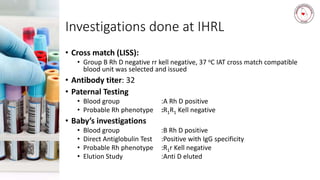
• Cross match (LISS):
• Group B Rh D negative rr kell negative, 37 oC IAT cross match compatible
blood unit was selected and issued
• Antibody titer: 32
• Paternal Testing
• Blood group :A Rh D positive
• Probable Rh phenotype :R1R1 Kell negative
• Baby’s investigations
• Blood group :B Rh D positive
• Direct Antiglobulin Test :Positive with IgG specificity
• Probable Rh phenotype :R1r Kell negative
• Elution Study :Anti D eluted
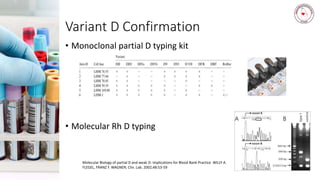
Variant D Confirmation
• Monoclonal partial D typing kit
• Molecular Rh D typing
Molecular Biology of partial D and weak D: Implications for Blood Bank Practice WILLY A.
FLEGEL, FRANZ F. WAGNER; Clin. Lab. 2002;48:53-59
Case 2
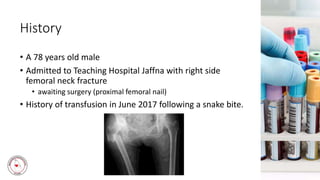
History
• A 78 years old male
• Admitted to Teaching Hospital Jaffna with right side
femoral neck fracture
• awaiting surgery (proximal femoral nail)
• History of transfusion in June 2017 following a snake bite.
Blood bank investigations
• Blood group - B Rh D Positive
• Direct Antiglobulin Test was negative
Anti A Anti AB Anti B Anti D A1 Cell B cell O cell
0 +4 +4 +4 +4 0 0
Blood bank investigations
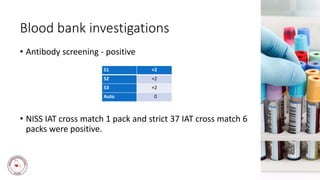
• Antibody screening - positive
• NISS IAT cross match 1 pack and strict 37 IAT cross match 6
packs were positive.
S1 +2
S2 +2
S3 +2
Auto 0
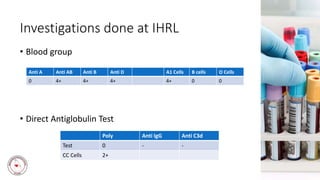
Investigations done at IHRL
• Blood group
• Direct Antiglobulin Test
Anti A Anti AB Anti B Anti D A1 Cells B cells O Cells
0 4+ 4+ 4+ 4+ 0 0
Poly Anti IgG Anti C3d
Test 0 - -
CC Cells 2+
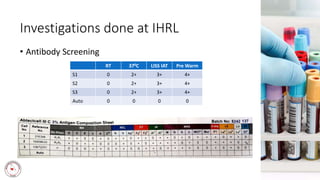
Investigations done at IHRL
• Antibody Screening
RT 370C LISS IAT Pre Warm
S1 0 2+ 3+ 4+
S2 0 2+ 3+ 4+
S3 0 2+ 3+ 4+
Auto 0 0 0 0
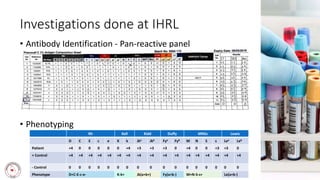
Investigations done at IHRL
• Antibody Identification - Pan-reactive panel
• Phenotyping
Rh Kell Kidd Duffy MNSs Lewis
D C E c e K k Jka Jkb Fya Fyb M N S s Lea Leb
Patient +4 0 0 0 0 0 +4 +3 +3 +3 0 +4 0 0 +3 +3 0
+ Control +4 +4 +4 +4 +4 +4 +4 +4 +4 +4 +4 +4 +4 +4 +4 +4 +4
- Control 0 0 0 0 0 0 0 0 0 0 0 0 0 0 0 0 0
Phenotype D+C-E-c-e- K-k+ Jk(a+b+) Fy(a+b-) M+N-S-s+ Le(a+b-)
Management
• Detected antibody - Anti Hr0/Anti Rh17
• Family screening was suggested
• Patient was the last child in the family
• older siblings and parents had passed away.
• Rh phenotyping done on the four children - compatible
phenotype was not found.
• Pre deposit autologous donation was suggested.
• Patient’s HGB was 9.7g/dl
• started on Hematanics and Erythropoietin
• conservative (non interventional) surgical management
Anti-Rh17 (anti-Hr0)
• Monospecific IgG alloantibody
• Reacts with a common determinant on the RhCE protein.
• Incidence is rare - produced after immune stimulus
• Designated as D- - and was first described by Race and Sanger in
1950.
• Detected best with antiglobulin testing - react with both normal and
enzyme-treated red blood cells.
• Implicated in transfusion reactions & mild to severe HDFN
• Compatible blood products - Rh deletion phenotype and lack RhCE
antigens.
• Extremely difficult to find Hr0 negative blood
• Autologous donation.
Immunohematology
Workshop
27th of March 2019

Rh D Variants

  • 1.
    Immunohematology Workshop 27th of March 2019 Presentedby : - Dr. G.D.A. Samaranayaka Prepared by :- Dr. Susudu Jayanetti, Dr. Dineesha Subasinghe
  • 2.
  • 3.
    History • 28 yearsold lady • P4C1 • Managed for Pregnancy Induced Hypertension • Blood requested due to postpartum hemorrhage • No history of recent anti D prophylaxis • History of red cell transfusion >3 months)
  • 4.
    Investigations done atthe local hospital • Full blood count • Hemoglobin - 10.4 g/dl • Platelet count - 201x109/l • WBC - 8.96x10¹¹/l • Blood Bank investigations • Blood group - B Rh D positive • Direct Antiglobulin Test - Negative Anti A Anti AB Anti B Anti D A1 Cell B cell O cell 0 +4 +4 +4 +4 0 0
  • 5.
    Investigations done atthe local hospital • Antibody Screening (LISS) S1 +2 S2 +2 S3 0 Auto 0
  • 6.
    Investigations done atIHRL • Blood group: B Rh D positive • Direct Antiglobulin Test: Negative Anti A Anti AB Anti B Anti D A1 Cell B cell O cell 0 +4 +4 +4 +4 0 0
  • 7.
    Investigations done atIHRL • Antibody Screening (LISS) • Probable antibodies; Anti D, Anti Fya, Anti Jka 37oC IAT Poly AHG CC cells S1 +1 +2 - S2 +1 +2 - S3 0 0 +2 Auto 0 0 +2 + cont(weak antiD + R1r) 0 +3 - - cont(inert AB + R1r) 0 0 +2
  • 8.
    Investigations done atIHRL • Antibody identification (LISS) • Interpretation: Anti D detected • Possibility of technical errors were excluded
  • 9.
    Investigations done atIHRL • Phenotyping • Interpretation • Most probable phenotype - R1r, Kell negative • (D+C+E-c+e+, K-k+) Rh phenotype Kell D C E c e K Patient +4 +4 0 +4 +4 0 + cont +4 +4 +4 +4 +4 +4 - cont 0 0 0 0 0 0 phenotype R1r Kell Neg
  • 10.
    Investigations done atIHRL • Cross match (LISS): • Group B Rh D negative rr kell negative, 37 oC IAT cross match compatible blood unit was selected and issued • Antibody titer: 32 • Paternal Testing • Blood group :A Rh D positive • Probable Rh phenotype :R1R1 Kell negative • Baby’s investigations • Blood group :B Rh D positive • Direct Antiglobulin Test :Positive with IgG specificity • Probable Rh phenotype :R1r Kell negative • Elution Study :Anti D eluted
  • 11.
    Variant D Confirmation •Monoclonal partial D typing kit • Molecular Rh D typing Molecular Biology of partial D and weak D: Implications for Blood Bank Practice WILLY A. FLEGEL, FRANZ F. WAGNER; Clin. Lab. 2002;48:53-59
  • 12.
  • 13.
    History • A 78years old male • Admitted to Teaching Hospital Jaffna with right side femoral neck fracture • awaiting surgery (proximal femoral nail) • History of transfusion in June 2017 following a snake bite.
  • 14.
    Blood bank investigations •Blood group - B Rh D Positive • Direct Antiglobulin Test was negative Anti A Anti AB Anti B Anti D A1 Cell B cell O cell 0 +4 +4 +4 +4 0 0
  • 15.
    Blood bank investigations •Antibody screening - positive • NISS IAT cross match 1 pack and strict 37 IAT cross match 6 packs were positive. S1 +2 S2 +2 S3 +2 Auto 0
  • 16.
    Investigations done atIHRL • Blood group • Direct Antiglobulin Test Anti A Anti AB Anti B Anti D A1 Cells B cells O Cells 0 4+ 4+ 4+ 4+ 0 0 Poly Anti IgG Anti C3d Test 0 - - CC Cells 2+
  • 17.
    Investigations done atIHRL • Antibody Screening RT 370C LISS IAT Pre Warm S1 0 2+ 3+ 4+ S2 0 2+ 3+ 4+ S3 0 2+ 3+ 4+ Auto 0 0 0 0
  • 18.
    Investigations done atIHRL • Antibody Identification - Pan-reactive panel • Phenotyping Rh Kell Kidd Duffy MNSs Lewis D C E c e K k Jka Jkb Fya Fyb M N S s Lea Leb Patient +4 0 0 0 0 0 +4 +3 +3 +3 0 +4 0 0 +3 +3 0 + Control +4 +4 +4 +4 +4 +4 +4 +4 +4 +4 +4 +4 +4 +4 +4 +4 +4 - Control 0 0 0 0 0 0 0 0 0 0 0 0 0 0 0 0 0 Phenotype D+C-E-c-e- K-k+ Jk(a+b+) Fy(a+b-) M+N-S-s+ Le(a+b-)
  • 19.
    Management • Detected antibody- Anti Hr0/Anti Rh17 • Family screening was suggested • Patient was the last child in the family • older siblings and parents had passed away. • Rh phenotyping done on the four children - compatible phenotype was not found. • Pre deposit autologous donation was suggested. • Patient’s HGB was 9.7g/dl • started on Hematanics and Erythropoietin • conservative (non interventional) surgical management
  • 20.
    Anti-Rh17 (anti-Hr0) • MonospecificIgG alloantibody • Reacts with a common determinant on the RhCE protein. • Incidence is rare - produced after immune stimulus • Designated as D- - and was first described by Race and Sanger in 1950. • Detected best with antiglobulin testing - react with both normal and enzyme-treated red blood cells. • Implicated in transfusion reactions & mild to severe HDFN • Compatible blood products - Rh deletion phenotype and lack RhCE antigens. • Extremely difficult to find Hr0 negative blood • Autologous donation.
  • 21.