A Hybrid Time and
Frequency Domain
Methodology for
Harmonic Power Flows.
by Marcolino Humberto Díaz Araujo.
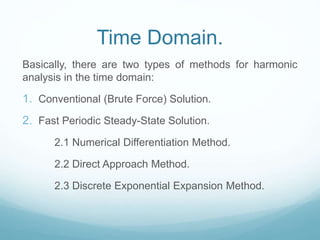
Time Domain.
Basically, there are two types of methods for harmonic
analysis in the time domain:
1. Conventional (Brute Force) Solution.
2. Fast Periodic Steady-State Solution.
2.1 Numerical Differentiation Method.
2.2 Direct Approach Method.
2.3 Discrete Exponential Expansion Method.
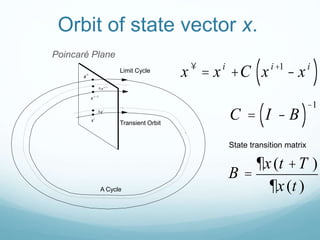
x¥
= xi
+C xi +1
- xi
( )
B =
¶x(t +T )
¶x(t )

x
1+
D i
x
1+i
x
i
xD
i
x
Poincaré Plane
Transient Orbit
Limit Cycle
A Cycle
Orbit of state vector x.
C = I - B( )
-1
State transition matrix
Frequency Domain.
In general, available methods for harmonic analysis in the
frequency domain are divided into:
1. Direct Method.
[Yh] Vh = Ih.
1. Iterative Harmonic Analysis.
2. Harmonic Power Flow Methods.
Hybrid Time and Frequency
Domain.
Fundamental principles for the hybrid methodology:
 The power components are represented in their natural
frame of reference, that is to say, the frequency domain for
the case of linear components, and the time domain for the
case of nonlinear components.
 The iterative process is based on the calculation of a current
mismatch ΔI, followed by a voltage update ΔV.
 The convergence characteristic of the algorithm is
accelerated for the time domain.
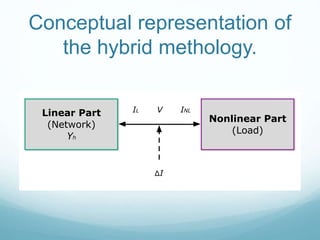
Conceptual representation of
the hybrid methology.
Linear Part
(Network)
Yh
Nonlinear Part
(Load)
V INLIL
ΔI
The iterative solution for the entire system has the form
Yh [ΔV] = ΔI
where
ΔI = IL + INL
IL = YhVh
INL is obtained by the time domain simulation
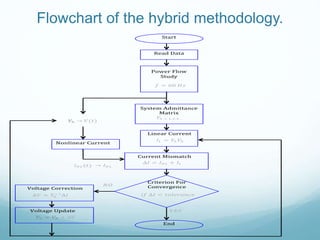
Flowchart of the hybrid methodology.
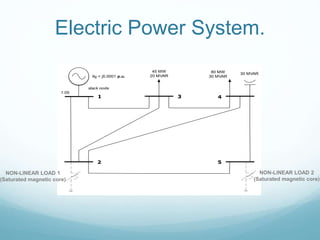
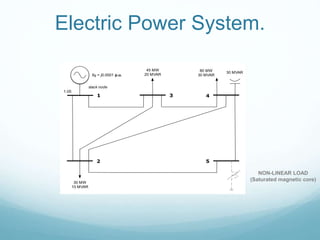
Electric Power System.
1
2
3 4
5
45 MW
20 MVAR
80 MW
30 MVAR
30 MVAR
Xg = j0.0001 p.u.
slack node
1.05
NON-LINEAR LOAD 1
(Saturated magnetic core)
NON-LINEAR LOAD 2
(Saturated magnetic core)
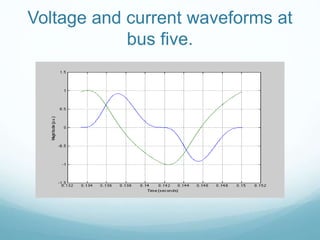
Voltage and current waveforms at
bus five.
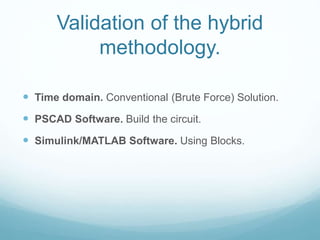
Validation of the hybrid
methodology.
 Time domain. Conventional (Brute Force) Solution.
 PSCAD Software. Build the circuit.
 Simulink/MATLAB Software. Using Blocks.
Electric Power System.
1
2
3 4
5
30 MW
10 MVAR
45 MW
20 MVAR
80 MW
30 MVAR
30 MVAR
Xg = j0.0001 p.u.
slack node
1.05
NON-LINEAR LOAD
(Saturated magnetic core)
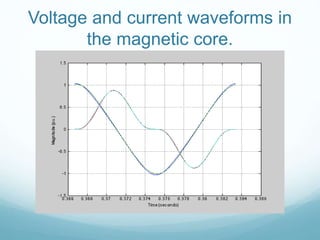
Voltage and current waveforms in
the magnetic core.
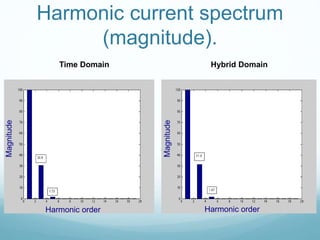
Harmonic current spectrum
(magnitude).
Time Domain Hybrid Domain
Harmonic order Harmonic order
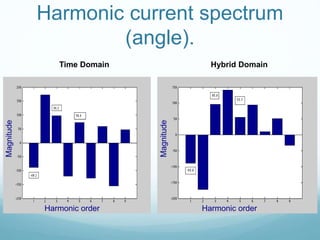
Harmonic current spectrum
(angle).
Time Domain Hybrid Domain
Harmonic order Harmonic order
Future research work.
 To apply parallel processing techniques based on GPU
to the hybrid methodology.
 To control the propagation of harmonic currents in the
power system.
 To incorporate non-linear components such as power
converters, wind generators, and photovoltaic sources.
 To extend the methodology for three-phase power
systems.
Thank you !

Expo unitedking

  • 1.
    A Hybrid Timeand Frequency Domain Methodology for Harmonic Power Flows. by Marcolino Humberto Díaz Araujo.
  • 2.
    Time Domain. Basically, thereare two types of methods for harmonic analysis in the time domain: 1. Conventional (Brute Force) Solution. 2. Fast Periodic Steady-State Solution. 2.1 Numerical Differentiation Method. 2.2 Direct Approach Method. 2.3 Discrete Exponential Expansion Method.
  • 3.
    x¥ = xi +C xi+1 - xi ( ) B = ¶x(t +T ) ¶x(t )  x 1+ D i x 1+i x i xD i x Poincaré Plane Transient Orbit Limit Cycle A Cycle Orbit of state vector x. C = I - B( ) -1 State transition matrix
  • 4.
    Frequency Domain. In general,available methods for harmonic analysis in the frequency domain are divided into: 1. Direct Method. [Yh] Vh = Ih. 1. Iterative Harmonic Analysis. 2. Harmonic Power Flow Methods.
  • 5.
    Hybrid Time andFrequency Domain. Fundamental principles for the hybrid methodology:  The power components are represented in their natural frame of reference, that is to say, the frequency domain for the case of linear components, and the time domain for the case of nonlinear components.  The iterative process is based on the calculation of a current mismatch ΔI, followed by a voltage update ΔV.  The convergence characteristic of the algorithm is accelerated for the time domain.
  • 6.
    Conceptual representation of thehybrid methology. Linear Part (Network) Yh Nonlinear Part (Load) V INLIL ΔI
  • 7.
    The iterative solutionfor the entire system has the form Yh [ΔV] = ΔI where ΔI = IL + INL IL = YhVh INL is obtained by the time domain simulation
  • 8.
    Flowchart of thehybrid methodology.
  • 9.
    Electric Power System. 1 2 34 5 45 MW 20 MVAR 80 MW 30 MVAR 30 MVAR Xg = j0.0001 p.u. slack node 1.05 NON-LINEAR LOAD 1 (Saturated magnetic core) NON-LINEAR LOAD 2 (Saturated magnetic core)
  • 10.
    Voltage and currentwaveforms at bus five.
  • 11.
    Validation of thehybrid methodology.  Time domain. Conventional (Brute Force) Solution.  PSCAD Software. Build the circuit.  Simulink/MATLAB Software. Using Blocks.
  • 12.
    Electric Power System. 1 2 34 5 30 MW 10 MVAR 45 MW 20 MVAR 80 MW 30 MVAR 30 MVAR Xg = j0.0001 p.u. slack node 1.05 NON-LINEAR LOAD (Saturated magnetic core)
  • 13.
    Voltage and currentwaveforms in the magnetic core.
  • 14.
    Harmonic current spectrum (magnitude). TimeDomain Hybrid Domain Harmonic order Harmonic order
  • 15.
    Harmonic current spectrum (angle). TimeDomain Hybrid Domain Harmonic order Harmonic order
  • 16.
    Future research work. To apply parallel processing techniques based on GPU to the hybrid methodology.  To control the propagation of harmonic currents in the power system.  To incorporate non-linear components such as power converters, wind generators, and photovoltaic sources.  To extend the methodology for three-phase power systems.
  • 17.