Lord1
2
EXPLOSION INJURIES &
THEIR FORENSIC
ASPECTS
Dr. VISHAL B. SURWADE,
Assistant Professor,
Forensic Medicine & Toxicology.
3
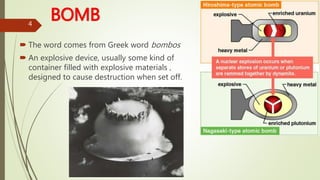
BOMB
 The word comes from Greek word bombos
 An explosive device, usually some kind of
container filled with explosive materials ,
designed to cause destruction when set off.
4
5
6
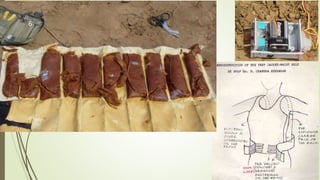
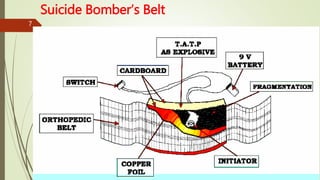
Suicide Bomber’s Belt
7
EXPLOSION INJURIES
Explosive material is suddenly converted into a large
volume of gas with a release of a tremendous amount of
energy
Pressure: up to 1000 tons per square inch (psi)
Temperature : up to 3000 degree Celsius
Solid surfaces reflects the blast waves and increases the
intensity of the blast injury
8
DEFINITION of EXPLOSION
Explosion is an phenomenon resulting from sudden
release of energy which is then dissipated by a blast wave,
by translocation of the objects in the space or by heat
generation.
Classified into three types:
Atomic
Mechanical
Chemical
9
EXPLOSIVES
Defined u/sec. 4 (d) of Indian Explosive Act,1884.
It may be High order
Explosion is supersonic
Blast contains a over-pressurized wave
Low order explosive
Explosion is not as fast as the speed of sound
No over-pressurization wave
 Crackers & Batteries
10
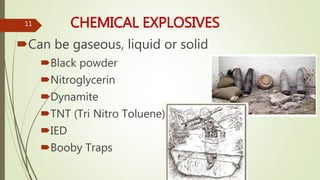
CHEMICAL EXPLOSIVES
Can be gaseous, liquid or solid
Black powder
Nitroglycerin
Dynamite
TNT (Tri Nitro Toluene)
IED
Booby Traps
11
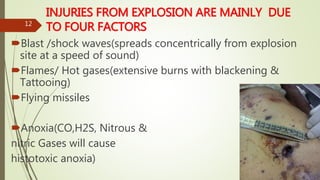
INJURIES FROM EXPLOSION ARE MAINLY DUE
TO FOUR FACTORS
Blast /shock waves(spreads concentrically from explosion
site at a speed of sound)
Flames/ Hot gases(extensive burns with blackening &
Tattooing)
Flying missiles
Anoxia(CO,H2S, Nitrous &
nitric Gases will cause
histotoxic anoxia)
12
13
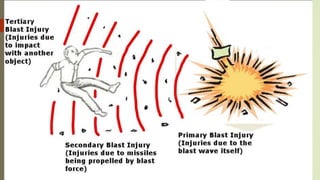
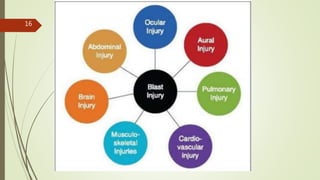
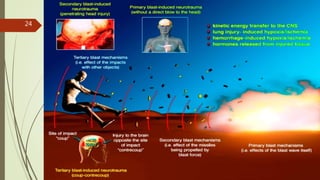
CLASSIFICATION: BOMB BLAST INJURIES
Primary blast injuries: direct effect of “blast overpressure.”
Injuries are due to compressed air, which tends to affect air –
filled organs such as Lungs, GIT, middle ear, etc.
Secondary blast injuries: due to flying objects generated by
the actual blast.
Tertiary Blast injuries: occurs when victims are thrown into
the air and strike other objects.
Miscellaneous blast injuries: injuries due to fire, collapse of
buildings , etc. (Collateral damages)
14
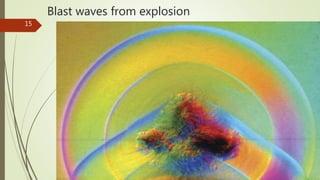
Blast waves from explosion
15
16
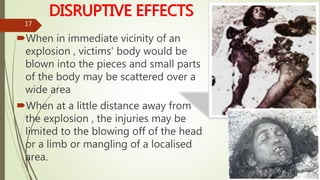
DISRUPTIVE EFFECTS
When in immediate vicinity of an
explosion , victims' body would be
blown into the pieces and small parts
of the body may be scattered over a
wide area
When at a little distance away from
the explosion , the injuries may be
limited to the blowing off of the head
or a limb or mangling of a localised
area.
17
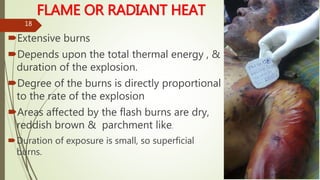
FLAME OR RADIANT HEAT
Extensive burns
Depends upon the total thermal energy , &
duration of the explosion.
Degree of the burns is directly proportional
to the rate of the explosion
Areas affected by the flash burns are dry,
reddish brown & parchment like.
Duration of exposure is small, so superficial
burns.
18
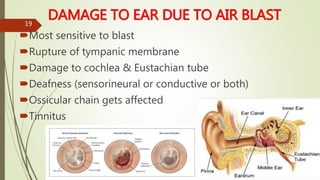
DAMAGE TO EAR DUE TO AIR BLAST
Most sensitive to blast
Rupture of tympanic membrane
Damage to cochlea & Eustachian tube
Deafness (sensorineural or conductive or both)
Ossicular chain gets affected
Tinnitus
19
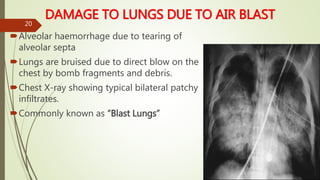
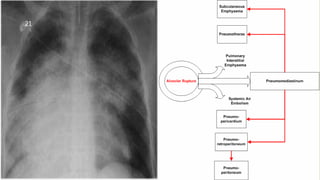
DAMAGE TO LUNGS DUE TO AIR BLAST
Alveolar haemorrhage due to tearing of
alveolar septa
Lungs are bruised due to direct blow on the
chest by bomb fragments and debris.
Chest X-ray showing typical bilateral patchy
infiltrates.
Commonly known as “Blast Lungs”
20
21
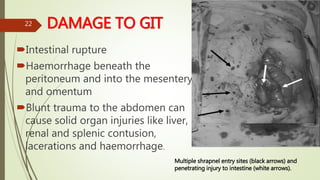
DAMAGE TO GIT
Intestinal rupture
Haemorrhage beneath the
peritoneum and into the mesentery
and omentum
Blunt trauma to the abdomen can
cause solid organ injuries like liver,
renal and splenic contusion,
lacerations and haemorrhage.
22
Multiple shrapnel entry sites (black arrows) and
penetrating injury to intestine (white arrows).
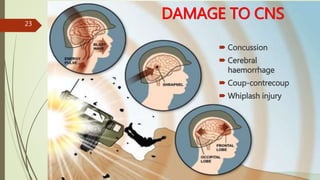
DAMAGE TO CNS
 Concussion
 Cerebral
haemorrhage
 Coup-contrecoup
 Whiplash injury
23
24
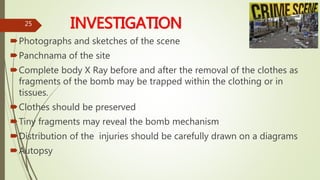
INVESTIGATION
Photographs and sketches of the scene
Panchnama of the site
Complete body X Ray before and after the removal of the clothes as
fragments of the bomb may be trapped within the clothing or in
tissues.
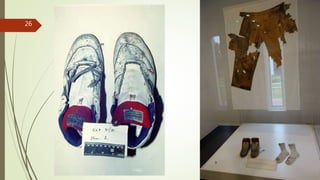
Clothes should be preserved
Tiny fragments may reveal the bomb mechanism
Distribution of the injuries should be carefully drawn on a diagrams
Autopsy
25
26
POST- MORTEM EXAMINATION
Identification(in case of fragmented body parts or in case of
mass disasters)
Radiological examination
Collection of surface evidence
Documentation of injuries
Identification of natural diseases
Collection of internal samples
27
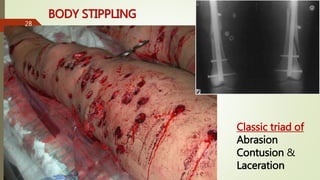
BODY STIPPLING
Classic triad of
Abrasion
Contusion &
Laceration
28
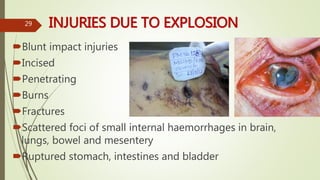
INJURIES DUE TO EXPLOSION
Blunt impact injuries
Incised
Penetrating
Burns
Fractures
Scattered foci of small internal haemorrhages in brain,
lungs, bowel and mesentery
Ruptured stomach, intestines and bladder
29
SAMPLES PRESERVATION
For tissue matching: Hair & blood
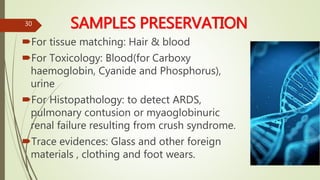
For Toxicology: Blood(for Carboxy
haemoglobin, Cyanide and Phosphorus),
urine
For Histopathology: to detect ARDS,
pulmonary contusion or myaoglobinuric
renal failure resulting from crush syndrome.
Trace evidences: Glass and other foreign
materials , clothing and foot wears.
30
CAUSE OF DEATH
Burns
Blunt force trauma
Falling debris
Asphyxia due to inhalation of product of combustion
Crush syndrome
Shock and haemorrhage
Air embolism
Delayed causes: Septicaemia
31
MEDICOLEGAL ASPECTS
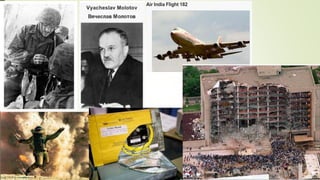
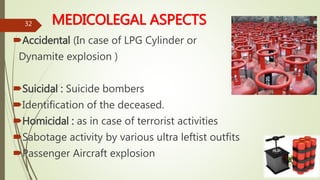
Accidental (In case of LPG Cylinder or
Dynamite explosion )
Suicidal : Suicide bombers
Identification of the deceased.
Homicidal : as in case of terrorist activities
Sabotage activity by various ultra leftist outfits
Passenger Aircraft explosion
32
33
IF THERE IS MASS DISASTER??
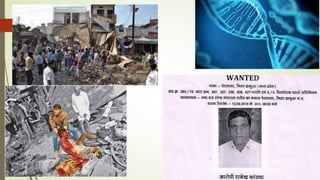
Ujjain is hosting Simhast.
Any untoward event: In case of living as well as in dead
Real challenge in front of the administration ( for both Civil and
Medical)
Set up field hospital with field Forensic Lab.
Proper collection & maintain the proper chain of custody of the
samples
Help line numbers
Use of social media
34
REFERENCES
 Blast Injuries ”True Weapons of Mass Destruction” by Charles Stewart
 Jane’s Defence Weekly: July,2014
 Modi’s Medical Jurisprudence- 24th Edition
 Essentials of Forensic Medicine & Toxicology: Anil Aggarwal
 India Defence.com
 Wikipedia.com
 Times of India clippings
 The Hindu clippings
35
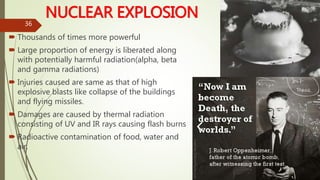
NUCLEAR EXPLOSION
 Thousands of times more powerful
 Large proportion of energy is liberated along
with potentially harmful radiation(alpha, beta
and gamma radiations)
 Injuries caused are same as that of high
explosive blasts like collapse of the buildings
and flying missiles.
 Damages are caused by thermal radiation
consisting of UV and IR rays causing flash burns
 Radioactive contamination of food, water and
air.
36

Explosion Injuries and its Forensic Aspect

  • 1.
  • 2.
  • 3.
    EXPLOSION INJURIES & THEIRFORENSIC ASPECTS Dr. VISHAL B. SURWADE, Assistant Professor, Forensic Medicine & Toxicology. 3
  • 4.
    BOMB  The wordcomes from Greek word bombos  An explosive device, usually some kind of container filled with explosive materials , designed to cause destruction when set off. 4
  • 5.
  • 6.
  • 7.
  • 8.
    EXPLOSION INJURIES Explosive materialis suddenly converted into a large volume of gas with a release of a tremendous amount of energy Pressure: up to 1000 tons per square inch (psi) Temperature : up to 3000 degree Celsius Solid surfaces reflects the blast waves and increases the intensity of the blast injury 8
  • 9.
    DEFINITION of EXPLOSION Explosionis an phenomenon resulting from sudden release of energy which is then dissipated by a blast wave, by translocation of the objects in the space or by heat generation. Classified into three types: Atomic Mechanical Chemical 9
  • 10.
    EXPLOSIVES Defined u/sec. 4(d) of Indian Explosive Act,1884. It may be High order Explosion is supersonic Blast contains a over-pressurized wave Low order explosive Explosion is not as fast as the speed of sound No over-pressurization wave  Crackers & Batteries 10
  • 11.
    CHEMICAL EXPLOSIVES Can begaseous, liquid or solid Black powder Nitroglycerin Dynamite TNT (Tri Nitro Toluene) IED Booby Traps 11
  • 12.
    INJURIES FROM EXPLOSIONARE MAINLY DUE TO FOUR FACTORS Blast /shock waves(spreads concentrically from explosion site at a speed of sound) Flames/ Hot gases(extensive burns with blackening & Tattooing) Flying missiles Anoxia(CO,H2S, Nitrous & nitric Gases will cause histotoxic anoxia) 12
  • 13.
  • 14.
    CLASSIFICATION: BOMB BLASTINJURIES Primary blast injuries: direct effect of “blast overpressure.” Injuries are due to compressed air, which tends to affect air – filled organs such as Lungs, GIT, middle ear, etc. Secondary blast injuries: due to flying objects generated by the actual blast. Tertiary Blast injuries: occurs when victims are thrown into the air and strike other objects. Miscellaneous blast injuries: injuries due to fire, collapse of buildings , etc. (Collateral damages) 14
  • 15.
    Blast waves fromexplosion 15
  • 16.
  • 17.
    DISRUPTIVE EFFECTS When inimmediate vicinity of an explosion , victims' body would be blown into the pieces and small parts of the body may be scattered over a wide area When at a little distance away from the explosion , the injuries may be limited to the blowing off of the head or a limb or mangling of a localised area. 17
  • 18.
    FLAME OR RADIANTHEAT Extensive burns Depends upon the total thermal energy , & duration of the explosion. Degree of the burns is directly proportional to the rate of the explosion Areas affected by the flash burns are dry, reddish brown & parchment like. Duration of exposure is small, so superficial burns. 18
  • 19.
    DAMAGE TO EARDUE TO AIR BLAST Most sensitive to blast Rupture of tympanic membrane Damage to cochlea & Eustachian tube Deafness (sensorineural or conductive or both) Ossicular chain gets affected Tinnitus 19
  • 20.
    DAMAGE TO LUNGSDUE TO AIR BLAST Alveolar haemorrhage due to tearing of alveolar septa Lungs are bruised due to direct blow on the chest by bomb fragments and debris. Chest X-ray showing typical bilateral patchy infiltrates. Commonly known as “Blast Lungs” 20
  • 21.
  • 22.
    DAMAGE TO GIT Intestinalrupture Haemorrhage beneath the peritoneum and into the mesentery and omentum Blunt trauma to the abdomen can cause solid organ injuries like liver, renal and splenic contusion, lacerations and haemorrhage. 22 Multiple shrapnel entry sites (black arrows) and penetrating injury to intestine (white arrows).
  • 23.
    DAMAGE TO CNS Concussion  Cerebral haemorrhage  Coup-contrecoup  Whiplash injury 23
  • 24.
  • 25.
    INVESTIGATION Photographs and sketchesof the scene Panchnama of the site Complete body X Ray before and after the removal of the clothes as fragments of the bomb may be trapped within the clothing or in tissues. Clothes should be preserved Tiny fragments may reveal the bomb mechanism Distribution of the injuries should be carefully drawn on a diagrams Autopsy 25
  • 26.
  • 27.
    POST- MORTEM EXAMINATION Identification(incase of fragmented body parts or in case of mass disasters) Radiological examination Collection of surface evidence Documentation of injuries Identification of natural diseases Collection of internal samples 27
  • 28.
    BODY STIPPLING Classic triadof Abrasion Contusion & Laceration 28
  • 29.
    INJURIES DUE TOEXPLOSION Blunt impact injuries Incised Penetrating Burns Fractures Scattered foci of small internal haemorrhages in brain, lungs, bowel and mesentery Ruptured stomach, intestines and bladder 29
  • 30.
    SAMPLES PRESERVATION For tissuematching: Hair & blood For Toxicology: Blood(for Carboxy haemoglobin, Cyanide and Phosphorus), urine For Histopathology: to detect ARDS, pulmonary contusion or myaoglobinuric renal failure resulting from crush syndrome. Trace evidences: Glass and other foreign materials , clothing and foot wears. 30
  • 31.
    CAUSE OF DEATH Burns Bluntforce trauma Falling debris Asphyxia due to inhalation of product of combustion Crush syndrome Shock and haemorrhage Air embolism Delayed causes: Septicaemia 31
  • 32.
    MEDICOLEGAL ASPECTS Accidental (Incase of LPG Cylinder or Dynamite explosion ) Suicidal : Suicide bombers Identification of the deceased. Homicidal : as in case of terrorist activities Sabotage activity by various ultra leftist outfits Passenger Aircraft explosion 32
  • 33.
  • 34.
    IF THERE ISMASS DISASTER?? Ujjain is hosting Simhast. Any untoward event: In case of living as well as in dead Real challenge in front of the administration ( for both Civil and Medical) Set up field hospital with field Forensic Lab. Proper collection & maintain the proper chain of custody of the samples Help line numbers Use of social media 34
  • 35.
    REFERENCES  Blast Injuries”True Weapons of Mass Destruction” by Charles Stewart  Jane’s Defence Weekly: July,2014  Modi’s Medical Jurisprudence- 24th Edition  Essentials of Forensic Medicine & Toxicology: Anil Aggarwal  India Defence.com  Wikipedia.com  Times of India clippings  The Hindu clippings 35
  • 36.
    NUCLEAR EXPLOSION  Thousandsof times more powerful  Large proportion of energy is liberated along with potentially harmful radiation(alpha, beta and gamma radiations)  Injuries caused are same as that of high explosive blasts like collapse of the buildings and flying missiles.  Damages are caused by thermal radiation consisting of UV and IR rays causing flash burns  Radioactive contamination of food, water and air. 36