Exploring LC-MS peptide dynamic range
From enhanced base signal to the higher end of the dynamic range in 10log steps
Anne Kleinnijenhuis
anne.kleinnijenhuis@triskelion.nl
Frédérique van Holthoon
Jan Toersche
Aim of the study
We observed that addition of a suitable internal standard can enhance
the analyte signal at lower concentrations.
Usually the most suitable IS is a stable isotope labeled internal
standard (SIL IS) due to the almost identical properties.
FTISADTSK (tryptic trastuzumab peptide, FTI) was analyzed using
UPLC-MS/MS (triple quadrupole) in the absence and presence of
FTISADTSK-13C6
15N2 (FTI IS) to investigate the effect of the presence
of SIL IS on the analyte base signal.
In addition the extent of the dynamic range, ion ratios and absolute
signals were investigated.
Experimental (1)
Preparation of stock solutions and reagents
Diluent: 0.5% TFA, 1% FA, 10% ACN in MQ.
FTI 4 µg/ml stock: dissolve 1 nmol (99.2% purity) in 240 µl diluent.
FTI IS 4 µg/ml stock: dissolve 1 nmol (96.8% purity) in 236 µl diluent.
FTI IS diluent (4 ng/ml): dilute FTI IS 4 µg/ml stock 1000-fold with
diluent.
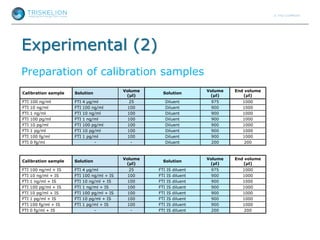
Experimental (2)
Preparation of calibration samples
Calibration sample Solution
Volume
(µl)
Solution
Volume
(µl)
End volume
(µl)
FTI 100 ng/ml FTI 4 µg/ml 25 Diluent 975 1000
FTI 10 ng/ml FTI 100 ng/ml 100 Diluent 900 1000
FTI 1 ng/ml FTI 10 ng/ml 100 Diluent 900 1000
FTI 100 pg/ml FTI 1 ng/ml 100 Diluent 900 1000
FTI 10 pg/ml FTI 100 pg/ml 100 Diluent 900 1000
FTI 1 pg/ml FTI 10 pg/ml 100 Diluent 900 1000
FTI 100 fg/ml FTI 1 pg/ml 100 Diluent 900 1000
FTI 0 fg/ml - - Diluent 200 200
Calibration sample Solution
Volume
(µl)
Solution
Volume
(µl)
End volume
(µl)
FTI 100 ng/ml + IS FTI 4 µg/ml 25 FTI IS diluent 975 1000
FTI 10 ng/ml + IS FTI 100 ng/ml + IS 100 FTI IS diluent 900 1000
FTI 1 ng/ml + IS FTI 10 ng/ml + IS 100 FTI IS diluent 900 1000
FTI 100 pg/ml + IS FTI 1 ng/ml + IS 100 FTI IS diluent 900 1000
FTI 10 pg/ml + IS FTI 100 pg/ml + IS 100 FTI IS diluent 900 1000
FTI 1 pg/ml + IS FTI 10 pg/ml + IS 100 FTI IS diluent 900 1000
FTI 100 fg/ml + IS FTI 1 pg/ml + IS 100 FTI IS diluent 900 1000
FTI 0 fg/ml + IS - - FTI IS diluent 200 200
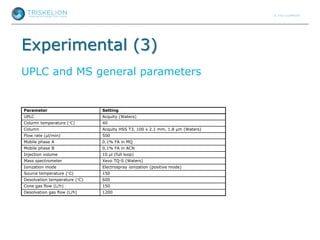
Experimental (3)
Parameter Setting
UPLC Acquity (Waters)
Column temperature (°C) 40
Column Acquity HSS T3, 100 x 2.1 mm, 1.8 µm (Waters)
Flow rate (µl/min) 500
Mobile phase A 0.1% FA in MQ
Mobile phase B 0.1% FA in ACN
Injection volume 10 µl (full loop)
Mass spectrometer Xevo TQ-S (Waters)
Ionization mode Electrospray ionization (positive mode)
Source temperature (°C) 150
Desolvation temperature (°C) 600
Cone gas flow (L/h) 150
Desolvation gas flow (L/h) 1200
UPLC and MS general parameters
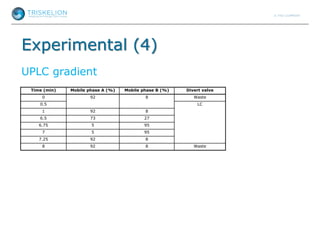
Experimental (4)
UPLC gradient
Time (min) Mobile phase A (%) Mobile phase B (%) Divert valve
0 92 8 Waste
0.5 LC
1 92 8
6.5 73 27
6.75 5 95
7 5 95
7.25 92 8
8 92 8 Waste
Experimental (5)
MS/MS conditions
Peptide Precursor
ion (m/z)
Product
ion (m/z)
Dwell time
(ms)
Cone
(V)
Collision
energy
(eV)
Assignment
FTISADTSK 485.25 721.4
608.3
221.1
52
52
52
16
16
16
12
12
10
[M+2H]2+ => y7
+
[M+2H]2+ => y6
+
[M+2H]2+ => a2
+
FTISADTSK-13C6
15N2
(SIL IS)
489.25 729.4
616.3
221.1
52
52
52
16
16
16
12
12
10
[M+2H]2+ => y7
+
[M+2H]2+ => y6
+
[M+2H]2+ => a2
+
Quantifiers are underlined.
FTI and FTI IS MS/MS settings were matched.
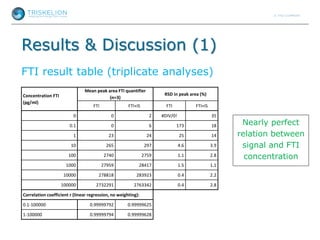
Results & Discussion (1)
Concentration FTI
(pg/ml)
Mean peak area FTI quantifier
(n=3)
RSD in peak area (%)
FTI FTI+IS FTI FTI+IS
0 0 2 #DIV/0! 35
0.1 0 6 173 18
1 23 24 25 14
10 265 297 4.6 3.9
100 2740 2759 1.1 2.8
1000 27959 28417 1.5 1.1
10000 278818 283923 0.4 2.2
100000 2732291 2763342 0.4 2.8
Correlation coefficient r (linear regression, no weighting):
0.1-100000 0.99999792 0.99999625
1-100000 0.99999794 0.99999628
FTI result table (triplicate analyses)
Nearly perfect
relation between
signal and FTI
concentration
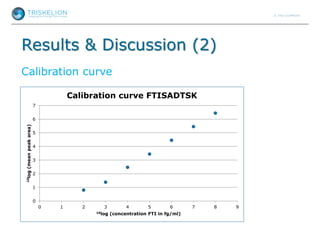
Results & Discussion (2)
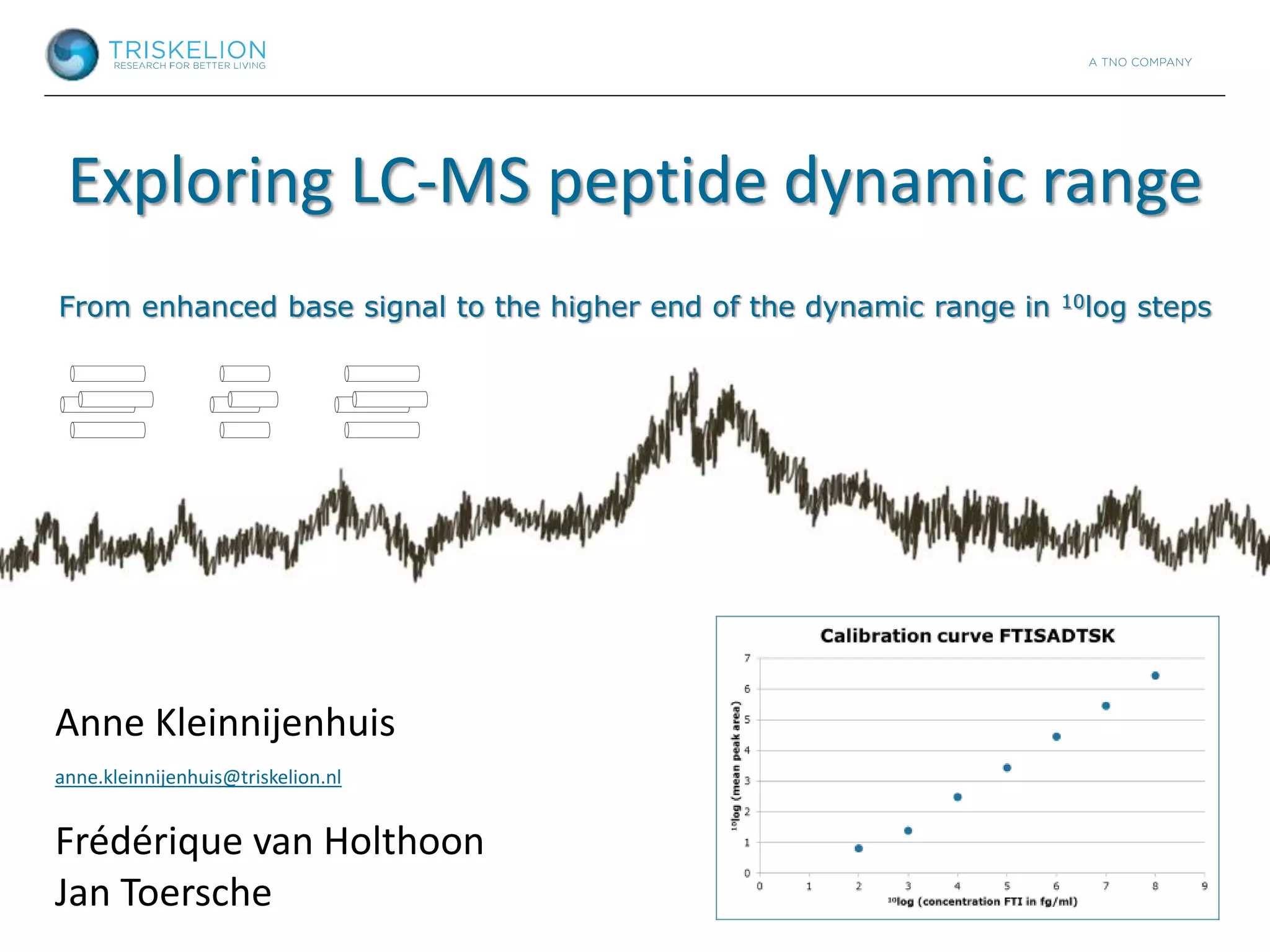
Calibration curve
0
1
2
3
4
5
6
7
0 1 2 3 4 5 6 7 8 9
10log(meanpeakarea)
10log (concentration FTI in fg/ml)
Calibration curve FTISADTSK
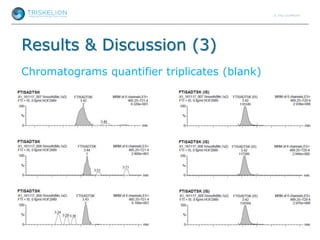
Results & Discussion (3)
Chromatograms quantifier triplicates (blank)
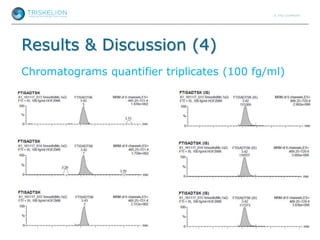
Results & Discussion (4)
Chromatograms quantifier triplicates (100 fg/ml)
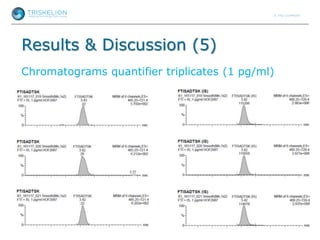
Results & Discussion (5)
Chromatograms quantifier triplicates (1 pg/ml)
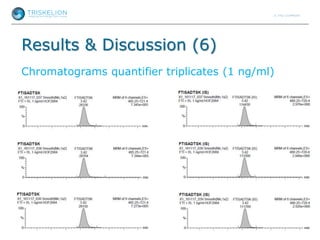
Results & Discussion (6)
Chromatograms quantifier triplicates (1 ng/ml)
Results & Discussion (7)
General remarks
Dynamic range at least 6 orders of magnitude.
Enhanced FTI analyte base signal and higher precision at lower FTI
concentrations after addition of FTI IS.
Linear behavior between 1 and 100000 pg/ml, r = 0.99999x.
The study was performed in pure solvents. It is assumed that the
presence of similar compounds and/or matrix complexity could also
result in enhanced base signal.
Enhanced base signal effect is attributed to the SIL IS attenuation of
factors which deteriorate method performance for an analyte, e.g.
adsorption.
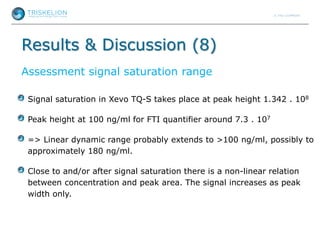
Results & Discussion (8)
Assessment signal saturation range
Signal saturation in Xevo TQ-S takes place at peak height 1.342 . 108
Peak height at 100 ng/ml for FTI quantifier around 7.3 . 107
=> Linear dynamic range probably extends to >100 ng/ml, possibly to
approximately 180 ng/ml.
Close to and/or after signal saturation there is a non-linear relation
between concentration and peak area. The signal increases as peak
width only.
Results & Discussion (9)
Assessment detection limit range
Base signal enhanced at 100 fg/ml after addition of FTI IS.
Enhancement effect might be more pronounced for analytes which
have major analytical issues. FTI is relatively straightforward to
analyze.
Below 1 pg/ml non-linear behavior of FTI signal.
However, signal still present at 100 fg/ml.
RSD in FTI peak area increases at lower concentrations.
Results & Discussion (10)
Expanding the opposite extremes of the linear range
Solutions for expanding the linear range near the detection limit:
Increase injection volume
Increase dwell time
Use smaller scale LC / nanospray
Solutions for expanding the linear range near signal saturation:
Decrease injection volume
Decrease dwell time
Use less intense transition
Use lower-abundance isotope as precursor
Deoptimize parameters e.g. cone voltage or needle position.
However, suboptimal settings could increase analytical variation.
Apply saturation correction algorithm.
Results & Discussion (11)
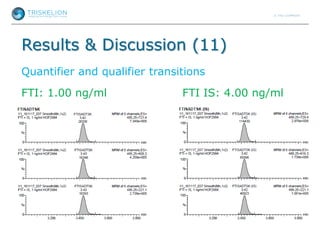
Quantifier and qualifier transitions
FTI: 1.00 ng/ml FTI IS: 4.00 ng/ml
Results & Discussion (12)
Ion ratios
Ion ratios are reproducible and similar between FTI and FTI IS
because the MS/MS settings were matched.
As expected, the presence of a C-terminal stable isotope labeled K
does not have a large impact on fragmentation behavior of FTI (IS).
By matching MS/MS settings for FTI and FTI IS, the latter can be used
as internal standard as well as calibrant, see also the next 2 slides.
Ion ratios
FTI: 0.1-100 ng/ml
FTI IS: 4 ng/ml
[M+2H]2+ => y7
+ / y6
+ [M+2H]2+ => y7
+ / a2
+ [M+2H]2+ => y6
+ / a2
+
FTI FTI IS FTI FTI IS FTI FTI IS
Average (n=24 for
FTI, n =24 for FTI IS)
1.72 1.72 2.68 2.69 1.56 1.56
RSD (%) 2.4 1.1 3.9 3.2 3.6 2.4
Results & Discussion (13)
Comparison FTI and FTI IS absolute signals (1)
Response factor comparison. FTI 1 pg/ml to 100 ng/ml.
FTI IS always 4 ng/ml
FTI: 27138 peak area per ng/ml (n=36, RSD 6.7%).
FTI IS: 28639 peak area per ng/ml (n=24, RSD 1.2%).
Experimental peak area ratio FTI IS / FTI = 1.06
Results & Discussion (14)
Comparison FTI and FTI IS absolute signals (2)
Calculation theoretical peak area ratio (Bioanalysis 2016, 8, 891-904):
(Fraction 1st isotope FTI IS / fraction 1st isotope FTI) multiplied by
(Molecular weight FTI / molecular weight FTI IS).
(0.6289 / 0.5855) * (969.05 / 976.99) = 1.07
Theoretical peak area ratio = 1.07
Only 1.0 % bias compared to 1.06 experimental peak area ratio.
=> Absolute signals reproducible and similar between FTI and FTI IS.
Conclusions
Dynamic range at least 6 orders of magnitude.
Enhanced analyte base signal and higher precision at lower FTI
concentrations through addition of FTI IS.
Only 1.00 fg or 1.03 amol FTI injected at lowest concentration 100
fg/ml.
Linear behavior between 1 and 100000 pg/ml.
Ion ratios and absolute signals reproducible and similar between FTI
and FTI IS.

Exploring LC-MS peptide dynamic range

  • 1.
    Exploring LC-MS peptidedynamic range From enhanced base signal to the higher end of the dynamic range in 10log steps Anne Kleinnijenhuis anne.kleinnijenhuis@triskelion.nl Frédérique van Holthoon Jan Toersche
  • 2.
    Aim of thestudy We observed that addition of a suitable internal standard can enhance the analyte signal at lower concentrations. Usually the most suitable IS is a stable isotope labeled internal standard (SIL IS) due to the almost identical properties. FTISADTSK (tryptic trastuzumab peptide, FTI) was analyzed using UPLC-MS/MS (triple quadrupole) in the absence and presence of FTISADTSK-13C6 15N2 (FTI IS) to investigate the effect of the presence of SIL IS on the analyte base signal. In addition the extent of the dynamic range, ion ratios and absolute signals were investigated.
  • 3.
    Experimental (1) Preparation ofstock solutions and reagents Diluent: 0.5% TFA, 1% FA, 10% ACN in MQ. FTI 4 µg/ml stock: dissolve 1 nmol (99.2% purity) in 240 µl diluent. FTI IS 4 µg/ml stock: dissolve 1 nmol (96.8% purity) in 236 µl diluent. FTI IS diluent (4 ng/ml): dilute FTI IS 4 µg/ml stock 1000-fold with diluent.
  • 4.
    Experimental (2) Preparation ofcalibration samples Calibration sample Solution Volume (µl) Solution Volume (µl) End volume (µl) FTI 100 ng/ml FTI 4 µg/ml 25 Diluent 975 1000 FTI 10 ng/ml FTI 100 ng/ml 100 Diluent 900 1000 FTI 1 ng/ml FTI 10 ng/ml 100 Diluent 900 1000 FTI 100 pg/ml FTI 1 ng/ml 100 Diluent 900 1000 FTI 10 pg/ml FTI 100 pg/ml 100 Diluent 900 1000 FTI 1 pg/ml FTI 10 pg/ml 100 Diluent 900 1000 FTI 100 fg/ml FTI 1 pg/ml 100 Diluent 900 1000 FTI 0 fg/ml - - Diluent 200 200 Calibration sample Solution Volume (µl) Solution Volume (µl) End volume (µl) FTI 100 ng/ml + IS FTI 4 µg/ml 25 FTI IS diluent 975 1000 FTI 10 ng/ml + IS FTI 100 ng/ml + IS 100 FTI IS diluent 900 1000 FTI 1 ng/ml + IS FTI 10 ng/ml + IS 100 FTI IS diluent 900 1000 FTI 100 pg/ml + IS FTI 1 ng/ml + IS 100 FTI IS diluent 900 1000 FTI 10 pg/ml + IS FTI 100 pg/ml + IS 100 FTI IS diluent 900 1000 FTI 1 pg/ml + IS FTI 10 pg/ml + IS 100 FTI IS diluent 900 1000 FTI 100 fg/ml + IS FTI 1 pg/ml + IS 100 FTI IS diluent 900 1000 FTI 0 fg/ml + IS - - FTI IS diluent 200 200
  • 5.
    Experimental (3) Parameter Setting UPLCAcquity (Waters) Column temperature (°C) 40 Column Acquity HSS T3, 100 x 2.1 mm, 1.8 µm (Waters) Flow rate (µl/min) 500 Mobile phase A 0.1% FA in MQ Mobile phase B 0.1% FA in ACN Injection volume 10 µl (full loop) Mass spectrometer Xevo TQ-S (Waters) Ionization mode Electrospray ionization (positive mode) Source temperature (°C) 150 Desolvation temperature (°C) 600 Cone gas flow (L/h) 150 Desolvation gas flow (L/h) 1200 UPLC and MS general parameters
  • 6.
    Experimental (4) UPLC gradient Time(min) Mobile phase A (%) Mobile phase B (%) Divert valve 0 92 8 Waste 0.5 LC 1 92 8 6.5 73 27 6.75 5 95 7 5 95 7.25 92 8 8 92 8 Waste
  • 7.
    Experimental (5) MS/MS conditions PeptidePrecursor ion (m/z) Product ion (m/z) Dwell time (ms) Cone (V) Collision energy (eV) Assignment FTISADTSK 485.25 721.4 608.3 221.1 52 52 52 16 16 16 12 12 10 [M+2H]2+ => y7 + [M+2H]2+ => y6 + [M+2H]2+ => a2 + FTISADTSK-13C6 15N2 (SIL IS) 489.25 729.4 616.3 221.1 52 52 52 16 16 16 12 12 10 [M+2H]2+ => y7 + [M+2H]2+ => y6 + [M+2H]2+ => a2 + Quantifiers are underlined. FTI and FTI IS MS/MS settings were matched.
  • 8.
    Results & Discussion(1) Concentration FTI (pg/ml) Mean peak area FTI quantifier (n=3) RSD in peak area (%) FTI FTI+IS FTI FTI+IS 0 0 2 #DIV/0! 35 0.1 0 6 173 18 1 23 24 25 14 10 265 297 4.6 3.9 100 2740 2759 1.1 2.8 1000 27959 28417 1.5 1.1 10000 278818 283923 0.4 2.2 100000 2732291 2763342 0.4 2.8 Correlation coefficient r (linear regression, no weighting): 0.1-100000 0.99999792 0.99999625 1-100000 0.99999794 0.99999628 FTI result table (triplicate analyses) Nearly perfect relation between signal and FTI concentration
  • 9.
    Results & Discussion(2) Calibration curve 0 1 2 3 4 5 6 7 0 1 2 3 4 5 6 7 8 9 10log(meanpeakarea) 10log (concentration FTI in fg/ml) Calibration curve FTISADTSK
  • 10.
    Results & Discussion(3) Chromatograms quantifier triplicates (blank)
  • 11.
    Results & Discussion(4) Chromatograms quantifier triplicates (100 fg/ml)
  • 12.
    Results & Discussion(5) Chromatograms quantifier triplicates (1 pg/ml)
  • 13.
    Results & Discussion(6) Chromatograms quantifier triplicates (1 ng/ml)
  • 14.
    Results & Discussion(7) General remarks Dynamic range at least 6 orders of magnitude. Enhanced FTI analyte base signal and higher precision at lower FTI concentrations after addition of FTI IS. Linear behavior between 1 and 100000 pg/ml, r = 0.99999x. The study was performed in pure solvents. It is assumed that the presence of similar compounds and/or matrix complexity could also result in enhanced base signal. Enhanced base signal effect is attributed to the SIL IS attenuation of factors which deteriorate method performance for an analyte, e.g. adsorption.
  • 15.
    Results & Discussion(8) Assessment signal saturation range Signal saturation in Xevo TQ-S takes place at peak height 1.342 . 108 Peak height at 100 ng/ml for FTI quantifier around 7.3 . 107 => Linear dynamic range probably extends to >100 ng/ml, possibly to approximately 180 ng/ml. Close to and/or after signal saturation there is a non-linear relation between concentration and peak area. The signal increases as peak width only.
  • 16.
    Results & Discussion(9) Assessment detection limit range Base signal enhanced at 100 fg/ml after addition of FTI IS. Enhancement effect might be more pronounced for analytes which have major analytical issues. FTI is relatively straightforward to analyze. Below 1 pg/ml non-linear behavior of FTI signal. However, signal still present at 100 fg/ml. RSD in FTI peak area increases at lower concentrations.
  • 17.
    Results & Discussion(10) Expanding the opposite extremes of the linear range Solutions for expanding the linear range near the detection limit: Increase injection volume Increase dwell time Use smaller scale LC / nanospray Solutions for expanding the linear range near signal saturation: Decrease injection volume Decrease dwell time Use less intense transition Use lower-abundance isotope as precursor Deoptimize parameters e.g. cone voltage or needle position. However, suboptimal settings could increase analytical variation. Apply saturation correction algorithm.
  • 18.
    Results & Discussion(11) Quantifier and qualifier transitions FTI: 1.00 ng/ml FTI IS: 4.00 ng/ml
  • 19.
    Results & Discussion(12) Ion ratios Ion ratios are reproducible and similar between FTI and FTI IS because the MS/MS settings were matched. As expected, the presence of a C-terminal stable isotope labeled K does not have a large impact on fragmentation behavior of FTI (IS). By matching MS/MS settings for FTI and FTI IS, the latter can be used as internal standard as well as calibrant, see also the next 2 slides. Ion ratios FTI: 0.1-100 ng/ml FTI IS: 4 ng/ml [M+2H]2+ => y7 + / y6 + [M+2H]2+ => y7 + / a2 + [M+2H]2+ => y6 + / a2 + FTI FTI IS FTI FTI IS FTI FTI IS Average (n=24 for FTI, n =24 for FTI IS) 1.72 1.72 2.68 2.69 1.56 1.56 RSD (%) 2.4 1.1 3.9 3.2 3.6 2.4
  • 20.
    Results & Discussion(13) Comparison FTI and FTI IS absolute signals (1) Response factor comparison. FTI 1 pg/ml to 100 ng/ml. FTI IS always 4 ng/ml FTI: 27138 peak area per ng/ml (n=36, RSD 6.7%). FTI IS: 28639 peak area per ng/ml (n=24, RSD 1.2%). Experimental peak area ratio FTI IS / FTI = 1.06
  • 21.
    Results & Discussion(14) Comparison FTI and FTI IS absolute signals (2) Calculation theoretical peak area ratio (Bioanalysis 2016, 8, 891-904): (Fraction 1st isotope FTI IS / fraction 1st isotope FTI) multiplied by (Molecular weight FTI / molecular weight FTI IS). (0.6289 / 0.5855) * (969.05 / 976.99) = 1.07 Theoretical peak area ratio = 1.07 Only 1.0 % bias compared to 1.06 experimental peak area ratio. => Absolute signals reproducible and similar between FTI and FTI IS.
  • 22.
    Conclusions Dynamic range atleast 6 orders of magnitude. Enhanced analyte base signal and higher precision at lower FTI concentrations through addition of FTI IS. Only 1.00 fg or 1.03 amol FTI injected at lowest concentration 100 fg/ml. Linear behavior between 1 and 100000 pg/ml. Ion ratios and absolute signals reproducible and similar between FTI and FTI IS.