Faculty Advisor: Dr. George Fu
Team Leader: Matthew Usry
Group Members: Abel Sualevai
Andrew Waters
Taylor Vail
Bernard Scott
 Introduction
 Objectives

and Scope
 Materials and Methods
 Results & Discussion
 Conclusions
 Further Studies
**Images obtained from Georgia Power
 Georgia

Power plants
produce an immense
amount of coal/fly ash
 Physical properties of fly
ash that provide means
for filtration/treatment of
some types of
wastewaters, such as
pulp mill effluent
produced at the
Weyerhaeuser plant.
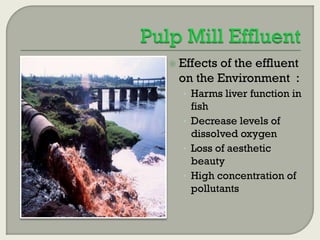
 Effects

of the effluent
on the Environment :
• Harms liver function in

fish
• Decrease levels of
dissolved oxygen
• Loss of aesthetic
beauty
• High concentration of
pollutants
•

•

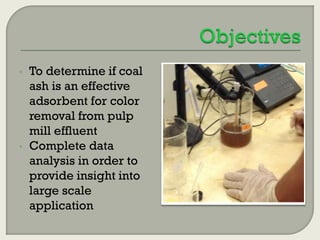
To determine if coal
ash is an effective
adsorbent for color
removal from pulp
mill effluent
Complete data
analysis in order to
provide insight into
large scale
application
 The

focus will be on such affection
factors for color removal efficiency:
• The dosage of ash
• Shake speed
• Contact Time

 Kinetic

Study to determine equilibrium

time
 Isotherm study performed to model the
adsorption mechanism


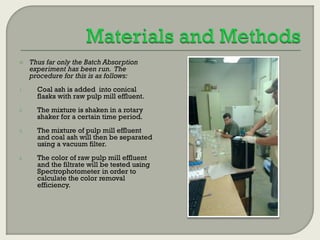
Thus far only the Batch Absorption
experiment has been run. The
procedure for this is as follows:

1.

Coal ash is added into conical
flasks with raw pulp mill effluent.

2.

The mixture is shaken in a rotary
shaker for a certain time period.

3.

The mixture of pulp mill effluent
and coal ash will then be separated
using a vacuum filter.

4.

The color of raw pulp mill effluent
and the filtrate will be tested using
Spectrophotometer in order to
calculate the color removal
efficiency.
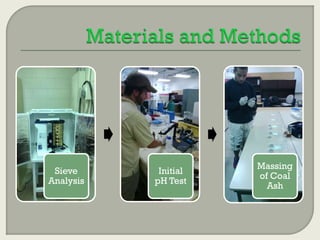
Sieve
Analysis

Initial
pH Test

Massing
of Coal
Ash
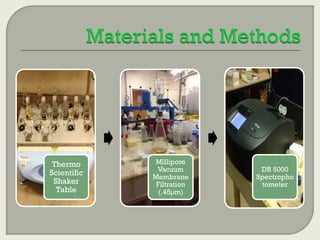
Thermo
Scientific
Shaker
Table

Millipore
Vacuum
Membrane
Filtration
(.45µm)

DR 5000
Spectropho
tometer
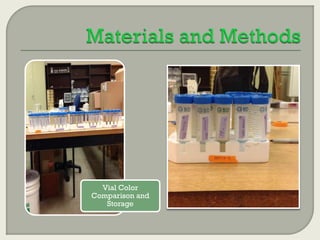
Vial Color
Comparison and
Storage
Measurement
Mass (g)

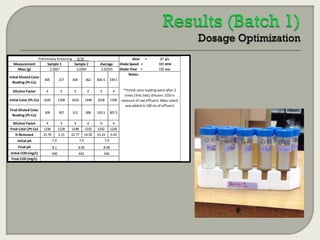
Preliminary Screening __9/18___
Sample 1
Sample 2
2.0267
2.0204

Average
2.02355

Initial Diluted Color
Reading (Pt-Co)

405

317

404

362

404.5

4

4

4

4

4

4

Initial Color (Pt-Co)

1620

1268

1616

1448

1618

1358

Final Diluted Color
Reading (Pt-Co)

309

307

312

308

310.5

307.5

Dilution Factor
Final Color (Pt-Co)
% Removed

4
1236
23.70

4
1228
3.15

4
1248
22.77

4
1232
14.92

4
1242
23.24

4
1230
9.43

20 g/L
300 RPM
720 min

339.5

Dilution Factor

Dose =
Shake Speed =
Shake Time =
Notes:

Initial pH

7.9

7.9

7.9

Final pH

8.1

8.06

8.08

Initial COD (mg/L)
Final COD (mg/L)

430

442

436

**Initial color reading were after 2
times (5mL:5mL) diltuion. COD is
measure of raw effluent. Mass noted
was added to 100 mL of effluent
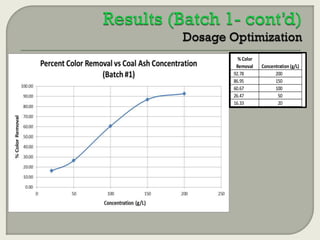
% Color
Removal
92.78
86.95
60.67
26.47
16.33

Concentration (g/L)
200
150
100
50
20
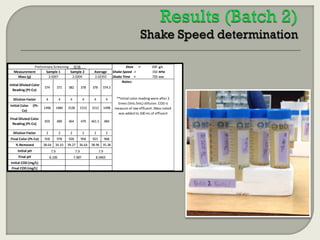
Preliminary Screening __9/18___
Measurement
Sample 1
Sample 2
Mass (g)
2.0267
2.0204

Average
2.02355

Initial Diluted Color
Reading (Pt-Co)

374

371

382

378

378

4

4

4

4

4

4

1496

1484

1528

1512

1512

1498

459

489

464

479

461.5

484

100 g/L
150 RPM
720 min

374.5

Dilution Factor

Dose =
Shake Speed =
Shake Time =
Notes:

Initial Color
Co)

(Pt-

Final Diluted Color
Reading (Pt-Co)
Dilution Factor

2

2

2

2

2

2

Final Color (Pt-Co)

918

978

928

958

923

968

% Removed

38.64

34.10

39.27

36.64

38.96 35.38

Initial pH

7.9

7.9

7.9

Final pH

8.106

7.987

8.0465

Initial COD (mg/L)
Final COD (mg/L)

**Initial color reading were after 2
times (5mL:5mL) diltuion. COD is
measure of raw effluent. Mass noted
was added to 100 mL of effluent
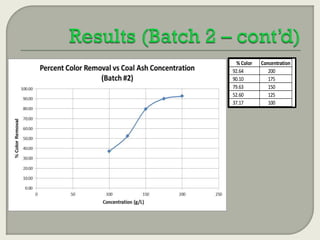
% Color
92.64
90.10
79.63
52.60
37.17

Concentration
200
175
150
125
100
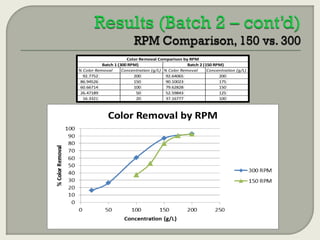
Color Removal Comparison by RPM
Batch 1 (300 RPM)
Batch 2 (150 RPM)
% Color Removal
Concentration (g/L) % Color Removal
Concentration (g/L)
92.7752
200
92.64065
200
86.94526
150
90.10023
175
60.66714
100
79.62828
150
26.47189
50
52.59843
125
16.3321
20
37.16777
100
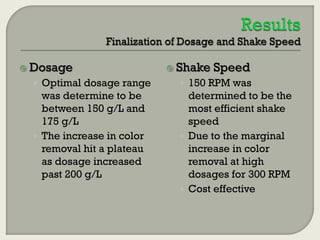
 Dosage

 Shake

Speed

• Optimal dosage range

• 150 RPM was

was determine to be
between 150 g/L and
175 g/L
• The increase in color
removal hit a plateau
as dosage increased
past 200 g/L

determined to be the
most efficient shake
speed
• Due to the marginal
increase in color
removal at high
dosages for 300 RPM
• Cost effective
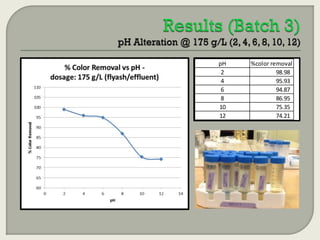
pH
2
4
6
8
10
12

%color removal
98.98
95.93
94.87
86.95
75.35
74.21
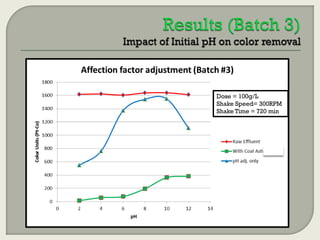
Dose = 100g/L
Shake Speed= 300RPM
Shake Time = 720 min
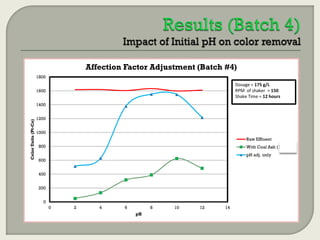
Affection Factor Adjustment (Batch #4)
1800

Dosage = 175 g/L
RPM of shaker = 150
Shake Time = 12 hours

1600

Color Units (Pt-Co)

1400
1200
1000
Raw Effluent
800

With Coal Ash (100g/L)
pH adj. only

600
400
200
0
0

2

4

6

8
pH

10

12

14
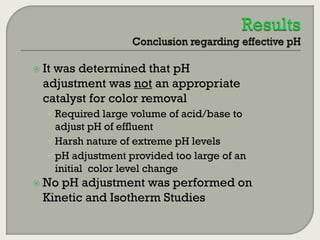
 It

was determined that pH
adjustment was not an appropriate
catalyst for color removal
 Required large volume of acid/base to

adjust pH of effluent
 Harsh nature of extreme pH levels
 pH adjustment provided too large of an
initial color level change
 No

pH adjustment was performed on
Kinetic and Isotherm Studies
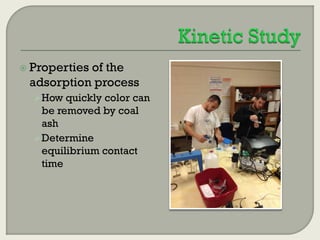
 Properties

of the
adsorption process
 How quickly color can

be removed by coal
ash
 Determine
equilibrium contact
time
Time
(min)
5
10
15
30
60
120
240
360
720
1440
2880

Color Units vs Time
1200

Color Units (Pt-Co)

1000

800

600

400

200

12 hr
0
0

10

20

30
Time (Hours)

40

50

60

Final Color Reading
(Pt-Co)
987
962
949
902
865
719
660
597
348.75
345.75
322

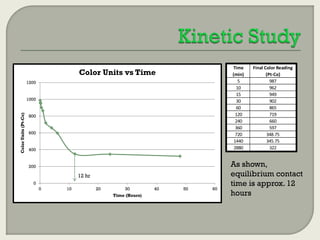
As shown,
equilibrium contact
time is approx. 12
hours



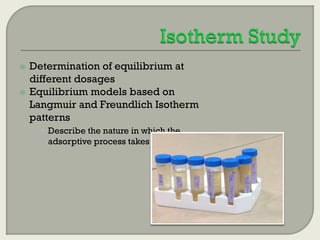
Determination of equilibrium at
different dosages
Equilibrium models based on
Langmuir and Freundlich Isotherm
patterns
 Describe the nature in which the
adsorptive process takes place
Process:



Relates the adsorption of
mono-layer molecules onto a
solid surface area to
concentration of
adsorbate

Langmuir Isotherm
Equation is:
[non-linear]
[Linear]

*note: linear Langmuir
equation is in y=mx+b
form

1/Ce
0.00073
0.001071
0.001718
0.002677
0.004878
0.005563
0.005814

Expected Asorption Rate (q)
19.72386588

mg/g

b
-2.729

Langmuir Isotherm Model

0.12

1/adsorption capacity (1/qe)



1/qe
0.097491
0.019339
0.014456
0.013972
0.014126
0.015801
0.017695

0.1
y = -7.2275x + 0.0507
R² = 0.2583

0.08
0.06
0.04
0.02
0
0

0.001

0.002
0.003
0.004
0.005
0.006
Concentration of Color at Equilibrium (Ce)

0.007
Process:

o

Relation of concentration
of a solute on the surface
of the media to the
concentration of solute left
in liquid

Freundlich
Isotherm Equation
is:

[non-linear]

[Linear]

*note: linear Freundlich
equation is in y=mx+b
form, but on log scale

Log Ce
3.136403
2.970347
2.764923
2.572291
2.311754
2.254669
2.235528

K
3.153

1/n
-0.5617

Freundlich Isotherm Model
2.000
1.800
1.600
1.400

log (qe)



log (qe )
1.011
1.714
1.840
1.855
1.850
1.801
1.752

1.200
y = -0.5617x + 3.153
R² = 0.4494

1.000
0.800
0.600
0.400
0.200
0.000
1.5

2

2.5
Log Ce

3

3.5


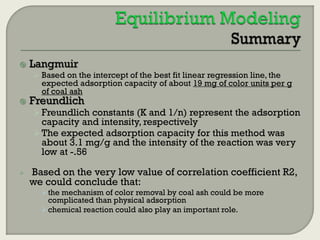
Langmuir
 Based on the intercept of the best fit linear regression line, the

expected adsorption capacity of about 19 mg of color units per g
of coal ash



Freundlich

 Freundlich constants (K and 1/n) represent the adsorption

capacity and intensity, respectively
 The expected adsorption capacity for this method was
about 3.1 mg/g and the intensity of the reaction was very
low at -.56


Based on the very low value of correlation coefficient R2,
we could conclude that:
the mechanism of color removal by coal ash could be more
complicated than physical adsorption
chemical reaction could also play an important role.







Dosage optimization was first performed and was
found to be approx. 175 g/L
Optimal shake speed was found to be 150 RPM as the
difference in color removal of 300 RPM was marginally
greater
Equilibrium contact time was determined to be
approximately 12 hours (720 min) from the Kinetic
Study
The Isotherm models suggested that the adsorptive
process taking place was not efficient and could be
more complicated than physical adsorption and
chemical reaction could also play an important role
 Received

Georgia Southern Undergraduate
Research Grant
 Submitted complete abstract of our research
for the “National Conference of Undergraduate
Research at Columbus University” in
Columbus, GA
 Plan to submit abstract and poster for
Undergraduate Research Symposium on our
campus Spring 2014
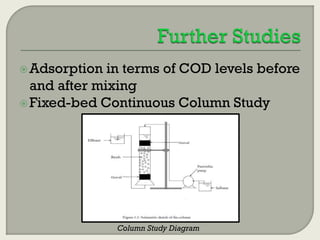
 Adsorption

in terms of COD levels before
and after mixing
 Fixed-bed Continuous Column Study

Column Study Diagram
Color Removal

Color Removal

  • 1.
    Faculty Advisor: Dr.George Fu Team Leader: Matthew Usry Group Members: Abel Sualevai Andrew Waters Taylor Vail Bernard Scott
  • 2.
     Introduction  Objectives andScope  Materials and Methods  Results & Discussion  Conclusions  Further Studies
  • 3.
  • 4.
     Georgia Power plants producean immense amount of coal/fly ash  Physical properties of fly ash that provide means for filtration/treatment of some types of wastewaters, such as pulp mill effluent produced at the Weyerhaeuser plant.
  • 5.
     Effects of theeffluent on the Environment : • Harms liver function in fish • Decrease levels of dissolved oxygen • Loss of aesthetic beauty • High concentration of pollutants
  • 6.
    • • To determine ifcoal ash is an effective adsorbent for color removal from pulp mill effluent Complete data analysis in order to provide insight into large scale application
  • 7.
     The focus willbe on such affection factors for color removal efficiency: • The dosage of ash • Shake speed • Contact Time  Kinetic Study to determine equilibrium time  Isotherm study performed to model the adsorption mechanism
  • 8.
     Thus far onlythe Batch Absorption experiment has been run. The procedure for this is as follows: 1. Coal ash is added into conical flasks with raw pulp mill effluent. 2. The mixture is shaken in a rotary shaker for a certain time period. 3. The mixture of pulp mill effluent and coal ash will then be separated using a vacuum filter. 4. The color of raw pulp mill effluent and the filtrate will be tested using Spectrophotometer in order to calculate the color removal efficiency.
  • 9.
  • 10.
  • 11.
  • 12.
    Measurement Mass (g) Preliminary Screening__9/18___ Sample 1 Sample 2 2.0267 2.0204 Average 2.02355 Initial Diluted Color Reading (Pt-Co) 405 317 404 362 404.5 4 4 4 4 4 4 Initial Color (Pt-Co) 1620 1268 1616 1448 1618 1358 Final Diluted Color Reading (Pt-Co) 309 307 312 308 310.5 307.5 Dilution Factor Final Color (Pt-Co) % Removed 4 1236 23.70 4 1228 3.15 4 1248 22.77 4 1232 14.92 4 1242 23.24 4 1230 9.43 20 g/L 300 RPM 720 min 339.5 Dilution Factor Dose = Shake Speed = Shake Time = Notes: Initial pH 7.9 7.9 7.9 Final pH 8.1 8.06 8.08 Initial COD (mg/L) Final COD (mg/L) 430 442 436 **Initial color reading were after 2 times (5mL:5mL) diltuion. COD is measure of raw effluent. Mass noted was added to 100 mL of effluent
  • 13.
  • 14.
    Preliminary Screening __9/18___ Measurement Sample1 Sample 2 Mass (g) 2.0267 2.0204 Average 2.02355 Initial Diluted Color Reading (Pt-Co) 374 371 382 378 378 4 4 4 4 4 4 1496 1484 1528 1512 1512 1498 459 489 464 479 461.5 484 100 g/L 150 RPM 720 min 374.5 Dilution Factor Dose = Shake Speed = Shake Time = Notes: Initial Color Co) (Pt- Final Diluted Color Reading (Pt-Co) Dilution Factor 2 2 2 2 2 2 Final Color (Pt-Co) 918 978 928 958 923 968 % Removed 38.64 34.10 39.27 36.64 38.96 35.38 Initial pH 7.9 7.9 7.9 Final pH 8.106 7.987 8.0465 Initial COD (mg/L) Final COD (mg/L) **Initial color reading were after 2 times (5mL:5mL) diltuion. COD is measure of raw effluent. Mass noted was added to 100 mL of effluent
  • 15.
  • 16.
    Color Removal Comparisonby RPM Batch 1 (300 RPM) Batch 2 (150 RPM) % Color Removal Concentration (g/L) % Color Removal Concentration (g/L) 92.7752 200 92.64065 200 86.94526 150 90.10023 175 60.66714 100 79.62828 150 26.47189 50 52.59843 125 16.3321 20 37.16777 100
  • 17.
     Dosage  Shake Speed •Optimal dosage range • 150 RPM was was determine to be between 150 g/L and 175 g/L • The increase in color removal hit a plateau as dosage increased past 200 g/L determined to be the most efficient shake speed • Due to the marginal increase in color removal at high dosages for 300 RPM • Cost effective
  • 18.
  • 19.
    Dose = 100g/L ShakeSpeed= 300RPM Shake Time = 720 min
  • 20.
    Affection Factor Adjustment(Batch #4) 1800 Dosage = 175 g/L RPM of shaker = 150 Shake Time = 12 hours 1600 Color Units (Pt-Co) 1400 1200 1000 Raw Effluent 800 With Coal Ash (100g/L) pH adj. only 600 400 200 0 0 2 4 6 8 pH 10 12 14
  • 21.
     It was determinedthat pH adjustment was not an appropriate catalyst for color removal  Required large volume of acid/base to adjust pH of effluent  Harsh nature of extreme pH levels  pH adjustment provided too large of an initial color level change  No pH adjustment was performed on Kinetic and Isotherm Studies
  • 22.
     Properties of the adsorptionprocess  How quickly color can be removed by coal ash  Determine equilibrium contact time
  • 23.
    Time (min) 5 10 15 30 60 120 240 360 720 1440 2880 Color Units vsTime 1200 Color Units (Pt-Co) 1000 800 600 400 200 12 hr 0 0 10 20 30 Time (Hours) 40 50 60 Final Color Reading (Pt-Co) 987 962 949 902 865 719 660 597 348.75 345.75 322 As shown, equilibrium contact time is approx. 12 hours
  • 24.
      Determination of equilibriumat different dosages Equilibrium models based on Langmuir and Freundlich Isotherm patterns  Describe the nature in which the adsorptive process takes place
  • 25.
    Process:  Relates the adsorptionof mono-layer molecules onto a solid surface area to concentration of adsorbate Langmuir Isotherm Equation is: [non-linear] [Linear] *note: linear Langmuir equation is in y=mx+b form 1/Ce 0.00073 0.001071 0.001718 0.002677 0.004878 0.005563 0.005814 Expected Asorption Rate (q) 19.72386588 mg/g b -2.729 Langmuir Isotherm Model 0.12 1/adsorption capacity (1/qe)  1/qe 0.097491 0.019339 0.014456 0.013972 0.014126 0.015801 0.017695 0.1 y = -7.2275x + 0.0507 R² = 0.2583 0.08 0.06 0.04 0.02 0 0 0.001 0.002 0.003 0.004 0.005 0.006 Concentration of Color at Equilibrium (Ce) 0.007
  • 26.
    Process: o Relation of concentration ofa solute on the surface of the media to the concentration of solute left in liquid Freundlich Isotherm Equation is: [non-linear] [Linear] *note: linear Freundlich equation is in y=mx+b form, but on log scale Log Ce 3.136403 2.970347 2.764923 2.572291 2.311754 2.254669 2.235528 K 3.153 1/n -0.5617 Freundlich Isotherm Model 2.000 1.800 1.600 1.400 log (qe)  log (qe ) 1.011 1.714 1.840 1.855 1.850 1.801 1.752 1.200 y = -0.5617x + 3.153 R² = 0.4494 1.000 0.800 0.600 0.400 0.200 0.000 1.5 2 2.5 Log Ce 3 3.5
  • 27.
     Langmuir  Based onthe intercept of the best fit linear regression line, the expected adsorption capacity of about 19 mg of color units per g of coal ash  Freundlich  Freundlich constants (K and 1/n) represent the adsorption capacity and intensity, respectively  The expected adsorption capacity for this method was about 3.1 mg/g and the intensity of the reaction was very low at -.56  Based on the very low value of correlation coefficient R2, we could conclude that: the mechanism of color removal by coal ash could be more complicated than physical adsorption chemical reaction could also play an important role.
  • 28.
        Dosage optimization wasfirst performed and was found to be approx. 175 g/L Optimal shake speed was found to be 150 RPM as the difference in color removal of 300 RPM was marginally greater Equilibrium contact time was determined to be approximately 12 hours (720 min) from the Kinetic Study The Isotherm models suggested that the adsorptive process taking place was not efficient and could be more complicated than physical adsorption and chemical reaction could also play an important role
  • 29.
     Received Georgia SouthernUndergraduate Research Grant  Submitted complete abstract of our research for the “National Conference of Undergraduate Research at Columbus University” in Columbus, GA  Plan to submit abstract and poster for Undergraduate Research Symposium on our campus Spring 2014
  • 30.
     Adsorption in termsof COD levels before and after mixing  Fixed-bed Continuous Column Study Column Study Diagram