EXPLORATORY RESEARCH
ANDREE C. SWANSON, EDD, MHR, MAOM
FORBES SCHOOL OF BUSINESS, ASHFORD UNIVERSITY
MANDATED RESEARCH REQUIREMENTS = FEAR
WHY RESEARCH?
 “… research-based scholarly
activity helps the individual
faculty member to become a
better teacher.”
(Richard & Parker, 1992, p. 79)
 “… leads to new and useful
theories…”
(Armstrong)
THEORY-BASED RESEARCH
BOYER AND DEWEY
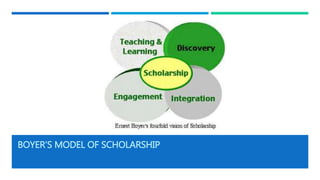
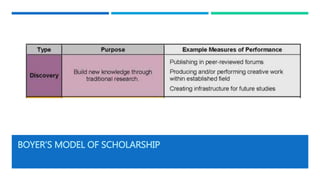
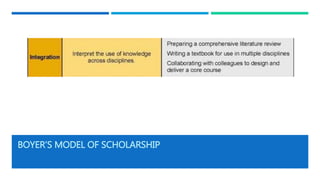
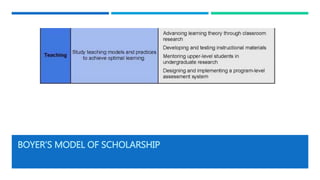
BOYER’S MODEL OF SCHOLARSHIP
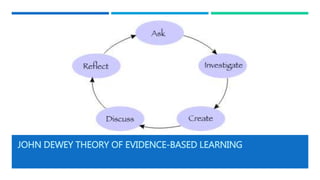
JOHN DEWEY THEORY OF EVIDENCE-BASED LEARNING
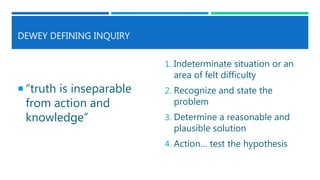
DEWEY DEFINING INQUIRY
 “truth is inseparable
from action and
knowledge”
1. Indeterminate situation or an
area of felt difficulty
2. Recognize and state the
problem
3. Determine a reasonable and
plausible solution
4. Action… test the hypothesis
WHY CONDUCT EXPLORATORY RESEARCH?
RESEARCH AND TEACHING
 Necessary ingredient in
effective teaching
 Improves the practice of a
particular discipline
 Perpetuates the discipline
 All faculty should teach and
transmit knowledge
(Richard & Parker, 1992, p. 79)
HIGHLIGHTS OF EXPLORATORY RESEARCH
 Initial research conducted to
clarify and define the nature of
a problem
 Does not provide conclusive
evidence
 Subsequent research expected
 May not be as rigorous
 Sample sizes may be small
 Results may lead to your
next study
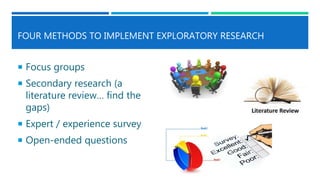
FOUR METHODS TO IMPLEMENT EXPLORATORY RESEARCH
 Focus groups
 Secondary research (a
literature review… find the
gaps)
 Expert / experience survey
 Open-ended questions
EXPERIENCE SURVEYS (EXPERT INTERVIEWS)
 Select a topic for a
research problem
 Ask knowledgeable
individuals
 Conduct interviews
 Conduct surveys
Surveymonkey
Qualtrics
PILOT STUDY
 Any small scale exploratory
study that uses sampling
 Does not apply rigorous
standards
 Not necessary to use…
 Validated survey tools
 May generate a survey
tool or theory from the
research results
CASE STUDY METHOD
 Intensely investigates one
or a few situations similar
to the problem
 Investigate in depth
 Careful study
 May require…
 Cooperation
 Permission
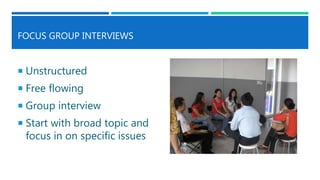
FOCUS GROUP INTERVIEWS
 Unstructured
 Free flowing
 Group interview
 Start with broad topic and
focus in on specific issues
GROUP COMPOSITION
 6 to 10 people
 Relatively homogeneous
 Similar lifestyles and
experiences
IRB APPROVAL Don’t forget to run ALL research through your Institution’s
Review Board.
QUALITATIVE RESEARCH VERSUS QUANTITATIVE
RESEARCH DESIGN
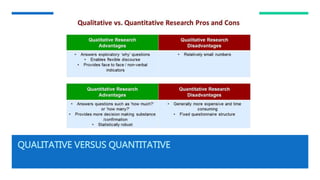
QUALITATIVE VERSUS QUANTITATIVE
ROLE PLAY
 Let’s consider some topics
for potential research
BIOGRAPHY
DR. ANDREE SWANSON
FORBES SCHOOL OF BUSINESS AT ASHFORD UNIVERSITY
 Assistant Professor and Chair of the Bachelors of Arts in Business Leadership, Forbes
College of Business at Ashford University
 Ed.D. Educational Leadership, University of Phoenix
 MA, Organizational Management, University of Phoenix
 MHR, Human Relations, University of Oklahoma
 BS, Business Management and Administration, University of Maryland (European
Division)
 Worked as a Dean of General Education, National Training Manager, and the US
government (DoD, USAF, & USA), corporations, and higher education.
DR. ANDREE SWANSON
© 2014, Dr. Andree Swanson

Exploratory Research

  • 1.
    EXPLORATORY RESEARCH ANDREE C.SWANSON, EDD, MHR, MAOM FORBES SCHOOL OF BUSINESS, ASHFORD UNIVERSITY
  • 2.
  • 3.
    WHY RESEARCH?  “…research-based scholarly activity helps the individual faculty member to become a better teacher.” (Richard & Parker, 1992, p. 79)  “… leads to new and useful theories…” (Armstrong)
  • 4.
  • 5.
    BOYER’S MODEL OFSCHOLARSHIP
  • 6.
    BOYER’S MODEL OFSCHOLARSHIP
  • 7.
    BOYER’S MODEL OFSCHOLARSHIP
  • 8.
    BOYER’S MODEL OFSCHOLARSHIP
  • 9.
    BOYER’S MODEL OFSCHOLARSHIP
  • 10.
    BOYER’S MODEL OFSCHOLARSHIP
  • 11.
    JOHN DEWEY THEORYOF EVIDENCE-BASED LEARNING
  • 12.
    DEWEY DEFINING INQUIRY “truth is inseparable from action and knowledge” 1. Indeterminate situation or an area of felt difficulty 2. Recognize and state the problem 3. Determine a reasonable and plausible solution 4. Action… test the hypothesis
  • 13.
  • 14.
    RESEARCH AND TEACHING Necessary ingredient in effective teaching  Improves the practice of a particular discipline  Perpetuates the discipline  All faculty should teach and transmit knowledge (Richard & Parker, 1992, p. 79)
  • 15.
    HIGHLIGHTS OF EXPLORATORYRESEARCH  Initial research conducted to clarify and define the nature of a problem  Does not provide conclusive evidence  Subsequent research expected  May not be as rigorous  Sample sizes may be small  Results may lead to your next study
  • 16.
    FOUR METHODS TOIMPLEMENT EXPLORATORY RESEARCH  Focus groups  Secondary research (a literature review… find the gaps)  Expert / experience survey  Open-ended questions
  • 17.
    EXPERIENCE SURVEYS (EXPERTINTERVIEWS)  Select a topic for a research problem  Ask knowledgeable individuals  Conduct interviews  Conduct surveys Surveymonkey Qualtrics
  • 18.
    PILOT STUDY  Anysmall scale exploratory study that uses sampling  Does not apply rigorous standards  Not necessary to use…  Validated survey tools  May generate a survey tool or theory from the research results
  • 19.
    CASE STUDY METHOD Intensely investigates one or a few situations similar to the problem  Investigate in depth  Careful study  May require…  Cooperation  Permission
  • 20.
    FOCUS GROUP INTERVIEWS Unstructured  Free flowing  Group interview  Start with broad topic and focus in on specific issues
  • 21.
    GROUP COMPOSITION  6to 10 people  Relatively homogeneous  Similar lifestyles and experiences
  • 22.
    IRB APPROVAL Don’tforget to run ALL research through your Institution’s Review Board.
  • 23.
    QUALITATIVE RESEARCH VERSUSQUANTITATIVE RESEARCH DESIGN
  • 24.
  • 25.
    ROLE PLAY  Let’sconsider some topics for potential research
  • 26.
    BIOGRAPHY DR. ANDREE SWANSON FORBESSCHOOL OF BUSINESS AT ASHFORD UNIVERSITY
  • 27.
     Assistant Professorand Chair of the Bachelors of Arts in Business Leadership, Forbes College of Business at Ashford University  Ed.D. Educational Leadership, University of Phoenix  MA, Organizational Management, University of Phoenix  MHR, Human Relations, University of Oklahoma  BS, Business Management and Administration, University of Maryland (European Division)  Worked as a Dean of General Education, National Training Manager, and the US government (DoD, USAF, & USA), corporations, and higher education. DR. ANDREE SWANSON © 2014, Dr. Andree Swanson