TELKOMNIKA, Vol.15, No.2, June 2017, pp. 726~732
ISSN: 1693-6930, accredited A by DIKTI, Decree No: 58/DIKTI/Kep/2013
DOI: 10.12928/TELKOMNIKA.v15i2.6121  726
Received February 5, 2017; Revised April 18, 2017; Accepted May 3, 2017
Human Re-identification with Global and Local Siamese
Convolution Neural Network
K. B. Low*
1
, U. U. Sheikh
2
Faculty of Electrical Engineering, Universiti Teknologi Malaysia, 81310, Johor Bahru, Malaysia
Corresponding author, e-mail: kblow2@live.utm.my*
1
, usman@fke.utm.my
2
Abstract
Human re-identification is an important task in surveillance system to determine
whether the same human re-appears in multiple cameras with disjoint views. Mostly,
appearance based approaches are used to perform human re-identification task because they
are less constrained than biometric based approaches. Most of the research works apply hand-
crafted feature extractors and then simple matching methods are used. However, designing a
robust and stable feature requires expert knowledge and takes time to tune the features. In this
paper, we propose a global and local structure of Siamese Convolution Neural Network which
automatically extracts features from input images to perform human re-identification task.
Besides, most of the current human re-identification tasks in single-shot approaches do not
consider occlusion issue due to lack of tracking information. Therefore, we apply a decision
fusion technique to combine global and local features for occlusion cases in single-shot
approaches.
Keywords: siamese network, convolution neural network, human re-identification, surveillance
system
Copyright © 2017 Universitas Ahmad Dahlan. All rights reserved.
1. Introduction
In recent years, human re-identification task has acquired a lot of attention from
researchers because it is a core task in surveillance system. It can be divided into two
approaches which are biometric based approaches and appearance based approaches.
Biometric based approaches such as iris, fingerprint, face, ears and gait recognition require
specific sensors to perform the recognition task. Besides, biometric based approaches hardly
perform well in wide area surveillance system due to the low resolution of images. Hence,
appearance based approaches are popular to be used in human re-identification task because it
is less constrained than biometric approaches and are suitable for surveillance system.
Appearance based approaches can be divided into two categories which are single-shot
approaches [1-11] and multiple-shot approaches [8, 9], [12-17]. These approaches are
determined by the number of images that are used to create their representation. Since single-
shot approaches only use single image per person in each camera, therefore it does not contain
tracking information like multiple-shot approaches. However, more complex algorithms are
required to exploit information from multiple images for multiple-shot approaches.
Human re-identification is a challenging task due to the viewpoint, human pose and
orientation, illumination and background variations. Most of the researchers are focusing on the
design of hand-crafted features to perform a stable and robust human representation and then
apply a simple matching such as Bhattacharyya distance and L1-norm, L2-norm based distance
to determine the similarity. For example, shape and appearance context model is proposed by
Wang et al. [3]. In their proposed method, the human image is segmented into regions and their
spatial color information is registered into a co-occurrence matrix. Their approach works well
when human is seen from similar viewpoints. Cai et al [6] proposed a patchbased approach by
using Canny edge detection algorithm. Extracted patches are represented by most dominant
color and frequency within the patch. Sequence-to-sequence matching is used in their
approach. However, their algorithm is computationally expensive. In [7], Bak et al performed
TELKOMNIKA ISSN: 1693-6930 
Human Re-identification with Global and Local Siamese Convolution Neural… (K. B. Low)
727
person re-identification task by using spatial covariance regions of their body parts. Four human
body parts which are torso, left arm, right arm and legs are detected by Histogram of Oriented
Gradients (HOG). Cheng et al [9] applied pictorial structures model for part based human
detection. They computed HSV histograms and MSCRs based on different body parts.
However, the approach proposed by [7] and [9] performs well only when the pose estimators
work accurately. Farenzena et al [8] extracted three types of features which are weighted color
histograms, maximally stable color regions (MSCR) and recurrent high-structured patches
(RHSP) to model human appearance. Besides, they exploit symmetry property in human
images to minimize the effect of view variation. Although their proposed method achieves
certain robustness, it is quite time consuming to extract these three features. To deal with pose
variations, Gheissari et al [12] fit a decomposable triangulated graph to capture the spatial
distribution of the local descriptors over time. However, the drawback of their approach is similar
to [3] that is, it is only applicable for human seen from similar viewpoints.
Besides hand-crafted feature design approach, metric learning based method is another
research direction for researchers to perform human re-identification task. For metric learning
based method, simplefeatures are extracted and similarity distance is measured by using a
distance metric. The goal of metric learning based method is to minimize the similarity distance
for similar pairs and maximize the distance for dissimilar pairs. Dikmen et al [10] proposed the
Large Margin Nearest Neighbor (LMNN-R) algorithm to learn the most effective metric. Their
metric learning method typically requires enormous labeled target pairs. Zheng et al [11]
presented a Probabilistic Relative Distance Comparison (PRDC) model which focused on
maximizing the probability that a similar pair have smaller distance. Nevertheless, in their
method, noise information of features was not taken into consideration.
In a nutshell, designing and learning a robust and stable feature still remains an open
problem to perform human re-identification task. One direction is to use deep learning methods
as it integrates both feature extraction and metric learning in a single framework. Until now,
there are only several papers on reidentification task by using deep learning methods. Li et al
[18] proposed deep filter pairing neural network (FPNN) to handle photometric and geometric
transformations. Their proposed method was the first work that applied deep learning in human
re-identification task. Another deep learning work which used Siamese Convolution Neural
Network (SCNN) is presented in [19]. SCNN architecture consists of two sub-networks which
are connected by similarity layers. Three overlapping body parts are used to extract features
and compute similarity metric separately. Final similarity score is obtained by summing up these
three similarity metrics.
2. Research Approach
Convolution Neural Network (CNN) consists of multiple layers with combination of
convolution layers, pooling layers and fully connected layer. Convolution layer is used to detect
same features at different locations in input image. Activation function is applied on feature
maps which are computed from convolution layer. Pooling layer reduces the spatial resolution of
each input feature map to achieve certain degree of shift, distortion and small tranformations
invariance. Fully connected layer is applied after convolution and pooling layers. CNN is one
kind of deep neural network. It works based on three basic ideas which are local receptive
fields, shared weights and pooling. It has less parameters than fully connected networks due to
its shared weights and local receptive field properties. Therefore, training a CNN is faster than
fully connected networks. The advantage of CNN is that it can automatically extract features
from 2D input images.
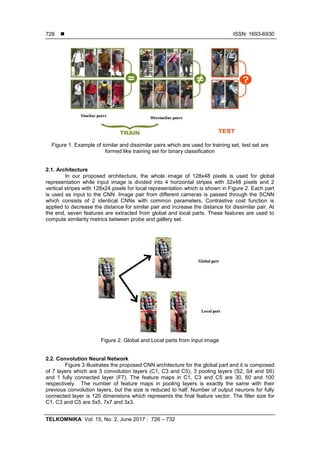
Subjects in training set are generally different than in testing set, therefore SCNN is
used to make the person re-identification task as binary classification which is “sample pair with
label” mode that is shown in Figure 1. In this paper, we propose a SCNN for global and local
structures to perform person reidentification task.
 ISSN: 1693-6930
TELKOMNIKA Vol. 15, No. 2, June 2017 : 726 – 732
728
Figure 1. Example of similar and dissimilar pairs which are used for training set, test set are
formed like training set for binary classification
2.1. Architecture
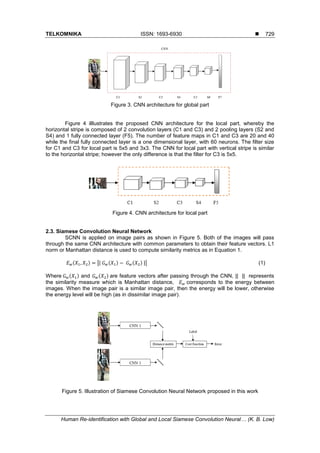
In our proposed architecture, the whole image of 128x48 pixels is used for global
representation while input image is divided into 4 horizontal stripes with 32x48 pixels and 2
vertical stripes with 128x24 pixels for local representation which is shown in Figure 2. Each part
is used as input to the CNN. Image pair from different cameras is passed through the SCNN
which consists of 2 identical CNNs with common parameters. Contrastive cost function is
applied to decrease the distance for similar pair and increase the distance for dissimilar pair. At
the end, seven features are extracted from global and local parts. These features are used to
compute similarity metrics between probe and gallery set.
Figure 2. Global and Local parts from input image
2.2. Convolution Neural Network
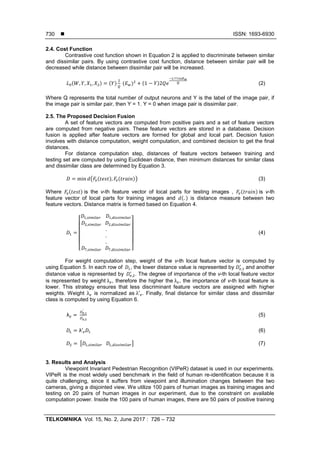
Figure 3 illustrates the proposed CNN architecture for the global part and it is composed
of 7 layers which are 3 convolution layers (C1, C3 and C5), 3 pooling layers (S2, S4 and S6)
and 1 fully connected layer (F7). The feature maps in C1, C3 and C5 are 30, 60 and 100
respectively. The number of feature maps in pooling layers is exactly the same with their
previous convolution layers, but the size is reduced to half. Number of output neurons for fully
connected layer is 120 dimensions which represents the final feature vector. The filter size for
C1, C3 and C5 are 5x5, 7x7 and 3x3.
TELKOMNIKA ISSN: 1693-6930 
Human Re-identification with Global and Local Siamese Convolution Neural… (K. B. Low)
729
Figure 3. CNN architecture for global part
Figure 4 illlustrates the proposed CNN architecture for the local part, whereby the
horizontal stripe is composed of 2 convolution layers (C1 and C3) and 2 pooling layers (S2 and
S4) and 1 fully connected layer (F5). The number of feature maps in C1 and C3 are 20 and 40
while the final fully connected layer is a one dimensional layer, with 60 neurons. The filter size
for C1 and C3 for local part is 5x5 and 3x3. The CNN for local part with vertical stripe is similar
to the horizontal stripe; however the only difference is that the filter for C3 is 5x5.
Figure 4. CNN architecture for local part
2.3. Siamese Convolution Neural Network
SCNN is applied on image pairs as shown in Figure 5. Both of the images will pass
through the same CNN architecture with common parameters to obtain their feature vectors. L1
norm or Manhattan distance is used to compute similarity metrics as in Equation 1.
(1)
Where and are feature vectors after passing through the CNN, || || represents
the similarity measure which is Manhattan distance, corresponds to the energy between
images. When the image pair is a similar image pair, then the energy will be lower, otherwise
the energy level will be high (as in dissimilar image pair).
Figure 5. Illustration of Siamese Convolution Neural Network proposed in this work
 ISSN: 1693-6930
TELKOMNIKA Vol. 15, No. 2, June 2017 : 726 – 732
730
2.4. Cost Function
Contrastive cost function shown in Equation 2 is applied to discriminate between similar
and dissimilar pairs. By using contrastive cost function, distance between similar pair will be
decreased while distance between dissimilar pair will be increased.
(2)
Where Q represents the total number of output neurons and Y is the label of the image pair, if
the image pair is similar pair, then Y = 1. Y = 0 when image pair is dissimilar pair.
2.5. The Proposed Decision Fusion
A set of feature vectors are computed from positive pairs and a set of feature vectors
are computed from negative pairs. These feature vectors are stored in a database. Decision
fusion is applied after feature vectors are formed for global and local part. Decision fusion
involves with distance computation, weight computation, and combined decision to get the final
distances.
For distance computation step, distances of feature vectors between training and
testing set are computed by using Euclidean distance, then minimum distances for similar class
and dissimilar class are determined by Equation 3.
(3)
Where is the v-th feature vector of local parts for testing images , is v-th
feature vector of local parts for training images and is distance measure between two
feature vectors. Distance matrix is formed based on Equation 4.
(4)
For weight computation step, weight of the v-th local feature vector is computed by
using Equation 5. In each row of , the lower distance value is represented by and another
distance value is represented by . The degree of importance of the v-th local feature vector
is represented by weight , therefore the higher the , the importance of v-th local feature is
lower. This strategy ensures that less discriminant feature vectors are assigned with higher
weights. Weight is normalized as . Finally, final distance for similar class and dissimilar
class is computed by using Equation 6.
(5)
(6)
(7)
3. Results and Analysis
Viewpoint Invariant Pedestrian Recognition (VIPeR) dataset is used in our experiments.
VIPeR is the most widely used benchmark in the field of human re-identification because it is
quite challenging, since it suffers from viewpoint and illumination changes between the two
cameras, giving a disjointed view. We utilize 100 pairs of human images as training images and
testing on 20 pairs of human images in our experiment, due to the constraint on available
computation power. Inside the 100 pairs of human images, there are 50 pairs of positive training
TELKOMNIKA ISSN: 1693-6930 
Human Re-identification with Global and Local Siamese Convolution Neural… (K. B. Low)
731
images, which are the same human images captured with the same cameras. The 50 pairs of
negative training images are randomly paired between two cameras with different humans.
3.1. Implementation Details
Input images that are going to be passed to the SCNN architecture will undergo simple
pre-processing steps. Color equalization method is applied on the raw image to reduce
illumination variations between different cameras. After that, input image after color equalization
is normalized so that it is in the range of 0 and 1.There are many activation functions which can
be used in CNN such as sigmoid, tanh, hypertanh and Rectified Linear Unit (ReLu) activation
function. In our proposed work, we chose ReLu as the activation function because it does not
face gradient vanishing problem as with sigmoid and tanh function. ReLu is the most popular
activation function in deep networks nowadays.
A pre-trained model is learned by using CUHK-02 dataset. Parameters of deep network
are initialized by the pre-trained model and then whole network is fine tuned by backpropagation
with VIPeR dataset.
3.2. Experimental Results
Cumulative Matching Characteristic (CMC) curve and normalized Area Under Curve
(nAUC) score for CMC curve are used to represent the performance of our proposed method.
Expectation of finding correct match in the top n matches is represented by CMC and how well
our method performs overall is represented by the nAUC.
In Table 1, nAUC for global and local SCNN is 95.75% which is better than using local
part SCNN (95.50%) and global part SCNN (91%). For occlusion case, the nAUC for global and
local SCNN (77.5%) is still better than local SCNN (75.50%) and global SCNN (76.5%) (Table
2). Global SCNN represents feature vectors that are extracted from the whole image while local
SCNN represents feature vectors that are extracted from part of the image. Feature vectors that
are extracted from global and local SCNN are complementary to each other.
Table 3 shows that nAUC for our proposed method (95.75%) is better than DML
method (82%) when there is no occlusion. In occlusion cases, nAUC of our proposed method
(77.5%) still performs better than DML method (47.50%) significantly. Our proposed method
performs better when occlusion occurs due to our decision fusion part for global and local
SCNN. Decision fusion is used to fuse global and local features and weighting scheme is
applied to balance the importance of global and local information. When there is occlusion in the
image, feature vectors extracted from occlusion part contains less discriminant feature vectors,
therefore it should be assigned with higher weights. More reliable discriminant feature vectors
will be assigned with a lower weight.
Table 1. The performance of our proposed method when there is no occlusion.
No occlusion CMC nAUC
Global and Local SCNN 65 75 85 90 100 100 100 100 100 95.75
Local SCNN 60 80 90 95 95 95 95 100 100 95.50
Global SCNN 45 70 75 75 90 90 95 95 95 91.00
Table 2. The performance of our proposed method perform when occlusion occur.
Occlusion CMC nAUC
Global and Local SCNN 30 45 55 60 70 70 75 75 75 77.50
Local SCNN 25 40 40 55 55 60 70 75 80 75.50
Global SCNN 25 35 45 55 60 70 75 75 80 76.50
Table 3. Comparison between the proposed method and DML method.
CMC nAUC
No Occlusion
Global and Local SCNN 65 75 85 90 100 100 100 100 100 95.75
DML [19] 35 45 50 50 60 65 80 85 90 82.00
Occlusion
Global and Local SCNN 30 45 55 60 70 70 75 75 75 77.50
DML 0 5 5 10 20 30 35 35 40 47.50
 ISSN: 1693-6930
TELKOMNIKA Vol. 15, No. 2, June 2017 : 726 – 732
732
4. Conclusion
In a nutshell, our proposed method which integrates both global and local structures of
SCNN and the proposed decision fusion has shown good result in handling human re-
identification task. Our experiments have shown that fusing both global and local SCNN is better
than only applying local part or global part alone. The proposed method was also evaluated in
the case of occlusion and performed better than existing work.
Acknowledgements
The authors would like to express their gratitude to Universiti Teknologi Malaysia (UTM)
for supporting this research work under GUP grant number Q.J130000.2523.11H73.
References
[1] J Kang, I Cohen, G Medioni. Object reacquisition using invariant appearance model. Proc. - Int. Conf.
Pattern Recognit. 2004; 4: 759-762.
[2] U Park, AK Jain, I Kitahara, K Kogure, N Hagita. ViSE: Visual Search Engine Using Multiple
Networked Cameras. 18th Int. Conf. Pattern Recognit. 2006; 3: 1204-1207.
[3] X Wang, G Doretto, T Sebastian, J Rittscher, P Tu. Shape and Appearance Context Modeling. Int.
Conf. Comput. Vis. 2007: 1-8.
[4] Y Yu, D Harwood, K Yoon, LS Davis. Human appearance modeling for matching across video
sequences. Mach. Vis. Appl. 2007; 18(3-4): 139-149.
[5] AC Gallagher, T Chen. Clothing cosegmentation for recognizing people. 26th IEEE Conf. Comput. Vis.
Pattern Recognition, CVPR. 2008.
[6] Y Cai, Huang, T Tan. Human appearance matching across multiple non-overlapping cameras. Icpr.
2008: 1-4.
[7] S Bak, E Corvee, F Bremond, M Thonnat. Person Re-identification Using Spatial Covariance Regions
of Human Body Parts. Int. Conf. Adv. Video Signal Based Surveill. 2010: 435-440.
[8] M Farenzena, L Bazzani, A Perina, V Murino, M Cristani. Person re-identification by symmetry-driven
accumulation of local features. Proc. IEEE Comput. Soc. Conf. Comput. Vis. Pattern Recognit. 2010:
2360-2367.
[9] VM Dong Seon Cheng, Marco Cristani, Michele Stoppa. Custom Pictorial Structures for Re-
identification. Bmvc. 2011: 1-11.
[10] M Dikmen, E Akbas, TS Huang, N Ahuja. Pedestrian recognition with a learned metric. Proc. Asian
Conf. Comput. Vision. 2011: 501-512.
[11] WS Zheng, S Gong, T Xiang. Person Re-identification by Probabilistic Relative Distance Comparison.
IEEE Trans. Pattern Anal. Mach. Intell. 2014; 35(3): 653-668.
[12] N Gheissari, TB Sebastian, PH Tu, J Rittscher, R Hartley. Person reidentification using
spatiotemporal appearance. Proc. IEEE Comput. Soc. Conf. Comput. Vis. Pattern Recognit. 2006; 2:
1528-1535.
[13] O Hamdoun, F Moutarde, B Stanciulescu, B Steux. Person Re-identification In Multi-camera System
By Signature Based On Interest Point Descriptors Collected On Short Video Sequences. Robotics.
2008: 1-5.
[14] L Bazzani, M Cristani, A Perina, M Farenzena, V Murino. Multiple-shot person re-identification by
HPE signature. Proc. - Int. Conf. Pattern Recognit. 2010: 1413-1416.
[15] A Bedagkar-Gala, SK Shah. Part-based spatio-temporal model for multi-person re-identification.
Pattern Recognit. Lett. 2012; 33(14): 1908-1915.
[16] B Ma, Y Su, F Jurie. BiCov: a novel image representation for person re-identification and face
verification. Procedings Br. Mach. Vis. Conf. 2012: 1-11.
[17] ak, E Corvee, F Brémond, M Thonnat. Multiple-shot human Re-identification by Mean
Riemannian Covariance Grid. 2011 8th IEEE Int. Conf. Adv. Video Signal Based Surveillance, AVSS
2011. 2011: 179-184.
[18] W Li, R Zhao, T Xiao, X Wang. DeepReID: Deep filter pairing neural network for person re-
identification. Proc. IEEE Comput. Soc. Conf. Comput. Vis. Pattern Recognit. 2014: 152-159.
[19] H Shi, X Zhu, S Liao, Z Lei, Y Yang, SZ Li. Deep Metric Learning for Person Re-identification. Proc.
Int. Conf. Pattern Recognit. 2014: 2666-2672.

Human Re-identification with Global and Local Siamese Convolution Neural Network

  • 1.
    TELKOMNIKA, Vol.15, No.2,June 2017, pp. 726~732 ISSN: 1693-6930, accredited A by DIKTI, Decree No: 58/DIKTI/Kep/2013 DOI: 10.12928/TELKOMNIKA.v15i2.6121  726 Received February 5, 2017; Revised April 18, 2017; Accepted May 3, 2017 Human Re-identification with Global and Local Siamese Convolution Neural Network K. B. Low* 1 , U. U. Sheikh 2 Faculty of Electrical Engineering, Universiti Teknologi Malaysia, 81310, Johor Bahru, Malaysia Corresponding author, e-mail: kblow2@live.utm.my* 1 , usman@fke.utm.my 2 Abstract Human re-identification is an important task in surveillance system to determine whether the same human re-appears in multiple cameras with disjoint views. Mostly, appearance based approaches are used to perform human re-identification task because they are less constrained than biometric based approaches. Most of the research works apply hand- crafted feature extractors and then simple matching methods are used. However, designing a robust and stable feature requires expert knowledge and takes time to tune the features. In this paper, we propose a global and local structure of Siamese Convolution Neural Network which automatically extracts features from input images to perform human re-identification task. Besides, most of the current human re-identification tasks in single-shot approaches do not consider occlusion issue due to lack of tracking information. Therefore, we apply a decision fusion technique to combine global and local features for occlusion cases in single-shot approaches. Keywords: siamese network, convolution neural network, human re-identification, surveillance system Copyright © 2017 Universitas Ahmad Dahlan. All rights reserved. 1. Introduction In recent years, human re-identification task has acquired a lot of attention from researchers because it is a core task in surveillance system. It can be divided into two approaches which are biometric based approaches and appearance based approaches. Biometric based approaches such as iris, fingerprint, face, ears and gait recognition require specific sensors to perform the recognition task. Besides, biometric based approaches hardly perform well in wide area surveillance system due to the low resolution of images. Hence, appearance based approaches are popular to be used in human re-identification task because it is less constrained than biometric approaches and are suitable for surveillance system. Appearance based approaches can be divided into two categories which are single-shot approaches [1-11] and multiple-shot approaches [8, 9], [12-17]. These approaches are determined by the number of images that are used to create their representation. Since single- shot approaches only use single image per person in each camera, therefore it does not contain tracking information like multiple-shot approaches. However, more complex algorithms are required to exploit information from multiple images for multiple-shot approaches. Human re-identification is a challenging task due to the viewpoint, human pose and orientation, illumination and background variations. Most of the researchers are focusing on the design of hand-crafted features to perform a stable and robust human representation and then apply a simple matching such as Bhattacharyya distance and L1-norm, L2-norm based distance to determine the similarity. For example, shape and appearance context model is proposed by Wang et al. [3]. In their proposed method, the human image is segmented into regions and their spatial color information is registered into a co-occurrence matrix. Their approach works well when human is seen from similar viewpoints. Cai et al [6] proposed a patchbased approach by using Canny edge detection algorithm. Extracted patches are represented by most dominant color and frequency within the patch. Sequence-to-sequence matching is used in their approach. However, their algorithm is computationally expensive. In [7], Bak et al performed
  • 2.
    TELKOMNIKA ISSN: 1693-6930 Human Re-identification with Global and Local Siamese Convolution Neural… (K. B. Low) 727 person re-identification task by using spatial covariance regions of their body parts. Four human body parts which are torso, left arm, right arm and legs are detected by Histogram of Oriented Gradients (HOG). Cheng et al [9] applied pictorial structures model for part based human detection. They computed HSV histograms and MSCRs based on different body parts. However, the approach proposed by [7] and [9] performs well only when the pose estimators work accurately. Farenzena et al [8] extracted three types of features which are weighted color histograms, maximally stable color regions (MSCR) and recurrent high-structured patches (RHSP) to model human appearance. Besides, they exploit symmetry property in human images to minimize the effect of view variation. Although their proposed method achieves certain robustness, it is quite time consuming to extract these three features. To deal with pose variations, Gheissari et al [12] fit a decomposable triangulated graph to capture the spatial distribution of the local descriptors over time. However, the drawback of their approach is similar to [3] that is, it is only applicable for human seen from similar viewpoints. Besides hand-crafted feature design approach, metric learning based method is another research direction for researchers to perform human re-identification task. For metric learning based method, simplefeatures are extracted and similarity distance is measured by using a distance metric. The goal of metric learning based method is to minimize the similarity distance for similar pairs and maximize the distance for dissimilar pairs. Dikmen et al [10] proposed the Large Margin Nearest Neighbor (LMNN-R) algorithm to learn the most effective metric. Their metric learning method typically requires enormous labeled target pairs. Zheng et al [11] presented a Probabilistic Relative Distance Comparison (PRDC) model which focused on maximizing the probability that a similar pair have smaller distance. Nevertheless, in their method, noise information of features was not taken into consideration. In a nutshell, designing and learning a robust and stable feature still remains an open problem to perform human re-identification task. One direction is to use deep learning methods as it integrates both feature extraction and metric learning in a single framework. Until now, there are only several papers on reidentification task by using deep learning methods. Li et al [18] proposed deep filter pairing neural network (FPNN) to handle photometric and geometric transformations. Their proposed method was the first work that applied deep learning in human re-identification task. Another deep learning work which used Siamese Convolution Neural Network (SCNN) is presented in [19]. SCNN architecture consists of two sub-networks which are connected by similarity layers. Three overlapping body parts are used to extract features and compute similarity metric separately. Final similarity score is obtained by summing up these three similarity metrics. 2. Research Approach Convolution Neural Network (CNN) consists of multiple layers with combination of convolution layers, pooling layers and fully connected layer. Convolution layer is used to detect same features at different locations in input image. Activation function is applied on feature maps which are computed from convolution layer. Pooling layer reduces the spatial resolution of each input feature map to achieve certain degree of shift, distortion and small tranformations invariance. Fully connected layer is applied after convolution and pooling layers. CNN is one kind of deep neural network. It works based on three basic ideas which are local receptive fields, shared weights and pooling. It has less parameters than fully connected networks due to its shared weights and local receptive field properties. Therefore, training a CNN is faster than fully connected networks. The advantage of CNN is that it can automatically extract features from 2D input images. Subjects in training set are generally different than in testing set, therefore SCNN is used to make the person re-identification task as binary classification which is “sample pair with label” mode that is shown in Figure 1. In this paper, we propose a SCNN for global and local structures to perform person reidentification task.
  • 3.
     ISSN: 1693-6930 TELKOMNIKAVol. 15, No. 2, June 2017 : 726 – 732 728 Figure 1. Example of similar and dissimilar pairs which are used for training set, test set are formed like training set for binary classification 2.1. Architecture In our proposed architecture, the whole image of 128x48 pixels is used for global representation while input image is divided into 4 horizontal stripes with 32x48 pixels and 2 vertical stripes with 128x24 pixels for local representation which is shown in Figure 2. Each part is used as input to the CNN. Image pair from different cameras is passed through the SCNN which consists of 2 identical CNNs with common parameters. Contrastive cost function is applied to decrease the distance for similar pair and increase the distance for dissimilar pair. At the end, seven features are extracted from global and local parts. These features are used to compute similarity metrics between probe and gallery set. Figure 2. Global and Local parts from input image 2.2. Convolution Neural Network Figure 3 illustrates the proposed CNN architecture for the global part and it is composed of 7 layers which are 3 convolution layers (C1, C3 and C5), 3 pooling layers (S2, S4 and S6) and 1 fully connected layer (F7). The feature maps in C1, C3 and C5 are 30, 60 and 100 respectively. The number of feature maps in pooling layers is exactly the same with their previous convolution layers, but the size is reduced to half. Number of output neurons for fully connected layer is 120 dimensions which represents the final feature vector. The filter size for C1, C3 and C5 are 5x5, 7x7 and 3x3.
  • 4.
    TELKOMNIKA ISSN: 1693-6930 Human Re-identification with Global and Local Siamese Convolution Neural… (K. B. Low) 729 Figure 3. CNN architecture for global part Figure 4 illlustrates the proposed CNN architecture for the local part, whereby the horizontal stripe is composed of 2 convolution layers (C1 and C3) and 2 pooling layers (S2 and S4) and 1 fully connected layer (F5). The number of feature maps in C1 and C3 are 20 and 40 while the final fully connected layer is a one dimensional layer, with 60 neurons. The filter size for C1 and C3 for local part is 5x5 and 3x3. The CNN for local part with vertical stripe is similar to the horizontal stripe; however the only difference is that the filter for C3 is 5x5. Figure 4. CNN architecture for local part 2.3. Siamese Convolution Neural Network SCNN is applied on image pairs as shown in Figure 5. Both of the images will pass through the same CNN architecture with common parameters to obtain their feature vectors. L1 norm or Manhattan distance is used to compute similarity metrics as in Equation 1. (1) Where and are feature vectors after passing through the CNN, || || represents the similarity measure which is Manhattan distance, corresponds to the energy between images. When the image pair is a similar image pair, then the energy will be lower, otherwise the energy level will be high (as in dissimilar image pair). Figure 5. Illustration of Siamese Convolution Neural Network proposed in this work
  • 5.
     ISSN: 1693-6930 TELKOMNIKAVol. 15, No. 2, June 2017 : 726 – 732 730 2.4. Cost Function Contrastive cost function shown in Equation 2 is applied to discriminate between similar and dissimilar pairs. By using contrastive cost function, distance between similar pair will be decreased while distance between dissimilar pair will be increased. (2) Where Q represents the total number of output neurons and Y is the label of the image pair, if the image pair is similar pair, then Y = 1. Y = 0 when image pair is dissimilar pair. 2.5. The Proposed Decision Fusion A set of feature vectors are computed from positive pairs and a set of feature vectors are computed from negative pairs. These feature vectors are stored in a database. Decision fusion is applied after feature vectors are formed for global and local part. Decision fusion involves with distance computation, weight computation, and combined decision to get the final distances. For distance computation step, distances of feature vectors between training and testing set are computed by using Euclidean distance, then minimum distances for similar class and dissimilar class are determined by Equation 3. (3) Where is the v-th feature vector of local parts for testing images , is v-th feature vector of local parts for training images and is distance measure between two feature vectors. Distance matrix is formed based on Equation 4. (4) For weight computation step, weight of the v-th local feature vector is computed by using Equation 5. In each row of , the lower distance value is represented by and another distance value is represented by . The degree of importance of the v-th local feature vector is represented by weight , therefore the higher the , the importance of v-th local feature is lower. This strategy ensures that less discriminant feature vectors are assigned with higher weights. Weight is normalized as . Finally, final distance for similar class and dissimilar class is computed by using Equation 6. (5) (6) (7) 3. Results and Analysis Viewpoint Invariant Pedestrian Recognition (VIPeR) dataset is used in our experiments. VIPeR is the most widely used benchmark in the field of human re-identification because it is quite challenging, since it suffers from viewpoint and illumination changes between the two cameras, giving a disjointed view. We utilize 100 pairs of human images as training images and testing on 20 pairs of human images in our experiment, due to the constraint on available computation power. Inside the 100 pairs of human images, there are 50 pairs of positive training
  • 6.
    TELKOMNIKA ISSN: 1693-6930 Human Re-identification with Global and Local Siamese Convolution Neural… (K. B. Low) 731 images, which are the same human images captured with the same cameras. The 50 pairs of negative training images are randomly paired between two cameras with different humans. 3.1. Implementation Details Input images that are going to be passed to the SCNN architecture will undergo simple pre-processing steps. Color equalization method is applied on the raw image to reduce illumination variations between different cameras. After that, input image after color equalization is normalized so that it is in the range of 0 and 1.There are many activation functions which can be used in CNN such as sigmoid, tanh, hypertanh and Rectified Linear Unit (ReLu) activation function. In our proposed work, we chose ReLu as the activation function because it does not face gradient vanishing problem as with sigmoid and tanh function. ReLu is the most popular activation function in deep networks nowadays. A pre-trained model is learned by using CUHK-02 dataset. Parameters of deep network are initialized by the pre-trained model and then whole network is fine tuned by backpropagation with VIPeR dataset. 3.2. Experimental Results Cumulative Matching Characteristic (CMC) curve and normalized Area Under Curve (nAUC) score for CMC curve are used to represent the performance of our proposed method. Expectation of finding correct match in the top n matches is represented by CMC and how well our method performs overall is represented by the nAUC. In Table 1, nAUC for global and local SCNN is 95.75% which is better than using local part SCNN (95.50%) and global part SCNN (91%). For occlusion case, the nAUC for global and local SCNN (77.5%) is still better than local SCNN (75.50%) and global SCNN (76.5%) (Table 2). Global SCNN represents feature vectors that are extracted from the whole image while local SCNN represents feature vectors that are extracted from part of the image. Feature vectors that are extracted from global and local SCNN are complementary to each other. Table 3 shows that nAUC for our proposed method (95.75%) is better than DML method (82%) when there is no occlusion. In occlusion cases, nAUC of our proposed method (77.5%) still performs better than DML method (47.50%) significantly. Our proposed method performs better when occlusion occurs due to our decision fusion part for global and local SCNN. Decision fusion is used to fuse global and local features and weighting scheme is applied to balance the importance of global and local information. When there is occlusion in the image, feature vectors extracted from occlusion part contains less discriminant feature vectors, therefore it should be assigned with higher weights. More reliable discriminant feature vectors will be assigned with a lower weight. Table 1. The performance of our proposed method when there is no occlusion. No occlusion CMC nAUC Global and Local SCNN 65 75 85 90 100 100 100 100 100 95.75 Local SCNN 60 80 90 95 95 95 95 100 100 95.50 Global SCNN 45 70 75 75 90 90 95 95 95 91.00 Table 2. The performance of our proposed method perform when occlusion occur. Occlusion CMC nAUC Global and Local SCNN 30 45 55 60 70 70 75 75 75 77.50 Local SCNN 25 40 40 55 55 60 70 75 80 75.50 Global SCNN 25 35 45 55 60 70 75 75 80 76.50 Table 3. Comparison between the proposed method and DML method. CMC nAUC No Occlusion Global and Local SCNN 65 75 85 90 100 100 100 100 100 95.75 DML [19] 35 45 50 50 60 65 80 85 90 82.00 Occlusion Global and Local SCNN 30 45 55 60 70 70 75 75 75 77.50 DML 0 5 5 10 20 30 35 35 40 47.50
  • 7.
     ISSN: 1693-6930 TELKOMNIKAVol. 15, No. 2, June 2017 : 726 – 732 732 4. Conclusion In a nutshell, our proposed method which integrates both global and local structures of SCNN and the proposed decision fusion has shown good result in handling human re- identification task. Our experiments have shown that fusing both global and local SCNN is better than only applying local part or global part alone. The proposed method was also evaluated in the case of occlusion and performed better than existing work. Acknowledgements The authors would like to express their gratitude to Universiti Teknologi Malaysia (UTM) for supporting this research work under GUP grant number Q.J130000.2523.11H73. References [1] J Kang, I Cohen, G Medioni. Object reacquisition using invariant appearance model. Proc. - Int. Conf. Pattern Recognit. 2004; 4: 759-762. [2] U Park, AK Jain, I Kitahara, K Kogure, N Hagita. ViSE: Visual Search Engine Using Multiple Networked Cameras. 18th Int. Conf. Pattern Recognit. 2006; 3: 1204-1207. [3] X Wang, G Doretto, T Sebastian, J Rittscher, P Tu. Shape and Appearance Context Modeling. Int. Conf. Comput. Vis. 2007: 1-8. [4] Y Yu, D Harwood, K Yoon, LS Davis. Human appearance modeling for matching across video sequences. Mach. Vis. Appl. 2007; 18(3-4): 139-149. [5] AC Gallagher, T Chen. Clothing cosegmentation for recognizing people. 26th IEEE Conf. Comput. Vis. Pattern Recognition, CVPR. 2008. [6] Y Cai, Huang, T Tan. Human appearance matching across multiple non-overlapping cameras. Icpr. 2008: 1-4. [7] S Bak, E Corvee, F Bremond, M Thonnat. Person Re-identification Using Spatial Covariance Regions of Human Body Parts. Int. Conf. Adv. Video Signal Based Surveill. 2010: 435-440. [8] M Farenzena, L Bazzani, A Perina, V Murino, M Cristani. Person re-identification by symmetry-driven accumulation of local features. Proc. IEEE Comput. Soc. Conf. Comput. Vis. Pattern Recognit. 2010: 2360-2367. [9] VM Dong Seon Cheng, Marco Cristani, Michele Stoppa. Custom Pictorial Structures for Re- identification. Bmvc. 2011: 1-11. [10] M Dikmen, E Akbas, TS Huang, N Ahuja. Pedestrian recognition with a learned metric. Proc. Asian Conf. Comput. Vision. 2011: 501-512. [11] WS Zheng, S Gong, T Xiang. Person Re-identification by Probabilistic Relative Distance Comparison. IEEE Trans. Pattern Anal. Mach. Intell. 2014; 35(3): 653-668. [12] N Gheissari, TB Sebastian, PH Tu, J Rittscher, R Hartley. Person reidentification using spatiotemporal appearance. Proc. IEEE Comput. Soc. Conf. Comput. Vis. Pattern Recognit. 2006; 2: 1528-1535. [13] O Hamdoun, F Moutarde, B Stanciulescu, B Steux. Person Re-identification In Multi-camera System By Signature Based On Interest Point Descriptors Collected On Short Video Sequences. Robotics. 2008: 1-5. [14] L Bazzani, M Cristani, A Perina, M Farenzena, V Murino. Multiple-shot person re-identification by HPE signature. Proc. - Int. Conf. Pattern Recognit. 2010: 1413-1416. [15] A Bedagkar-Gala, SK Shah. Part-based spatio-temporal model for multi-person re-identification. Pattern Recognit. Lett. 2012; 33(14): 1908-1915. [16] B Ma, Y Su, F Jurie. BiCov: a novel image representation for person re-identification and face verification. Procedings Br. Mach. Vis. Conf. 2012: 1-11. [17] ak, E Corvee, F Brémond, M Thonnat. Multiple-shot human Re-identification by Mean Riemannian Covariance Grid. 2011 8th IEEE Int. Conf. Adv. Video Signal Based Surveillance, AVSS 2011. 2011: 179-184. [18] W Li, R Zhao, T Xiao, X Wang. DeepReID: Deep filter pairing neural network for person re- identification. Proc. IEEE Comput. Soc. Conf. Comput. Vis. Pattern Recognit. 2014: 152-159. [19] H Shi, X Zhu, S Liao, Z Lei, Y Yang, SZ Li. Deep Metric Learning for Person Re-identification. Proc. Int. Conf. Pattern Recognit. 2014: 2666-2672.