MODULE IV
Expert System and Learning
B.Tech.(AI), IV
Artificial Intelligence (CSE 401)
Amity School of Engineering and Technology
Dr. Nidhi Mishra, Assistant Professor
Department of CSE, ASET
LEARNING OUTCOMES
• Students will be able to know about Expert System and
their importance in AI
• Students will be able to understand knowledge
acquisition, process of knowledge acquisition
What is an expert system?
3
“An expert system is a computer system that
emulates, or acts in all respects, with the decision-
making capabilities of a human expert.”
Professor Edward Feigenbaum
Stanford University
4
• Expert systems aimed to capture specialist human expertise
which was in short supply. Eg..,
– Medical expertise
– Computer configuration expertise.
– Expertise for oil exploration.
• Aim was to develop systems capturing this expertise, so the
knowledge could be deployed where experts were unavailable.
• Expert system (ES) are knowledge intensive programs that solve
problems in a domain that requires considerable amount of
technical expertise.
5
An Expert System (ES) is a computer-based system (mainly
software) that uses knowledge and facts, and apply an appropriate
reasoning technique (inferencing) to solve problems in a given
field (domain) that normally require the services of human
experts.
6
• Attempt to Imitate Expert Reasoning Processes and knowledge
in Solving Specific Problems
• Most Popular Applied AI Technology
– Enhance Productivity
– Augment Work Forces
• Narrow Problem-Solving Areas or Tasks
• Provide Direct Application of Expertise
• Expert Systems Do Not Replace Experts, But They
– Make their Knowledge and Experience More Widely
Available
– Permit Non experts toWork Better
Need & Justification for expert
systems- cognitive problems
7
• Expert systems are suitable for knowledge intensive problems
that are typically solved by human experts.
• Because expert systems depend on human knowledge, if
human experts are unable to solve a given problem, no
successful expert system can be developed to solve the problem
either.
• When the demand for human expertise surpasses the
availability of experts, an expert system may be the tool for
handling the situation.
• The justification of using an expert system for a selected
problem depends on the primary goal of the organization and
the types of alternatives available.
8
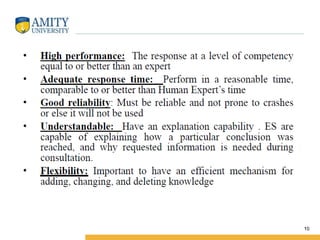
Characteristics of Expert System
9
10
Brief history
11
12
13
14
15
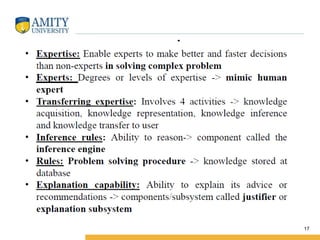
Basic Concept of ES
16
17
Designing Expert System
18
Architecture of Expert System
19
20
1. Knowledge Base
21
Using the Knowledge Base
22
2. User Interface
23
3. Inference Engine
24
4. Explanation facility
25
5. Knowledge Acquisition facility
26
6. External interface
27
This provides the communication link between the ES and the external
environment.
Expert System Shells
28
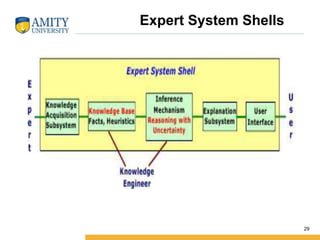
Expert System Shells
29

AI_Module_4_lecture_1.pptx

  • 1.
    MODULE IV Expert Systemand Learning B.Tech.(AI), IV Artificial Intelligence (CSE 401) Amity School of Engineering and Technology Dr. Nidhi Mishra, Assistant Professor Department of CSE, ASET
  • 2.
    LEARNING OUTCOMES • Studentswill be able to know about Expert System and their importance in AI • Students will be able to understand knowledge acquisition, process of knowledge acquisition
  • 3.
    What is anexpert system? 3 “An expert system is a computer system that emulates, or acts in all respects, with the decision- making capabilities of a human expert.” Professor Edward Feigenbaum Stanford University
  • 4.
    4 • Expert systemsaimed to capture specialist human expertise which was in short supply. Eg.., – Medical expertise – Computer configuration expertise. – Expertise for oil exploration. • Aim was to develop systems capturing this expertise, so the knowledge could be deployed where experts were unavailable. • Expert system (ES) are knowledge intensive programs that solve problems in a domain that requires considerable amount of technical expertise.
  • 5.
    5 An Expert System(ES) is a computer-based system (mainly software) that uses knowledge and facts, and apply an appropriate reasoning technique (inferencing) to solve problems in a given field (domain) that normally require the services of human experts.
  • 6.
    6 • Attempt toImitate Expert Reasoning Processes and knowledge in Solving Specific Problems • Most Popular Applied AI Technology – Enhance Productivity – Augment Work Forces • Narrow Problem-Solving Areas or Tasks • Provide Direct Application of Expertise • Expert Systems Do Not Replace Experts, But They – Make their Knowledge and Experience More Widely Available – Permit Non experts toWork Better
  • 7.
    Need & Justificationfor expert systems- cognitive problems 7 • Expert systems are suitable for knowledge intensive problems that are typically solved by human experts. • Because expert systems depend on human knowledge, if human experts are unable to solve a given problem, no successful expert system can be developed to solve the problem either. • When the demand for human expertise surpasses the availability of experts, an expert system may be the tool for handling the situation. • The justification of using an expert system for a selected problem depends on the primary goal of the organization and the types of alternatives available.
  • 8.
  • 9.
  • 10.
  • 11.
  • 12.
  • 13.
  • 14.
  • 15.
  • 16.
  • 17.
  • 18.
  • 19.
  • 20.
  • 21.
  • 22.
  • 23.
  • 24.
  • 25.
  • 26.
  • 27.
    6. External interface 27 Thisprovides the communication link between the ES and the external environment.
  • 28.
  • 29.