Presented by:
Aakash Gautam
Arshdeep Singh
Prerit Jain
Richa Asthana
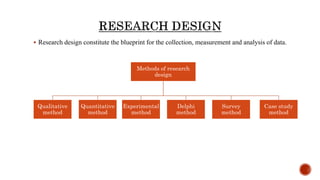
 Research design constitute the blueprint for the collection, measurement and analysis of data.
Methods of research
design
Qualitative
method
Quantitative
method
Experimental
method
Delphi
method
Survey
method
Case study
method
 An experiment is generally used to infer a causality. In an experiment, a
researcher actively manipulates one or more causal variables and measures their
effects on the dependent variable of interest.
 It’s a type of research that attempts to influence a particular variable.
 Enables the researcher to determine whether the treatment has an effect or
whether one treatment is more effective than the other.
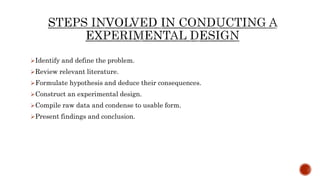
Identify and define the problem.
Review relevant literature.
Formulate hypothesis and deduce their consequences.
Construct an experimental design.
Compile raw data and condense to usable form.
Present findings and conclusion.
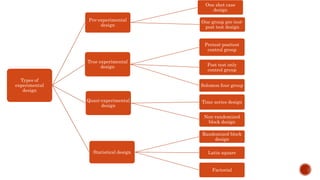
Types of
experimental
design
Pre-experimental
design
One shot case
design
One group pre test-
post test design
True experimental
design
Pretest-posttest
control group
Post test only
control group
Solomon four group
Quasi-experimental
design
Time series design
Non-randomized
block design
Statistical design
Randomized block
design
Latin square
Factorial
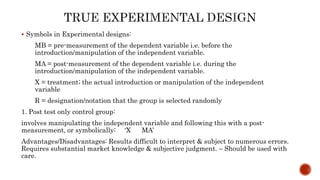
 Symbols in Experimental designs:
MB = pre-measurement of the dependent variable i.e. before the
introduction/manipulation of the independent variable.
MA = post-measurement of the dependent variable i.e. during the
introduction/manipulation of the independent variable.
X = treatment; the actual introduction or manipulation of the independent
variable
R = designation/notation that the group is selected randomly
1. Post test only control group:
involves manipulating the independent variable and following this with a post-
measurement, or symbolically: ‘X MA’
Advantages/Disadvantages: Results difficult to interpret & subject to numerous errors.
Requires substantial market knowledge & subjective judgment. – Should be used with
care.
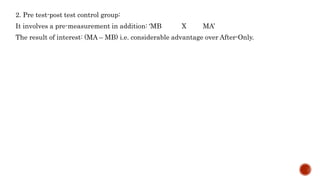
2. Pre test-post test control group:
It involves a pre-measurement in addition: ‘MB X MA’
The result of interest: (MA – MB) i.e. considerable advantage over After-Only.
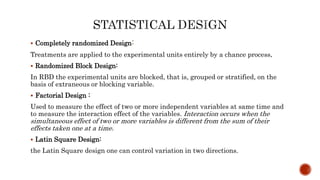
 Completely randomized Design:
Treatments are applied to the experimental units entirely by a chance process.
 Randomized Block Design:
In RBD the experimental units are blocked, that is, grouped or stratified, on the
basis of extraneous or blocking variable.
 Factorial Design :
Used to measure the effect of two or more independent variables at same time and
to measure the interaction effect of the variables. Interaction occurs when the
simultaneous effect of two or more variables is different from the sum of their
effects taken one at a time.
 Latin Square Design:
the Latin Square design one can control variation in two directions.
 The design requires that extraneous or blocking variables be divided in to an equal no.
of blocks or levels, such as drugstores, supermarkets and discount stores. The
independent variables be divided in to the same no. of levels, such as high price,
medium price & low price.
1.Treatments are arranged in rows and columns
2.Each row contains every treatment.
3.Each column contains every treatment.
4.The most common sizes of LS are 5x5 to 8x8
 Advantages of the LS Design
1. You can control variation in two directions.
2. Hopefully you increase efficiency as compared to the RBD.
 Disadvantages of the LS Design:
1.The number of treatments must equal the number of replicates.
2. The experimental error is likely to increase with the size of the square.

Experimental research design

  • 1.
    Presented by: Aakash Gautam ArshdeepSingh Prerit Jain Richa Asthana
  • 2.
     Research designconstitute the blueprint for the collection, measurement and analysis of data. Methods of research design Qualitative method Quantitative method Experimental method Delphi method Survey method Case study method
  • 3.
     An experimentis generally used to infer a causality. In an experiment, a researcher actively manipulates one or more causal variables and measures their effects on the dependent variable of interest.  It’s a type of research that attempts to influence a particular variable.  Enables the researcher to determine whether the treatment has an effect or whether one treatment is more effective than the other.
  • 4.
    Identify and definethe problem. Review relevant literature. Formulate hypothesis and deduce their consequences. Construct an experimental design. Compile raw data and condense to usable form. Present findings and conclusion.
  • 5.
    Types of experimental design Pre-experimental design One shotcase design One group pre test- post test design True experimental design Pretest-posttest control group Post test only control group Solomon four group Quasi-experimental design Time series design Non-randomized block design Statistical design Randomized block design Latin square Factorial
  • 6.
     Symbols inExperimental designs: MB = pre-measurement of the dependent variable i.e. before the introduction/manipulation of the independent variable. MA = post-measurement of the dependent variable i.e. during the introduction/manipulation of the independent variable. X = treatment; the actual introduction or manipulation of the independent variable R = designation/notation that the group is selected randomly 1. Post test only control group: involves manipulating the independent variable and following this with a post- measurement, or symbolically: ‘X MA’ Advantages/Disadvantages: Results difficult to interpret & subject to numerous errors. Requires substantial market knowledge & subjective judgment. – Should be used with care.
  • 7.
    2. Pre test-posttest control group: It involves a pre-measurement in addition: ‘MB X MA’ The result of interest: (MA – MB) i.e. considerable advantage over After-Only.
  • 8.
     Completely randomizedDesign: Treatments are applied to the experimental units entirely by a chance process.  Randomized Block Design: In RBD the experimental units are blocked, that is, grouped or stratified, on the basis of extraneous or blocking variable.  Factorial Design : Used to measure the effect of two or more independent variables at same time and to measure the interaction effect of the variables. Interaction occurs when the simultaneous effect of two or more variables is different from the sum of their effects taken one at a time.  Latin Square Design: the Latin Square design one can control variation in two directions.
  • 9.
     The designrequires that extraneous or blocking variables be divided in to an equal no. of blocks or levels, such as drugstores, supermarkets and discount stores. The independent variables be divided in to the same no. of levels, such as high price, medium price & low price. 1.Treatments are arranged in rows and columns 2.Each row contains every treatment. 3.Each column contains every treatment. 4.The most common sizes of LS are 5x5 to 8x8  Advantages of the LS Design 1. You can control variation in two directions. 2. Hopefully you increase efficiency as compared to the RBD.  Disadvantages of the LS Design: 1.The number of treatments must equal the number of replicates. 2. The experimental error is likely to increase with the size of the square.