EXPECTATION-
CONFIRMATION THEORY
Hamideh Iraj
Sahar Najafikhah
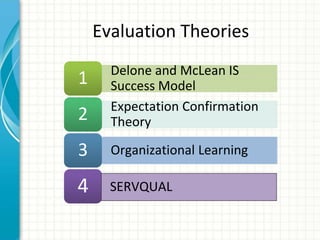
Delone and McLean IS
Success Model1
Expectation Confirmation
Theory2
Organizational Learning3
4
Evaluation Theories
SERVQUAL
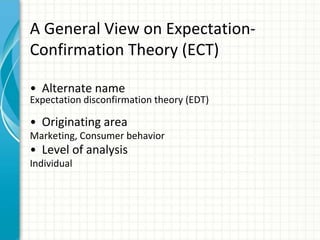
A General View on Expectation-
Confirmation Theory (ECT)
• Alternate name
Expectation disconfirmation theory (EDT)
• Originating area
Marketing, Consumer behavior
• Level of analysis
Individual
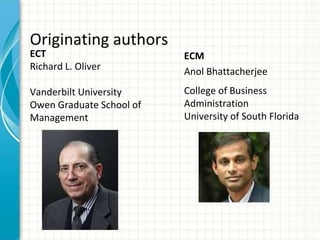
Originating authors
ECT
Richard L. Oliver
Vanderbilt University
Owen Graduate School of
Management
ECM
Anol Bhattacherjee
College of Business
Administration
University of South Florida
Consumer satisfaction
● A fundamental and crucial concept in marketing studies
● The single most important construct that determines
consumers’ subsequent behavior
● A fundamental prerequisite to establish customer loyalty
and continuance usage intention
ECT and ECM
The Expectation–
Confirmation Theory (ECT)
● Predict consumers’ behavior
● Deploy necessary marketing
strategies based on the
consumer-satisfaction status
The Evolution of
Expectation–Confirmation
Model (ECM)
concentrated on post-acceptance
variables (such as
“post-usage expectations” which the author
named as “perceived usefulness”)
The Expectation–Confirmation
Theory (ECT)
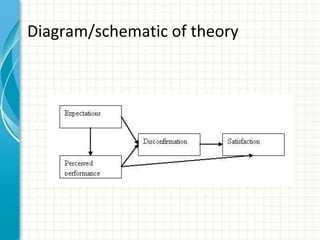
Diagram/schematic of theory
The Expectation–Confirmation
Theory (ECT)
1. First, consumers form initial expectation about a
specific product or service prior to purchase
2. Following a period of initial consumption, they
form perceptions about its performance.
3. Third, they assess the perceived performance of
the product/service
4. Fourth, the consumers form a level of satisfaction.
The Expectation–Confirmation
Theory (ECT)- cont.
Positive disconfirmation (performance > expectation)
Simple confirmation (performance = expectation)
Negative disconfirmation (performance < expectation)
ECT Limitations
1. Limitation in explaining IS expectation formation
process
2. ECT mainly focuses on consumers’ repurchase
intention. It cannot capture the IS products/services
quality factors (system quality, information quality
and service quality)
3. It needs to be modified in defining the subject as
ECT deals with consumers rather than with
customers
customer : pays for a product/service
consumer: consumes/uses the product/service
The Expectation–Confirmation
Model (ECM)
The Expectation–Confirmation
Model (ECM)
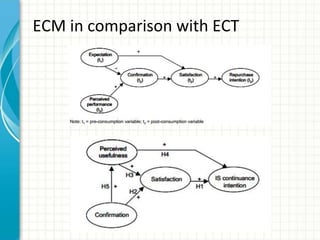
1. First, after using a particular IS for a period of time the
users form a conception of perceived usefulness,
2. Second, the users determine to what extent their
perception of usefulness about that IS has been confirmed
3. If the user finds that the product/service is as useful as
he/she perceived, he/she forms a notion of satisfaction.
1. Finally, satisfied users intend to continue the usage of that
IS whereas dissatisfied users intend to discontinue the
service
ECM in comparison with ECT
Resources
1. Integrated Series in Information Systems, Volume 28, Information Systems Theory Explaining
and Predicting Our Digital Society, Vol. 1, Springer; 2012 edition
2. Bhattacherjee, A. Understanding information systems continuance: An expectation–
confirmation model. MIS Quarterly, 25(3), 351–370,September 2001
1. http://istheory.byu.edu/wiki/Expectation_confirmation_theory
THANK YOU FOR YOUR ATTENTION

Expectation confirmation theory -English

  • 1.
  • 2.
    Delone and McLeanIS Success Model1 Expectation Confirmation Theory2 Organizational Learning3 4 Evaluation Theories SERVQUAL
  • 3.
    A General Viewon Expectation- Confirmation Theory (ECT) • Alternate name Expectation disconfirmation theory (EDT) • Originating area Marketing, Consumer behavior • Level of analysis Individual
  • 4.
    Originating authors ECT Richard L.Oliver Vanderbilt University Owen Graduate School of Management ECM Anol Bhattacherjee College of Business Administration University of South Florida
  • 5.
    Consumer satisfaction ● Afundamental and crucial concept in marketing studies ● The single most important construct that determines consumers’ subsequent behavior ● A fundamental prerequisite to establish customer loyalty and continuance usage intention
  • 6.
  • 7.
    The Expectation– Confirmation Theory(ECT) ● Predict consumers’ behavior ● Deploy necessary marketing strategies based on the consumer-satisfaction status
  • 8.
    The Evolution of Expectation–Confirmation Model(ECM) concentrated on post-acceptance variables (such as “post-usage expectations” which the author named as “perceived usefulness”)
  • 10.
  • 11.
  • 12.
    The Expectation–Confirmation Theory (ECT) 1.First, consumers form initial expectation about a specific product or service prior to purchase 2. Following a period of initial consumption, they form perceptions about its performance. 3. Third, they assess the perceived performance of the product/service 4. Fourth, the consumers form a level of satisfaction.
  • 13.
    The Expectation–Confirmation Theory (ECT)-cont. Positive disconfirmation (performance > expectation) Simple confirmation (performance = expectation) Negative disconfirmation (performance < expectation)
  • 14.
    ECT Limitations 1. Limitationin explaining IS expectation formation process 2. ECT mainly focuses on consumers’ repurchase intention. It cannot capture the IS products/services quality factors (system quality, information quality and service quality) 3. It needs to be modified in defining the subject as ECT deals with consumers rather than with customers customer : pays for a product/service consumer: consumes/uses the product/service
  • 15.
  • 16.
    The Expectation–Confirmation Model (ECM) 1.First, after using a particular IS for a period of time the users form a conception of perceived usefulness, 2. Second, the users determine to what extent their perception of usefulness about that IS has been confirmed 3. If the user finds that the product/service is as useful as he/she perceived, he/she forms a notion of satisfaction. 1. Finally, satisfied users intend to continue the usage of that IS whereas dissatisfied users intend to discontinue the service
  • 17.
  • 18.
    Resources 1. Integrated Seriesin Information Systems, Volume 28, Information Systems Theory Explaining and Predicting Our Digital Society, Vol. 1, Springer; 2012 edition 2. Bhattacherjee, A. Understanding information systems continuance: An expectation– confirmation model. MIS Quarterly, 25(3), 351–370,September 2001 1. http://istheory.byu.edu/wiki/Expectation_confirmation_theory
  • 19.
    THANK YOU FORYOUR ATTENTION