EXPANDEDGENETICCODE
engineering
GENOME ENGINEERING TECHNOLOGIES
MAGE & CAGE
MAGE
• Multiplex automated genome
engineering
• Introduction of multiple
changes
• Multiple locations
CAGE
• conjugative assembly genome
engineering
• bacterial conjugation
• production of extensively modified
genomes
To achieve…
• Virus
resistance
• genetic
isolation
• stable
expansion
searchable genome annotation
databases
sequence manipulation tools
synthetic circuit design tools
 sequencing analysis tools
• artificially modified genetic code
• Specific codons have been re-allocated
• non-standard amino acid to
encode
• an unused codon
• a tRNA
• a tRNA synthetase
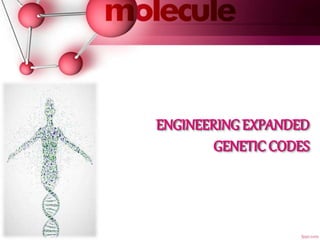
ENGINEERING EXPANDED
GENETICCODES
• In vitro flexibility
• Incorporation of
nsAA
Formation of un-
natural backbone
for translation
Best way
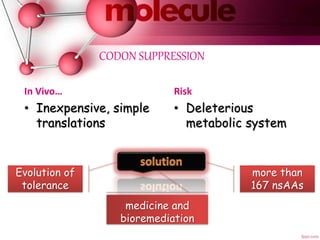
CODON SUPPRESSION
In Vivo…
• Inexpensive, simple
translations
Risk
• Deleterious
metabolic system
Evolution of
tolerance
more than
167 nsAAs
medicine and
bioremediation
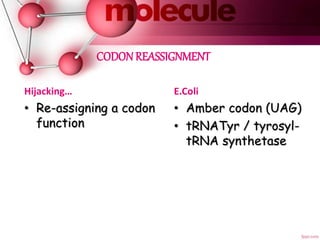
CODON REASSIGNMENT
Hijacking…
• Re-assigning a codon
function
E.Coli
• Amber codon (UAG)
• tRNATyr / tyrosyl-
tRNA synthetase
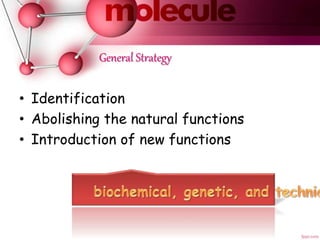
General Strategy
• Identification
• Abolishing the natural functions
• Introduction of new functions
CODON CREATION
Beyond Re-purposing…
• Addition of a
base pair Immediate implementation
• High fidelity
• Efficient proof
reading
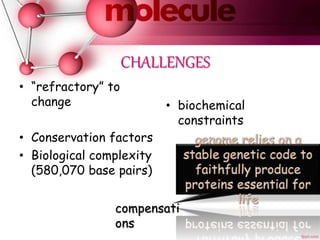
CHALLENGES
• “refractory” to
change
• Conservation factors
• Biological complexity
(580,070 base pairs)
• biochemical
constraints
compensati
ons
BARRIERS TO CHANGE
GENETIC CODE
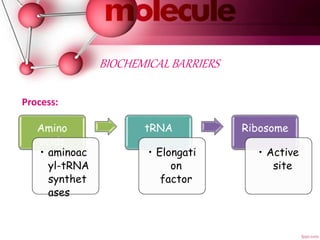
BIOCHEMICAL BARRIERS
Process:
Amino
acids
• aminoac
yl-tRNA
synthet
ases
tRNA
• Elongati
on
factor
Ribosome
• Active
site
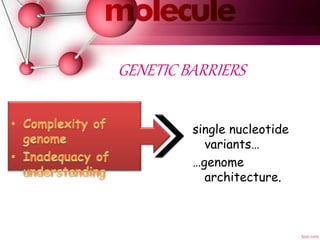
GENETIC BARRIERS
single nucleotide
variants…
…genome
architecture.
GENOME ENGINEERING BARRIERS
• Prediction of
changes
• draft genomes
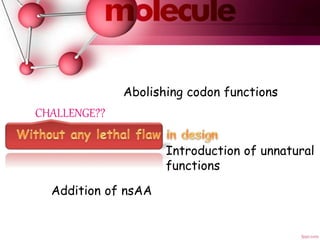
Abolishing codon functions
Addition of nsAA
Introduction of unnatural
functions
CHALLENGE??

Expanded Genetic Code Engineering