The Journal of Prosthetic Dentistry
Year- 2018
Volume-119
Issue-5
Page No’s- 855 to 857
Osamu Shimodaira (DDS, PhD), Yuji Sato (DDS, PhD), Chie Oonishi
(DDS) and Chihiro Nishioka (DDS).
Presented By- Dr. Prathamesh Fulsundar
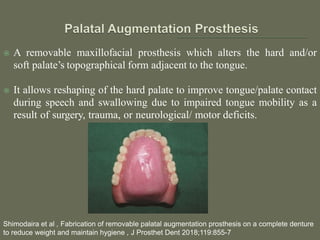
 A removable maxillofacial prosthesis which alters the hard and/or
soft palate’s topographical form adjacent to the tongue.
 It allows reshaping of the hard palate to improve tongue/palate contact
during speech and swallowing due to impaired tongue mobility as a
result of surgery, trauma, or neurological/ motor deficits.
Shimodaira et al , Fabrication of removable palatal augmentation prosthesis on a complete denture
to reduce weight and maintain hygiene , J Prosthet Dent 2018;119:855-7
 Dysphagia (difficulty in swallowing)
 Tongue weakness after a stroke
 Amyotrophic lateral sclerosis of tongue
 Parkinson's disease
 Dysarthria (motor speech disorder due to neurological injury
characterized by poor articulation of tongue).
 Partial or Hemi glossectomy.
Shimodaira et al , Fabrication of removable palatal augmentation prosthesis on a complete denture
to reduce weight and maintain hygiene , J Prosthet Dent 2018;119:855-7
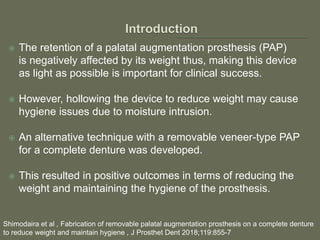
 The retention of a palatal augmentation prosthesis (PAP)
is negatively affected by its weight thus, making this device
as light as possible is important for clinical success.
 However, hollowing the device to reduce weight may cause
hygiene issues due to moisture intrusion.
 An alternative technique with a removable veneer-type PAP
for a complete denture was developed.
 This resulted in positive outcomes in terms of reducing the
weight and maintaining the hygiene of the prosthesis.
Shimodaira et al , Fabrication of removable palatal augmentation prosthesis on a complete denture
to reduce weight and maintain hygiene , J Prosthet Dent 2018;119:855-7
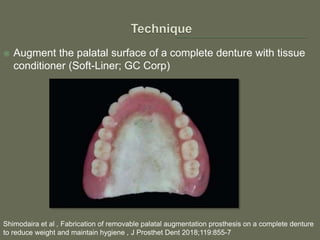
 Augment the palatal surface of a complete denture with tissue
conditioner (Soft-Liner; GC Corp)
Shimodaira et al , Fabrication of removable palatal augmentation prosthesis on a complete denture
to reduce weight and maintain hygiene , J Prosthet Dent 2018;119:855-7
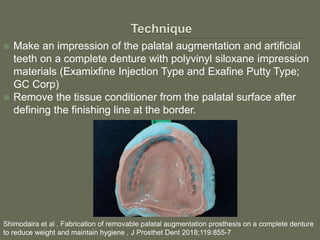
 Make an impression of the palatal augmentation and artificial
teeth on a complete denture with polyvinyl siloxane impression
materials (Examixfine Injection Type and Exafine Putty Type;
GC Corp)
 Remove the tissue conditioner from the palatal surface after
defining the finishing line at the border.
Shimodaira et al , Fabrication of removable palatal augmentation prosthesis on a complete denture
to reduce weight and maintain hygiene , J Prosthet Dent 2018;119:855-7
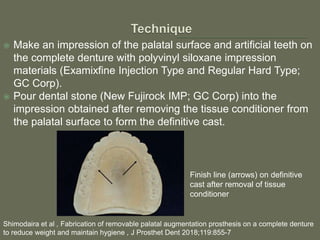
 Make an impression of the palatal surface and artificial teeth on
the complete denture with polyvinyl siloxane impression
materials (Examixfine Injection Type and Regular Hard Type;
GC Corp).
 Pour dental stone (New Fujirock IMP; GC Corp) into the
impression obtained after removing the tissue conditioner from
the palatal surface to form the definitive cast.
Shimodaira et al , Fabrication of removable palatal augmentation prosthesis on a complete denture
to reduce weight and maintain hygiene , J Prosthet Dent 2018;119:855-7
Finish line (arrows) on definitive
cast after removal of tissue
conditioner
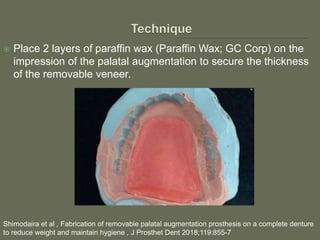
 Place 2 layers of paraffin wax (Paraffin Wax; GC Corp) on the
impression of the palatal augmentation to secure the thickness
of the removable veneer.
Shimodaira et al , Fabrication of removable palatal augmentation prosthesis on a complete denture
to reduce weight and maintain hygiene , J Prosthet Dent 2018;119:855-7
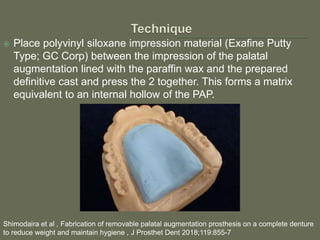
 Place polyvinyl siloxane impression material (Exafine Putty
Type; GC Corp) between the impression of the palatal
augmentation lined with the paraffin wax and the prepared
definitive cast and press the 2 together. This forms a matrix
equivalent to an internal hollow of the PAP.
Shimodaira et al , Fabrication of removable palatal augmentation prosthesis on a complete denture
to reduce weight and maintain hygiene , J Prosthet Dent 2018;119:855-7
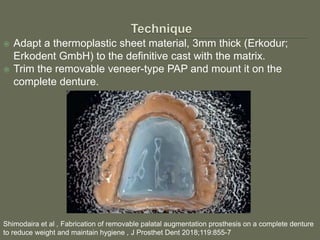
 Adapt a thermoplastic sheet material, 3mm thick (Erkodur;
Erkodent GmbH) to the definitive cast with the matrix.
 Trim the removable veneer-type PAP and mount it on the
complete denture.
Shimodaira et al , Fabrication of removable palatal augmentation prosthesis on a complete denture
to reduce weight and maintain hygiene , J Prosthet Dent 2018;119:855-7
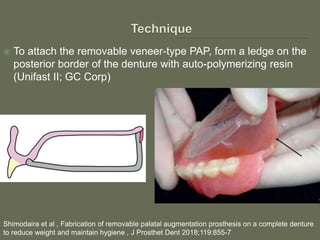
 To attach the removable veneer-type PAP, form a ledge on the
posterior border of the denture with auto-polymerizing resin
(Unifast II; GC Corp)
Shimodaira et al , Fabrication of removable palatal augmentation prosthesis on a complete denture
to reduce weight and maintain hygiene , J Prosthet Dent 2018;119:855-7
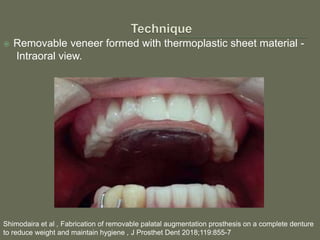
 Removable veneer formed with thermoplastic sheet material -
Intraoral view.
Shimodaira et al , Fabrication of removable palatal augmentation prosthesis on a complete denture
to reduce weight and maintain hygiene , J Prosthet Dent 2018;119:855-7
 The weight of the PAP was reduced by using tissue
conditioner from 27.1 g at the time of palatal augmentation to
16.6 g for the definitive removable veneer-type prosthesis,
demonstrating satisfactory weight reduction.
 This is almost the same weight as a conventional complete
denture (13.3 g).
 Therefore, retention of the denture will not be compromised.
 Additionally, the removable veneer-type PAP, with the
thermoplastic sheet material, was as hygienic as a conventional
complete denture.
Shimodaira et al , Fabrication of removable palatal augmentation prosthesis on a complete denture
to reduce weight and maintain hygiene , J Prosthet Dent 2018;119:855-7
 PAP treatment based on functional training by using a definitive
denture is considered to provide reasonable and predictable
outcomes relative to the method of augmentation of the palatal
surface on an unstable record base during the wax denture
stage.
 In addition, because the intact definitive cast is preserved, the
removable veneer can be refabricated if necessary. Changes in
tongue movement because of the outcome of functional
training and reoperation may lead to the refabrication of a
removable veneer-type PAP.
Shimodaira et al , Fabrication of removable palatal augmentation prosthesis on a complete denture
to reduce weight and maintain hygiene , J Prosthet Dent 2018;119:855-7
 The removable veneer-type PAP resists fracture because
of the polyethylene terephthalate (PETG) thermoformed
resin.
 The thermoplastic sheet material has advantages over
metal in terms of cost and has sufficient strength to complement
the movement of the tongue.
 Also, the thermoplastic sheet material is easier to handle than
other resins.
Shimodaira et al , Fabrication of removable palatal augmentation prosthesis on a complete denture
to reduce weight and maintain hygiene , J Prosthet Dent 2018;119:855-7
 The thermoplastic sheet material tends to discolor.
 The attachment ledge may fracture.
 Considerable skill is required for fixation of the removable
veneer-type PAP.
 Long-term use data are lacking.
Shimodaira et al , Fabrication of removable palatal augmentation prosthesis on a complete denture
to reduce weight and maintain hygiene , J Prosthet Dent 2018;119:855-7
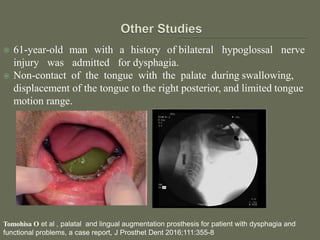
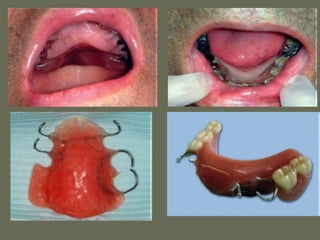
 61-year-old man with a history of bilateral hypoglossal nerve
injury was admitted for dysphagia.
 Non-contact of the tongue with the palate during swallowing,
displacement of the tongue to the right posterior, and limited tongue
motion range.
Tomohisa O et al , palatal and lingual augmentation prosthesis for patient with dysphagia and
functional problems, a case report, J Prosthet Dent 2016;111:355-8
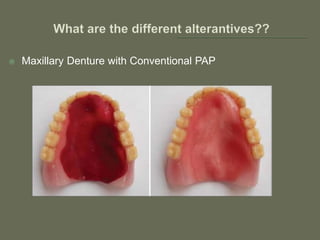
 Maxillary Denture with Conventional PAP
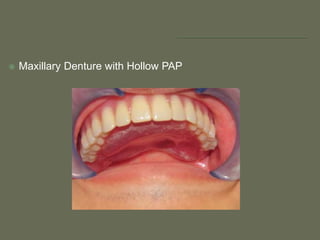
 Maxillary Denture with Hollow PAP
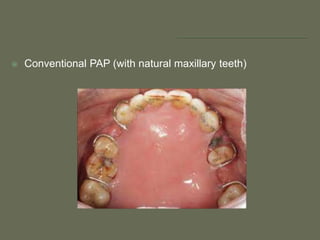
 Conventional PAP (with natural maxillary teeth)
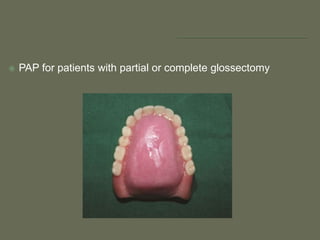
 PAP for patients with partial or complete glossectomy
 Robert C, Thomas AC, Thomas S, John B, Barbara SV. Maxillary speech
prostheses for mandibular surgical defects. J Prosthet Dent 1969;22:253-
60
 Kim S. A hollow obturator using clear resin aiming improvement
pronunciation and reduction of weight. J Jpn Prosthodont Soc
2004;48:273-4
 Ohi T. A complete edentulous prosthesis following oral floor tumor
extirpation: application of an implant-supported fixed prosthesis and a
palatal augmentation prosthesis. Ann Jpn Prosthodont Soc 2010;2:48-51.
 Logemann JA, Kahrilas PJ, Hurst P, Davis J, Krugler C. Effect of intraoral
prosthetics on swallowing in patients with oral cancer. Dysphagia
1989;4:118-20.
 Wheeler RL, Logemann JA, Rosen MS. Maxillary reshaping prostheses:
effectiveness in improving speech and swallowing of postsurgical oral
cancer patients. J Prosthet Dent 1980;43:313-9.
Removable Palatal Augmentation Prosthesis

Removable Palatal Augmentation Prosthesis

  • 1.
    The Journal ofProsthetic Dentistry Year- 2018 Volume-119 Issue-5 Page No’s- 855 to 857 Osamu Shimodaira (DDS, PhD), Yuji Sato (DDS, PhD), Chie Oonishi (DDS) and Chihiro Nishioka (DDS). Presented By- Dr. Prathamesh Fulsundar
  • 2.
     A removablemaxillofacial prosthesis which alters the hard and/or soft palate’s topographical form adjacent to the tongue.  It allows reshaping of the hard palate to improve tongue/palate contact during speech and swallowing due to impaired tongue mobility as a result of surgery, trauma, or neurological/ motor deficits. Shimodaira et al , Fabrication of removable palatal augmentation prosthesis on a complete denture to reduce weight and maintain hygiene , J Prosthet Dent 2018;119:855-7
  • 3.
     Dysphagia (difficultyin swallowing)  Tongue weakness after a stroke  Amyotrophic lateral sclerosis of tongue  Parkinson's disease  Dysarthria (motor speech disorder due to neurological injury characterized by poor articulation of tongue).  Partial or Hemi glossectomy. Shimodaira et al , Fabrication of removable palatal augmentation prosthesis on a complete denture to reduce weight and maintain hygiene , J Prosthet Dent 2018;119:855-7
  • 4.
     The retentionof a palatal augmentation prosthesis (PAP) is negatively affected by its weight thus, making this device as light as possible is important for clinical success.  However, hollowing the device to reduce weight may cause hygiene issues due to moisture intrusion.  An alternative technique with a removable veneer-type PAP for a complete denture was developed.  This resulted in positive outcomes in terms of reducing the weight and maintaining the hygiene of the prosthesis. Shimodaira et al , Fabrication of removable palatal augmentation prosthesis on a complete denture to reduce weight and maintain hygiene , J Prosthet Dent 2018;119:855-7
  • 5.
     Augment thepalatal surface of a complete denture with tissue conditioner (Soft-Liner; GC Corp) Shimodaira et al , Fabrication of removable palatal augmentation prosthesis on a complete denture to reduce weight and maintain hygiene , J Prosthet Dent 2018;119:855-7
  • 6.
     Make animpression of the palatal augmentation and artificial teeth on a complete denture with polyvinyl siloxane impression materials (Examixfine Injection Type and Exafine Putty Type; GC Corp)  Remove the tissue conditioner from the palatal surface after defining the finishing line at the border. Shimodaira et al , Fabrication of removable palatal augmentation prosthesis on a complete denture to reduce weight and maintain hygiene , J Prosthet Dent 2018;119:855-7
  • 7.
     Make animpression of the palatal surface and artificial teeth on the complete denture with polyvinyl siloxane impression materials (Examixfine Injection Type and Regular Hard Type; GC Corp).  Pour dental stone (New Fujirock IMP; GC Corp) into the impression obtained after removing the tissue conditioner from the palatal surface to form the definitive cast. Shimodaira et al , Fabrication of removable palatal augmentation prosthesis on a complete denture to reduce weight and maintain hygiene , J Prosthet Dent 2018;119:855-7 Finish line (arrows) on definitive cast after removal of tissue conditioner
  • 8.
     Place 2layers of paraffin wax (Paraffin Wax; GC Corp) on the impression of the palatal augmentation to secure the thickness of the removable veneer. Shimodaira et al , Fabrication of removable palatal augmentation prosthesis on a complete denture to reduce weight and maintain hygiene , J Prosthet Dent 2018;119:855-7
  • 9.
     Place polyvinylsiloxane impression material (Exafine Putty Type; GC Corp) between the impression of the palatal augmentation lined with the paraffin wax and the prepared definitive cast and press the 2 together. This forms a matrix equivalent to an internal hollow of the PAP. Shimodaira et al , Fabrication of removable palatal augmentation prosthesis on a complete denture to reduce weight and maintain hygiene , J Prosthet Dent 2018;119:855-7
  • 10.
     Adapt athermoplastic sheet material, 3mm thick (Erkodur; Erkodent GmbH) to the definitive cast with the matrix.  Trim the removable veneer-type PAP and mount it on the complete denture. Shimodaira et al , Fabrication of removable palatal augmentation prosthesis on a complete denture to reduce weight and maintain hygiene , J Prosthet Dent 2018;119:855-7
  • 11.
     To attachthe removable veneer-type PAP, form a ledge on the posterior border of the denture with auto-polymerizing resin (Unifast II; GC Corp) Shimodaira et al , Fabrication of removable palatal augmentation prosthesis on a complete denture to reduce weight and maintain hygiene , J Prosthet Dent 2018;119:855-7
  • 12.
     Removable veneerformed with thermoplastic sheet material - Intraoral view. Shimodaira et al , Fabrication of removable palatal augmentation prosthesis on a complete denture to reduce weight and maintain hygiene , J Prosthet Dent 2018;119:855-7
  • 13.
     The weightof the PAP was reduced by using tissue conditioner from 27.1 g at the time of palatal augmentation to 16.6 g for the definitive removable veneer-type prosthesis, demonstrating satisfactory weight reduction.  This is almost the same weight as a conventional complete denture (13.3 g).  Therefore, retention of the denture will not be compromised.  Additionally, the removable veneer-type PAP, with the thermoplastic sheet material, was as hygienic as a conventional complete denture. Shimodaira et al , Fabrication of removable palatal augmentation prosthesis on a complete denture to reduce weight and maintain hygiene , J Prosthet Dent 2018;119:855-7
  • 14.
     PAP treatmentbased on functional training by using a definitive denture is considered to provide reasonable and predictable outcomes relative to the method of augmentation of the palatal surface on an unstable record base during the wax denture stage.  In addition, because the intact definitive cast is preserved, the removable veneer can be refabricated if necessary. Changes in tongue movement because of the outcome of functional training and reoperation may lead to the refabrication of a removable veneer-type PAP. Shimodaira et al , Fabrication of removable palatal augmentation prosthesis on a complete denture to reduce weight and maintain hygiene , J Prosthet Dent 2018;119:855-7
  • 15.
     The removableveneer-type PAP resists fracture because of the polyethylene terephthalate (PETG) thermoformed resin.  The thermoplastic sheet material has advantages over metal in terms of cost and has sufficient strength to complement the movement of the tongue.  Also, the thermoplastic sheet material is easier to handle than other resins. Shimodaira et al , Fabrication of removable palatal augmentation prosthesis on a complete denture to reduce weight and maintain hygiene , J Prosthet Dent 2018;119:855-7
  • 16.
     The thermoplasticsheet material tends to discolor.  The attachment ledge may fracture.  Considerable skill is required for fixation of the removable veneer-type PAP.  Long-term use data are lacking. Shimodaira et al , Fabrication of removable palatal augmentation prosthesis on a complete denture to reduce weight and maintain hygiene , J Prosthet Dent 2018;119:855-7
  • 17.
     61-year-old manwith a history of bilateral hypoglossal nerve injury was admitted for dysphagia.  Non-contact of the tongue with the palate during swallowing, displacement of the tongue to the right posterior, and limited tongue motion range. Tomohisa O et al , palatal and lingual augmentation prosthesis for patient with dysphagia and functional problems, a case report, J Prosthet Dent 2016;111:355-8
  • 19.
     Maxillary Denturewith Conventional PAP
  • 20.
     Maxillary Denturewith Hollow PAP
  • 21.
     Conventional PAP(with natural maxillary teeth)
  • 22.
     PAP forpatients with partial or complete glossectomy
  • 23.
     Robert C,Thomas AC, Thomas S, John B, Barbara SV. Maxillary speech prostheses for mandibular surgical defects. J Prosthet Dent 1969;22:253- 60  Kim S. A hollow obturator using clear resin aiming improvement pronunciation and reduction of weight. J Jpn Prosthodont Soc 2004;48:273-4  Ohi T. A complete edentulous prosthesis following oral floor tumor extirpation: application of an implant-supported fixed prosthesis and a palatal augmentation prosthesis. Ann Jpn Prosthodont Soc 2010;2:48-51.  Logemann JA, Kahrilas PJ, Hurst P, Davis J, Krugler C. Effect of intraoral prosthetics on swallowing in patients with oral cancer. Dysphagia 1989;4:118-20.  Wheeler RL, Logemann JA, Rosen MS. Maxillary reshaping prostheses: effectiveness in improving speech and swallowing of postsurgical oral cancer patients. J Prosthet Dent 1980;43:313-9.