The Journal of Prosthetic Dentistry
Year- 2014
Volume-112
Issue-6
Page No’s- 1597 to 1600
BY- Dr. Prathamesh Fulsundar
 The posterior palatal seal is defined as, “the
soft tissues along the junction of the hard and
soft palates on which pressure within the
physiological limits of the tissues can be applied
by a denture to aid in the retention of the
denture”
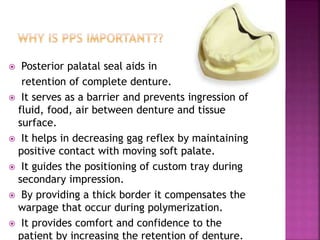
 Posterior palatal seal aids in
retention of complete denture.
 It serves as a barrier and prevents ingression of
fluid, food, air between denture and tissue
surface.
 It helps in decreasing gag reflex by maintaining
positive contact with moving soft palate.
 It guides the positioning of custom tray during
secondary impression.
 By providing a thick border it compensates the
warpage that occur during polymerization.
 It provides comfort and confidence to the
patient by increasing the retention of denture.
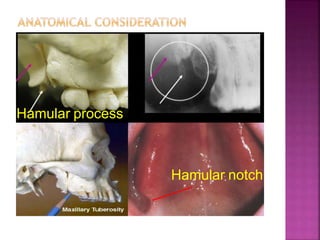
Hamular process
Hamular notch
Evolution of Techniques in Recording Posterior Palatal Seal – A Review Journal of
Academy of Dental Education, 13-17, DOI: 10.18311/jade/2017/16451
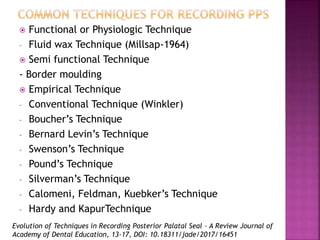
 Functional or Physiologic Technique
- Fluid wax Technique (Millsap-1964)
 Semi functional Technique
- Border moulding
 Empirical Technique
- Conventional Technique (Winkler)
- Boucher’s Technique
- Bernard Levin’s Technique
- Swenson’s Technique
- Pound’s Technique
- Silverman’s Technique
- Calomeni, Feldman, Kuebker’s Technique
- Hardy and KapurTechnique
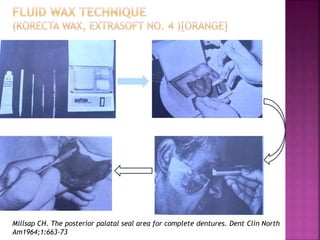
Millsap CH. The posterior palatal seal area for complete dentures. Dent Clin North
Am1964;1:663-73
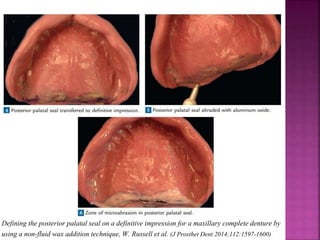
Defining the posterior palatal seal on a definitive impression for a maxillary complete denture by
using a non-fluid wax addition technique, W. Russell et al. (J Prosthet Dent 2014;112:1597-1600)
Disadvantages
•More time is necessary during the
impression appointment
•Difficulty in handling materials
•Wax may not remain dimensionally stable
during impression procedure or cast
production.
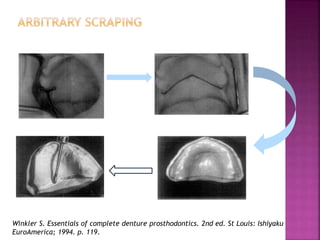
Winkler S. Essentials of complete denture prosthodontics. 2nd ed. St Louis: Ishiyaku
EuroAmerica; 1994. p. 119.
Defining the posterior palatal seal on a definitive impression for a maxillary complete denture by
using a non-fluid wax addition technique, W. Russell et al. (J Prosthet Dent 2014;112:1597-1600)
Disadvantages
•Not a physiologic technique
•Potential for overcompression of tissues
Defining the posterior palatal seal on a definitive impression for a maxillary complete denture by
using a non-fluid wax addition technique, W. Russell et al. (J Prosthet Dent 2014;112:1597-1600)
 Definitive impressions for tissue-supported
prosthetics are made with polyvinyl siloxane or
polysulfide impression materials.
 This article presents a technique in which static
wax can be firmly applied to these elastomeric
impression materials and with which a PPS can
be precisely formed.
Defining the posterior palatal seal on a definitive impression for a maxillary complete denture by
using a non-fluid wax addition technique, W. Russell et al. (J Prosthet Dent 2014;112:1597-1600)
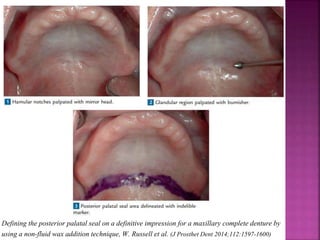
 Make an accurate polyvinyl siloxane maxillary
definitive impression
 Identify the hamular notches in the mouth by running
the blunt head of the mirror on the crest of the ridge
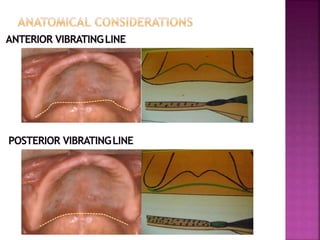
 Identify the posterior vibrating line by asking the
patient to say “Ah.”
 Palpate the glandular region of the hard palate with a
burnisher to clinically evaluate its compressibility and
anterior extent
 Mark the area intra-orally with an indelible indicator
 Transcribed the markings to the definitive cast.
Defining the posterior palatal seal on a definitive impression for a maxillary complete denture by
using a non-fluid wax addition technique, W. Russell et al. (J Prosthet Dent 2014;112:1597-1600)
Defining the posterior palatal seal on a definitive impression for a maxillary complete denture by
using a non-fluid wax addition technique, W. Russell et al. (J Prosthet Dent 2014;112:1597-1600)
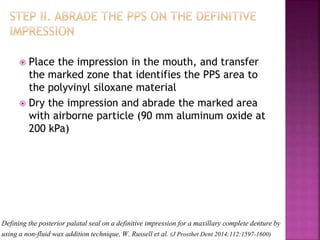
 Place the impression in the mouth, and transfer
the marked zone that identifies the PPS area to
the polyvinyl siloxane material
 Dry the impression and abrade the marked area
with airborne particle (90 mm aluminum oxide at
200 kPa)
Defining the posterior palatal seal on a definitive impression for a maxillary complete denture by
using a non-fluid wax addition technique, W. Russell et al. (J Prosthet Dent 2014;112:1597-1600)
Defining the posterior palatal seal on a definitive impression for a maxillary complete denture by
using a non-fluid wax addition technique, W. Russell et al. (J Prosthet Dent 2014;112:1597-1600)
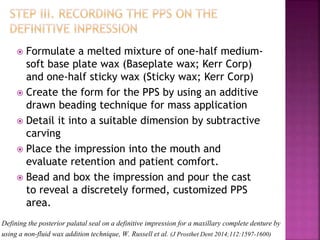
 Formulate a melted mixture of one-half medium-
soft base plate wax (Baseplate wax; Kerr Corp)
and one-half sticky wax (Sticky wax; Kerr Corp)
 Create the form for the PPS by using an additive
drawn beading technique for mass application
 Detail it into a suitable dimension by subtractive
carving
 Place the impression into the mouth and
evaluate retention and patient comfort.
 Bead and box the impression and pour the cast
to reveal a discretely formed, customized PPS
area.
Defining the posterior palatal seal on a definitive impression for a maxillary complete denture by
using a non-fluid wax addition technique, W. Russell et al. (J Prosthet Dent 2014;112:1597-1600)
Defining the posterior palatal seal on a definitive impression for a maxillary complete denture by
using a non-fluid wax addition technique, W. Russell et al. (J Prosthet Dent 2014;112:1597-1600)
 This wax mixture, when heated thoroughly, will
adhere to most non-aqueous impression
materials.
 Wax is stiff enough so can be shaped and carved
easily.
 More dimensional stability.
 This approach is less arbitrary than
traditional methods of carving the definitive
cast.
 Helps promote retention and stability in record
bases and definitive prosthesis.
 Defining the posterior palatal seal on a definitive impression for
a maxillary complete denture by using a non-fluid wax addition
technique, W. Russell et al. (J Prosthet Dent 2014;112:1597-1600)
 Winkler S. Essentials of complete denture prosthodontics. 2nd ed.
St Louis: Ishiyaku EuroAmerica; 1994. p. 119
 Millsap CH. The posterior palatal seal area for complete
dentures. Dent Clin North Am1964;1:663-73
 The glossary of prosthodontic terms. J Prosthet Dent 2005;94:63.
 Evolution of Techniques in Recording Posterior Palatal Seal – A
Review Journal of Academy of Dental Education, 13-17, DOI:
10.18311/jade/2017/16451
Defining posteri or palatal seal

Defining posteri or palatal seal

  • 1.
    The Journal ofProsthetic Dentistry Year- 2014 Volume-112 Issue-6 Page No’s- 1597 to 1600
  • 2.
  • 3.
     The posteriorpalatal seal is defined as, “the soft tissues along the junction of the hard and soft palates on which pressure within the physiological limits of the tissues can be applied by a denture to aid in the retention of the denture”
  • 4.
     Posterior palatalseal aids in retention of complete denture.  It serves as a barrier and prevents ingression of fluid, food, air between denture and tissue surface.  It helps in decreasing gag reflex by maintaining positive contact with moving soft palate.  It guides the positioning of custom tray during secondary impression.  By providing a thick border it compensates the warpage that occur during polymerization.  It provides comfort and confidence to the patient by increasing the retention of denture.
  • 5.
  • 7.
    Evolution of Techniquesin Recording Posterior Palatal Seal – A Review Journal of Academy of Dental Education, 13-17, DOI: 10.18311/jade/2017/16451  Functional or Physiologic Technique - Fluid wax Technique (Millsap-1964)  Semi functional Technique - Border moulding  Empirical Technique - Conventional Technique (Winkler) - Boucher’s Technique - Bernard Levin’s Technique - Swenson’s Technique - Pound’s Technique - Silverman’s Technique - Calomeni, Feldman, Kuebker’s Technique - Hardy and KapurTechnique
  • 8.
    Millsap CH. Theposterior palatal seal area for complete dentures. Dent Clin North Am1964;1:663-73
  • 9.
    Defining the posteriorpalatal seal on a definitive impression for a maxillary complete denture by using a non-fluid wax addition technique, W. Russell et al. (J Prosthet Dent 2014;112:1597-1600) Disadvantages •More time is necessary during the impression appointment •Difficulty in handling materials •Wax may not remain dimensionally stable during impression procedure or cast production.
  • 10.
    Winkler S. Essentialsof complete denture prosthodontics. 2nd ed. St Louis: Ishiyaku EuroAmerica; 1994. p. 119.
  • 11.
    Defining the posteriorpalatal seal on a definitive impression for a maxillary complete denture by using a non-fluid wax addition technique, W. Russell et al. (J Prosthet Dent 2014;112:1597-1600) Disadvantages •Not a physiologic technique •Potential for overcompression of tissues
  • 12.
    Defining the posteriorpalatal seal on a definitive impression for a maxillary complete denture by using a non-fluid wax addition technique, W. Russell et al. (J Prosthet Dent 2014;112:1597-1600)  Definitive impressions for tissue-supported prosthetics are made with polyvinyl siloxane or polysulfide impression materials.  This article presents a technique in which static wax can be firmly applied to these elastomeric impression materials and with which a PPS can be precisely formed.
  • 13.
    Defining the posteriorpalatal seal on a definitive impression for a maxillary complete denture by using a non-fluid wax addition technique, W. Russell et al. (J Prosthet Dent 2014;112:1597-1600)  Make an accurate polyvinyl siloxane maxillary definitive impression  Identify the hamular notches in the mouth by running the blunt head of the mirror on the crest of the ridge  Identify the posterior vibrating line by asking the patient to say “Ah.”  Palpate the glandular region of the hard palate with a burnisher to clinically evaluate its compressibility and anterior extent  Mark the area intra-orally with an indelible indicator  Transcribed the markings to the definitive cast.
  • 14.
    Defining the posteriorpalatal seal on a definitive impression for a maxillary complete denture by using a non-fluid wax addition technique, W. Russell et al. (J Prosthet Dent 2014;112:1597-1600)
  • 15.
    Defining the posteriorpalatal seal on a definitive impression for a maxillary complete denture by using a non-fluid wax addition technique, W. Russell et al. (J Prosthet Dent 2014;112:1597-1600)  Place the impression in the mouth, and transfer the marked zone that identifies the PPS area to the polyvinyl siloxane material  Dry the impression and abrade the marked area with airborne particle (90 mm aluminum oxide at 200 kPa)
  • 16.
    Defining the posteriorpalatal seal on a definitive impression for a maxillary complete denture by using a non-fluid wax addition technique, W. Russell et al. (J Prosthet Dent 2014;112:1597-1600)
  • 17.
    Defining the posteriorpalatal seal on a definitive impression for a maxillary complete denture by using a non-fluid wax addition technique, W. Russell et al. (J Prosthet Dent 2014;112:1597-1600)  Formulate a melted mixture of one-half medium- soft base plate wax (Baseplate wax; Kerr Corp) and one-half sticky wax (Sticky wax; Kerr Corp)  Create the form for the PPS by using an additive drawn beading technique for mass application  Detail it into a suitable dimension by subtractive carving  Place the impression into the mouth and evaluate retention and patient comfort.  Bead and box the impression and pour the cast to reveal a discretely formed, customized PPS area.
  • 18.
    Defining the posteriorpalatal seal on a definitive impression for a maxillary complete denture by using a non-fluid wax addition technique, W. Russell et al. (J Prosthet Dent 2014;112:1597-1600)
  • 19.
    Defining the posteriorpalatal seal on a definitive impression for a maxillary complete denture by using a non-fluid wax addition technique, W. Russell et al. (J Prosthet Dent 2014;112:1597-1600)  This wax mixture, when heated thoroughly, will adhere to most non-aqueous impression materials.  Wax is stiff enough so can be shaped and carved easily.  More dimensional stability.  This approach is less arbitrary than traditional methods of carving the definitive cast.  Helps promote retention and stability in record bases and definitive prosthesis.
  • 20.
     Defining theposterior palatal seal on a definitive impression for a maxillary complete denture by using a non-fluid wax addition technique, W. Russell et al. (J Prosthet Dent 2014;112:1597-1600)  Winkler S. Essentials of complete denture prosthodontics. 2nd ed. St Louis: Ishiyaku EuroAmerica; 1994. p. 119  Millsap CH. The posterior palatal seal area for complete dentures. Dent Clin North Am1964;1:663-73  The glossary of prosthodontic terms. J Prosthet Dent 2005;94:63.  Evolution of Techniques in Recording Posterior Palatal Seal – A Review Journal of Academy of Dental Education, 13-17, DOI: 10.18311/jade/2017/16451