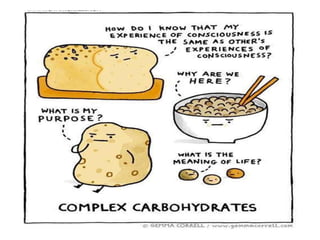

What do Complex Carbohydrates
have to do with Levels of
Consciousness?
Its not only carbohydrates
who are having an
existential crisis, each one
of us is asking the same
questions!
Carbohydrates may
be complex but
humans are even
more complex.....
Carbohydrates are neither
good or bad / right or
wrong… they are a type of
food that when eaten in the
correct proportion enhance
our health and wellness…
How we ask questions
determines the quality of
the answer. Asking a better
question give us a more
satisfactory answer, such as:
How much complex
carbohydrates can I include
in my diet to improve my
physical fitness?
Knowing how carbohydrates
interact with our unique
metabolism is a far better piece of
information than whether they
are good or bad… for what? Right
or wrong …. For who? And When?
The quality of life improves with
the quality of our thoughts which
are based on knowledge which
comes from our questions.
Improve question-asking and you
improve thinking….
Clarity of thinking begins with
mental hygiene … We need to
understand not only what we
think but how we think and why
we think what we think .. to be
aware of our consciousness ……
If you are interested in learning
more about Consciousness and its
various Levels then send a mail to
frances@hitw.co.za for a
brochure on
“Spiral Dynamics and the Art of
Thinking”
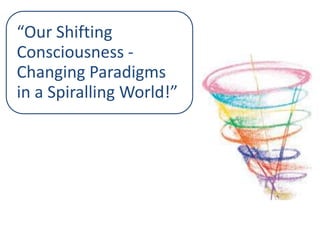
“Our Shifting
Consciousness ‐
Changing Paradigms
in a Spiralling World!”
The World is constantly
changing and so is our
Consciousness
We don't see things
as they are, we see
them as we are.
Anais Nin
“I can calculate the motion of heavenly bodies but not the
madness of people.”
― Isaac Newton
No man can
walk into the
same river
twice because
he is not the
same man and
it is not the
same river –
Heraclitus
Why are we different?
• WHY do we make
decisions in
different ways?

WHY do we respond to
different motivators?
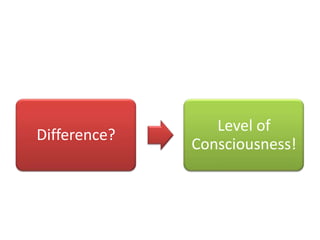
Difference?

Level of
Consciousness!
Consciousness???
•HOW people think about things as opposed to
WHAT they think
•Why people make decisions in different ways
•Why people respond to different motivators
•Why and how values arise and spread
•The nature of change and the forces of
disruption – everything counts – how to shift
context
• Do your current beliefs empower you to be
your best, or do they doom you to live as a
mere shadow of what you could be?
• Can you honestly say that you are doing your
best or very close to it?
• Are you living congruently with your most
deeply held beliefs?
• Whatever your religious or spiritual beliefs,
how well do you practice them?
.
• Do you walk your talk?
• If you really believe something, you will act in
accordance with that belief — always.
• If you believe in gravity, you will never attempt
to defy it.
• If you claim to hold a belief but act
incongruently, then you don’t actually believe
it.
• You’re only kidding yourself
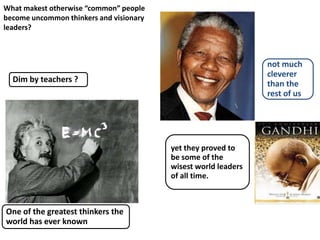
What makest otherwise “common” people
become uncommon thinkers and visionary
leaders?

not much
cleverer
than the
rest of us

Dim by teachers ?

yet they proved to
be some of the
wisest world leaders
of all time.

One of the greatest thinkers the
world has ever known
Albert Einstein’s school teachers considered
him to be a little dim – yet he became one of
the greatest thinkers the world has ever
known.
On paper, Gandhi and Nelson Mandela are not
much cleverer than the rest of us — yet they
proved to be two of the wisest world leaders
of all time
What allows otherwise “common” people to
become uncommon thinkers and visionary
leaders?
The ability to approach life and its problems
with creativity and heightened emotional
intelligence, is what we have experienced.
High EQ = Better Fit in 21st C
Individuals with enhanced emotional
intelligence are able to deal effectively with
stress, activate their creative thinking and find
new, inspired ways to solve problems. This
translates into improved productivity, greater
optimism, renewed passion and fulfilling
relationships — in both the professional and
personal environments.
The ability to develop enhanced emotional
intelligence is available to everyone — all it
takes is a little training and regular practice.
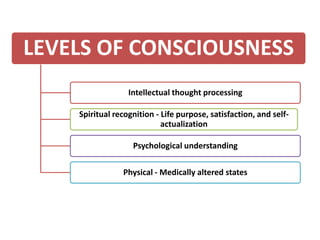
LEVELS OF CONSCIOUSNESS
Intellectual thought processing
Spiritual recognition - Life purpose, satisfaction, and selfactualization
Psychological understanding
Physical - Medically altered states
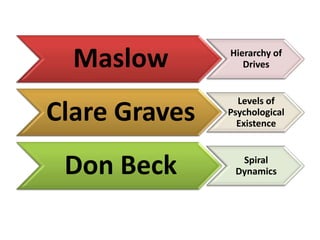
Maslow

Hierarchy of
Drives

Clare Graves

Levels of
Psychological
Existence

Don Beck

Spiral
Dynamics
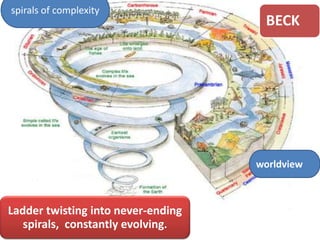
spirals of complexity

BECK

worldview

Ladder twisting into never-ending
spirals, constantly evolving.
A Good Story to tell …..

South Africa
Spiral Dynamics
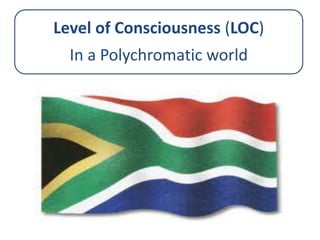
Level of Consciousness (LOC)
In a Polychromatic world
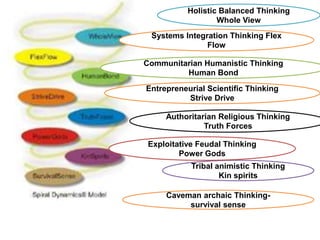
Holistic Balanced Thinking
Whole View
Systems Integration Thinking Flex
Flow
Communitarian Humanistic Thinking
Human Bond
Entrepreneurial Scientific Thinking
Strive Drive
Authoritarian Religious Thinking
Truth Forces
Exploitative Feudal Thinking
Power Gods
Tribal animistic Thinking
Kin spirits
Caveman archaic Thinkingsurvival sense
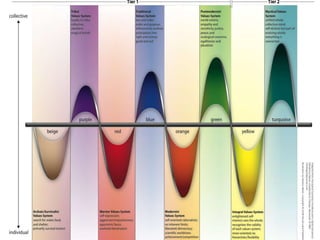
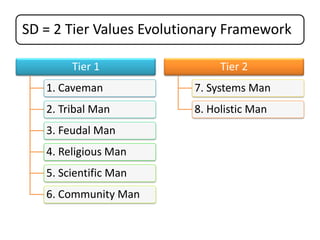
SD = 2 Tier Values Evolutionary Framework
Tier 1

Tier 2

1. Caveman

7. Systems Man

2. Tribal Man

8. Holistic Man

3. Feudal Man
4. Religious Man
5. Scientific Man

6. Community Man
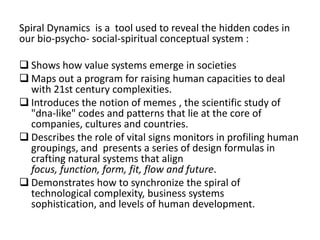
Spiral Dynamics is a tool used to reveal the hidden codes in
our bio-psycho- social-spiritual conceptual system :

 Shows how value systems emerge in societies
 Maps out a program for raising human capacities to deal
with 21st century complexities.
 Introduces the notion of memes , the scientific study of
"dna-like" codes and patterns that lie at the core of
companies, cultures and countries.
 Describes the role of vital signs monitors in profiling human
groupings, and presents a series of design formulas in
crafting natural systems that align
focus, function, form, fit, flow and future.
 Demonstrates how to synchronize the spiral of
technological complexity, business systems
sophistication, and levels of human development.
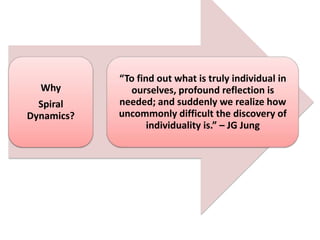
Why
Spiral
Dynamics?

“To find out what is truly individual in
ourselves, profound reflection is
needed; and suddenly we realize how
uncommonly difficult the discovery of
individuality is.” – JG Jung
• To learn more about this new evolutionary
framework of thinking as described by the
Spiral Dynamics model
• contact Frances Kazan for next Seminar
• frances@hitw.co.za or 0833950292
Existential crisis and spiral dynamics

Existential crisis and spiral dynamics

  • 1.
    What do ComplexCarbohydrates have to do with Levels of Consciousness?
  • 3.
    Its not onlycarbohydrates who are having an existential crisis, each one of us is asking the same questions!
  • 4.
    Carbohydrates may be complexbut humans are even more complex.....
  • 5.
    Carbohydrates are neither goodor bad / right or wrong… they are a type of food that when eaten in the correct proportion enhance our health and wellness…
  • 6.
    How we askquestions determines the quality of the answer. Asking a better question give us a more satisfactory answer, such as:
  • 7.
    How much complex carbohydratescan I include in my diet to improve my physical fitness?
  • 8.
    Knowing how carbohydrates interactwith our unique metabolism is a far better piece of information than whether they are good or bad… for what? Right or wrong …. For who? And When?
  • 9.
    The quality oflife improves with the quality of our thoughts which are based on knowledge which comes from our questions. Improve question-asking and you improve thinking….
  • 10.
    Clarity of thinkingbegins with mental hygiene … We need to understand not only what we think but how we think and why we think what we think .. to be aware of our consciousness ……
  • 11.
    If you areinterested in learning more about Consciousness and its various Levels then send a mail to frances@hitw.co.za for a brochure on “Spiral Dynamics and the Art of Thinking”
  • 12.
    “Our Shifting Consciousness ‐ ChangingParadigms in a Spiralling World!”
  • 13.
    The World isconstantly changing and so is our Consciousness
  • 14.
    We don't seethings as they are, we see them as we are. Anais Nin
  • 15.
    “I can calculatethe motion of heavenly bodies but not the madness of people.” ― Isaac Newton
  • 16.
    No man can walkinto the same river twice because he is not the same man and it is not the same river – Heraclitus
  • 17.
    Why are wedifferent? • WHY do we make decisions in different ways? WHY do we respond to different motivators?
  • 18.
  • 19.
    Consciousness??? •HOW people thinkabout things as opposed to WHAT they think •Why people make decisions in different ways •Why people respond to different motivators •Why and how values arise and spread •The nature of change and the forces of disruption – everything counts – how to shift context
  • 20.
    • Do yourcurrent beliefs empower you to be your best, or do they doom you to live as a mere shadow of what you could be? • Can you honestly say that you are doing your best or very close to it? • Are you living congruently with your most deeply held beliefs? • Whatever your religious or spiritual beliefs, how well do you practice them? .
  • 21.
    • Do youwalk your talk? • If you really believe something, you will act in accordance with that belief — always. • If you believe in gravity, you will never attempt to defy it. • If you claim to hold a belief but act incongruently, then you don’t actually believe it. • You’re only kidding yourself
  • 22.
    What makest otherwise“common” people become uncommon thinkers and visionary leaders? not much cleverer than the rest of us Dim by teachers ? yet they proved to be some of the wisest world leaders of all time. One of the greatest thinkers the world has ever known
  • 23.
    Albert Einstein’s schoolteachers considered him to be a little dim – yet he became one of the greatest thinkers the world has ever known. On paper, Gandhi and Nelson Mandela are not much cleverer than the rest of us — yet they proved to be two of the wisest world leaders of all time
  • 24.
    What allows otherwise“common” people to become uncommon thinkers and visionary leaders? The ability to approach life and its problems with creativity and heightened emotional intelligence, is what we have experienced.
  • 25.
    High EQ =Better Fit in 21st C Individuals with enhanced emotional intelligence are able to deal effectively with stress, activate their creative thinking and find new, inspired ways to solve problems. This translates into improved productivity, greater optimism, renewed passion and fulfilling relationships — in both the professional and personal environments.
  • 26.
    The ability todevelop enhanced emotional intelligence is available to everyone — all it takes is a little training and regular practice.
  • 27.
    LEVELS OF CONSCIOUSNESS Intellectualthought processing Spiritual recognition - Life purpose, satisfaction, and selfactualization Psychological understanding Physical - Medically altered states
  • 28.
    Maslow Hierarchy of Drives Clare Graves Levelsof Psychological Existence Don Beck Spiral Dynamics
  • 30.
    spirals of complexity BECK worldview Laddertwisting into never-ending spirals, constantly evolving.
  • 31.
    A Good Storyto tell ….. South Africa Spiral Dynamics
  • 32.
    Level of Consciousness(LOC) In a Polychromatic world
  • 33.
    Holistic Balanced Thinking WholeView Systems Integration Thinking Flex Flow Communitarian Humanistic Thinking Human Bond Entrepreneurial Scientific Thinking Strive Drive Authoritarian Religious Thinking Truth Forces Exploitative Feudal Thinking Power Gods Tribal animistic Thinking Kin spirits Caveman archaic Thinkingsurvival sense
  • 34.
    SD = 2Tier Values Evolutionary Framework Tier 1 Tier 2 1. Caveman 7. Systems Man 2. Tribal Man 8. Holistic Man 3. Feudal Man 4. Religious Man 5. Scientific Man 6. Community Man
  • 36.
    Spiral Dynamics isa tool used to reveal the hidden codes in our bio-psycho- social-spiritual conceptual system :  Shows how value systems emerge in societies  Maps out a program for raising human capacities to deal with 21st century complexities.  Introduces the notion of memes , the scientific study of "dna-like" codes and patterns that lie at the core of companies, cultures and countries.  Describes the role of vital signs monitors in profiling human groupings, and presents a series of design formulas in crafting natural systems that align focus, function, form, fit, flow and future.  Demonstrates how to synchronize the spiral of technological complexity, business systems sophistication, and levels of human development.
  • 37.
    Why Spiral Dynamics? “To find outwhat is truly individual in ourselves, profound reflection is needed; and suddenly we realize how uncommonly difficult the discovery of individuality is.” – JG Jung
  • 38.
    • To learnmore about this new evolutionary framework of thinking as described by the Spiral Dynamics model • contact Frances Kazan for next Seminar • frances@hitw.co.za or 0833950292

Editor's Notes

  • #14 There are forces that shape our lives EVOLUTIONARY FORCESChanging Values
  • #16 Theory of gravity - Isaac Newton – magnetic fields
  • #23 .
  • #33 The bedrock of Mandela’s rainbow nation
  • #34 Here's the key idea. Centers of gravity Societies at different levels of psycho-cultural emergence, of evolutionary levels of complexity. Russian dollsPreviously awakened levels stay active impacting the nature and form of the more complex systems – Different societies, cultures and subcultures, as well as entire nations are at different levels of psycho-cultural emergence, as displayed within these evolutionary levels of complexity. They have different centers of gravity. The previously awakened levels do not disappear. Rather, they stay active within the worldview stacks, thus impacting the nature and form of the more complex systems. Like the Russian dolls, there are systems within systems within systems. So, many of the same issues we confront on the West Bank (Red to Blue) can be found in South Central Los Angeles. One can experience the animistic (Purple) worldview on Bourbon Street as well as in Zaire. Matters brought before city council in Minneapolis (Orange to Green to Yellow) are not unlike the debates in front of governing bodies in the Netherlands. Countries and cultures are mosaics of multiple vMEME codes. The model fits just as well on individuals, organisations, societies, politics and geopolitics All colours can appear in one person, organisation or culture but usually one or two are more apparent – representing a centre of gravity It is not types of people but rather ways of thinking In todays global world we have a clash of colours that have never been seen before – all exist at once If we can learn to understand SD we can avoid a lot of unnecessary conflicts in all areas of our lives Been field tested in SA and was the tool used for negotiations between the NATS and ANC Suggests ways to move more quickly in the direction of deep dialogue and comprehensive integral solutions
  • #36 Values influence how people behave and how goals will be achieved Spiral Dynamics represents deepest values Suggests ways to move quickly in the direction of deep dialogue and comprehensive integral solutionsDemographics vsConsciousnessDemographics? External FactorsRace EthnicityGender Age Income Unique ThoughtsEmotionsBehaviours Ambitions