Spiral Dynamics Value Systems Introduction © Aubyn Howard 2006 1
aubyn@powernet.co.uk +44(0)7801861416
Spiral Dynamics and Value Systems
“Our thinking creates problems that the same type of thinking will not solve”
Albert Einstein
“Without some sort of worldview, we remain lost in the blooming buzzing confusion of experience, as
William James put it. In other words, all of our individual perceptions are, to some extent, embedded
in particular worldviews. Within these worldviews, we still possess abundant freedom of choice, but
worldviews generally constrain what we are even considering choosing.”
(Ken Wilber, p262 One Taste)
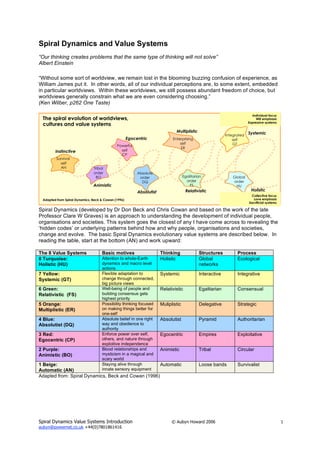
Spiral Dynamics (developed by Dr Don Beck and Chris Cowan and based on the work of the late
Professor Clare W Graves) is an approach to understanding the development of individual people,
organisations and societies. This system goes the closest of any I have come across to revealing the
‘hidden codes’ or underlying patterns behind how and why people, organisations and societies,
change and evolve. The basic Spiral Dynamics evolutionary value systems are described below. In
reading the table, start at the bottom (AN) and work upward:
The 8 Value Systems Basic motives Thinking Structures Process
8 Turquoise:
Holistic (HU)
Attention to whole-Earth
dynamics and macro level
actions
Holistic Global
networks
Ecological
7 Yellow:
Systemic (GT)
Flexible adaptation to
change through connected,
big picture views
Systemic Interactive Integrative
6 Green:
Relativistic (FS)
Well-being of people and
building consensus gets
highest priority
Relativistic Egalitarian Consensual
5 Orange:
Multiplistic (ER)
Possibility thinking focused
on making things better for
one-self
Muliplistic Delegative Strategic
4 Blue:
Absolutist (DQ)
Absolute belief in one right
way and obedience to
authority
Absolutist Pyramid Authoritarian
3 Red:
Egocentric (CP)
Enforce power over self,
others, and nature through
exploitive independence
Egocentric Empires Exploitative
2 Purple:
Animistic (BO)
Blood relationships and
mysticism in a magical and
scary world
Animistic Tribal Circular
1 Beige:
Automatic (AN)
Staying alive through
innate sensory equipment
Automatic Loose bands Survivalist
Adapted from: Spiral Dynamics, Beck and Cowan (1996)
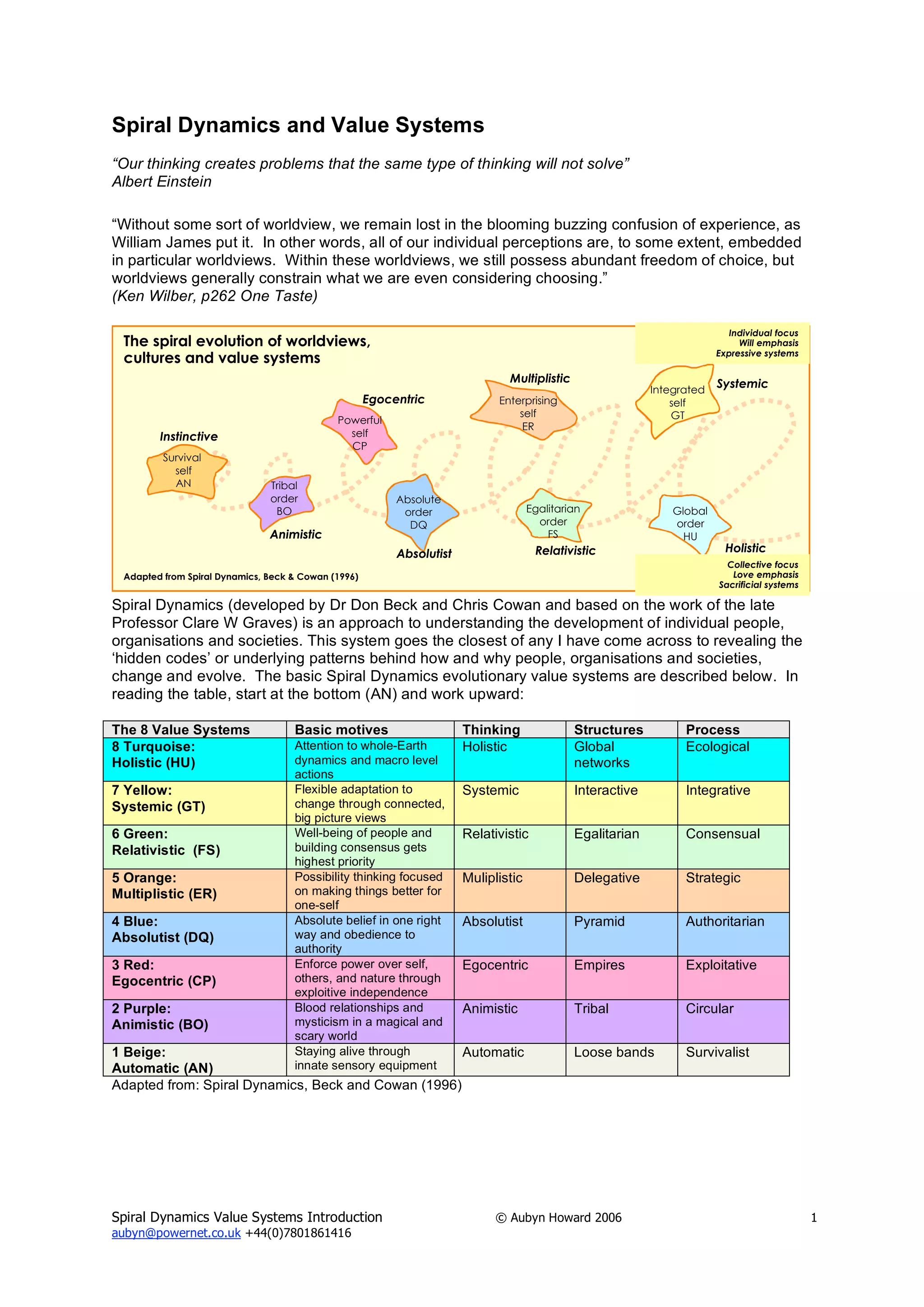
The spiral evolution of worldviews,
cultures and value systems
Adapted from Spiral Dynamics, Beck & Cowan (1996)
Survival
self
AN
Instinctive
Powerful
self
CP
Egocentric Enterprising
self
ER
Multiplistic
Integrated
self
GT
Systemic
Tribal
order
BO
Animistic
Absolute
order
DQ
Absolutist
Egalitarian
order
FS
Relativistic
Global
order
HU
Holistic
Individual focus
Will emphasis
Expressive systems
Collective focus
Love emphasis
Sacrificial systems
Spiral Dynamics Value Systems Introduction © Aubyn Howard 2006 2
aubyn@powernet.co.uk +44(0)7801861416
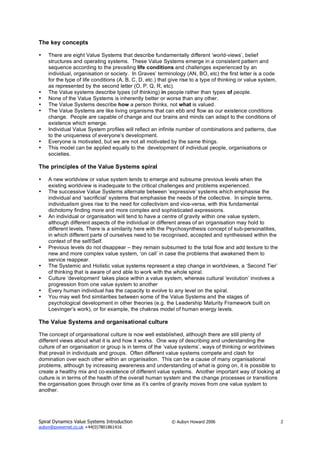
The key concepts
• There are eight Value Systems that describe fundamentally different ‘world-views’, belief
structures and operating systems. These Value Systems emerge in a consistent pattern and
sequence according to the prevailing life conditions and challenges experienced by an
individual, organisation or society. In Graves’ terminology (AN, BO, etc) the first letter is a code
for the type of life conditions (A, B, C, D, etc.) that give rise to a type of thinking or value system,
as represented by the second letter (O, P, Q, R, etc).
• The Value systems describe types (of thinking) in people rather than types of people.
• None of the Value Systems is inherently better or worse than any other.
• The Value Systems describe how a person thinks, not what is valued.
• The Value Systems are like living organisms that can ebb and flow as our existence conditions
change. People are capable of change and our brains and minds can adapt to the conditions of
existence which emerge.
• Individual Value System profiles will reflect an infinite number of combinations and patterns, due
to the uniqueness of everyone’s development.
• Everyone is motivated, but we are not all motivated by the same things.
• This model can be applied equally to the development of individual people, organisations or
societies.
The principles of the Value Systems spiral
• A new worldview or value system tends to emerge and subsume previous levels when the
existing worldview is inadequate to the critical challenges and problems experienced.
• The successive Value Systems alternate between ‘expressive’ systems which emphasise the
individual and ‘sacrificial’ systems that emphasise the needs of the collective. In simple terms,
individualism gives rise to the need for collectivism and vice-versa, with this fundamental
dichotomy finding more and more complex and sophisticated expressions.
• An individual or organisation will tend to have a centre of gravity within one value system,
although different aspects of the individual or different areas of an organisation may hold to
different levels. There is a similarity here with the Psychosynthesis concept of sub-personalities,
in which different parts of ourselves need to be recognised, accepted and synthesised within the
context of the self/Self.
• Previous levels do not disappear – they remain subsumed to the total flow and add texture to the
new and more complex value system, ‘on call’ in case the problems that awakened them to
service reappear.
• The Systemic and Holistic value systems represent a step change in worldviews, a ‘Second Tier’
of thinking that is aware of and able to work with the whole spiral.
• Culture ‘development’ takes place within a value system, whereas cultural ‘evolution’ involves a
progression from one value system to another
• Every human individual has the capacity to evolve to any level on the spiral.
• You may well find similarities between some of the Value Systems and the stages of
psychological development in other theories (e.g. the Leadership Maturity Framework built on
Loevinger’s work), or for example, the chakras model of human energy levels.
The Value Systems and organisational culture
The concept of organisational culture is now well established, although there are still plenty of
different views about what it is and how it works. One way of describing and understanding the
culture of an organisation or group is in terms of the ‘value systems’, ways of thinking or worldviews
that prevail in individuals and groups. Often different value systems compete and clash for
domination over each other within an organisation. This can be a cause of many organisational
problems, although by increasing awareness and understanding of what is going on, it is possible to
create a healthy mix and co-existence of different value systems. Another important way of looking at
culture is in terms of the health of the overall human system and the change processes or transitions
the organisation goes through over time as it’s centre of gravity moves from one value system to
another.
Spiral Dynamics Value Systems Introduction © Aubyn Howard 2006 3
aubyn@powernet.co.uk +44(0)7801861416
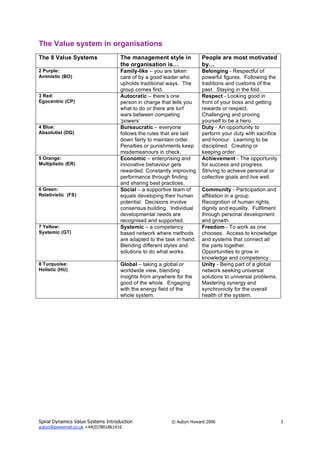
The Value system in organisations
The 8 Value Systems The management style in
the organisation is…
People are most motivated
by…
2 Purple:
Animistic (BO)
Family-like – you are taken
care of by a good leader who
upholds traditional ways. The
group comes first.
Belonging - Respectful of
powerful figures. Following the
traditions and customs of the
past. Staying in the fold.
3 Red:
Egocentric (CP)
Autocratic – there’s one
person in charge that tells you
what to do or there are turf
wars between competing
‘powers’
Respect - Looking good in
front of your boss and getting
rewards or respect.
Challenging and proving
yourself to be a hero.
4 Blue:
Absolutist (DQ)
Bureaucratic – everyone
follows the rules that are laid
down fairly to maintain order.
Penalties or punishments keep
misdemeanours in check.
Duty - An opportunity to
perform your duty with sacrifice
and honour. Learning to be
disciplined. Creating or
keeping order.
5 Orange:
Multiplistic (ER)
Economic – enterprising and
innovative behaviour gets
rewarded. Constantly improving
performance through finding
and sharing best practices.
Achievement - The opportunity
for success and progress.
Striving to achieve personal or
collective goals and live well.
6 Green:
Relativistic (FS)
Social – a supportive team of
equals developing their human
potential. Decisions involve
consensus building. Individual
developmental needs are
recognised and supported.
Community - Participation and
affiliation in a group.
Recognition of human rights,
dignity and equality. Fulfilment
through personal development
and growth.
7 Yellow:
Systemic (GT)
Systemic – a competency
based network where methods
are adapted to the task in hand.
Blending different styles and
solutions to do what works.
Freedom - To work as one
chooses. Access to knowledge
and systems that connect all
the parts together.
Opportunities to grow in
knowledge and competency.
8 Turquoise:
Holistic (HU)
Global – taking a global or
worldwide view, blending
insights from anywhere for the
good of the whole. Engaging
with the energy field of the
whole system.
Unity - Being part of a global
network seeking universal
solutions to universal problems.
Mastering synergy and
synchronicity for the overall
health of the system.

Spiral DynamicsValueSystems

  • 1.
    Spiral Dynamics ValueSystems Introduction © Aubyn Howard 2006 1 aubyn@powernet.co.uk +44(0)7801861416 Spiral Dynamics and Value Systems “Our thinking creates problems that the same type of thinking will not solve” Albert Einstein “Without some sort of worldview, we remain lost in the blooming buzzing confusion of experience, as William James put it. In other words, all of our individual perceptions are, to some extent, embedded in particular worldviews. Within these worldviews, we still possess abundant freedom of choice, but worldviews generally constrain what we are even considering choosing.” (Ken Wilber, p262 One Taste) Spiral Dynamics (developed by Dr Don Beck and Chris Cowan and based on the work of the late Professor Clare W Graves) is an approach to understanding the development of individual people, organisations and societies. This system goes the closest of any I have come across to revealing the ‘hidden codes’ or underlying patterns behind how and why people, organisations and societies, change and evolve. The basic Spiral Dynamics evolutionary value systems are described below. In reading the table, start at the bottom (AN) and work upward: The 8 Value Systems Basic motives Thinking Structures Process 8 Turquoise: Holistic (HU) Attention to whole-Earth dynamics and macro level actions Holistic Global networks Ecological 7 Yellow: Systemic (GT) Flexible adaptation to change through connected, big picture views Systemic Interactive Integrative 6 Green: Relativistic (FS) Well-being of people and building consensus gets highest priority Relativistic Egalitarian Consensual 5 Orange: Multiplistic (ER) Possibility thinking focused on making things better for one-self Muliplistic Delegative Strategic 4 Blue: Absolutist (DQ) Absolute belief in one right way and obedience to authority Absolutist Pyramid Authoritarian 3 Red: Egocentric (CP) Enforce power over self, others, and nature through exploitive independence Egocentric Empires Exploitative 2 Purple: Animistic (BO) Blood relationships and mysticism in a magical and scary world Animistic Tribal Circular 1 Beige: Automatic (AN) Staying alive through innate sensory equipment Automatic Loose bands Survivalist Adapted from: Spiral Dynamics, Beck and Cowan (1996) The spiral evolution of worldviews, cultures and value systems Adapted from Spiral Dynamics, Beck & Cowan (1996) Survival self AN Instinctive Powerful self CP Egocentric Enterprising self ER Multiplistic Integrated self GT Systemic Tribal order BO Animistic Absolute order DQ Absolutist Egalitarian order FS Relativistic Global order HU Holistic Individual focus Will emphasis Expressive systems Collective focus Love emphasis Sacrificial systems
  • 2.
    Spiral Dynamics ValueSystems Introduction © Aubyn Howard 2006 2 aubyn@powernet.co.uk +44(0)7801861416 The key concepts • There are eight Value Systems that describe fundamentally different ‘world-views’, belief structures and operating systems. These Value Systems emerge in a consistent pattern and sequence according to the prevailing life conditions and challenges experienced by an individual, organisation or society. In Graves’ terminology (AN, BO, etc) the first letter is a code for the type of life conditions (A, B, C, D, etc.) that give rise to a type of thinking or value system, as represented by the second letter (O, P, Q, R, etc). • The Value systems describe types (of thinking) in people rather than types of people. • None of the Value Systems is inherently better or worse than any other. • The Value Systems describe how a person thinks, not what is valued. • The Value Systems are like living organisms that can ebb and flow as our existence conditions change. People are capable of change and our brains and minds can adapt to the conditions of existence which emerge. • Individual Value System profiles will reflect an infinite number of combinations and patterns, due to the uniqueness of everyone’s development. • Everyone is motivated, but we are not all motivated by the same things. • This model can be applied equally to the development of individual people, organisations or societies. The principles of the Value Systems spiral • A new worldview or value system tends to emerge and subsume previous levels when the existing worldview is inadequate to the critical challenges and problems experienced. • The successive Value Systems alternate between ‘expressive’ systems which emphasise the individual and ‘sacrificial’ systems that emphasise the needs of the collective. In simple terms, individualism gives rise to the need for collectivism and vice-versa, with this fundamental dichotomy finding more and more complex and sophisticated expressions. • An individual or organisation will tend to have a centre of gravity within one value system, although different aspects of the individual or different areas of an organisation may hold to different levels. There is a similarity here with the Psychosynthesis concept of sub-personalities, in which different parts of ourselves need to be recognised, accepted and synthesised within the context of the self/Self. • Previous levels do not disappear – they remain subsumed to the total flow and add texture to the new and more complex value system, ‘on call’ in case the problems that awakened them to service reappear. • The Systemic and Holistic value systems represent a step change in worldviews, a ‘Second Tier’ of thinking that is aware of and able to work with the whole spiral. • Culture ‘development’ takes place within a value system, whereas cultural ‘evolution’ involves a progression from one value system to another • Every human individual has the capacity to evolve to any level on the spiral. • You may well find similarities between some of the Value Systems and the stages of psychological development in other theories (e.g. the Leadership Maturity Framework built on Loevinger’s work), or for example, the chakras model of human energy levels. The Value Systems and organisational culture The concept of organisational culture is now well established, although there are still plenty of different views about what it is and how it works. One way of describing and understanding the culture of an organisation or group is in terms of the ‘value systems’, ways of thinking or worldviews that prevail in individuals and groups. Often different value systems compete and clash for domination over each other within an organisation. This can be a cause of many organisational problems, although by increasing awareness and understanding of what is going on, it is possible to create a healthy mix and co-existence of different value systems. Another important way of looking at culture is in terms of the health of the overall human system and the change processes or transitions the organisation goes through over time as it’s centre of gravity moves from one value system to another.
  • 3.
    Spiral Dynamics ValueSystems Introduction © Aubyn Howard 2006 3 aubyn@powernet.co.uk +44(0)7801861416 The Value system in organisations The 8 Value Systems The management style in the organisation is… People are most motivated by… 2 Purple: Animistic (BO) Family-like – you are taken care of by a good leader who upholds traditional ways. The group comes first. Belonging - Respectful of powerful figures. Following the traditions and customs of the past. Staying in the fold. 3 Red: Egocentric (CP) Autocratic – there’s one person in charge that tells you what to do or there are turf wars between competing ‘powers’ Respect - Looking good in front of your boss and getting rewards or respect. Challenging and proving yourself to be a hero. 4 Blue: Absolutist (DQ) Bureaucratic – everyone follows the rules that are laid down fairly to maintain order. Penalties or punishments keep misdemeanours in check. Duty - An opportunity to perform your duty with sacrifice and honour. Learning to be disciplined. Creating or keeping order. 5 Orange: Multiplistic (ER) Economic – enterprising and innovative behaviour gets rewarded. Constantly improving performance through finding and sharing best practices. Achievement - The opportunity for success and progress. Striving to achieve personal or collective goals and live well. 6 Green: Relativistic (FS) Social – a supportive team of equals developing their human potential. Decisions involve consensus building. Individual developmental needs are recognised and supported. Community - Participation and affiliation in a group. Recognition of human rights, dignity and equality. Fulfilment through personal development and growth. 7 Yellow: Systemic (GT) Systemic – a competency based network where methods are adapted to the task in hand. Blending different styles and solutions to do what works. Freedom - To work as one chooses. Access to knowledge and systems that connect all the parts together. Opportunities to grow in knowledge and competency. 8 Turquoise: Holistic (HU) Global – taking a global or worldwide view, blending insights from anywhere for the good of the whole. Engaging with the energy field of the whole system. Unity - Being part of a global network seeking universal solutions to universal problems. Mastering synergy and synchronicity for the overall health of the system.